
InspectAPedia® FREE Encyclopedia of Building & Environmental Construction, Diagnosis, Maintenance & Repair |
Question? Just ask us! InspectAPedia
|
 Backdrafting Heating Equipment Hazards
Definition of backdrafting, why it's dangerous
- POST a QUESTION or COMMENT about back-drafting and flue gas hazards at heating equipment, fireplaces, in tight houses
Heating appliance backdrafting:
This article discusses the causes and cures of back drafting and flue gas spillage hazards in tight houses.
We explain the difference between flue gas spillage and back-drafting. While the trend is toward power-vented appliances, most furnaces, boilers, and water heaters still use atmospheric or “natural” venting. Atmospheric venting relies on the natural buoyancy of warm air in the flue or chimney to carry exhaust gases from the home.
InspectAPedia tolerates no conflicts of interest. We have no relationship with advertisers, products, or services discussed at this website.
Backdrafting of Heating Appliances & Indoor Air Hazards
 Discussed here: Backdrafting heating equipment: safety hazards and combustion air problems.
Definition of backdrafting:
Back-drafting or feeding of combustion products out of the burner area into the building's occupied space air occurs when a gas or oil fired heating furnace draws air out of the exhaust flue (or out of a leaky heat exchanger) and sends it into the HVAC duct system.
Watch out: backdrafting is very dangerous: it can cause fatal carbon monoxide gas to be sent into the occupied spaces in the building. The first line of defense against backdrafting is the installation of properly-located and tested carbon monoxide detectors.
See CO DETECTION OPTIONS.
This article includes excerpts or adaptations from Best Practices Guide to Residential Construction (Steve Bliss, J Wiley & Sons) , by Steven Bliss, courtesy of Wiley & Sons.
The strength of the draft depends on the temperature difference between the flue gases and outside air, the height of the chimney, and the indoor air pressure.
- Leaky vs. tight homes.
While brief spillage of flue gases has always occurred in homes, natural-draft appliances had little trouble establishing and sustaining an adequate draft in older, leaky homes.
Not only was there a ready supply of combustion and dilution air, but the flue gases were also hotter than they are in today’s more efficient appliances.
In newer, tighter houses, significant negative pressures can be generated by kitchen and bath exhaust fans, gas dryers, and unbalanced air flows in the home’s air distribution system.
Unbalanced pressures can also be caused by leaks in return ductwork, by the use of building cavities as ducts, or by the simple closing of bedroom doors in homes with a central return register. Leaky return duct- work in a basement may be enough to backdraft a water heater or furnace.
Flue Gas Spillage vs. Backdrafting
 If a naturally vented appliance
lies in an area of the house with strong enough depressurization, the flue gases will spill into the home. When the flow reversal lasts for 30 seconds to a minute, it is called spillage; longer sustained spills are
called backdrafting, a far more serious condition.
If a naturally vented appliance
lies in an area of the house with strong enough depressurization, the flue gases will spill into the home. When the flow reversal lasts for 30 seconds to a minute, it is called spillage; longer sustained spills are
called backdrafting, a far more serious condition.
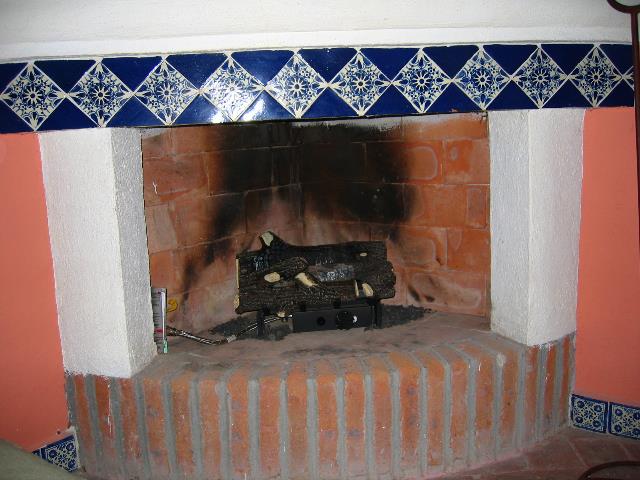
If the gas-log fireplace shown at left is not properly vented, spillage of combustion gases including possibly carbon monoxide into the building interior may be continuous. In tight quarters there is also the risk of oxygen depletion.
Watch out: Both of these are potentially fatal hazards.
While the manufacturer of the gas log shown in our photograph advertised that the burner includes a safety device that would shut off the fire in the event of dangerous oxygen depletion, we found that we were unable to operate this appliance without setting off the carbon monoxide detector alarm in the room, and the alarm continued to sound even when the detector was placed in an adjoining hallway.
Continuing from from Best Practices Guide to Residential Construction (Steve Bliss, J Wiley & Sons) :
Once backdrafting begins and the flue gets cold, it may be sustained for a long time. Research has shown that negative pressure of as little as 5 Pascals (Pa) creates a risk of backdrafting with naturally vented boilers and furnaces. Numerous studies have documented the prevalence of high negative pressures and frequent spillage in new homes built to current codes but not intentionally built airtight.
If the heating equipment is well adjusted and has adequate combustion air, the flue gases will contain primarily water vapor and carbon dioxide, along with nitrous and sulfur oxides, and particulates.
If the burner is malfunctioning for any reason, it may put out large quantities of carbon monoxide and turn a backdrafting situation deadly. Fireplaces and poorly sealed woodstoves are most likely to reverse flow late at night when the fire is smoldering, producing a weak draft and high levels of CO.
Guide to Preventing Backdrafting at Heating Equipment, Woodstoves, & Fireplaces
There are three key elements to preventing backdrafting:
- Heating equipment maintenance to avoid backdrafting:
In existing equipment, make sure all burners are properly adjusted and that flues are properly sized and free of cracks or blockages. Inspect annually. Common Indoor Pollutants and Sources 295 - Heating equipment venting to avoid backdrafting:
In new construction, eliminate all atmospherically vented appliances, including woodstoves and fireplaces. - Building Depressurization causing backdrafting:
Minimize depressurization by reducing exhaust fan sizes and balancing airflows in heating, cooling, and ventilation systems.
See COMBUSTION AIR for TIGHT BUILDINGS for details on how to provide adequate combustion air in tight buildings.
Watch out: as we discuss also
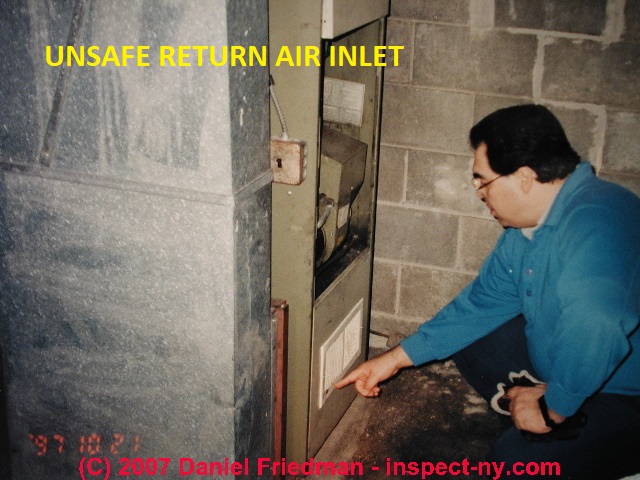
at AIR FILTER LOCATION, a common backdrafting problem found by heating service technicians and by experienced home inspectors is the addition of an improperly-located return air or "makeup air" opening in a warm air heating system return duct or in the return duct at an air handler that works for both air conditioning and heating air supply.
When the supply of cooled or heated air to occupied building spaces is inadequate and the cause is suspected to be inadequate return-air in the system duct design, an amateur retrofit "repair" for this condition is to simply cut additional return air openings in the return duct.
But if those HVAC return air supply openings are cut too close to a heating appliance, especially gas fired heating appliances, the in-draft created by the return air opening cut close to the gas burner can interfere with adequate combustion air supply to the burner, causing dangerous or even fatal carbon monoxide production, and backdrafting into the occupied space.
See UNSAFE DUCT OPENINGS and also
see COMBUSTION AIR for TIGHT BUILDINGS for additional details.
Chimney Problems Related to Backdrafting
A chimney or flue that is too large, too small, or blocked by a bird’s nest or loose brick will not draw properly and will be prone to spillage problems. Uninsulated chimneys on outside walls are also prone to poor draft and to condensation problems that can deteriorate flue materials. These problems should be fixed first before addressing problems inside the house.
at CHIMNEY INSPECTION DIAGNOSIS REPAIR we discuss chimney inspection and diagnosis including unsafe venting and fire hazards.
Mechanical-Draft Appliances
Heating systems with fan-powered exhaust systems can withstand higher negative pressures than natural-draft appliances. Some types of fan-powered systems are much better than others, however. In order of effectiveness, the choices are:
- Sealed-combustion.
Also called “direct vent,” these appliances draw all combustion and dilution air from outside. These can typically tolerate negative pressures in the range from 25 to 50 Pa. - Power-vented.
These draw their makeup air from indoors and are also called fan-assisted, forced-draft, or mechanical-draft. These can typically tolerate up to 15 to 20 Pa of negative pressure. - Induced-draft.
These have a small fan added for energy performance, not to overcome house depressurization. These can typically tolerate 5 to 15 Pa of negative pressure.
By comparison, an atmospherically vented furnace can backdraft with as little as 5 Pa of negative pressure, and a gas water heater will have spillage at 2 or 3 Pa. Fireplaces can start having problems at about 3 Pa. Canadian codes limit negative pressures in homes with atmospherically vented equipment to 5 Pa. U.S. codes do not currently address the issue.
Guide to Reducing Building Depressurization to Assure Safe Heating Equipment Venting
To keep indoor depressurization to a minimum, do not oversize bathroom and kitchen fans, and avoid the use of downdraft and island fans, which can draw 600 cfm or more. If large fans must be used, they should be interlocked with a supply fan to provide makeup air.
See VENTILATION, WHOLE HOUSE STRATEGIES
Canadian requirement for fan-supplied make-up air in buildings
Canada’s 1995 National Building Code requires that in homes with fuel- burning appliances vented through a chimney, any exhaust fan with a net capacity greater than 160 cfm must have fan- supplied makeup air.
The makeup air fan should be sized to reduce the net exhaust rate to no more than 160 cfm and can be delivered to an adjacent room or through the forced-air distribution system. For example, a 300 cfm exhaust fan should have at least 140 cfm (300 minus 160) of makeup air.
How much an exhaust fan will depressurize a house
depends on the tightness of the house. A 1993 study of several newly built energy-efficient homes in Minnesota found that exhaust airflows of 300 to 550 cfm depressurized the homes to 5 Pa, the level at which natural-draft appliances start having spillage problems.
Other studies indicate that a 600-cfm exhaust fan can produce negative pressures from 3 to over 20 Pa, depending on house tightness.
Without an adequate source of makeup air, a fan this size (or a combination of exhaust fans running at the same time) will pull air from the path of least resistance—often a nearby chimney or flue. Unless makeup air is provided, exhaust fans of this strength should not be used in homes with chimneys.
How to Check for Dangerous Chimney & Flue Backdrafting by Performing a "Worst Case" Test
In homes with the potential for back- drafting, a simple test can be conducted to determine the likelihood of problems:
- Close all interior doors
except those leading to the furnace room and rooms where exhaust fans are located. - Switch on all exhaust fans,
dryers, and other exhaust equipment, including the air handler if the home has forced-air heating. - Turn up the thermostat
to turn on the boiler or furnace, and run hot water to turn on the water heater burner. - Hold a smoke indicator,
such as an incense stick, about 3 inches from the draft hood of a gas furnace or water hater or near the barometric damper of an oil furnace. Test a fireplace near the top center of the firebox opening, and a woodstove near the doors or where the stovepipe connects to the stove.
Perform the test with the air handler both on and off, since unbalanced airflows can be a significant factor. If smoke spills into the room for more than 30 seconds at any combustion appliance, the home has a potential backdrafting problem that requires attention.
A more scientific procedure for determining backdrafting potential, using a pressure gauge, can be found in Step 7 of the “Recommended Procedures for Safety Inspection” in Appendix H of the National Fuel Gas Code.
Guide to Fireplaces & Woodstoves as Sources of Indoor Air Pollutants
Traditional open fireplaces and older leaky woodstoves burn very inefficiently and produce hundreds of chemical compounds, including carbon monoxide, organic gases, particulates, and some of the same cancer-causing agents found in tobacco smoke.
Minor spillage of these pollutants occurs regularly, primarily when starting or stoking the fire. However, the larger concern is when the fire smolders late at night, producing high levels of CO and a weak draft. Backdrafting at this time can be dangerous or even fatal.
Another problem, particularly with fireplaces, is created when the fire is roaring and drawing up to 400 cfm of combustion air.
At this point, its voracious appetite for air can cause backdrafting in other combustion appliances such as a gas water heater. Also, the need to reheat all the makeup air drags down the fireplace’s heating efficiency to less than 15% and, if the fireplace is allowed to smolder all night, it becomes a net heat loser.
Woodstove efficiency has improved dramatically in response to EPA emissions standards (begun in 1988 and updated in 1990), which apply to most freestanding wood stoves and to fireplace inserts with air-supply controls and tight-fitting doors. To meet these standards, manufacturers use either a catalytic converter, similar to the ones used in cars, or a re- engineered firebox.
The new fireboxes have primary and secondary combustion zones capable of reaching system efficiencies of 60% or more and reducing combustion air intake to as little as 10 cfm. If installed with an outdoor air supply, these can be successfully de- coupled from household air pressures.
While many fireplaces are fitted with glass doors, and some have outside air intakes, nearly all of the glass doors leak air.
Even with low levels of depressurization, these fireplaces can still backdraft, and the fireplace’s outdoor air supply might become the makeup air for the kitchen range hood or other exhaust fans, drawing fireplace fumes along with it. The best solution is an airtight fireplace insert.
How To minimize pollution, indoors and outside, from wood-burning appliances
- Choose a properly sized stove or insert
certified as meeting EPA emissions standards. - Make sure the door gaskets are in good shape,
the doors fit tightly, and the stove is free of air leaks. - Make sure the flue is the correct diameter and height,
and have it inspected and cleaned annually. - Use wood that has been split and dried for at least six
months.
Try to use small pieces, and do not overload the firebox. Leave enough room for air to circulate freely around the wood. - Install a smoke alarm and carbon
monoxide detector
in the same room as the woodstove or fireplace, for safety purposes.
-- Adapted with permission from Best Practices Guide to Residential Construction (Steve Bliss, J Wiley & Sons) .
Reader Comments, Questions & Answers About The Article Above
Below you will find questions and answers previously posted on this page at its page bottom reader comment box.
Reader Q&A - also see RECOMMENDED ARTICLES & FAQs
On 2023-03-23 by InspectApedia Editor - must look at the whole venting system and all of the appliances venting into a shared chimney as well as at combustion air supply
@Margaret,
I agree with your tech that a tilted draft hood alone would NOT cause backdrafting.
One needs to look at the whole venting system and all of the appliances venting into a shared chimney as well as at combustion air supply.
I hope you'll read the article above on this page so that we will be sure we have a common understanding of the backdrafting problem as researched and explained by experts.
Draft measurements, CO detection, flue gas detection, flue gas spillage checks at all of the equipment, and a chimscan camera inspection of the flue sound appropriate to me.
Use a chimney inspector who's expert and certified, such as described at
https://inspectapedia.com/chimneys/Chimney_Inspection_Camera.php
CHIMNEY FLUE INSPECTION CAMERA
Perhaps a CSIA certified or a National Chimney Sweeps Guild certified inspector.
If your tech didn't even look into the chimney I'm left uncertain of how thoroughly you've looked into your backdrafting concern.
On 2023-03-21 by Margaret
@InspectApedia Editor ,
Update:
We explained our backdraft-related observations to the owners (both licensed plumbers) of the company which previously installed the WH and furnace. We sent them photos of the crooked draft hood -- they stated there was nothing wrong with the install and that it could not be responsible for a backdraft.
We asked if they could send a tech. to measure draft as per your suggestions before fixing the hood -- they responded they saw no value in such measurements, that they had to check the base of the chimney for debris as part of any vent-related work, and that we would have to pay for their doing so as part of fixing the hood.
Since we wanted them to fix the hood and felt that checking the chimney was a good idea, we agreed to have them perform the outlined work.
The tech. who came ended up not actually checking the chimney base -- he disconnected the vent/ductwork that attaches to the piece that sticks out of the chimney and looked only into the vent pipe. He felt it was clean to the extent there could not be problematic debris at the chimney base.
He also didn't entirely level the hood (unfortunately we didn’t realize this until after he left-- that although it is much more level than it was, it is still not totally level [one of the legs is not touching the top of the WH]).
We no longer have a backdraft when both the WH and the furnace have been on for some time. A flame placed close to the vent hood does not go out, although it is not really drawn towards it in some areas. So the vent hood being quite crooked certainly seemed to have been the cause of the backdraft as that is the only change/work that the tech did.
We appreciate your responses and CO-related concern. We intend to have a chimney service inspect the chimney in the late spring/early summer; and, in the interim, purchased an additional CO alarm for the bedroom level. Thanks!
On 2023-03-07 by InspectApedia Editor - inadequate information available merits corrective action as we've been discussing
@Margaret,
The crooked draft hood should be corrected but isn't likely, alone, to explain backdrafting.
Your CO detector, if it's the type to be mounted on a wall or ceiling, is not a proper test device and may not respond to brief local backdrafting.
Nor do we know how much CO vs CO2 is in the exhaust from your heater.
This is not something to panic about but it does merit corrective action as we've been discussing.
On 2023-03-07 by InspectApedia Editor - chim-scan camera inspection of the flue would be helpful
@Margaret,
RE:
1) would it help if I measure the diameter and length of these pipes (and/or post additional photos of the venting)?
No, that's not sufficient information; the input BTUH of your heated equipment and objective measurements of draft by a technician are what's needed
2) combustion air ... I don’t know how much air is needed
See COMBUSTION AIR REQUIREMENTS
and review the Recommended Articles at the end of that page
and have your heating service technician or installer review this question.
3) Our chimney cap is firmly in place and no animal could possibly have gotten in.
A chim-scan camera inspection of the flue is in order if there is any reason to suspect blockage, leaks, internal damage etc. The risks are not just backdrafting but fire (if a spark escapes into combustible areas or onto such surfaces) or fatal carbon monoxide poisoning - not questions to try to solve by text Q&A
4) The objective data you mentioned in #3: what conclusion would we draw from this data, such that we know how to proceed? Could any numbers show that there was an installation problem because would want to be able to tell that to the installer plumber on the spot?
the input BTUH of your heated equipment and objective measurements of draft by a technician are what's needed
It's trivial to show that draft is below the usual draft requirements specified by the equipment manufacturer -
5) ... this might not be a new problem, it may be that you simply never noticed it before.” I absolutely think this is a possibility. ... wouldn’t there have been more rust on the water heater if that were the case?
No. The rate at which a painted surface begins to show rust varies depending on a number of factors
6) With regard to #4 on your list, in your opinion, is it realistic that a chimney can be clogged to the extent that it can handle the gasses from the furnace but not the water heater as well?
It's possible.
Look, there are life safety questions here. In my opinion it's a serious mistake and dangerous to spend a lot of time and effort speculating when what's needed is objective data from a trained, qualified, onsite expert. We can describe common problems and solutions, standards, etc. but we can't see your home and its mechanical systems.
In five decades of building investigations, every time I have ever been to a building after discussing it with owners or occupants, I have pretty much always found important additional site or equipment conditions that simply were not apparent or were not mentioned - that's why it's helpful to have an experienced technician on site, and why i don't dare bet your health and safety only on what you can tell me by texting and photos.
On 2023-03-07 by Margaret - Could tilted vent hood alone account for the backdraft and droplets
@InspectApedia Editor ,
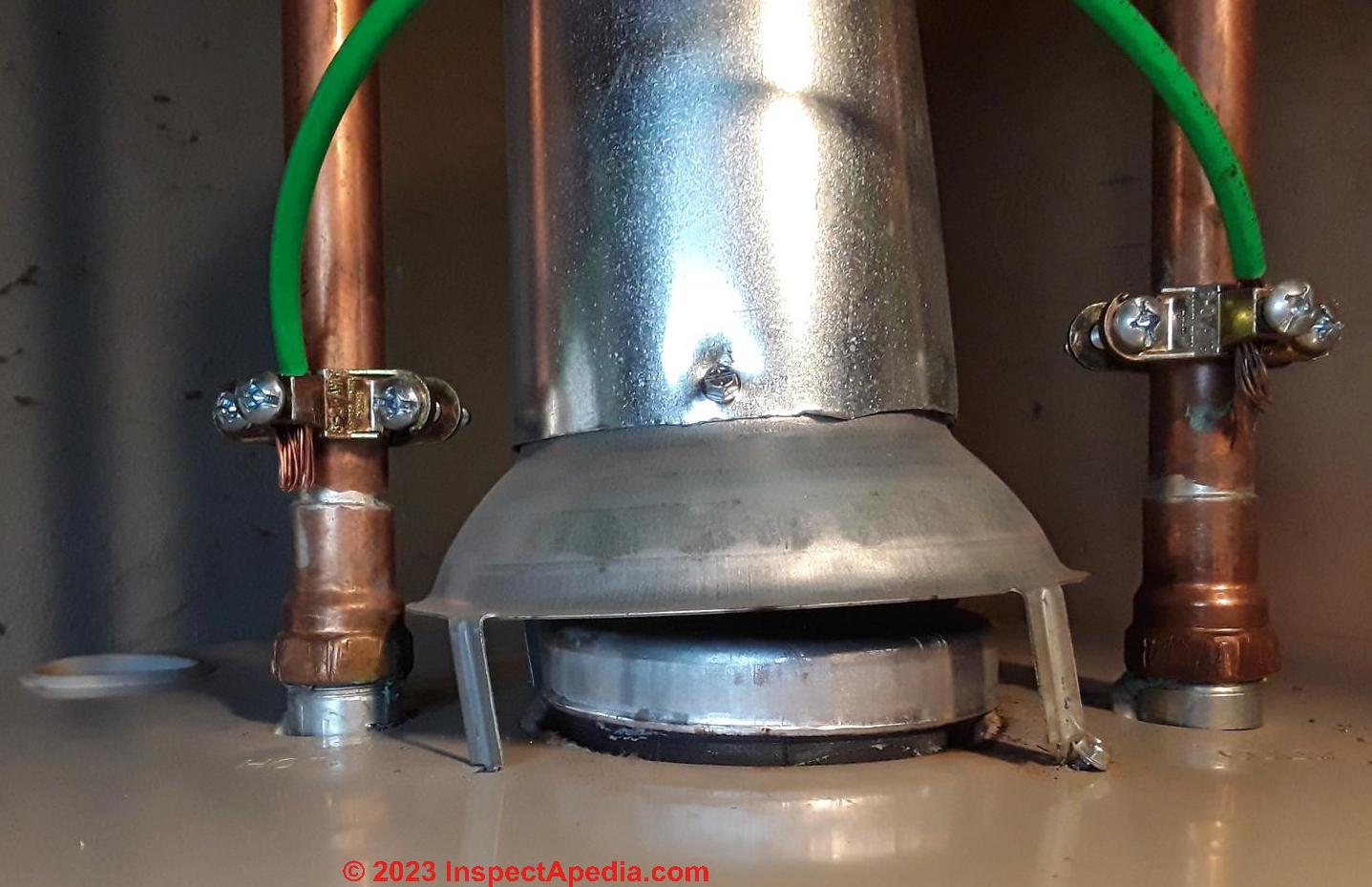
Further update from my post from an hour ago: This morning, we had the furnace on for 10 minutes, and then we ran the hot water to trigger the HW to go on. We felt moist air from the right side of the vent hood and saw droplets of water forming on top of the WH on that side.
Placing a lighter on that side caused the flame to go out, as opposed to being drawn towards the vent hood (and not going out) which is what happened on the other sides. The right side of the vent hood is tilted up and doesn’t overhang as much over the vent. (Please see photo.)
Could that alone account for the backdraft and droplets, or is that just causing us to feel it only on one side, and if it were level we would have the backdraft and feel it all around?
We brought our co detector into the room and it didn’t register any carbon monoxide. We will buy another one just to be sure it is operating properly. We definitely felt moist air. Is it possible it could contain so little CO that it didn’t register?
Thank you.
On 2023-03-07 by Margaret
@InspectApedia Editor ,
Thank you so much for your response. I have a few questions and follow up information based on your answer.
1) When you say that "the chimney and flue vent connector pipes need to be big enough to vent adequately when both appliances are running at once," would it help if I measure the diameter and length of these pipes (and/or post additional photos of the venting)?
2) When you say, "You are confident that there is plenty of combustion air so we don't think that's a likely cause of this trouble," I am sorry I gave the impression of confidence because I am not confident as I don’t know how much air is needed. I had hoped that giving the room dimensions and lack of other venting apparatus in the house would lead you to that conclusion, but I have no knowledge of the matter.
3) Our chimney cap is firmly in place and no animal could possibly have gotten in.
4) The objective data you mentioned in #3: what conclusion would we draw from this data, such that we know how to proceed? Could any numbers show that there was an installation problem because would want to be able to tell that to the installer plumber on the spot?
5) When you said: “Keep in mind that this might not be a new problem, it may be that you simply never noticed it before.” I absolutely think this is a possibility. One question I have is, wouldn’t there have been more rust on the water heater if that were the case?
6) With regard to #4 on your list, in your opinion, is it realistic that a chimney can be clogged to the extent that it can handle the gasses from the furnace but not the water heater as well?
Thank you.
On 2023-03-06 by InspectApedia Editor - chimney and flue vent connector pipes need to be big enough to vent adequately
@Margaret,
When a water heater is sharing a flue with a boiler, as in your case, the chimney and flue vent connector pipes need to be big enough to vent adequately when both appliances are running at once, under all variations of building and outdoor temperature (that affect draft).
Now if your problem is an inadequate flue size, the backdrafting would have been occurring from some point in the first year (accounting for varying weather and heater and boiler use) - that is, from original installation.
Your installation is 4 years old.
You are confident that there is plenty of combustion air so we don't think that's a likely cause of this trouble.
So if this is a new problem, something has changed.
That could be a blocked flue or it could be something affecting combustion air supply to the equipment (or something else).
Order of priority:
1. Be sure that you have working carbon monoxide detectors and smoke detectors properly located, installed, and tested - so we can both sleep at night without worry of you not waking up
2. Inspect for visually obvious mistakes that can cause back-drafting - discussed in this article and others in the series - something as simple as a lost chimney rain cap can cause trouble, as can sneaky birds or raccoons in the flue. The first is easy to see from the ground.
3. Let's get some objective data: any heating service tech can actually measure the draft in the flue at 3 locations:
- at the water heater
- at the boiler
- after the point at which those two are joined
under conditions of
- just boiler operating
- just water heater operating
- both operating
(though consider that when it's quite cold outside and the chimney is cold you might get back-drafting at start-up)
If the draft is weak or there's backdrafting at the heater when the boiler has been off for a time and the chimney is cool, it's possible that the heater just can't develop enough draft. Of course this would have been true from the time of original installation (in cold weather).
Keep in mind that this might not be a new problem, it may be that you simply never noticed it before.
4. Have the chimney flue inspected by a certified chimney sweep who uses a flue inspection camera - so that the inspection is complete.
I would not assume that the chimney needs repair or re-lining before having objective data - the results of that inspection.
Keep us posted.
On 2023-03-06 by Margaret
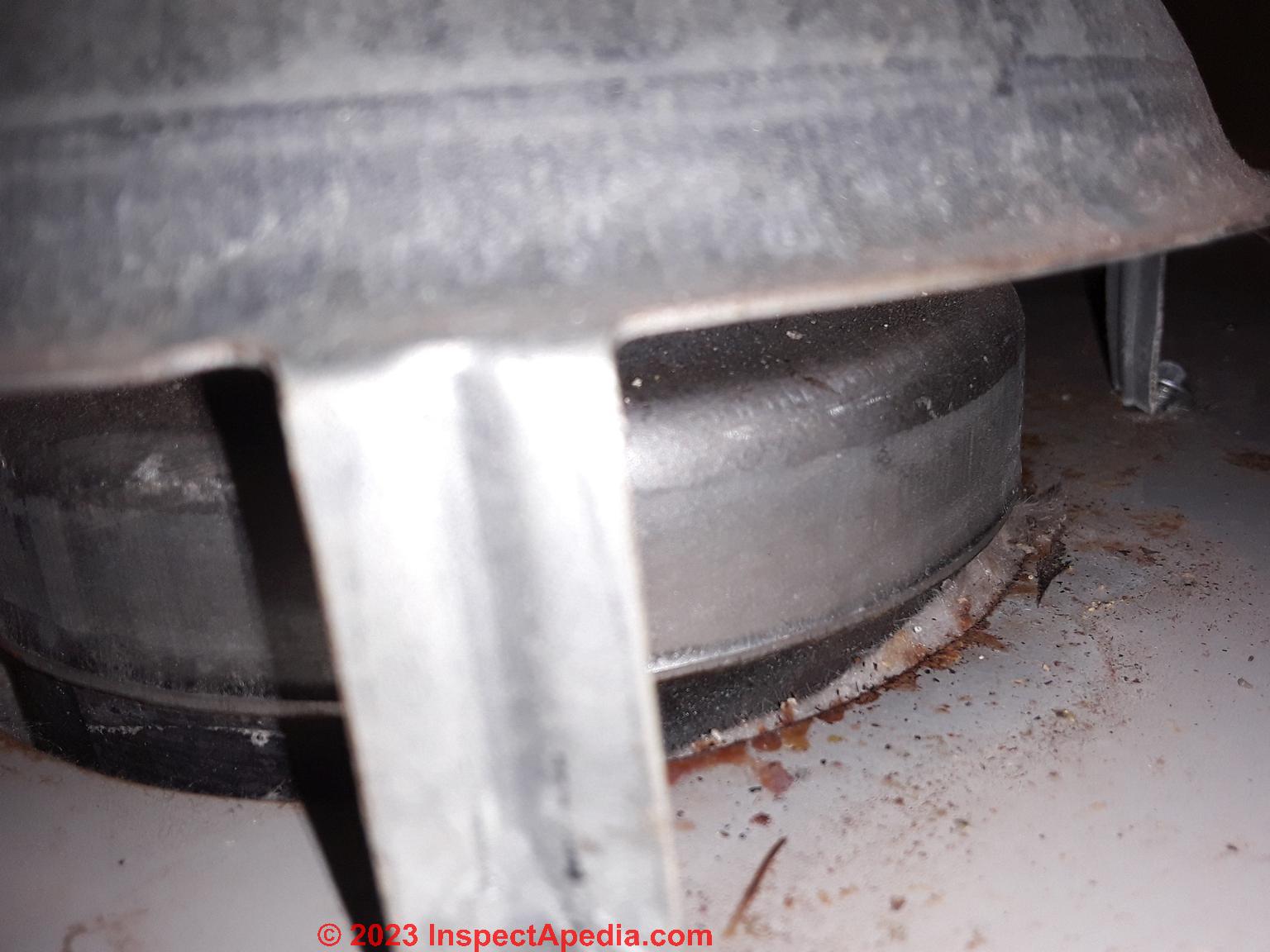 Sorry for the long post, but I don’t want to leave anything important out.
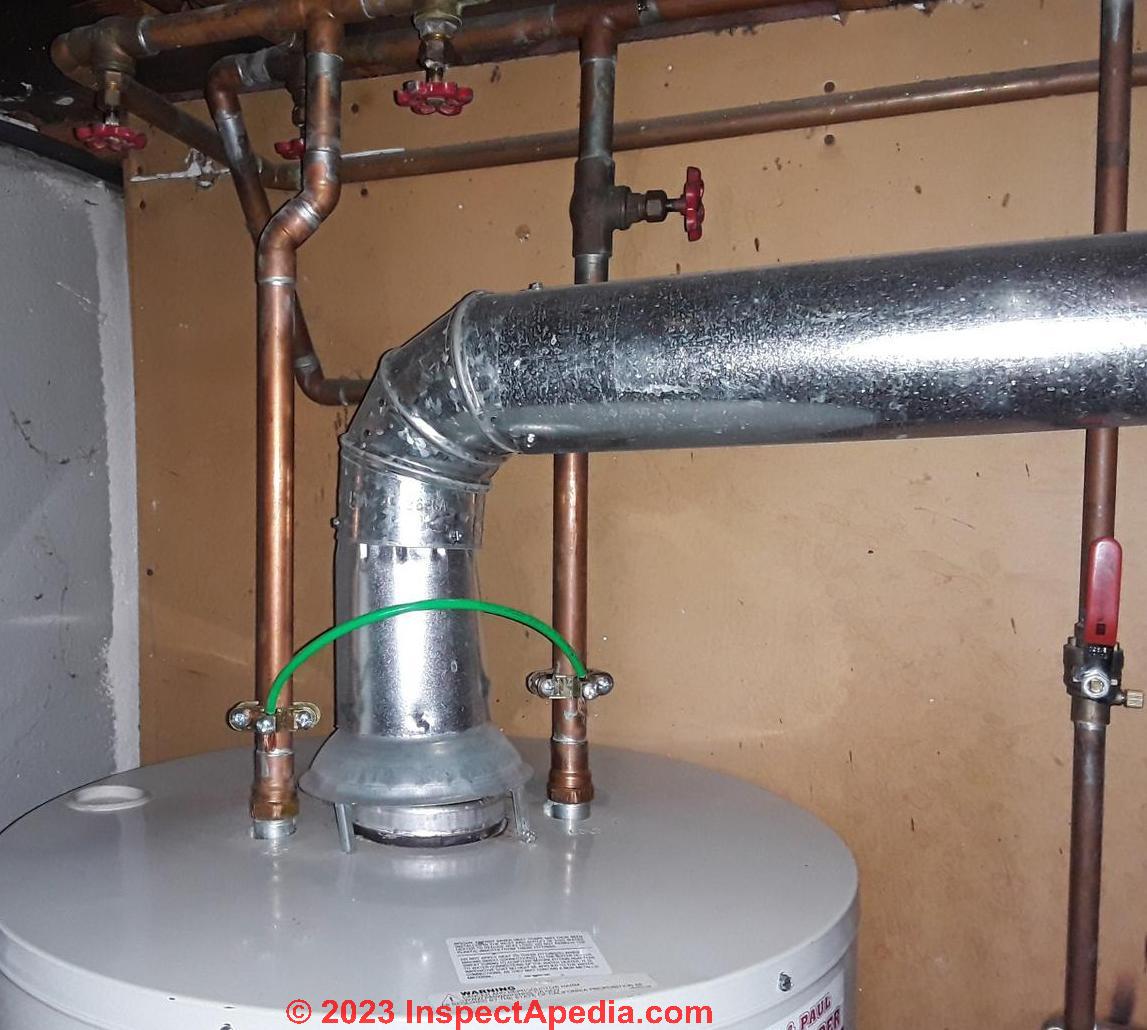
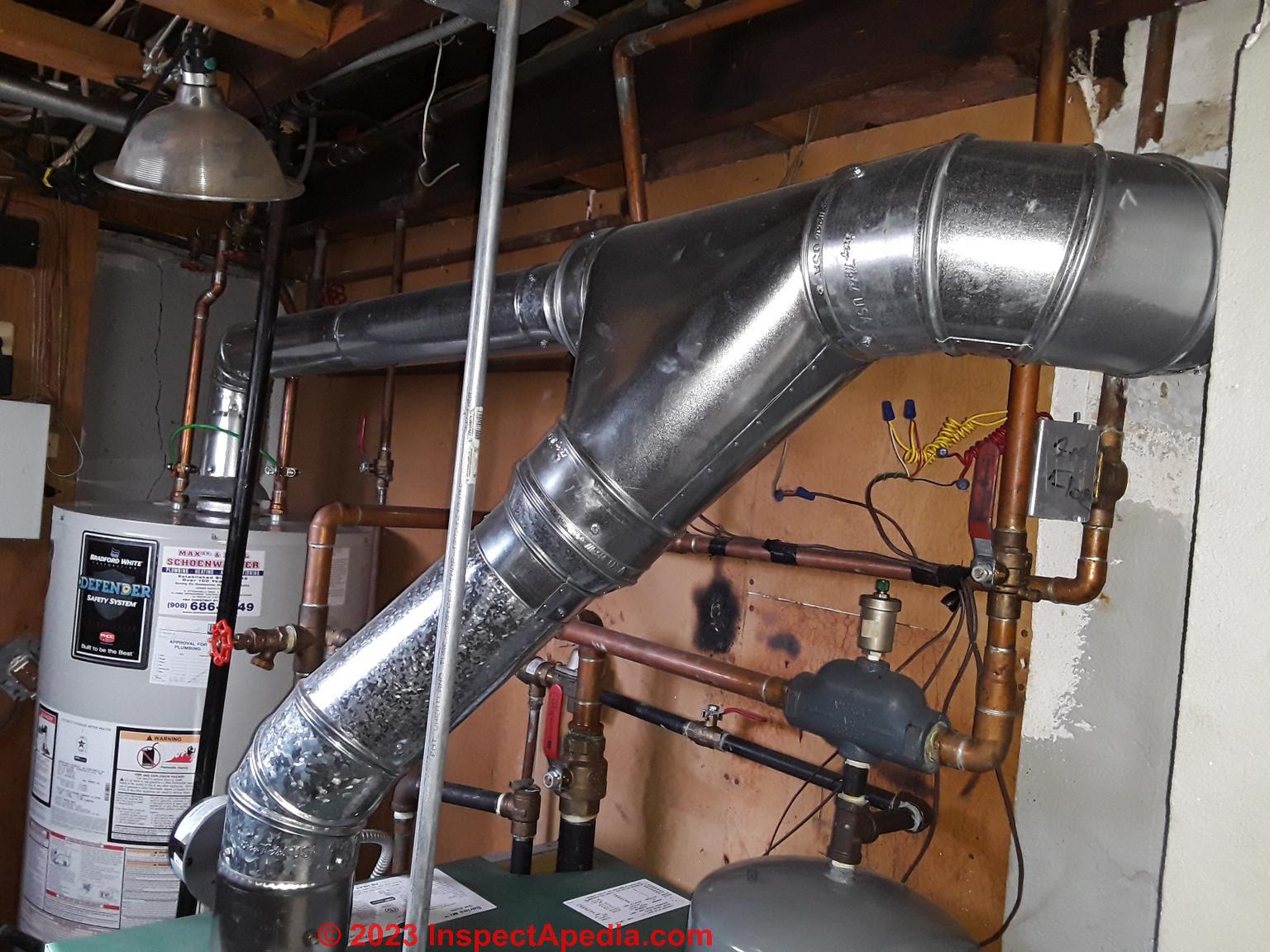
 Over the weekend, I noticed that our hot water heater back drafts when the furnace is on at the same time. They both vent together to the chimney. Please see attached pictures. The WH (40 gallon – 40,000BTU input) is 4 years old. Our medium efficiency furnace (max input: 105,000 BTU, heating capacity: 86,000BTU) is being used for its 3rd winter season.
They were both installed by the same plumbing company. Our previous WH lasted for about 16 years and was either a 40 or 50 gallon (I don’t remember) and our old furnace was from the 1960’s. The ductwork all dates from when the new appliances were put in.
The HW heater and furnace are located in a small utility room in the basement (approx 35 sq ft) but the door to it is ALWAYS left completely open and leads into a 200 sq foot room. Next to that room is an even larger room (which is not sealed very well despite my efforts), and the door between them is left open about halfway.
We have no other appliance or fixture in the house which vents besides for the dryer which is not used for more than a couple hours a week, and has not been used since last Wednesday.
We have a CO detector in the 200 sq foot room, about 15 feet from the WH and 10 feet from the furnace. It has never gone off. Neither has the one outside our bedrooms on the 2nd floor of the house.
When I entered the utility room on Friday, I happened to look at the top of the WH and noticed some drops of water on it. I then noticed some rust as well. This covers an area about 1/4 of the circumference around the vent opening. The rest is all free of rust. (Maybe this is because the vent hood is centered imperfectly.)
I read that this could be a sign of back drafting. My husband and I discovered that when the WH is on by itself, there is no issue and the air goes straight up the vent. But when the furnace is on as well, there is a back draft. My husband tested this with a lighter, and he couldn’t even light it anywhere near the area, the air would put it out. When the furnace is on by itself, everything seems fine. Certainly no air back drafts down the WH.
We see no other visible signs of a problem. The window in the room and the water pipes don’t have condensation. I don’t see rust on the top of the furnace.
Is there anything about the ductwork that looks amiss? Is it possible we don’t have enough air for combustion even though that room opens up into a much larger one?
One possible explanation for our situation, is that there may be a partial blockage in the chimney. Probably dating from when the new furnace was put in, although it could be from a couple years before that when the old one was serviced, my husband was able to see into the chimney from the basement (the plumber had detached the venting) and he said that he saw some debris inside, similar to the floor of a constructions site, but the airspace seemed unobstructed.
We also had someone from a chimney company some months ago go on the roof of the house because we had had it repointed, but still occasionally when we have a rainstorm with wind from a particular direction, a small amount leaks into the attic.
He doesn’t know for sure what is causing this but he did say that the chimney liner, which is made of (ceramic) tiles, has some joints where the mortar is missing. He was looking only with his eyes so of course he couldn’t see very far down.
If the furnace indeed has no problem and is operating properly, could it really be that there is enough air space in the chimney for the furnace gases but when combined with the WH gases, there is not enough room, and those back draft? My husband is of the opinion that the WH produces a lot less gas than the furnace.
On the other hand, if we have had this problem since the furnace was installed 2+ years ago, would we not have even more rust on the WH?
Any help would be much appreciated. We certainly don’t want to go through the expense of having the chimney relined when it is not responsible for this issue. And if we called in the plumber, we would more than likely just be paying him to say that there is no problem and that he did everything correctly.
 ...
... 
On 2022-12-21 by InspectApedia (Editor) - Emerson Goodman furnace problem
@Ryan santman,
Sorry but I'm not sure what you mean by "down draft blower motor"
Are we discussing a draft booster in the furnace chimney or flue vent connector or a blower that moves building air through the furnace heat exchanger?
What is the furnace fuel? Oil, Gas, electric?
if the air handler blower motor (circulating building air through the heater) never turns on that's discussed, along with diagnostic suggestions, at
FAN WON'T START (Air Handler Blower Fans)
https://inspectapedia.com/heat/Blower-Fan-Wont-Start.php
If you're asking about a draft inducer fan see
DRAFT INDUCER FANS
https://inspectapedia.com/heat/Draft_Inducer_Fan_Requirements.php
On 2022-12-21 by Ryan santman
When I turn on the furnace I can here the furnace click on but the down draft blower motor dose not turn on and the unit shuts back off it's a Emerson goodman
On 2018-01-09 by (mod) -
Thank you for asking, Marge. I have sent you our content use policy by email. Basically you are welcome to make **printed** copies of any InspectApedia.com article provided our material is not being used as an advertisement to sell anything.
That's to protect reader trust and to protect our online use of the material and our own website efforts.
On 2018-01-09 by Marge Padgitt
I would like to reprint this article in Wood-Fired Magazine and the Midwest Chimney Safety Council News Magazine. Please contact me at margepadgittmcsc@gmail.com
On 2017-02-20 by (mod) -
Jonathan,
I can but guess as I can't see your fireplace by e-text: very often when you close glass doors on a fireplace the doors are not perfectly air tight. There is considerable up-draft in the hot fire-box. That draws air in around door openings, often along the door bottom or center. The effect is a virtual blow-torch. I'd consider a better fireplace door that is perfectly sealed.
On 2017-02-20 by Jonathan
Hi
I have a wood fireplace. Tonight before going to bed I closed the doors of the fireplace while making sure that the vent remained open. The fire had been burning for a few hours and was about to die. As soon as I closed the door a big back draft formed in the fireplace. I managed to fix the draft by opening the doors of the fireplace.
Now I have been using the fireplace since november so I m a novice. Tonight was pretty warm for the season (about 0C). Could the outside temperature and or pressure be the cause of the backdraf ?
Thanks
On 2017-02-15 by (mod) -
Jon
Please see your question and our detailed reply along with more about creosote hazards at inspectapedia.com/chimneys/Chimney_Creosote_Fire.php CREOSOTE FIRE HAZARDS
On 2017-02-15 by Jon
Inhave a wood furnace. I loaded it up and titned it down before leaving the other night so it would slow burn through the night. When i got back there was a black oily liquid everuwhere in the ground around it, on the back, dripping from the lower part of the dmoke exhause ventbright bu wjere you close and open the vent and some on theninside of the door.
Could this be from the kind of wood that was burned or something else... Also a different question, is it ok to leave the ash door open and close everything else (the smoke exhaust valve and the smoke bypass rod) really get it going and staying going if i sm around it and want itbto really stay warm?
Question: trouble finding the source of high carbon monoxide levels indoors
(Feb 7, 2015) Lori said:
we are having a major back draft issue at our place of business. we recently had to remove workers and clients out of the building because of high Carbon monoxide levels, this has happened 3 times over the past 2 weeks.
We have changed nothing in the building, we have had 4 different professionals in to check the problem and NO ONE can find a reason!! We have no idea what to do...Please help
Reply:
Thanks for asking, Lori but gee: I surely can't be smarter than 4 different on-site professionals who will have seen a lot more than I.
Basically you're looking at
- inadequate combustion air
- inadequate draft or a blocked flue
- improper heater operation
Has anyone inspected the chimney flue for leaks or blockages?
Certainly I would not occupy such a building until you think the problem has been identified and fixed, and even then I'd be darn sure that there are properly located and installed carbon monoxide CO detectors and smoke detectors.
Question:
(Feb 17, 2015) Charles Miller said:
I have a similar problem with a home furnace that gets it's combustion air from the garage. There is inadequate combustion air. Apparently, opening the garage door a smidgeon allows more combustion air inside although it also creates a negative pressure in the house that cancels the improvement. This is a real problem we've had for years, with an old furnace and a new one.
My skin turns blue. I have a cough at night that drives me crazy. WHen I leave the house in the morning it takes about an hour so that I can breathe. Technicians are clueless. Any input from anyone would be valued. gcmiller4@aol.com
Reply:
Charles
Watch out: for safety, be certain that you have properly located and installed working carbon monoxide detectors and smoke detectors. CO poisoning can easily be fatal. You can die.
Get everyone out of the building immediately if you think that you are being exposed to carbon monoxide.
Then you can call for heating system inspection and repair by a trained expert.
...
Continue reading at SPILL SWITCH & COMBUSTION AIR TESTS to detect flue gas spillage that may be due to backdrafting, or select a topic from the closely-related articles below, or see the complete ARTICLE INDEX.
Or see these
Recommended Articles
- BACKDRAFTING & SEWER/SEPTIC ODORS
- BALANCED VENTILATION, HEAT COST SAVINGS
- BLUE vs YELLOW COMBUSTION FLAMES
- BLUERAY Recall
- CARBON MONOXIDE - CO
- CHIMNEY INSPECTION DIAGNOSIS REPAIR
- COMBUSTION AIR REQUIREMENTS
- COMBUSTION4 AIR for TIGHT BUILDINGS
- COMBUSTION APPLIANCE CONTAMINANTS
- COMBUSTION GASES & PARTICLE HAZARDS
- COMBUSTION PRODUCTS & IAQ
- CO DETECTION OPTIONS
- DRAFT REGULATORS / HOODS GAS HEATERS
- DRAFT MEASUREMENT, CHIMNEYS & FLUES
- DRAFT REGULATOR, DAMPER, BOOSTER
- GAS EXPOSURE LIMITS & STANDARDS
- GAS FIRED WATER HEATERS
- ODORS FROM HEATING SYSTEMS
- POISONING SYMPTOMS - CO
- SPILL SWITCH & COMBUSTION AIR TESTS to detect flue gas spillage that may be due to backdrafting
Suggested citation for this web page
BACKDRAFTING HEATING EQUIPMENT at InspectApedia.com - online encyclopedia of building & environmental inspection, testing, diagnosis, repair, & problem prevention advice.
Or see this
INDEX to RELATED ARTICLES: ARTICLE INDEX to GAS HAZARDS in BUILDINGS
Or use the SEARCH BOX found below to Ask a Question or Search InspectApedia
Ask a Question or Search InspectApedia
Try the search box just below, or if you prefer, post a question or comment in the Comments box below and we will respond promptly.
Search the InspectApedia website
Note: appearance of your Comment below may be delayed: if your comment contains an image, photograph, web link, or text that looks to the software as if it might be a web link, your posting will appear after it has been approved by a moderator. Apologies for the delay.
Only one image can be added per comment but you can post as many comments, and therefore images, as you like.
You will not receive a notification when a response to your question has been posted.
Please bookmark this page to make it easy for you to check back for our response.
Our Comment Box is provided by Countable Web Productions countable.ca
Citations & References
In addition to any citations in the article above, a full list is available on request.
- McWilliams, Jennifer, and Max Sherman. "Review of literature related to residential ventilation requirements." Lawrence Berkeley National Laboratory (2005).
- Nagda, Niren L., Michael D. Koontz, Irwin H. Billick, Neil P. Leslie, and David W. Behrens. "Causes and consequences of backdrafting of vented gas appliances." Journal of the Air & Waste Management Association 46, no. 9 (1996): 838-846.
- Tsongas, George. "Building Tightness Guidelines: When is a house too tight?." Home Energy 10, no. 2 (1993): 18.
- In addition to citations & references found in this article, see the research citations given at the end of the related articles found at our suggested
CONTINUE READING or RECOMMENDED ARTICLES.
- Carson, Dunlop & Associates Ltd., 120 Carlton Street Suite 407, Toronto ON M5A 4K2. Tel: (416) 964-9415 1-800-268-7070 Email: info@carsondunlop.com. Alan Carson is a past president of ASHI, the American Society of Home Inspectors.
Thanks to Alan Carson and Bob Dunlop, for permission for InspectAPedia to use text excerpts from The HOME REFERENCE BOOK - the Encyclopedia of Homes and to use illustrations from The ILLUSTRATED HOME .
Carson Dunlop Associates provides extensive home inspection education and report writing material. In gratitude we provide links to tsome Carson Dunlop Associates products and services.
 | HOME | ABOUT | ASK a QUESTION | CONTACT | CONTENT USE POLICY | DESCRIPTION | POLICIES | PRIVACY | |
| © 2024 - 1985 Publisher InspectApedia.com - Daniel Friedman | |||||||||