
InspectAPedia® FREE Encyclopedia of Building & Environmental Construction, Diagnosis, Maintenance & Repair |
Question? Just ask us! InspectAPedia
|
 Porch & Deck Construction
Home Page & Index to Articles
- POST a QUESTION or COMMENT about safe and un-safe deck construction practices & details
This article series defines the parts & components of a deck and discusses building permits and code requirements needed for a do it yourself design-build deck project.
We describes critical safe-construction details for decks and porches, including avoiding deck or porch collapse and unsafe deck stairs and railings.
InspectAPedia tolerates no conflicts of interest. We have no relationship with advertisers, products, or services discussed at this website.
Deck & Porch Construction, Inspection, Repair & Safety Guide
The Parts of a Deck or Porch
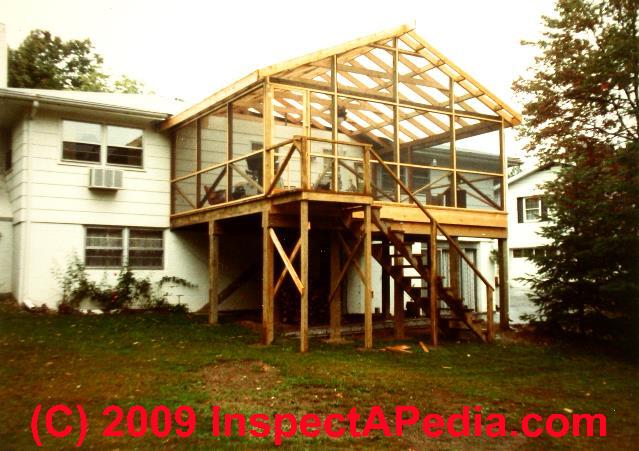 As a deck project begin to take shape, you will need to have a basic understanding of the structure of a typical deck. Knowing the name and purpose of each part will also help you in talking with your lumberyard and the local building department, as well as any contractors or architects.
The photo, left, shows a tall deck project that quickly evolved into a covered porch. It was constructed by the website editor, Daniel Friedman, in 1983.
One of the project conditions requested by the owner was that this high deck should not be wobbly or bouncy (nor unsafe).
Decks consist of several layers of construction, each with its own components and function.
The ledger joins a deck to the house framing. Concrete piers, often resting on wider footings below ground, provide the deck’s ’solid connection with the ground. Posts establish the height of the deck, tying the piers to on more beams. Joists attach ledger and beams, provide underlying frame for the d which is the surface layer.
If the deck is more than 2 feet above ground, it should be surrounded by a railing, which typically consists of posts, and balusters. Stairs are treads and sometimes risers attached to stringers, as well as a railing on each side.
Decks, like houses, are largely held together by lumber and fasteners. But houses have roofs, sheathing, and siding to protect them from the elements and add support. Decks, on the other hand, are exposed to all kinds of weather.
They can be buried in snow one season and baked in the sun the next, and may have to endure heavy foot traffic, deep freezes, and drenching rainfalls. When faced with such conditions, the materials that go into a deck are prone to deteriorate. Wood rots, fasteners loosen, metal rusts, and foundations may heave.
On many decks, shortcuts or simple errors made in planning or building accelerate the damage. A well-designed and well-constructed deck can survive intact for decades with regular maintenance. A poorly built and maintained deck can begin to deteriorate in just a couple of years.
Fine deck building may require that you spend a little more for materials, take a little longer on the construction, and take time to maintain and repair the deck as needed, but the results will be worth it.
Deck Building Building Permit and Deck Building Code Inspection Warnings
We inspected a deck built nearly eight feet above ground level, and without any railings. The owner wanted the view to remain unobstructed. The owner promptly asked us to convert the deck to a sun-porch using translucent corrugated roof panels. At the time of this photo safe railing balusters had not yet been installed.
At another New York deck that was built abutting the home but not attached to it, we also encountered deck high above the ground (about 8') with no railings whatsoever.
Our opinion was that this was a dangerous structure and that guard railings were needed. A local inspector examined the deck and opined that because the deck was a free standing structure, "building codes did not apply" and so no guardrail was "required". Our advice was that railings were needed for safety, regardless of that local opinion.
In most jurisdictions, home inspectors, building consultants, and builders are not permitted to declare that a structure does or does not comply with local, state, national, or modern building codes. That authority is reserved for the local building code compliance officer.
But in most jurisdictions a building permit and final building code compliance inspections are required to build a deck, regardless of whether or not the deck is attached to the principal structure.
And regardless of what any inspector claims about the "legal requirement" for guard rails on decks, we recommend that for safety, guard rails and stair railings (if stairs are installed) should be provided; if the deck is more than 3 ft. above ground level the requirement for guard railings and stair rails is required by model and most local building codes.
References on Deck Construction & Inspection
- Manual for the Inspection of Residential Wood Decks and Balconies, by Cheryl Anderson, Frank Woeste (Forest Products Society), & Joseph Loferski, October 2003, ISBN-13: 978-1892529343,
- Prescriptive Residential Wood Deck Construction Guide, [PDF] based on the 2009 International Residential Code, American Forest & Paper Association, Inc., provided by reader Mark Morsching from Everflashing.
- Manual for the Inspection of Residential Wood Decks and Balconies, by Cheryl Anderson, Frank Woeste (Forest Products Society), & Joseph Loferski, October 2003, ISBN-13: 978-1892529343,
- NADA, 10-POINT CONSUMER SAFETY CHECKLIST [PDF] North American Deck and Railing Association, NADRA, http://nadra.org/ 888.623.7248, Quoting:
The mission of the North American Deck and Railing Association (NADRA) is to provide a unified source for the professional development, promotion, growth, and sustenance of the Deck and Railing building industry in North America so that members can exceed the expectations of their customers. - LSS, "Outdoor Deck and Porch Injury Study", Legacy Services LLC., http://www.buildingonline.com/news/pdfs/Outdoor-Deck-and-Porch-Injury-Study.pdf [No named authors, address] also includes the next 3 citations below.
- Consumer Product Safety Commission’s National Electronic Injury Surveillance System, http://www.cpsc.gov/LIBRARY/neiss.html
- Kessler, E. and T. Schroeder. (1998). National Electronic Injury Surveillance System (NEISS) Estimated Generalized Relative Sampling Errors. Washington, DC: U.S. Consumer Product Safety Commission.
- National Ornamental & Miscellaneous Metals Association (NOMMA) and Whorton Marketing & Research (WM&R) Climbability, Research, Analysis, and Communications Planning document, May 31, 2006.
- Best Practices Guide to Residential Construction, by Steven Bliss. John Wiley & Sons, 2006. ISBN-10: 0471648361, ISBN-13: 978-0471648369, Hardcover: 320 pages, available from Amazon.com and also Wiley.com.
See our BOOK REVIEW of Best Practices Guide to Residential Construction - Building Failures, Diagnosis & Avoidance, 2d Ed., W.H. Ransom, E.& F. Spon, New York, 1987 ISBN 0-419-14270-3
- Building Pathology, Deterioration, Diagnostics, and Intervention, Samuel Y. Harris, P.E., AIA, Esq., ISBN 0-471-33172-4, John Wiley & Sons, 2001 [General building science-DF] ISBN-10: 0471331724 ISBN-13: 978-0471331728
- Design of Wood Structures - ASD, Donald E. Breyer, Kenneth Fridley, Kelly Cobeen, David Pollock, McGraw Hill, 2003, ISBN-10: 0071379320, ISBN-13: 978-0071379328
- Diagnosing & Repairing House Structure Problems, Edgar O. Seaquist, McGraw Hill, 1980 ISBN 0-07-056013-7 (obsolete, incomplete, missing most diagnosis steps, but very good reading; out of print but used copies are available at Amazon.com, and reprints are available from some inspection tool suppliers).
Ed Seaquist was among the first speakers invited to a series of educational conferences organized by D Friedman for ASHI, the American Society of Home Inspectors, where the topic of inspecting the in-service condition of building structures was first addressed. - Sullivan, Aleca John Leeke, PERSERVING HISTORIC WOOD PORCHES [PDF] Preservation Brief #No. 35, US NPS, - retrieved 2022/06/30, original source: https://www.nps.gov/tps/how-to-preserve/briefs/45-wooden-porches.htm adapted and re-printed in color by InspectApedia
Excerpt:
This Preservation Brief provides guidance for the everyday care of wood porches on older buildings. It focuses primarily on the maintenance and repair of wood porches, but acknowledges other, often challenging, work as well.
This publication provides a brief history of the American porch and identifies its basic structural and decorative elements. It outlines how to assess the condition of a wood porch, how much work may be needed, and how to develop a specific scope of work.
Detailed guidance on each level of work is provided, beginning with routine maintenance, followed by general repairs for various porch components, and concluding with replacement of parts that are beyond repair.
Recommendations are provided for work that may require professional assistance. Although the Brief primarily addresses residential buildings, much of the information can be applied to wood porches on any structure. - See additional sources at the end of this page atReferences or Citations
Reader Comments, Questions & Answers About The Article Above
Below you will find questions and answers previously posted on this page at its page bottom reader comment box.
Reader Q&A - also see RECOMMENDED ARTICLES & FAQs
On 2020-05-26 by (mod) - where are exterior step requirements ?
Glad to help, Ext.
The specifications for designing and building stairs are in the ARTICLE INDEX above where you'll start at one of these two articles
STAIRS, RAILINGS, LANDINGS, RAMPS https://inspectapedia.com/Stairs/Stairs.php
or
STAIR DIMENSIONS, WIDTH, HEIGHT https://inspectapedia.com/Stairs/Stair_Dimension_Specifications.php
On 2020-05-26 by exterior stairs
where are exterior step requirements
On 2018-08-24 by jim
where can I find info on building with cedar log guard posts and railings for a deck
On 2018-05-16 - by (mod) -
Not sure what you're asking.
There are several brands of bolts and connectors that can bolt through a ledger board into a masonry wall or foundation - if that's your situation. Each will have its particular application and installation details.
Some examples are at fastenersplus.com
On 2018-05-15 by candice
Dynabolt or metal braces to attach deck to house?
On 2016-06-20 - by (mod) -
Beck
Short answer: for a slider you aren't required to build a landing platform. But I would either make the steps no less than the width of the open area of the door (preferred) or you'll need to construct a ridiculous-looking guardrail across the door opening to force the user to walk down more-narrow stairs.
Here are some details:
Typical Minnesota stair codes state
A landing is required at the top and bottom of each stairway.
A landing is not required at the top of an interior flight of stairs provided a door does not
swing over the stairs.
The width (perpendicular to the direction of travel) of the landing shall not be less than the width
of the stairway it is serving.
The depth (in the direction of travel) of the landing shall not be less than 36”.
Landings shall have a maximum slope of one-unit vertical in 48-units horizontal (2% slope).
Guards shall be provided for landings that are more than 30” above grade.
Your local building official is the final legal authority on what's required by way of stair landings where you live. Certainly I see sliding doors that open directly to a single step rather than (the preferred) landing; the builder argues that there is no door swinging "out" and thus the "landing" equivalent is the interior floor. Not all building inspectors buy that view.
The landing platform (or step if you get away with that) should be at least the width of the door opening space.
Using St. Cloud as an example of minnesota stair building codes,
see http://www.ci.stcloud.mn.us/DocumentCenter/Home/View/786
On 2016-06-20 by BeckCo
I need to build stairs up to an exterior 6' wide patio door. Top of door threshold is 30" above grade. Does code require a landing? Do stairs need to be 6' wide (door width)? Im located in MN. Thanks in advance!
On 2016-03-30 - by (mod) -
Anon: a deck can certainly be free standing. But
Watch out: I've seen the "free standing" deck design used as a trick to run around building code compliance. At a home inspection I saw a deck 8 ft. above ground with no guardrails. I noted to my client that falling off such a deck would surely injure someone and that guardrails were badly needed.
The deck was built free-standing, about 1" from the wall of the house and entered by a sliding door from the house.
The owner, incensed, called his local building department for a defense.
The building inspector who had issued a CO on this travesty - this unsafe construction - bailed himself out by saying "OK, well the deck is not attached to the house so I don't have to inspect it and it's not part of the structure" and the owner said "OK so building codes don't apply" (which is not the case everywhere)
My reply is that "building codes may not apply" as the local inspector is the final authority.
But when somebody falls off the deck and breaks their neck, their neck is still broken, and if that's not bad enough, you can figure that their lawyer won't accept a defense that the unsafe deck was, in that jurisdiction, "legal" as any moron can see that for safety it needed guardrailis.
As you can hear, I'm still upset by this fiasco, decades later. We don't need to kill anybody just to sell our home.
Not that this applies to you, Anonymous.
On 2016-03-30 by Anonymous
Does a deck have to bge connected to the building, or could it be free standing?
On 2016-03-20 by Anonymous
any issues with upgrading a 4x4 post to a 6x6 post on a 8 inch pier? height is 32 inches If so what issue does it cause to the pier?
...
Continue reading at DECK DESIGN & BUILD or select a topic from the closely-related articles below, or see the complete ARTICLE INDEX.
Or see these
Recommended Articles
- CRACKS CHECKS SPLITS in BEAMS, LOGS & POSTS for more about cracks versus breaking and collapsing posts or beams
- DECK COLLAPSE Case Study
- DECK CONSTRUCTION BEST PRACTICES
- DECK DESIGN & BUILD
- DECK & PORCH CONSTRUCTION - home - for a comparison of good and bad deck or porch construction methods.
- DECK FLASHING LEAKS, ROT Case Study for an example of an older deck with rot and collapse due to improper construction and missing building flashing
- DECK & PORCH CONSTRUCTION - home
- DREAM PORCHES & SUNROOMS - design ideas
- POOL CONCRETE COOL DECK SURFACES
- PORCH & DECK CONSTRUCTION - home
- PORCH COLUMN REPAIR or REPLACEMENT
- PORCH CONSTRUCTION & SCREENING
Suggested citation for this web page
DECK & PORCH CONSTRUCTION at InspectApedia.com - online encyclopedia of building & environmental inspection, testing, diagnosis, repair, & problem prevention advice.
Or see this
INDEX to RELATED ARTICLES: ARTICLE INDEX to BUILDING DECKS & PORCHES
Or use the SEARCH BOX found below to Ask a Question or Search InspectApedia
Or see
INDEX to RELATED ARTICLES: ARTICLE INDEX to BUILDING STRUCTURES
Or use the SEARCH BOX found below to Ask a Question or Search InspectApedia
Ask a Question or Search InspectApedia
Try the search box just below, or if you prefer, post a question or comment in the Comments box below and we will respond promptly.
Search the InspectApedia website
Note: appearance of your Comment below may be delayed: if your comment contains an image, photograph, web link, or text that looks to the software as if it might be a web link, your posting will appear after it has been approved by a moderator. Apologies for the delay.
Only one image can be added per comment but you can post as many comments, and therefore images, as you like.
You will not receive a notification when a response to your question has been posted.
Please bookmark this page to make it easy for you to check back for our response.
Our Comment Box is provided by Countable Web Productions countable.ca
Citations & References
In addition to any citations in the article above, a full list is available on request.
- [1] Steve Bliss's Building Advisor at buildingadvisor.com helps homeowners & contractors plan & complete successful building & remodeling projects: buying land, site work, building design, cost estimating, materials & components, & project management through complete construction. Email: info@buildingadvisor.com
Steven Bliss served as editorial director and co-publisher of The Journal of Light Construction for 16 years and previously as building technology editor for Progressive Builder and Solar Age magazines. He worked in the building trades as a carpenter and design/build contractor for more than ten years and holds a masters degree from the Harvard Graduate School of Education. Excerpts from his recent book, Best Practices Guide to Residential Construction, Wiley (November 18, 2005) ISBN-10: 0471648361, ISBN-13: 978-0471648369, appear throughout this website, with permission and courtesy of Wiley & Sons. Best Practices Guide is available from the publisher, J. Wiley & Sons, and also at Amazon.com - [2] Decks and Porches, the JLC Guide to, Best Practices for Outdoor Spaces, Steve Bliss (Editor), The Journal of Light Construction, Williston VT, 2010 ISBN 10: 1-928580-42-4, ISBN 13: 978-1-928580-42-3, available from Amazon.com
- [3] Prescriptive Residential Wood Deck Construction Guide, based on the 2009 International Residential Code, American Forest & Paper Association, Inc., provided by reader Mark Morsching from Everflashing.
- [4] Mark Morsching, Everflashing, Tel: 800-550-1667, Email: everflashing@gmail.com. The Everflashing product comes in G-185 and Stainless Steel and is intended for use with treated lumber with copper in it. Everflashing produces a variety of specialty flashing products including flashings for use with decks at deck ledgers and deck perimeters.
- [2] Manual for the Inspection of Residential Wood Decks and Balconies, by Cheryl Anderson, Frank Woeste (Forest Products Society), & Joseph Loferski, October 2003, ISBN-13: 978-1892529343,
- [5] Claudia Hudson, Asheville NC, Tel: 828-252-0644 Email: claudiahudson@charter.net . Ms. Hudson is an SEO copyrighter / content writer. She has provided background research and text for InspectApedia's articles on deck and porch construction methods & procedures. April 2013.
- Our recommended books about building & mechanical systems design, inspection, problem diagnosis, and repair, and about indoor environment and IAQ testing, diagnosis, and cleanup are at the InspectAPedia Bookstore. Also see our Book Reviews - InspectAPedia.
- In addition to citations & references found in this article, see the research citations given at the end of the related articles found at our suggested
CONTINUE READING or RECOMMENDED ARTICLES.
- Carson, Dunlop & Associates Ltd., 120 Carlton Street Suite 407, Toronto ON M5A 4K2. Tel: (416) 964-9415 1-800-268-7070 Email: info@carsondunlop.com. Alan Carson is a past president of ASHI, the American Society of Home Inspectors.
Thanks to Alan Carson and Bob Dunlop, for permission for InspectAPedia to use text excerpts from The HOME REFERENCE BOOK - the Encyclopedia of Homes and to use illustrations from The ILLUSTRATED HOME .
Carson Dunlop Associates provides extensive home inspection education and report writing material. In gratitude we provide links to tsome Carson Dunlop Associates products and services.
 | HOME | ABOUT | ASK a QUESTION | CONTACT | CONTENT USE POLICY | DESCRIPTION | POLICIES | PRIVACY | |
| © 2024 - 1985 Publisher InspectApedia.com - Daniel Friedman | |||||||||