
InspectAPedia® FREE Encyclopedia of Building & Environmental Construction, Diagnosis, Maintenance & Repair |
Question? Just ask us! InspectAPedia
|
 Wood Framing Fasteners
Stud, Joist, Porch, Deck Board Screws & Nails
- POST a QUESTION or COMMENT about structural fasteners, nails, bolts, or hidden fasteners for wood framing of buildings, decks & porches
Choices of deck structural & flooring fasteners:
types of construction screws, nails, bolts to use when building a deck, railing, or exterior stair.
This article explains critical safe-construction details for decks and porches, including avoiding deck or porch collapse and unsafe deck stairs and railings.
InspectAPedia tolerates no conflicts of interest. We have no relationship with advertisers, products, or services discussed at this website.
InspectAPedia tolerates no conflicts of interest. We have no relationship with advertisers, products, or services discussed at this website.
Guide to Selecting the Proper Deck & Porch Structural Fasteners, Screws, Nails, Lags, Bolts
 The Right & The Wrong Fastener Nails & Screws Used for Joist Hangers, Framing Ties, Framing Connector Plates
Article Contents
- Structural Fasteners, screws, nails, bolts, hidden fasteners used for wood frame construction, including deck & porch construction
- Choices of deck nails, screws, coated fasteners, and hidden fasteners for deck floor, railing, joist hanger, and other construction connectors
- Using drywall screws, roofing nails, hanger tabs, or other improper fasteners for wood framing
- What are the Key Forces that Hold Nails & Screws in Wood as Structural Connectors?
- New Wood Preservatives and Their Corrosion Effects on Deck Nails, Screws, Connectors & Fasteners
- Typical[7] Nail Schedule for Metal Framing Connectors - Joist Hangers
- Stainless Steel Nails & Screws for Decks in Salt-Exposed or Wet/Humid Climates; aluminum deck nails?
- Hidden Deck Fasteners for Deck Boards; Screws for Use with Deck Floors - Decking
- Deck Joist & Beam Sizing Tables & A Quick Rule of Thumb for Sizing Joists
- Examples of poor or improperly made structural connections that lead to collapse of Decks and Porches
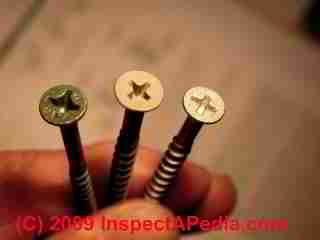
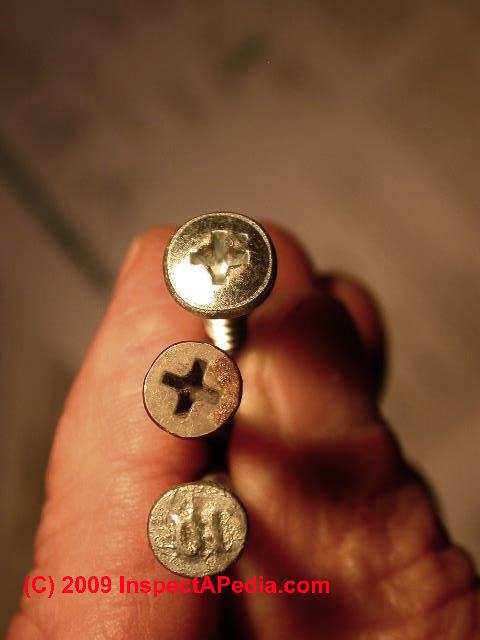
Our photo, above left, shows three fasteners we have found used with steel joist hangers. This PHOTO shows the heads of each of these fasteners.
Because the new wood preservatives ACQ (alkaline copper quat) and copper azole contain significantly more copper than the older CCA-treated lumber, they are estimated to be two to four times more corrosive to metals and galvanized coatings than the CCA they are replacing.
- Hot dipped galvanized nails:
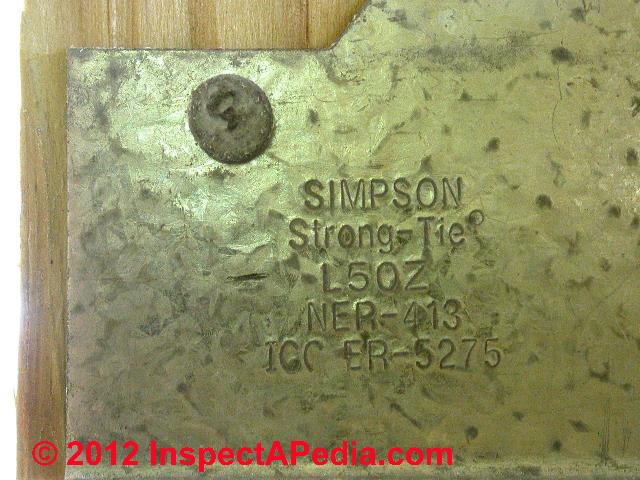
At bottom of our photo above and shown fully nailed at left is a 1.5" long hot-dipped galvanized nail made by Simpson, and discussed just below. This is a proper fastener to use with galvanized steel joist hangers.
Other specialty fasteners used for joist hangers, post connectors and similar connector plates and ties are provided by a variety of manufacturers including special power-tool operated fasteners used with special Paslode™ or Senco™ mailers.
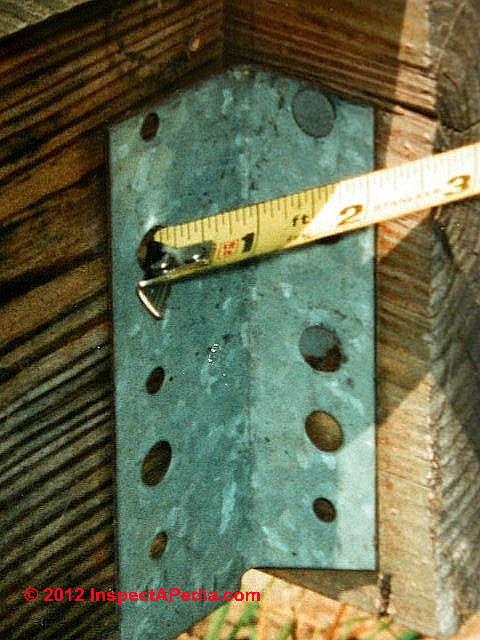
- Roofing nails used for Joist Hangers? No. Use of roofing nails as structural fasteners is unsafe and violates building codes.
Watch out: do not use a roofing nail for fastening framing connectors. The short length of galvanized roofing nails and their easy availability tempts some inexperienced framers to use them for structural fasteners.
Do not do this. This is an improper fastener that will fail and risks catastrophic deck collapse.
In fact the final hammer blows that seat a roofing nail onto a steel framing connector can weaken or even completely sever the connection between the nail head and the nail shank,leaving no structural connection at all!
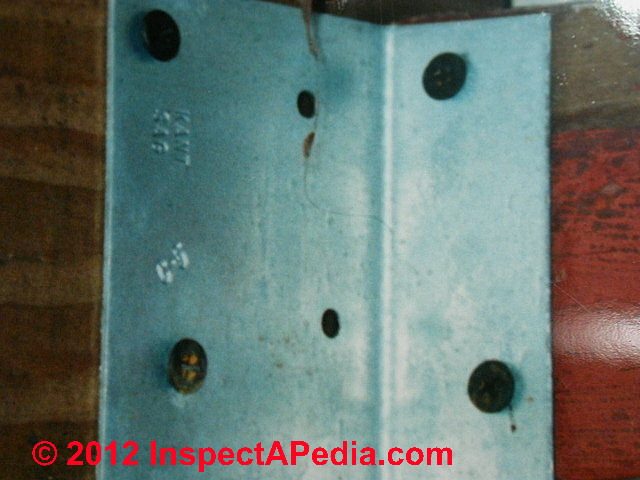
- Drywall screws: In the middle of our photo above is a 1.5" drywall screw. These screws are tempting to use because they are available, easy to install, do not require drilling.
Watch out: drywall screws are not structural fasteners. We have inspected decks constructed entirely using interior drywall screws for both decking and for structural connections and joist hangers.
Do not do this. This is an improper fastener that will fail and risks catastrophic deck collapse.
Comparing Joist Hanger Nails, Drywell Screws, Joist Hanger Tabs, & Utility "Construction" Screws - which are acceptable?
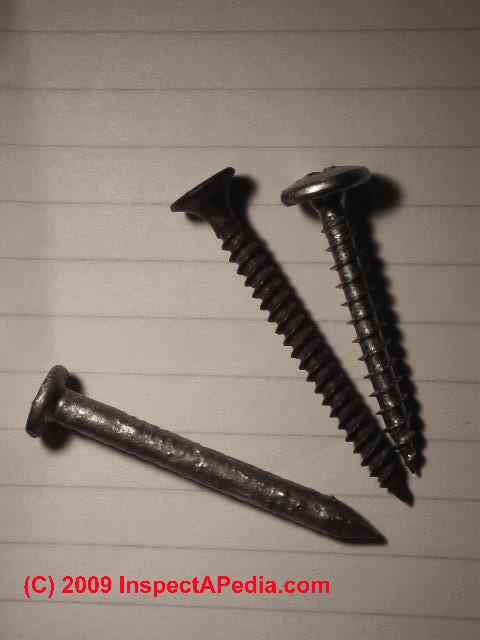
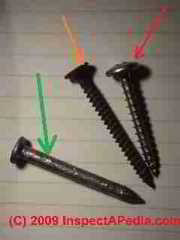
Stainless steel utility screws: At the top of our photo (red arrow at left) is a 1 1/4" stainless steel screw used by a contractor to secure joist hangers when building the deck shown at the top
of DECK & PORCH CONSTRUCTION.
The orange arrow points to a drywall screw, and the green arrow to the proper nail for steel structural fasteners, a Simpson Strong-Tie N10 DHDG 1 1/2" hot dipped galvanized "joist hanger" nail.
Watch out: Although the stainless steel screw (red arrow) screw is also made by a company that makes structural fasteners, a quick look at the company's specifications for this screw revealed that the manufacturer specifically advised that this screw was not a structural fastener and should not be used with steel framing connectors.
What about those little "Tabs" on Joist Hangers - can I just nail those in and skip the joist hanger nails?
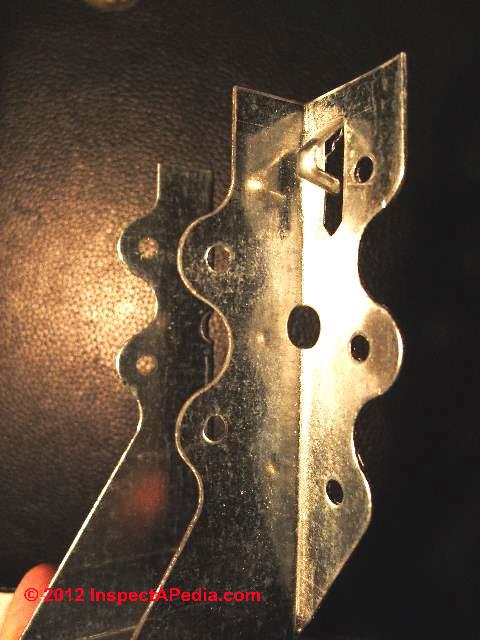
Watch out: the short answer is "no".
The locating tab (red oval in our photo at left) is intended to temporarily hold the joist hanger in place (just hammer it in) while you reach down into your nail apron to grasp a handful of joist hanger nails.
The tab is not a structural fastener and cannot be relied-on for that purpose.
Notice that the Tamlyn joist hanger shown in our photo provides for two joist hanger nails that will be hammered into the sides of the sides of the joist (two from each side), and three that will be nailed into the header or rim joist or ledger board (three at each side).
Our green arrows remind us of where we should see nails in the installed joist hanger.
Key Forces that Hold Nails & Screws in Wood as Structural Connectors
Nailing Stainless steel, galvanized, as well as proprietary-coating surfaced construction screws for use with treated lumber are available and of course are fine if used as recommended. But not the two screws shown in this photo and removed from decks we inspected.
In the deck we inspected and where these improper screws had been installed, the contractor agreed to remove the screws and to replace them using the proper fasteners instead.
Watch out: when removing and replacing wood framing fasteners:
Even then we were not quite sure that the deck was safely framed. Why?
The hole left by removing the wrong screws amounts to a "pre-drilled" opening in the ledger board or beam to which the joist hangers were later nailed. The holding power of a nail (or screw) fastener, the force that keeps the structure safely together, involves:
Shear force - force across the diameter of the fastener. The shear force resistance of a nail or screw is a function of the thickness and composition of the screw material.
Withdrawal force - the force that keeps the fastener from pulling out of the wood.
Screw fasteners have improved withdrawal force resistance because their threads cut into the surrounding wood.
Nails depend on friction for their resistance to withdrawal force - the "tightness" with which the wood member presses against the sides of the nail. When we nail into a pre-existing hole in a structural member, this withdrawal force may be compromised, especially depending on the diameter of the hole but also depending on the wood species and its dryness as well as the smoothness of the shank of the nail itself.
at DECK COLLAPSE Case Study we describe a serious deck collapse that occurred when the deck ledger pulled away from the building. T
he deck ledger discussed in that study had been nailed to the rim joist through siding, using too-small common nails, missing bolt connectors or other proper ties.
The ledger, and thus the whole deck was unable to resist withdrawal forces.
The deck pulled away from the building and collapsed. Other mistakes exacerbated the failure and fall. People were injured.
Position
of the fastener also is significant in withdrawal force of both nails and screws.
For the identical size, weight, and number of fasteners, a nail that is horizontal with respect to the components it is supporting has less withdrawal force imposed on it (in general) than one which is nailed upwards: nailing a board straight "up" to a ceiling joist or rafter imposes more withdrawal force on the nails than nailing a board horizontally onto studs in a structural wall.
Length of the fastener
is also significant. The fastener must be long enough to penetrate the structural wood members deeply enough to provide sufficient resistance against withdrawal.
(That's why roof shingle nailing specifications, presuming the installation is over 3/4" plywood, expect the tip of the roofing nail to protrude through the 3/4" decking - to be sure that we have at least 3/4" of wood around the full-diameter shank of the roofing nail.)
Toe-nailing
is particularly effective at improving the withdrawal force of nails used in framing construction.
The crossing of nails past one another when nailed from opposing sides of a joist or stud forms a stronger connection than the same number of nails would provide if all placed on the same angle but just in one side of the framing member.
Most treatment manufacturers recommend that fasteners and hardware in contact with the new treated wood be stainless-steel, heavily coated hot-dipped galvanized, or proprietary fasteners tested and approved by the manufacturer.
Securing Deck Ledger to the Structure
where this structural screw is discussed:
- LedgerLOK, LedgerLOK TECHNICAL SPECIFICATIONS [PDF] FastenMaster Co., - code-compliant structural wood screw designed to secure the deck ledger to the rim joist of a structure, illustrateda above on this page. This is a structural lag-screw. Web: fastenmaster.com/products/ledgerlok
New Wood Preservatives and Their Corrosion Effects on Deck Nails, Screws, Connectors & Fasteners
Hot-Dipped Galvanized Nails for Treated Lumber Decking
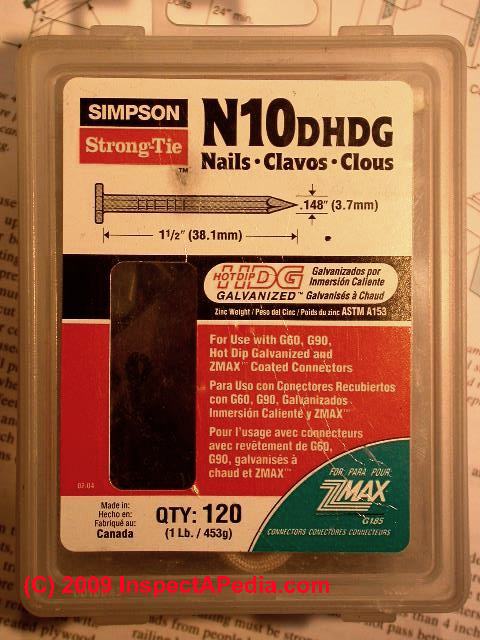
These deck construction nails, such as the joist hanger nails shown in our photo above, have three times as much zinc coating as standard G60 connectors. Examples of G185 coatings include Simpson’s Z-Max or USP Connector’s Triple-Zinc. Best Practices Guide to Residential Construction (Steve Bliss, J Wiley & Sons) explains:
When using lumber treated with ACQ or copper azole, use hot-dipped galvanized fasteners that meet ASTM A153 with a minimum of 2 ounces of zinc coating per square foot.
Some galvanized nails intended for deck construction are marketed as “doublehot-
dipped.”
Connectors, flashings, and other hardware in contact with treated wood should meet ASTM A653, Class G185 (1.85 ounces of zinc per square foot of metal surface). Galvanized fasteners may stain redwood and cedar, however.
Also see PRESERVATIVE TREATED WOOD LIFE
Typical[7] Nail Schedule for Metal Framing Connectors - Joist Hangers
| Nominal Wood Joist Size | Nails into Abutting Header (through the connector) (10d 1 1/2" joist hanger nails) |
Nails into Joist (through the connector) (10d 1 1/2" joist hanger nails) |
| Single Joists | ||
| 2x4 | 4 | 2 |
| 2x6 | 6 | 4 |
| 2x8 | 8 | 6 |
| 2x10 | 10 | 6 |
| 2x12 | 10 | 6 |
| 2x14 | 10 | 6 |
Typical[7] Nail Schedule for Metal Framing Connectors - Joist Hangers - Built-up Beams
| Nominal Wood Joist Size | Nominal Thickness (as number of 2x's making up the header or beam) | Nails into Abutting Header (through the connector - sum of both sides) (10d 1 1/2" joist hanger nails) |
Nails into Joist (through the connector, sum of both sides) (10d 1 1/2" joist hanger nails) |
| Built-up headers & beams: double, triple, quad or custom thickness, joist & truss hangers | |||
| 2x6 | 2 - 2x6's (3" thick) | 8 | 4 |
| 2x8 | 2 - 2x8's (3" thick) | 12 | 6 |
| 2x10 | 2 - 2x10's (3" thick) | 14 | 8 |
| 2x12 | 2 - 2x12's (3" thick) | 14 | 8 |
| 2x14 | 2 - 2x14's (3" thick) | 14 | 8 |
| 4x8 | 4x8 (3-1/2" thick) | 12 | 6 |
| 4x10 | 4x10 (3-1/2" thick) | 14 | 8 |
| 2x10 | 3 - 2x10's | 14 | 8 |
| 2x10 | 4 - 2x10's | 6 (review needed) | 4 (review needed) |
References
- Simpson Strong-tie DECK CONNECTION and FASTENING GUIDE [PDF] (2019) Recommendations for the construction of building-code-compliant decks, Simpson Strong Tie®, retrieved 2020/11/23, original source: https://www2.strongtie.com/catalog_order.asp?site=SST where you can download any of a large collection of reference documents, catalogs, and product guides from Simpson Strong-Tie.
- Simpson Strong-tie FASTENING SYSTEMS CATALOG & TECHNICAL GUIDE [PDF] (2019) , Simpson Strong Tie®, retrieved 2020/11/23, original source: https://www2.strongtie.com/catalog_order.asp?site=SST where you can download any of a large collection of reference documents, catalogs, and product guides from Simpson Strong-Tie.
- Simpson Strong-tie C-F-2019TECHSUP [PDF] is a 164-page technical document featuring engineering data, illustrations, diagrams and tables for structural fasteners featured in the C-F-2019 Fastening Systems Catalog listed just above.
- Simpson Strong-tie WOOD CONSTRUCTION CONNECTORS [PDF] (2020) , Simpson Strong Tie®, retrieved 2020/11/23, original source: https://www2.strongtie.com/catalog_order.asp?site=SST where you can download any of a large collection of reference documents, catalogs, and product guides from Simpson Strong-Tie.
Stainless Steel Nails & Screws for Decks in Salt-Exposed or Wet/Humid Climates
In very wet or humid climates, or in areas subject to salt-water spray or deicing salts, stainless steel is the best choice. Stainless steel is also recommended for tropical hardwoods, which tend to cause staining with coated nails.
Both types 304 and 316 stainless steel have been tested for use with the new wood preservatives ACQ and copper azole. Type 304 is suitable for above- ground applications. Type 316 is recommended in areas subject to salt or salt water.
Watch out: Never use stainless steel in contact with galvanized steel, as the galvanized coating will quickly corrode. Where fasteners such as nails, bolts, or lags are in contact with metal connectors, use the same metal for both components.
Proprietary Structural & Deck Board Screws & Screw or Nail Coatings
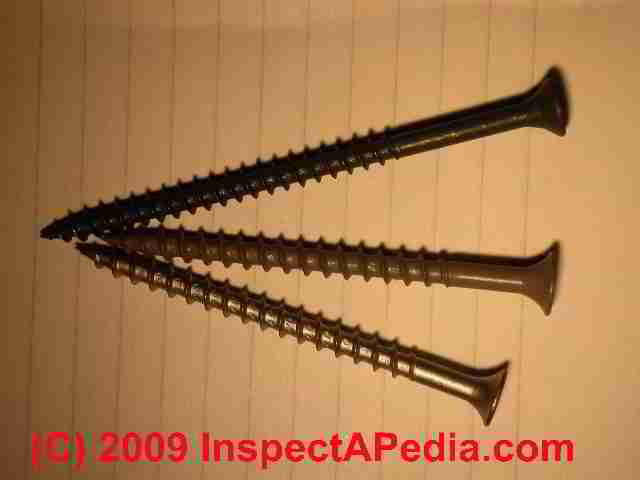
 Many decking screws sold in home centers have newer proprietary ceramic and epoxy coatings over an electro galvanized core.
Originally developed for use with CCA-treated lumber, many have now been tested and approved for use with ACQ and copper azole.
Our photo, left, shows two proprietary-coating coated structural screws used for decks; the right-hand most screw is hot-dip galvanized.
This PHOTO shows these 2 1/2" screws from the side view.
- Cleveland Steel Structural Fasteners, 26001 Richmond Rd., Bedford Heights, OH 44146,| Phone: 216.464.9400, Fax: 216.464.9404, E-mail: info@clevelandsteel.com, Website: http://clevelandsteel.thomasnet.com/category/construction-hardware-division?
- Daytona Bolt & Nut, 815 N. Beach Street, P.O. Box 1391, Daytona, FL 32114, P: 386-255-0248, F: 386-257-5985, E-mail:Daytona@DaytonaBolt.com
- Grip-Rite Fas'ners® produces "PrimeGuard Ten" exterior screws that use a coating approved for exterior use with all types of treated lumber.
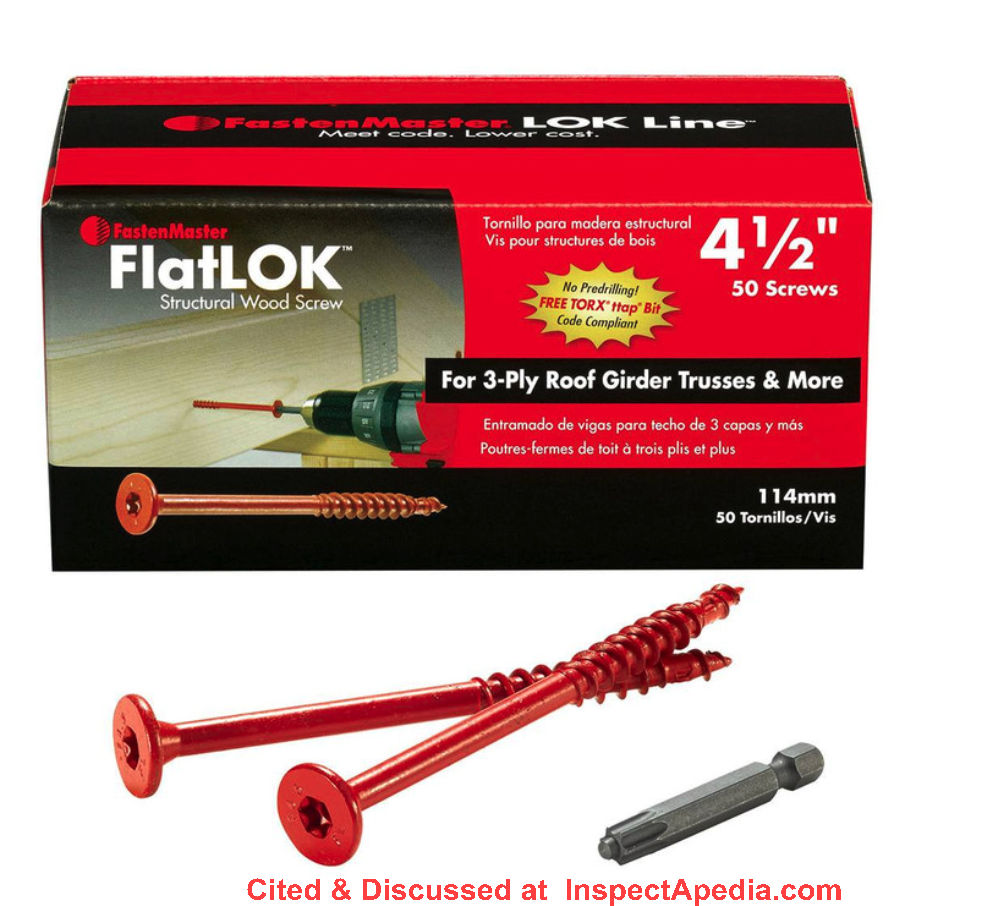
- FastenMaster FlatLOK Structural Wood screws are illustrated below. FastenMaster, 153 Bowles Road, Agawam, MA 01001 USA, Tel: 413-789-0252 / 800. 518. 3569 Web: Fastenmaster.com
These structural screws, driven with a torx bit, are very strong, thin enough in diameter to avoid splitting wood, are corrosion-resistant coated, and of course available in a range of sizes and lengths.
Product description excerpts:
The FlatLOK Structural Wood Fastener has been designed specifically for joining multiple plies of dimensional lumber and engineered wood for headers, girders, and beams.
When installed as instructed in this bulletin, these fasteners can be used to replace nailing and bolting patterns prescribed by code, specified by the engineer or recommended by the engineered lumber manufacturer.
FastenMaster FlatLOK is a multi-purpose structural wood-to-wood fastener that is an alternative fastening method to using nails and through bolts when attaching multi-ply LVL, dimensional beams and girder trusses.
FlatLOK is easy-to-use because it requires no predrilling, thereby saving time and money. The flat head sits flush, allowing for easy application of drywall or trim. In addition, FlatLOK is approved for single-sided installation making the job easier to complete both at ground level or for elevated applications.
FastenMaster FlatLOK wood screw features TORX(R) ttap(R) drive system that maximizes bit fit, reducing the potential for stripping. The stability button allows for maximum penetration into the fastener and a wobble-free drive. A free TORX tap bit is included in every box.
See these instructions and product guide:
FlatLOK FASTENMATER TECHNICAL GUIDE [PDF]
Framing instructions, products, uses, guidelines.
FlatLOK FASTENMASTER TECHNICAL BULLETIN [PDF] (2021) FastenMaster, 153 Bowles Road, Agawam, MA 01001 USA, Tel: 413-789-0252 / 800. 518. 3569 Web: Fastenmaster.com
- Incom Distributor Supply, PO Box 868, Fort Wayne IN 46801, Tel: 260-748, 5469, Website: http://shop.incomsupply.com/shop/, "... a growing nationwide network of over 500 Commercial Industrial Distributors" Incom Inc, 73-5600 Kauhola St Ste C, Kailua Kona, HI 96740, Tel: (808) 329-1311
- Prudential produces galvanized exterior deck screws such as the one shown at the right in our photo, above.
These screws are warranted "for as long as you own your home" and are rated for use in untreated or CCA pressure treated wood in residential structures. - Schuler Mfg. & Equip. Co. Inc., 63724 Richland Road, Griswold, Iowa 51535, Tel: (712) 774-2228 Website: http://www.schulermfg.net/
- Silva Timber Products, Unit 4, Albright Road
Widnes,
Cheshire,
WA8 8FY,
Tel: 0151 495 3111,
Fax: 0151 495 2255,
Website: http://www.silvatimber.co.uk/, Email: enquiries@silvatimber.co.uk
Silva's Double Shear Joist hangers include a cut-out/stamping that provides distributed, and properly-angled 45-degree nailing positions (load points) in the joist hanger.
The angles assure proper toe-nailing of the hanger nails.
Double shear nailing hangers are a patented [since 1984] feature of Simpson Strong-Tie ZMAX galvanized joist hangers.
Other companies such as Silva Timber Products (in the U.K.) produce similar double-shear joist and truss hanger products.
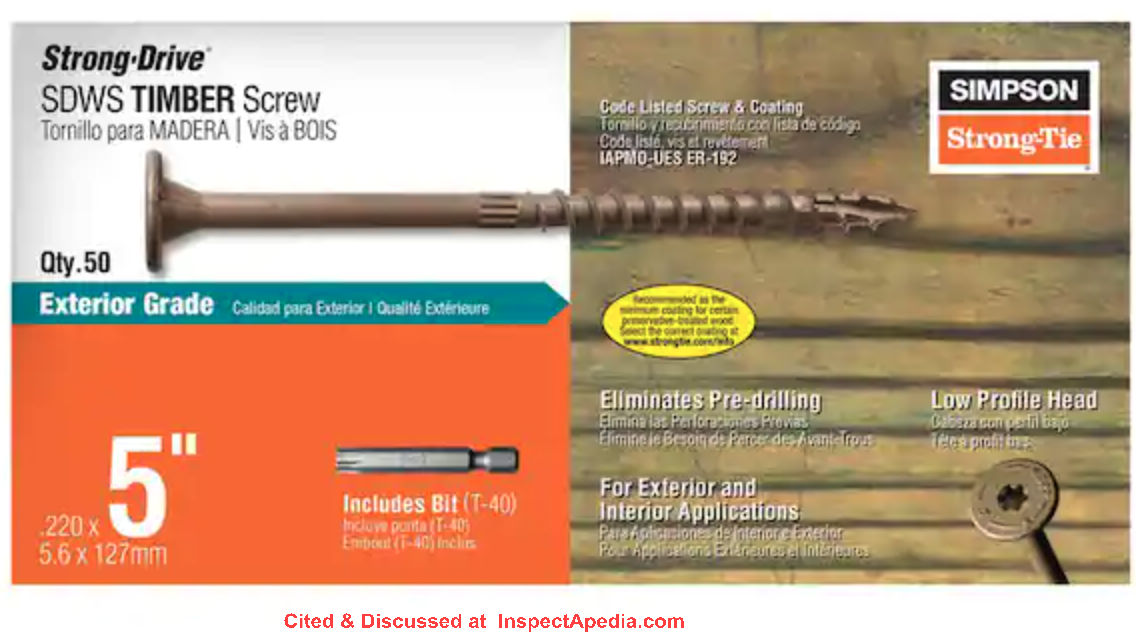
- Simpson Strong-Drive SDWS TIMBER Screws are illustrated below. Simpson Strong Tie®, Tel:1-800-999-5099, Website: .strongtie.com/
These coated structural screws from Simpson Strong Tie are available in lengths of 4, 5,6, 8 and 10 inches.
Product details excerpt:
Designed to provide an easy-to-install, high-strength alternative to through-bolting and traditional lag screws.
The Strong-Drive SDWS Timber Screw (Exterior Grade) is ideal for the contractor and do-it-yourselfer alike.
It is code Listed under IAPMO UES ER-192 and meets 2015 and 2018 IRC and IBC code requirements for several common wood framing applications.
Simpson WARRANTY [PDF] excerpt:
Simpson Strong-Tie Company Inc. warrants catalog products to be free from defects in material or manufacturing. Simpson Strong-Tie Company Inc. products are further warranted for adequacy of design when used in accordance with design limits in this catalog and when properly specified, installed and maintained.
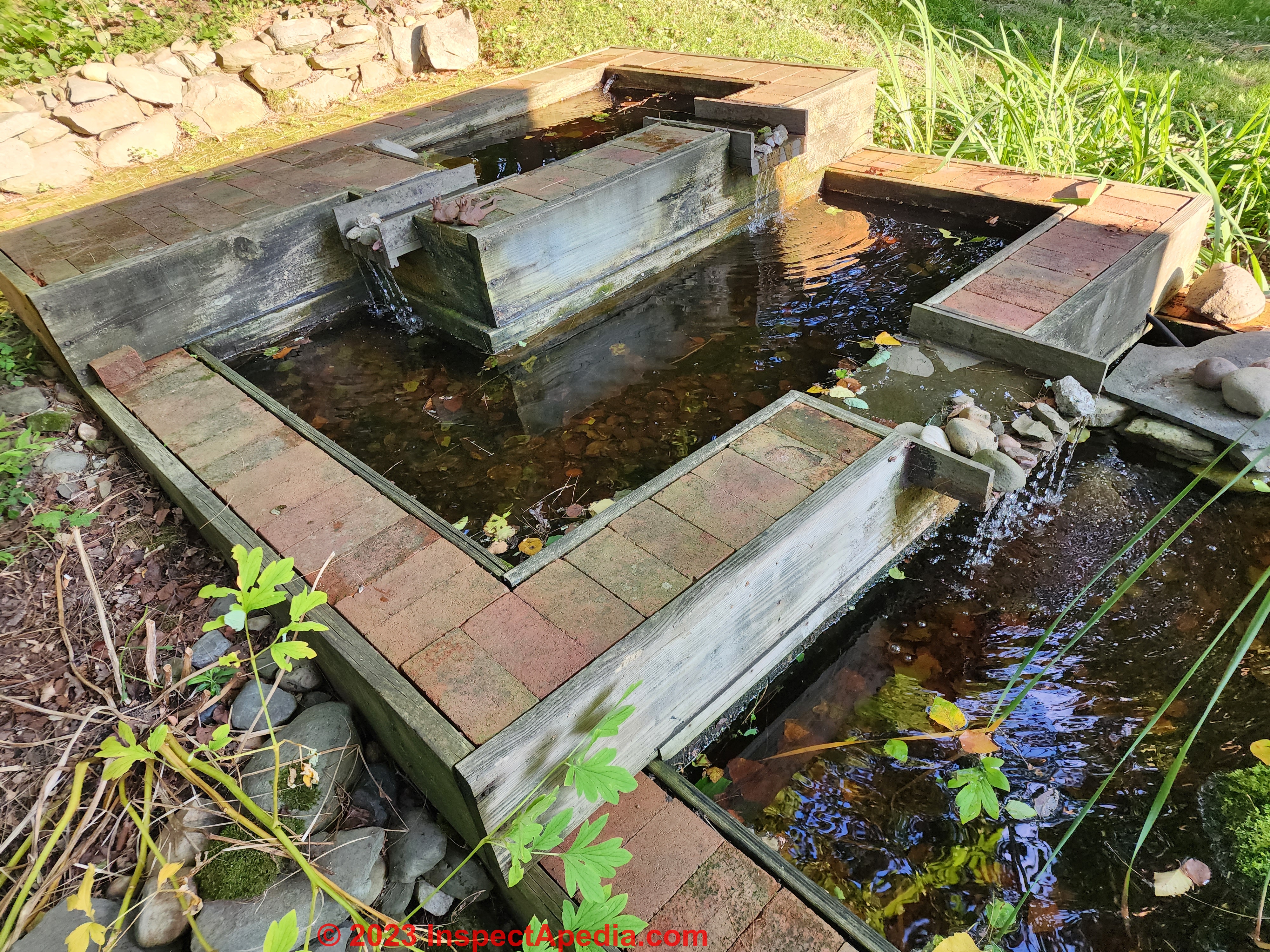
Below: We used an earlier version of these Simpson structural screws in constructing a treated-wood pond enclosure twenty years ago [shown below] - they and the structure they joined are still intact - Ed.
- "Tamlyn Structural Lumber Connectors, Masonry / Concrete Products, Pest Control, [catalog & reference guide]", Tamlyn, 13623 Pike Road, Stafford, TX 77477, USA Toll Free 800-334-1676, Phone: 281-499-9604, Fax: 281-499-8948, (photo, above left), Website: http://tamlyn.com/ [copy on file as /structure/Framing/Connectors Framing/Tamlyn_Structural_Connector_Cat.pdf]
- USP Structural Connectors®, Tel: 1-800-328-5934, Email: uspcustomerservice@mii.com, Website: http://www.uspconnectors.com/
Watch out: when using any of these fastener types, make sure that it is recommended by the manufacturer for the specific type of decking, framing lumber, or timber or post connections being installed.
Aluminum Deck Nails
Best Practices Guide to Residential Construction continues:
Watch out: Do not use aluminum fasteners, connectors, or flashings in contact with pressure-treated wood. The copper-based waterborne preservatives will cause corrosion and premature failure.
Also see PRESERVATIVE TREATED LUMBER.
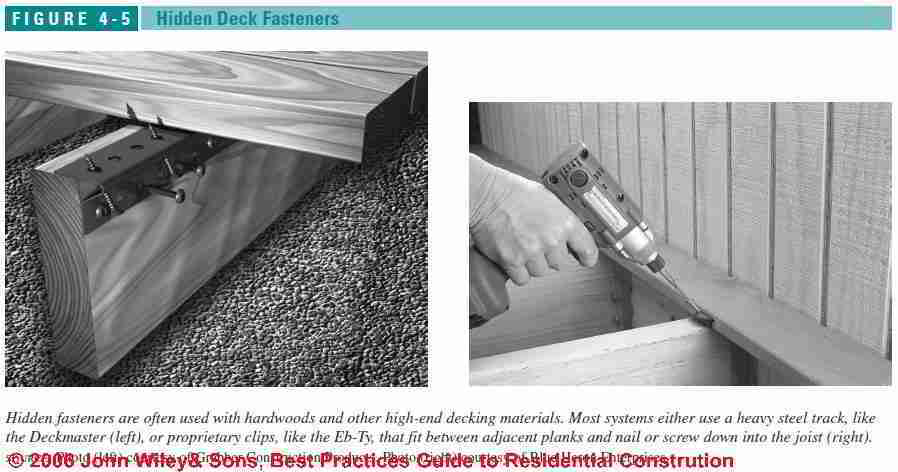
Hidden Deck Fasteners for Deck Boards
Over time, face-nailed deck fasteners may loosen, stain the wood decking, or lead to splitting and water penetration. Particularly with higher-end decking materials, such as tropical hardwoods, more customers are opting for hidden fastening systems.
See DECK & PORCH PRODUCTS, MANUFACTURERS
Each system is proprietary, and some require proprietary tools supplied by the fastener manufacturer.
Some suppliers of hardwood decking recommend a specific fastener for their product and may sell the fasteners along with the decking. There are two types of systems.
One, such as Deckmaster® (Grabber Construction Products), uses a right-angle bracket that fastens to the tops of the joists and screws into the underside of the decking. These are easiest to install if the installer has access from below the deck.
The other type uses individual fasteners that fit between adjacent decking planks and screw down into the top of the joist. These typically attach to the edges of the decking planks with clips or prongs.
A variation on this type called Eb-Ty (Blue Heron Enterprises) fits into slots cut into the edges of adjacent deck boards with a plate jointer (see Figure 4-5 below).
The biggest concern with hidden deck fasteners is whether they are strong enough to resist the tendency of deck boards to warp or twist.
For that reason, they are best used with premium decking products, which are dimensionally stable. Tropical hardwoods and composite decking are good candidates for hidden fasteners.
-- Adapted with permission from Best Practices Guide to Residential Construction (Steve Bliss, J Wiley & Sons) .
Guide to Selecting the Proper Deck or Porch Floor Decking Fasteners
Whether using nails or screws, make sure to choose a product that is up to the task both structurally and aesthetically. In general, screws are more expensive to buy and install, but often they make for a neater job with fewer callbacks due to boards popping up.
Construction adhesives specially formulated for treated wood may be used in conjunction with nails or screws.
Nails for Use with Deck Floors - Decking
If the decking is to be nailed, use either spiral-, twist-, or ring-shanked nails to resist pullout. When using pressure-treated wood, the fasteners should be either hot- dipped galvanized, meeting ASTM A153, or stainless steel Type 304 or higher
See WOOD PRESERVATIVES & CORROSION above
and see PRESERVATIVE TREATED LUMBER.
Galvanized nails sometimes cause discoloration with redwood, cedar, and tropical hardwoods, so stainless steel is a safer choice with these materials. Aluminum nails are also an option for redwood or cedar, but they should not be used with pressure-treated wood.
The bigger the head, the better the hold-down power.
At a minimum, use a casing nail, preferably a common. Some manufacturers sell special decking nails with a head size in between the two. For 5/4" decking use a 10d (3-inch) nail. For thicker decking use a 16d (3 1/2") nail.
Deck Joist & Beam Sizing Tables & A Quick Rule of Thumb for Sizing Joists
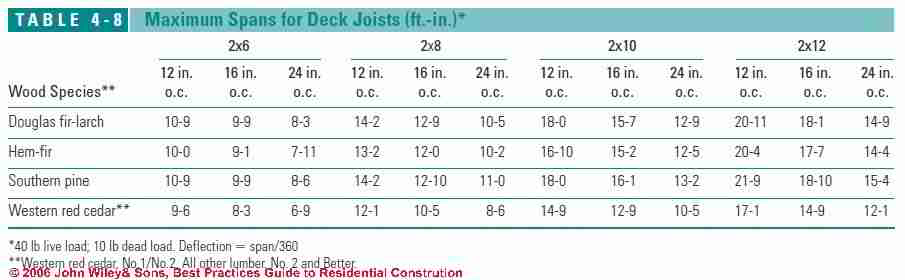
Spans, sizes and spacings for deck joists and deck beams are discussed in detail
at FRAMING TABLES, SPANS for DECKS
and are listed in Table 4-7
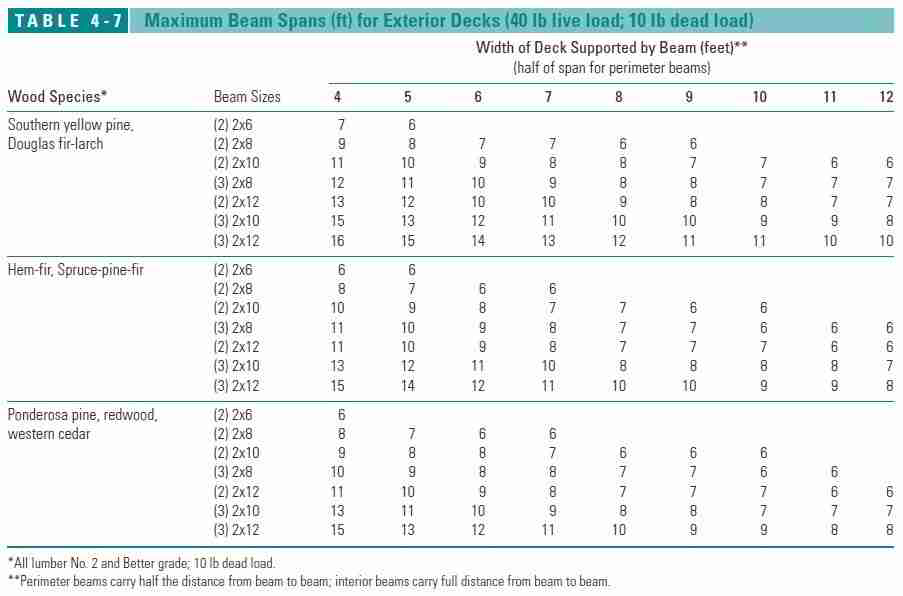
and Table 4-8.
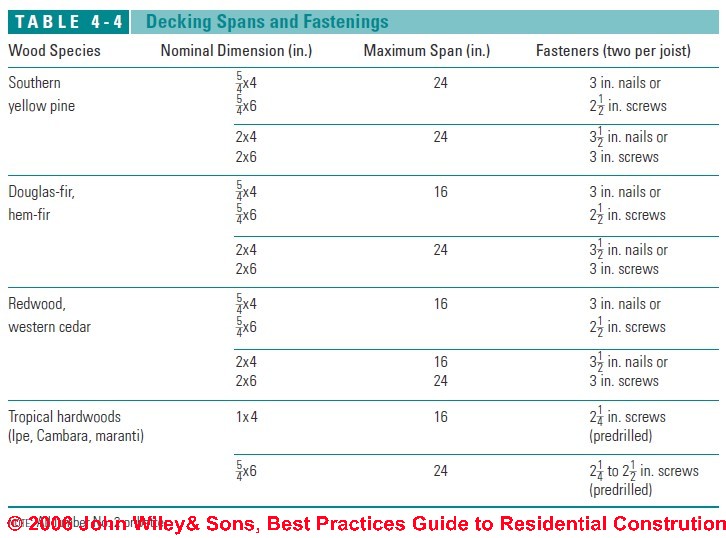
Decking Spans for deck flooring are shown in the Table 4-4 below.
[Click to enlarge any image or table]
[
Screws for Use with Deck Floors - Decking
Power-driven screws are more expensive and a little slower to install, but they are the best choice since they do a better job of holding down the decking and are more easily removed for repairs.
For treated wood, use either hot-dipped galvanized screws that meet ASTM A153, stainless-steel multipurpose screws, or specialty decking screws with proprietary coatings tested and approved for use with the new types of wood treatments.
Multipurpose screws have a thicker shank and courser thread than drywall screws, giving them greater strength and better holding power. Some specialized decking screws also have cutting nubs under the head for self-countersinking in wood.
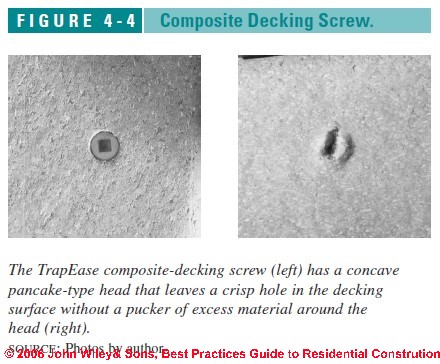
Others have special concave “pancake” heads for composite decking. The composite-decking screws leave a crisp hole in the decking surface without the typical pucker of excess material (mushrooming) around the screw head (see Figure 4-4 below).
In addition to Phillips-head screws, decking screws come with square-drive and star-drive heads that allow higher torque driving without stripping the head.
Also see DECK COLLAPSE Case Study (collapse of a new code-approved deck)
and DECK FLASHING LEAKS, ROT Case Study for an example of an older deck with rot and collapse due to improper construction and missing building flashing.
-- Adapted with permission from Best Practices Guide to Residential Construction (Steve Bliss, J Wiley & Sons) .
Hidden Deck Screws
"Hidden" deck screws are structural fasteners for connecting decking that use proprietary screws or backer connectors that do not appear on the deck surface. See:
- FastenMaster, [Cortex® hidden fastening system] Tel: 1-800-518-3569, Email: info@fastenmaster.com, Website: fastenmaster.com
- Hohmann & Barnard, Inc, produces a huge range of structural ties and anchors, including for masonry repair and restoration, stone anchors, rebar positioners, [Wing Nut 2-Seal™ Tie, wing nut veneer anchor seals air barriers], Offices in 8 U.S. cities, including H&B New York 30 Rasons Court, Hauppauge, NY 11788 (P) 631-234-0600, (F) 631-234-0683, Toll: 800-645-0616, Website: www.h-b.com
Basic building framing information is found at FRAMING AGE, SIZE, SPACING, TYPES.
Spans, sizes and spacings for deck joists and deck beams are discussed in detail
at FRAMING TABLES, SPANS for DECKS
and are shown in Table 4-7 and Table 4-8.
Tips for Removing Coated Deck Fasteners & Screws
Reader Question: how can I remove the screws securing PVC deck railings from my deck?
I am trying to remove PVC deck rails from my deck using an 18 volt power driver and can’t budge most of the fasteners which are coated 2 ½ #8. In a lot of cases the heads have broken off, but most will not budge even with the driver set in the highest torque. Any ideas? - J.R. 30 June 2015
Reply:
Break them or cut them through with a hacksaw blade and reciprocating saw.
Reader follow-up:
Thanks ... unfortunately the screws are inside a PVC deck railing bracket and the bottom brackets are 36 inches down a PVC post sleeve! I even tied buying a speed out kit that “removes any damaged screws in 10 seconds” and that didn’t work.
 Reply:
When I've had this trouble I've broken the screws by driving a flat bar through the interfaced connection.
The screws will snap nicely.
If there is a risk of damaging the deck rail or other PVC deck components with the flat bar, use two thin flat bars, drive them between the joined segments, then hammer a third flat bar or even a flooring chisel between them to break the fastener without gouging the PVC material.
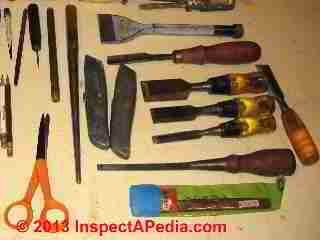
The grey chisel near the top right in the photo shown at above left is a flooring chisel that can work in this application
If you can get a couple of thin flatbars and a thin cold chisel and IF your situation gives you a place to drive them, the fasteners will usually snap quickly. I've used this method to remove deck boards when the freakin' screws all stripped when I tried to unscrew them.
An alternative that works with wood joists and beams into which screws are driven is to use a long thin punch and drive the screws downwards into the underlying member.
Drilling the screw heads off will also sometimes allow pry up of the attached member from the secured-to member. Then the screw remains that projects up from the secured-to member can be clipped or snapped off. But I'd avoid drilling through PVC plastic rails in areas where a slipping drill bit makes an ugly mess.
...
Continue reading at DECK FASTENER CHOICES or select a topic from the closely-related articles below, or see the complete ARTICLE INDEX.
Or see these FRAMING FASTENERS, NAILS, SCREWS FAQs - questions & answers posted originally on this page
Or see these
Recommended Articles
- CONNECTORS, FASTENERS, TIES
- DECK BUILDING & CARPENTRY TOOLS
- DECK CONSTRUCTION BEST PRACTICES - home
- DECK DESIGN & BUILD - home
- DECK FASTENER CHOICES
- DECK FRAMING TABLES, SPANS
- FRAMING DAMAGE, INSPECTION, REPAIR - home
- FRAMING FASTENERS, NAILS, SCREWS - best construction practices.
- FRAMING CONNECTORS & JOIST HANGERS - best construction practices.
- HURRICANE TIE DOWN CONNECTORS & FASTENERS - in framing connectors, are screws ok to use instead of nails? Yes in some cases.
- STAIR STRINGER to FRAMING CONNECTORS
- TOE NAILED FRAMING CONNECTIONS - traditional framing without steel connectors
Suggested citation for this web page
FRAMING FASTENERS, NAILS, SCREWS at InspectApedia.com - online encyclopedia of building & environmental inspection, testing, diagnosis, repair, & problem prevention advice.
Or see this
INDEX to RELATED ARTICLES: ARTICLE INDEX to BUILDING DECKS & PORCHES
Or use the SEARCH BOX found below to Ask a Question or Search InspectApedia
Or see
INDEX to RELATED ARTICLES: ARTICLE INDEX to BUILDING STRUCTURES
Or use the SEARCH BOX found below to Ask a Question or Search InspectApedia
Ask a Question or Search InspectApedia
Try the search box just below, or if you prefer, post a question or comment in the Comments box below and we will respond promptly.
Search the InspectApedia website
Note: appearance of your Comment below may be delayed: if your comment contains an image, photograph, web link, or text that looks to the software as if it might be a web link, your posting will appear after it has been approved by a moderator. Apologies for the delay.
Only one image can be added per comment but you can post as many comments, and therefore images, as you like.
You will not receive a notification when a response to your question has been posted.
Please bookmark this page to make it easy for you to check back for our response.
Our Comment Box is provided by Countable Web Productions countable.ca
Citations & References
In addition to any citations in the article above, a full list is available on request.
- Our recommended books about building & mechanical systems design, inspection, problem diagnosis, and repair, and about indoor environment and IAQ testing, diagnosis, and cleanup are at the InspectAPedia Bookstore. Also see our Book Reviews - InspectAPedia.
- Steve Bliss's Building Advisor at buildingadvisor.com helps homeowners & contractors plan & complete successful building & remodeling projects: buying land, site work, building design, cost estimating, materials & components, & project management through complete construction. Email: info@buildingadvisor.com
Steven Bliss served as editorial director and co-publisher of The Journal of Light Construction for 16 years and previously as building technology editor for Progressive Builder and Solar Age magazines. He worked in the building trades as a carpenter and design/build contractor for more than ten years and holds a masters degree from the Harvard Graduate School of Education. Excerpts from his recent book, Best Practices Guide to Residential Construction, Wiley (November 18, 2005) ISBN-10: 0471648361, ISBN-13: 978-0471648369, appear throughout this website, with permission and courtesy of Wiley & Sons. Best Practices Guide is available from the publisher, J. Wiley & Sons, and also at Amazon.com - Decks and Porches, the JLC Guide to, Best Practices for Outdoor Spaces, Steve Bliss (Editor), The Journal of Light Construction, Williston VT, 2010 ISBN 10: 1-928580-42-4, ISBN 13: 978-1-928580-42-3, available from Amazon.com
- [2] Mark Morsching, Everflashing, Tel: 800-550-1667, Email: everflashing@gmail.com. The Everflashing product comes in G-185 and Stainless Steel and is intended for use with treated lumber with copper in it. Everflashing produces a variety of specialty flashing products including flashings for use with decks at deck ledgers and deck perimeters.
- In addition to citations & references found in this article, see the research citations given at the end of the related articles found at our suggested
CONTINUE READING or RECOMMENDED ARTICLES.
- Carson, Dunlop & Associates Ltd., 120 Carlton Street Suite 407, Toronto ON M5A 4K2. Tel: (416) 964-9415 1-800-268-7070 Email: info@carsondunlop.com. Alan Carson is a past president of ASHI, the American Society of Home Inspectors.
Thanks to Alan Carson and Bob Dunlop, for permission for InspectAPedia to use text excerpts from The HOME REFERENCE BOOK - the Encyclopedia of Homes and to use illustrations from The ILLUSTRATED HOME .
Carson Dunlop Associates provides extensive home inspection education and report writing material. In gratitude we provide links to tsome Carson Dunlop Associates products and services.
 | HOME | ABOUT | ASK a QUESTION | CONTACT | CONTENT USE POLICY | DESCRIPTION | POLICIES | PRIVACY | |
| © 2024 - 1985 Publisher InspectApedia.com - Daniel Friedman | |||||||||