
InspectAPedia® FREE Encyclopedia of Building & Environmental Construction, Diagnosis, Maintenance & Repair |
Question? Just ask us! InspectAPedia
|
 How to Remove & Avoid Formaldehyde Gas Hazards In buildings
- POST a QUESTION or COMMENT about reducing indoor formaldehyde gas levels
Reduce formaldehyde hazards in buildings:
This article describes steps to reduce or eliminate exposure to formaldehyde gas in air or water indoors - how to remove formaldehyde gas and formaldehyde gas emitting building products.
We include scholarly research on methods for reduction of formaldehyde levels in buildings and in other systems.
InspectAPedia tolerates no conflicts of interest. We have no relationship with advertisers, products, or services discussed at this website.
Suggestions for Reducing Exposure to Formaldehyde Indoors
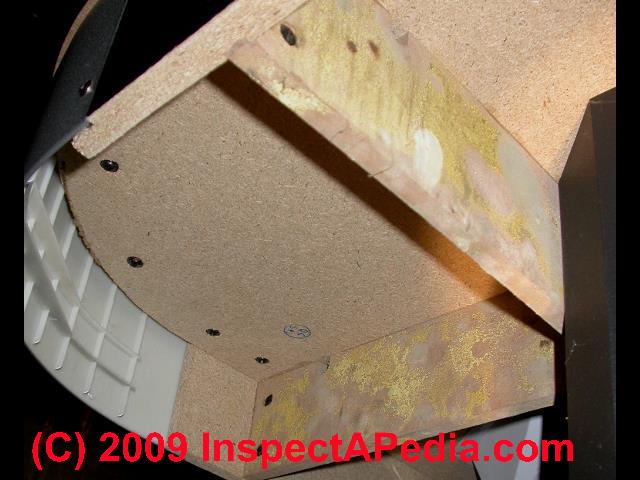
How to get rid of indoor formaldehyde gas. How to avoid formaldehyde gas hazards indoors. List of sources of formaldehyde gas or odors in buildings. How to reduce formaldehyde exposure levels in a buildingrmaldehyde gas odors or hazards in buildings.
Our photo (left) shows bare particle board visible on the under-side of a game table. The yellow growth happens to be a mold infection.
If the bare particle board surface had been sealed with a clear sealant or a paint the moisture up-take of this particle board product would have been less friendly to mold growth and possibly to formaldehyde outgassing as well.
[Click to enlarge any image]
This article includes excerpts or adaptations from Best Practices Guide to Residential Construction (Steve Bliss, J Wiley & Sons) , by Steven Bliss, courtesy of Wiley & Sons.
As we described at FORMALDEHYDE HAZARDS
Formaldehyde is a ubiquitous volatile organic compound (VOC) that occurs in nature and is widely used in building products, finishes, and furnishings because of its desirable properties and low cost. Nearly all products made with formaldehyde outgas to some extent, but only a few contribute significantly to indoor air problems.
The best way to limit exposure to formaldehyde is to avoid the use of bare pressed wood products made with urea-formaldehyde resins.
Also avoid cabinets, flooring, and furniture finished with acid- catalyzed urea formaldehyde coatings, which emit a very high level of formaldehyde when new. Individuals with formaldehyde sensitivity should take further steps to avoid permanent press draperies, wallpaper, and conventional paints, many of which use formaldehyde as a preservative.
The highest emitting products are typically medium- density fiberboard, particle board, interior hardwood plywoods, such as lauan, and prefinished interior plywood paneling. In addition to underlayments and decorative panels, these product are widely used in cabinets, countertops, shelving, and furniture.
Where possible, substitute solid wood, softwood plywood, or products certified as low emitters of formaldehyde. All exterior-grade plywood and pressed-wood products and all APA-stamped plywood panels use phenol-formaldehyde resins, which are more chemically stable than urea- formaldehyde and have negligible emissions. Homasote products are also free of formaldehyde and can be used as underlayment and sound insulation.
For cabinetwork, look for low-emitting substrates using phenol-formaldehyde or methylene diisocyanate (MDI) resin, such as SierraPine’s formaldehyde-free medium-density-fiberboard called Medite II.
There are also many “low-formaldehyde” panel products developed to comply with U.S. Department of Housing and Urban Development (HUD) requirements for manufactured housing. While these generally have lower formaldehyde emissions than noncertified products, they may still have over three times the emissions of products made with phenolic or MDI resin.
Where panel products with urea-formaldehyde resins must be used, they should be covered or coated on as many surfaces as possible.
Panels covered with an impermeable facing, such a vinyl or plastic laminate, have low emissions. Another option is to coat the panels with two or more coats of a water-resistant finish, such as polyurethane, lacquer, or alkyd paint. In general, unless a finish is visibly thick and an effective vapor barrier, it probably has little effect on formaldehyde emissions.
Controlling heat and humidity is also important, since hot, humid conditions significantly raise the level of formaldehyde emissions. Sensitive individuals should also launder permanent-press draperies before using and should avoid newly painted rooms for several days.
Prior to use, any new furnishings or surfaces with formaldehyde-based materials should be allowed to air out for several days to several weeks in a well-ventilated space.
Generally, formaldehyde levels will drop off rapidly at first and eventually level off at very low levels. Monitoring of 40 new houses by Oak Ridge National Laboratory found that, after five years, nearly all houses, including those insulated with urea-formaldehyde (UF) foam insulation, had formaldehyde levels below 0.1 ppm.
-- Adapted with permission from Best Practices Guide to Residential Construction (Steve Bliss, J Wiley & Sons) .
Reader Question: Eliminating formaldehyde using Ammonia NH4 ?
My daughter purchased a used trailer that now apparently has a formaldehyde odor in it. It doesn’t bother her husband, but does irritate her nose and eyes. She ran across a homeopathic remedy to (apparently) “eliminate” the problem. It involves putting NH4 in the room.
The chemistry is shown at a homeopathic remedy website in an article titled "FORMALDEHYDE and its ANTAGONISTS" . The reactions seem reasonable, but this begs the question of the effectiveness of the treatment itself. What do you think about this? Your opinion is appreciated. Thanks in advance. - Eric
Reply: Best approach to indoor formaldehyde: find and remove the sources of irritating indoor chemicals
OPINION: A discussion I had some time ago with a theoretical phyisist included her observation that while, as a theoretician operating at the edge of human understanding of particle physics, she was reluctant to say that anything is impossible, including the "water memory" theory underpinning the very-dilute-is-more-effective principle of homeopathic remedies that dilute a substance with water until not a single molecule of the original substance remains in the treated water.
We recognize that some people report using and being very satisfied with homeopathic remedies for a wide range of complaints, notwithstanding the scientific challenges involved.
But the same physicist pointed out that for that latter homeopathic theory to hold, many other scientific observations that are widely accepted, ranging from observations of the earth circling the sun to the operation of internal combustion engines, would have to be found false.
So I'm uncertain about citing a homeopathy product marketing website as a source of a "cure" for formaldehyde odors.
Even if the chemistry theory of putting ammonia into indoor air to attack formaldhyde has a theoretical basis, the practical theory may be a bit thin, as we elaborate below.
The procedure described in the article wants you to place the item that is a formadehyde source in a location with an open bowl of lemon-scented ammonia. There is no evidence given in the article that the concentrations of airborne ammonia in a living room populated with formaldehyde outgassing carpets, furniture, cabinetry, would be adequate to have the desired reaction without also producing a dangerous indoor level of ammonia.
Still from a more practical and in our opinion more significant viewpoint, when dealing with most indoor contaminants, it makes the most sense to correct (remove) the source of the contaminant than to try to keep dealing with it by disguising or neutralizing it as it is generated in the indoor environment.
Otherwise, as I see it, we permit a continuing source of noxious outgassing to continue and then keep trying to deal with the result.
Watch out: The article to which you refer argues that using ammonia to "get rid of" formaldehyde invoves chemistry in which ammonia reacts with formaldehyde to produce "... a harmless imine with a byproduct of water". Ammonia too is a chemical (or gas) to which exposure can be dangerous and harmful.
In your daughter's case, if moving to a different home is out of the question, then identifying the in-home products that are the primary sources of irritating formaldehyde outgassing would be in order. Often those are carpet padding and in some cases chipboard-based cabinets and furniture. It may be possible to make just a few changes that remove the primary sources of formaldehyde sufficiently that the home no longer bothers her.
Also in at least some products, outgassing diminishes from new products after weeks or months. So the passage time alone, allowing product outgassing to complete (rather than exposure to ammonia) might explain the improvement in formaldehyde levels in many cases.
Reader Question: how do we test & what's the best way to get rid of formaldehyde outgassing from a Freight Liquidator's Laminate Flooring Job
7 March 2015 Californian said:
We just purchased a house with Lumber Liquidator flooring that was found by 60 minutes to contain formaldehyde level many times higher than the legal limit in the U.S. However, our installation is more than 2 years old.
Do you think the outgas process of our floor is mostly done? We thought about replacing the flooring but the current floor was installed on top of a plywood subfloor.
Now, what if the formaldehyde has transferred into the subfloor so if we re-install any kind of porous flooring (like carpet) then it would only allow the formaldehyde to rise through the new flooring into our living space? Is this a realistic possibility? What can we do to test the level of formaldehyde in the indoor air? And what's the best way to get rid of it?
Reply:
Thanks for the interesting question, Californian.
I'm not sure I agree with your premise that a significant level of formaldehyde has transferred to the subflooring below your laminate flooring. I would not, without carefully-constructed testing, assume that the subfloor is a meaningful receiver of formaldehyde such that it would continue to offer an outgassing hazard from having had a laminate or engineered floor installed above it, nor would I assume, without proper testing, that the finish flooring in your home is hazardous.
Nor do we know that your particular floor was the specific Chinese-made product that has raised this formaldehyde concern.
While the article you cite reported unacceptably high levels of formaldehyde, I have not yet located specifics on exactly how the test was performed - so we don't have a clear idea of how well it represents the actual experience likely to be had by homeowners where laminate flooring was installed.
Before contemplating any costly action I would want to see the results of two carefully constructed tests of formaldehyde levels.
- A properly-conducted test of formaldehyde levels in your home at a fixed height above the floor (where people breathe), both in the laminate-floored room and in another more remote room in the home where other flooring products (including carpeting and excluding it too) are installed.
That way we have an idea of whether or not occupants are being exposed to hazardous formaldehyde levels. - A "worst case" formaldehyde test in your home, or in my parlance, "most aggressive" test of the flooring in the most-suspect room(s) in the home. This might be performed by collecting a sample under an enclosed cover right over the floor surface either over a specified interval.
Please see complete details including your question and a more exhaustive reply now found
at FORMALDEHYDE in LAMINATE FLOORING
Formaldehyde Removal & Formaldehyde Antagonists scholarly research articles
Note: The research articles we could find discussing formaldehyde antagonists did not share the viewpoint of the reader whose question was reported above.
- See FORMALDEHYDE HAZARDS for a table of formaldehyde levels found outdoors and in buildings and a comparison of those levels with current residential exposure standards for formaldehyde.
- Aydogan, Ahu, and Lupita D. Montoya. "Formaldehyde removal by common indoor plant species and various growing media." Atmospheric environment 45, no. 16 (2011): 2675-2682.
- Chin, Paul, Lao P. Yang, and David F. Ollis. "Formaldehyde removal from air via a rotating adsorbent combined with a photocatalyst reactor: Kinetic modeling." Journal of catalysis 237, no. 1 (2006): 29-37.
- Eichler, O., and C. Koch. "Antiphlogistic, analgesic and spasmolytic effect of harpagoside, a glycoside from the root of Harpagophytum procumbens DC." Arzneimittel-Forschung 20, no. 1 (1970): 107.
- Eiroa, M., C. Kennes, and M. C. Veiga. "Formaldehyde and urea removal in a denitrifying granular sludge blanket reactor." Water research 38, no. 16 (2004): 3495-3502.
- Garrido, J. M., R. Mendez, and J. M. Lema. "Simultaneous urea hydrolysis, formaldehyde removal and denitrification in a multifed upflow filter under anoxic and anaerobic conditions." Water research 35, no. 3 (2001): 691-698.
- Garrido, J., R. Mndez, and J. Lema. "Treatment of wastewaters from a formaldehyde-urea adhesives factory." Water Science & Technology 42, no. 5-6 (2000): 293-300.
- He, Yunbing, Hongbing Ji, and Lefu Wang. "Development of the removal of indoor formaldehyde with catalytic oxidation." Chemical Industry and Engineering Progress 26, no. 8 (2007): 1104.
- Hidalgo, A., A. Lopategi, M. Prieto, J. Serra, and M. Llama. "Formaldehyde removal in synthetic and industrial wastewater by Rhodococcus erythropolis UPV-1." Applied Microbiology and biotechnology 58, no. 2 (2002): 260-264.
- Kim, Kwang Jin, Mi Jung Kil, Jeong Seob Song, Eun Ha Yoo, Ki-Cheol Son, and Stanley J. Kays. "Efficiency of volatile formaldehyde removal by indoor plants: contribution of aerial plant parts versus the root zone." Journal of the American Society for Horticultural Science 133, no. 4 (2008): 521-526.
- Lu, Zijin, and W. Hegemann. "Anaerobic toxicity and biodegradation of formaldehyde in batch cultures." Water Research 32, no. 1 (1998): 209-215.
- Mo, Jinhan, Yinping Zhang, Rui Yang, and Qiujian Xu. "Influence of fins on formaldehyde removal in annular photocatalytic reactors." Building and Environment 43, no. 3 (2008): 238-245.
- Northover, B. J., and G. Subramanian. "SOME INHIBITORS OF HISTAMINE‐INDUCED AND FORMALDEHYDE‐INDUCED INFLAMMATION IN MICE." British journal of pharmacology and chemotherapy 16, no. 2 (1961): 163-169.
- Offermann, Francis (Bud) J., P.E., C.I.H., ASHRAE & Mark Nicas, Ph.D., MPH, C.I.H., USE WITH ADEQUATE VENTILATION ? [PDF], ASHRAE Journal, May 2018, also available as a PDF here with permission of the authors.
Abstract:
Consumer products such as paints, cleaning chemicals, and adhesives often contain toxic volatile chemicals. When these products are used indoors, these chemicals are released into the air resulting in inhalation exposures to applicators and other occupants.
The resulting indoor concentrations can result in exposures that cause acute adverse health effects, including death, and/or explosion risks.
Warning labels on these products and information in “safety data sheets” often simply caution to “use with adequate ventilation.”
Excerpt:
Providing consumers with the required ventilation rates and product quantity limitations for indoor applications of paints, cleaning chemicals, and adhesives should significantly reduce adverse health impacts associated with the use of these products. - Offermann, Bud & Linda Kincaid, "Unintended Consequences: Formaldehyde Exposures in Green Homes", The Synergist, February 2010 pp. 30-33. American Industrial Hygiene Association
- Offermann, F. J. 2009. Ventilation and Indoor Air Quality in New Homes. California Air Resources Board and California Energy Commission, PIER Energy‐Related Environmental Research Program. Collaborative Report. CEC‐500‐2009‐085
- Pei, Jingjing, and Jianshun S. Zhang. "On the performance and mechanisms of formaldehyde removal by chemi-sorbents." Chemical Engineering Journal 167, no. 1 (2011): 59-66.
- Tong, Zhiqian, Wenhong Luo, Yanqing Wang, Fei Yang, Ying Han, Hui Li, Hongjun Luo et al. "Tumor tissue-derived formaldehyde and acidic microenvironment synergistically induce bone cancer pain." PLoS One 5, no. 4 (2010): e10234.
- WANG, Wen-chao, Shi-xue ZHOU, Yao-yao JIANG, and Min-jian YANG. "Progress on Indoor Formaldehyde Removal." Environmental Science & Technology 9 (2006): 044.
- Zhao, De-Zhi, Xiao-Song Li, Chuan Shi, Hong-Yu Fan, and Ai-Min Zhu. "Low-concentration formaldehyde removal from air using a cycled storage–discharge (CSD) plasma catalytic process." Chemical Engineering Science 66, no. 17 (2011): 3922-3929.
InspectAPedia is an independent publisher of building, environmental, and forensic inspection, diagnosis, and repair information for the public - we have no business nor financial connection with any manufacturer or service provider discussed at our website. We are dedicated to making our information as accurate, complete, useful, and unbiased as possible: we very much welcome critique, questions, or content suggestions for our web articles.
Reader Comments, Questions & Answers About The Article Above
Below you will find questions and answers previously posted on this page at its page bottom reader comment box.
Reader Q&A - also see RECOMMENDED ARTICLES & FAQs
On 2020-04-16 - by (mod) - how to track down the source of off-gassing odors in a new mobile home
Anon
Unfortunately surface washing with anything will not stop the off-gassing in your new home when that off-gassing is coming from new building materials such as pressboard, chipboard used to make cabinets or trim or wall-coverings, or from new carpet padding.
However suggestions on this page can help: heat speeds up the off-gassing and fresh-air ventilation dilutes it and improves indoor air quality.
Just how long that off-gassing will take depends on what materials are involved.
See SMELL PATCH TEST to FIND ODOR SOURCE
for an inexpensive and easy way to make a reasonably-reliable test to identify which materials or surfaces are the odor source.
Instead of $1,200. the cost of the test is no more than a bit of aluminum foil and some clean paper towels and a bit of masking tape. About $1.20 in materials.
On 2020-04-16 6 by Anonymous
I just purchased a new 2019 mobile home. I am having a problem with out gassing on the inside of the house.
I have carpet in the bedrooms and linoleum floor in the rest of house. I also have cabinet s that are not solid wood.
I have tried washing The whole house with vinegar water, set baking powder in every room. I even bought charcoals and put in pans in each room. I verve windows open all day with fans and no help.
I ask the manufacturer and they said they never heard of off gassing in their new homes.
Please any help for I can’t remodel a new home!!! I can’t seem to be able to narrow down the source. I called an air quality service and they want $1200.00.
Please help
Bobbie
On 2020-03-19 - by (mod) - chemical smell from kitchen cupboards
Gina
I'd be worried about a hidden mold reservoir in building ceiling, wall, floor cavities; if you are certain that those areas didn't get wet and are not moldy then what's left is
- fresh air ventilation
- dry out the cupboards
- seal the surfaces, perhaps with a lacquer primer/sealer
On 2020-03-19 by Gina
My kitchen cupboards got wet in a pipe leak, and started emitting a very strong chemical smell that makes me cough. This apparently restarted the formaldehyde outgassing as there is no mold present! What can I do besides ripping out the entire kitchen?
On 2016-11-26 by Lynne - hot tub cover odors
New hot tub cover began musty smell that escalated to unbearable and was removed from room when it was learned that was the cause; how do I get rid of the remaining awful odor in the room??
On 2016-10-05 by Janet Trimbach - odors from chest of drawers
My husband is a Funeral Director/Embalmer. 7 years ago we inherited a chest of drawers from a firm he worked for. It is a wooden case with several small and large drawers.
It held the cosmetics and was kept between the prep room and dressing room for more than 20 years. I want to repurpose it as a loveelry stand for my daughter.
How do I remove the Formaldehyde film off the outside and inside. What would be the best paint and sealer to use to protect us from the deep down Formaldehyde or is this just a lost cause that isn't worth my time? Thank you for your time, Janet
On 2016-09-13 - by (mod) - chemical smell from kitchen cabinets
Yes, Joe, particularly when a formaldehyde-glue-based chipboard cabinet is built with surfaces that seal the chipboards, outgassing or "off gassing" of formaldehyde can continue for a long time.
DO NOT try applying solvents to the doors. Formaldehyde is an ingredient in the glue that bonds the cabinet boards together. Solvent is likely to damage the cabinet surfaces and it won't fix the offgassing problem. No surface wash will "cure" offgassing from formaldehde-based chipboard cabinets or shelving.
Suggestions in the article above do apply: time, heat, fresh air circulation OR sealing the surfaces to reduce the rate of offgassing + improvement in indoor fresh air.
On 2016-09-12 by Joe P.
We have some kitchen cabinets that, after two years, still have a chemical smell that we believe is formaldehyde.
Barring the solution of removing/replacing them (your previous suggestions seem to focus on either not purchasing such items or to remove them, which is not practical in our situation unless you say there is no other solution), is there some SOLVENT, say, that can be applied to the cabinet surfaces that would reduce/remove the odor? We have tried applying baking soda solution, vinegar/water solution, place charcoal-filled bags, etc., and while they helped, the smell is still there. Thanks.
On 2016-08-14 - by (mod) - not all formaldehyde off-gassing ends in just a few years.
Ron:
Unfortunately not all formaldehyde off-gassing occurs in just a few years. A more accurate answer is, as my Florida Guru Inspector Mark Cramer says, "it depends".
For example, carpet padding may offgas enough that formaldehyde levels fall off significantly after a few months to a year; but other formaldehyde-off-gassing products such as some laminate flooring products and possibly some cabinets may off-gas for many years.
A reason I shudder at "air tests" is that they are not notoriously inaccurate, but worse, unless conducted by an expert with the right focus, they are not diagnostic: that is, even when the test says "yeah you ought to do something about this - whatever - that we tested-for" the test doesn't give a clue about the contaminant source - so you're left spending more money to do the tests over again in a more useful manner.
In sum you need to know what the formaldehyde source, or at least main source(s) is (are) before you can decide on a course of action.
Mean while, if you can live with open windows or other sources of fresh air in the home that'll dilute indoor gas levels.
On 2016-08-13 by Ron
I live in 1991 Schult 16 x 80 mobile home. It smells. I ordered a diy air quality test. Results formaldehyde concentration 98 ng/l which is classified as elevated. There has been nothing new done to this home since it was made, including original carpets. If off gassing occurs in 2, 3, 4 years how can this be? And what do you recommend to eliminate or at least improve air quality. I am concerned for my health.
On 2016-05-01 by janet McEvoy - formaldehyde in a 2007 RV
If fornaldahyde excist in a RV 2007 trailer. Can the walls and cabinets be sealed
Question: levels of formaldehyde in UFFI-insulated homes insulated in 1980
(Jan 22, 2014) Anonymous said:
A house which we bought in 2001 was injected with Formaldehyde in 1880 In 1985 it was tested and the test result came in at 0.026ppi which is below the max. level of 0.1 ppi What could the level be know 17 years later Is there anything for me to worry about? Thanks GLW
Reply:
GLW,
- I suspect you actually mean UFFI, urea formaldehyde foam insulation, and 1980, since we don't actually inject formaldehyde into homes and in 1880 nobody was producing UFFI insulation.
- My OPINION is that the chances that a 30+ year old installation of formaldehyde is producing a detectable level of formaldehyde are zero or close to it. We're talking about a volatile gas that was used in an open celled foam. Wood and glue products take longer, but a few years, not decades, for outgassing to drop to trivial levels.
- My view is that if today you detected a high formaldehyde in a building, it would be due to some newer material: cabinets, chipboard, carpet padding or similar items.
You don't note why you ask this question, but if there is an indoor air or environment question for the home, be sure you are chasing the right problem.
Daniel
(Jan 23, 2014) Anonymous said:
A house which we bought in 2001 was injected with Formaldehyde in 1880 In 1985 it was tested and the test result came in at 0.026ppi which is below the max. level of 0.1 ppi What could the level be know 17 years later Is there anything for me to worry about? Thanks GLW
Reply:
GLW in my OPINION, no, probably there is not something to worry about. But then we dont' know how the home was tested, how well the test results represent actual exposure levels, test conditions such as closed house, activity of vents or fans, etc.
Question: how to get rid of outdoor carpet gases
(Apr 23, 2014) Elta Greene said:
I put down outdoor carpet in my garage. How may I rid it of gasses or should I take it up, I am alergic to formaldehyde causing gasses?
Reply:
Elta I'm a bit surprised to read that your outdoor carpet is outgassing formaldehyde, but I'm not surprised that a plastic or synthetic fabric/carpet might be emitting a chemical-like odor.
It's possibleyou're smelling a plastic odor - which may be annoying or even unhealthy, but not formaldehyde,
Sometimes you can "cook" out the chemical smell by placing the carpeting outdoors in bright sunlight on a warm sunny day - or several days. If that doesn't work you'll have to remove it entirely.
Keep in mind that carpet backing or padding is often the source of outgassing or odors too.
Comment: role of ventilation is important when lowering indoor VOCs, odors, other gases
(July 6, 2014) Anonymous said:
Good points made for reducing indoor VOCs. I would like to point out that another option for treatment for individuals with sensitivities to VOCs is to use a good fresh air ventilation system. I use a model by VenMar/Nutone-Broan (~$1000 plus installation and duct work) that incorporates an ERV and HEPA filter.
By circulating a continuous stream of fresh outdoor air (runs through a prefilter and HEPA), I was able to re-inhabit a room in our basement that had a slight odor of some kind of chemical adhesive that gave me sinus congestion and headaches. After locating a new return register in this room, I was able to prevent the symptoms from recurring.
(FYI: My sensitivity condition is presumed to have been caused by a lengthy exposure to a water damaged building which led to an ongoing multi-year battle with chemical sensitivity, chronic fatigue, chronic inflammatory pain, ongoing sleep disorder, etc.
Relocating to a less toxic indoor environment was absolutely crucial, and quite difficult to achieve after being disabled without unlimited funds). - Michael
Reply:
Thanks so much Michael, you make some good points.
Over at a separate article series
inspectapedia.com/BestPractices/Ventilation_Whole_House.php
we discuss various house ventilation systems including introducing fresh air - which becomes particularly important in tight buildings.
Question: how to get rid of formaldehyde outgassing from Lumber Liquidator's Chinese Flooring
Californian said:
We just purchased a house with Lumber Liquidator flooring that was found by 60 minutes to contain formaldehyde level many times higher than the legal limit in the U.S. However, our installation is more than 2 years old.
Do you think the outgas process of our floor is mostly done? We thought about replacing the flooring but the current floor was installed on top of a plywood subfloor.
Now, what if the formaldehyde has transferred into the subfloor so if we re-install any kind of porous flooring (like carpet) then it would only allow the formaldehyde to rise through the new flooring into our living space? Is this a realistic possibility? What can we do to test the level of formaldehyde in the indoor air? And what's the best way to get rid of it?
Reply:
Californian
For space and to permit useful links we've repeated your question and moved our detailed reply into
FORMALDEHYDE in LAMINATE FLOORING
and we also include remarks in
the FORMALDEHYDE GAS HAZARD REDUCTION article above.
Don't hesitate to ask if you have further questions about formaldehyde outgassing and laminate flooring.
...
Continue reading at CARPETING & INDOOR AIR QUALITY or select a topic from the closely-related articles below, or see the complete ARTICLE INDEX.
Or see these
Recommended Articles
- CARPETING & INDOOR AIR QUALITY
- FORMALDEHYDE HAZARDS - home
- INDOOR AIR QUALITY IMPROVEMENT GUIDE - home
- ODORS GASES SMELLS, DIAGNOSIS & CURE - home
- SMELL PATCH TEST to FIND ODOR SOURCE
Suggested citation for this web page
FORMALDEHYDE GAS HAZARD REDUCTION at InspectApedia.com - online encyclopedia of building & environmental inspection, testing, diagnosis, repair, & problem prevention advice.
Or see this
INDEX to RELATED ARTICLES: ARTICLE INDEX to GAS HAZARDS in BUILDINGS
Or use the SEARCH BOX found below to Ask a Question or Search InspectApedia
Ask a Question or Search InspectApedia
Try the search box just below, or if you prefer, post a question or comment in the Comments box below and we will respond promptly.
Search the InspectApedia website
Note: appearance of your Comment below may be delayed: if your comment contains an image, photograph, web link, or text that looks to the software as if it might be a web link, your posting will appear after it has been approved by a moderator. Apologies for the delay.
Only one image can be added per comment but you can post as many comments, and therefore images, as you like.
You will not receive a notification when a response to your question has been posted.
Please bookmark this page to make it easy for you to check back for our response.
Our Comment Box is provided by Countable Web Productions countable.ca
Citations & References
In addition to any citations in the article above, a full list is available on request.
- In addition to citations & references found in this article, see the research citations given at the end of the related articles found at our suggested
CONTINUE READING or RECOMMENDED ARTICLES.
- Carson, Dunlop & Associates Ltd., 120 Carlton Street Suite 407, Toronto ON M5A 4K2. Tel: (416) 964-9415 1-800-268-7070 Email: info@carsondunlop.com. Alan Carson is a past president of ASHI, the American Society of Home Inspectors.
Thanks to Alan Carson and Bob Dunlop, for permission for InspectAPedia to use text excerpts from The HOME REFERENCE BOOK - the Encyclopedia of Homes and to use illustrations from The ILLUSTRATED HOME .
Carson Dunlop Associates provides extensive home inspection education and report writing material. In gratitude we provide links to tsome Carson Dunlop Associates products and services.
 | HOME | ABOUT | ASK a QUESTION | CONTACT | CONTENT USE POLICY | DESCRIPTION | POLICIES | PRIVACY | |
| © 2024 - 1985 Publisher InspectApedia.com - Daniel Friedman | |||||||||