
InspectAPedia® FREE Encyclopedia of Building & Environmental Construction, Diagnosis, Maintenance & Repair |
Question? Just ask us! InspectAPedia
|
 Guide to Recommended Lighting Levels for Indoor Areas
Tables & Rules of Thumb for Interior Lighting
- POST a QUESTION or COMMENT about recommendations for proper levels of lighting in various types of indoor spaces
This article series details guidelines for selecting and installing interior lighting to meet the requirements for different building areas.
This article includes excerpts or adaptations from Best Practices Guide to Residential Construction (Steve Bliss, J Wiley & Sons) , by Steven Bliss, courtesy of Wiley & Sons.or
InspectAPedia tolerates no conflicts of interest. We have no relationship with advertisers, products, or services discussed at this website.
Guide to Recommended Lighting Levels Indoors
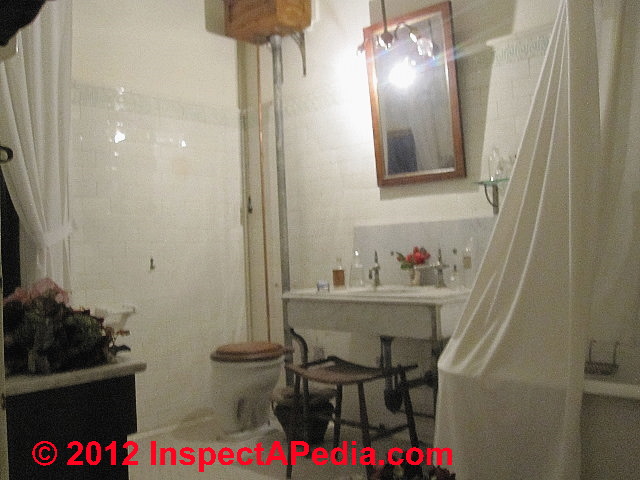
Many factors affect the illumination needed for a specific task. This article discusses lighting recommendations for various indoor areas and includes some RULES of THUMB INTERIOR LIGHTING .
An often overlooked factor is the age of the occupants.
At 60 years old, we need two to three times the light we needed at age 20, and also more shielding and diffusers since older eyes are more sensitive to glare.
[Click to enlarge any image]
The other main factors in determining lighting requirements are how detailed the work is and the level of contrast and reflectance of the work surface.
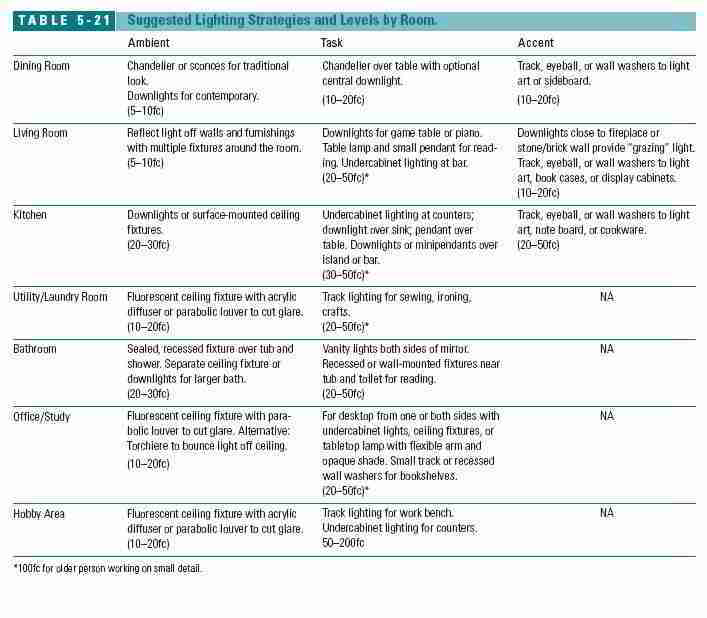
Table 5-21 shows the recommended lighting along with common strategies for each type of room. For task lighting, the low numbers in each range represent the light needed for simple tasks with high contrast (reading large black type on white paper).
The high number is for tasks with more detail or lower contrast (reading the newspaper). For very detailed, low-contrast work or for older persons, light levels of 100 footcandles are often needed.
Interior Lighting Rules of Thumb
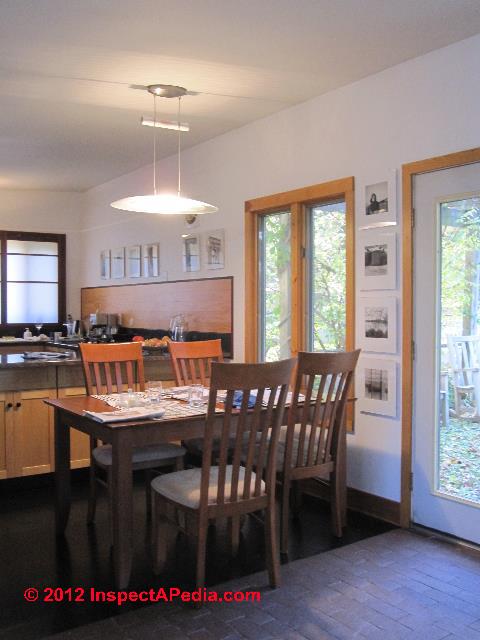
The illumination level on a surface depends on many factors, including the colors of the room and furnishings and the type of lamp and fixture. High ceilings, dark colors, and diffusers on fixtures all reduce light levels. The commonly used black baffles in recessed lights reduce output by up to 40%.
Tightly focused spots produce much higher light levels than wide floods.
Rules about Distance from Light Source
The distance from the light source is also critical. Doubling the distance to a lamp reduces the lighting level by a factor of four. So moving the light closer to the task is often the simplest way to provide a big boost in lighting levels.
Rule of Thumb for Brightly-Lit Space Needs
As a starting point for design in kitchens, baths, home offices, and other brightly lit spaces, provide at least 2 watts of incandescent light or 3/4-watt of fluorescent light per square foot of floor area. In larger spaces, using multiple fixtures will provide more even lighting and reduce glare.
Downlighting Suggestions
Also, since lighting needs change throughout the day with changes in daylight and usage, it is good to provide flexibility by separately switching groups of lights and adding dimmers. Increase these minimums by 50 to 100% for:
- Valences or other indirect lighting schemes
- Rooms with dark surfaces
- Lighting placed in cathedral ceilings or other high ceilings
- Recessed lighting with diffusers, black baffles, or other light-blocking trim
- - Adapted with permission from Best Practices Guide to Residential Construction (Steve Bliss, J Wiley & Sons) .
Also compare table lighting, task lighting and downlighting
...
Continue reading at KITCHEN LIGHTING REQUIREMENTS or select a topic from the closely-related articles below, or see the complete ARTICLE INDEX.
Or see these
Interior Lighting Articles
- LIGHTING, INTERIOR GUIDE - home
- BATHROOM LIGHTING GUIDELINES
- BAYONET BASE BULB TYPES
- BULB & LAMP ABBREVIATIONS & CODES
- BULB & LAMP TYPES GUIDE - home
- BULB COLOR TEMPERATURE COMPRARISONS
- BULB & FIXTURE TYPES for SOFFIT
- CLOSET LIGHTING FIRE SAFETY
- ELECTRIC POWER LOSS / FLICKERING LIGHTS
- FLUORESCENT LIGHT REPAIRS
- KITCHEN LIGHTING REQUIREMENTS
- LED BULB & LIGHTING TYPES
- LIGHTING LEVELS INDOORS, RECOMMENDED
- LUMENS DEFINITION COMPARISON
- RECESSED LIGHT CLEARANCES
- RECESSED LIGHT HOUSINGS GUIDE
- RECESSED & TRACK LIGHT USES
- RECESSED & TRACK LIGHT BULB GUIDE
- RECESSED LIGHT FIXTURE TRIM
- RECESSED SOFFIT or ROOF OVERHANG
- SPACING GUIDE for LIGHT FIXTURES
- TABLE TOP LIGHTING
- TASK LIGHTING
- LIGHTING OVER STAIRS & AT EXITS
Suggested citation for this web page
LIGHTING LEVELS INDOORS, RECOMMENDED at InspectApedia.com - online encyclopedia of building & environmental inspection, testing, diagnosis, repair, & problem prevention advice.
Or see this
INDEX to RELATED ARTICLES: ARTICLE INDEX to BUILDING LIGHTING
Or use the SEARCH BOX found below to Ask a Question or Search InspectApedia
Ask a Question or Search InspectApedia
Try the search box just below, or if you prefer, post a question or comment in the Comments box below and we will respond promptly.
Search the InspectApedia website
Note: appearance of your Comment below may be delayed: if your comment contains an image, photograph, web link, or text that looks to the software as if it might be a web link, your posting will appear after it has been approved by a moderator. Apologies for the delay.
Only one image can be added per comment but you can post as many comments, and therefore images, as you like.
You will not receive a notification when a response to your question has been posted.
Please bookmark this page to make it easy for you to check back for our response.
Our Comment Box is provided by Countable Web Productions countable.ca
Citations & References
In addition to any citations in the article above, a full list is available on request.
- Steve Bliss's Building Advisor at buildingadvisor.com helps homeowners & contractors plan & complete successful building & remodeling projects: buying land, site work, building design, cost estimating, materials & components, & project management through complete construction. Email: info@buildingadvisor.com
Steven Bliss served as editorial director and co-publisher of The Journal of Light Construction for 16 years and previously as building technology editor for Progressive Builder and Solar Age magazines. He worked in the building trades as a carpenter and design/build contractor for more than ten years and holds a masters degree from the Harvard Graduate School of Education. Excerpts from his recent book, Best Practices Guide to Residential Construction, Wiley (November 18, 2005) ISBN-10: 0471648361, ISBN-13: 978-0471648369, appear throughout this website, with permission and courtesy of Wiley & Sons. Best Practices Guide is available from the publisher, J. Wiley & Sons, and also at Amazon.com - Our recommended books about building & mechanical systems design, inspection, problem diagnosis, and repair, and about indoor environment and IAQ testing, diagnosis, and cleanup are at the InspectAPedia Bookstore. Also see our Book Reviews - InspectAPedia.
- Best Practices Guide to Residential Construction, by Steven Bliss. John Wiley & Sons, 2006. ISBN-10: 0471648361, ISBN-13: 978-0471648369, Hardcover: 320 pages, available from Amazon.com and also Wiley.com. See our book review of this publication.
- "Simplified Electrical Wiring," Sears, Roebuck and Co., 15705 (F5428) Rev. 4-77 1977 [Lots of sketches of older-type service panels.]
- "How to plan and install electric wiring for homes, farms, garages, shops," Montgomery Ward Co., 83-850.
- "Electrical System Inspection Basics," Richard C. Wolcott, ASHI 8th Annual Education Conference, Boston 1985.
- "Simplified Electrical Wiring," Sears, Roebuck and Co., 15705 (F5428) Rev. 4-77 1977 [Lots of sketches of older-type service panels.]
- "How to plan and install electric wiring for homes, farms, garages, shops," Montgomery Ward Co., 83-850.
- "Home Wiring Inspection," Roswell W. Ard, Rodale's New Shelter, July/August, 1985 p. 35-40.
- "Evaluating Wiring in Older Minnesota Homes," Agricultural Extension Service, University of Minnesota, St. Paul, Minnesota 55108.
- "Electrical Systems," A Training Manual for Home Inspectors, Alfred L. Alk, American Society of Home Inspectors (ASHI), 1987, available from ASHI. [DF NOTE: I do NOT recommend this obsolete publication, though it was cited in the original Journal article as it contains unsafe inaccuracies]
- "Basic Housing Inspection," US DHEW, S352.75 U48, p.144, out of print, but is available in most state libraries.
- Electrical System & Wiring Hazard Inspection, Detection, Cause, Remedy, Prevention - Main Electrical Page
- In addition to citations & references found in this article, see the research citations given at the end of the related articles found at our suggested
CONTINUE READING or RECOMMENDED ARTICLES.
- Carson, Dunlop & Associates Ltd., 120 Carlton Street Suite 407, Toronto ON M5A 4K2. Tel: (416) 964-9415 1-800-268-7070 Email: info@carsondunlop.com. Alan Carson is a past president of ASHI, the American Society of Home Inspectors.
Thanks to Alan Carson and Bob Dunlop, for permission for InspectAPedia to use text excerpts from The HOME REFERENCE BOOK - the Encyclopedia of Homes and to use illustrations from The ILLUSTRATED HOME .
Carson Dunlop Associates provides extensive home inspection education and report writing material. In gratitude we provide links to tsome Carson Dunlop Associates products and services.
 | HOME | ABOUT | ASK a QUESTION | CONTACT | CONTENT USE POLICY | DESCRIPTION | POLICIES | PRIVACY | |
| © 2024 - 1985 Publisher InspectApedia.com - Daniel Friedman | |||||||||