
InspectAPedia® FREE Encyclopedia of Building & Environmental Construction, Diagnosis, Maintenance & Repair |
Question? Just ask us! InspectAPedia
|
 Guide to Sound Control in Building Supply & Drain Piping
- POST a QUESTION or COMMENT about how to control annoying sounds in buildings
Building plumbing system noise control & sound isolation:
This article explains methods and materials used to control plumbing piping & plumbing fixture sound transmission in buildings: how to assure quiet plumbing fixtures, plumbing drains, supply piping, heating piping in buildings.
We explain the difference in noise levels from plastic versus cast iron drain piping, we illustrate the sequence of steps in sound insulation useful for isolating noises a plumbing pipe chase from occupied building spaces, we describe noise sources traced to water supply piping & heating system pipes, and we list other plumbing-related sources of building noise. In a series of photo-illustrations we discuss plumbing drain pipe chase insulation & fire safety.
InspectAPedia tolerates no conflicts of interest. We have no relationship with advertisers, products, or services discussed at this website.
How to Control Plumbing Noise in buildings

This article series discusses noise and sound control in buildings, and includes excerpts or adaptations from Best Practices Guide to Residential Construction (Steve Bliss, J Wiley & Sons) , by Steven Bliss, courtesy of Wiley & Sons.
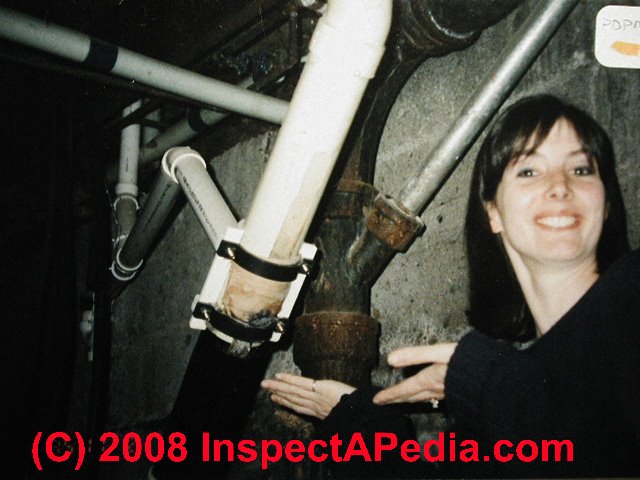
The page top photo shows our client commenting on a mix of plastic (more noisy) and cast iron (more quiet) drain piping in a building basement where renovations and conversion to occupied space were planned.
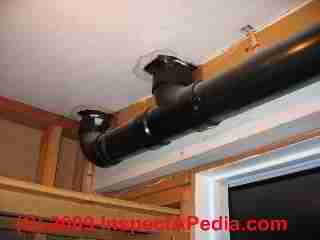
Plumbing drain & pipe chase noise control photo 1 - pipe chase construction: at left you can see a horizontal plumbing chase running beneath a floor above.
In typical indoor construction the builder might simply install drywall over the chase framing structure to enclose the supply and drain piping.
The result will be significant noise transmission into the room below, particularly when plastic drain piping has been used, such as the black ABS drain shown in our photo - courtesy Galow Homes [3]. [Click to enlarge].
Other noise and sound diagnosis and control articles are found
at NOISE / SOUND DIAGNOSIS & CURE.
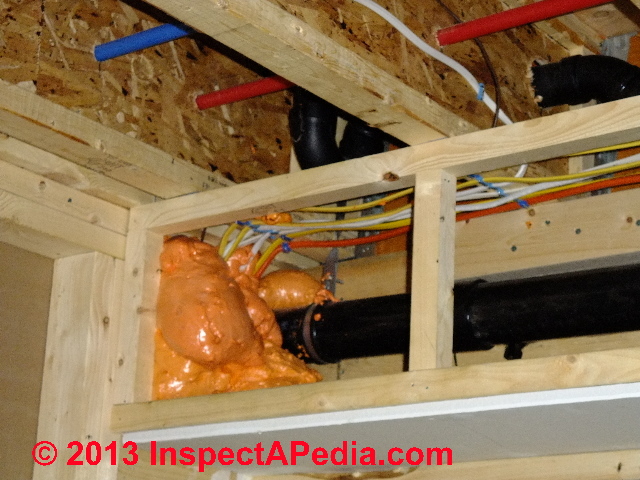
Plumbing chase noise control photo 2 - insulate wall or ceiling penetrations: at left you will see the orange foam insulation that was sprayed to seal the plumbing drain piping where it penetrates an interior wall.
The foam product selected here was chosen for its fire resistance to comply with local building codes.
We divide plumbing drain and fixture noises into two groups:
- Plumbing defect noises associated with plumbing system problems or defects whose identification and diagnosis is discussed at our complete list of various plumbing system noise
See PLUMBING NOISE CHECKLIST for just that - a list of plumbing noise sources
We explain how to diagnose plumbing drain noises
at PLUMBING DRAIN NOISE DIAGNOSIS
and
at PLUMBING DRAIN NOISE REPAIR we explain how to correct these disturbances. - Normal (but annoying) plumbing system noises that will be corrected by noise transmission control or sound insulation are discussed here
at SOUND CONTROL for PLUMBING
where we describe controlling the transmission of plumbing noises in buildings and where we give methods for mimizing plumbing noises and sounds.
Normal plumbing drain sounds
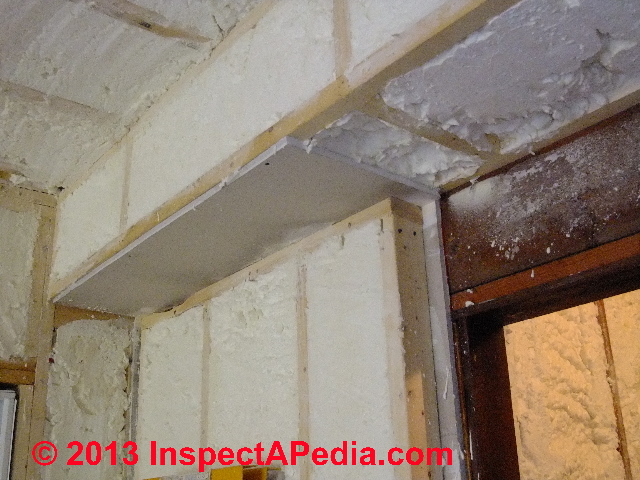
Plumbing chase noise control photo 3 - complete plumbing pipe chase insulation: as you can see in our photo at left, we completed insulating the pipe chase with spray foam insulation during building wall and ceiling insulation installation.
While thermal insulation was not required between this room and the occupied space above - for heating or cooling purposes, the cost of including the spray foam insulation in this area was low when contracted as part of a building-wide insulation job.
Insulating here provided excellent sound insulation and also improved the thermal performance and temperature consistency in both this room and in the floor above.
As we stated
at PLUMBING DRAIN NOISE DIAGNOSIS,
Hearing the sound of running water in a building drain is not likely to indicate a problem with the drain system itself. In older buildings where cast iron and steel drain pipes were used, not much sound normally is heard: even the sound of running water, say when a shower is running or when a toilet was flushed.
But in a more modern structure that uses plastic or copper drain piping these materials can transmit the sound of running water to the building interior. Builders can reduce sound transmission from plumbing lines by enclosing them in insulated chaseways.
We have also found cases in pipes in a building transmit sounds from one area of the building to another. We've also found that electromagnetic fields generated in a building, say by a bank of electric meters located in one area, can be transmitted to other building areas through metal piping.
Plumbing Noise & Sound Transmission Sources & Control
As described in the book, Best Practices Guide to Residential Construction (Steve Bliss, J Wiley & Sons) Chapter 5, Interior Finish:
One of the most common noise complaints in single-family construction is the sound of water gushing through PVC waste pipes.
The best solution, short of using cast iron, is to box in the pipes and fill the cavity with fiberglass insulation. Then enclose the cavity with one or two layers of drywall.
Plumbing chase noise control photo 4: Our photo (left) shows a different building in which the plastic drain waste piping was routed through a basement that was being finished and to be used as offices. This drain was a subject of recurrent noise complaints in the building.
The leak stains at the ceiling needed to be investigated and the source corrected before this piping run was enclosed in a heavily insulated drywall pipe chase to minimize sound transmission from the upstairs plumbing fixtures into the lower level offices.
Noises from water supply piping & hot water heating piping
Continuing from from Best Practices Guide to Residential Construction (Steve Bliss, J Wiley & Sons) :
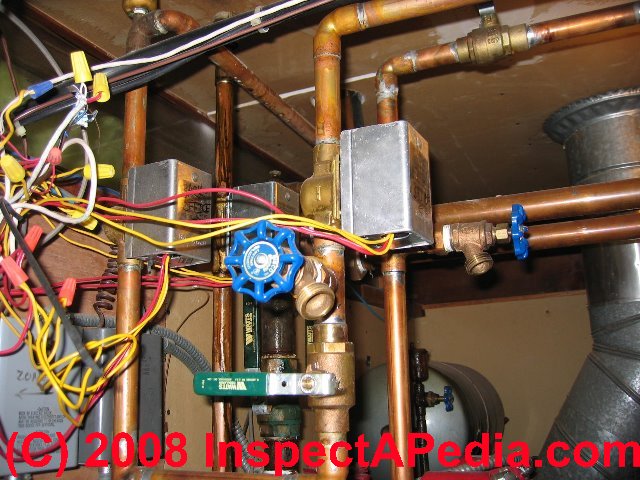
Water supply and heating pipes can also radiate noise through the framing if there is rigid contact between pipes and framing or finish materials. This can be a particular problem when heating pipes expand and contract. To avoid these problems, make sure pipe runs are not tight against framing.
While special non hardening acoustical sealants are often specified in commercial work, any high-quality sealant that remains flexible can be effective in blocking sound transmission. Butyl, silicone, and urethane caulk can all be used.
To prevent sound leaks, use sealant around electrical boxes, plumbing penetrations, and any other penetrations in the wall or ceiling surface.
see ACOUSTICAL SEALANT for SOUND CONTROL for additional details.
Other sources of noises associated with water or heating piping in buildings
- Poorly secured water supply or heating piping where pipes run along below floors or ceilings can lead to clanking or other noises. As Carson Dunlop point out in their Home Reference Book,
As valves are opened and closed, vibration can be set up in the piping making it rattle.
Sometimes this can be corrected by pushing newspapers into the wall cavity to keep the pipes from contacting the walls or each other. Foam insulation can also help in some cases.
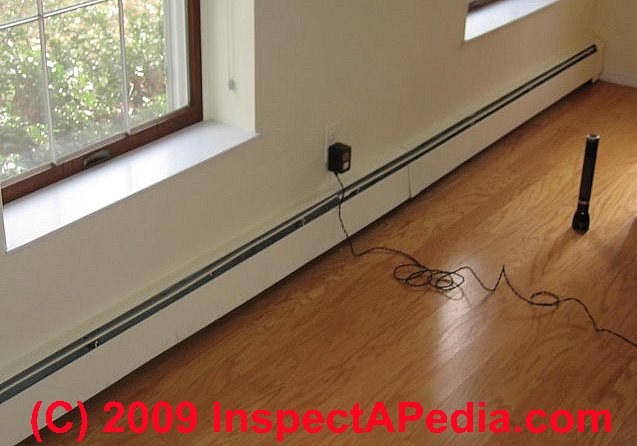
Where a pipe passes through the floor system or wood studs, it may rub on the wood and squeak as the pipe expands and contracts with heat. - Hot water supply and heating baseboard piping noises where pipes creak, click, and clank at floor or wall penetrations, especially during temperature changes such as heating system on-off cycling or hot water usage.
- Hot or cold water supply piping running water noises may be amplified and transmitted through some building areas when water is running through pipes that are mounted in contact with framing or in contact with floor or wall partition materials.
If you are debugging piping noises in a building and have been unable to locate the source of a running water sound, turn off water at the building water main and listen again.
This step eliminates running toilets and open faucets in the building. Try using a mechanic's stethoscope on water supply piping where the water piping enters the building. On occasion we have found that a running water sound was due to a leak in buried water supply piping outside of the building itself. Sound was transmitted through the pipe itself into the building interior.
Leaving a clearance opening to accommodate pipe movement during temperature changes, and sealing all pipe penetrations (discussed above) can substantially reduce indoor supply or heating piping noise. - Water hammer (or hydrostatic shock) is a noisy pipe problem that occurs when valves are shut off quickly. Water hammer can damage pipe connections and result in leakage.
See WATER HAMMER NOISE DIAGNOSE & CURE for details. - Water Heater Noises:
see NOISES COMING FROM WATER HEATER for the diagnosis and cure of clanking or thumping noises that may be coming from your water heater or heating boiler.
-- Adapted with permission from Best Practices Guide to Residential Construction (Steve Bliss, J Wiley & Sons) . Additional text adapted with permission from The Home Reference Book
Reader Comments, Questions & Answers About The Article Above
Below you will find questions and answers previously posted on this page at its page bottom reader comment box.
Reader Q&A - also see RECOMMENDED ARTICLES & FAQs
Question:
(Oct 24, 2014) lodinbvs@aol.com said:
After flushing toilet, there are approx. 6 consecutive noises sounding like swishing of air in line. Also grout in one floor area near toilet shows signs of possible discoloration, or dampness underneath.
(Aug 17, 2015) John Thompson said:
My residence is about 7-8 years old. I have odd noises which occur about 2 feet inside my home at the location where a whole house water filter is.
The plumbing coming into the house is a 1" PVC line which flows through the water filter housing [the filter was removed, but the noises remain]. The PVC pipe then goes immediately to a pressure reducing valve and then turns into a 3/4" copper line, to distribute water throughout the residence. I have a Hot Water Circulating Pump[now unplugged, but the noise was there before it was unplugged] and a 8" diameter Water Hammer Arrestor above my Hot Water heater.
The noises occur at the Water Filter Housing and before the Pressure Reducing Valve. A noise almost always occurs when the water in the house is turned off at any location. It also occurs continuously when a faucet outside the home is turned off at the nozzel, but the water remains on. Sometime the noise sounds like a giant drip or some sort of moaning or humming noise. This has been going on for around a year, but not before. What can you tell me about trying to find the source of the noise and how to eliminate the noise? Thanks, John
Reply:
John, I'd use a mechanic's sthetoscope and some digging to find the problem point: I suspect you'll need to change a valve or elbow or fitting that is vibrating as water flows through it.
...
Continue reading at PLUMBING SUPPLY PIPE NOISE or select a topic from the closely-related articles below, or see the complete ARTICLE INDEX.
Or see these
Recommended Articles
- PLUMBING NOISE CHECKLIST
- PLUMBING SYSTEM NOISE DIAGNOSIS & CURE - home
- APPLIANCE NOISE DIAGNOSIS
- BANGING HEATING PIPES RADIATORS
- CLOGGED DRAIN DIAGNOSIS & REPAIR
- DRIPPING WATER SOUND Sources
- PLUMBING DRAIN NOISE DIAGNOSIS
- PLUMBING DRAIN NOISE REPAIR
- PLUMBING NOISE CHECKLIST
- PLUMBING NOISE TRANSMISSION CONTROL
- PLUMBING SUPPLY PIPE NOISE
- PLUMBING VENT CODES, DEFINITIONS, TYPES
- PLUMBING VENT DEFECTS & NOISES
- PLUMBING VENT NOISE
- SOUND CONTROL for PLUMBING
- WASHING MACHINE NOISE CAUSE & CURE
- WATER HAMMER NOISE DIAGNOSE & CURE
- WATER HEATER NOISE DIAGNOSIS, CURE
- WATER PUMP NOISE DIAGNOSIS
- WATER SUPPLY PIPE WHISTLE NOISE
- WATER TANK NOISE DIAGNOSIS
- PLUMBING VENT DEFECTS & NOISES
- PLUMBING VENT PIPING
- SOUND CONTROL in BUILDINGS
Suggested citation for this web page
PLUMBING NOISE TRANSMISSION CONTROL at InspectApedia.com - online encyclopedia of building & environmental inspection, testing, diagnosis, repair, & problem prevention advice.
Or see this
INDEX to RELATED ARTICLES: ARTICLE INDEX to BUILDING NOISE DIAGNOSIS
Or use the SEARCH BOX found below to Ask a Question or Search InspectApedia
Or see
INDEX to RELATED ARTICLES: ARTICLE INDEX to PLUMBING SYSTEMS
Or use the SEARCH BOX found below to Ask a Question or Search InspectApedia
Ask a Question or Search InspectApedia
Try the search box just below, or if you prefer, post a question or comment in the Comments box below and we will respond promptly.
Search the InspectApedia website
Note: appearance of your Comment below may be delayed: if your comment contains an image, photograph, web link, or text that looks to the software as if it might be a web link, your posting will appear after it has been approved by a moderator. Apologies for the delay.
Only one image can be added per comment but you can post as many comments, and therefore images, as you like.
You will not receive a notification when a response to your question has been posted.
Please bookmark this page to make it easy for you to check back for our response.
Our Comment Box is provided by Countable Web Productions countable.ca
Citations & References
In addition to any citations in the article above, a full list is available on request.
- [1] Marpac Corporation, P.O. Box 560 Rocky Point, NC 28457 Phone: 800-999-6962 (USA and Canada) Fax: 910-602-1435 1-910-602-1421 (worldwide), 800-999- or email: info@marpac.com <[2] Sound Oasis sound conditioners are produced by Sound Oasis: http://www.sound-oasis.com/ email: info@sound-oasis.com or 1-866-625-3218
- [3] Eric Galow, Galow Homes, Lagrangeville, NY. Mr. Galow can be reached by email: ericgalow@gmail.com or by telephone: 914-474-6613. Mr. Galow specializes in residential construction including both new homes and repairs, renovations, and additions.
- Best Practices Guide to Residential Construction, Steve Bliss, Wiley (November 18, 2005) ISBN-10: 0471648361, ISBN-13: 978-0471648369, Hardcover: 320 pages, available from the publisher, J. Wiley & Sons, and also at Amazon.com. See our book review of this publication.
- Steven Bliss served as editorial director and co-publisher of The Journal of Light Construction for 16 years and previously as building technology editor for Progressive Builder and Solar Age magazines. He worked in the building trades as a carpenter and design/build contractor for more than ten years and holds a masters degree from the Harvard Graduate School of Education.
Excerpts from his recent book, Best Practices Guide to Residential Construction, Wiley (November 18, 2005) ISBN-10: 0471648361, ISBN-13: 978-0471648369, appear throughout this website, with permission and courtesy of Wiley & Sons. Best Practices Guide is available from the publisher,
J. Wiley & Sons, and also at Amazon.com.
Excerpts with updates and annotations expanding the original Best Practices Guide text can be found in the online review and book summary at BEST CONSTRUCTION PRACTICES GUIDE and also at DECK & PORCH CONSTRUCTION, at INDOOR AIR QUALITY IMPROVEMENT GUIDE, and in other articles found at InspectAPedia.com. - Mark Cramer Inspection Services Mark Cramer, Tampa Florida, Mr. Cramer is a past president of ASHI, the American Society of Home Inspectors and is a Florida home inspector and home inspection educator. Mr. Cramer serves on the ASHI Home Inspection Standards. Contact Mark Cramer at: 727-595-4211 mark@BestTampaInspector.com
- John Cranor [Website: /www.house-whisperer.com ] is an ASHI member and a home inspector (The House Whisperer) is located in Glen Allen, VA 23060. He is also a contributor to InspectApedia.com in several technical areas such as plumbing and appliances (dryer vents). Contact Mr. Cranor at 804-873-8534 or by Email: johncranor@verizon.net
- Roger Hankey is principal of Hankey and Brown home inspectors, Eden Prairie, MN. Mr. Hankey is a past chairman of the ASHI Technical Committee and the ASHI Standards Committee. Mr. Hankey serves as co-chairmain of ASHI legislative committee, and has served in other ASHI professional and leadership roles. Contact Roger Hankey at: 952 217 1617 (MN) / 970-393-6604 (CO) - hankeybrown@comcast.net
- Our recommended books about building & mechanical systems design, inspection, problem diagnosis, and repair, and about indoor environment and IAQ testing, diagnosis, and cleanup are at the InspectAPedia Bookstore. Also see our Book Reviews - InspectAPedia.
- The Journal of Light Construction has generously given reprint permission to InspectAPedia.com for this article. All rights and contents are ©Journal of Light Construction and may not be reproduced in any form.
- In addition to citations & references found in this article, see the research citations given at the end of the related articles found at our suggested
CONTINUE READING or RECOMMENDED ARTICLES.
- Carson, Dunlop & Associates Ltd., 120 Carlton Street Suite 407, Toronto ON M5A 4K2. Tel: (416) 964-9415 1-800-268-7070 Email: info@carsondunlop.com. Alan Carson is a past president of ASHI, the American Society of Home Inspectors.
Thanks to Alan Carson and Bob Dunlop, for permission for InspectAPedia to use text excerpts from The HOME REFERENCE BOOK - the Encyclopedia of Homes and to use illustrations from The ILLUSTRATED HOME .
Carson Dunlop Associates provides extensive home inspection education and report writing material. In gratitude we provide links to tsome Carson Dunlop Associates products and services.
 | HOME | ABOUT | ASK a QUESTION | CONTACT | CONTENT USE POLICY | DESCRIPTION | POLICIES | PRIVACY | |
| © 2024 - 1985 Publisher InspectApedia.com - Daniel Friedman | |||||||||