
InspectAPedia® FREE Encyclopedia of Building & Environmental Construction, Diagnosis, Maintenance & Repair |
Question? Just ask us! InspectAPedia
|
 EIFS Wall Drainage Systems Avoid Moisture & Mold Troubles - Best Practices Guide
- POST a QUESTION or COMMENT about the requirement & methods for installing wall drainage systems behind synthetic stucco wall coverings
EIFS Drainage systems:
This article discusses in-wall drainage systems introduced to avoid moisture and mold problems in EIFS synthetic stucco wall systems, and the role of weather and moisture in stucco wall installation, durability, and painting success.
This article series discusses best practices construction details for building exteriors, including stucco exteriors, exterior caulks and sealants, and choices and application of exterior finishes on buildings.
InspectAPedia tolerates no conflicts of interest. We have no relationship with advertisers, products, or services discussed at this website.
Drainage Systems for EIFS "Stucco" Walls to Reduce Leak Damage
Continuing from from Best Practices Guide to Residential Construction (Steve Bliss, J Wiley & Sons) we discuss the introduction of drainage systems intended to reduce or avoid these EIFS difficulties.
This article series includes excerpts or adaptations from Best Practices Guide to Residential Construction (Steve Bliss, J Wiley & Sons) , by Steven Bliss, courtesy of Wiley & Sons.
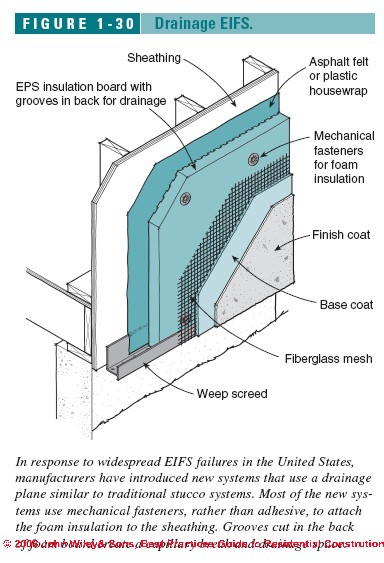
In response to these problems, most EIFS manufacturers have introduced new “drainage” or “water-managed” systems, which require the same type of waterproof drainage plane found behind traditional stucco systems (see Figure 1-30)
[Click to enlarge any image]
As with traditional stucco, layered building paper or plastic housewrap protects the framing and sheathing, and all exterior openings and penetrations are flashed to conduct any water to the outside of the sheathing wrap.
Since window leakage was the single biggest contributor to EIFS failures, pan flashing is recommended at windows.
Rather than gluing the EPS foam to the sheathing, the new drainage EIFS typically use mechanical fasteners and are designed with a capillary break between the back of the EPS and the sheathing wrap to promote drainage.
Some EIFS contractors use special corrugated or wrinkled sheathing papers to create the drainage space, while others have vertical grooves cut into the back face of the foam insulation.
In all cases,
the drainage plane leads to a perforated weep flashing at
the foundation to drain away any trapped water.
See STUCCO WALL WEEP SCREED DRAINAGE
Workmanship & EIFS Exterior Stucco Wall Success
The backup drainage layer, however, should not provide an excuse for sloppy workmanship on the exterior skin. The new kinds of EIFS should still be made as waterproof as possible, since any water that leaks past the skin may be slow to dry out. EIFS consultant Russell Kenney, who has worked with these systems for nearly 20 years, recommends exceeding the minimum specs required by EIFS manufacturers.
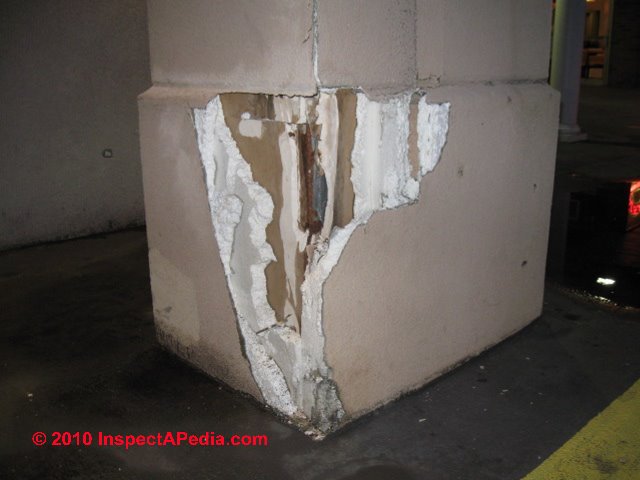
On the other hand, our EIFS damage photograph (left) shows how water or moisture traps can form in an EIFS wall even in a building interior, leading to substantial damage. (Photograph courtesy of home inspector John Rudy).
Kenney recommends a higher-density EPS foam with only 2% water absorption by volume instead of the 4% allowed by ASTM C584. In addition, Kenney recommends a heavier 6-ounce reinforcing mesh versus the typical 3-ounce cloth, as well as special high-impact mesh in high-traffic areas.
He also recommends a 3/32-inch base coat applied in two layers, with the first layer used to partially embed the fiberglass reinforcing and the second layer to fully cover and protect it.
These steps will significantly improve the impact resistance of EIFS, but it is still less durable than traditional stucco or thin-coat stucco.
See details about the cause, diagnosis, cure, or prevention of paint failures on stucco exterior walls, found at STUCCO PAINT FAILURES.
Apply Sealant to EIFS Base Coat
As with the original barrier EIFS, all penetrations require a high-quality elastomeric sealant. The sealant needs to be applied to the base coat since the finish coat tends to soften when wet, providing a poor substrate for sealant. For the caulk joints to last, they must be wide enough to tolerate the anticipated movement, typically 3/8 to 1/2-inch, and backed up by backer rod (see “Joint Design,” page 37 in Best Practices Guide to Residential Construction (Steve Bliss, J Wiley & Sons) ).
While control joints are generally not needed along the length of the wall—unless it exceeds 75 feet and is in direct sun—they are required between floors on multistory buildings. Silicone sealant is recommended at all joints for its longevity and flexibility in cold temperatures.
In theory at least, drainage EIFS should function the same as any other exterior cladding systems. Any water that manages to penetrate the outer skin should be stopped by the drainage layer and safely drained away. However, given the low permeability of polymer-based coatings and the tendency of EPS foam to soak up and hold water, EIFS are best avoided in residential projects unless high-quality workmanship and regular maintenance of sealants can be assured.
-- Adapted with permission from Best Practices Guide to Residential Construction (Steve Bliss, J Wiley & Sons) .
Stucco Finish System Articles
- CONCRETE STAINS: ID & REMOVAL
- HOUSEWRAP AIR & VAPOR BARRIERS
- INSECTS & FOAM INSULATION
- PAINT FAILURE, DIAGNOSIS, CURE, PREVENTION - home
- SIDING EIFS & STUCCO - home
- PAINT on STUCCO, FAILURES
- SIDING EIFS STUCCO PAINT FAILURES
- SIDING EIFS WALL LEAK POINTS
- STUCCO & CONCRETE BONDING AGENTS
- STUCCO EIFS DRAINAGE SYSTEMS
- STUCCO, HARD COAT INSTALLATION, INSPECTION, REPAIR
- STUCCO OVER FOAM INSULATION
- STUCCO WAll FAILURES DUE TO WEATHER
- STUCCO WALL METHODS & INSTALLATION
- STUCCO WALL METHODS & INSTALLATION FAQs
- STUCCO RECIPES & APPLICATION
- STUCCO THIN COAT APPLICATION
- STUCCO WALL WEEP SCREED DRAINAGE
- SIDING LEAK DIAGNOSIS & REPAIR
- SIDING TYPES, INSTALLATION, DEFECTS
- STONE, STUCCO & BRICK CLEANING METHODS
- VAPOR BARRIERS & HOUSEWRAP
...
Continue reading at STUCCO WALL WEEP SCREED DRAINAGE or select a topic from the closely-related articles below, or see the complete ARTICLE INDEX.
Or see
SIDING EIFS WALL LEAK POINTS for a photo guide to common leak points in synthetic stucco applications.
Suggested citation for this web page
STUCCO EIFS DRAINAGE SYSTEMS at InspectApedia.com - online encyclopedia of building & environmental inspection, testing, diagnosis, repair, & problem prevention advice.
Or see this
INDEX to RELATED ARTICLES: ARTICLE INDEX to EXTERIORS of BUILDINGS
Or use the SEARCH BOX found below to Ask a Question or Search InspectApedia
Ask a Question or Search InspectApedia
Questions & answers or comments about the requirement & methods for installing wall drainage systems behind synthetic stucco wall coverings.
Try the search box just below, or if you prefer, post a question or comment in the Comments box below and we will respond promptly.
Search the InspectApedia website
Note: appearance of your Comment below may be delayed: if your comment contains an image, photograph, web link, or text that looks to the software as if it might be a web link, your posting will appear after it has been approved by a moderator. Apologies for the delay.
Only one image can be added per comment but you can post as many comments, and therefore images, as you like.
You will not receive a notification when a response to your question has been posted.
Please bookmark this page to make it easy for you to check back for our response.
Our Comment Box is provided by Countable Web Productions countable.ca
Citations & References
In addition to any citations in the article above, a full list is available on request.
- Steve Bliss's Building Advisor at buildingadvisor.com helps homeowners & contractors plan & complete successful building & remodeling projects: buying land, site work, building design, cost estimating, materials & components, & project management through complete construction. Email: info@buildingadvisor.com
Steven Bliss served as editorial director and co-publisher of The Journal of Light Construction for 16 years and previously as building technology editor for Progressive Builder and Solar Age magazines. He worked in the building trades as a carpenter and design/build contractor for more than ten years and holds a masters degree from the Harvard Graduate School of Education. Excerpts from his recent book, Best Practices Guide to Residential Construction, Wiley (November 18, 2005) ISBN-10: 0471648361, ISBN-13: 978-0471648369, appear throughout this website, with permission and courtesy of Wiley & Sons. Best Practices Guide is available from the publisher, J. Wiley & Sons, and also at Amazon.com - Best Practices Guide to Residential Construction, by Steven Bliss. John Wiley & Sons, 2006. ISBN-10: 0471648361, ISBN-13: 978-0471648369, Hardcover: 320 pages, available from Amazon.com and also Wiley.com. See our book review of this publication.
- Mark Cramer Inspection Services Mark Cramer, Tampa Florida, Mr. Cramer is a past president of ASHI, the American Society of Home Inspectors and is a Florida home inspector and home inspection educator. Mr. Cramer serves on the ASHI Home Inspection Standards. Contact Mark Cramer at: 727-595-4211 mark@BestTampaInspector.com
- John Cranor [Website: /www.house-whisperer.com ] is an ASHI member and a home inspector (The House Whisperer) is located in Glen Allen, VA 23060. He is also a contributor to InspectApedia.com in several technical areas such as plumbing and appliances (dryer vents). Contact Mr. Cranor at 804-873-8534 or by Email: johncranor@verizon.net
- Paul Galow [Website galowconsulting.com ] - technical consultant on networking, LAN design, applications support. Galow Consulting Services [Website galowconsulting.com ] , 914-204-1749, email: paulgalow@galowconsulting.com
- John Rudy, Advantage Home Inspections, Flemington N.J. 08822 home inspector, 908-806- 6364, Home, Radon & Termite Inspections, Central & Parts of North New Jersey, email: jonadvantage1@yahoo.com
- Malco® Products siding tools are available from that company, including the SideSwiper II SRT2 discussed at Malco's website. Websearch 09/07/2010 http://malcoproducts.com/product/roofing-siding-gutter/siding-vinyl/siding-tools-vinyl/sideswiper-ii. Malco also produces other vinyl siding repair tools such as aprons, awls, hole punches, saw blades, and tools for for fiber cement products including power-assisted cutters
- Parmetol, a wood preservative recommended by the manufacturer was used as a fungicidal additive to paint on the Blue Poplar wood sculpture in Amsterdam, by artist Mari Shields [Website marishields.com ] [ - art conservation consult DJF-artist MS 2010]
- WEATHER RESISTIVE BARRIERS [PDF] U.S. Department of Energy, ", how to select and install housewrap and other types of weather resistive barriers
- "Flashing: the plain solution to leaky walls", Thomas E. Remmele, Manager, Technical Services, Sto Corporation, Building Standards, November/December 1999 p. 21-25.
- Our recommended books about building & mechanical systems design, inspection, problem diagnosis, and repair, and about indoor environment and IAQ testing, diagnosis, and cleanup are at the InspectAPedia Bookstore. Also see our Book Reviews - InspectAPedia.
- Decks and Porches, the JLC Guide to, Best Practices for Outdoor Spaces, Steve Bliss (Editor), The Journal of Light Construction, Williston VT, 2010 ISBN 10: 1-928580-42-4, ISBN 13: 978-1-928580-42-3, available from Amazon.com
- The Journal of Light Construction has generously given reprint permission to InspectAPedia.com for this article. All rights and contents are ©Journal of Light Construction and may not be reproduced in any form.
- In addition to citations & references found in this article, see the research citations given at the end of the related articles found at our suggested
CONTINUE READING or RECOMMENDED ARTICLES.
- Carson, Dunlop & Associates Ltd., 120 Carlton Street Suite 407, Toronto ON M5A 4K2. Tel: (416) 964-9415 1-800-268-7070 Email: info@carsondunlop.com. Alan Carson is a past president of ASHI, the American Society of Home Inspectors.
Thanks to Alan Carson and Bob Dunlop, for permission for InspectAPedia to use text excerpts from The HOME REFERENCE BOOK - the Encyclopedia of Homes and to use illustrations from The ILLUSTRATED HOME .
Carson Dunlop Associates provides extensive home inspection education and report writing material. In gratitude we provide links to tsome Carson Dunlop Associates products and services.
 | HOME | ABOUT | ASK a QUESTION | CONTACT | CONTENT USE POLICY | DESCRIPTION | POLICIES | PRIVACY | |
| © 2024 - 1985 Publisher InspectApedia.com - Daniel Friedman | |||||||||