
InspectAPedia® FREE Encyclopedia of Building & Environmental Construction, Diagnosis, Maintenance & Repair |
Question? Just ask us! InspectAPedia
|
 How to Safely Enter & Inspect a Building After a Disaster: Earthquake, Fire, Flood, Hurricane, Windstorm

- POST a QUESTION or COMMENT about how to make safe entry to a building after a disaster such as earthquake, flooding, fire, or storm damage or disaster
How & when to enter a building damaged by a disaster:
Safety advice for entering flood-damaged or other disaster-damaged buildings. DO NOT ENTER a Building Under These Circumstances (list). SAFETY PROCEDURES When Planning to or Actually Entering a Building Damaged by Flooding, Fire, Earthquake, Other Disaster.
This article describes when & how to safely enter a flood-damaged building after it has been flooded. We discuss when to stay out, when you can enter, and safety considerations on entry of flooded buildings.
Adapted and expanded from Repairing your Flooded Home, American Red Cross & FEMA & from additional expert sources.[1] NOTICE: neither the ARC nor FEMA have yet approved the additions & expansions we have made to the original document. .
InspectAPedia tolerates no conflicts of interest. We have no relationship with advertisers, products, or services discussed at this website.
Building Entry Safety Procedures in a Disaster: Procedures for Entering a Safe, Disaster-Damaged Building following an Earthquake, Fire, Flood, Hurricane, Windstorm, or other Disaster
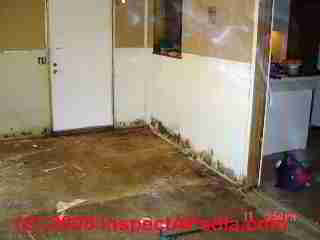
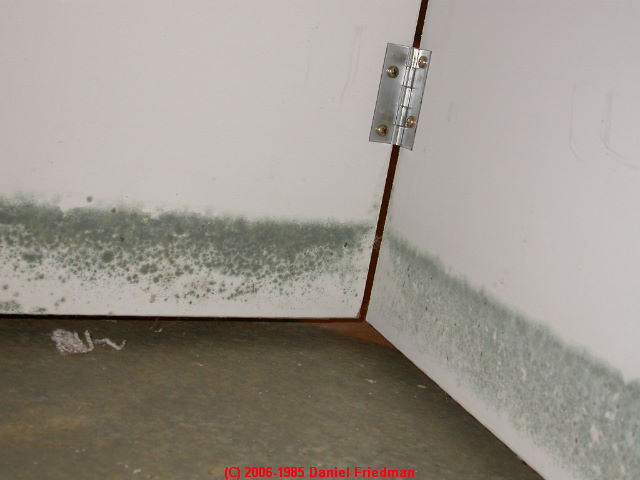 Hazards in and around flooded & other damaged buildings include risk of structural collapse, risk of septic system collapse, trip and fall injury hazards, electrical shock hazards, fire and explosion hazards where natural gas or bottled gas are present, toxic sludge and materials containing waterborne bacteria, such as the E. coli and Enterococci bacteria, toxic mold growth indoors.
When entering buildings, use extreme caution. Building damage may have occurred where you least expect it. Watch carefully every step you take.
Our page top photograph shows a flooded home in Jasper, TX. If your building has been flooded, this website provides an easy to understand guide for flood damage assessment, setting priorities of action, safety, and we provide special information about avoiding or minimizing mold damage.
Watch out: Do Not Enter a Building Under These Circumstances:
- Avoid disaster areas: Your presence might hamper rescue and other emergency operations, and put you at further risk from the residual effects of floods, such as contaminated waters, crumbled roads, landslides, mud flows, and other hazards.
- Buildings that have not been declared safe: Avoid entering ANY building (home, business, or other) before local officials have said it is safe to do so. Buildings may have hidden damage that makes them unsafe.
- If the building is still flooded, burning, moving: Flood waters often undermine foundations, causing sinking, floors can crack or break and buildings can collapse.
- Collapse, explosion, or fire hazards are present: If the building is damaged or has moved off of its foundation: Damage to the building may mean that there is a risk of collapse.
buildings which have moved off of their foundation - ruptured gas or electrical lines are extremely dangerous.
See EARTHQUAKE DAMAGED FOUNDATIONS
and FLOOD DAMAGE TO FOUNDATIONS
Even the smallest shift of a building on or off of its foundation, possibly less than an inch, can rupture gas piping or electrical wiring, creating a dangerous condition.
See FOUNDATION INSPECTION & DIAGNOSIS - Crawl spaces (or flooded basements) that are unsafe should not be entered - see CRAWL SPACE SAFETY ADVICE
- Electrocution hazards are present: If there are live electrical systems or wires: Where electrical wiring is live and wet or under water or even simply
standing in water or on a wet surface without special protection can lead to a fatal electrical shock.
See ELECTRICAL INSPECTION SAFETY. Below we also warn about use of electrical generators. - Gas explosion hazards are present: If there there are damaged, loose, or broken gas piping or other fuel spills that could result in a fire or explosion. Make sure that all of the utilities, electricity, gas, even water, have been safely shut down.
Safety Procedures When Planning to or Actually Entering a Building Damaged by Flooding, Fire, Earthquake, Other Disaster
- Review the FIRST PRIORITIES before entering a flooded, storm-damaged, or earthquake damaged building.
- Animals, watch out for invading or disaster-stranded animals, especially poisonous snakes, that may have come into buildings with the flood waters. Use a stick to poke through debris. Flood waters flush snakes and many animals out of their homes. Trapped rats, raccoons, even dogs and cats are likely to be frightened, defensive, desperate.
- Continue to listen to a NOAA Weather Radio: or local radio or television stations and return home only when authorities indicate it is safe to do so.
Flood dangers do not end when the water begins to recede; there may be flood-related hazards within your community, which you could hear about from local broadcasts.
- Collapse dangers in damaged buildings
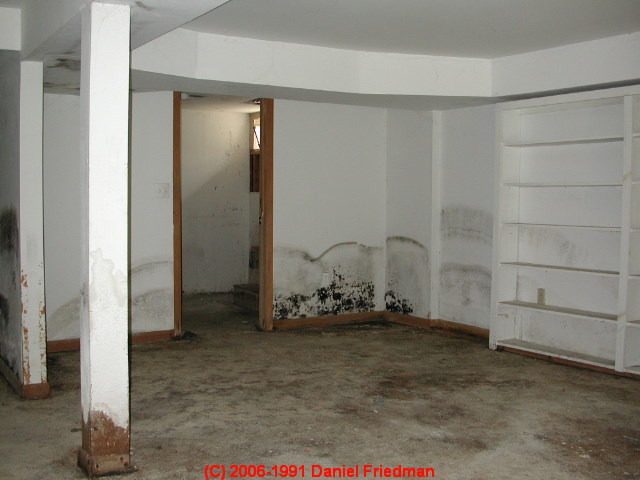
- Examine walls, floors, doors, staircases, and windows to make sure that the building is not in danger of collapsing.
- Foundations & masonry walled structures should be inspected for
- Horizontal dislocation of the building (meaning broken gas lines, etc)
- Leaning, bulging, bowing foundations; bulged concrete block foundations are particularly prone to sudden collapse.
- Cracks or other damage.
Cracks and damage to a foundation can render a building uninhabitable if the damage is severe enough that there is risk of a building collapse. So some evaluation should be made of the basic safety of the structure.
A block foundation wall bulged-inwards more than an inch, or leaning walls that have moved enough to pull apart building framing connectors are particularly dangerous.
Details are at FOUNDATION CRACKS & DAMAGE GUIDE
- Crawl space hazard summary:
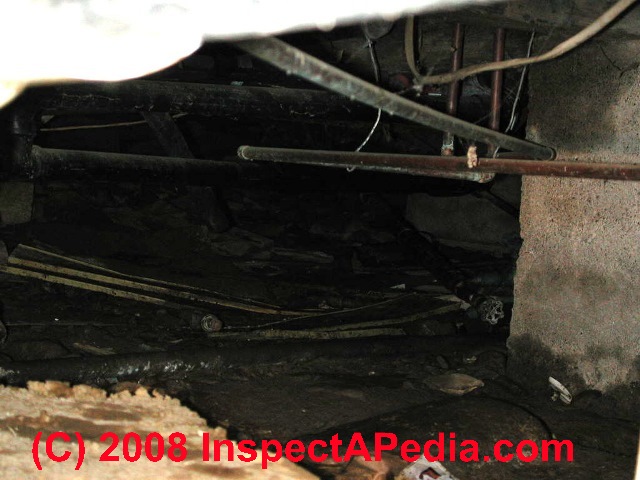
Flooded crawl spaces may be contaminated with sewage bacteria, mold, rodents, or chemicals.
Flooded crawl spaces may be in danger from collapse of the structure overhead.
There may be a danger of electrocution in crawl spaces, especially wet ones, if electrical power remains on.
Crawl spaces may be particularly dangerous for a variety of reasons such as the presence of sewage, mold, asbestos, rodents, snakes, chemicals, pesticides, or structural collapse hazards.
See CRAWL SPACE SAFETY ADVICE.
- Drinking water: some possible sources of drinking water are described at How to Obtain Emergency Drinking Water. If the purity of a water source is suspect or unknown the water will need to be disinfected or sterilized.
- Drinking water wells that were inundated by flood waters should be pumped out and the water tested for purity before drinking. See our well sterilization procedure using household bleach which is detailed at
WHEN & HOW to CHLORINATE or SHOCK a WELL
If in doubt, call your local public health authority. Ill health effects often occur when people drink water contaminated with bacteria and germs. - If drinking water is of questionable purity, boil the water for at least five minutes, and/or add bleach, and/or distill drinking water before using if a distiller and electrical power or an alternative heat source are available. See information on water treatment under the "Disaster Supplies Kit" section of some public documents.
- Drinking water wells that were inundated by flood waters should be pumped out and the water tested for purity before drinking. See our well sterilization procedure using household bleach which is detailed at
- Drywall & Plaster collapses: watch for loose plaster, drywall, and ceilings that could fall. Notice sagging in drywall ceilings and watch out for cracked plaster ceilings that have come loose from the supporting lath.
- Electrical system damage. If you see sparks or broken or frayed wires, or if you smell burning insulation, turn off the electricity at the main fuse box or circuit breaker. If you have to step in water to get to the fuse box or circuit breaker, call an electrician first for advice. Electrical equipment should be checked and dried before being returned to service.
- Fire hazards. There may be broken or leaking gas lines, flooded electrical circuits, or submerged furnaces or electrical appliances. Flammable or explosive materials may travel from upstream. Fire is the most frequent hazard following floods.
- Food that has come in contact with flood waters should not be eaten - throw it away. Some canned foods may be salvageable. If the cans are dented or damaged, throw them away. Food contaminated by flood waters can cause severe infections.
- Gas leaks & explosion hazards: Check for gas leaks. If you smell gas or hear a blowing or hissing noise, open a window and quickly leave the building. Turn off the gas at the outside main valve if you can and call the gas company from a neighbor's home.
If you turn off the gas for any reason, it must be turned back on by a professional. Watch out for gas leaks in flooded or earthquake damaged buildings - flooding and earthquakes as well as hurricanes and some other disasters move buildings & causes gas line leaks.
Building damage & movement may not be obvious. Even a very small movement, an inch or less, can rupture gas lines.
Do not Smoke Near or Inside buildings that Have not Been Declared Safe - a ruptured gas line or leaking gas from appliances could cause a gas explosion and fire. Do not smoke inside buildings. Smoking in a confined area can cause a fire or gas explosion.
Do not turn electricity back on in a building where gas leaks could be present. Use a sealed flashlight for inspection, not a plug-in light. - Lighting: Use battery-powered lanterns or flashlights when examining buildings. Battery-powered lighting is the safest and easiest, preventing fire hazard for the user, occupants, and building.
- Mold, Muck, Insects, Toxic Sludge & Toxic Dust Hazards exist in flooded or storm damaged buildings - a mixture of household chemicals, paints, stored gasoline, lead, sewer or septic system backup, debris and possibly asbestos.
Do not begin cleanup efforts without understanding the hazards that may be present and be sure to use the necessary protective clothing and equipment.
See FLOOD RESPONSE CHECKLIST
Mold warning: If there is extensive visible mold, or if there is or has been sewage contamination, wear a HEPA-rated respirator during your initial walk-through, and if you are asthmatic or otherwise at particular risk, stay out of the building. - Photographs: Take pictures of the damage, both of the building and its contents, for insurance claims.
- Protective clothing & gear:
- Shoes: wear sturdy shoes. The most common injury following a disaster is cut feet caused by clambering through damaged structures.
- Gloves & eye protection: don't touch moldy or contaminated surfaces or materials with your bare hands; if in an emergency (rescuing someone) you must do so, certainly wash your hands as soon as possible after touching suspect surfaces or materials; certainly do not put a moldy or dirty finger in your eye nor in a cut.
- Shoes: wear sturdy shoes. The most common injury following a disaster is cut feet caused by clambering through damaged structures.
- Septic system hazards: include sewage-contaminated floods in buildings and risk of collapsing septic systems.
See SEPTIC & CESSPOOL SAFETY; rope off and prevent access to areas over or close to the septic tank until its condition has been investigated.
See SEPTIC SYSTEM FLOOD DAMAGE REPAIR for advice on repairing septic systems that have been flooded. - Sewage and water supply line damage. If you suspect sewage lines are damaged, avoid using the toilets and call a plumber. If water pipes are damaged, contact the water company and avoid using water from the tap.
- Teamwork - Do not work alone: if you fall or are injured and are alone you may not receive prompt assistance.
If you must work alone despite this advice, be sure you have a working radio or cell phone to use to summons assistance. etc. - Utility lines (electric, gas, sewer, water) that are broken: should be reported, such as electrical, gas, water or sewer piping to the appropriate authorities. Reporting potential hazards will get the utilities turned off as quickly as possible, preventing further hazard and injury.
Check with your utility company now about where broken lines should be reported.
...
Continue reading at ELECTRICAL SAFETY for Flood Damage Inspectors or select a topic from the closely-related articles below, or see the complete ARTICLE INDEX.
Or see our FLOOD RESPONSE CHECKLIST that lists key actions you should take after building flooding to minimize mold damage, and includes some safety warnings.
Or see these articles on
Flood Damaged Building Inspection, Repair, Damage Prevention
- FLOOD & DISASTER BUILDING DAMAGE REPAIR PROCEDURES - home
- Step 1. TAKE CARE OF YOURSELF FIRST
- Step 2. GIVE YOUR HOME FIRST AID
- Step 3. GET ORGANIZED
- Step 4. BUILDING DRY-OUT PROCEDURES
- SALVAGE BUILDING CONTENTS
- Step 5. RESTORE UTILITIES AFTER FLOODING
- MOLD CONTROL, FLOOD RESPONSE
- Step 6. FLOOD DAMAGED BUILDING CLEAN-UP
- Step 7. CHECK ON FINANCIAL ASSISTANCE
- Step 8. REBUILD AND FLOODPROOF
- Step 9. FLOOD & STORM INSURANCE
- FLOOD-CAUSED MOLD PREVENTION
- FLOOD REPAIR CONTRACTORS
- WHEN TO STOP LOOKING FOR MOLD
- FLOOD & STORM DAMAGE REFERENCES for damage assessment & cleanup
- FLOOD ZONES & FLOOD ZONE MAPS
Suggested citation for this web page
BUILDING ENTRY for DAMAGE ASSESSMENT at InspectApedia.com - online encyclopedia of building & environmental inspection, testing, diagnosis, repair, & problem prevention advice.
Or see this
INDEX to RELATED ARTICLES: ARTICLE INDEX to BUILDING DAMAGE, DISASTER, REPAIRS
Or use the SEARCH BOX found below to Ask a Question or Search InspectApedia
Or see
INDEX to RELATED ARTICLES: ARTICLE INDEX to BUILDING STRUCTURES
Or use the SEARCH BOX found below to Ask a Question or Search InspectApedia
Ask a Question or Search InspectApedia
Try the search box just below, or if you prefer, post a question or comment in the Comments box below and we will respond promptly.
Search the InspectApedia website
Note: appearance of your Comment below may be delayed: if your comment contains an image, photograph, web link, or text that looks to the software as if it might be a web link, your posting will appear after it has been approved by a moderator. Apologies for the delay.
Only one image can be added per comment but you can post as many comments, and therefore images, as you like.
You will not receive a notification when a response to your question has been posted.
Please bookmark this page to make it easy for you to check back for our response.
Our Comment Box is provided by Countable Web Productions countable.ca
Citations & References
In addition to any citations in the article above, a full list is available on request.
- [1] REPAIRING YOUR FLOODED HOME [PDF], American Red Cross & FEMA: Federal Emergency Management Agency, FEMA PO Box 2012, Jessup MD 20794-2012. Printed copies of this book are available from the American Red Cross, from your local Red Cross chapter, or by writing to the address above. Web search 10/4/2010, original source: http://www.redcross.org/www-files/Documents
/pdf/Preparedness/file_cont333_lang0_150.pdf - [2] The following are available free from:
Federal Emergency
Management Agency
Attn: Publications
P. O. Box 2012
Jessup, MD 20794-2012
- Design Manual for Retrofitting Flood-prone Residential Structures, FEMA-114. This detailed manual explains all the floodproofing options in language a homeowner can understand.
- Elevated Residential Structures, FEMA-54.
- Floodproofing Non-residential Structures, FEMA-102.
- Coastal Construction Manual, FEMA-55.
- Manufactured Home Installation in Flood Hazard Areas, FEMA 85.
- [3] The following are available for
free from:
U.S. Army Corps of Engineers
Attn: CECW-PF
20 Massachusetts Avenue, NW
Washington, D.C. 20314
- Introduction to Flood Proofing, John R. Sheaffer, 1967
- Flood-Proofing Regulations, U.S. Army Corps of Engineers, Pittsburgh District, 1990, 80 pages (Corps publication EP 1165 3 314).
- Flood Proofing Systems & Techniques, L.N. Flanagan, editor, 1984
- Flood Proofing Tests, Tests of Materials and Systems for Flood Proofing Structures, Corps of Engineers, National Flood Proofing Committee, August, 1988.
- Raising and Moving the Slab- On-Grade House, Corps of Engineers National Flood Proofing Committee, 1990.
- [4] The following publications are
available from the American Red
Cross. Contact your Red Cross
chapter for more information:
- Your Family Disaster Plan (ARC 4466)
- Su plan para el hogar en caso de desastres (ARC 4466S)
- Your Family Disaster Supplies Kit (ARC 4463)
- Su Equipo de suministros para la familia en caso de desastres (ARC 4463S)
- Safe Living in Your Manufactured Home (ARC 4465)
- Are You Ready for a Flood or Flash Flood? (ARC 4458)
- ¿Está preparado para una inundación or inundación súbita? (ARC 4458S)
- Are You Ready for a Hurricane? (ARC 4454)
- ¿Está preparado para un huracán? (ARC 4454S)
- [5] Clean up References Many Cooperative Extension Service offices have home economists and food and farm experts. Check your telephone book under the county name. For example, if you live in Pittsburg County, check under “Pittsburg County Cooperative Extension Service”.
- [6] Questions on cleaning or disinfecting of specific materials can be answered by manufacturers of cleaning products. Check the product labels for toll free telephone numbers.
- [7] References on technical aspects of floodproofing can be located through the Floodplain Management Resource Center, a free service provided by the Association of State Floodplain Managers. Call 303/492-6818
- [8] CMHC, Canadian Mortgage and Housing Corporation, "After the Flood — A Homeowner’s Checklist", retrieved 10/21/2012, original source http://www.cmhc-schl.gc.ca/en/co/maho/em/em_001.cfm [copy on file as After_The_Flood_CMHC.pdf]
- Mark Cramer Inspection Services Mark Cramer, Tampa Florida, Mr. Cramer is a past president of ASHI, the American Society of Home Inspectors and is a Florida home inspector and home inspection educator. (727) 595-4211 mark@BestTampaInspector.com 11/06
- Hankey and Brown home inspectors, Eden Prairie, MN, technical review by Roger Hankey, prior chairman, Standards Committee, American Society of Home Inspectors - ASHI. 952 829-0044 - hankeyandbrown.com 11/06
- Arlene Puentes [Website: www.octoberhome.com ] , a licensed home inspector, educator, and building failures researcher in Kingston, NY. 11/29/06
- Como Reparar su Hogar Inundado American Red Cross and FEMA - PDF - espanol
- Flood Cleanup - Avoiding Indoor Air Quality Problems US EPA Fact Sheet
- Cleaning Up After a Flood Texas Department of State Health Services.
- "Performance of Glass/Cladding of High-Rise Buildings in Hurricane Katrina", Ahsan Kareem and Rachel Bashor, NatHaz Modeling Laboratory, University of Notre Dame Notre Dame, IN 46656, - web search 06/26/2010 original source: http://www.nd.edu/~nathaz/doc/Katrina_AAWE_9-21.pdf
- "Hurricane Damage to Residential Structures: Risk and Mitigation", Jon K. Ayscue, The Johns Hopkins University, Baltimore, Maryland, published by the Natural Hazards Research and Applications Information Center, Institute of Behavioral Science, University of Colorado, November 1996. Abstract:
"Property damage and loss from hurricanes have increased with population growth in coastal areas, and climatic factors point to more frequent and intense hurricanes in the future. This paper describes potential hurricane hazards from wind and water. Damage to residential structures from three recent intense hurricanes - Hugo, Andrew, and Iniki - shows that wind is responsible for greater property loss than water. The current state-of-the-art building technology is sufficient to reduce damage from hurricanes when properly applied, and this paper discusses those building techniques that can mitigate hurricane damage and recommends measures for mitigating future hurricane damage to homes." - online at www.colorado.edu/hazards/publications/wp/wp94/wp94.html - Living in the Danger Zone: Realities about Hurricanes, Fran Marscher, IUniverse; illustrated edition edition (April 25, 2001), ISBN-10: 0595170420, ISBN-13: 978-0595170425
- American Red Cross - how to contact the Red Cross - for emergency relief: food, clothing, shelter. If you are in need of a shelter during a disaster, contact your local Red Cross chapter - enter your zip code on this web page. - web search 05/31/2010
- FEMA - how to contact FEMA - the Federal Emergency Management Agency - Telephone: 1 (800) 621-FEMA (3362), TDD: 1 (800) 462-7585, Fax: 1 (800) 827-8112 or http://www.disasterassistance.gov/daip_en.portal for online disaster relief application - Web search 05/31/2010
Hurricane advice original source - http://www.fema.gov/hazard/hurricane/hu_during.shtm - Kansas State University, department of plant pathology, extension plant pathology web page on wheat rust fungus: see http://www.oznet.ksu.edu/path-ext/factSheets/Wheat/Wheat%20Leaf%20Rust.asp
- In addition to citations & references found in this article, see the research citations given at the end of the related articles found at our suggested
CONTINUE READING or RECOMMENDED ARTICLES.
- Carson, Dunlop & Associates Ltd., 120 Carlton Street Suite 407, Toronto ON M5A 4K2. Tel: (416) 964-9415 1-800-268-7070 Email: info@carsondunlop.com. Alan Carson is a past president of ASHI, the American Society of Home Inspectors.
Thanks to Alan Carson and Bob Dunlop, for permission for InspectAPedia to use text excerpts from The HOME REFERENCE BOOK - the Encyclopedia of Homes and to use illustrations from The ILLUSTRATED HOME .
Carson Dunlop Associates provides extensive home inspection education and report writing material. In gratitude we provide links to tsome Carson Dunlop Associates products and services.
 | HOME | ABOUT | ASK a QUESTION | CONTACT | CONTENT USE POLICY | DESCRIPTION | POLICIES | PRIVACY | |
| © 2024 - 1985 Publisher InspectApedia.com - Daniel Friedman | |||||||||