
InspectAPedia® FREE Encyclopedia of Building & Environmental Construction, Diagnosis, Maintenance & Repair |
Question? Just ask us! InspectAPedia
|
 Can Foundation Insulation Cause or Prevent Buckled Foundation Damage?
- POST a QUESTION or COMMENT about the role of foundation insulation in buckled foundation walls due to frost pressures
Do foundation cracks occur due to foundation insulation?
Can foundation insulation or insulation underground around a foundation prevent frost eaves and frost push damage to foundations and slabs?
This article discusses the causes of foundation cracks, buckling, or collapse in areas of freezing weather, clay soils, or wet soils.
We discuss the role of building insulation in foundation damage, the question of whether or not foundation insulation is the root cause of foundation damage or collapse in very cold climates, and the role that water and frost play in foundation damage. We include suggestions to avoid foundation collapses.
InspectAPedia tolerates no conflicts of interest. We have no relationship with advertisers, products, or services discussed at this website.
What is Foundation Insulation's Role in Foundation Buckling
In this article series we include solar energy, solar heating, solar hot water, and related building energy efficiency improvement articles reprinted/adapted/excerpted with permission from Solar Age Magazine - editor Steven Bliss.
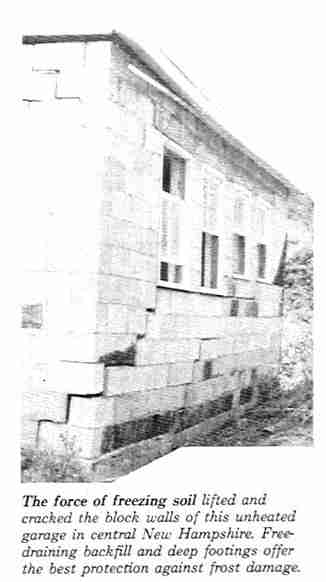
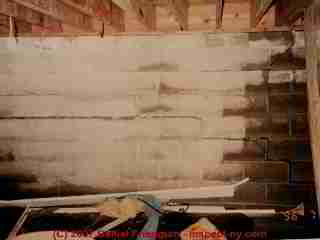
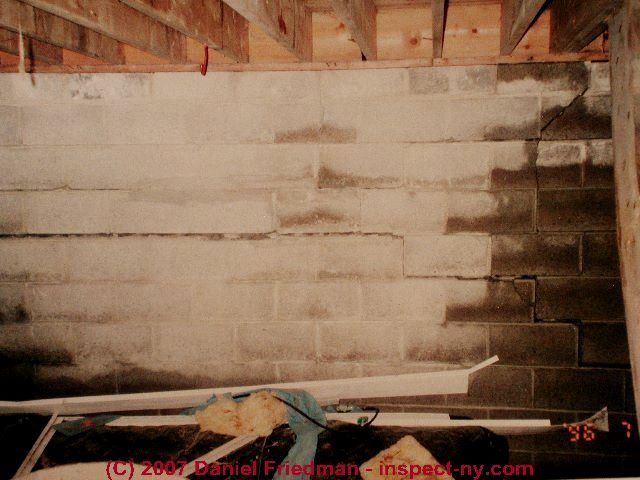
Photo (above) shows a badly buckled concrete foundation. Notice the water stains starting at the top of the wall in the right side of the photo?
The text below includes and expands upon the original material (the two PDF files above); it paraphrases, quotes-from, updates, and comments an original article from Solar Age Magazine and written by Steven Bliss.
Buckled Foundations: Is Insulation Guilty?
Every now and then we hear a story about insulation causing a foundation wall to crack. But until I received a letter from Minnesota engineer Paul Shea, I had never had one of these stories verified.
Shea wrote that "Buckling of foundations as a result of adding insulation is well known in Duluth, Minnesota. I personally audited three houses in Duluth that performed OK until insulation was installed."
When I [Steve Bliss] called Shea, he had four cases to report, two of which took place in "vegetable rooms" - small basement alcoves for storing product - that had been insulated in otherwise uninsulated basements.
In each case, said Shea, the walls buckled after they had been insulated on the building interior side, either with fiberglass or polystyrene insulation.
The failed foundation walls faced uphill sides of sloped sites, which acted as catch basins for rain and meltwater. As far as he knows, all of the walls were of un reinforced concrete block.
The soil in the area, he said, is very heavy clay. The climate is very cold (10,000 degree days) and wet.
Frost penetrates to five feet and deeper in Duluth, Minnesota. [DJF Note: we have seen similar foundation collapses in New York State where the combination of freezing with very wet soils pushed in the masonry block foundation wall. In similar structures where there is not a problem of wet soils (from improper surface or roof runoff disposal) these problems are rarely seen.]
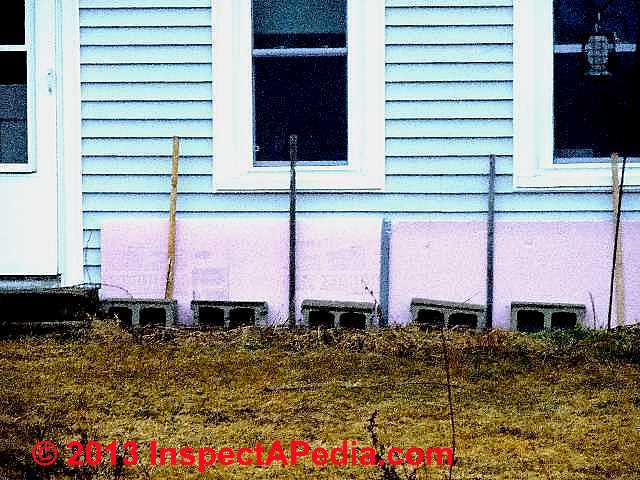
Our photo of above-ground building perimeter & foundation insulation is from a home we observed in Maine - [Daniel Friedman]
I Tracked down another foundation damage case in the area and spoke with the owner, who, incidentally, sells masonry supplies for a living.
He had insulated two adjacent foundation walls with extruded polystyrene, planning to finish the other two walls later.
That winter, one wall cracked and the other burst, pushing up in six inches at one joint. The wall that cracked had a concrete patio next to it.
The wall that gave way abutted the driveway. The house, said the owner, had been built around 1920. It cost him $3600 to repair the two foundation walls.
At the time the basement burst, he said, the room was cold - it had no heating boiler or furnace - just a small, rarely-used space heater.
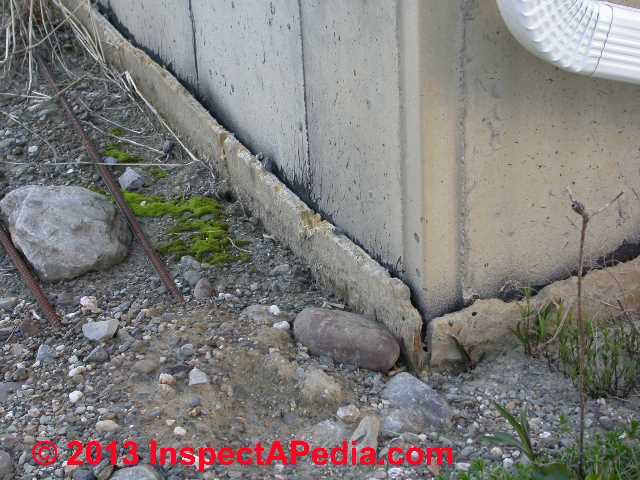 In the Duluth area, said the owner, many builders won't insulate foundations on the building interior.
Even when they put insulation on the foundation exterior, he said, some hold it a foot short of the footing - to let household heat bleed into the soil to moderate the freezing. Minnesota Power Co. energy auditor Roger Freeman recommends that the basement insulation stop two feet below grade and then flare out if desired (see the "Scandinavian Flared Foundation Insulation Option" described at BASEMENT HEAT LOSS).
Some Minnesota contractors refuse (in the 1980's) to install basement insulation altogether - though this cannot be an energy efficient building design.
Across the state of Minnesota, in Fargo, North Dakota, they don't seem to have this problem.
Soils Engineer Duane Heley, of Midwest Testing, in Fargo, said he has seen many basements damaged by expansive clay soils, but none he could attribute to frost problems.
On the other hand, he has seen frozen soil drag up and displace exterior foundation insulation.
Frost lensing is discussed at VERTICAL MOVEMENT IN FOUNDATIONS.
For that reason, he recommends placing foundation insulation on the building interior, where Mother Nature will not push it around.
In 11,000-degree-day Saskatchewan, they don't seem to have any problems with basement insulation according to building researcher Bob Dumont. The reason may be that Saskatchewan has only 15 inches of precipitation annually, compared with Duluth's 28 inches of rainfall, most of which drops in the summer and fall - saturating clay soils there.
Other cold-climate soils engineers I contacted around the country concurred that they had never seen frost action cause structural damage to residential foundations.
Foundation Damage from Frost Generally Also Involves Water (Ice)
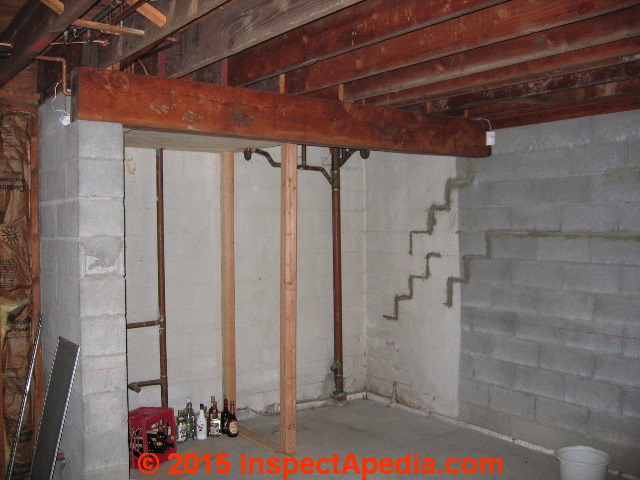
DJF Note: we have seen foundation collapses in New York State where the combination of freezing with very wet soils pushed in the masonry block foundation wall. In similar structures where there is not a problem of wet soils (from improper surface or roof runoff disposal) these problems are rarely seen.
Solving the site's water problems seems critical for builders and owners who want both energy efficient buildings (incorporating at least some foundation insulation) and also to avoid frost damage to the foundation caused by the combination of water and freezing conditions.
In the Hudson Valley of New York State when we see horizontal cracks in the upper third of a concrete block foundation wall that is mostly below grade (photograph at left), we associate that damage with water and frost - the frost line is about three feet down in the Hudson Valley.
When we see cracks and movement low on the foundation wall, near the floor, we associate that damage with earth pressure, possibly exacerbated by the extra weight of water and vehicles, but not with frost.
More about diagnosing horizontal foundation cracks and movement is
at HORIZONTAL MOVEMENT IN FOUNDATIONS
Here we include solar energy, solar heating, solar hot water, and related building energy efficiency improvement articles reprinted/adapted/excerpted with permission from Solar Age Magazine - editor Steven Bliss.
"Buckled Foundations: Is Insulation Guilty?" - links to the original article in PDF form immediately below were preceded by an expanded/updated online version of this article. This article by Steven Bliss reviews four case reports addressing foundation damage in which the building insulation may have played a role.
Readers who need to diagnose the cause and decide on the cure for foundation damage should start
at FOUNDATION CRACKS & DAMAGE GUIDE.
Contact us to suggest text changes and additions and, if you wish, to receive online listing and credit for that contribution.
Links to the original article in PDF form immediately below .
- BUCKLED FOUNDATIONS due to INSULATION? page 1 - PDF document, use your browser's back button to return to this page
- BUCKLED FOUNDATIONS due to INSULATION? page 2 [PDF]
- BUCKLED FOUNDATIONS due to INSULATION? page 3 [PDF]
See POLYSTYRENE FOAM INSULATION for a guide to using this material in below-grade foundation insulation applications.
See TERMITE SHIELDS vs TERMITICIDE for a discussion of avoiding insect damage when foam insulating board is used below or at ground level.
See WET BASEMENT PREVENTION for other exterior treatments of building foundation walls to combine foundation insulation with basement waterproofing membranes and drainage systems.
Reader Comments, Questions & Answers About The Article Above
Below you will find questions and answers previously posted on this page at its page bottom reader comment box.
Reader Q&A - also see RECOMMENDED ARTICLES & FAQs
Question:
 I was watching a show several years ago that showed a flat insulated board that was laid on an angle away from the foundation to prevent water/ice forming around the foundations in Vermont.
I have been wondering ever since what that material was and if it worked.
It was placed at the frost line on a downward slope. Any ideas? - M.M. 8/26/20134
Reply:
1. Keeping water away from foundations is important in freezing climates: I have some experience with trying to get water away from buildings and with using insulation to avoid several problems:
- frost push, foundation cracking, movement
- frost lensing, foundation is lifted by heaving soils (Ice Lenses, Frost Heaves vs. Frozen Soil Pressure)
- foundation leakage
Along with Steve Bliss we've published some relevant notes on an old debate about whether or not foundation insulation might even cause rather than avoid foundation damage
- see BUCKLED FOUNDATIONS due to INSULATION?
In my experience & OPINION, using solid closed cell foam insulation alone to try to get water away from buildings is ineffective or not cost effective or both; Considering that most foundations are built in a larger-sized excavated hole, backfill around the foundation is less firmly packed than other virgin soil at the same site. A result is that even if soil slopes away from the foundation, water spilling close to it or running close to it from in-slope grade tends to soak down through the soil where there is risk of frost and leak damage to the structure.
A sloped foam insulating pad is not water-tight unless abutting seams are sealed and even then may be too narrow a drain-pad around the building unless extended far enough away to deliver water to the surface at a location where it continues to drain away from the structure, or to deliver water to a buried drainage system well away from the building and continuing to daylight or to a storm drain. So I'm doubtful that a foam insulation apron alone keeps water from running beneath itself and thus towards the structure.
What's left then: well the foam may slow or reduce the freezing of soils close to the building, while still admitting water.
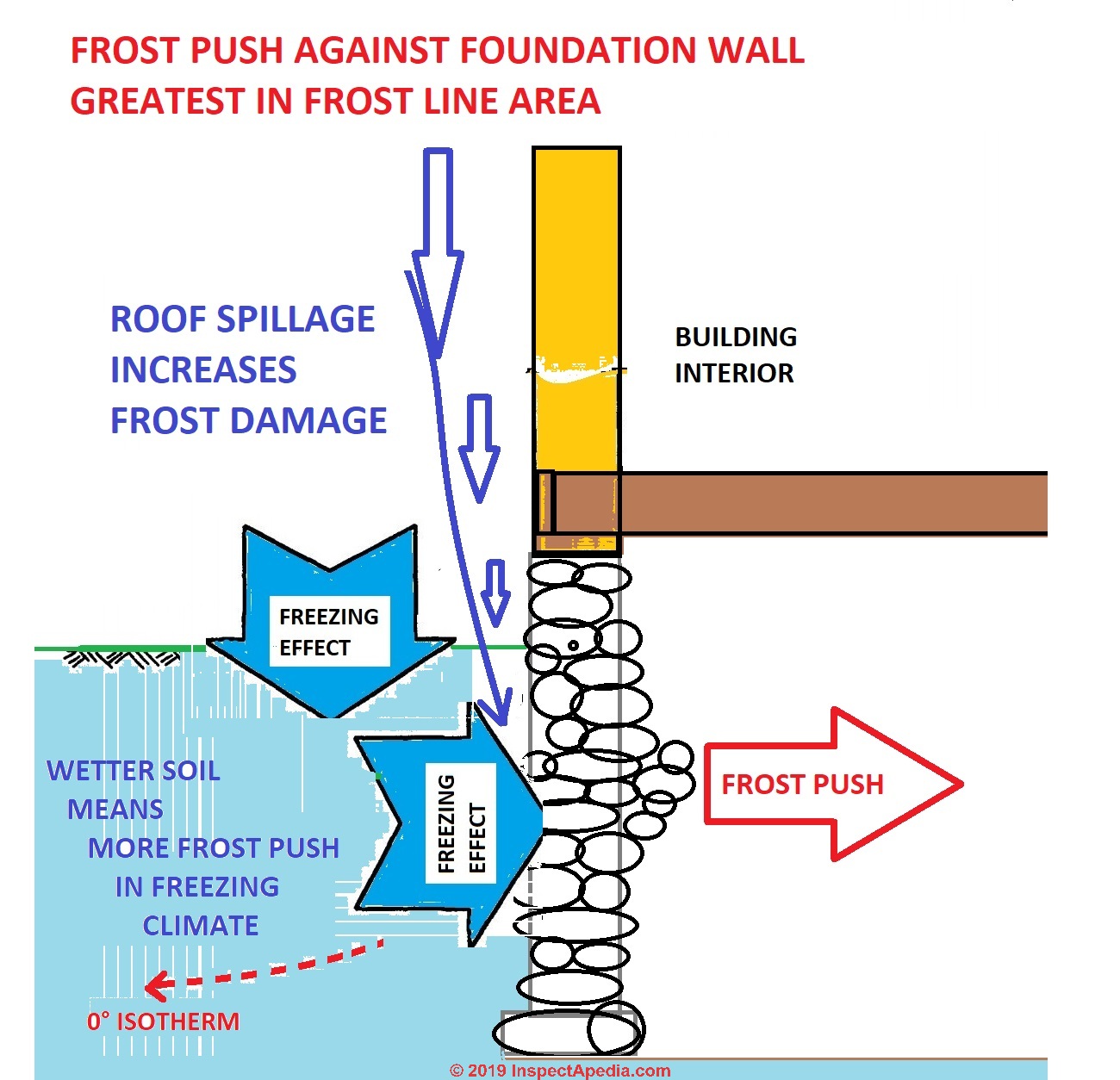
Above: Frost -push forces that can damage foundations of any material, particularly masonry such as concrete block and stone and peraps unreinforced concrete.
[Click to enlarge any image]
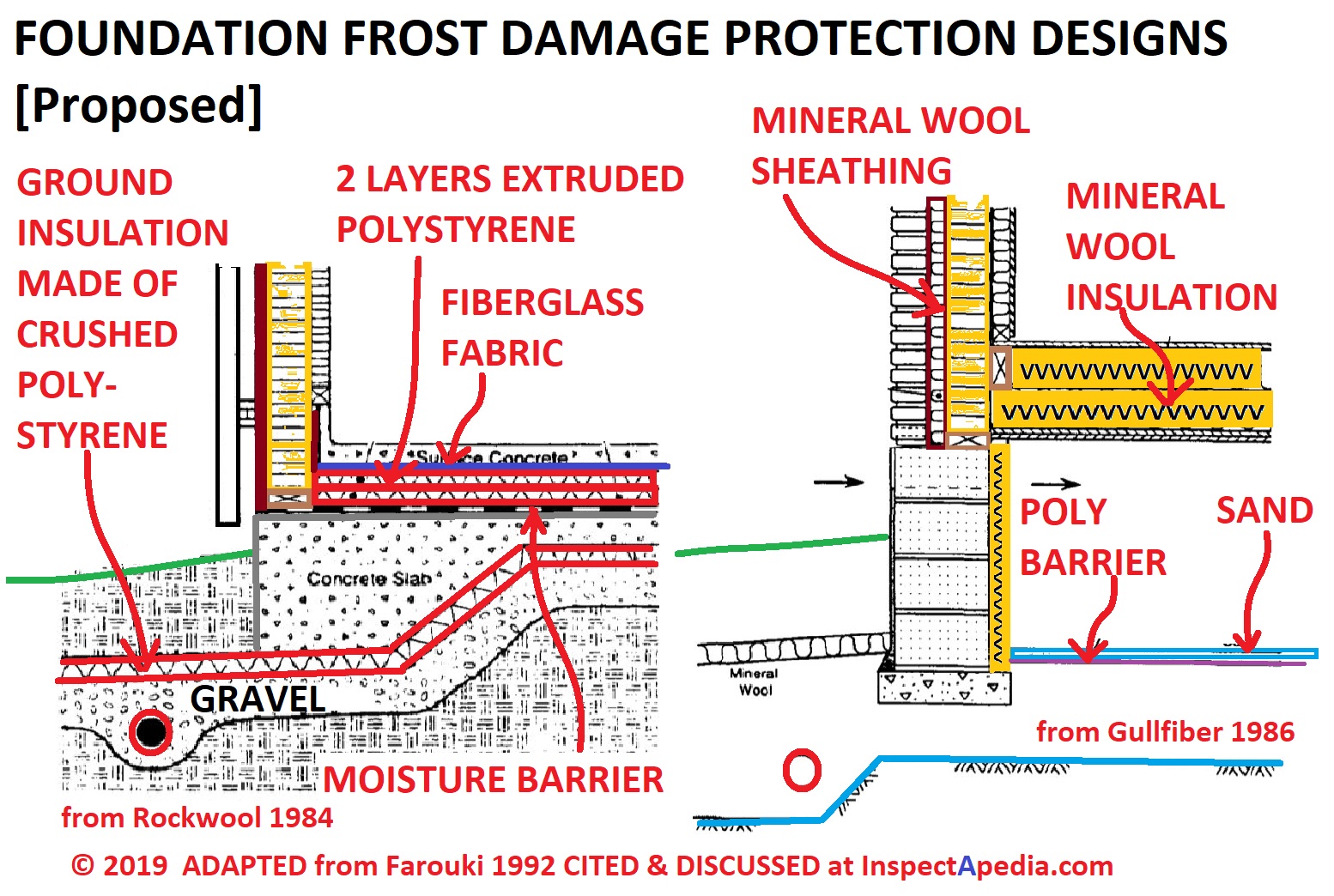
2. Using Insulation to Protect Foundations from Frost Damage: The illustration shown below, adapted from Farouki (1992) VTT (1987) suggests using insulation buried parallel to the ground surface near foundations to help protect from frost damage.
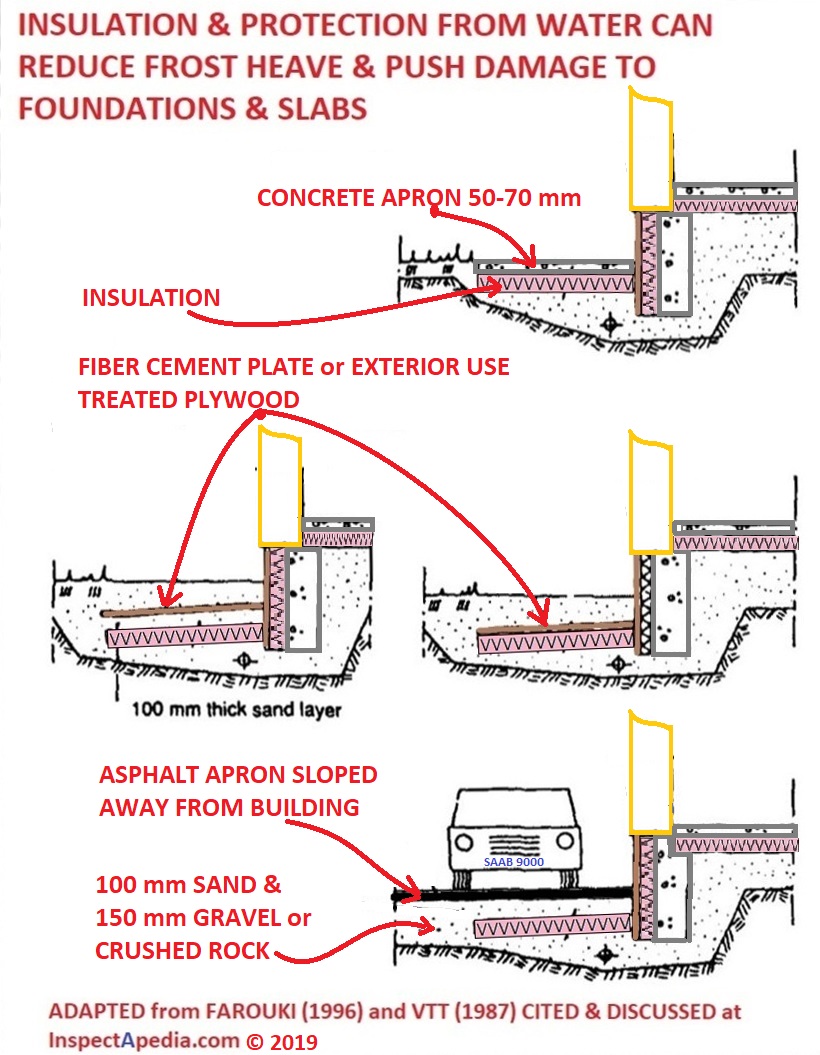
Farouki (1992) and VTT (1985) describe using a combination of extruded polystyrene insulation, mineral wool facing board (or equivalent), fiberglass favric, and outside, ground insulation made of crushed polystyrene combined with sand, gravel, and drainage to protect against frost damage by eave or push against slabs and foundation walls in freezing climates. Adapted from the same source are other examples of proposed methods for protecting foundatiobns and slabs from frost damage.
Research on this approach are also
at STONE FOUNDATION DEFECTS where we also discuss frost push damage to foundations.
In my OPINION the insulation alone cannot protect the foundation from frost damage in cold climates. In protracted very cold conditions wet soil below the insulation will ultimately freeze and push on the foundation wall or slab unless there is also heat loss from the building keeping the soil un-frozen for some distance from the structure - an approach that might work but might be rather expensive in heating cost and fuel consumpation as well.
However a combination of insulation plus measures that keep the soil dry around the building foundation or below a slab can be effective at preventing frost damage to the structure. Dry soil means less water to freeze and thus less pressure from the tremendous force of expansion as water freezes into ice.
3. Use geotextiles, gravel, sloped surface to keep water away from a foundation where gutters cannot be installed or maintained: I have not inspected a structure with a foam apron at or close to grade, sloping away, that prevented frost or water damage; I have inspected, and also helped design and install geotextile installations that waterproofed around a building foundation;
We used this approach at a metal-roofed converted barn home in Newbugh NY because the owner simply could not keep gutters on the building.
Key was getting roof spillage away from the foundation by a combination of a buried geotextile combination of plastic and fabric matting that sloped at least 10 ft. from the structure, in some locations more, and terminating where water was then drained off of the property; we backfilled and seeded or sodded over the geotextile installation, maintaining the desired drainage contour; close to the building walls we installed a band of gravel to reduce rain splash-up onto the building walls along the roof drip-line.
You will want to see BASEMENT HEAT LOSS for a detailed discussion of insulating building foundations.
See POLYSTYRENE FOAM INSULATION for a guide to using this material in below-grade foundation insulation applications.
See TERMITE SHIELDS vs TERMITICIDE for a discussion of avoiding insect damage when foam insulating board is used below or at ground level.
See WET BASEMENT PREVENTION for other exterior treatments of building foundation walls to combine foundation insulation with basement waterproofing membranes and drainage systems
...
Continue reading at FOUNDATION DAMAGE by ICE LENSING or select a topic from the closely-related articles below, or see the complete ARTICLE INDEX.
Or see these
Recommended Articles
- BULGED vs. LEANING FOUNDATIONS
- BULGE or LEAN MEASUREMENTS
- FOUNDATION DAMAGE & REPAIR GUIDE - home
- FOUNDATION DAMAGE by ICE LENSING
- FOUNDATION DAMAGE SEVERITY
- FOUNDATION FAILURES in CLAY SOIL
- FOUNDATION FAILURE by INSULATION - insulation causing foundation buckling or damage
- FOUNDATION FAILURES by MOVEMENT TYPE - home
- FOUNDATION FAILURES by TYPE & MATERIAL - home
- FROST HEAVES, FOUNDATION, SLAB
- HORIZONTAL MOVEMENT IN FOUNDATIONS
- INSULATION LOCATION - WHERE TO PUT IT - home & separate article series
- STONE FOUNDATION DEFECTS
- VERTICAL MOVEMENT IN FOUNDATIONS
Suggested citation for this web page
FOUNDATION FAILURE by INSULATION at InspectApedia.com - online encyclopedia of building & environmental inspection, testing, diagnosis, repair, & problem prevention advice.
Or see this
INDEX to RELATED ARTICLES: ARTICLE INDEX to BUILDING INSULATION
Or use the SEARCH BOX found below to Ask a Question or Search InspectApedia
Ask a Question or Search InspectApedia
Try the search box just below, or if you prefer, post a question or comment in the Comments box below and we will respond promptly.
Search the InspectApedia website
Note: appearance of your Comment below may be delayed: if your comment contains an image, photograph, web link, or text that looks to the software as if it might be a web link, your posting will appear after it has been approved by a moderator. Apologies for the delay.
Only one image can be added per comment but you can post as many comments, and therefore images, as you like.
You will not receive a notification when a response to your question has been posted.
Please bookmark this page to make it easy for you to check back for our response.
Our Comment Box is provided by Countable Web Productions countable.ca
Citations & References
In addition to any citations in the article above, a full list is available on request.
- Solar Age Magazine was the official publication of the American Solar Energy Society. The contemporary solar energy magazine associated with the Society is Solar Today. "Established in 1954, the nonprofit American Solar Energy Society (ASES) is the nation's leading association of solar professionals & advocates. Our mission is to inspire an era of energy innovation and speed the transition to a sustainable energy economy. We advance education, research and policy. Leading for more than 50 years. ASES leads national efforts to increase the use of solar energy, energy efficiency and other sustainable technologies in the U.S. We publish the award-winning SOLAR TODAY magazine, organize and present the ASES National Solar Conference and lead the ASES National Solar Tour – the largest grassroots solar event in the world."
- Steve Bliss's Building Advisor at buildingadvisor.com helps homeowners & contractors plan & complete successful building & remodeling projects: buying land, site work, building design, cost estimating, materials & components, & project management through complete construction. Email: info@buildingadvisor.com
Steven Bliss served as editorial director and co-publisher of The Journal of Light Construction for 16 years and previously as building technology editor for Progressive Builder and Solar Age magazines. He worked in the building trades as a carpenter and design/build contractor for more than ten years and holds a masters degree from the Harvard Graduate School of Education. Excerpts from his recent book, Best Practices Guide to Residential Construction, Wiley (November 18, 2005) ISBN-10: 0471648361, ISBN-13: 978-0471648369, appear throughout this website, with permission and courtesy of Wiley & Sons. Best Practices Guide is available from the publisher, J. Wiley & Sons, and also at Amazon.com - Our recommended books about building & mechanical systems design, inspection, problem diagnosis, and repair, and about indoor environment and IAQ testing, diagnosis, and cleanup are at the InspectAPedia Bookstore. Also see our Book Reviews - InspectAPedia.
- In addition to citations & references found in this article, see the research citations given at the end of the related articles found at our suggested
CONTINUE READING or RECOMMENDED ARTICLES.
- Carson, Dunlop & Associates Ltd., 120 Carlton Street Suite 407, Toronto ON M5A 4K2. Tel: (416) 964-9415 1-800-268-7070 Email: info@carsondunlop.com. Alan Carson is a past president of ASHI, the American Society of Home Inspectors.
Thanks to Alan Carson and Bob Dunlop, for permission for InspectAPedia to use text excerpts from The HOME REFERENCE BOOK - the Encyclopedia of Homes and to use illustrations from The ILLUSTRATED HOME .
Carson Dunlop Associates provides extensive home inspection education and report writing material. In gratitude we provide links to tsome Carson Dunlop Associates products and services.
 | HOME | ABOUT | ASK a QUESTION | CONTACT | CONTENT USE POLICY | DESCRIPTION | POLICIES | PRIVACY | |
| © 2024 - 1985 Publisher InspectApedia.com - Daniel Friedman | |||||||||