
InspectAPedia® FREE Encyclopedia of Building & Environmental Construction, Diagnosis, Maintenance & Repair |
Question? Just ask us! InspectAPedia
|
 Expansive Clay Soil Damage to Foundations
The Main Causes of Buckled Foundation Damage in Wet, Freezing Climates with Clay Soils
- POST a QUESTION or COMMENT about the causes of buckled building foundations for structures built in wet freezing climates and or on clay soils
Expansive clay soil damage to building foundations or slabs:
Role of frost, freezing, & clay or wet soils in foundation heaves, cracks, damage: this article explains the main causes of foundation cracks, buckling, or collapse in areas of freezing weather, clay soils, or wet soils.
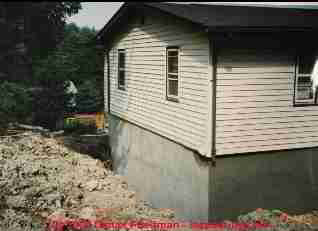
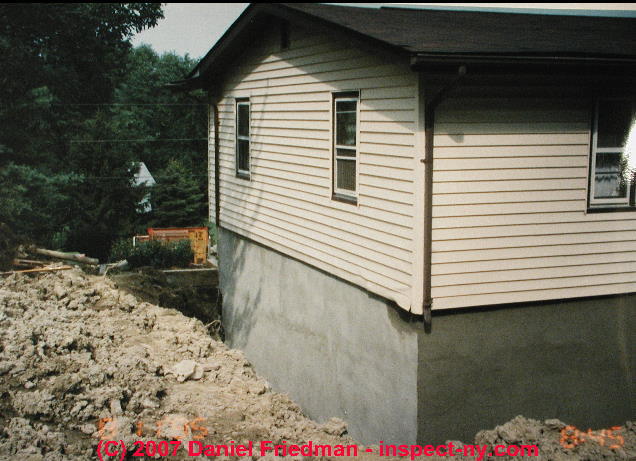
We provide suggestions for avoiding foundation damage or collapse and we discuss the proper foundation insulation locations and materials for use in problem areas. Photo (above) shows a new foundation constructed below a New York home after a catastrophic foundation collapse caused by wet soils.
InspectAPedia tolerates no conflicts of interest. We have no relationship with advertisers, products, or services discussed at this website.
What is the Main Cause of Foundation Failures in Expansive Clay Soils?
 The USGS defines "expansive soils" as
Types of soil that shrink or swell as the moisture content decreases or increases. Structures built on these soils may experience shifting, cracking, and breaking damage as soils shrink and subside or expand.
The following includes text adapted from Solar Age Magazine, Steven Bliss: Most foundation failures in clay soil have nothing to do with freezing. The culprit is more often the expansion of the soil when it absorbs water.
In Fargo, said housing engineer Lambert Vogel, when the soil dries out and shrinks, it can pull away from the foundation as much as two inches to a depth of three feet or more.
Either the wind or the homeowner is likely to fill this crack with loose soil. When the clay soil gets wet again and expands, crack goes the wall - if it is weak.
In some areas of expansive clay soils such as portions of Colorado, builders install a soil watering system below the building's foundation and slab in order to prevent this clay soil shrinkage during dry weather.
Watch out: other more varigated concrete crack patterns (shown below) may be ascribed
to FOUNDATION DAMAGE by MATERIAL or INCLUSIONS
producing soil heaving, unstable soils, or crack patterns in concrete caused by inclusion of iron sulfide (pyrrhotite) particles in the concrete mix itself.
Recommendations to Avoid Foundation Wall Cave-Ins in Cold Climates
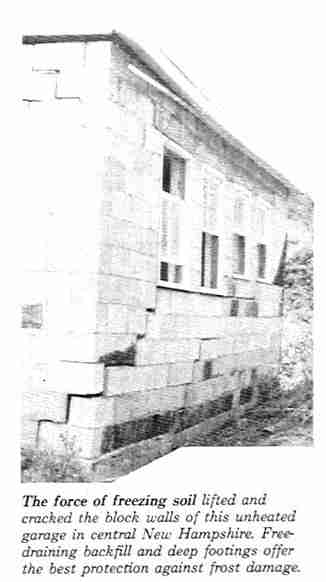
Vary rarely do foundation walls cave in from insulation, except possibly in Duluth, Minnesota, where all the conditions are ripe for foundation failure: lots of rainfall, clay soils, very cold winters, and building practices that often do not include foundation drainage to assure that soils close to the building foundation are not water-saturated.
But you can prevent all frost-related foundation damage problems by following standard good building practices:
- Provide positive site drainage - do not direct surface or roof water spillage against or close to the building foundation
- Use granular backfill or gravel around foundation walls, including footing drains that carry water to daylight well away from the building
- Build foundation walls strong enough to withstand unavoidable intermittent pressures and loads exerted by water or ice.
- If your foundation insulation is to be installed on the outside of the wall, use a material such as Styrofoam that will not lose its insulating value when exposed to moisture or water.
- If your foundation insulation is to be installed on the inside of the foundation wall, we still prefer using insulating foam board products such as high R-value urethane foam boards rather than fiberglass insulation. That's because fiberglass against or close to a below-ground-level building foundation is exposed to moisture from both the building interior as well as from the building exterior.
Moist or wet fiberglass insulation not only loses its insulating value, but it can become a problematic mold reservoir in the building.
See FIBERGLASS INSULATION MOLD.
Given basically sound foundation and site work, it is acceptable to insulate a building foundation inside (giving up the thermal mass benefits to the building) or outside, and to install foundation wall insulation half-way, full-height, or flared-out - anywhere in the continental United States.
In foundation insulation retrofits in very cold climates, life is not so simple. What if you have an un reinforced concrete block foundation, a frost-susceptible soil (clay or silt), and poor site drainage? Then we would be reluctant to install any foundation insulation without first correcting the site - at the very least by conducting surface water and roof spillage well away from the building foundation.
Where the integrity of the foundation wall is in doubt, there are compromise solutions. We might install half-height insulation on the inside of the foundation wall, or half-height insulation n the outside of the foundation wall with the addition of at 2- to 4-foot flare.
But don't expect good thermal performance with half-height interior foundation insulation on an open-core concrete block foundation wall. Convection in the concrete block cores will carry heat right past the insulation.
Also consider the wintertime temperatures in the basement or crawl space. If the building owners have insulated the basement or crawl space ceiling, and are heating with a woodstove upstairs rather than a furnace or boiler in the basement, the basement walls, not to mention the water pipes could get very cold.
See WINTERIZE A BUILDING.
Here we include solar energy, solar heating, solar hot water, and related building energy efficiency improvement articles reprinted/adapted/excerpted with permission from Solar Age Magazine - editor Steven Bliss.
Useful Research on Expansive Soil Damage Assessment
- Al-Rawas, Amer Ali, and Mattheus FA Goosen, eds. Expansive soils: recent advances in characterization and treatment. Taylor & Francis, 2006.
- BASEMENT HEAT LOSS for a discussion of basement and foundation insulation
- Buttler, Larry J., Sr., A REVIEW of CONSTRUCTION PRACTICES to CONTROL HEAVE in HIGHWAY PAVEMENTS [PDF] (1973) Texas Highway Department, Highway Design Division, retrieved 2019/10/07 original source: https://library.ctr.utexas.edu/digitized/texasarchive/thdresearch/ss-10_2_txdot.pdf
Introduction excerpts:
To the average motorist, heave can be described as irregular but pronounced bumps in the roadway. Evidence of a heaving or swelling roadway is also indicated by asphaltic leveling on short sections of fairly new pavements or a heater-planer at work as it removes the humps caused by swelling.
Expansive clays which cause these problems in highways can be defined as a clay which shows extensive volume changes when wetted or dried. True, all soils show some change with changes in moisture content, but the ones which cause damage to the pavement above them can be said to be expansive.
To the engineer, distress caused by expansive soils has been observed in a number of forms, such as
(1) transverse waves or bumps that occur at fairly regular intervals for a significant length of roadway without cracking or visible damage;
(2) general uneveness along the roadway usually without cracking;
(3) longitudinal cracking parallel to the road centerline;
(4) heave in localized conditions, such as distress at culverts which is generally accompanied by lateral cracking; and (5) uplift of the pavement near bridge ends. - Dessouky, Samer, and Jeong Ho Oh, Mijia Yang, Mohammad Ilias, Sang Ick Lee, Tom Freeman, Mark Bourland, and Mien Jao, PAVEMENT REPAIR STRATEGIES FOR SELECTED
DISTRESSES IN FM ROADWAYS [PDF] (2012) prepared with the Texas Department of Transportation and the U.S. Fedral Highway Administration, retrieved 2019/10/07 original source: https://static.tti.tamu.edu/tti.tamu.edu/documents/0-6589-1.pdf
Abstract
Expansive soil is considered one of the most common causes of pavement distresses in FM roadways. Depending upon the moisture level, expansive soils will experience changes in volume due to moisture fluctuations from seasonal variations. The objective of this research was to evaluate existing repair projects on selected FM roadways.
Those roadways experienced failures in the form of fatigue and rutting in the wheel path, and longitudinal (faulted) cracking including edge cracking. The causes of those failures were mainly linked to high PI expansive soil and narrow pavement.
This study involved field and laboratory testing on those projects to examine the effectiveness of the applied treatments. The projects presented in this report are examples of how TxDOT districts choose to address severe pavement conditions that lead to failure on FM roads. Some of those examples are innovative, and others are routine.
These projects do not represent the only options for treatment, and each project should be designed based on its existing conditions, such as the intended design life cycle, cost effectiveness, local climate, local traffic, and available local materials. - Fredlund, Delwyn G., and Harianto Rahardjo. Soil mechanics for unsaturated soils. John Wiley & Sons, 1993.
- Fredlund, D. G., N. Ro Morgenstern, and R. A. Widger. "The shear strength of unsaturated soils." Canadian geotechnical journal 15, no. 3 (1978): 313-321.
- FOUNDATION CRACKS & DAMAGE GUIDE to diagnose the cause and decide on the cure for foundation damage
- FOUNDATION DAMAGE by MATERIAL or INCLUSIONS - heaving damage to foundation walls & cracking foundations or slabs due to Iron sulfide mineral (pyrrhotite) inclusions in concrete or due to building on Iron sulfide mineral (pyrrhotite) shale.
- Hamberg, D. J., and J. D. Nelson. "Prediction of floor slab heave." In Fifth International Conference on Expansive Soils 1984: Preprints of Papers, p. 137. Institution of Engineers, Australia, 1984.
- Holland, J.E., J. Richards, ROAD PAVEMENTS on EXPANSIVE CLAYS [PDF], Australian Road Research, Vol. 12 No. 3, Sept. 1982, retrieved 2019/10/07, original source: http://railknowledgebank.com
Abstract excerpt:
This paper briefly outlines the world-wide problems that can result from the construction of road pavements on expansive clay subgrades.
- Ito, Maki, and Shahid Azam. "Determination of swelling and shrinkage properties of undisturbed expansive soils." Geotechnical and Geological Engineering 28, no. 4 (2010): 413-422. also referring to Proceedings, 4th international conference on expansive soils, Denver, Colorado, USA.
- Jones, Lee D., and Ian Jefferson. Expansive soils. ICE Publishing, 2012.
- McKeen, R. Gordon, VALIDATION OF PROCEDURES FOR PAVEMENT DESIGN ON EXPANSIVE SOILS [PDF] (1985), New Mexico Engineering Research Institute
Box 25, University of New Mexico
Albuquerque, New Mexico 87131, Program Engineering
and Maintenance Service
Washington, D.C. 20591, retrieved from NTIS, National Technical Information Service, Springfield, Virginia 22161 - Miller, Debora J. Expansive soils: problems and practice in foundation and pavement engineering. John Wiley & Sons, 1997.
- Mokhtari, Masoumeh, and Masoud Dehghani. SWELL-SHRINK BEHAVIOR OF EXPANSIVE SOILS, DAMAGE AND CONTROL [PDF] Electronic Journal of Geotechnical Engineering 17 (2012): 2673-2682.
Abstract:
Expansive soils occurring in arid and semi-arid climate regions of the world cause serious problems on civil engineering structures. Such soils swell when given an access to water and shrink when they dry out. Several attempts are being made to control the swell-shrink behavior of these soils. The Swelling potential of the expansive soil mainly depends upon the properties of soil and environmental factors and Stress Conditions. Each year, expansive soils cause in damage to houses, other buildings, roads, pipelines, and other structures.
This is more than twice the damage from floods, hurricanes, tornadoes, and earthquakes combined. This article presents description of expansive soil, shrink - swell behavior and control it, Factors Influencing Swelling and Structural damage. KEYWORDS: Expansive soils, swell-shrink behavior, Factors Influencing Swelling, Structural damage. - Noe, David C. "Heaving‐Bedrock Hazards, Mitigation, and Land‐Use Policy: Front Range Piedmont, Colorado." Environmental Geosciences 4, no. 2 (1997): 48-57.
- Rogers, J. David, Robert Olshansky, and Robert B. Rogers, DAMAGE TO FOUNDATIONS FROM EXPANSIVE SOILS [PDF] Missouri S&T, retrieved 2019/10/07 original source: https://web.mst.edu/~rogersda/expansive_soils/DAMAGE%20TO%20FOUNDATIONS%20FROM%20EXPANSIVE%20SOILS.pdf
Excerpt:
Expansive soils in many parts of the United States pose a significant hazard to foundations for light buildings. Swelling clays derived from residual soils can exert uplift pressures of as much as 5,500 PSF, which can do considerable damage to lightly-loaded wood-frame structures. Insurance companies pay out millions of dollars yearly to repair homes distressed by expansive soils.
Expansive soils owe their characteristics to the presence of swelling clay minerals. As they get wet, the clay minerals absorb water molecules and expand; conversely, as they dry they shrink, leaving large voids in the soil. Swelling clays can control the behavior of virtually any type of soil if the percentage of clay is more than about 5 percent by weight. Soils with smectite clay minerals, such as montmorillonite, exhibit the most profound swelling properties. - SETTLEMENT CRACKS in SLABS - why is my garage floor falling-in?
- SETTLEMENT vs. FROST HEAVE CRACKS
- Simic D. EVALUATION OF ROADBED POTENTIAL DAMAGE INDUCED BY SWELLING/SHRINKAGE
OF THE SUBGRADE [PDF] Effet du retrait-gonflement des sols sur les structures de chaussées, in Proceedings of the 18th International Conference on Soil Mechanics and Geotechnical Engineering, Paris 2013, pp. 1357-1360, retrieved 2019/10/07 original source: http://www.cfms-sols.org/sites/default/files/Actes/1357-1360.pdf
ABSTRACT: The expansive soils in arid and semi-arid regions are subject to seasonal moisture variations that trigger changes in volume. These movements are reflected in swellings along the wet months and shrinkages along the dry months; seasonal movements that induce significant damages in the pavements.
Traditionally, the construction of pavements on expansive clays has resulted in roads with a poor comfort level for the customers and a great maintenance cost for the administration. Such facts make very problematic the construction of road pavements in expansive soils. This paper analyzes the behavior of the pavement subject to deformations due to swelling and shrinkage of the subgrade, in order to evaluate some of the published design methods for the protection of the pavement against the swelling phenomena of underlying clays.
To introduce the design methods, this paper will describe first the usual pathologies due to swelling and shrinkage, and their explanation by means of the analysis of some instrumented sections in existing roads. The different design methods will be summarized, showing also some limitations of the assumptions adopted in each analysis method.
RÉSUMÉ : Les sols gonflants situés dans des régions au climat aride sont soumis à des variations en teneur d’eau accompagnées de changements volumétriques : des gonflements en période humide et rétraction en période sec. Ces déformations se propageant au niveau de la chaussée donnent lieu à d’importants coûts de maintenance.
Ces coûts rendent problématique la construction si ces problèmes ne sont pas correctement cernés et gérés. Dans cet article, le comportement de la chaussée soumise aux déformations de gonflement est décrit et les pathologies et méthodes d’analyse existantes dans la littérature sont évaluées. Des exemples sont montrés ainsi que les limitations des hypothèses retenues dans les procédés analysés
KEYWORDS: expansive soils, roads, semi-arid regions. MOTS-CLÉS: sols expansifs, routes, regions semi-arides. - USGS at https://www.usgs.gov
- Gill, J. D., M. W. West, D. C. Noe, H. W. Olsen, and D. K. McCarty. "Geologic control of severe expansive clay damage to a subdivision in the Pierre Shale, Southwest Denver Metropolitan area, Colorado." Clays and clay minerals 44, no. 4 (1996): 530-539.
Abstract:
Shortly after construction of a subdivision in the southwest Denver metropolitan area in 1986, a portion of the subdivision built directly on steeply-dipping strata of the Pierre Shale began experiencing damaging differential movements, causing house foundations to fail and pavements to warp and crack. This formation is a Late Cretaceous marine clay-shale composed predominantly of fluvial mixed-layer illite/smectite and quartz. During deposition of the shale, periodic and explosive volcanism generated thin beds of bentonite, consisting initially of volcanic ash and subsequently altered to nearly pure smectite.
Some of these bentonite beds were exposed in a trench adjacent to the subdivision and perpendicular to the strike of the steeply-dipping strata. The thickest bentonite beds correlated well with linear heave features that these beds parallel the bedrock strike throughout the subdivision were mapped via severely deformed pavements.
Mineralogical data show the bentonite bed that correlates with the worst damage within the subdivision consists of about 62% smectite by weight with mixed-layer illite/smectite expandability of 92%. By comparison, a sample of the typical silty claystone, which is fluvial mixed-layer illite/smectite mixed with detrital quartz from the adjacent strata, had about 23% smectite by weight with 70% to 90% illite/smectite expandability.
Geotechnical tests for swell potential show that samples of 2 bentonite beds swelled 39% to 43% compared to 2% to 8% for samples of the typical silty claystone. It is proposed that differential swell resulting from stratigraphically-controlled differences in clay mineralogy and grain-size is the primary factor controlling extreme damage for this geologic setting.
- Gill, J. D., M. W. West, D. C. Noe, H. W. Olsen, and D. K. McCarty. "Geologic control of severe expansive clay damage to a subdivision in the Pierre Shale, Southwest Denver Metropolitan area, Colorado." Clays and clay minerals 44, no. 4 (1996): 530-539.
- Wells, R.R., S.N. Prasad, and M.J.M Romkens, 2001a. Cracking modes of an expansive Mississippi
Delta soil. In Mississippi Delta management systems evaluation areas project, 1995-99,
Mississippi Agricultural and Forestry Experiment Station Information Bulletin 377.
Abstract:
Modes of cracking in expansive soils of the Mississippi delta and their impact on infiltration were examined. Preliminary laboratory infiltration studies suggested an evolutionary pattern of the crack network. Subsequent studies were conducted to investigate the primary modes of crack formation and their impact on infiltration.
Of particular importance in the evolution of the crack morphology, the role of the seal and development of stress within the substrate is discussed. Understanding the developmental aspects of cracked soils permits further development of infiltration relationships that are used to determine the transport capabilities of cracked soils.
Reader Comments, Questions & Answers About The Article Above
Below you will find questions and answers previously posted on this page at its page bottom reader comment box.
Reader Q&A - also see RECOMMENDED ARTICLES & FAQs
On 2020-10-26 by (mod) - how to evaluate damage from expansive clay soil
John
Thanks for an important and interesting question about investigating possible expansive clay soil damage that might affect a slab, foundation, and plumbing.
Thank you for the interesting question - it helps us realize where we need to work on making our text more clear or more complete. A competent onsite inspection by an expert usually finds additional clues that would permit a more accurate, complete, and authoritative answer than we can give by email alone. You will find additional depth and detail in the article series beginning on this page.
That said, I have these comments:
General Priorities for Evaluating Building Foundation Damage
There are several key concerns, and your question suggests we're of similar mind:
1. Structural condition, stability, safety (not likely to be a major concern but worth ruling out) - see FOUNDATION DAMAGE SEVERITY https://inspectapedia.com/structure/Foundation_Damage_Assessment.php
for some detailed suggestions.
In general, IF you see horizontal cracking in a masonry-unit wall or foundation (block or brick, for example)
AND in particular if the wall is significantly bulged (say bulged in more than an inch)
OR if the wall is structural brick and cracked and bulged
See FOUNDATION BULGE or LEAN MEASUREMENTS
THEN there is risk of collapse that justifies an immediate evaluation by an experienced mason or if you hire an engineer, one who has specific experience and expertise in residential masonry construction.
Vertical cracks and non-bulged walls are usually less of an urgent concern as even if damage is significant and repair costly, the risk of a sudden precipitous collapse is considerably less.
See details at FOUNDATION DAMAGE SEVERITY
2. Electrical and fire safety: if building movement has damaged or dislocated electrical wiring or a chimney or a heating fuel source piping then those conditions are dangerous and also merit prompt evaluation and repair.
3. Sanitation: if a sewage line is heaved it may fail to drain, or if it's broken it may release sewage: both potential sources of a sewage backup and health risks.
Let's start by your own visual inspection: you can probably see, without relying on precise measurements, whether or not the foundation wall is bulged or leaning or dislocated. If the damage is only to the slab itself but the supporting walls are un-touched then we can rest more-easily regarding priority item 1 and with a bit more visual inspection, item 2.
To evaluate item 3, when you say a pipe is clean, clear, passes no water I'm not sure what that means; but if you're not certain of the condition of drains in the area of heaving then you might hire a plumber with a sewer line camera to inspect the drain system for heaves or damage.
Please also be sure to
read EXPANSIVE CLAY SOIL DAMAGE to FOUNDATIONS where we wil re-post this conversation to invite pertinent comments from other readers.
Let me know what you see, think, find, are-told, or what questions remain.
Stay safe, and don't let this so distract you that you forget to vote.
On 2020-10-26 by John
Our home is a late 1980's 2-story built on a concrete slab foundation where clay soil abounds.
During a very dry spell we moved our raised rack firewood, that was 1' away from wall, which revealed a 2'x6' wet soil area & what appears to be a 3' thin horizontal crack (maybe more than one or possibly "stair-stepped") holding ozed dirt & mold(?) growth along with a 2' area presenting a 1" bulging out of the concrete compared to the rest of the footing(?).
This is behind our kitchen & near a 3 1/2" pvc access pipe which is clean, clear, & passes no water.
Thinking plumbing issue w/footing & or slab compromised; research shows $$$ & not sure where to start: insurance, plumber (who cuts the concrete out?), struct. engineer, or concrete co.?
Question: can a paved street creep atop clay soil?
I wonder if you've ever heard of a situation where the paved street creeps atop the clay soil? We have a situation where our soil is clay (Troy. MI). The street is pushing slowly against our driveway, which then pushes against our garage floor, and from there, the foundation.
We are on an inside corner in our subdivision. A number of years ago, it cracked the top section of our poured concrete foundation and moved the section inward several inches. When our builder repaired it, he told us that a nearby city (Brownstown, MI) also had a similar situation.
The driveway has been pushed approximately 2 inches toward our house, as evidenced by a visible difference between the control joint in the driveway and the edge of the sidewalk, which was originally in line with the control joint. We also had the builder cut a section from the back of the garage floor concrete to reduce the potential for contact with the foundation.
Additionally, we had sections cut at the sidewalk end of driveway and at the garage end, sufficient to replace the sections with pavers and still have room for sand to take up any movement. The additional room has reduced since we did this. Our garage door track which is embedded in the concrete floor shows movement as well, and the framing has been moved to a point where the caulking has stretched past its limit. The movement is greater on one side than the other.
The city claims no knowledge and no responsibility for the movement of the street, despite having to replace most of the street a couple of years ago.
I am looking for other instances of the same issue to present to the city, since they said they "never heard of it", with an eye to (at a minimum) an abatement on our city tax commensurate with the reduction in value of the house (which they do not admit - especially since that is a different department). So far, I'm unable to identify the search terms that will locate such information.
Have you heard of this before? Do you have any instances that I could research and cite to the city? Can you help me find the correct search terms to find such instances?
I recently retired and my income has dropped significantly, leaving me in a place where I cannot afford to file a lawsuit against the city for damages based on their street engineering, and they refuse to consider that it might be their issue. I would hate to see this happen to others, since homeowner's insurance doesn't cover the situation, and no one thinks about adding ground movement coverage to their insurance - likely because, as the city believes - it never happens.
Any assistance you could provide would be most appreciated.
Thank you, Anonymous, Troy Michigan, by private email 2019/10/07
Reply: street creep due to expansive clay soils
Yes Anon, expansive clay is, in some areas such as parts of Texas, a well-known source of pavement and roadway damage.
In addition, thermal expansion of some paved streets and sidewalks has been cited by contractors and engineers in hot climates such as Florida.
In the article above we include a reference to Dessouky (2012) as a PDF file that you might want to print and give to your doubters.
However you'd need an expert on-site examination and maybe some soil testing to make sure that the movement that concerns your property is from this effect since some of the distances involved may raise questions;
Also, if the street is moving and damaging your property I'd expect it to have had at least some effects on other drives and buildings along the same roadway; have you investigated and documented those effects?
Depending on the distances from the paved street to your building and the building and paving materials involved, even if neighboring homes also suffer foundation damage and even if that damage is due to expansive clay soil, it is possible that the damage is due to soil conditions beneath and surrounding the building itself.
Where the damage to the building is traced to forces exerted by the street paving itself we would expect to see continuous paving materials between the street and the building foundation walls or slabs, and we might see that some homes along a street suffer more damage than others, depending on the geometric relationship of the home's foundation to longer runs or wider expanses of street paving.
That is to say that the physical location of a home with respect to paved streets can cause some homes to suffer more than others.
For example a home whose driveway abuts the end of a street at a tee or cul-de-sac or whose drive abuts the outside radius of a curved roadway and whose own driveway or sidewalks provide a rigid connection between the home's foundation and the street may suffer more street creep damage than homes in other locations with respect to the same street in the same neighborhood.
Reader follow-up:
Yes, our neighbors on the inside curve have had a similar problem. When the builder came out to repair their house, after ours, he mentioned the same thing.
I have no problem with outside inspection, although I do have to clear that side of the basement for them to see the issue.
The repair to the foundation wall is obvious, as the stairs to the basement had to be moved to accommodate the repair.
The wall moved about 2 inches and was shored up and re-cemented. Since the crack was under the garage and behind the steps, there was no water leakage to deal with (thank Heaven), but the wall between the house and garage still sits unevenly on the top of the foundation and there is an uneven space between the stairs and the wall top to bottom.
Thank you for the information and the references. I will review them with my husband so that we can decide whether we need more information (measurements, outside inspection, etc.) before we approach the city again. Since I have recently retired, I finally have time to follow up on this again.
I so appreciate your help. May I contact you again if there are more questions once I’ve reviewed the reference material?
Reply:
Of course; the discussion and questions and research are helpful to us and perhaps also to other readers.
I don't think that inspection to confirm damage itself is critical since from your description the damage is quite apparent.
But onsite inspection of soil conditions around and under the home may be what's needed to support an argument that the expansive clay soil movement (as such soil expands and contracts in response to changes in moisture level) that has damaged the home's foundation is really traceable to the street as opposed to soil conditions immediately below and surrounding the home.
Photos of the site showing the street, home, damage, distances, surrounding control of roof runoff, description of any expansive clay soil damage management systems already in place, are examples of data that would be helpful.
What to do about Street Creep due to Thermal Expansion or Expansive Clay Soils
You will need advice from an onsite expert such as a geotechnincal engineer. However speaking rather generally, in addition to making any necessary repairs to the building structure or foundation, steps to protect the building from further thermal or expansive soil street movement or street creep might include cutting and installing expansion joints at right angles to the direction of pressure exerted by the street, at one or more locations.
Where expansive clay soil damage is due to local forces immediately around a building, steps to keep the soil at a more-constant moisture level, including sub-slab watering or de-watering systems, are commonly used.
...
Continue reading at FROST HEAVES, FOUNDATION, SLAB or select a topic from the closely-related articles below, or see the complete ARTICLE INDEX.
Or see these
Recommended Articles
- BULGED vs. LEANING FOUNDATIONS
- BULGE or LEAN MEASUREMENTS
- FOUNDATION CRACK DICTIONARY for a discussion of the diagnosis of specific crack patterns in masonry
- FOUNDATION DAMAGE & REPAIR GUIDE - home
- FOUNDATION DAMAGE REPORTS
- FOUNDATION DAMAGE by ICE LENSING
- FOUNDATION DAMAGE SEVERITY
- FOUNDATION FAILURES in CLAY SOIL
- FOUNDATION FAILURE by INSULATION - insulation causing or preventing foundation buckling or damage
- FOUNDATION FAILURES by MOVEMENT TYPE - home
- FOUNDATION FAILURES by TYPE & MATERIAL - home
- FROST HEAVES, FOUNDATION, SLAB
- SOIL PROPERTIES & BUILDING FAILURES
Suggested citation for this web page
FOUNDATION FAILURES in CLAY SOIL at InspectApedia.com - online encyclopedia of building & environmental inspection, testing, diagnosis, repair, & problem prevention advice.
Or see this
INDEX to RELATED ARTICLES: ARTICLE INDEX to BUILDING STRUCTURES
Or use the SEARCH BOX found below to Ask a Question or Search InspectApedia
Or see
INDEX to RELATED ARTICLES: ARTICLE INDEX to BUILDING INSULATION
Or use the SEARCH BOX found below to Ask a Question or Search InspectApedia
Ask a Question or Search InspectApedia
Try the search box just below, or if you prefer, post a question or comment in the Comments box below and we will respond promptly.
Search the InspectApedia website
Note: appearance of your Comment below may be delayed: if your comment contains an image, photograph, web link, or text that looks to the software as if it might be a web link, your posting will appear after it has been approved by a moderator. Apologies for the delay.
Only one image can be added per comment but you can post as many comments, and therefore images, as you like.
You will not receive a notification when a response to your question has been posted.
Please bookmark this page to make it easy for you to check back for our response.
Our Comment Box is provided by Countable Web Productions countable.ca
Citations & References
In addition to any citations in the article above, a full list is available on request.
- Solar Age Magazine was the official publication of the American Solar Energy Society. The contemporary solar energy magazine associated with the Society is Solar Today. "Established in 1954, the nonprofit American Solar Energy Society (ASES) is the nation's leading association of solar professionals & advocates. Our mission is to inspire an era of energy innovation and speed the transition to a sustainable energy economy. We advance education, research and policy. Leading for more than 50 years. ASES leads national efforts to increase the use of solar energy, energy efficiency and other sustainable technologies in the U.S. We publish the award-winning SOLAR TODAY magazine, organize and present the ASES National Solar Conference and lead the ASES National Solar Tour – the largest grassroots solar event in the world."
- Steve Bliss's Building Advisor at buildingadvisor.com helps homeowners & contractors plan & complete successful building & remodeling projects: buying land, site work, building design, cost estimating, materials & components, & project management through complete construction. Email: info@buildingadvisor.com
Steven Bliss served as editorial director and co-publisher of The Journal of Light Construction for 16 years and previously as building technology editor for Progressive Builder and Solar Age magazines. He worked in the building trades as a carpenter and design/build contractor for more than ten years and holds a masters degree from the Harvard Graduate School of Education. Excerpts from his recent book, Best Practices Guide to Residential Construction, Wiley (November 18, 2005) ISBN-10: 0471648361, ISBN-13: 978-0471648369, appear throughout this website, with permission and courtesy of Wiley & Sons. Best Practices Guide is available from the publisher, J. Wiley & Sons, and also at Amazon.com - Our recommended books about building & mechanical systems design, inspection, problem diagnosis, and repair, and about indoor environment and IAQ testing, diagnosis, and cleanup are at the InspectAPedia Bookstore. Also see our Book Reviews - InspectAPedia.
- In addition to citations & references found in this article, see the research citations given at the end of the related articles found at our suggested
CONTINUE READING or RECOMMENDED ARTICLES.
- Carson, Dunlop & Associates Ltd., 120 Carlton Street Suite 407, Toronto ON M5A 4K2. Tel: (416) 964-9415 1-800-268-7070 Email: info@carsondunlop.com. Alan Carson is a past president of ASHI, the American Society of Home Inspectors.
Thanks to Alan Carson and Bob Dunlop, for permission for InspectAPedia to use text excerpts from The HOME REFERENCE BOOK - the Encyclopedia of Homes and to use illustrations from The ILLUSTRATED HOME .
Carson Dunlop Associates provides extensive home inspection education and report writing material. In gratitude we provide links to tsome Carson Dunlop Associates products and services.
 | HOME | ABOUT | ASK a QUESTION | CONTACT | CONTENT USE POLICY | DESCRIPTION | POLICIES | PRIVACY | |
| © 2024 - 1985 Publisher InspectApedia.com - Daniel Friedman | |||||||||