
InspectAPedia® FREE Encyclopedia of Building & Environmental Construction, Diagnosis, Maintenance & Repair |
Question? Just ask us! InspectAPedia
|
 Common Indoor Air Pollutants & How to Remove Them

- POST a QUESTION or COMMENT about indoor air pollution: causes, detection, testing, remedies
This article describes common indoor air pollutants and explains how to remove them.
[Click to enlarge any image]
InspectAPedia tolerates no conflicts of interest. We have no relationship with advertisers, products, or services discussed at this website.
Common Indoor Air Pollutants & How to Remove Them
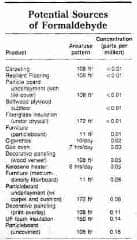
Table at page top and accompanying text are reprinted/adapted/excerpted with permission from Solar Age Magazine - editor Steven Bliss. Readers looking for a thorough, detailed guide to improving indoor air quality should also see INDOOR AIR QUALITY IMPROVEMENT GUIDE. Contact us to suggest text changes and additions and, if you wish, to receive online listing and credit for that contribution. [Click to enlarge any image including the page top table]
How to Remove indoor air contaminants including: allergens, formaldehyde gas, radon gas, particulates such as smoke, soot, carbon monoxide, carbon dioxide, nitrogen dioxide, organic compounds, asbestos, and improved make-up air in buildings.
The following key articles provide in-depth information about indoor air contaminant detection, effects, testing, and remediation or removal.- AIRBORNE PARTICLE ANALYSIS METHODS - common levels of airborne particulates, hazard levels & methods of of analysis
- ALLERGEN TESTS for BUILDINGS discusses the detection of allergenic particles indoors, such as animal dander, hair, cockroach and insect fragments, dust mites, mite fecals, etc.
- ARSENIC HAZARDS at BUILDINGS - old wallpaper?
- ASBESTOS HAZARDS as well as other indoor air quality topics listed in detail at the end of this article .
- BIOLOGICAL POLLUTANTS such as mold, animal dander, cat or dog dander, mouse dander or droppings, animal hair, cockroaches, dust mites, dust mite fecal pellets
- COMBUSTION GASES & PARTICLE HAZARDS discusses indoor pollutants associated with oil or gas burning heating appliances
- FIBER & HAIR IDENTIFICATION - identify fibers & hairs in buildings as allergens, contaminants, or for other purposes
- FORMALDEHYDE GAS HAZARD REDUCTION explains and illustrates how to reduce indoor formaldehyde gas levels in buildings.
- FORMALDEHYDE HAZARDS lists sources of formaldehyde in buildings, and also
- FORMALDEHYDE & RADON REDUCTION INDOORS-part 1 - a PDF article: "Breathing Free, Part I: how to do battle with formaldehyde and radon in houses", (use your browser's back button to return to this article series). This article discusses how to reduce formaldehyde-using products in buildings.
- FORMALDEHYDE & RADON REDUCTION INDOORS-part 2 - a PDF article, "Breathing Free part 2" contains additional current details about formaldehyde and radon hazards and corrective measures
- also see RADON HAZARD TESTS & MITIGATION
- LEAD EXPOSURE HAZARDS INDOORS in indoor air and dust as well as outdoors in soil near older homes
- MOLD: A COMPLETE GUIDE TO MOLD INSPECTION, TESTING, CLEANUP & PREVENTION discusses mold, on building surfaces, and airborne toxic mold, allergenic mold, or pathogenic mold: how to find, identify, remove, and prevent indoor mold contamination. We also describe harmless cosmetic mold in buildings.
- NITROGEN DIOXIDE NOx HAZARDS - combustion products, road traffic nitrogen oxide, nitrogen dioxide hazards indoors
- OIL TANK LEAK & ODOR CAUSES - where do heating oil or fuel oil smells come from & how are these leaks found & fixed?
- PARTICULATES & ALLERGENS INDOORS Part 1 - "Breathing Free
- PARTICULATES & ALLERGENS INDOORS Part 2 - "Breathing Free, Part 2
Avoiding BACKDRAFTING HEATING EQUIPMENT pollutants
- (CO, CO2, NO2 - see COMBUSTION APPLIANCE CONTAMINANTS), avoiding indoor allergens (dust mites, pollen, mold), avoiding toxic organic compounds found indoors (construction products, cleaning fluids, cosmetics, paints, caulks, adhesives, home workshops and hobby materials, and
See VOCs VOLATILE ORGANIC COMPOUNDS). - PESTICIDE EXPOSURE HAZARDS including improper application of pesticides and pesticides in drinking water
- VOCs VOLATILE ORGANIC COMPOUNDS contamination from glues, formaldehyde, mold, paints, finishes, other sources
- RADON GAS HAZARDS and radon in water hazards in buildings - list of key Radon articles is given below
- SULFUR DIOXIDE GAS SO2
This article series, originally by Steven Bliss and appearing in Solar Age Magazine, explains Indoor Air Pollutants & How to Remove Them, including indoor air contamination by allergens, formaldehyde gas, radon gas, particulates such as smoke, soot, carbon monoxide, carbon dioxide, nitrogen dioxide, organic compounds, asbestos, and improved make-up air in buildings.
Sources of Formaldehyde in Buildings & Formaldehyde Exposure Effects
High levels of formaldehyde gas indoors can cause eye and respiratory irritation, and can cause headaches and dizziness. Long term exposure to formaldehyde may cause respiratory-tract harm and can trigger asthma attacks in susceptible individuals. Previous cancer-concerns associated with formaldehyde offgassing from UFFI insulation were discounted by subsequent research.
Formaldehyde can cause eye, nose and throat irritation, and has been identified as a human cancer-causing agent (IARC, 2004/2009). As early as 1984 ASHRAE reported as a standard a "comfort level" of indoor formaldehyde gas as 0.1 ppm.
Formaldehyde was used and continues to be used in many building products, coatings, finishes, and furnishings because it has desirable chemical properties and is inexpensive. Nearly all products made using formaldehyde outgas to some extent, some completely, so that the level of this irritating gas is usually substantially reduced or eliminated over time with little or no consumer action.
Of chief concern, probably because their outgassing lasts longer, are wood products made with urea formaldehyde (UF) glues, including most hardwood plywoods, decorative paneling, and nearly all particle board materials. On the other hand, nearly all softwood plywoods use phenol formaldehyde adhesives that are more chemically stable and that have negligible formaldehyde emissions.
See FORMALDEHYDE HAZARDS for a table of "Common Concentrations of Formaldehyde (HCHO) in Indoor & Outdoor Air " - formaldehyde levels found outdoors and in buildings and a comparison of those levels with current residential exposure standards for formaldehyde.
See FORMALDEHYDE GAS EXPOSURE LIMITS for a table of Health Effects of Exposure to Formaldehyde and for formaldehyde exposure standards around the world.
See FORMALDEHYDE GAS SOURCES in BUILDINGSfor a detailed list & description of common sources of formaldehyde in buildings.
See UREA FORMALDEHYDE FOAM INSULATION, UFFI for a history of possible formaldehyde off gassing from UFFI in buildings
See FORMALDEHYDE in LAMINATE FLOORING for details about formaldehyde offgassing from Chinese made laminate flooring
Also see these research articles on formaldehyde sources in buildings
- Bissett, John. "Fungi associated with urea-formaldehyde foam insulation in Canada." Mycopathologia 99, no. 1 (1987): 47-56.
Abstract:
Sixty-eight fungal taxa were identified from samples of urea-formaldehyde foam insulation taken from Canadian residences. Mesophilic taxa were predominant, with Penicillium spp.,
Trichoderma harzianum and Paecilomyces variotii observed most frequently. Extensive or conspicuous growth also was seen for Hormoconis resinae, Stachybotrys chartarum and Trichoderma viride in some samples.
The potential for these fungi to have contributed to the adverse health effects reported in some homes containing UF-foam insulation is discussed.
Excerpt 1: High temperatures and humidity accelerate deterioration of UFFI, leading to breakage of the foam cell walls and shrinkage of the foam [6].
Excerpt 2: Although off-gassing was initially thought the probable cause of the reported adverse health effects in some UFFI homes, studies to date do not show a clear correlation between adverse symptoms and the concentratio nof off-gases from foam insulation. Consequently, other facctors associated with UFFI, including the presence of fungi, have been investigated as concomitant causes of tehse adverse health symptoms. - Guo, H., N. H. Kwok, H. R. Cheng, S. C. Lee, W. T. Hung, and Y. S. Li. "Formaldehyde and volatile organic compounds in Hong Kong homes: concentrations and impact factors." Indoor Air 19, no. 3 (2009): 206-217.
- Hodgson, A. T., D. Beal, and J. E. R. McIlvaine. "Sources of formaldehyde, other aldehydes and terpenes in a new manufactured house." Indoor Air 12, no. 4 (2002): 235-242.
- Järnström, H., K. Saarela, P. E. a1 Kalliokoski, and A-L. Pasanen. "Reference values for indoor air pollutant concentrations in new, residential buildings in Finland." Atmospheric Environment 40, no. 37 (2006): 7178-7191.
- Kim, Sumin, and Hyun‐Joong Kim. "Comparison of formaldehyde emission from building finishing materials at various temperatures in under heating system; ONDOL." Indoor Air 15, no. 5 (2005): 317-325.
- Wieslander, G1, D. Norbäck, E. Björnsson, C. Janson, and G. Boman. "Asthma and the indoor environment: the significance of emission of formaldehyde and volatile organic compounds from newly painted indoor surfaces." International archives of occupational and environmental health 69, no. 2 (1996): 115-124.
- Yu, Chuck, and Derrick Crump. "A review of the emission of VOCs from polymeric materials used in buildings." Building and Environment 33, no. 6 (1998): 357-374.
Radon Gas in Building Air and Water - Sources & Exposure Effects
Radon is an odorless, colorless gas that occurs naturally as a byproduct of the decay of uranium. In parts of the world where uranium-bearing rock is present under buildings, this gas can in some (not all) instances seep into buildings where the enclosed character of the building leads to a higher level of radon than would be found outdoors.
At higher levels radon gas is a lung cancer hazard, especially to people who smoke (who have an 80-times greater risk than non-smokers).
See FORMALDEHYDE & RADON REDUCTION INDOORS - part 2 for additional information about radon gas, and for details see these articles:
Detailed Articles about Radon: detection, correction, & prevention in buildings
See Radon Enviro-Scare for a full discussion of the normal cycle of public fear that accompanies the discovery and publicity of various environmental hazards, including radon gas and see Enviro-Scare, the Cycle of Public Fear for our article about consumer environmental safety worry cycles that change over time.
For a Thorough Background in Radon Hazards, Radon Mitigation, & the History of Radon Concerns in the U.S. also see these articles reprinted/adapted/excerpted with permission from Solar Age Magazine - editor Steven Bliss.
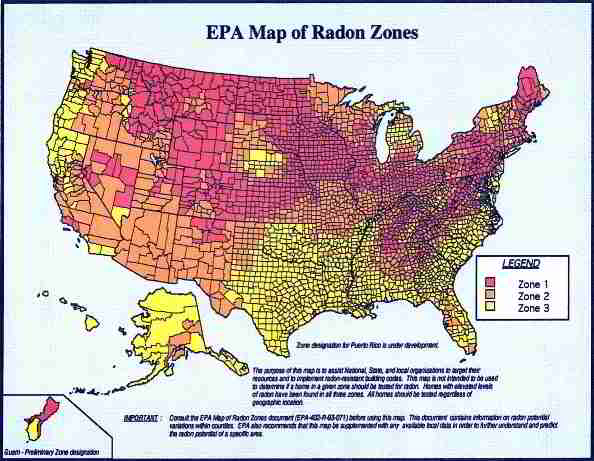
- "Radon's Threat Can Be Subdued", part 1 - William Turner, Terry Brennan, Solar Age Magazine Radon and its progeny are the slipperiest pollutants in the indoor environment, but there are simple ways to keep radon and its relations at bay.
- "Radon's Threat Can Be Subdued", part 2 - what is radon, where does radon come from, how does radon get indoors, and why is radon a problem in buildings.
- "Radon's Threat Can Be Subdued", part 3 - standards for airborne radon levels in buildings and recommended levels of radon for action, how radon is best detected, and radon action plan.
- "Radon's Threat Can Be Subdued", part 4 - radon prevention advice for new construction, radon in well water - how it is removed, sources of information about radon gas and radon contamination.
- "Defeating Radon" part 1 - Terry Brennan, Bill Turner, Solar Age Magazine - How does radon get into buildings, how do I know if a building has a radon gas problem, how can I solve radon problems in existing homes, and what can I do to prevent radon from entering new homes. Part 1: where Radon comes from, how to diagnose radon
- "Defeating Radon" part 2 - Guide to keeping radon out of new houses - design details
- "Defeating Radon" part 3 - Key spots to seal, to stop radon gas leaks into buildings
- "Defeating Radon" part 4 - Data on radon levels in buildings before & after radon mitigation treatment
- "Defeating Radon" part 5 - Air filtering, testing after radon mitigation, where to buy radon tests
Other Sources of Common Indoor Air Pollutants or Contaminants
Basic checks for sources of common indoor air contaminants in buildings: Here and in detailed articles whose links are found at the end of this article , we provide air contamination troubleshooting help for buildings by expanded annotated information from the US EPA [5] who suggested common air pollutant sources to be considered during an indoor air quality investigation.
- Outside sources of air pollution that may impact indoor air quality under some conditions include
- airborne pollen, dust, or fungal (mold) spores; The levels of these particles in outdoor air and thus potentially in indoor air vary widely by season, proximity to source, and building air handling and ventilation equipment design. and use.
- Industrial emissions
- Vehicle emissions, particularly near highways, urban centers, and locations where vehicles may be left idling for long periods such as loading docks
- Air pollution sources nearby to buildings where indoor air quality complaints are observed include:
- loading docks
- garbage container odors such as nearby dumpsters
- Unsanitary debris or building exhausts (cooking, bath, industrial) near building outdoor "fresh air" intake openings
- Underground sources of air pollution in or around buildings
- Radon gas
- Pesticides
- Underground oil storage tanks or other fuel storage tanks
- Sewage backups, septic tank leaks, septic drainfield failures
- Building HVAC equipment sources of indoor air pollution
- Mold or bacterial growth in condensate drip pans, ductwork, cooling coils, and humidifiers
- Chimney flue and vent defects that spill combustion products in the building
- Dust, debris, rodents, mold, or prior flooding in the HVAC system ductwork
- Building equipment sources of indoor air contaminants
- Office equipment such as copiers that may spill inks, toners, ozone, VOCs
- Shops, labs, cleaning processes that emit contaminants; we have traced severe building odor complaints to a beauty parlor at one of the building whose HVAC system was transporting odors throughout the structure
- Building components/furniture/furnishings as sources of indoor air quality complaints or contaminants
- microbial growth in or on soiled or water damaged materials such as carpeting or furniture
- Dry plumbing traps permitting sewer gases to escape into the building
- Materials in furnishings that emit VOCs, inorganic compounds, or asbestos particles (from damaged asbestos insulation or asbestos-containing products
- Furnishings such as furniture or flooring that may emit odors from glues, sealants, paints, foam cushions, particleboard
- Other common indoor air pollution or IAQ complaint sources in buildings including homes & schools
- Science labs
- Sewage backups, toilet overflows
- Vocational arts areas
- Copy or printing centers
- Food preparation areas
- Smoking lounges
- Cleaning materials stored in or near areas of complaints
- Trash and garbage odors
- Pesticides sprayed or placed in or around the building
- Odors and VOCs from paints, chalks, adhesives used in the building
- Occupants who suffer from communicable diseases
- Dry-erase markers and pens
- Insect infestation, or other building pests such as rodents, feral cats, raccoons, squirrels birds
- Personal care products
Ventilation to Improve Indoor Air Quality
While avoiding use of outgassing products to reduce formaldehyde gas indoors and sealing cracks or installing a radon mitigation system is effective in eliminating indoor radon gas hazards, the soup of indoor irritants and pollutants can also be effectively thinned by good building ventilation.
Doubling the rate of fresh air intake in a building will in general cut most indoor air pollutant levels in half. (This might not be true for pollen levels in some locations in some seasons where air conditioning or air filtration will be a better bet.)
Mr. Bliss's article interestingly points out that the level of indoor air contaminants varies among buildings by a factor of 100, so don't make an assumption about what your home needs without more careful study.
See INDOOR AIR QUALITY IMPROVEMENT, KEY STEPS
and VENTILATION, WHOLE HOUSE STRATEGIES for more details.
Here we include solar energy, solar heating, solar hot water, and related building energy efficiency improvement articles reprinted/adapted/excerpted with permission from Solar Age Magazine - editor Steven Bliss.
...
Continue reading at INDOOR AIR QUALITY IMPROVEMENT, KEY STEPS or select a topic from the closely-related articles below, or see the complete ARTICLE INDEX.
Or see these
Recommended Articles
- AIRBORNE MOLD SPORE COUNT GUIDE - home
- AIRBORNE PARTICLE LEVELS vs IAQ - home
- AIRBORNE PARTICLE SIZE DEFINITIONS & TYPES
- AIRBORNE PARTICLE SIZE TABLE
- AIRBORNE PARTICLES in INDOOR AIR, CHART
- INDOOR AIR QUALITY IMPROVEMENT GUIDE - home
Suggested citation for this web page
AIR POLLUTANTS, COMMON INDOOR at InspectApedia.com - online encyclopedia of building & environmental inspection, testing, diagnosis, repair, & problem prevention advice.
Or see this
INDEX to RELATED ARTICLES: ARTICLE INDEX to BUILDING INDOOR AIR QUALITY IAQ
Or use the SEARCH BOX found below to Ask a Question or Search InspectApedia
Ask a Question or Search InspectApedia
Try the search box just below, or if you prefer, post a question or comment in the Comments box below and we will respond promptly.
Search the InspectApedia website
Note: appearance of your Comment below may be delayed: if your comment contains an image, photograph, web link, or text that looks to the software as if it might be a web link, your posting will appear after it has been approved by a moderator. Apologies for the delay.
Only one image can be added per comment but you can post as many comments, and therefore images, as you like.
You will not receive a notification when a response to your question has been posted.
Please bookmark this page to make it easy for you to check back for our response.
Our Comment Box is provided by Countable Web Productions countable.ca
Citations & References
In addition to any citations in the article above, a full list is available on request.
- AIHA, American Industrial Hygiene Association, “Is Air Quality a Problem in My Home?”,
https://www.aiha.org/about-aiha/Press/ConsumerBrochures/Is%20Air%20Quality%20a%20Problem%20in%20My%20Home.pdf - IARC, 2009. IARC classifies formaldehyde as carcinogenic to humans; press release no.153; International Agency for Research on Cancer: Lyon.
- In addition to citations & references found in this article, see the research citations given at the end of the related articles found at our suggested
CONTINUE READING or RECOMMENDED ARTICLES.
- Carson, Dunlop & Associates Ltd., 120 Carlton Street Suite 407, Toronto ON M5A 4K2. Tel: (416) 964-9415 1-800-268-7070 Email: info@carsondunlop.com. Alan Carson is a past president of ASHI, the American Society of Home Inspectors.
Thanks to Alan Carson and Bob Dunlop, for permission for InspectAPedia to use text excerpts from The HOME REFERENCE BOOK - the Encyclopedia of Homes and to use illustrations from The ILLUSTRATED HOME .
Carson Dunlop Associates provides extensive home inspection education and report writing material. In gratitude we provide links to tsome Carson Dunlop Associates products and services.
 | HOME | ABOUT | ASK a QUESTION | CONTACT | CONTENT USE POLICY | DESCRIPTION | POLICIES | PRIVACY | |
| © 2024 - 1985 Publisher InspectApedia.com - Daniel Friedman | |||||||||