InspectAPedia ®

Building & Environmental Inspection, Testing, Diagnosis, Repair, & Problem Prevention Advice
InspectAPedia
Home
| Air
Conditioning
| Electrical | Indoor
Environment
| Exteriors | Heating | Home
Inspection
| Insulate
Ventilate
| Interiors | Mold
Inspect/Test
| Plumbing
Water
Septic
| Roofing | Structure | Contact Us
Directory of Professionals to Inspect or Test a Building


Mobile Phone/PDA website viewMobile View
AIR CONDITIONING & HEAT PUMP SYSTEMS
ENERGY SAVINGS in BUILDINGS
INSULATION & VENTILATION INSPECTION & IMPROVEMENT
INTERIORS of BUILDINGS
ACOUSTICAL SEALANTS
AGE of a BUILDING - how to determine
AIR BYPASS LEAKS
AIR LEAK DETECTION TOOLS
  Find Heat Loss & Air Leaks
  Heat Loss Investigation Sequence
  Blower Door Test Data Results
  Smoke Gun for Air Leaks
  Attic Energy Losses - InfraRed
  Basement Energy Losses- IR & Visual
  Duct System Air Movement
  Living Space Heat Loss
  Targets & Hidden Leak Points
  Convective Loops & Thermal Bypass Leaks
  Insulation Air & Heat Leaks
  The Bottom Line on Energy Retrofits
AIR LEAK MINIMIZATION
AIR SEALING STRATEGIES
ANIMAL ALLERGENS
ASBESTOS IDENTIFICATION IN BUILDINGS
ATTIC LEAKS, CONDENSATION & ATTIC MOLD
ATTIC VENTILATION
BASEMENT HEAT LOSS
BASEMENT LEAKS Moisture or Mold
BASEMENT WATERPROOFING
BATHROOM VENTILATION
BLOWER DOORS & AIR INFILTRATION
BRICK LINED WALLS
BUCKLED FOUNDATIONS due to INSULATION?
CATHEDRAL CEILING INSULATION
CHIMNEY INSPECTION DIAGNOSIS & REPAIR
COMBUSTION AIR for TIGHT BUILDINGS
CRAWL SPACES
DEW POINT CALCULATION for WALLS
DEW POINT TABLE - CONDENSATION POINT GUIDE
ELECTRICAL INSPECTION, DIAGNOSIS, REPAIR
ENERGY SAVINGS in BUILDINGS
ENERGY SAVINGS PRIORITIES
ENERGY SAVINGS RETROFIT CASE STUDY
ENERGY SAVINGS RETROFIT LEAK SEALING GUIDE
ENERGY SAVINGS RETROFIT OPTIONS
ENVIRONMENTAL HAZARDS
FIBERGLASS INSULATION
FIBERGLASS HAZARDS
FIBERGLASS MOLD
FIREPLACE Damage & Unsafe Hearths - Settlement
FLAT ROOF MOISTURE & CONDENSATION
FLOOD DAMAGE ASSESSMENT, SAFETY & CLEANUP
FLOODS IN BUILDINGS-mold
FLOORING TYPES & DEFECTS
FOUNDATION WATERPROOFING
FRAMING DETAILS for BETTER INSULATION
FRAMING DETAILS for DOUBLE WALL HOUSES
FREEZE-PROOF A BUILDING
HEAT LOSS in BUILDINGS
HEAT LOSS DETECTION TOOLS
  Find Heat Loss & Air Leaks
  Heat Loss Investigation Sequence
  Blower Door Test Data Results
  Smoke Gun for Air Leaks
  Attic Energy Losses - InfraRed
  Basement Energy Losses- IR & Visual
  Duct System Air Movement
  Living Space Heat Loss
  Targets & Hidden Leak Points
  Convective Loops & Thermal Bypass Leaks
  Insulation Air & Heat Leaks
  The Bottom Line on Energy Retrofits
HEAT LOSS INDICATORS
HEAT LOSS R U & K VALUE CALCULATION
Heat Tapes: Use on Roofs for Ice
HEATING COST SAVINGS METHODS
HOUSEWRAP AIR & VAPOR BARRIERS
HUMIDITY LEVEL TARGET
ICE DAM PREVENTION
Ice Dams: Comparing Two Houses
INSULATION CHOICES
INSULATION FACT SHEET- DOE
INSULATION IDENTIFICATION GUIDE
INSULATION LOCATION for BASEMENTS
INSULATION LOCATION for CAPES, CRAWLSPACES
INSULATION for GREENHOUSE or SOLARIUM
INSULATION MATERIAL IDENTIFICATION GUIDE
INSULATION MOLD
INSULATION R-Values & Properties
INSULATION & VENTILATION INSPECTION & IMPROVEMENT
  ATTIC CONDENSATION CAUSE & CURE
  Air Bypass Leaks, Thermal Tracking
  Blocked Soffit Intake Vents
  BRICK VENEER WALL INSULATION
  CATHEDRAL CEILING INSULATION
  ENERGY SAVINGS in BUILDINGS
  ENERGY SAVINGS PRIORITIES
  ENERGY SAVINGS RETROFIT CASE STUDY
  ENERGY SAVINGS RETROFIT LEAK SEALING GUIDE
  ENERGY SAVINGS RETROFIT OPTIONS
  FRAMING DETAILS for BETTER INSULATION
  FRAMING DETAILS for DOUBLE WALL HOUSES
  Inspect Attics for Moisture or Mold
  Inspect Basements for Moisture or Mold
  Inspect Building Exterior
  Inspect the Ridge Vent System from the Attic
  Inspect the Soffit Vent System from the Attic
  Insulation Air & Heat Leaks
  INSULATION R-Values & Properties
  Insulation Values of Log Home Walls
  POLYISOCYANURATE FOAM INSULATION
  POLYSTYRENE FOAM INSULATION
  RADIANT BARRIERS
  RIGID FOAM USE INDOORS
  Urea Formaldehyde Foam Insulation UFFI
  URETHANE FOAM Deterioration, Outgassing
  Vermiculite Insulation
LOG HOME GUIDE
MOBILE HOME INSPECTIONS
MOISTURE CONTROL in BUILDINGS
Mold Growth Resistance of Foam Insulation
MOLD INFORMATION CENTER
ODORS & SMELLS DIAGNOSIS & CURE
PAINT FALURE, DIAGNOSIS, CURE, PREVENTION
PLASTER & BEAVERBOARD & DRYWALL
RADIANT BARRIERS
RADIANT HEAT
RADIANT HEAT Floor Mistakes to Avoid
RADIANT SLAB FLOORING CHOICES
RADIANT SLAB TUBING & FLUID CHOICES
ROOF VENTILATION SPECIFICATIONS
ROT, FUNGUS, TERMITES
  TERMITE SHIELDS vs TERMITICIDE
ROT, TIMBER FRAME
SAFETY HAZARDS & INSPECTIONS
SEARS KIT HOUSES
SOLAR ENERGY SYSTEMS
SOUND CONTROL in BUILDINGS
STAIN DIAGNOSIS
STAIRS, RAILINGS, LANDINGS, RAMPS
STUCCO OVER FOAM INSULATION
STRUCTURAL INSPECTIONS & DEFECTS
SUMP PUMPS GUIDE
THERMAL EXPANSION of MATERIALS
THERMAL MASS in BUILDINGS
THERMAL MASS in UPSTAIRS
THERMAL TRACKING & HEAT LOSS
  Ceiling Thermal Tracking Marks
  Wall Thermal Tracking Stains
  Floor Carpet Thermal Tracking Stains
  Air Bypass Leaks Marks on Insulation
  Thermal Tracking to Diagnose IAQ
  Stains HVAC Supply Registers
  Pet Stains on Floors
  Pet Stains on Walls
  Human Occupant Stains on Walls
  Stains from Candles, Woodstoves, Fireplaces
  Other Stains on Indoor Walls & Ceilings
  What to Do About Thermal Tracking
VAPOR BARRIERS & AIR SEALING at BAND JOISTS
VAPOR BARRIERS & CONDENSATION in BUILDINGS
VAPOR BARRIERS & HOUSEWRAP
VAPOR CONDENSATION & BUILDING SHEATHING
VENTILATION in BUILDINGS
WATER ENTRY in BUILDINGS
WIND TURBINES
WINDOWS & DOORS
WINTERIZE A BUILDING
WOOD Burning Heaters Fireplaces Stoves


More Information

InspectAPedia.comInspectAPedia ® Home & Site Map
InspectAPedia Blog - News Updates
Air Conditioning & Heat Pumps
Bookstore
Electrical
Environment
Exteriors
Heating
Home Inspection
Insulate Ventilate
Interiors
Mold Inspect/Test
Plumbing Water Septic
Roofing
Structure
Accuracy & Privacy Policies
Contact Us


Open partition wall (C) Daniel Friedman

Convective Loops, Air Leaks & Heat Loss Analysis for Buildings
InspectAPedia®  -    

  • How to find & diagnose convection loop heat losses in buildings
  • Heat loss due to convection loops in fire walls, party walls, & interior partition walls
  • Heat loss due to convective loops in bathrooms & plumbing chaseways
  • Heat loss due to cold air leaks into return ducts routed through building framing chaseways
  • How convection loops pump heat out of a building even with no air leaks
  • Where convection loops most often occur in buildings
  • Solar Age Magazine Articles on Renewable Energy, Energy Savings, Construction Practices
Our site offers impartial, unbiased advice without conflicts of interest. We will block advertisements which we discover or readers inform us are associated with bad business practices, false-advertising, or junk science. Our contact info is at InspectAPedia.com/appointment.htm.

This article series discusses how to find and correct convective loop heat losses in buildings, a step in how to find points of heat loss and air leaks in buildings using a variety of tools and inspection methods including infra red, smoke tests, visual inspection, and tests. This detailed article accompanies a building weatherization and energy-savings company through a detailed building inspection for heat loss points and air leaks. The author accompanied Princeton Energy Partners as they used the blower door, thermal imaging, smoke guns, and visual inspection to pinpoint building air leaks, convective loops, heat loss points, air infiltration and air exfiltration on a building. Readers should also see AIR BYPASS LEAKS as well as HEAT LOSS in BUILDINGS and HEAT LOSS INDICATORS.

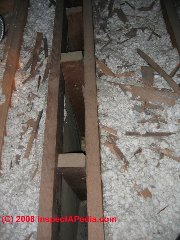
Our page top photo shows an uninsulated interior partition wall forming a convective heat loop as well as a thermal bypass loop in a building. Contact us to suggest text changes and additions and, if you wish, to receive online listing and credit for that contribution.

© Copyright 2009 Daniel Friedman, All Rights Reserved. Information Accuracy & Bias Pledge is at below-left. Use links at the left of each page to navigate this document or to view other topics at this website. Green links show where you are in our document or website.

How to Find Points of Convective Heat Loop - Heat Loss in Buildings

This article series explains how to survey a building for air and heat loss or gain points and how to correct them.

As we introduced above, in this article the author, Steven Bliss, accompanies a building weatherization and energy-savings company through a detailed building inspection for heat loss points, convective loops, and air leaks. The author accompanies Princeton Energy Partners as they use thermal imaging, smoke guns, and visual inspection to pinpoint building air leaks, heat loss points, air infiltration and air exfiltration on a building. The importance of setting priorities for sealing these points of energy wasted is emphasized and discussed, and sketches as well as photographs of common points of building heat loss, or unwanted heat gain, and air leaks are provided.

The text below paraphrases, quotes-from, updates, and comments an original article, "House Doctors with Better Medicine, Princeton Energy Partners use the latest diagnostic tools to comb a house for the major causes of heat loss. Their findings are often astonishing. Their strong prescriptions bring results', Steven Bliss, (see links just above) from Solar Age Magazine and written by Steven Bliss.

Convective Heat Loops & Leaks - Thermal Bypass Leaks in Buildings

Thermal Bypasses, Air Leaks, & Convective Heat Loops in Building Partitions
Convective loop heat loss (C) Daniel Friedman

The energy contractors assert that their work consistently saves the homeowner considerably more money than is predicted by the reductions in air infiltration alone. This seeming magic is attributed to the elimination of "thermal bypasses", that is, the myriad ways heat gets out of the building other than through wall and ceiling components following the rules and regulations of ASHRAE.

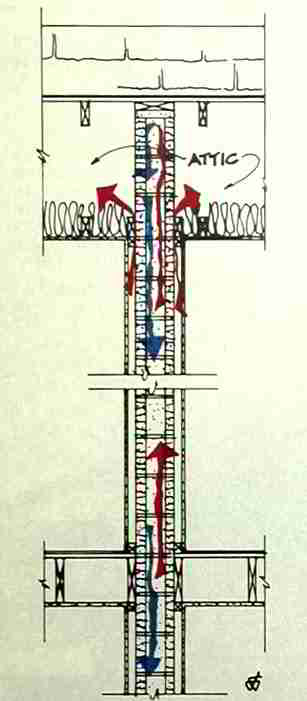
Prominent among these heat leaks are convective loops - wall and ceiling cavities that act as room-sized heat exchangers, relentlessly pumping heat out of a building even if there is no direct air leakage from indoors to outdoors.

The convective loop shown in the sketch at left depicts heat movement in an interior hollow core masonry block partition wall in a building. In many cases PEP (the energy consulting and weatherizing firm in the original article) finds interior partitions colder than outside walls.

Since the cooling effect of a convective loop is only partly due to air leakage, even a completely closed wall cavity such as a (hollow core block) masonry party wall can cause problems.

In multi-unit dwellings energy retrofitters often encounter concrete-block party walls between adjoining living spaces and extending into the building attic. Warm air rises through the masonry block hollow cores, is cooled in the un-heated attic, and falls again.

Regardless of whether or not the block wall is capped with solid blocks in the attic (or outside above the rooftop), this convective heat loop chills the party wall and robs heat from the building. A related problem might be a reduction in building wall R-values if air flows through fiberglass insulation. While this phenomenon has been reported many times in the research literature, it is generally overlooked since it defies accurate prediction.

One cure in the case of a masonry party wall is a solid course of block at the ceiling level at each floor level, isolating the airflow within the heated space. Of course this is most easily accomplished during new construction. Sealing a block party wall against convection loops as a retrofit is a challenge and may be costly. An example might include drilling every block at ceiling level to inject fire-block-rated foam.
Convective loop heat losses occur in buildings within uninsulated, wood-framed or metal stud interior partition walls, not just in hollow core masonry walls, as we discuss below at Convection Loops at Interior Partition Walls.

Stacked Bathrooms & Plumbing Chases & Return Ducts Run Through Framing Form Convective Loops

Convective heat loss loops at stacked bathrooms (C) Daniel Friedman


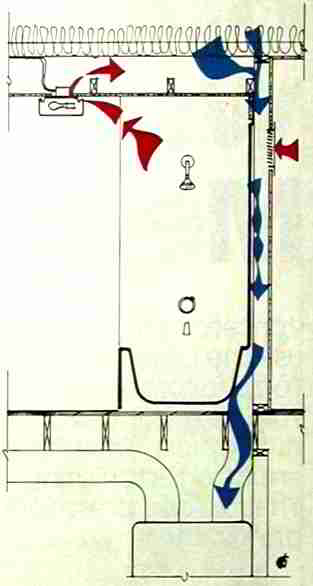
In multifamily and even single family buildings it is common for bathrooms to be "stacked" one on top of the other, forming a giant convective loop.

The sketch at left shows warm air and heat leaking into the ceiling around a bathroom light and exhaust fan (the red arrows).

The blue arrows in the sketch depict cold air falling from an un-heated attic into the heating cool-air return duct, leaking through wire holes and gaps in framing, allowing un-wanted cold air to be drawn into the heating system duct work.

Also, since this is a bathroom wall, moist air is likely to be drawn into the framing as well. The solution is to seal off the duct space (run through framing members in this building) so that it functions properly.


Convective Loop Heat Losses at Kitchen Cabinets & Soffits
Kitchen soffit thermal bypass and convective leaks (C) Daniel Friedman


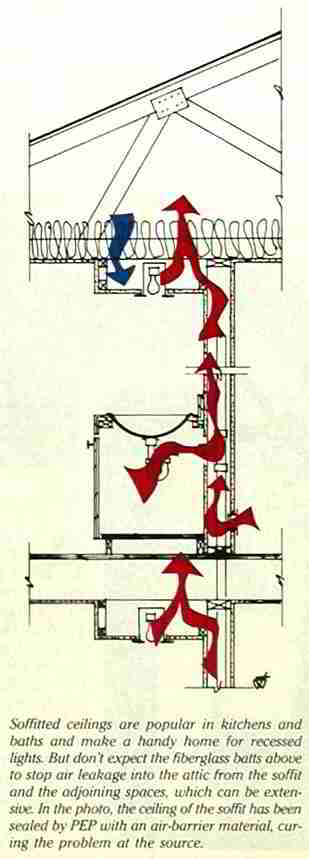
As we cited earlier at Living Space Heat Loss, air leaks through kitchen cabinets and interior soffits can be very significant heat loss points in buildings. Soffited ceilings are popular in kitchens and baths, and make a handy home for recessed lights. But improper insulation installation or openings cut for recessed lights, wiring, or plumbing can permit air leaks into the ceiling cavity or directly into the attic. Such leaks can be extensive.

An infrared scan or invasive inspection can identify this energy loss location.

Sealing the connection between the cabinet soffit and the building's exterior wall reduced building air leakage by 20 percent at a townhouse investigated by the experts in the original article given here.

The sketch at left demonstrates how a kitchen soffit can become a heat pump, moving warm air (red arrows) and heat into a cold attic space while bringing cold air down into the living area.

A small soffit over a kitchen cabinet may not look like much until you discover that it is drawing air from all kinds of wall and ceiling spaces.

Convection Loops at Interior Partition Walls & Party Walls or Fire Walls

Open partition wall (C) Daniel Friedman

As our photo at the top of this page shows an open, uninsulated interior partition wall top, viewed from a building attic. In an older wood frame building an interior partition wall such as this one may extend from the attic down through two floors in the building, finding a stop only at a sill plate or "shoe" where the partition wall begins on the first floor.

Our photo of a fire-rated drywall party wall (left) shown extending into the attic of a multi-unit dwelling, describes a tall, often uninsulated interior partition wall that can form a convective heating loop. Party walls between building units are required to slow the spread of fire from one building section to another.

(A catastrophic fire occurred in an older section of the Fox Hill condominiums in Poughkeepsie NY (ca 1980) as fire spread rapidly through an attic where these fire barriers had been omitted.) The party wall either extends through and above the roof, or the roof sheathing may be protected (typically for four feet) on either side of the party wall using fire retardant treated plywood or fire-rated drywall covering.

The hollow chimney created by an interior partition wall, regardless of whether or not it extends up through the attic, forms a heat pump, moving building warmth into the cold attic during the heating season.

Simply sealing the wall top in the attic will help alot, as would fire-blocking (now required in many jurisdictions) at each floor and ceiling level in such a wall. Fire-blocking retrofit that can also interrupt this thermal convection loop may be permitted in your jurisdiction using a fire-rated foam - check with your local building department.

When we observe thermal tracking stains on the upper section of an interior partition wall, one possible explanation is that convective loops within the wall, even if it is not leaking badly into the attic, are cooling the upper part of the wall. See THERMAL TRACKING & HEAT LOSS for details.

Estimating convective loop heat losses

In addition to their effect on energy bills, the impact of convective loops in buildings can be gauged by measuring attic temperatures before and after sealing off thermal bypasses such as chases and wall partitions, or it can be roughly modeled from the temperature difference and the height of the convective loop.

Share this Article      

...

Technical Reviewers & References

  • Daniel Friedman - principal author/editor of the InspectAPedia® Website
  • InspectAPedia Bookstore lists recommended books, organized by topic & available for purchase. Most of our articles also include a list of recommended books for the specific article topic as well as other references, and information sources.
  • Critique, contributions wanted: Contact Us to suggest corrections or additions to articles at this website, and if you wish, to receive online listing and credit as a contributor. Particular thanks are due to the many experts and also consumers who read and critique technical articles at InspectAPedia.com.
  • Additional technical contributors & reference sources for this article are listed below.

Use links just below or at the left of each page to navigate this document or to view other topics at this website. Green links show where you are in our document or website.

AIR CONDITIONING & HEAT PUMP SYSTEMS
ENERGY SAVINGS in BUILDINGS
INSULATION & VENTILATION INSPECTION & IMPROVEMENT
INTERIORS of BUILDINGS
ACOUSTICAL SEALANTS
AGE of a BUILDING - how to determine
AIR BYPASS LEAKS
AIR LEAK DETECTION TOOLS
  Find Heat Loss & Air Leaks
  Heat Loss Investigation Sequence
  Blower Door Test Data Results
  Smoke Gun for Air Leaks
  Attic Energy Losses - InfraRed
  Basement Energy Losses- IR & Visual
  Duct System Air Movement
  Living Space Heat Loss
  Targets & Hidden Leak Points
  Convective Loops & Thermal Bypass Leaks
  Insulation Air & Heat Leaks
  The Bottom Line on Energy Retrofits
AIR LEAK MINIMIZATION
AIR SEALING STRATEGIES
ANIMAL ALLERGENS
ASBESTOS IDENTIFICATION IN BUILDINGS
ATTIC LEAKS, CONDENSATION & ATTIC MOLD
ATTIC VENTILATION
BASEMENT HEAT LOSS
BASEMENT LEAKS Moisture or Mold
BASEMENT WATERPROOFING
BATHROOM VENTILATION
BLOWER DOORS & AIR INFILTRATION
BRICK LINED WALLS
BUCKLED FOUNDATIONS due to INSULATION?
CATHEDRAL CEILING INSULATION
CHIMNEY INSPECTION DIAGNOSIS & REPAIR
COMBUSTION AIR for TIGHT BUILDINGS
CRAWL SPACES
DEW POINT CALCULATION for WALLS
DEW POINT TABLE - CONDENSATION POINT GUIDE
ELECTRICAL INSPECTION, DIAGNOSIS, REPAIR
ENERGY SAVINGS in BUILDINGS
ENERGY SAVINGS PRIORITIES
ENERGY SAVINGS RETROFIT CASE STUDY
ENERGY SAVINGS RETROFIT LEAK SEALING GUIDE
ENERGY SAVINGS RETROFIT OPTIONS
ENVIRONMENTAL HAZARDS
FIBERGLASS INSULATION
FIBERGLASS HAZARDS
FIBERGLASS MOLD
FIREPLACE Damage & Unsafe Hearths - Settlement
FLAT ROOF MOISTURE & CONDENSATION
FLOOD DAMAGE ASSESSMENT, SAFETY & CLEANUP
FLOODS IN BUILDINGS-mold
FLOORING TYPES & DEFECTS
FOUNDATION WATERPROOFING
FRAMING DETAILS for BETTER INSULATION
FRAMING DETAILS for DOUBLE WALL HOUSES
FREEZE-PROOF A BUILDING
HEAT LOSS in BUILDINGS
HEAT LOSS DETECTION TOOLS
  Find Heat Loss & Air Leaks
  Heat Loss Investigation Sequence
  Blower Door Test Data Results
  Smoke Gun for Air Leaks
  Attic Energy Losses - InfraRed
  Basement Energy Losses- IR & Visual
  Duct System Air Movement
  Living Space Heat Loss
  Targets & Hidden Leak Points
  Convective Loops & Thermal Bypass Leaks
  Insulation Air & Heat Leaks
  The Bottom Line on Energy Retrofits
HEAT LOSS INDICATORS
HEAT LOSS R U & K VALUE CALCULATION
Heat Tapes: Use on Roofs for Ice
HEATING COST SAVINGS METHODS
HOUSEWRAP AIR & VAPOR BARRIERS
HUMIDITY LEVEL TARGET
ICE DAM PREVENTION
Ice Dams: Comparing Two Houses
INSULATION CHOICES
INSULATION FACT SHEET- DOE
INSULATION IDENTIFICATION GUIDE
INSULATION LOCATION for BASEMENTS
INSULATION LOCATION for CAPES, CRAWLSPACES
INSULATION for GREENHOUSE or SOLARIUM
INSULATION MATERIAL IDENTIFICATION GUIDE
INSULATION MOLD
INSULATION R-Values & Properties
INSULATION & VENTILATION INSPECTION & IMPROVEMENT
  ATTIC CONDENSATION CAUSE & CURE
  Air Bypass Leaks, Thermal Tracking
  Blocked Soffit Intake Vents
  BRICK VENEER WALL INSULATION
  CATHEDRAL CEILING INSULATION
  ENERGY SAVINGS in BUILDINGS
  ENERGY SAVINGS PRIORITIES
  ENERGY SAVINGS RETROFIT CASE STUDY
  ENERGY SAVINGS RETROFIT LEAK SEALING GUIDE
  ENERGY SAVINGS RETROFIT OPTIONS
  FRAMING DETAILS for BETTER INSULATION
  FRAMING DETAILS for DOUBLE WALL HOUSES
  Inspect Attics for Moisture or Mold
  Inspect Basements for Moisture or Mold
  Inspect Building Exterior
  Inspect the Ridge Vent System from the Attic
  Inspect the Soffit Vent System from the Attic
  Insulation Air & Heat Leaks
  INSULATION R-Values & Properties
  Insulation Values of Log Home Walls
  POLYISOCYANURATE FOAM INSULATION
  POLYSTYRENE FOAM INSULATION
  RADIANT BARRIERS
  RIGID FOAM USE INDOORS
  Urea Formaldehyde Foam Insulation UFFI
  URETHANE FOAM Deterioration, Outgassing
  Vermiculite Insulation
LOG HOME GUIDE
MOBILE HOME INSPECTIONS
MOISTURE CONTROL in BUILDINGS
Mold Growth Resistance of Foam Insulation
MOLD INFORMATION CENTER
ODORS & SMELLS DIAGNOSIS & CURE
PAINT FALURE, DIAGNOSIS, CURE, PREVENTION
PLASTER & BEAVERBOARD & DRYWALL
RADIANT BARRIERS
RADIANT HEAT
RADIANT HEAT Floor Mistakes to Avoid
RADIANT SLAB FLOORING CHOICES
RADIANT SLAB TUBING & FLUID CHOICES
ROOF VENTILATION SPECIFICATIONS
ROT, FUNGUS, TERMITES
  TERMITE SHIELDS vs TERMITICIDE
ROT, TIMBER FRAME
SAFETY HAZARDS & INSPECTIONS
SEARS KIT HOUSES
SOLAR ENERGY SYSTEMS
SOUND CONTROL in BUILDINGS
STAIN DIAGNOSIS
STAIRS, RAILINGS, LANDINGS, RAMPS
STUCCO OVER FOAM INSULATION
STRUCTURAL INSPECTIONS & DEFECTS
SUMP PUMPS GUIDE
THERMAL EXPANSION of MATERIALS
THERMAL MASS in BUILDINGS
THERMAL MASS in UPSTAIRS
THERMAL TRACKING & HEAT LOSS
  Ceiling Thermal Tracking Marks
  Wall Thermal Tracking Stains
  Floor Carpet Thermal Tracking Stains
  Air Bypass Leaks Marks on Insulation
  Thermal Tracking to Diagnose IAQ
  Stains HVAC Supply Registers
  Pet Stains on Floors
  Pet Stains on Walls
  Human Occupant Stains on Walls
  Stains from Candles, Woodstoves, Fireplaces
  Other Stains on Indoor Walls & Ceilings
  What to Do About Thermal Tracking
VAPOR BARRIERS & AIR SEALING at BAND JOISTS
VAPOR BARRIERS & CONDENSATION in BUILDINGS
VAPOR BARRIERS & HOUSEWRAP
VAPOR CONDENSATION & BUILDING SHEATHING
VENTILATION in BUILDINGS
WATER ENTRY in BUILDINGS
WIND TURBINES
WINDOWS & DOORS
WINTERIZE A BUILDING
WOOD Burning Heaters Fireplaces Stoves

  • Solar Age Magazine was the official publication of the American Solar Energy Society. The contemporary solar energy magazine associated with the Society is Solar Today. "Established in 1954, the nonprofit American Solar Energy Society (ASES) is the nation's leading association of solar professionals & advocates. Our mission is to inspire an era of energy innovation and speed the transition to a sustainable energy economy. We advance education, research and policy. Leading for more than 50 years. ASES leads national efforts to increase the use of solar energy, energy efficiency and other sustainable technologies in the U.S. We publish the award-winning SOLAR TODAY magazine, organize and present the ASES National Solar Conference and lead the ASES National Solar Tour – the largest grassroots solar event in the world."
  • Steven Bliss served as editorial director and co-publisher of The Journal of Light Construction for 16 years and previously as building technology editor for Progressive Builder and Solar Age magazines. He worked in the building trades as a carpenter and design/build contractor for more than ten years and holds a masters degree from the Harvard Graduate School of Education. Excerpts from his recent book, Best Practices Guide to Residential Construction, Wiley (November 18, 2005) ISBN-10: 0471648361, ISBN-13: 978-0471648369, appear throughout this website, with permission and courtesy of Wiley & Sons. Best Practices Guide is available from the publisher, J. Wiley & Sons, and also at Amazon.com.
    Excerpts with updates and annotations expanding the original Best Practices Guide text can be found in the online review and book summary at BEST CONSTRUCTION PRACTICES GUIDE and also at DECK & PORCH CONSTRUCTION, at INDOOR AIR QUALITY IMPROVEMENT GUIDE, and in other articles found at InspectAPedia.com such as HOUSEWRAP AIR & VAPOR BARRIERS, SOUND CONTROL in BUILDINGS, and other topics.
  • Ice Dam Leaks in building attics and roof cavities, how to inspect for evidence of leaks, identify causes, and correct bad attic ventilation, improper roof venting, and these causes of attic mold or roof structure damage

Books & Articles on Building & Environmental Inspection, Testing, Diagnosis, & Repair

  • Our recommended books about building design, inspection, and repair, and about indoor environment testing, diagnosis, and cleanup are at the InspectAPedia Bookstore.
  • ...
INSULATION & VENTILATION INSPECTION & IMPROVEMENT

More Information

InspectAPedia.comInspectAPedia ® Home & Site Map
InspectAPedia Blog - News Updates
Air Conditioning & Heat Pumps
Bookstore
Electrical
Environment
Exteriors
Heating
Home Inspection
Insulate Ventilate
Interiors
Mold Inspect/Test
Plumbing Water Septic
Roofing
Structure
Accuracy & Privacy Policies
Contact Us

More Information on Building Diagnostic Inspections and Repairs

    ...
InspectAPedia.comInspectAPedia® Home & Site Map - Building & Environmental Inspection, Testing, Diagnosis, Repair, & Problem Prevention Advice: In-depth research & advice on diagnosing, testing, correcting, & preventing building defects & indoor environmental hazards. Unbiased information, no conflicts of interest.
GO TO the MOLD and INDOOR ENVIRONMENT INFORMATION CENTER for in-depth advice on avoiding testing for or cleaning up mold and other indoor environmental hazards, odors, gases, contaminants
The Mold Information Center:
What to Do About Mold in Buildings, When and How to Inspect for Mold, Clean Up Mold, or Avoid Mold Problems
GO TO MOLD TEST KITS: This expert-recommended mold test kit is cheap and yet top performing *IF* you use a competent analysis laboratory!
Use this simple, economical mold test kit
by following our instructions on how to collect and mail mold samples to our lab
GO TO IAQ/MOLD-TEST LAB SERVICES: Mold, Pollen, indoor air quality, field and laboratory services by an expert.Environmental Inspection, Testing, & Diagnosis On-Site IAQ, Gas, Air Testing, Mold Investigation, Sick Building Diagnosis, Lab Services, & Remediation Plan Preparation - indoor air quality testing, problem source determination, supporting lab work, written remediation plan addressing removal of environmental and other hazards and prevention of their recurrence.
GO TO our PRE PURCHASE BUILDING INSPECTION SERVICES: Authoritative information for home buyers and home owners is included with your inspection.
Building Inspection, Problem Diagnosis
, Forensic Investigation & Testing, Repair Consulting

CONTACT Daniel Friedman - Dan is a senior ASHI home inspector, nationally recognized expert on building inspection, building failures, and sick building investigation
Contact Daniel Friedman for website content suggestions or for fee-paid consulting

10/01/2009 - 09/05/2006 - InspectAPedia.com/Energy/Heat_Loss_Tools.htm - © 2009 - 1988 Copyright Daniel Friedman All Rights Reserved - InspectAPedia® is a Registered U.S. Trademark