
InspectAPedia® FREE Encyclopedia of Building & Environmental Construction, Diagnosis, Maintenance & Repair |
Question? Just ask us! InspectAPedia
|
 Rigid Insulating Board HVAC Ducts
- POST a QUESTION or COMMENT about rigid fiberglass duct insulation board
Fiberglass insulating duct board:
This article discusses the use of rigid insulating board to construct air conditioning and heating system ductwork, and use of rigid ductwork with a thermosiphoning air collector system (TAP).
InspectAPedia tolerates no conflicts of interest. We have no relationship with advertisers, products, or services discussed at this website.
Rigid Insulating Board & Fiberglass Air Conditioning & Heating Duct Construction
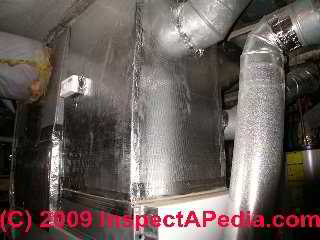
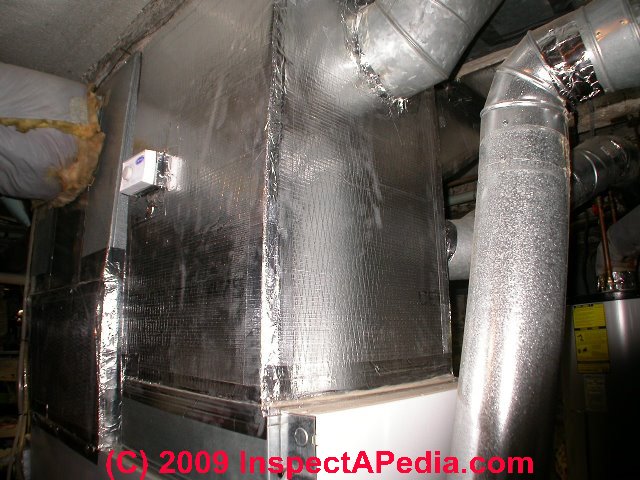
 Our page top photograph shows reinforced aluminum foil faced fiberglass duct board used to construct the supply air plenum on a heating system.
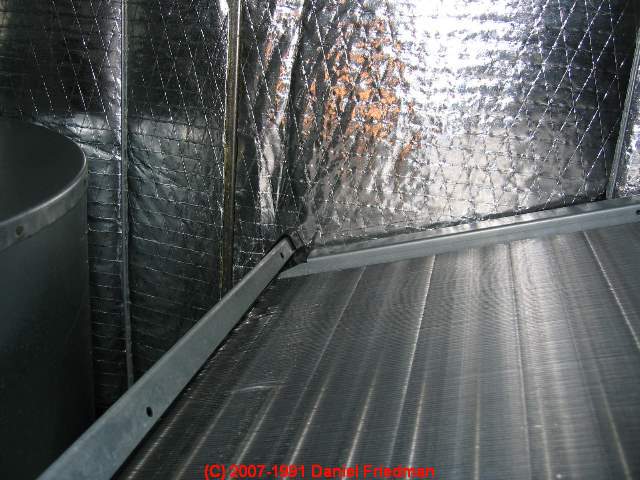
The photo shown here illustrates foil-faced rigid duct insulation inside of an air handler.
The question-and-answer article below paraphrases, quotes-from, updates, and comments an original article from Solar Age Magazine and written by Steven Bliss.
[Click to enlarge any image]
Question: How are Rigid-Insulation Ducts Constructed, What Materials & Tools are Used?
I have heard that rigid insulating board can be used to construct heating ducts (or air conditioning ductwork). Can you provide information about the construction of rigid insulating board ductwork, including duct construction tools, etc.?
Is it reasonable to use rigid duct board with a thermosiphoning air collector (TAP), considering that I desire to move air 12 to 15 feet from the south wall to the middle of a one-story house?
This thermosiphoning air collector plan also includes using air from the basement to enter the cold side of the TAP. -- Byrl Bowman, Kalamazoo, MI
Answer: Fiberglass Duct Board
The product you refer to is fiberglass duct board, available from Certainteed, Knauf, and Owens Corning.
The fiberglass insulating board panels are one-inch in thickness, R-4.3, rigid-fiberglass panels that have a reinforced kraft paper or foil facing on one side. Rigid fiberglass duct board panels can be cut and fitted on site using a utility knife and special grooving tools to make the folds and laps.
The duct board sections are stapled together and sealed using pressure-sensitive aluminum foil tape.
The duct construction hand tools are made by AmCraft, Inc..
To purchase fiberglass insulation duct board materials, check with the larger heating and air-conditioning supply houses in your area, or with a manufacturer's rep.
As for your plan to use a thermosiphoning air collector, it sounds fine, but don't expect much air flow from a thermosiphoning collector if the system is ducted. A fan will be needed.
Technical Opinion About Rigid Fiberglass Ductwork
Foil faced rigid fiberglass duct board has proven an excellent system for constructing air plenums and main trunk lines for duct systems for both heating and air conditioning, and is in popular use across North America as well as in other countries. -- DJ Friedman
Advantages of Rigid Fiberglass Duct Board
- Rapid, easy, low-cost onsite custom fabrication of ductwork
- Combination of both duct insulation and a rigid material to form the duct itself
- Ductwork constructed of this material transmits much less noise than metal ductwork
Disadvantages of Rigid Fiberglass Duct Board
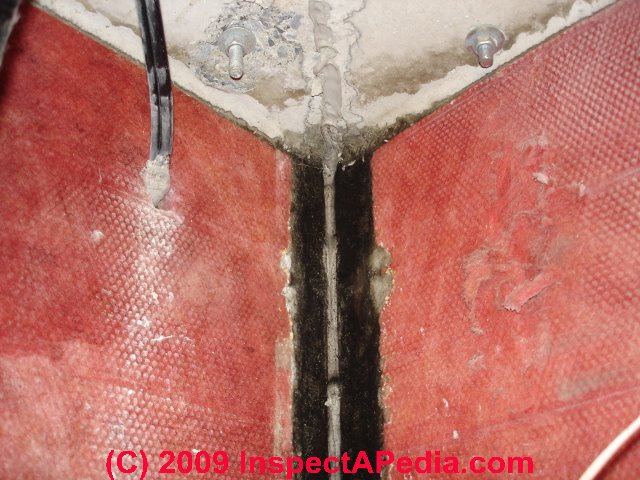
- Cleaning difficulty: When ducts are constructed using board that is foil faced only on the outside, the inner, fiberglass insulation can not be mechanically cleaned without damaging the ducts.
If the fiberglass is damaged an increased level of release of fiberglass into the building air may be a problem for building occupants. - See FIBERGLASS HVAC DUCTS and
also FIBERGLASS FRAGMENT HAZARDS in AIR or DUST for details. - Mold growth: In some air conditioning systems (improperly maintained, improper handling of condensate, or location in very humid climates), over-spray of condensate in the air handler or leaks into the ductwork can combine with the collection of organic debris in house dust to support mold growth.
In some instances problem mold growth may be present in duct work at a significant level, although usually our field investigation finds that there are other more critical mold reservoirs in buildings where mold is detected in the duct system.
See MOLD in FIBERGLASS INSULATION for details.
Also see
- Owens Corning, Owens Corning, OWENS CORNING FIBERGLAS® ENDURACOAT® DUCT SYSTEM [PDF] (1995) Submittal Sheet + supplemental data including clearance to combustibles, Louisiana Office of State Fire Marshal, 8181 Independence Blvd. Baton Rouge, Louisiana 70806
1-800-256-5452 http://lasfm.org/ retrieved 2019/02/07, includes additional information including clearance to combustibles and installation instructions
original source: http://sfm.dps.louisiana.gov/doc/gbmemos/Bad%20Memos/bm_28.pdff
Excerpt: The Owens-Corning EnDuraCoat™ Duct System is made from rigid resin-bonded Fiberglas® boards with a tough, damage-resistant, flame r-etardant reinforced aluminum foil air barrier faacing.
The inner air stream surface has a smooth, durable acrylic coating that isolates the glass fiber substrate from the air stream and inhibits penetrastion of the insulation by dirt, dust, and other pollutants.
Here we include solar energy, solar heating, solar hot water, and related building energy efficiency improvement articles reprinted/adapted/excerpted with permission from Solar Age Magazine - editor Steven Bliss.
Original Article
The link to the original Q&A article in PDF form immediately below is preceded by an expanded/updated online version of this article.
- Q&A on Rigid Insulating Board Ductwork: Rigid-Insulation Ducts - PDF version, Use your browser's back button to return to this page
Reader Comments, Questions & Answers About The Article Above
Below you will find questions and answers previously posted on this page at its page bottom reader comment box.
Reader Q&A - also see RECOMMENDED ARTICLES & FAQs
Question: strange HVAC duct lining materials: plaster
(Jan 3, 2013) Lou said:
Our son' s home in Austin was built in 2006. The ducts are lined with foam rubber and the round tubes are connected with plaster. It leaks, one section has busted (i have used duct tape to patch it up). What is your suggestion: repair with same material or replace with all metal ductwork?
Reply:
Lou this is a design and materials unfamiliar to me: plaster inside ductwork around tubes? Perhaps you can send us some sharp photos and I can comment further.
Question: get rid of ductwork shedding fiberglass
25 Feb 2015 ray said:
how can rigid air ducks be replace to fix the dust an fiberglass from coming out all the time
Reply:
Ray,
If the ducts are damaged internally, say by mechanical cleaning, for example, then the ductwork would simply need to be replaced. my OPINION is that I don't like the spray-coating approach that some techs use in these situations.
...
Continue reading at MICRO-AIRE® HVAC DUCTS or select a topic from the closely-related articles below, or see the complete ARTICLE INDEX.
Or see these
Fiberglass HVAC Duct Articles
- FIBERGLASS AIR DUCT MOLD TEST
- FIBERGLASS DETECTION in BUILDING AIR & DUST
- FIBERGLASS DUCT, RIGID CONSTRUCTION
- FIBERGLASS HAZARDS - home
- FIBERGLASS HVAC DUCTS
- AIR HANDLER FIBERGLASS INSULATION
- FIBERGLASS DUCT WRAP
- FOIL-COVERED FIBERGLASS FLEX DUCT
- MICRO-AIRE® HVAC DUCTS
- PLASTIC-COVERED FIBERGLASS FLEX DUCT
- RIGID BOARD FIBERGLASS DUCTS
- RIGID ROUND FIBERGLASS DUCTS
- FIBERGLASS INSULATION MOLD
Suggested citation for this web page
FIBERGLASS DUCT, RIGID CONSTRUCTION at InspectApedia.com - online encyclopedia of building & environmental inspection, testing, diagnosis, repair, & problem prevention advice.
Or see this
INDEX to RELATED ARTICLES: ARTICLE INDEX to HVAC DUCT SYSTEMS
Or use the SEARCH BOX found below to Ask a Question or Search InspectApedia
Ask a Question or Search InspectApedia
Try the search box just below, or if you prefer, post a question or comment in the Comments box below and we will respond promptly.
Search the InspectApedia website
Note: appearance of your Comment below may be delayed: if your comment contains an image, photograph, web link, or text that looks to the software as if it might be a web link, your posting will appear after it has been approved by a moderator. Apologies for the delay.
Only one image can be added per comment but you can post as many comments, and therefore images, as you like.
You will not receive a notification when a response to your question has been posted.
Please bookmark this page to make it easy for you to check back for our response.
Our Comment Box is provided by Countable Web Productions countable.ca
Citations & References
In addition to any citations in the article above, a full list is available on request.
- Solar Age Magazine was the official publication of the American Solar Energy Society. The contemporary solar energy magazine associated with the Society is Solar Today. "Established in 1954, the nonprofit American Solar Energy Society (ASES) is the nation's leading association of solar professionals & advocates. Our mission is to inspire an era of energy innovation and speed the transition to a sustainable energy economy. We advance education, research and policy. Leading for more than 50 years. ASES leads national efforts to increase the use of solar energy, energy efficiency and other sustainable technologies in the U.S. We publish the award-winning SOLAR TODAY magazine, organize and present the ASES National Solar Conference and lead the ASES National Solar Tour – the largest grassroots solar event in the world."
- Steve Bliss's Building Advisor at buildingadvisor.com helps homeowners & contractors plan & complete successful building & remodeling projects: buying land, site work, building design, cost estimating, materials & components, & project management through complete construction. Email: info@buildingadvisor.com
Steven Bliss served as editorial director and co-publisher of The Journal of Light Construction for 16 years and previously as building technology editor for Progressive Builder and Solar Age magazines. He worked in the building trades as a carpenter and design/build contractor for more than ten years and holds a masters degree from the Harvard Graduate School of Education. Excerpts from his recent book, Best Practices Guide to Residential Construction, Wiley (November 18, 2005) ISBN-10: 0471648361, ISBN-13: 978-0471648369, appear throughout this website, with permission and courtesy of Wiley & Sons. Best Practices Guide is available from the publisher, J. Wiley & Sons, and also at Amazon.com - AmCraft,Inc., 2311 Mechanic St., Waterville, OH 43566.
- [5] Ahearn, D.G., S A Crow, R B Simmons, D L Price, J A Noble, S K Mishra and D L Pierson, "Fungal colonization of fiberglass insulation in the air distribution system of a multi-story office building: VOC production and possible relationship to a sick building syndrome", Journal of Industrial Microbiology & Biotechnology, Volume 16, Number 5 (1996), 280-285, DOI: 10.1007/BF01570035. Abstract:
Complaints characteristic of those for sick building syndrome prompted mycological investigations of a modern multi-story office building on the Gulf coast in the Southeastern United States (Houston-Galveston area). The air handling units and fiberglass duct liner of the heating, ventilating and air conditioning system of the building, without a history of catastrophic or chronic water damage, demonstrated extensive colonization with Penicillium spp and Cladosporium herbarum. Although dense fungal growth was observed on surfaces within the heating-cooling system, most air samples yielded fewer than 200 CFU m–3. Several volatile compounds found in the building air were released also from colonized fiberglass. Removal of colonized insulation from the floor receiving the majority of complaints of mouldy air and continuous operation of the units supplying this floor resulted in a reduction in the number of complaints. - [6] Ahearn, D.G., S.A. Crow, R.B. Simmons, D.L. Price, S.K. Mishra and D.L. Pierson, "Fungal Colonization of Air Filters and Insulation in a Multi-Story Office Building: Production of Volatile Organics", Current Microbiology Volume 35, Number 5 (1997), 305-308, DOI: 10.1007/s002849900259, Abstract:
Secondary air filters in the air-handling units on four floors of a multi-story office building with a history of fungal colonization of insulation within the air distribution system were examined for the presence of growing fungi and production of volatile organic compounds. Fungal mycelium and conidia of Cladosporium and Penicillium spp. were observed on insulation from all floors and both sides of the air filters from one floor. Lower concentrations of volatile organics were released from air filter medium colonized with fungi as compared with noncolonized filter medium. However, the volatiles from the colonized filter medium included fungal metabolites such as acetone and a carbonyl sulfide-like compound that were not released from noncolonized filter medium. The growth of fungi in air distribution systems may affect the content of volatile organics in indoor air. - [7] Price,D. L., R. B. Simmons, I. M. Ezeonu, S. A. Crow and D. G. Ahearn, "Colonization of fiberglass insulation used in heating, ventilation and air conditioning systems", Journal of Industrial Microbiology & Biotechnology Volume 13, Number 3 (1994), 154-158, DOI: 10.1007/BF01584000, Abstract: The number of fungal species colonizing thermal and acoustic fiberglass insulations used in heating, ventilation, and air conditioning (HVAC) systems was fewer than that obtained from initial direct culture of these insulations. The colonization, determined by the microscopic observation of conidiophores with conidia, was primarily of acrylic-latex-facing material, but eventually the fungi permeated the fiberglass matrix. Isolates of Aspergillus versicolor were most often obtained from non-challenged insulation, whereasAcremonium obclavatum appeared to be the primary colonizing fungus in high-humidity (>90%) challenge chambers. At a lower humidity (about 70%) Aspergillus flavus was one of the more prominent fungi. Not all duct liner samples were equally susceptible to colonization and duct board appeared relatively resistant to colonization.
- [8] Simmons, R. B. and S. A. Crow, "Fungal colonization of air filters for use in heating, ventilating, and air conditioning (HVAC) systems", Journal of Industrial Microbiology & Biotechnology Volume 14, Number 1 (1995), 41-45, DOI: 10.1007/BF01570065, Abstract:
New and used cellulosic air filters for HVAC systems including those treated with antimicrobials were suspended in vessels with a range of relative humidities (55–99%) and containing non-sterile potting soil which stimulates fungal growth. Most filters yielded fungi prior to suspension in the chambers but only two of 14 nontreated filters demonstrated fungal colonization following use in HVAC systems. Filters treated with antimicrobials, particularly a phosphated amine complex, demonstrated markedly less fungal colonization than nontreated filters. In comparison with nontreated cellulosic filters, fungal colonization of antimicrobial-treated cellulosic filters was selective and delayed. - [9] Ifeoma M. Ezeonu, Daniel L. Price, Sidney A. Crow and Donald G. Ahearn, "Effects of extracts of fiberglass insulations on the growth of Aspergillus fumigatus and A. versicolor", Mycopathologia Volume 132, Number 2 (1995), 65-69, DOI: 10.1007/BF01103777
, Abstract:
Water extracts of thermal and acoustic fiberglass insulations used in the duct work of heating, ventilation and air conditioning (HVAC) systems supported germination of conidia and growth of Aspergillus versicolor (Vuillemin) Tiraboschi 1908–9 and Aspergillus fumigatus Fresenius 1863. Urea, formaldehyde and unidentified organics were detected in the extracts. Formaldehyde in concentrations similar to those found in the extracts restricted the growth of both species in enriched media. A. versicolor, the more common species associated with fiberglass insulations, was more resistant to formaldehyde than A. fumigatus. - Our recommended books about building & mechanical systems design, inspection, problem diagnosis, and repair, and about indoor environment and IAQ testing, diagnosis, and cleanup are at the InspectAPedia Bookstore. Also see our Book Reviews - InspectAPedia.
- Fiberglass carcinogenicity: "Glass Wool Fibers Expert Panel Report, Part B - Recommendation for Listing Status for Glass Wool Fibers and Scientific Justification for the Recommendation", The Report on Carcinogens (RoC) expert panel for glass wool fibers exposures met at the Sheraton Chapel Hill Hotel, Chapel Hill, North Carolina on June 9-10, 2009, to peer review the draft background document on glass wool fibers exposures and make a recommendation for listing status in the 12th Edition of the RoC. The National Institute of Environmental Health Sciences is one of the National Institutes of Health within the U.S. Department of Health and Human Services. The National Toxicology Program is headquartered on the NIEHS campus in Research Triangle Park, NC. The National Institute of Environmental Health Sciences is one of the National Institutes of Health within the U.S. Department of Health and Human Services. The National Toxicology Program is headquartered on the NIEHS campus in Research Triangle Park, NC.
Following a discussion of the body of knowledge, the expert panel reviewed the RoC listing criteria and made its recommendation. The expert panel recommended by a vote of 8 yes/0 no that glass wool fibers, with the exception of special fibers of concern (characterized physically below), should not be classified either as known to be a human carcinogen or reasonably anticipated to be a human carcinogen. The expert panel also recommended by a vote of 7 yes/0 no/1 abstention, based on sufficient evidence of carcinogenicity in well-conducted animal inhalation studies, that special-purpose glass fibers with the physical characteristics as follows longer, thinner, less soluble fibers (for 1 example, > 15 μm length with a kdis of < 100 ng/cm2/h) are reasonably anticipated to be a human carcinogen for the listing status in the RoC. The major considerations discussed that led the panel to its recommendation include the observations of tumors in multiple species of animals (rats and hamsters). Both inhalation and intraperitoneal routes of exposure produced tumors, although inhalation was considered more relevant for humans.
- In addition to citations & references found in this article, see the research citations given at the end of the related articles found at our suggested
CONTINUE READING or RECOMMENDED ARTICLES.
- Carson, Dunlop & Associates Ltd., 120 Carlton Street Suite 407, Toronto ON M5A 4K2. Tel: (416) 964-9415 1-800-268-7070 Email: info@carsondunlop.com. Alan Carson is a past president of ASHI, the American Society of Home Inspectors.
Thanks to Alan Carson and Bob Dunlop, for permission for InspectAPedia to use text excerpts from The HOME REFERENCE BOOK - the Encyclopedia of Homes and to use illustrations from The ILLUSTRATED HOME .
Carson Dunlop Associates provides extensive home inspection education and report writing material. In gratitude we provide links to tsome Carson Dunlop Associates products and services.
 | HOME | ABOUT | ASK a QUESTION | CONTACT | CONTENT USE POLICY | DESCRIPTION | POLICIES | PRIVACY | |
| © 2024 - 1985 Publisher InspectApedia.com - Daniel Friedman | |||||||||