
InspectAPedia® FREE Encyclopedia of Building & Environmental Construction, Diagnosis, Maintenance & Repair |
Question? Just ask us! InspectAPedia
|
 Fire Protection Requirements for Foam Board Building Insulation
- POST a QUESTION or COMMENT about exposed foam board building insulation & fire safety requirements
Exposed foam board insulation fire hazards:
This Q&A article discusses the requirement for a fire-resistant covering for foam and foam-board board building insulation. Since most fire codes call for a minimum of half-hour fire rating over foam insulations, paneling would probably not provide a sufficient fire barrier over the foam insulating board.
InspectAPedia tolerates no conflicts of interest. We have no relationship with advertisers, products, or services discussed at this website.
Fire Safety and Foam Insulation Board
The question-and-answer article below paraphrases, quotes-from, updates, and comments an original article from Solar Age Magazine and written by Steven Bliss.
What coverings are acceptable for foam insulation used indoors?
Question:
I am reinsulating a house that has concrete block walls, a stucco exterior, and 3/4-inch foil-backed gypsum board over furring strips on the building interior.
If I glued foam insulating board directly over the existing plaster wall finish, would paneling be sufficient covering? Will the foil backing on the gypsum board create a cold-side vapor barrier? - Gordon Reed Jr., Kingsford MI.
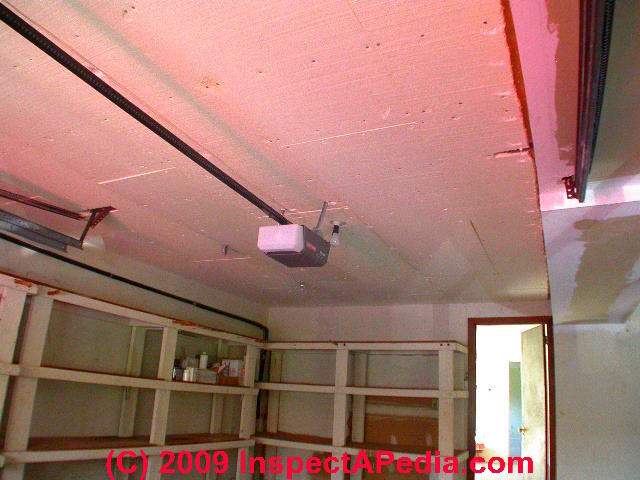
In the photograph at left, foam insulating board is shown on a garage ceiling below a second floor bedroom - this material should have been covered with fire rated drywall to meet local building code specifications for fire safety.
Answer: Fire Code Requirements for Covering Foam Insulating Board
Since most fire codes call for a minimum of half-hour fire rating over foam insulations, paneling would probably not provide a sufficient fire barrier over the foam insulating board. New 1/2-inch drywall is usually called for [and in some installations, fire-rated drywall or thicker drywall may be required for local codes and for certain applications].
The thin foil used on the back of drywall will create a moderate cold-side vapor retarder, but the exact permenance is not published for foil-backed gypsum board.
The safe tack is to use a highgraade air/vapor barrier on the inside, keeping it much less permeable than the cold side barrier. We suggest foil-faced foam insulating board with the joints sealed with foil tape.
Watch out: depending on whether or not the foil backing on the existing foil-backed gypsum board is perforated or not, the perm rating of that surface could be near zero - that is, very resistant to moisture movement, forming a moisture barrier in the "wrong place".
So it would also be a good idea to take measures to keep interior building moisture levels to a moderate level. See HUMIDITY LEVEL TARGET
Background on foam board insulation and fire protection:
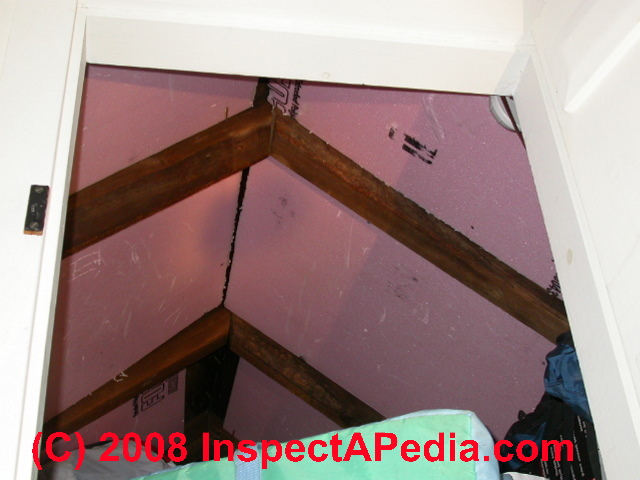
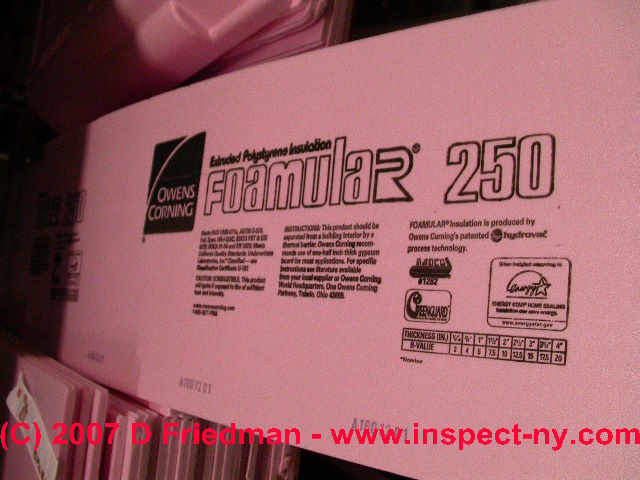
Foam insulation board should not be left exposed in building interiors.
While many modern foam insulating products do not themselves readily support combustion (that is they don't catch fire and burn alone) they may give off thick acrid or toxic black smoke in a fire, making it difficult to safely exit the burning building.
Foam Insulation Alternatives to Solid Foam Board Insulation
Various foam insulation products that are sprayed in buildings, including UFFI, Icynene, Latex, and other insulating foams as well as fire resistant spray foam insulation used for sealing building penetrations, a different product from the foam board insulation discussed here, are described
at INSULATION IDENTIFICATION GUIDE
and
at FOAM SPRAY INSULATION TYPES.
Original article
The link to the original Q&A article in PDF form immediately below is preceded by an expanded/updated online version of this article.
- Q&A on Covering Indoor Foam Insulation - PDF version, use your browser's back button to return to this page. Original article, Solar Age Magazine, September 1985, adapted and updated for InspectAPedia.com November 2010.
Note: some building code officials may accept fire-retardant spray paint coatings on spray-foam and possibly solid foam board insulation in some locations.
Watch out: do not rely on fire-retardant paints without approval from your local building and fire officials.
Watch out: suitable fire-barriers are required over foam board insulation in occupied spaces. Currently (2022) there are NO paint-on coatings that give polystyrene insulation board a 15-minute fire rating.
We have read that DOW has been working on a fire-retardant or fire-rated version of EPS and XPS. - [cited below- Ed. ]
Research on Foam Board Fire Properties & Fire Protection
- American Chemistry Council FIRE SAFETY GUIDELINES FOR USE OF RIGID
POLYURETHANE AND POLYISOCYANURATE FOAM
INSULATION IN BUILDING CONSTRUCTION [PDF] (2015)
Excerpt:
Current model building codes2 require foam plastic insulations to be separated from the interior of a building by a thermal barrier such as ½ inch gypsum wallboard or other approved material meeting the requirements of National Fire Protection Association (NFPA) 275. 3 However, the model building codes provide exceptions to this requirement under specific conditions. - DOW, DOW STYROFOAM INSULATION NOW PRODUCED WITH SUSTAINABLE FLAME RETARDANT [PDF] (2018) Dow Chemical, retrieved 2022/09/10 original source: https://www.hpac.com/fire-smoke/press-release/20929447/dow-styrofoam-insulation-now-produced-with-sustainable-flame-retardant
Excerpt: Dow invented BLUEDGE polymeric flame retardant technology as a sustainable flame retardant alternative. - DuPont, MEETING THE FIRE CODE WITH
CONTINUOUS FOAM PLASTIC INSULATION [PDF] DuPont Corp., - retrieved 2022/09/10 original source: https://www.dupont.com/content/dam/dupont/amer/us/en/performance-building-solutions/public/documents/en/meeting-the-fire-code-with-continuous-foam-plastic-insulation-43-D100637-enUS.pdf
Excerpt:
The 2012 International Building Code (IBC) specifies the fire tests that must be passed if a foam plastic material is to be used in Type I-IV commercial construction.
Chapter 26 of the IBC refers to the essential fire tests and other chapters refer to fire tests that are required for specific conditions.
This paper outlines each area of tests within the IBC as it relates to foam plastic wall assemblies. - Eumeps, BEHAVIOUR of EPS in CASE of FIRE [PDF], Eumeps (Construction), Avenue Marcel Thiry 204, B-1200 Brussels, Belgium, Tel: +32 2 774 96 20, Email: eumeps@eyam.be, August 2002, cited in the U.S. by the California Office of the State Fire Marshall, CAL FIRE, retrieved 2017/06/03, original source: http://osfm.fire.ca.gov/codedevelopment/pdf/wgfsbim/EUMEPS_FireBehavior.pdf
- Maine, §2447-B. FOAM PLASTIC INSULATION STANDARDS [PDF] in Title 25: INTERNAL SECURITY AND PUBLIC SAFETY Part 6: FIRE PREVENTION AND FIRE PROTECTION Chapter 317: PREVENTIVE MEASURES AND RESTRICTIONS, Maine State Legislature, retrieved 2022/09/10 original source: https://legislature.maine.gov/statutes/25/title25sec2447-B.html
- OSHA, FIRE HAZARD OF POLYURETHANE AND OTHER ORGANIC FOAM INSULATION ABOARD SHIPS AND IN CONSTRUCTION [PDF] Occupational Safety & Health Administration 200 Constitution Ave NW Washington, DC 20210 800-321-6742 (OSHA), USA, retrieved 2022/09/10 original source: https://www.osha.gov/publications/hib19890510
...
Continue reading at FOAM BOARD INSULATION TYPES - topic home, or select a topic from the closely-related articles below, or see the complete ARTICLE INDEX.
Or see these
Recommended Articles
- FOAM BOARD INSULATION TYPES - topic home
- FIRE PROTECTION FOR FOAM BOARD INSULATION
- FOAM SPRAY INSULATION TYPES
- FOAM INSULATION & INSECTS
- ICYNENE FOAM SPRAY INSULATION
- MOLD in FOAM INSULATION
- PERLITE INSULATION
- PHENOLIC FOAM INSULATION
- POLYISOCYANURATE FOAM BOARD
- POLYISOCYANURATE FOAM and IAQ
- POLYISOCYANURATE FOAM BELOW SLABS
- POLYSTYRENE FOAM INSULATION
- RIGID FOAM USE INDOORS
- SLAB INSULATION, RADIANT / PASSIVE SOLAR
- STRESS SKIN / STRUCTURAL INSULATED PANELS (SIPs)
- UREA FORMALDEHYDE FOAM INSULATION, UFFI
- URETHANE FOAM INSULATION
Suggested citation for this web page
FIRE PROTECTION FOR FOAM BOARD INSULATION at InspectApedia.com - online encyclopedia of building & environmental inspection, testing, diagnosis, repair, & problem prevention advice.
Or see this
INDEX to RELATED ARTICLES: ARTICLE INDEX to BUILDING INSULATION
Or use the SEARCH BOX found below to Ask a Question or Search InspectApedia
Ask a Question or Search InspectApedia
Questions & answers or comments about exposed foam board building insulation & fire safety requirements.
Try the search box just below, or if you prefer, post a question or comment in the Comments box below and we will respond promptly.
Search the InspectApedia website
Note: appearance of your Comment below may be delayed: if your comment contains an image, photograph, web link, or text that looks to the software as if it might be a web link, your posting will appear after it has been approved by a moderator. Apologies for the delay.
Only one image can be added per comment but you can post as many comments, and therefore images, as you like.
You will not receive a notification when a response to your question has been posted.
Please bookmark this page to make it easy for you to check back for our response.
Our Comment Box is provided by Countable Web Productions countable.ca
Citations & References
In addition to any citations in the article above, a full list is available on request.
- 3/07: thanks to Gary Randolph, Ounce of Prevention Home Inspection, LLC Buffalo, NY, for attentive reading and editing suggestions. Mr. Randolph can be reached in Buffalo, NY, at (716) 636-3865 or email: gary@ouncehome.com
- Our recommended books about building & mechanical systems design, inspection, problem diagnosis, and repair, and about indoor environment and IAQ testing, diagnosis, and cleanup are at the InspectAPedia Bookstore. Also see our Book Reviews - InspectAPedia.
- In addition to citations & references found in this article, see the research citations given at the end of the related articles found at our suggested
CONTINUE READING or RECOMMENDED ARTICLES.
- Carson, Dunlop & Associates Ltd., 120 Carlton Street Suite 407, Toronto ON M5A 4K2. Tel: (416) 964-9415 1-800-268-7070 Email: info@carsondunlop.com. Alan Carson is a past president of ASHI, the American Society of Home Inspectors.
Thanks to Alan Carson and Bob Dunlop, for permission for InspectAPedia to use text excerpts from The HOME REFERENCE BOOK - the Encyclopedia of Homes and to use illustrations from The ILLUSTRATED HOME .
Carson Dunlop Associates provides extensive home inspection education and report writing material. In gratitude we provide links to tsome Carson Dunlop Associates products and services.
 | HOME | ABOUT | ASK a QUESTION | CONTACT | CONTENT USE POLICY | DESCRIPTION | POLICIES | PRIVACY | |
| © 2024 - 1985 Publisher InspectApedia.com - Daniel Friedman | |||||||||