
InspectAPedia® FREE Encyclopedia of Building & Environmental Construction, Diagnosis, Maintenance & Repair |
Question? Just ask us! InspectAPedia
|
 Is it Necessary to Insulate Under a Slab in a Superinsulated House?
- POST a QUESTION or COMMENT about floor slab insulation guidelines & specifications or requirements
Slab insulation placement guide:
Tthis article discusses the question of insulating under a basement floor slab, and just where is the optimum placement of basement insulation.
Do we insulate just the slab perimeter or the whole floor? Can we use uninsulated floor slabs to help with cooling? Critical insulation under radiant floors & passive solar floors. Advice for building insulation priorities.
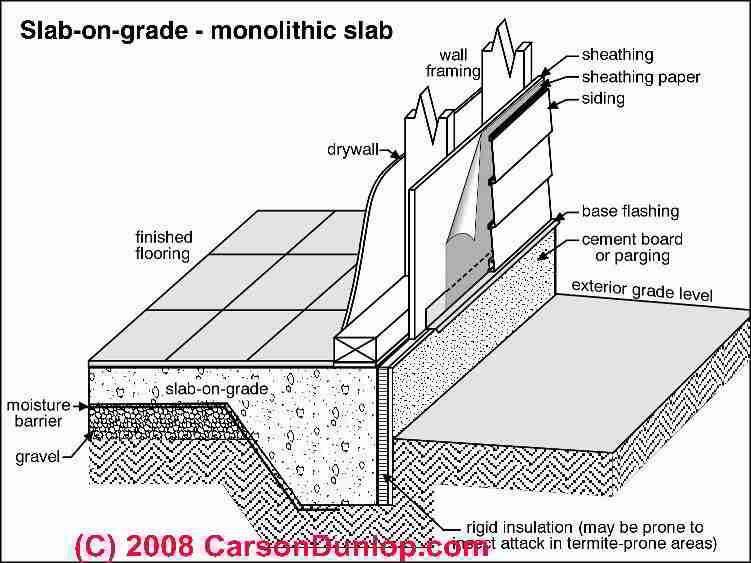
This article explains that the location of building insulation is as important as its quantity. Sketch at page top is courtesy of Carson Dunlop Associates, a Toronto home inspection, education & report writing tool company [ carsondunlop.com ].
InspectAPedia tolerates no conflicts of interest. We have no relationship with advertisers, products, or services discussed at this website.
Floor Slab Insulation Advice for Well-Insulated Homes
 Insulation Advice for Full Basements - Do We Need to Insulate Under the Basement Floor?
The accompanying text is adapted and expanded from the original article with permission from Solar Age Magazine - editor Steven Bliss.
Reader Question:
Is it necessary to insulate under a slab in a superinsulated house? I assume an uninsulated slab would help cool the house in summer. -- William Lee, Cave Creerk AZ
Answer:
Experts [in 1985] did not agree as to whether or how much to insulated below a slab. It is most important to insulated the perimeter of a slab down to the bottom of the footing.
Second most important [to insulating the slab perimeter down below the frost line] is to insulate under the first few feet around the edge of the slab.
In [moderate] climates where cooling as well as heating is an issue, it may be best to insulate only the perimeter and leave the underslab uninsulated, as you suggested, for cooling.
Full insulation is indeed recommended under the slab in some situations.
These include radiant heat delivery or passive solar storage
See INSULATION LOCATION for PASSIVE SOLAR FLOOR SLAB
Also, if wood flooring or carpeting isn't planned, underslab insulations will make the floor feel warmer to bare feet.
See FLOOR, CONCRETE SLAB CHOICES.
And if your concrete floor is a "floating slab" without below-frost-line footings, such as our thoughtless contractor installed in Northern Minnesota, insulation under the entire slab may be critical to avoid pumping most of your heat into the ground during the heating season.
If you are installing a radiant heat basement floor system, insulation under the floor slab and the location of the heating tubing are critical -
see RADIANT HEAT FLOOR MISTAKES. --DF
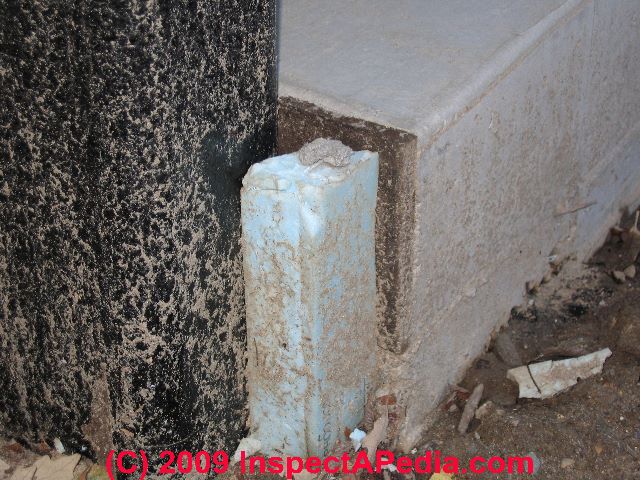
The material of choice for insulating a slab would be high density, closed-cell rigid foam board insulation, such as extruded polystyrene.
Thermally break the interior finish of the basement floor from the concrete (e.g. with wood or solid foam board) to increase comfort and to control condensation if that's a problem in your area during summer months.
If you are installing a radiant heat basement floor system, insulation under the floor slab and the location of the heating tubing are critical - see RADIANT HEAT FLOOR MISTAKES.
The link to the original Q&A article in PDF form immediately below is followed by an expanded/updated online version of this article.
- Q & A: Insulation Under the Slab? - Do I need to insulate under the slab of a superinsulated home? - PDF form
The question-and-answer article about Under-Basement Insulation , quotes-from, updates, and comments an original article from Solar Age Magazine and written by Steven Bliss.
...
Continue reading at INSULATION LOCATION for PASSIVE SOLAR FLOOR SLAB or select a topic from the closely-related articles below, or see the complete ARTICLE INDEX.
Or see these
Recommended Articles
- INSULATION LOCATION - WHERE TO PUT IT - article series home
- RADIANT HEAT FLOOR MISTAKES
Suggested citation for this web page
INSULATION LOCATION & EXTENT for SLABS at InspectApedia.com - online encyclopedia of building & environmental inspection, testing, diagnosis, repair, & problem prevention advice.
Or see this
INDEX to RELATED ARTICLES: ARTICLE INDEX to BUILDING INSULATION
Or use the SEARCH BOX found below to Ask a Question or Search InspectApedia
Ask a Question or Search InspectApedia
Try the search box just below, or if you prefer, post a question or comment in the Comments box below and we will respond promptly.
Search the InspectApedia website
Note: appearance of your Comment below may be delayed: if your comment contains an image, photograph, web link, or text that looks to the software as if it might be a web link, your posting will appear after it has been approved by a moderator. Apologies for the delay.
Only one image can be added per comment but you can post as many comments, and therefore images, as you like.
You will not receive a notification when a response to your question has been posted.
Please bookmark this page to make it easy for you to check back for our response.
Our Comment Box is provided by Countable Web Productions countable.ca
Citations & References
In addition to any citations in the article above, a full list is available on request.
- In addition to citations & references found in this article, see the research citations given at the end of the related articles found at our suggested
CONTINUE READING or RECOMMENDED ARTICLES.
- Carson, Dunlop & Associates Ltd., 120 Carlton Street Suite 407, Toronto ON M5A 4K2. Tel: (416) 964-9415 1-800-268-7070 Email: info@carsondunlop.com. Alan Carson is a past president of ASHI, the American Society of Home Inspectors.
Thanks to Alan Carson and Bob Dunlop, for permission for InspectAPedia to use text excerpts from The HOME REFERENCE BOOK - the Encyclopedia of Homes and to use illustrations from The ILLUSTRATED HOME .
Carson Dunlop Associates provides extensive home inspection education and report writing material. In gratitude we provide links to tsome Carson Dunlop Associates products and services.
 | HOME | ABOUT | ASK a QUESTION | CONTACT | CONTENT USE POLICY | DESCRIPTION | POLICIES | PRIVACY | |
| © 2024 - 1985 Publisher InspectApedia.com - Daniel Friedman | |||||||||