
InspectAPedia® FREE Encyclopedia of Building & Environmental Construction, Diagnosis, Maintenance & Repair |
Question? Just ask us! InspectAPedia
|
 Passive Solar Energy: A Probe into Claimed & Actual Performance
- POST a QUESTION or COMMENT about the actual vs claimed energy efficiency of solar energy
Effectiveness of passive solar designs:
This article discusses the actual vs claimed performance of passive solar designs and an explanation of why those figures differed in a 1980's passive solar home design are detailed.
Illustration at page top and accompanying text are reprinted/adapted/excerpted with permission from Solar Age Magazine - editor Steven Bliss.
InspectAPedia tolerates no conflicts of interest. We have no relationship with advertisers, products, or services discussed at this website.
A Probe of Passive Solar System Performance: is passive solar energy as efficient in actual use as claimed in theory?
Steve Bliss, associate editor, Solar Age Magazine
The question-and-answer article below paraphrases, quotes-from, updates, and comments an original article from Solar Age Magazine and written by Steven Bliss.
Passive Solar Performance: Actual, Claimed, & Evaluated
[Click to enlarge any image]
Many passive solar homes surpass the thermal performance goals set by their designers. This success is often the result of careful management and low indoor temperatures, or conservative calculations to begin with.
In too many homes, though, great performance comes only at the expense of good design, or worse - the homes demand a heavy sacrifice of comfort from the occupants.
Few such compromises were made in the architecturally ambitious Langley home, where careful consideration of living patterns and site issues remained a major concern throughout the passive solar project.
In addition to the usual siting and layout requirements of passive solar design, views to all directions were to be preserved, the solar collection space was also to serve as living space, and the heating program was to be flexible - providing heat only when and where it was needed.
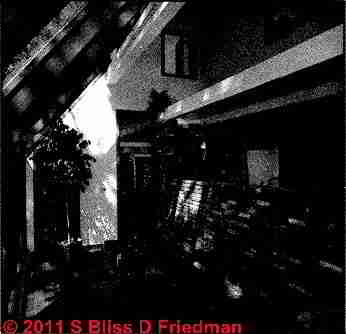
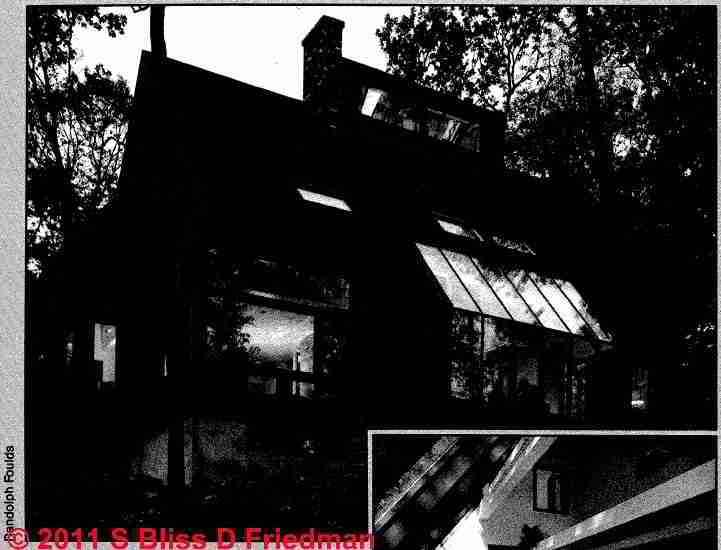
Glass and lightly stained cedar interplay in the handsome geometry of the southern facade of the Langley house designed and built by the Bourgeois-Moran team.
The brick mass wall in the sunspace provides a decorative boundary for the kitche workspace (see sketch below). Warmed air collected from the greenhouse in the upper plenum is ducted to the remote rockbed, which boosts the forced-hot-air auxiliary furnace. IN summer, clerestory glazing is opened for whole-house venting.
Architecturally, this house in western Massachusetts was and remains an unqualified success; the owners treasure their home.
Yet thermal performance of this passive solar implementation at the time of this investigation was not encouraging. A close examination of the project suggested why passive solar performance goals had not been met and what steps might be taken to correct the problems.
As is the case with good custom homes - solar and non-solar alike - the initial design grew out of hours of conversation between the owners and the architect, probing their "philosophy of living" and feelings about the particular setting. Ken and Joan Langley and their teenage children were swept up in the design process. In their words, "we really got hooked on the idea of building when (we) suddenly realized how much the house would really be ours."
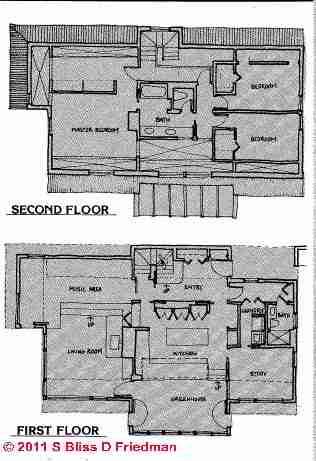
The plan provided for primary living spaces cantilevered over the south-sloping landscape toward mountain views and summer-shading deciduous trees. As cooking was a central activity of the Langley family, a large sunspace/kitchen area was designed as the spatial and thermal focus of the home.
With a hot-air above and rockbed below [for heat storage], the kitchen area would be the most consistently heated space. The adjoining two-story sunspace would function as both eating nook and circulation zone, therefore requiring few furnishings that might shade the direct-gain thermal mass. At the cost of losing a measure of thermal efficiency, the solar collection area was included as primary living space. R-9 night insulation was planned to minimize heat losses.
The Langleys were also a musical family. For occasional performances with family and friends, the expansive living room, opened up with west-facing windows, adjoins a raised music area. The platform serves nicely as an informal stage. Two teenage daughters [in the 1980's] needed smaller private spaces. The young women ended up with compact but exciting two-story bedrooms with large sleeping lofts.
All the rooms that face south can be opened to the sunny core of the home. Operable doors and windows are opened or closed as passive heating or cooling is required. For primary space heating, the Langleys, who each worked but anticipated soon being empty-nesters, wanted a flexible program that would deliver high-grade heat to peripheral rooms quickly, and only as needed. A passive-hybrid, forced hot air furnace system was chosen for its simplicity and economy.
The environmentally attuned design team placed the garage to the northwest as a wind buffer with the driveway to the south for solar-assisted snow removal. Similarly, a woodbin to the east of the entry is exposed to the south to help keep the wood dry. Judiciously placed plantings and a sparing use of glass kept the northern facade relatively enclosed for minimal heat loss.
Design for Hybrid Heating in This Passive Solar Home
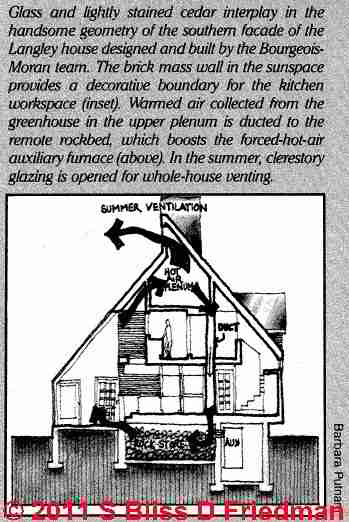
Choosing ducts, fans, and dampers over pipes, pumps, and valves, the Bourgeois-Moran design team, together with consulting engineer Bill Alschuler, designed a passive-collection, active-delivery forced hot-air system for the Langley residence.
Air from the heavily insulated plenum above the kitchen/greenhouse area is drawn down to a 25-ton rockbed storage component in the basement where it is heated in winter or cooled in summer.
Also see BLOCKBED RADIANT FLOORS - SOLAR DESIGN
and PASSIVE SOLAR FLOOR TILES, PHASE CHANGE
Sketch at left (Barbara Putnam).
The conditioned air is then ducted in-line through a Thermopride multi-fuel furnace and is passed by an auxiliary electric resistance element before being fed to the lower rooms and children's bedrooms through operable floor registers.
The master bedroom is open to convective heating from the living room below, which has a backup wood stove.
WOOD BURNING HEATERS FIREPLACES STOVES
The design/builders could not find a multi-fuel unit with built-in electric backup that met local code requirements, so they were forced to improvise with less-than-compatible components and controls.
In an effort to achieve the higher efficiencies sought in active system rock storage, the consulting engineer designed a reversing system (two-way flow) with separate collection and delivery modes for heating and cooling, and an additional mode for electrically-boosted auxiliary heating.
In summer, the owners open vent windows in the upper air plenum to convert it to a thermosiphoning tower, which both vents the sunspace and draws cooling air through the house.
Assessing Thermal Performance of This Passive Solar Design
According to performance criteria supplied by the design team, the Langley home was designed to attain a Solar Savings Fraction of .37, an ambitious goal for New England, in this case requiring 460 square feet of south-facing glass. This figure indicates that 37 percent of the heat required to maintain design temperature would be supplied by solar energy.
At this level of performance, 5 1/2 cords of hardwood, supplying 55 million BTUs of auxiliary heat, would be required to maintain the indoor temperature at an average of 65 degF. [
lso see PASSIVE SOLAR HEAT PERFORMANCE.
In fact, in the heating season of 1981-82, the Langleys burned only 5 1/2 cords of hardwood, but design temperatures were not approached.
Based on data compiled by the owner on a multi-thermistor Heliologic control module, house temperatures were as follows: while average daytime temperatures were maintained close to 63 degF throughout much of the house, the nighttime average in-house temperature dropped to 58 degF.
The kitchen/greenhouse area rarely exceeded the high 50's. After a sunny day with no auxiliary heat, the house averaged 60-62 degF. before sunset. On these days the upper plenum reached the mid-70's, the rockbed the mid 60's, and warm air to the room approximately 60 degF. The owners reported that air from the supply registers, even when warmer than room temperature, felt cold to the skin. It's not like the 110-120 degF. air that they expected from a forced hot-air heating system.
Also see PASSIVE SOLAR ENERGY MONITORING
While the owners were very pleased with their home, with the thoughtful and imaginative use of space, the grand views, and fine detailing throughout, they expressed disappointment in the solar performance of the building. They reported that the rockbed did not work as expected, and, in fact, was not needed since overheating was not a problem.
On winter mornings, the Langleys tolerated a chilly kitchen, feeling it was the price they paid for the glass and the views. They also wished they had more control over temperatures in the master bedroom, which is always open to the living room below. When they warmed the living room by lighting the wood stove, they automatically warmed the bedroom above to a few degrees higher. The Langleys, however, liked to sleep in a cold room.
The design/build team felt that the owners did not fully understand the function of the rock storage -that it was a thermal flywheel meant to stabilize temperature swings rather than to supply high-temperature air to the registers on its own.
The consulting engineer, after being alerted to the problems, carefully rechecked his calculations and later visited the completed site. His measur4ements indicated a 35 percent reduction in insulation at the greenhouse due to shading (on a specific day of observation in early October, at 2:00 PM).
He also noted the lack of nighttime insulation and, as water leaks had plagued the greenhouse glazing, he suspected high infiltration losses as well.
The consultant who performed the calculations assumed an unobstructed southern exposure, while the owners and designer had planned to leave trees for summer shading and landscaping. After some trimming of these trees, the owners estimated a 20-percent shading loss may still have remained.
As for the R-9 night insulation in the calculations, the owners planned to install some night insulation as soon as they had tackled the greenhouse leakage problems.
The lack of nighttime insulation alone dramatically lowered the SSF from 0.37 to just above 0.10, raising the auxiliary heating requirements by 23 million BTUs or almost 2 1/2 cords of wood more than the original 5 1/2 estimated.
The estimated shading coefficient of 20 percent at the sunspace would account for an additional loss of 6.6 million BTUS annually. If glazing repairs reduced air infiltration in the sunspace, greater savings would accrue as well.
The house as a whole had a relatively high heat loss compared with passive solar homes of similar size. This was partly due to the liberal use of non-south-facing windows and the inclusion of the greenhouse as primary living space. The amenities that resulted from these design decisions must certainly be weighed in the economic equation.
Assessing the Rock Bed Storage System for this Passive Solar Home
A reversing rockbed, when operated effectively, will perform at a higher efficiency than a simpler one-way-flow rockbed storage system. But the additional cost and complexity may not be justified in a passive-collection system such as the one designed for this home. Temperature gradients across the rockbed were too small to make much of a difference.
See ROCK-BED SOLAR HEAT STORAGE DESIGN.
The designers, in retrospect, tend to agree.
If the whole house were brought up to design temperatures by correcting the heat loss and shading problems, then the owners would probably be more satisfied with the rockbed as "flywheel". Fine-tuning the passive solar system so that control settings, air temperatures, and blower speeds are balanced for owner comfort could help further.
Despite the shortcomings in the home's thermal performance, the Langleys reported that "the home offers so much flexibility that we have found ways to make it do what we want." And as corrective measures helped bring the house in conformity with its original design criteria, it was likely to fulfill its promise as an exciting and working passive solar home.
Passive Solar Home Design & Build Participants & Specifications
- Architect/Contractor: Donald J. and Mollie B. Bourgeois-Moran
- Energy Consultant: Energy Design Team
Building Data
- Completion date: August 1981
- Square footage: 2100
- Heating degree days: 6197
- Design heating load: 7.8 BTU/(degF-day Ft2)
- Collector: direct gain:, 460 square feet south facing
- Thermal Storage: 21,300 BTU/degF: concrete slab, brick masonry walls, 50-ton remote rock bin
Conservation Package
- Foundation: R-10, 2-inch Styrofoam™
- Walls: R-28, 6-inches fiberglass, 1-inch Thermax™
- Ceiling: R-40, 12 inches fiberglass insulation
- Glazing: double-glazing on the south, triple on additional 177.5 square feet
- Night insulation: R-9 to be installed on south glazing
This article is reprinted/adapted/excerpted with permission from Solar Age Magazine - editor Steven Bliss.
Here we include solar energy, solar heating, solar hot water, and related building energy efficiency improvement articles reprinted/adapted/excerpted with permission from Solar Age Magazine - editor Steven Bliss.
Original article
This article appears in original form (the PDF links just below) and an updated/expanded web article above.
- A Probe of Passive [Solar System] Performance part 1 - PDF version, use your browser's back button to return to this page. Original article, Solar Age Magazine, MMM, 1986, adapted and updated for InspectAPedia.com in 2011.
- A Probe of Passive [Solar System] Performance part 2
...
Continue reading at PASSIVE SOLAR HEAT PERFORMANCE or select a topic from the closely-related articles below, or see the complete ARTICLE INDEX.
Or see these
Recommended Articles
Suggested citation for this web page
PASSIVE SOLAR PERFORMANCE PROBE at InspectApedia.com - online encyclopedia of building & environmental inspection, testing, diagnosis, repair, & problem prevention advice.
Or see this
INDEX to RELATED ARTICLES: ARTICLE INDEX to SOLAR ENERGY
Or use the SEARCH BOX found below to Ask a Question or Search InspectApedia
Ask a Question or Search InspectApedia
Try the search box just below, or if you prefer, post a question or comment in the Comments box below and we will respond promptly.
Search the InspectApedia website
Note: appearance of your Comment below may be delayed: if your comment contains an image, photograph, web link, or text that looks to the software as if it might be a web link, your posting will appear after it has been approved by a moderator. Apologies for the delay.
Only one image can be added per comment but you can post as many comments, and therefore images, as you like.
You will not receive a notification when a response to your question has been posted.
Please bookmark this page to make it easy for you to check back for our response.
Our Comment Box is provided by Countable Web Productions countable.ca
Citations & References
In addition to any citations in the article above, a full list is available on request.
- Solar Age Magazine was the official publication of the American Solar Energy Society. The contemporary solar energy magazine associated with the Society is Solar Today. "Established in 1954, the nonprofit American Solar Energy Society (ASES) is the nation's leading association of solar professionals & advocates. Our mission is to inspire an era of energy innovation and speed the transition to a sustainable energy economy. We advance education, research and policy. Leading for more than 50 years. ASES leads national efforts to increase the use of solar energy, energy efficiency and other sustainable technologies in the U.S. We publish the award-winning SOLAR TODAY magazine, organize and present the ASES National Solar Conference and lead the ASES National Solar Tour – the largest grassroots solar event in the world."
- Steve Bliss's Building Advisor at buildingadvisor.com helps homeowners & contractors plan & complete successful building & remodeling projects: buying land, site work, building design, cost estimating, materials & components, & project management through complete construction. Email: info@buildingadvisor.com
Steven Bliss served as editorial director and co-publisher of The Journal of Light Construction for 16 years and previously as building technology editor for Progressive Builder and Solar Age magazines. He worked in the building trades as a carpenter and design/build contractor for more than ten years and holds a masters degree from the Harvard Graduate School of Education. Excerpts from his recent book, Best Practices Guide to Residential Construction, Wiley (November 18, 2005) ISBN-10: 0471648361, ISBN-13: 978-0471648369, appear throughout this website, with permission and courtesy of Wiley & Sons. Best Practices Guide is available from the publisher, J. Wiley & Sons, and also at Amazon.com - PASSIVE SOLAR DESIGN HANDBOOK VOLUME I [PDF], the Passive Solar Handbook Introduction to Passive Solar Concepts, in a version used by the U.S. Air Force - online version available at this link and from the USAF also at wbdg.org/ccb/AF/AFH/pshbk_v1.pdf
- PASSIVE SOLAR DESIGN HANDBOOK VOLUME II [PDF], the Passive Solar Handbook Comprehensive Planning Guide, in a version used by the U.S. Air Force - online version available at this link and from the USAF also at wbdg.org/ccb/AF/AFH/pshbk_v2.pdf [This is a large PDF file that can take a while to load]
- PASSIVE SOLAR HANDBOOK VOLUME III [PDF], the Passive Solar Handbook Programming Guide, in a version used by the U.S. Air Force - online version available at this link and from the USAF also at wbdg.org/ccb/AF/AFH/pshbk_v3.pdf
- The Passive Solar Design and Construction Handbook, Steven Winter Associates (Author), Michael J. Crosbie (Editor), Wiley & Sons, ISBN 978-047118382 or 0471183083
- "PASSIVE SOLAR HOME DESIGN [PDF] ", U.S. Department of Energy, describes using a home's windows, walls, and floors to collect and store solar energy for winter heating and also rejecting solar heat in warm weather.
- SOLAR WATER HEATERS [PDF] , U.S. Department of Energy article on solar domestic water heaters to generate domestic hot water in buildings, explains how solar water heaters work. Solar heat for swimming pools is also discussed.
- HEAT EXCHANGERS for SOLAR WATER HEATING SYSTEMS [PDF], U.S. DOE describes the types of solar water heater heat exchange methods between the sun and the building's hot water supply
- HEAT-TRANSFER FLUIDS for SOLAR WATER HEATING SYSTEMS [PDF] , U.S. DOE, describes the types of fluids selected to transfer heat between the solar collector and the hot water in storage tanks in a building. These include air, water, water with glycol antifreeze mixtures (needed when using solar hot water systems in freezing climates), hydrocarbon oils, and refrigerants or silicones for heat transfer.
- SOLAR WATER HEATING SYSTEM MAINTENANCE & REPAIR [PDF] , U.S. DOE
- SOLAR WATER HEATING SYSTEM FREEZE PROTECTION [PDF] , U.S. DOE,using antifreeze mixture in solar water heaters (or other freeze-resistant heat transfer fluids), as well as piping to permit draining the solar collector and piping system.
- "Scaling and Corrosion in Solar Water Heating Systems", U.S. DOE
- www.energysavers.gov/your_home/water_heating/index.cfm/mytopic=12850 is the base U.S. DOE website for these articles
- ACTIVE SOLAR HEATING SYSTEMS [PDF] , U.S. Department of Energy, including
- "Radiant Heating Systems" U.S. DOE
- ABSORPTION HEAT PUMPS & COOLERS [PDF] , U.S. DOE
- SOLAR AIR HEATING [PDF] U.S. DOE also referred to as "Ventilation Preheating" in which solar systems use air for absorbing and transferring solar energy or heat to a building
- SOLAR LIQUID HEATING [PDF] U.S. DOE, systems using liquid (typically water) in flat plate solar collectors to collect solar energy in the form of heat for transfer into a building for space heating or hot water heating. The term "solar liquid" is used for accuracy, rather than "solar water" because the water may contain an antifreeze or other chemicals.
- Best Practices Guide to Residential Construction, Wiley (November 18, 2005) ISBN-10: 0471648361, ISBN-13: 978-0471648369, appear throughout this website, with permission and courtesy of Wiley & Sons. Best Practices Guide is available from the publisher, J. Wiley & Sons, and also at Amazon.com.
- In addition to citations & references found in this article, see the research citations given at the end of the related articles found at our suggested
CONTINUE READING or RECOMMENDED ARTICLES.
- Carson, Dunlop & Associates Ltd., 120 Carlton Street Suite 407, Toronto ON M5A 4K2. Tel: (416) 964-9415 1-800-268-7070 Email: info@carsondunlop.com. Alan Carson is a past president of ASHI, the American Society of Home Inspectors.
Thanks to Alan Carson and Bob Dunlop, for permission for InspectAPedia to use text excerpts from The HOME REFERENCE BOOK - the Encyclopedia of Homes and to use illustrations from The ILLUSTRATED HOME .
Carson Dunlop Associates provides extensive home inspection education and report writing material. In gratitude we provide links to tsome Carson Dunlop Associates products and services.
 | HOME | ABOUT | ASK a QUESTION | CONTACT | CONTENT USE POLICY | DESCRIPTION | POLICIES | PRIVACY | |
| © 2024 - 1985 Publisher InspectApedia.com - Daniel Friedman | |||||||||