
InspectAPedia® FREE Encyclopedia of Building & Environmental Construction, Diagnosis, Maintenance & Repair |
Question? Just ask us! InspectAPedia
|
 Radon Hazards in Underground Housing
- POST a QUESTION or COMMENT about the actual health hazards from radon gas and how these risks are reduced or eliminated in homes
Radon hazards in underground homes:
This article explains the level of radon hazard likely to be found in underground houses, and how to prevent radon gas contamination in concrete and underground houses.
This article series provides details about radon in buildings, its health effects, how to measure radon, the effect of radon contamination on real estate values and home sales, and a guide on how to remove radon from buildings.
InspectAPedia tolerates no conflicts of interest. We have no relationship with advertisers, products, or services discussed at this website.
Q&A: What is the Radon Hazard in Underground Houses & How do I Prevent an Indoor Radon Gas Problem
 Radon Basics
Question:
I plan to build an underground house of concrete. The location will be in the Northwest where there is a lot of granite rock. I would appreciate any information you can give me on radon in underground housing. -- Harold F. Williams, Lakeport CA
[Click to enlarge any image]
This question-and-answer article paraphrases, quotes-from, updates, and comments an original article from Solar Age Magazine and written by Steven Bliss.
Answer:
Radon is a colorless, odorless gas released during the natural decay of radium, an element found throughout the earth's crust. Concentrations of radon vary greatly from an average of 0.7 picocuries per gram (of soil) in North American soils to seven to ten times that in New Hampshire granites.
Radon enters the home primarily through cracks in the foundation, from unpaved and unvented crawl spaces, and from sump pump pits. Water from deep wells can also be a source of radon gas in air and water in buildings, as can stone and masonry construction materials themselves, particularly when directly exposed to interior spaces. [That's why we don't conduct a radon test indoors by placing the test canister on the brick or stone fireplace mantel--DF].
There is evidence that the average home in the U.S. contains twice the atmospheric level of radon and that basements, on average, contain higher concentrations of radon gas than upper stories.
Radon levels indoors are reduced by good building practices such as thorough sealing and waterproofing, positive drainage, and granular backfill - which keep the radon gas out of the house and allow it a route to the outdoor soil surface.
Indoor air ventilation to 0.5 air changes per hour (ACH) should minimize any radon-related health hazard except under extraordinary conditions, and water borne radon can be filtered out with charcoal.
Medical experts agree that long-term exposure to low-level radon gas increases the likelihood of lung cancer, but the degree of risk is unclear. Radon levels found in problem homes have been compared in risk to smoking one to three cigarettes a day.
If you are concerned about the proposed building site for your underground home, radon detectors from Terradex Corporation can assess the level of radon present in soil at the building site.
This article is reprinted/adapted/excerpted with permission from Solar Age Magazine - editor Steven Bliss.
The text below paraphrases, quotes-from, updates, and comments an original article from Solar Age Magazine and written by Steven Bliss.
The question-and-answer article about ... , quotes-from, updates, and comments an original article from Solar Age Magazine and written by Steven Bliss.
Here we include solar energy, solar heating, solar hot water, and related building energy efficiency improvement articles reprinted/adapted/excerpted with permission from Solar Age Magazine - editor Steven Bliss.
Additional Radon details quoted from How to Remove Indoor Radonare just below.
As reported in Best Practices Guide to Residential Construction (Steve Bliss, J Wiley & Sons) :
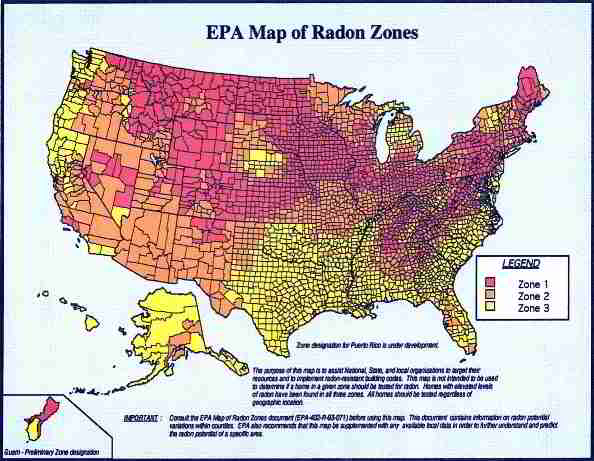
The EPA and the U.S. Geological Survey have rated every county in the United States as Zone 1 to 3 for radon risk. Links to state maps with county by- county risk levels can be found at www.epa.gov/ radon/zonemap.html.
The EPA recommends that all homes in Zone 1 counties be built with radon-resistant features, which can be easily upgraded to a radon remediation system if needed.
Since homes in Zones 2 and 3 can also have high levels, it is best to check with your state radon office to see if they are aware of any local “hot spots.”
The techniques for radon-resistant building vary for different foundation types and site conditions, but all contain the six basic elements described below.
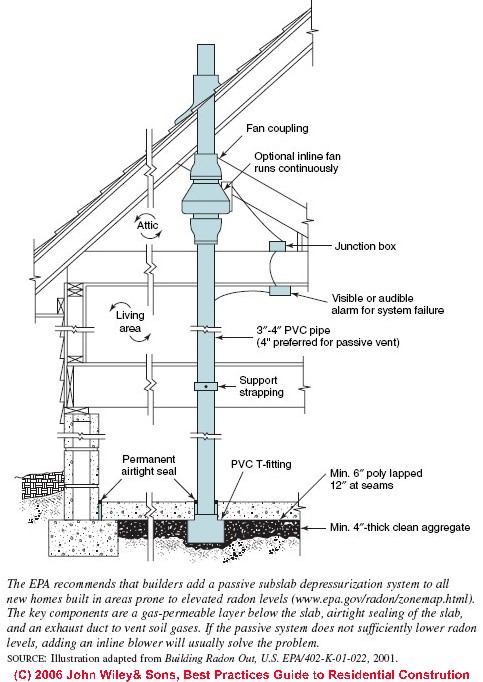
Following these steps creates a passive soil depressurization system, which sufficiently lowers radon levels in about 50% of homes requiring mitigation.
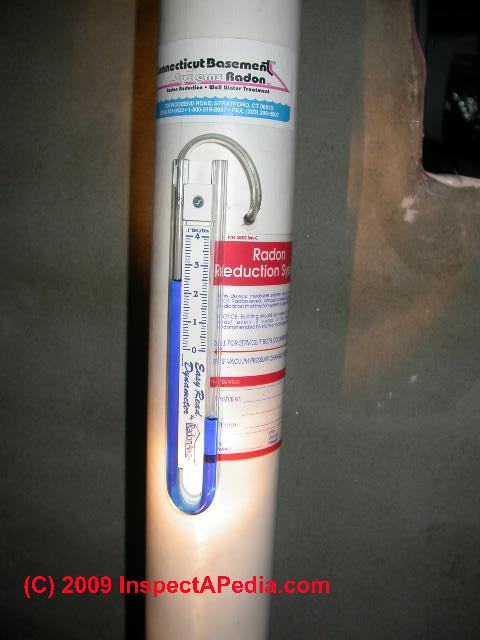
If radon levels need to be lowered further, the system can be easily converted to an active system by adding an inline fan, which can meet the target levels in nearly all cases (see Figure at above left, showing a typical radon mitigation system installation). The goal of radon remediation is to lower the average indoor radon gas level to less than 4 pCi/L, and preferably 2 pCi/L.
- - Adapted with permission from Best Practices Guide to Residential Construction (Steve Bliss, J Wiley & Sons) .
For a Thorough Background in Radon Hazards, Radon Mitigation, & the History of Radon Concerns in the U.S. also see these articles reprinted/adapted/excerpted with permission from Solar Age Magazine - editor Steven Bliss.
- "Radon's Threat Can Be Subdued", part 1 - [PDF] William Turner, Terry Brennan, Solar Age Magazine Radon and its progeny are the slipperiest pollutants in the indoor environment, but there are simple ways to keep radon and its relations at bay.
- "Radon's Threat Can Be Subdued", part 2 - [PDF] what is radon, where does radon come from, how does radon get indoors, and why is radon a problem in buildings.
- "Radon's Threat Can Be Subdued", part 3 - [PDF] standards for airborne radon levels in buildings and recommended levels of radon for action, how radon is best detected, and radon action plan.
- "Radon's Threat Can Be Subdued", part 4 -[PDF] radon prevention advice for new construction, radon in well water - how it is removed, sources of information about radon gas and radon contamination.
- "Defeating Radon" part 1 - [PDF] Terry Brennan, Bill Turner, Solar Age Magazine - How does radon get into buildings, how do I know if a building has a radon gas problem, how can I solve radon problems in existing homes, and what can I do to prevent radon from entering new homes. Part 1: where Radon comes from, how to diagnose radon
- "Defeating Radon" part 2 - [PDF] Guide to keeping radon out of new houses - design details
- "Defeating Radon" part 3 - [PDF] Key spots to seal, to stop radon gas leaks into buildings
- "Defeating Radon" part 4 - [PDF] Data on radon levels in buildings before & after radon mitigation treatment
- "Defeating Radon" part 5 - [PDF] Air filtering, testing after radon mitigation, where to buy radon tests
Original article:
The link to the original Q&A article in PDF form immediately below is preceded by an expanded/updated online version of this article.
- "Radon Basics", for Underground Homes - Q&A article, Solar Age, April 1984 - PDF version, Use your browser's back button to return to this page
Radon Gas Hazards Articles
...
Continue reading at RADON IMPACT ON HOME SALES or select a topic from the closely-related articles below, or see the complete ARTICLE INDEX.
Or see these
Recommended Articles
Suggested citation for this web page
RADON HAZARD in UNDERGROUND HOMES at InspectApedia.com - online encyclopedia of building & environmental inspection, testing, diagnosis, repair, & problem prevention advice.
Or see this
INDEX to RELATED ARTICLES: ARTICLE INDEX to BUILDING INDOOR AIR QUALITY IAQ
Or use the SEARCH BOX found below to Ask a Question or Search InspectApedia
Ask a Question or Search InspectApedia
Questions & answers or comments about the actual health hazards from radon gas and how these risks are reduced or eliminated in homes.
Try the search box just below, or if you prefer, post a question or comment in the Comments box below and we will respond promptly.
Search the InspectApedia website
Note: appearance of your Comment below may be delayed: if your comment contains an image, photograph, web link, or text that looks to the software as if it might be a web link, your posting will appear after it has been approved by a moderator. Apologies for the delay.
Only one image can be added per comment but you can post as many comments, and therefore images, as you like.
You will not receive a notification when a response to your question has been posted.
Please bookmark this page to make it easy for you to check back for our response.
Our Comment Box is provided by Countable Web Productions countable.ca
Citations & References
In addition to any citations in the article above, a full list is available on request.
- Terradex Corporation, 460 Wignet Lane, Walnut Creek CA 94598 415-938-2545
- RTCA, the Radon Testing Corporation of America, is in Elmsford, NY - 800-457-2366 sells radon testing kits and equipment and provides radon mitigation services (RMCA)
- "Radon Basics-PDF", Q&A article, Solar Age, April 1984, includes advice for radon-resistant construction for an underground house built of concrete
- Best Practices Guide to Residential Construction, by Steven Bliss. John Wiley & Sons, 2006. ISBN-10: 0471648361, ISBN-13: 978-0471648369, Hardcover: 320 pages, available from Amazon.com and also Wiley.com. See our book review of this publication.
- Decks and Porches, the JLC Guide to, Best Practices for Outdoor Spaces, Steve Bliss (Editor), The Journal of Light Construction, Williston VT, 2010 ISBN 10: 1-928580-42-4, ISBN 13: 978-1-928580-42-3, available from Amazon.com
- In addition to citations & references found in this article, see the research citations given at the end of the related articles found at our suggested
CONTINUE READING or RECOMMENDED ARTICLES.
- Carson, Dunlop & Associates Ltd., 120 Carlton Street Suite 407, Toronto ON M5A 4K2. Tel: (416) 964-9415 1-800-268-7070 Email: info@carsondunlop.com. Alan Carson is a past president of ASHI, the American Society of Home Inspectors.
Thanks to Alan Carson and Bob Dunlop, for permission for InspectAPedia to use text excerpts from The HOME REFERENCE BOOK - the Encyclopedia of Homes and to use illustrations from The ILLUSTRATED HOME .
Carson Dunlop Associates provides extensive home inspection education and report writing material. In gratitude we provide links to tsome Carson Dunlop Associates products and services.
 | HOME | ABOUT | ASK a QUESTION | CONTACT | CONTENT USE POLICY | DESCRIPTION | POLICIES | PRIVACY | |
| © 2024 - 1985 Publisher InspectApedia.com - Daniel Friedman | |||||||||