
InspectAPedia® FREE Encyclopedia of Building & Environmental Construction, Diagnosis, Maintenance & Repair |
Question? Just ask us! InspectAPedia
|
 Is Roof Venting Needed?
- POST a QUESTION or COMMENT about the need for roof cavity ventilation
Requirements & choices of methods for roof ventilation: this article discusses the options for venting versus un-vented roof.
What problems can we expect for buildings with hot roofs or un-vented roofs?
What problems occur on un-vented roofs? - are "hot roofs" really so hot?
InspectAPedia tolerates no conflicts of interest. We have no relationship with advertisers, products, or services discussed at this website.
Need for Roof Ventilation + Options for Un-Vented & Hot Roofs
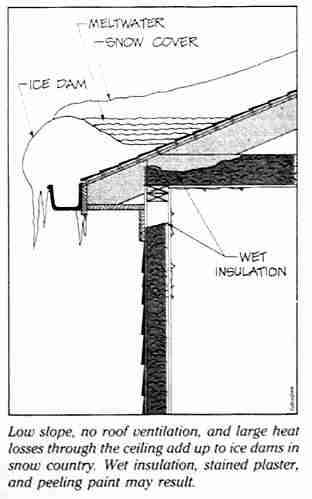
 Sketch at page top and accompanying text are reprinted/adapted/excerpted with permission from Solar Age Magazine - editor Steven Bliss.
"Is Roof Venting Necessary? The old rules may not apply to new roofs" - links to the original article in PDF form immediately below are followed by an expanded/updated online version of this article.
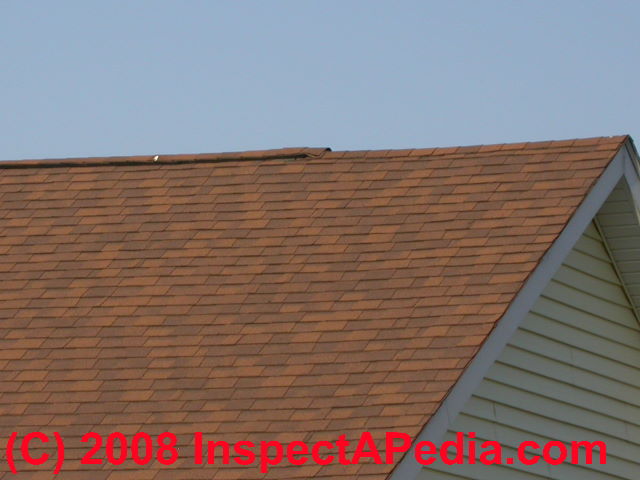
Our photo (left) shows a ridge vent on a modern asphalt shingle roof. Is this outlet vent necessary? Is it enough?
This article provides a review of roof ventilation theory, explaining the importance of preventing attic moisture (and mold), ice dam leaks, and at the same time, energy loss in buildings.
Mr. Bliss explains how moisture and the resulting condensation gets into roof cavities and building walls following moisture laden air that leaks through gaps in building drywall, around exposed beams, intersecting walls and ceilings, at light fixtures, electrical outlets, and other openings by riding air convection currents that move air in and out of building cavities as building interior conditions change.
Arguments for and about Un-Vented Roofs
Mr. Bliss points out that often the air/vapor barrier installation is imperfect or has been compromised, permitting leaks into building cavities.
He also points out that improperly installed ventilation (such as installing a ridge vent at the top of a roof without installing air intake openings at the soffits or eaves) can make building air movement, moisture, and condensation problems worse.
 Bliss cites researchers at Lawrence Berkeley Labs who found that in a mild climate (3000 degree days), most attic moisture comes from the ventilation air itself, not from air inside the house.
In general attics are wetter in winter than summer (due to cooler temperatures causing condensation in that space), but in both daily and seasonal cycles, the water entering from outside vent air is stored (and later released) safely from the attic lumber and sheathing.
The "no-vent" or "hot roof" design is discussed, and the author points out that construction, including the vapor barrier, must be just about perfect for this approach to work.
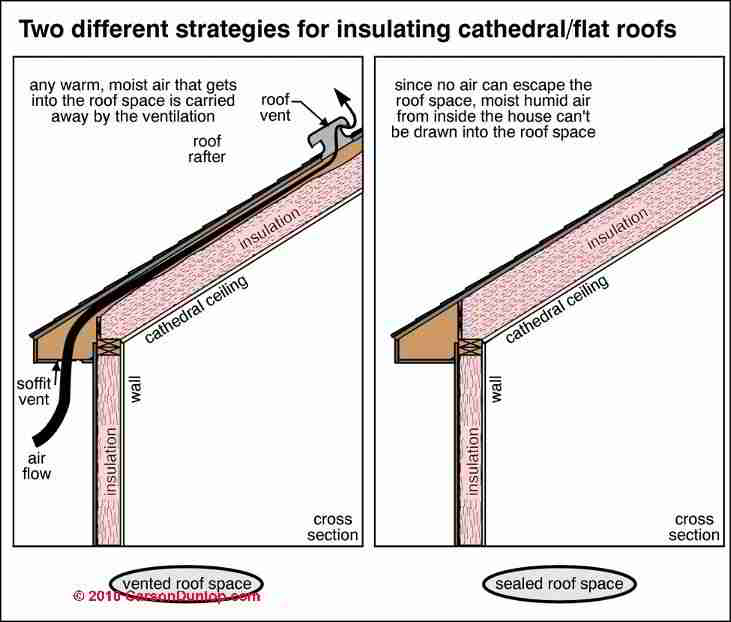
Sketch (above left) is courtesy of Carson Dunlop Associates shows the two basic strategies for insulating cathedral ceilings and flat roofs.
While the article omits later field experience of experts like Henri DeMarne, we caution readers that the hot roof design is extra vulnerable to severe rot and mold damage from hidden, un-discovered leaks that cause more rapid, more extreme damage in enclosed un-vented building cavities than in well-ventilated ones such as a vented roof space.
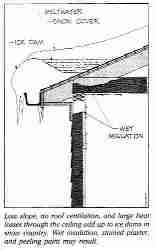
Ice dams (see the sketch at page top), form when snow sits on a roof for three or four sub-freezing days. Light dry snow makes good insulation on top of the roof, permitting warmth from or inside the attic space below to warm and melt the underside of the snow. This water runs down the roof surface until it meets the cold roof edge or eaves where it freezes to form a dam of ice along the roof edge.
When sufficient water backs up above the ice dam, over the warmer sections of the lower roof edges, water leaks up under the shingles, into the attic, or into the building wall cavities.
Mr. Bliss points out that super-insulated modern homes may be at less risk of ice dams than older homes with poorly-insulated attics or roof cavities. In theory, enough insulation can prevent ice dam formation on roofs, except probably on low-slope roofs that hold so much snow as to compete with the R-values provided by the roof insulation.
The article also cites a few complaints of rain or snow blowing in at ridge vents, though in nearly 40 years of building inspections we have almost never found building damage nor mold from this cause.
Conditions Under Which Un-Vented Roofs Might Work
Based on research in Sweden, an un-vented roof can work if:
- the vapor barrier is perfect
- the roof covering material is clay tiles or concrete tiles, or other materials that are not absolutely air tight
- the climate is comparable to southern Sweden (6000 to 8000 degree days)
- great care is taken that the lumber does not get soaked before or during construction
- [added by DJF] over the life of the building, no roof leak or roof damage from any other source ever occurs
Roof Vent Debate Conclusions
- Mr. Bliss concluded (back in 1985, and we agree today) that a non-vented roof is a bit risky, but with a good [read "perfect"] vapor barrier [and, if no roof leaks ever occur over the life of the building] you can probably get away with it.
- Shallow low-slope roofs such as over shed-dormers should be vented if at all possible.
- Where roof ventilation is not possible, as in some retrofits or in complex roof designs, pay close attention to sealing air leaks into the roof cavity through the ceiling.
- Consider using waterproof membranes such as ice and water shield over hard to vent roof sections where ice dams are likely or where they have occurred in the past. [added-DJF]
- In unvented roofs we would prefer (DJF and Mr. Bliss) if the roofing were air- and moisture-permeable. Wood shingles and shakes (and slate roofs installed on spaced nailers) meet these tests.
- In un-vented "hot roof" designs, you should expect shorter roof covering life unless the materials are clay tiles, concrete tiles, metal, slate, or something else that is not very affected by the hotter roof temperatures that will be encountered during summer weather [added DJF)
Readers should not fail to review the more extensive information about the need for and methods of roof ventilation found at ROOF VENTILATION SPECIFICATIONS. Also see ICE DAM PREVENTION and Ice Dams: Comparing Two Houses.
Here we include solar energy, solar heating, solar hot water, and related building energy efficiency improvement articles reprinted/adapted/excerpted with permission from Solar Age Magazine - editor Steven Bliss.
Original article
- Is Roof Venting Needed? - PDF form, see your browser's back button to return to this page
- Is Roof Venting Needed? - PDF form, part 2
Reader Comments, Questions & Answers About The Article Above
Below you will find questions and answers previously posted on this page at its page bottom reader comment box.
Reader Q&A - also see RECOMMENDED ARTICLES & FAQs
On 2023-07-02 by Louise
@InspectApedia Publisher,
Aah! So much to learn!
On 2023-07-02 by InspectApedia Publisher - On a low slow or nearly flat roof with no air intake, turbine vents aren't going to do anything
@Louise,
On a low slow or nearly flat roof with no air intake, turbine vents aren't going to be doing a thing for you.
On 2023-07-01 by Louise
@InspectApedia Publisher,
I was wondering about those roof turbines... But I worry about putting holes into the thick, old deck and creating opportunities for leaks. My goal after all is to keep the original deck, such as it is. Eventually, I'll remove the current bituminous membrane with its dubious "insulation" and replace it with one of those peel and stick waterproofing membranes.
I have used those snap-in wires in my Sears-Roebuck kit house in MA, but the floor joists were an exact 16 inches on centre. These roof rafters are 39 inches on centre! I was wondering about chicken wire tacked up there to hold everything up, but what a hassle!
I am putting the foam in myself. Foam companies will not come to my house because I would be using under 6,000 board feet of foam... This being said, those rafters are 10 inches deep! I agree with you that filling those bays entirely with foam would be ideal, but the cost would be prohibitive. The hybrid design (foam + mineral wool) is much more affordable, and I get the same R value without loosing the advantages of the foam (sealing, waterproofing, structural integrity).
So if I understand you well: a warm roof assembly (closed cell foam + rock wool + membrane), then a 10' dropped drywall ceiling, with a thick blanket of unfaced pink rolls on top. And the space between that ceiling and the warm roof remains empty and unvented.
Sounds like a plan!
Again thank you for all your insights!
On 2023-07-01 by InspectApedia Publisher - need to install entirely new roof decking that included vented panels
@Louise,
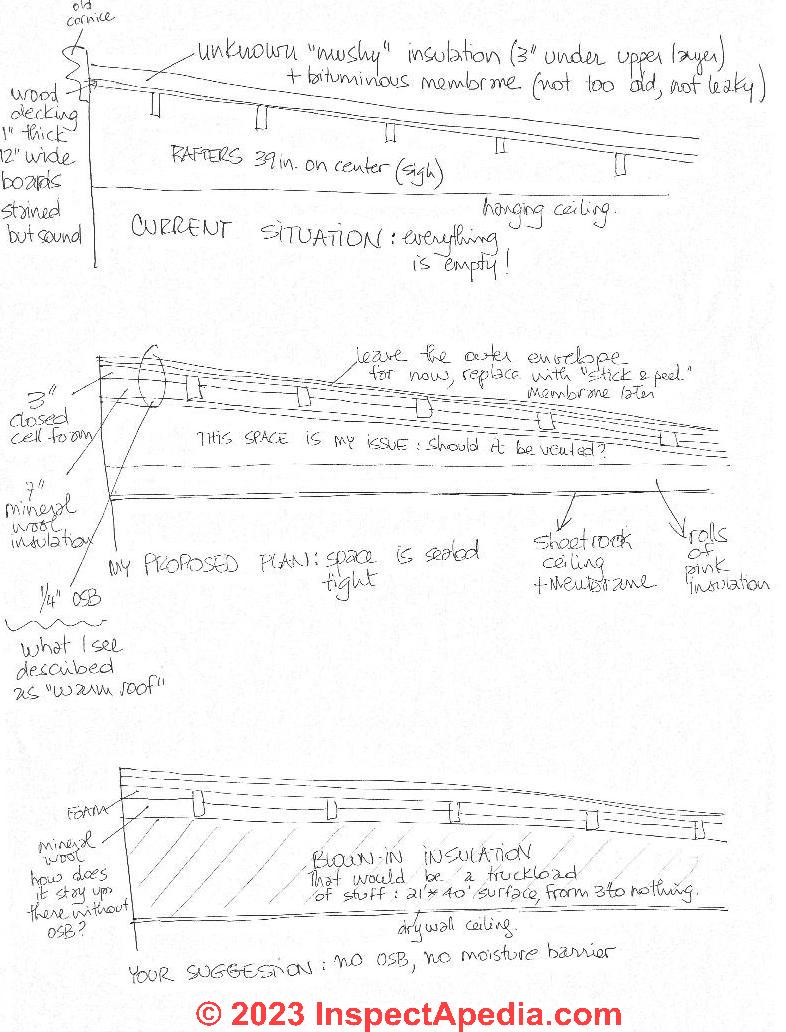
Thanks, that's a helpful sketch.
That sort of roof is virtually impossible to vent unless you installed entirely new roof decking that included vented panels. The cross-beams prevent flow-through in any under-roof venting schema.
So a hot roof design seems right.
The mineral wool batts can be supported by snap-in straight lengths of spring wire that are simply pushed in place every couple of feet. Wire ends extend to near the bottom of the facing sides of wooden rafters or beams between which the batts are inserted. That's a very common way of supporting un-faced insulating batts of fiberglass or mineral wool.
IT does seem a bit odd to be using so many different insulating materials.
I'd get some calculations from the foam insulation installer - it might be reasonable to simply foam out the underside of the roof to the depth of the cross-beams, build your false ceiling, insulate above it with blown-in fiberglass or cellulose. Depending on the total R-value or its average across the roof, you might not need to completely fill the high-end.
On 2023-07-01 y Louise
@InspectApedia Publisher,
My document was a .pdf
Here is the .jpg version
Thanks!
On 2023-06-24 by InspectApedia Publisher
@Louise,
Apologize for what I'm sure is frustrating and trying to post an image. Basically you can post almost any image form such as a.jpg.img.png.img.bmp file simply by selecting the ad image button in your browser or on your smartphone and then navigating to the location of the image file on your computer or phone and selecting it.
It's possible if your image isn't appearing that you're trying to post multiple images at once or you are trying to post a file that's not a conventional image. For example you can't post a PDF.
On 2023-06-24 by Louise
@InspectApedia DF,
Diagram, again. Not sure what is going on?
On 2023-06-24 by InspectApedia DF (mod)
@Louise,
Please try again to attach your diagram by using the Add Image button.
On 2023-06-24 by Louise
@InspectApedia Publisher,
Thank you for your prompt response! I attached a diagram (such as it is) to this message to illustrate my construct.
In general, you did understand well what I am dealing with. I hope the picture dismisses any doubts.
My questions at this point:
1) No membrane, no watertight space? I understand the issue of accumulating moisture causing rot, but I also read so much about vapour dispersion through minute openings...
2) So much blown in insulation! If I keep my ceiling at 10' as it is now, that's many, many cubic feet of blown-in insulation. And then the cavity becomes inaccessible, unless that stuff is carted away...
3) Can I just go "cathedral" then? Outer membrane (as it stands now, to be improved later), wooden deck, closed cell foam, mineral wool, OSB, drywall. A simple warm roof and I frame up to where that is? 13' in the front, 10' in the back.
It is my understanding that firemen in Baltimore always enter through the roof, and no amount of layers deter them from busting through. It is also my understanding that the main concern for inspectors is that the envelope of the house is airtight to prevent draughts from "pulling" flames upwards. Apart from insulating, the E-84 fire-rated closed cell foam I am using serves that purpose.
Also, I was thinking about 1/4" OSB, just to hold everything up. Not putting any in makes my life that much easier!!
Again, thank you for looking at all this! I really appreciate the wise insights!
On 2023-06-22 by InspectApedia Publisher - do I need to vent my plan to create a hybrid warm roof from the top down
@Louise,
Thanks for an interesting and challenging question. All of my reply is OPINION. (Glad to see you consulting Lstiburek.)
If I understand the design correctly, you're insulating below the low-slope roof with foam then fiberglass and you want to end with a level ceiling inside.
I would be nervous about adding a second impermeable layer (closed cell foam) below that fiberglass, creating a "sandwich" which, over the life of the building, risks moisture intrusion, trapping, rot, mold.
According to the Maryland Energy Administration, the code (and so recommended) R-value for ceilings in Maryland is R-49. Your schema is close to target.
Why not fill your wedge space with fiberglass, blown-in? Then apply drywall to the ceiling. Avoid penetrations to minimize the worry of air leaks up into the space.
If you're doing that, you'd probably not want that layer of OSB as below the roof structure you're going to build a level ceiling (wedge), insulate that, and then add a moisture barrier (usually omitted) and then drywall.
(We don't want a roof that is built with multiple layers of structural ceiling - a fire-fighting hazard and probably a code violation where you live).
Let me know if I've misunderstood your design. Perhaps you could attach a sketch.
For other readers: these recommendations may be useful
YOUR HOME & THE ENERGY CODE - WHAT YOU NEED TO KNOW FOR YOUR HOME BUILDING OR RENOVATION PROJECT [PDF] - Maryland Energy Administration, original source: https://energy.maryland.gov/Documents/YourHomeandtheEnergyCode.pdf
On 2023-06-22 by Louise
I am renovating an old row house (1920) in Baltimore. It has the customary flat roof with the required pitch. The deck is sound, it is covered with a bituminous membrane with some sort of cushy substance (not thicker that 2 inches) that I do not with to disturb for now. Apart from that, zero insulation...
The plan is to create a hybrid warm roof from the top down: fill the top of the bays with 2.5 inches closed cell foam (~R15) and some R30 fiberglass batts (total R45, with the 30% impermeable to permeable ratio cited by Joseph W. Lstiburek in his October 2017 Building Science Corporation "Insight" article). I would then seal the underside of the rafters with a membrane and some OSB panels.
My problem is that the ceiling of the room under that roof is below that construction. Unless I keep the full height of the walls (which is a possibility, but not my first choice), I get a space in the shape of a wedge that starts at 3 feet at the front of the house, and tapers to nothing at the back.
My plan was to cover the 10' hanging ceilings with drywall and spread another layer of fiberglass insulation on top of that, but I wonder about that resulting space. Do I need to vent it? Or can I just seal the residual wallspace with more foam and leave it airtight?
Thank you for your insights!
 On 2019-07-26 by (mod) -
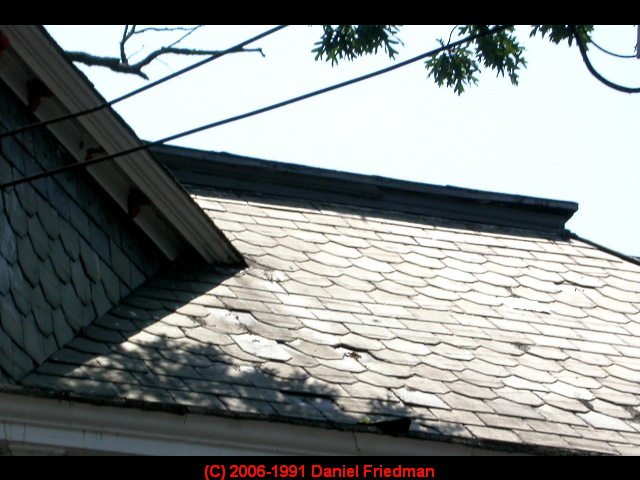
venting a slate roof?
On 2019-07-26 by (mod) -
venting a slate roof?
RE-posting from private email:
SK wrote
Not sure if I got the correct email address but I have a serious issue I need some guidance :
My 3rd floor (attic) is a walk up and finished with r19 insulation and baffles behind it. No eaves for soffit vents and there's cathedral ceiling so no ridge vents.
The roof is Vermont slate... I have knee walls all around the perimeter of the 3rd floor with ac handlers and ductwork inside. The knee walls aren't "finished" but they're technically "part of the house".
The temperature in there is always slightly off from the main finished and conditioned space... BUT.. Inside the knee walls get extremely humid in hot days.. There's no form of ventilation inside..
We were told to add Ventilation into the knee walls and that the humidity issue should be resolved.
However, I don't know how that would work as far as a slate roof standpoint. Is that kind of suggested environment okay behind the slate roof (ventilation behind r19 behind baffles that really vent nowhere)? Is the r 19 venting it thru the slate?
Do you think there's moisture accumulating behind the slates and that's in turn causing the humidity in the knee walls? Is my current setup (humidity aside) acceptable for the roof?
How do what kind of intake and exhaust can I retrofit into a slate roof with no eaves and no ridge vents? I've also heard that slate roofs don't need venting.
I don't know what to think and any roofer i bring to my house doesn't really address slate. I keep searching for answers online and I keep getting routed back to your website!
I'm really hoping while I wait for a slate expert to call me back that maybe you can shed some light on this for me. I'm terrified of mold growth around my 4 young kids and the moisture loving insects that have been harboring in my knee walls.
If anything needs clarification, please feel free to ask!
Moderator reply: slate roof ventilation is sometimes needed but there are other solutions
In original (older) slate roof construction on battens there was sufficient air movement out through the roof that some condensation issues were probably never a concern.
But as buildings are updated with additional insulation and ceiling coverings, such as when an attic under a slate roof is converted to occupied space, there can be problems of moisture condensation in the roof cavity, wetting the roof, wetting insulation, with concomitant problems I will list below.
First, in general attic or under-roof ventilation is a general recommendation except for "hot roof" designs. Hot roofs are un-vented and insulated usually between rafters. Those details are
Excepting hot roofs, we vent the roof space or attic space for several reasons including:
- cooler attic in hot weather, reducing building cooling costs
- longer roofing material life
- avoiding trapped moisture or condensation that can damage roofing and wood structures and that can lead to costly mold contamination
See details at ROOF VENTILATION SPECIFICATIONS - home
Usually slate roofs are not air tight; there can be air movement out of the roof cavity or attic through the slates when slates are installed onto batten.
Whether or not that ventilation makes a difference to the building and to the problems of which I gave examples above depends on other building conditions.
For example if warm moist air is leaking into an attic there can be an attic condensation problem or even frost and ice formation in cold / freezing weather.
Two approaches to either avoiding that problem or solving it include closing off air leaks into the roof space or attic from below, and adding under-roof ventilation, best as continuous intake venting at the soffit or eaves and continuout outlet venting along the ridge. Those vents can be installed on most types of roofs including slate.
Some companies such as Cupizarras in Spain sell slate roof vents that are an add-on slate roof venting system. In my OPINION these or ANY roof venting system that does not vent all of the under-roof space between all rafter pairs is inadequate; too often I've inspected homes with intermittent roof vent systems in which I found moldy, wet, or water-damaged building materials in the roof sections that were not vented.
Send me some photos of your slate roof (or poste them at the end of this page) and photos of the attic area and we can comment further.
See our complete library of slate roofing articles beginning
at SLATE ROOF INSPECTION & REPAIR - home
Question: no roof venting in Bozeman Montana
(Oct 7, 2012) Paul said:
A contractor built a Lodge in the mountains of Bozeman Montana without roof venting. THe roof has no attic and it has ice shield and it has metal roofing. It saved the us (owners) about $3500. THere has been no problems that I can see to this point.
Sorry I forgot too that the cavity is about 11 1/2 inches and there were 4 inches of sprayed foam and the rest of the cavity was filled with batt insulation. IF there are problems that could occur with this I sure would like to know.
Reply:
Thanks for the report Paul. I agree that in some installations a hot roof design can work well, and I too would prefer a very reliable roof covering, such as metal roofing, in such an installation. We recently built a roof of similar specs.
Though under a metal roof I'm not sure what the ice and water shield is adding for you.
With enough insulation to not reachnthe dew point in the roof cvity, and with no ceiling leaksmor penetrations the riskmof under-roof condensation is minimized.
I'd inspect the roof surface annually just to be sure it's undamaged, as leaks into an inaccessible cavity can lead to undiscoverd damage that festers until severe.
(Oct 8, 2012) Anonymous said:
Thanks for the information Dan. I haven't seen any problem in the 3 years since completion. If I saw a possible problem could just installing ridge vents prevent anything?
We keep the lodge heated during the winter to a minimum of 50 degrees and then during the spring, summber and fall the heat is off.
Question: how to add insulation without proper air or vapor barriers
Recently acquired a building with a warm pitched roof (50mm rigid board insulation over the rafters) and converting the building to a house. Wondering how to safely add insulation without using a Vapor Control Layer (VCL) ?
Roof layers from outside; slates, batons, tyvek felt, counter batons, insulation, plyboard, all above the 6" x 2" rafters which are totally opened. There are knee walls. Too difficult to apply a VCL correctly. Block boards at eves presently prevent air flow under the roof.
Shoulder straps allow for an attic height of 3ft. I presume the options are to add insulation and keep it as a warm roof or to create a vented roof.
Not sure how to proceed with added insulation to achieve a U value of .2 (refurb. regulation). Hoping you can assist. Thanking you, Tim.
Reply:
Tim
I'm not sure how to proceed either as we don't know enough about your building, how it's designed, its moisture sources, or what the risks are for you.
Certainly there are several options but cost-benefit analysis is missing when we don't know the building. For example you could remove roof covering (shingles or whatever are installed) and add insulated panels (a sandwich of plywood and foam referred to as SIPs or structural insulated panels). Such panels are also sold with built-in eaves-to ridge venting though the space may be so small that the airflow is questionable.
...
Continue reading at ROOF VENTILATION SPECIFICATIONS for more extensive information about the need for and methods of roof ventilation, or select a topic from the closely-related articles below, or see the complete ARTICLE INDEX.
Or see these
Recommended Articles
- ROOF ICE DAM LEAKS
- ICE DAMS: COMPARING TWO HOUSES
- ROOF VENTILATION ENERGY SAVING DETAILS
- ROOF VENTILATION SPECIFICATIONS
- ROOF VENTILATION NEEDED?
- SOFFIT VENTILATION
Suggested citation for this web page
ROOF VENTILATION NEEDED? at InspectApedia.com - online encyclopedia of building & environmental inspection, testing, diagnosis, repair, & problem prevention advice.
Or see this
INDEX to RELATED ARTICLES: ARTICLE INDEX to BUILDING VENTILATION
Or use the SEARCH BOX found below to Ask a Question or Search InspectApedia
Ask a Question or Search InspectApedia
Try the search box just below, or if you prefer, post a question or comment in the Comments box below and we will respond promptly.
Search the InspectApedia website
Note: appearance of your Comment below may be delayed: if your comment contains an image, photograph, web link, or text that looks to the software as if it might be a web link, your posting will appear after it has been approved by a moderator. Apologies for the delay.
Only one image can be added per comment but you can post as many comments, and therefore images, as you like.
You will not receive a notification when a response to your question has been posted.
Please bookmark this page to make it easy for you to check back for our response.
Our Comment Box is provided by Countable Web Productions countable.ca
Citations & References
In addition to any citations in the article above, a full list is available on request.
- Solar Age Magazine was the official publication of the American Solar Energy Society. The contemporary solar energy magazine associated with the Society is Solar Today. "Established in 1954, the nonprofit American Solar Energy Society (ASES) is the nation's leading association of solar professionals & advocates. Our mission is to inspire an era of energy innovation and speed the transition to a sustainable energy economy. We advance education, research and policy. Leading for more than 50 years. ASES leads national efforts to increase the use of solar energy, energy efficiency and other sustainable technologies in the U.S. We publish the award-winning SOLAR TODAY magazine, organize and present the ASES National Solar Conference and lead the ASES National Solar Tour – the largest grassroots solar event in the world."
- Steve Bliss's Building Advisor at buildingadvisor.com helps homeowners & contractors plan & complete successful building & remodeling projects: buying land, site work, building design, cost estimating, materials & components, & project management through complete construction. Email: info@buildingadvisor.com
Steven Bliss served as editorial director and co-publisher of The Journal of Light Construction for 16 years and previously as building technology editor for Progressive Builder and Solar Age magazines. He worked in the building trades as a carpenter and design/build contractor for more than ten years and holds a masters degree from the Harvard Graduate School of Education. Excerpts from his recent book, Best Practices Guide to Residential Construction, Wiley (November 18, 2005) ISBN-10: 0471648361, ISBN-13: 978-0471648369, appear throughout this website, with permission and courtesy of Wiley & Sons. Best Practices Guide is available from the publisher, J. Wiley & Sons, and also at Amazon.com - In addition to citations & references found in this article, see the research citations given at the end of the related articles found at our suggested
CONTINUE READING or RECOMMENDED ARTICLES.
- Carson, Dunlop & Associates Ltd., 120 Carlton Street Suite 407, Toronto ON M5A 4K2. Tel: (416) 964-9415 1-800-268-7070 Email: info@carsondunlop.com. Alan Carson is a past president of ASHI, the American Society of Home Inspectors.
Thanks to Alan Carson and Bob Dunlop, for permission for InspectAPedia to use text excerpts from The HOME REFERENCE BOOK - the Encyclopedia of Homes and to use illustrations from The ILLUSTRATED HOME .
Carson Dunlop Associates provides extensive home inspection education and report writing material. In gratitude we provide links to tsome Carson Dunlop Associates products and services.
 | HOME | ABOUT | ASK a QUESTION | CONTACT | CONTENT USE POLICY | DESCRIPTION | POLICIES | PRIVACY | |
| © 2024 - 1985 Publisher InspectApedia.com - Daniel Friedman | |||||||||