InspectAPedia.com InspectAPedia®
Google
InspectAPedia
 

Free Encyclopedia of Building & Environmental Inspection, Testing, Diagnosis, Repair

Ask a Question or Search InspectAPedia

  • HOME
  • AIR CONDITIONING
  • DAMAGE ASSESSMENT
  • ELECTRICAL
  • EXTERIORS
  • HEATING
  • HOME INSPECTION
  • INTERIORS
  • PLUMBING
  • ROOFING
  • SEPTIC SYSTEMS
  • STRUCTURE
  • WATER SUPPLY
  • ENERGY SAVINGS
  • ENVIRONMENT
  • INDOOR AIR IAQ
  • INSULATION
  • MOLD INSPECT TEST REMOVE
  • NOISE
  • ODORS
  • SOLAR ENERGY
  • VENTILATION
  • EXPERTS DIRECTORY
  • CONTACT US


InspectAPedia ® Home

EXTERIORS of buildings

ADHESIVES, EXTERIOR CONSTRUCTION
AGE of a BUILDING - how to determine
ALGAE, FUNGUS, LICHENS, MOSS
ANIMAL ENTRY POINTS in buildings
ANIMAL ODORS IN buildings
ARCHITECTURE & BUILDING COMPONENT ID
ASBESTOS IDENTIFICATION IN buildings
ATTIC CONDENSATION CAUSE & CURE

BASEMENT WATERPROOFING
BEST CONSTRUCTION PRACTICES GUIDE
BOOKSTORE - EXTERIORS
BUILDING SETTLEMENT

CARPENTER ANTS
CARPENTER BEES
CAULK GUN TYPES, CHOICES
CAULKS & SEALANTS, EXTERIOR
CONNECTORS, FASTENERS, TIES
CRAWL SPACES

DECK & PORCH CONSTRUCTION

EIFS & STUCCO EXTERIORS
EXTERIOR WALL SIDING TRIM & FINISHES
EXTRACTIVE BLEEDING STAINS

FLASHING MEMBRANES PEEL & STICK
FLASHING SIDING DETAILS
FLASHING WALL DETAILS
FLASHING WINDOW DETAILS

GALVANIC SCALE & METAL CORROSION
GLUES ADHESIVES, EXTERIOR CONSTRUCTION
GUTTERS & DOWNSPOUTS

HOUSE PARTS, DEFINITIONS
HOUSEWRAP / SHEATHING WRAP
HOUSEWRAP INSTALLATION DETAILS
HOUSEWRAP PRODUCT CHOICES
HOUSEWRAP at SILLS, SOLES, TOP PLATES
HUMIDITY LEVEL TARGET

INDOOR AIR QUALITY & HOUSE TIGHTNESS
INSECT INFESTATION / DAMAGE

KIT HOMES, Aladdin, Sears, Wards, Others

LEAD POISONING HAZARDS GUIDE
LEED GREEN BUILDING CERTIFICATION
LOG HOME GUIDE

METAL LATH, PLASTER & STUCCO
MOISTURE CONTROL in BUILDINGS

ODORS & SMELLS DIAGNOSIS & CURE

PAINT & STAIN GUIDE, EXTERIOR
PAINT FALURE, DIAGNOSIS, CURE, PREVENTION
PAINT FAILURE DICTIONARY
PAINT SURFACE PREPARATION
PAINTING MISTAKES
PORCHES & Sunrooms
PORCH CONSTRUCTION & SCREENING

ROT RESISTANT LUMBER
ROT, TIMBER FRAME
ROT, TIMBER ASSESSMENT

SEARS KIT HOUSES
SMELL PATCH TEST to Track Down Odors
SOUND CONTROL in buildings
STAINS on & in BUILDINGS, CAUSES & CURES
STAIN DIAGNOSIS on BUILDING EXTERIORS
STAIN DIAGNOSIS on BUILDING INTERIORS
STAIRS, RAILINGS, LANDINGS, RAMPS
STONE CLEANING METHODS
STUCCO WAll FAILURES DUE TO WEATHER
STUCCO WALL METHODS & INSTALLATION

TERMITES
TEST KITS for DUST, MOLD, PARTICLE TESTS
Thermal Expansion Cracking of Brick
THERMAL EXPANSION of MATERIALS
THERMAL IMAGING, THERMOGRAPHY
THERMAL MASS in BUILDINGS
TREES & SHRUBS, TRIM OFF BUILDING
TRIM, EXTERIOR CHOICES, INSTALLATION

VAPOR BARRIERS & CONDENSATION in buildings
VAPOR BARRIERS, VINYL SIDING
VENTILATION in BUILDINGS
VINYL CHLORIDE HEALTH INFO
VINYL Siding or PLASTIC Window ODORS
Volatile Organic Compounds VOCs

WALL CONSTRUCTION BARRIER vs CAVITY
WATER BARRIERS, EXTERIOR BUILDING
WATER ENTRY in buildings
WIND ENERGY SYSTEMS
WIND TURBINES & LIGHTNING
WINDOWS & DOORS
WINTERIZE A BUILDING

More Information

Greenhouse or sunspace glare photo (C) Daniel FriedmanGreenhouse / Sunspace Glare Complaints & Solutions
     

  • Definition of direct and indirect glare caused by sunlight
    • Usual sources of complaints of solar glare: long term exposure
    • How to reduce or control solar glare in greenhouses and sunspaces
    • Seasonal vs. year-round control of solar light glare in buildings
    • Rearranging room contents to eliminate solar or sunlight glare
    • Use of supplemental lighting to reduce indoor glare effects
    • Use of solar shades or blinds to control or reduce sunlight glare indoors
  • GLASS vs HEAT MIRROR SOLAR GAIN/Loss - separate article
  • GREENHOUSE DESIGN for SOLAR HEATING - separate article
  • GREENHOUSE or SOLARIUM INSULATION - separate article
  • GREENHOUSE / SUNSPACE GLARE
  • SOLAR GAIN CALCULATION - separate article
  • SUNSPACE GLAZING for SUNTANNING - separate article
  • Questions & Answers about controlling glare problems at and in buildings
  • Solar Age Magazine Articles on Renewable Energy, Energy Savings, Construction Practices
  • References

Click to Show or Hide Related Topics

  • WINDOWS & DOORS - home
  • ARCHITECTURE & BUILDING COMPONENT ID
  • BEST PRACTICES, WINDOWS & DOORS
  • CAULKS & SEALANTS, EXTERIOR
  • CONDENSATION on WINDOWS, SKYLIGHTS
  • DOORS, ENERGY EFFICIENCY
  • DOORS, EXTERIOR, Selecting & Installing
  • DOORS, EXTERIOR FRAMES
  • DOORS, INTERIOR
  • DOOR FLASHING DETAILS
  • DOOR SOURCES
  • FLASHING WINDOW DETAILS
  • GLASS vs HEAT MIRROR SOLAR GAIN-LOSS
  • HURRICANE, WIND, & STORM-RESISTANT WINDOWS
  • LOW-E WINDOW GLAZING
  • LOW-E VS QUAD-GLAZING
  • LOW-E RETROFIT ADD-ON FILMS
  • PAINT FALURE, DIAGNOSIS, CURE, PREVENTION
  • POLYCARBONATE GLAZING
  • SITE-BUILT DOUBLE GLAZED WINDOWS
  • SKYLIGHTS, GUIDE
  • SLIDING GLIDING WINDOW DEFECTS
  • SLOPED GLAZING DETAILS
  • STORM WINDOW INTERIOR
  • STORM WINDOW PLASTIC CHOICES
  • STORM WINDOW WEEP HOLES
  • SUNGAIN, FILMS, LOW-E GLASS
  • SUNSPACE GLAZING for SUNTANNING
  • SWEATING PIPES, TANKS
  • VERTICAL GLAZING DETAILS
  • VINYL WINDOWS
  • VINYL / PVC WINDOW WARPING
  • WALL / WINDOW LEAK DIAGNOSIS
  • WINDOWS, ALUMINUM
  • WINDOW CERTIFICATION
  • WINDOW EFFICIENCY Features & Ratings
  • WINDOW SHADING, SCREENING
  • WINDOWS, FIBEGLASS
  • WINDOW FLASHING & SEALING Guide
  • WINDOW GLAZING BASED ON CLIMATE
  • WINDOW HARDWARE PHOTOS
  • WINDOW INSTALLATION, Flange-Type
  • WINDOW INSTALLATION, Integral Brickmold
  • WINDOW / DOOR ENERGY EFFICIENT, DOE
  • WINDOW / DOOR AIR LEAK SEALING HOW TO
  • WINDOW LEAKS INTO BASEMENT
  • WINDOW MATERIALS & CONSTRUCTION
  • WINDOW SHADING, SCREENING
  • WINDOW SOURCES
  • WINDOW TYPES, Guide
  • WINDOW TYPES - Photo Guide
InspectAPedia tolerates no conflicts of interest. We have no relationship with advertisers, products, or services discussed at this website.

This article discusses how to control direct and indirect glare caused by sunlight in green houses and sunspaces.

Green links show where you are. © Copyright 2013 InspectAPedia.com, All Rights Reserved. Author Daniel Friedman.

Advice for Insulating a Greenhouse or Solarium Against Night Time Heat Loss

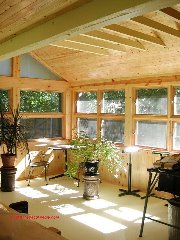
The accompanying text is reprinted/adapted/excerpted with permission from Solar Age Magazine - editor Steven Bliss. Our page top photos shows a sunspace constructed by the website editor (DF) and an example of indirect solar glare (to the right of the plant in our photograph).

Readers should see GREENHOUSE DESIGN for SOLAR HEATING, also see INSULATION for GREENHOUSE or SOLARIUM. Details about solar shades that may be useful in controlling solar glare are found at SOLAR SHADES & SUNSCREENS and SOLAR SHADES, LOW-E EFFECTIVENESS. Contact us to suggest text changes and additions and, if you wish, to receive online listing and credit for that contribution.

  • Q&A: Beating Sunspace Glare for Greenhouses or Solariums - PDF version; use your browser's back button to return to this page. Original article, Solar Age Magazine, October 1985, adapted and updated for InspectAPedia.com December 2010.

The question-and-answer article below paraphrases, quotes-from, updates, and comments an original article from Solar Age Magazine and written by Steven Bliss.

Beating Sunspace or Greenhouse Glare in buildings

Question: what strategies are most promising for controlling indoor glare from sunlight or other sources?

A building we own and occupy has a three-story atrium/sunspace with over 30 2x5-foot windows. Our computer room faces the atrium and users complain about the glare.

We are considering installing shades or films to control the glare from sunlight. What solar glare strategies are most promising? - Lou Nemesec, Illinois Industrial Commission, Chicago IL

Answer: Solutions to Sunlight and Indoor Light Glare
Greenhouse floor slab insulation retrofit (C) Daniel Friedman Steven BlissGlare can interfere with vision and cause discomfort, eye fatigue, and over time, eye damage, even contributing to cataract formation where UV wavelength light is also present.

Types of Light Glare: Indirect & Direct

There are two kinds of glare: direct glare and indirect glare.

Direct glare is caused by light coming directly into the eye from the light source.

Indirect glare is caused by reflected light (see our photo at page top).

Strategies for Controlling Glare in buildings

As we elaborate below, you can control glare and reduce glaring light complaints in buildings by one or more of the following six methods:

  • Reducing the brightness or size of the light source
  • Changing the position of the light source
  • Making the area around the light source brighter
  • Rearranging furniture and seating positions to change the relationship between the light source, work surface, and worker
  • Reducing the contrast between incoming light and surrounding surfaces
  • Adapting glaring light control to seasonal changes in sunlight

You can control glare by reducing the brightness or size of the light source, changing the position of the light source, or making the area around the light source brighter.

We assume that the complaints about glare come from long exposure, since short term exposure to glare can usually be tolerated. We also assume that you can't rearrange the building or room to change the relationship between the light source, work surface, and the workers themselves in order to change the angles of light and light reflection to simply eliminate the problem.

The size of the light source in your building too is fixed, unless you block out some of the entering sunlight with an opaque material.

So what measures are left to reduce indoor glaring light problems?

You could reduce the contrast between the incoming light and the surrounding surfaces by increasing the lighting level on the interior surfaces with electric lighting.

But it seems that your best bet is limiting the brightness of the light source.

Polyester solar screen used at a New York City construction site (C) Daniel Friedman

If you need year-round help, use window films. Window films can cut out anywhere from 45 to 86 percent of the incoming light. If view is not important, permanent louvers may do.

If you want seasonal control over glaring light, use movable or removable shades or blinds. Interior choices for glaring light source control include vertical or horizontal blinds(discussed in more detail at SOLAR SHADES & SUNSCREENS).

External choices for glaring light control include woven fiberglass shades or aluminum mini-louvers.

Details about solar shades are found at SOLAR SHADES & SUNSCREENS and SOLAR SHADES, LOW-E EFFECTIVENESS.

This article is reprinted/adapted/excerpted with permission from Solar Age Magazine - editor Steven Bliss.


Frequently Asked Questions (FAQs)

...

Ask a Question or Search InspectApedia

Questions & answers or comments about controlling glare problems at and in buildings .

Ask a Question or Enter Search Terms in the InspectApedia search box just below.

Technical Reviewers & References

Related Topics, found near the top of this page suggest articles closely related to this one.

  • Solar Age Magazine was the official publication of the American Solar Energy Society. The contemporary solar energy magazine associated with the Society is Solar Today. "Established in 1954, the nonprofit American Solar Energy Society (ASES) is the nation's leading association of solar professionals & advocates. Our mission is to inspire an era of energy innovation and speed the transition to a sustainable energy economy. We advance education, research and policy. Leading for more than 50 years. ASES leads national efforts to increase the use of solar energy, energy efficiency and other sustainable technologies in the U.S. We publish the award-winning SOLAR TODAY magazine, organize and present the ASES National Solar Conference and lead the ASES National Solar Tour – the largest grassroots solar event in the world."
  • Steve Bliss's Building Advisor at buildingadvisor.com helps homeowners & contractors plan & complete successful building & remodeling projects: buying land, site work, building design, cost estimating, materials & components, & project management through complete construction. Email: info@buildingadvisor.com
    Steven Bliss served as editorial director and co-publisher of The Journal of Light Construction for 16 years and previously as building technology editor for Progressive Builder and Solar Age magazines. He worked in the building trades as a carpenter and design/build contractor for more than ten years and holds a masters degree from the Harvard Graduate School of Education. Excerpts from his recent book, Best Practices Guide to Residential Construction, Wiley (November 18, 2005) ISBN-10: 0471648361, ISBN-13: 978-0471648369, appear throughout this website, with permission and courtesy of Wiley & Sons. Best Practices Guide is available from the publisher, J. Wiley & Sons, and also at Amazon.com
  • Mark Cramer Inspection Services Mark Cramer, Tampa Florida, Mr. Cramer is a past president of ASHI, the American Society of Home Inspectors and is a Florida home inspector and home inspection educator. Mr. Cramer serves on the ASHI Home Inspection Standards. Contact Mark Cramer at: 727-595-4211 mark@BestTampaInspector.com
  • John Cranor is an ASHI member and a home inspector (The House Whisperer) is located in Glen Allen, VA 23060. He is also a contributor to InspectApedia.com in several technical areas such as plumbing and appliances (dryer vents). Contact Mr. Cranor at 804-747-7747 or by Email: johncranor@verizon.net
  • Carson, Dunlop &
Associates Ltd., TorontoCarson, Dunlop & Associates Ltd., 120 Carlton Street Suite 407, Toronto ON M5A 4K2. (416) 964-9415 1-800-268-7070 info@carsondunlop.com. The firm provides professional home inspection services & home inspection education & publications. Alan Carson is a past president of ASHI, the American Society of Home Inspectors. Thanks to Alan Carson and Bob Dunlop, for permission for InspectAPedia to use text excerpts from The Home Reference Book & illustrations from The Illustrated Home. Carson Dunlop Associates' provides:
    • Commercial Building Inspection Courses - protocol ASTM Standard E 2018-08 for Property Condition Assessments
    • Home Inspection Education Courses including home study & live classes at eleven colleges & universities.
    • Home Inspection Education Home Study Courses - ASHI@Home Training 10-course program.
      Special Offer: Carson Dunlop Associates offers InspectAPedia readers in the U.S.A. a 5% discount on these courses: Enter INSPECTAHITP in the order payment page "Promo/Redemption" space. InspectAPedia.com editor Daniel Friedman is a contributing author.
    • The Home Reference Book, a reference & inspection report product for building owners & inspectors.
      Special Offer: For a 10% discount on any number of copies of the Home Reference Book purchased as a single order. Enter INSPECTAHRB in the order payment page "Promo/Redemption" space. InspectAPedia.com editor Daniel Friedman is a contributing author.
    • The Home Reference eBook, an electronic version for PCs, the iPad, iPhone, & Android smart phones.
      Special Offer: For a 5% discount on any number of copies of the Home Reference eBook purchased as a single order. Enter inspectaehrb in the order payment page "Promo/Redemption" space.
    • The Illustrated Home illustrates construction details and building components, a reference for owners & inspectors.
      Special Offer: For a 5% discount on any number of copies of the Illustrated Home purchased as a single order Enter INSPECTAILL in the order payment page "Promo/Redemption" space.
    • The Horizon Software System manages business operations,scheduling, & inspection report writing using Carson Dunlop's knowledge base & color images. The Horizon system runs on always-available cloud-based software for office computers, laptops, tablets, iPad, Android, & other smartphones.
  • Passive Solar Design Handbook Volume I, the Passive Solar Handbook Introduction to Passive Solar Concepts, in a version used by the U.S. Air Force - online version available at this link and from the USAF also at wbdg.org/ccb/AF/AFH/pshbk_v1.pdf
  • Passive Solar Design Handbook Volume II, the Passive Solar Handbook Comprehensive Planning Guide, in a version used by the U.S. Air Force - online version available at this link and from the USAF also at wbdg.org/ccb/AF/AFH/pshbk_v2.pdf [This is a large PDF file that can take a while to load]
  • Passive Solar Handbook Volume III, the Passive Solar Handbook Programming Guide, in a version used by the U.S. Air Force - online version available at this link and from the USAF also at wbdg.org/ccb/AF/AFH/pshbk_v3.pdf
  • The Passive Solar Design and Construction Handbook, Steven Winter Associates (Author), Michael J. Crosbie (Editor), Wiley & Sons, ISBN 978-047118382 or 0471183083 is available at Amazon.com and via the The Passive Solar Design and Construction Handbook, Steven Winter Associates (Author), Michael J. Crosbie (Editor), Wiley & Sons, ISBN 978-047118382 or 0471183083 is available at Amazon.com and via the InspectAPedia Bookstore
  • "Passive Solar Home Design", U.S. Department of Energy, describes using a home's windows, walls, and floors to collect and store solar energy for winter heating and also rejecting solar heat in warm weather.
  • "Solar Water Heaters", U.S. Department of Energy article on solar domestic water heaters to generate domestic hot water in buildings, explains how solar water heaters work. Solar heat for swimming pools is also discussed.
  • "Heat Exchangers for Solar Water Heating Systems", U.S. DOE describes the types of solar water heater heat exchange methods between the sun and the building's hot water supply
  • "Heat-Transfer Fluids for Solar Water Heating Systems", U.S. DOE, describes the types of fluids selected to transfer heat between the solar collector and the hot water in storage tanks in a building. These include air, water, water with glycol antifreeze mixtures (needed when using solar hot water systems in freezing climates), hydrocarbon oils, and refrigerants or silicones for heat transfer.
  • "Solar Water Heating System Maintenance and Repair", U.S. DOE
  • "Solar Water Heating System Freeze Protection", U.S. DOE,using antifreeze mixture in solar water heaters (or other freeze-resistant heat transfer fluids), as well as piping to permit draining the solar collector and piping system.
  • "Scaling and Corrosion in Solar Water Heating Systems", U.S. DOE
  • www.energysavers.gov/your_home/water_heating/index.cfm/mytopic=12850 is the base U.S. DOE website for these articles
  • "Active Solar Heating Systems", U.S. Department of Energy, including
  • "Radiant Heating Systems" U.S. DOE
  • "Absorption Heat Pumps & Coolers", U.S. DOE
  • "Solar Air Heating" U.S. DOE also referred to as "Ventilation Preheating" in which solar systems use air for absorbing and transferring solar energy or heat to a building
  • "Solar Liquid Heating" U.S. DOE, systems using liquid (typically water) in flat plate solar collectors to collect solar energy in the form of heat for transfer into a building for space heating or hot water heating. The term "solar liquid" is used for accuracy, rather than "solar water" because the water may contain an antifreeze or other chemicals.

Books & Articles on Building & Environmental Inspection, Testing, Diagnosis, & Repair

  • Our recommended books about building & mechanical systems design, inspection, problem diagnosis, and repair, and about indoor environment and IAQ testing, diagnosis, and cleanup are at the InspectAPedia Bookstore. Also see our Book Reviews - InspectAPedia.
  • Home Reference Book - Carson DunlopThe Home Reference Book - the Encyclopedia of Homes, Carson Dunlop & Associates, Toronto, Ontario, 25th Ed., 2012, is a bound volume of more than 450 illustrated pages that assist home inspectors and home owners in the inspection and detection of problems on buildings. The text is intended as a reference guide to help building owners operate and maintain their home effectively. Field inspection worksheets are included at the back of the volume. Special Offer: For a 10% discount on any number of copies of the Home Reference Book purchased as a single order. Enter INSPECTAHRB in the order payment page "Promo/Redemption" space. InspectAPedia.com editor Daniel Friedman is a contributing author.

    Or choose the The Home Reference eBook for PCs, Macs, Kindle, iPad, iPhone, or Android Smart Phones. Special Offer: For a 5% discount on any number of copies of the Home Reference eBook purchased as a single order. Enter INSPECTAEHRB in the order payment page "Promo/Redemption" space.

  • GO TO Carson Dunlop's Home Study Course Information - How to Become a Home Inspector: Carson Dunlop's nationally recognized Home Study Course, selected by ASHI the American Society of Home Inspectors and other professionals and associations. This website author is a contributor to this course.
  • GO TO Carson Dunlop's Home Study Course Information - How to Become a Home Inspector: Carson Dunlop's nationally recognized Home Study Course, selected by ASHI the American Society of Home Inspectors and other professionals and associations. This website author is a contributor to this course.
  • GO TO Carson Dunlop's Home Study Course Information - How to Become a Home Inspector: Carson Dunlop's nationally recognized Home Study Course, selected by ASHI the American Society of Home Inspectors and other professionals and associations. This website author is a contributor to this course.
    Building inspection education & report writing systems from Carson, Dunlop & Associates Ltd
  • Carson Dunlop, Associates, Toronto, have provided us with (and we recommend) Carson Dunlop Weldon & Associates' Technical Reference Guide to manufacturer's model and serial number information for heating and cooling equipment
    Special Offer
    : Carson Dunlop Associates offers InspectAPedia readers in the U.S.A. a 5% discount on any number of copies of the Technical Reference Guide purchased as a single order. Just enter INSPECTATRG in the order payment page "Promo/Redemption" space.

  • Best Practices Guide to Residential Construction, Wiley (November 18, 2005) ISBN-10: 0471648361, ISBN-13: 978-0471648369, appear throughout this website, with permission and courtesy of Wiley & Sons. Best Practices Guide is available from the publisher, J. Wiley & Sons, and also at Amazon.com.
  • ...

HOME ABOUT CONTACT COPYING DESCRIPTION POLICIES PRINTING PRIVACY © 2013 Copyright InspectAPedia.com