
InspectAPedia® FREE Encyclopedia of Building & Environmental Construction, Diagnosis, Maintenance & Repair |
Question? Just ask us! InspectAPedia
|
 Diagnose, Correct, & Prevent Exterior or Interior Paint Failures - paint failure diagnostic clues found indoors
- POST a QUESTION or COMMENT about how to diagnose, cure, & prevent peeling paint failures on buildings - clues found indoors can diagnose exterior paint failures
This paint failiure diagnosis article explains that clues found indoors can help explain both exterior building paint failures (especially bubbling and peeling paint) as well as interior paint failures.
An interior paint diagnostic checklist found here describes common building interior surface painting mistakes and lists visual clues that help diagnose paint failures on building most surfaces.
InspectAPedia tolerates no conflicts of interest. We have no relationship with advertisers, products, or services discussed at this website.
Paint Failure Checklist: Interior Clues
Interior Observations Related to Paint Failures
This article series reviews common building exterior & interior painting mistakes, describes how to diagnose paint failures on buildings, and outlines a procedure for diagnostic field inspection & lab testing of failed painted surfaces. We include photographs of paint failures on buildings and more photos of forensic paint laboratory examination of samples of failed paint useful to assist in diagnosing the probable cause of each type of paint failure.
Although outdoor sun and weather exposure are not a significant factor in indoor surface paint failures, many building interior paint & coating failures are similar to other causes of exterior paint job failures in their origin and cure, including bad surface preparation, incompatible paints, etc.
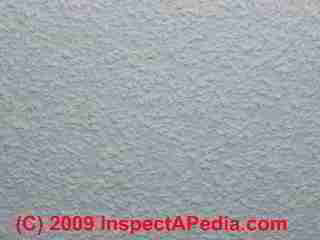
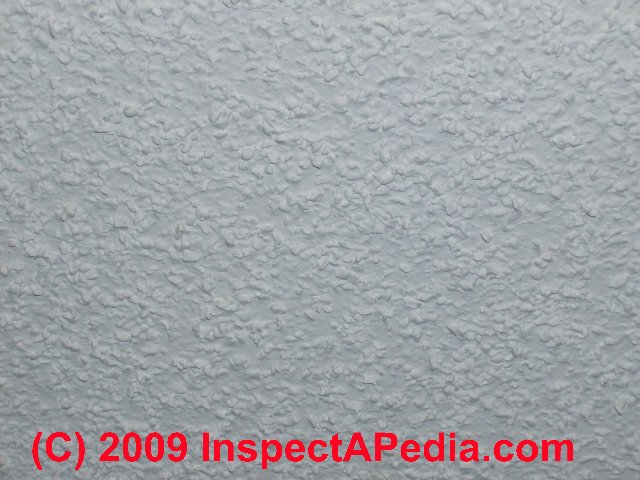
Our page top photo shows popcorn-style ceiling paint in good condition. Textured ceiling paints, including the spray-on "popcorn" type coatings that were used into the late 1970's may contain asbestos and should be handled accordingly if the surface is being stripped or demolished.
Readers should also see PAINT FAILURE CASE PHOTOS, SITE and
then PAINT FAILURE CASE PHOTOS, LAB
The diagnosis and cure of paint failure on building interior ceilings, walls, floors, trim, and other surfaces is quite possible if there is a careful and thorough inspection of the building, its history, its surfaces, and the actual points of paint failure. It is diagnostic to compare the same coating on the same type of surface at different locations on a building and in areas of failed and not-failed paint.
List of Indoor Clues that May Explain Exterior Building Paint Failures
Here is our list of clues that help diagnose the cause of both indoor paint job failures and some exterior paint failures. Additional clues that can help diagnose an indoor paint problem are at STAIN DIAGNOSIS on BUILDING INTERIORS. If you are diagnosing a building exterior paint problem also
see PAINT FAILURE - EXTERIOR CLUES.
- Signs of leaks or water entry from all sources, at all locations
- Relative humidity, use of humidifiers, dehumidifiers, hot air heat
- Construction details, air movement in the building
- Sources of water, leaks, moisture
- Sources of exfiltration - indoor air moving out through the building envelope
- Sources of infiltration - outdoor leaking into the building or into building cavities
- Information about insulation, ventilation, vapor retarders, water and air barriers
- Presence/absence of mildew, moisture stains, other signs
- Type of heating/cooling equipment installed (forced air, humidifiers, etc.)
- Fan placement and usage and effect on air movement
- Relationship of leaks or high humidity, vapor barrier defects, absent insulation, or other contributors, and areas of paint failure
- Placement and type of vapor barriers in building walls and ceilings
- Mapping of failed and not-failed paint on various building areas, overlaid on the above list of possible causes.
Reader Comments, Questions & Answers About The Article Above
Below you will find questions and answers previously posted on this page at its page bottom reader comment box.
Reader Q&A - also see RECOMMENDED ARTICLES & FAQs
Question: paint looks stained in rainy weather
(Nov 28, 2012) Burhan said:
I have problem with interior paint, which applied when dry condition and its still good after rainy season comes.
If rain, the paint looks stain at several areas and will gone if the rain stop. For your information the area which problems occur are at corridor especially from 10th floor up to 20th floor. This area perfectly covered all without any ventilation and use AC. Could you please help me to find out the causes and how to fix the problems. Thanks
Reply:
Burhan,
The most likely explanation of what you describe is that there are water leaks into a building wall or cavity that are sending moisture to the cavity side of some building interior surfaces. I'd cut a test opening and inspect the wall or ceiling cavity in the corridor you are describing.
Less likely but possible is an interaction between a particular paint coating (paint mix, formula, chemistry, and the surface to which it was applied) and an increase in indoor humidity.
Certainly it will be diagnostic to look for hidden leaks, high moisture, or differences in paint formulation and appication conditions between the problem area and other building areas where the problem does not appear.
...
Continue reading at PAINT FAILURE - SITE HISTORY of or select a topic from the closely-related articles below, or see the complete ARTICLE INDEX.
Or see these
Paint Failure Indicator Articles
- PAINT FAILURE CASE PHOTOS, SITE
- PAINT FAILURE, DIAGNOSIS, CURE, PREVENTION - home
- PAINT FAILURE DICTIONARY - illustrated list of all types of paint failures
- PAINT FAILURE INDICATORS
Suggested citation for this web page
PAINT FAILURE - INTERIOR CLUES at InspectApedia.com - online encyclopedia of building & environmental inspection, testing, diagnosis, repair, & problem prevention advice.
Or see this
INDEX to RELATED ARTICLES: ARTICLE INDEX to PAINTS & STAINS & FAILURES
Or use the SEARCH BOX found below to Ask a Question or Search InspectApedia
Ask a Question or Search InspectApedia
Try the search box just below, or if you prefer, post a question or comment in the Comments box below and we will respond promptly.
Search the InspectApedia website
Note: appearance of your Comment below may be delayed: if your comment contains an image, photograph, web link, or text that looks to the software as if it might be a web link, your posting will appear after it has been approved by a moderator. Apologies for the delay.
Only one image can be added per comment but you can post as many comments, and therefore images, as you like.
You will not receive a notification when a response to your question has been posted.
Please bookmark this page to make it easy for you to check back for our response.
Our Comment Box is provided by Countable Web Productions countable.ca
Citations & References
In addition to any citations in the article above, a full list is available on request.
- Quotes in the opening text of this document are from the encyclopedic but not quite complete paint website: PPG Exterior Failures http://www.ppg.com/getpaint/etraining/solver/exterior.html
- Paint and Surface Coatings, Theory and Practice, R. Lambourne & T.A. Strivens, Ed., Woodhead Publishing Ltd., William Andrew Publishing, 1999 ISBN 1-85573-348 X & 1-884207-73-1 [This is perhaps the leading reference on modern paints and coatings, but is a difficult text to obtain, and is a bit short on field investigation methods - DF]
Provides a comprehensive reference source for all those in the paint industry, paint manufacturers and raw materials suppliers, undergraduate and postgraduate students, and industrial paint users. R. Lambourne was in the Research Department at ICI Paints Division and the Industrial Colloid Advisory Group, Birstol University, UK. - Analysis of Modern Paints, Thomas J.S. Learner, Research in Conservation, 2004 ISBN 0-89236-779-2 [Chemistry of modern paints, overview of analytical methods, pyrolysis-gas chromatography signatures of basic modern paints and their constituents, Fourier transform infrared spectroscopy for paint analysis, direct temperature-resolved mass spectrometry, and analysis in practice - technical reference useful for forensic paint science, focused on art works -DF]
- Seeing Through Paintings, Physical Examination in Art Historical Studies, Andrea Kirsh, Rustin S. Levenson, Materials in Fine Arts, 2000 ISBN 99-051835 [ forensic science, technical reference, focused on art works - DF]
- Sealants, Durability of Building Sealants (RILEM Proceedings), J.C. Beech, A.T. Wolf, Spon Press; illustrated edition (1995), ISBN-10: 0419210709, ISBN-13: 978-0419210702
This book presents the papers given at the RILEM Seminar held at the Building Research Establishment, Garston, UK in October 1994. The book provides an opportunity for researchers to review up-to-date progress towards the achievement of the objectives of the standardisation of laboratory techniques of sealants in the variety of service conditions to which they are exposed. - Soiling and Cleaning of Building Facades (RILEM Report), L.G.W. Verhoef (Editor), Routledge; 1 edition (November 3, 1988), ISBN-10: 0412306700, USBN-13: 978-0412306709
The report of a comprehensive investigation by RILEM which examines all aspects of the cleaning of facades, subject to soiling by both biological and non-biological agencies. The contributors are international authorities working in this field giving essential advice to all those who need to know how to approach the problems connected with the soiling and cleaning of building facades. - Staining, Prevention of Premature Staining in New buildings, Phil Parnham, Taylor & Francis; 1996, ISBN-10: 0419171304, ISBN-13: 978-0419171300
The appearance of ugly staining early in a buildings life, ruins an otherwise pleasing appearance, tarnishes the image of the owners and gives rise to costly refurbishment works. In this book Phil Parnham raises a number of questions that should be considered whenever a new building is being designed or built. These are: * why has staining become so prominent; * what causes premature staining; which parts of new buildings are likely to be affected; * how can it be avoided? By using a number of highly illustrated case studies, the author answers these questions and ends by suggesting measures that should be taken by all design and construction professionals to prevent premature staining.
- Exterior Paint Problems on Historic Woodwork [Copy on file as /exterior/Preservation_Brief_10_ Exterior_Paint_Problems_on_Historic_Woodwork.pdf ] - , Kay D. Weeks and David W. Look, AIA, U.S. Department of the Interior, National Parks Service Preservation Brief No. 10. Web search 02/01/2011, original source: http://www.nps.gov/hps/tps/briefs/brief10.htm
- Paint Magic, Jocasta Innes, Frances Lincoln; 4th edition (August 17, 2006), ISBN-10: 071122272X, ISBN-13: 978-0711222724 - Paint advice for home decoration, including painting techniques such as antiquing, bambooing, bleaching, color washing, combing, decorative painting, dragging, dyeing, gliding, graining, japanning, lacquering, lining, marbling, porphyry, rag-rolling, sponging, staining, stencilling, stippling, tortoiseshelling, trompe l'oeil, and vinegar painting - DF
- Paint and Surface Coatings, Theory and Practice, R. Lambourne & T.A. Strivens, Ed., Woodhead Publishing Ltd., William Andrew Publishing, 1999 ISBN 1-85573-348 X & 1-884207-73-1
[ This is perhaps the leading reference on modern paints and coatings, but is a difficult text to obtain, and is a bit short on field investigation methods. Encyclopedic reference on the composition, production, properties, use, and testing of paints and coatings - DF]
Provides a comprehensive reference source for all those in the paint industry, paint manufacturers and raw materials suppliers, undergraduate and postgraduate students, and industrial paint users. - Understanding Ventilation, John Bower, The Healthy House Institute, ISBN 0-9637156-5-8, 1995 [General building science-DF - ** Particularly useful text. Mr. Bower has retired from the field but his book continues to be important]
- Dampness in buildings, Diagnosis, Treatment, Instruments, T.A. Oxley & E.G. Gobert, ISBN 0-408-01463-6, Butterworths, 1983-1987 [General building science-DF]
- "Moisture Control in buildings: Putting Building Science in Green Building," Alex Wilson, Environmental Building News, Vol. 12. No. 5. [Good tutorial, "Moisture 101" outlining the physics of moisture movement in buildings and a good but incomplete list of general suggestions for moisture control - inadequate attention given to exterior conditions such as roof and surface drainage defects which are among the most-common sources of building moisture and water entry.--DJF]
- PAINT FAILURE PROBLEMS AND THEIR CURE [PDF] Daniel L. Cassens and William C. Feist, National Forest Products Laboratory
- Supplemental Guidelines for Removing Paint From Interior and Exterior Wood Surfaces [on file as "/exterior/Paint_Removal_USGSA.pdf ] - , US General Services Administration, Historical Preservation Technical Procedures, 06400-02, web search August 2010, original source: //w3.gsa.gov/web/p/Hptp.nsf/0/40aff5a115b6a9e5852565c50054b4f4?OpenDocument
- "Common Paint Problems," parkerpaint.com/Common%20Paint%20Problems.htmlparkerpaint.com/Common%20Paint%20Problems.html illustrates common paint failures - though their images and text appear to have been stolen from PPG -whose own original page www.ppg.com/getpaint/etraining/solver/exterior.html was DOA as of 2019/12/13 which catalogs paint failures and causes
- "Paint problem solver" from Lowes unfortunately abandoned and removed from their site as of 2019/12/13
- In addition to citations & references found in this article, see the research citations given at the end of the related articles found at our suggested
CONTINUE READING or RECOMMENDED ARTICLES.
- Carson, Dunlop & Associates Ltd., 120 Carlton Street Suite 407, Toronto ON M5A 4K2. Tel: (416) 964-9415 1-800-268-7070 Email: info@carsondunlop.com. Alan Carson is a past president of ASHI, the American Society of Home Inspectors.
Thanks to Alan Carson and Bob Dunlop, for permission for InspectAPedia to use text excerpts from The HOME REFERENCE BOOK - the Encyclopedia of Homes and to use illustrations from The ILLUSTRATED HOME .
Carson Dunlop Associates provides extensive home inspection education and report writing material. In gratitude we provide links to tsome Carson Dunlop Associates products and services.
 | HOME | ABOUT | ASK a QUESTION | CONTACT | CONTENT USE POLICY | DESCRIPTION | POLICIES | PRIVACY | |
| © 2024 - 1985 Publisher InspectApedia.com - Daniel Friedman | |||||||||