
InspectAPedia® FREE Encyclopedia of Building & Environmental Construction, Diagnosis, Maintenance & Repair |
Question? Just ask us! InspectAPedia
|
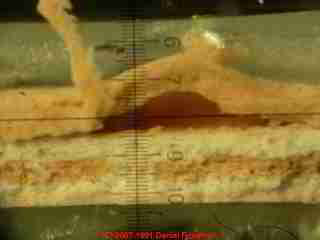 Microscopic Lab Analysis & Photographs of Paint Failures on Building Surfaces Diagnose Causes
- POST a QUESTION or COMMENT about what paint failures look like in the forensic lab
Laboratory analysis of paint samples to diagnose paint failure cause:
Here we the details of of paint analysis lab photographs of types of paint failures - what do paint samples look like under the microscope: a library of microscopic evidence of different sorts of paint job mistakes, problems, and failures.
This article series reviews common building exterior & interior painting mistakes, describes how to diagnose paint failures on buildings, and outlines a procedure for diagnostic field inspection & lab testing of failed painted surfaces.
InspectAPedia tolerates no conflicts of interest. We have no relationship with advertisers, products, or services discussed at this website.
PAINT FAILURE INVESTIGATOR'S PHOTOS- Microscopic Examination of Paint Chips as a Paint Failure Diagnostic Aid
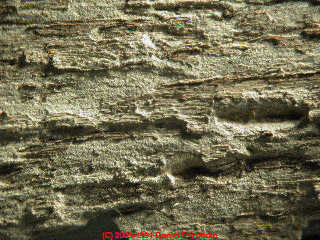 -- Daniel Friedman
Photos and text at this document are from detailed paint failure studies conducted by our field and laboratory paint failure investigation service, including site photographs, lab photographs through the forensic microscope, and paint chip samples are available as a class for building inspectors.
[Click to enlarge any image]
The accompanying photographs taken in our forensic lab provide examples of paint contaminants or other conditions associated with paint failures that can be of assistance to analysts investigating paints on buildings, artifacts, and works of art.
Simple 10x or stereo-microscope-magnified "forensic observation" of a surface from which paint has peeled, observation of the back of a paint chip, and dissection of a paint chip or painted surface to disclose the history of the layers of paint applied to a building is important in forming an opinion about the reasons for paint failure on a particular building.
For completeness, such observations should be combined with a record of detailed site observations and a report of historic conditions at the building in order to document probable causes of or contributors to the failure of a painted surface.
Above and in photos below are a few paint chip and paint dust photos from our forensic microscopy lab, along with some diagnostic comments
Wood fibers on the back of this paint chip whown above confirm that the paint didn't want to "let go" of the surface to which it was applied.
I believe that this paint was probably "pushed" off of the surface by moisture, perhaps also frost as this investigation was on a building in a northern climate.

Chalking paint on the under-side of a paint chip is shown in this high power microscope photograph. The very fine particles may be less than one micron.
Finding this dust on the back of a paint chip taken from a failing surface is a strong suggestion that the failing paint was applied over a chalked surface. This failure may have been avoidable by better surface cleaning, perhaps power washing, and possibly by a better choice of a primer.
The pine pollen grain in this photo is included for scale.

Paint pigment as a typical particle is much larger than the chalking particles shown above.
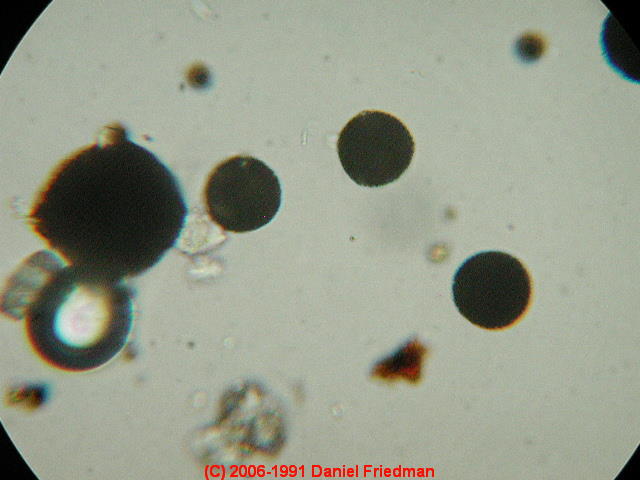
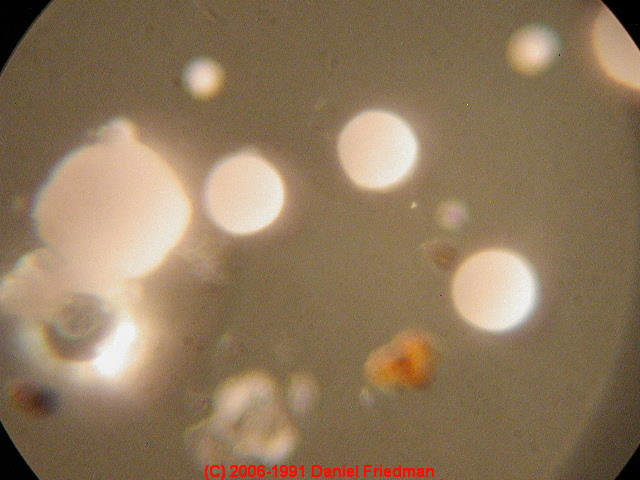
Paint droplets left by spraying paint, such as this fungicidal sealant (MicroBan(TM)) in the microscope are entirely different from pigment fragments collected from a painted surface or failing paint chip - see the preceding photograph.
Paint droplets look black in the microscope by normal transmitted light, but if a simple forensic technique is used to provide top lighting you'll see the actual color of the paint pigment as shown in this photo.
Paint Test Laboratory Listings Welcome: independent forensic and microscopic or chemistry labs offering paint analysis or paint failure services are welcome to be listed here at no fee.
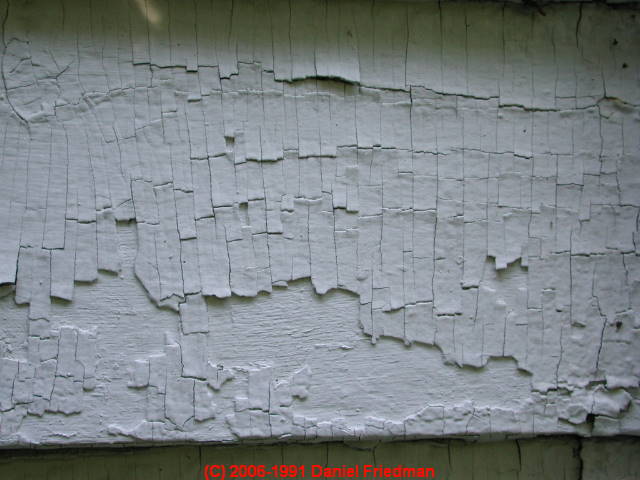
Alligatoring: [very common failure] cracked paint which resembles alligator skin. This is due to application of paint in too many layers. The inner paint layers have lost elasticity. As temperatures change and the building surfaces expand and contract, the old, brittle paint cracks.
Alligatoring might also be caused by poor adhesion to a glossy surface, painting over an inadequately-dried first coat, or from weather exposure. Painting over an "alligatored" surface is futile. The older under-paint will continue to crack, causing failure of the new coating. Stripping off of the old paint down to bare wood is what's needed.
Also see cracking, below for a distinction between these two similar failures.
Paint Blistering: this very common failure is caused by moisture getting behind paint, or by painting over wet or damp surfaces.
Moisture blisters in paint usually occur when moisture evaporates to form a vapor bubble under an impermeable layer of paint, especially on new thin coatings or oil paint coatings.
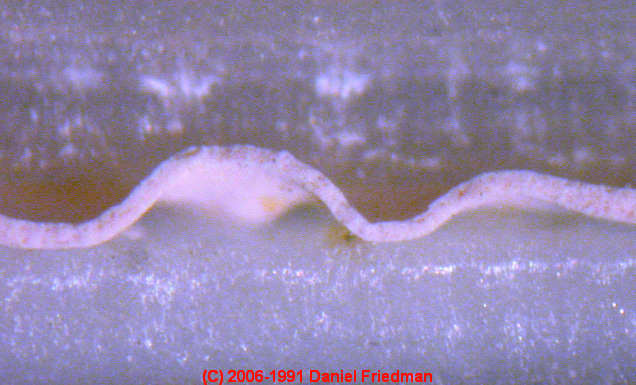
Thermal blistering, or "temperature blistering" occurs when painting in sun, or if paint is applied to hot surfaces; the blister may be from moisture or solvents in the paint itself, when its outer skin dries before its inner layers, and the inner layer is heated. Both causes may occur together.
Thermal blistering or paint solvent blisters look very different in the paint film from moisture-caused blistering.
The microphotograph shown here at 120x, taken in our laboratory, shows the edge of a microscopic paint blister, possibly solvent or thermal blistering. Often one cannot see this defect with the naked eye. Instead one observes paint cracking and adhesion failures on the painted surface.
Microscopic laboratory analysis is required to complete the failure diagnosis.
See our separate article on PAINT LABORATORY SAMPLE PREPARATION for a procedure useful to prepare an edge-view of paint layers for microscopic examination.
Also see NCR133 article below.
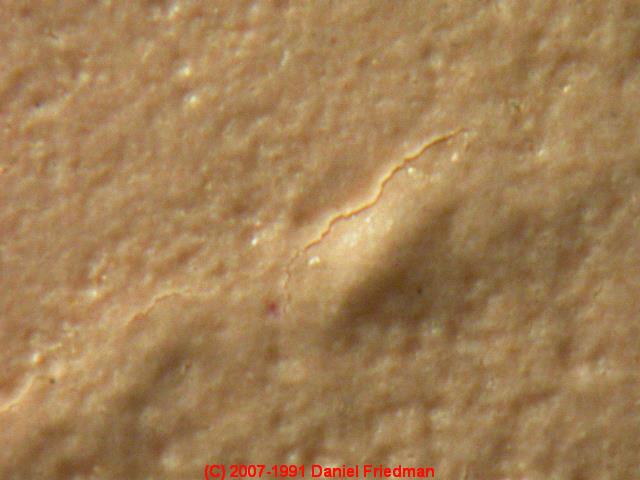

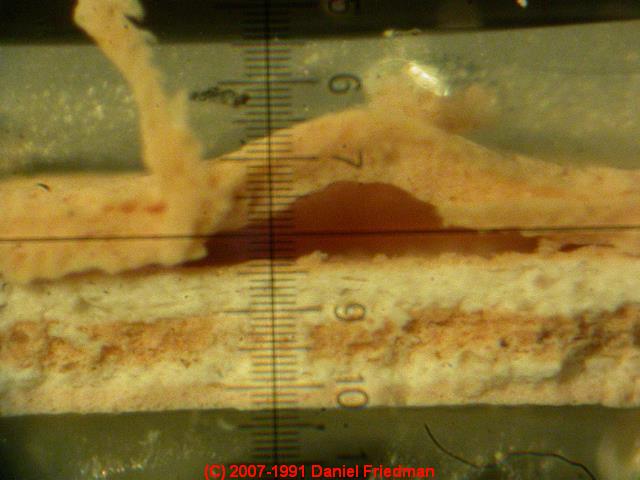
Paint Solvent blisters are small, usually microscopic. Where solvent blisters rupture they may leave pinholes in the paint or small craters. Usually ruptured solvent blisters leave craters surrounded by fine cracks radiating out from the crater.
Distinguishing solvent blisters from small moisture blisters:
Paint Solvent blisters occur as the paint is drying as solvent trapped behind the drying or dried outer film of the paint layer form gases (perhaps from sun exposure) which form a bubble and try to escape from the film.Paint Moisture blisters may be small, tend to occur behind the paint film after the paint is totally dry, are round or have rounded edges, separate the paint from the old surface uniformly, may bleed water when punctured, and can on occasion be extremely large, as much as 24" x the width of a clapboard. Moisture blisters in paint do not create pinholes, craters, nor crater-cracks.
Like thermal blisters, solvent blisters may be an underlying mechanism for paint failure that cannot be seen by the naked eye. Where paint cracks around pinholes and blisters, paint adhesion failure may be observed.
The ultimate paint failure, loss of paint adhesion, may be due to paint shrinkage and movement over the surface or moisture penetration of the paint layers at pinholes and cracks.
Paint which has failed in this manner may show other mechanisms of paint failure as well, such as separation of paint ingredients such as separation and bubbling of paint resins intended to function as adhesives, also key factors in the paint loss from the surface.
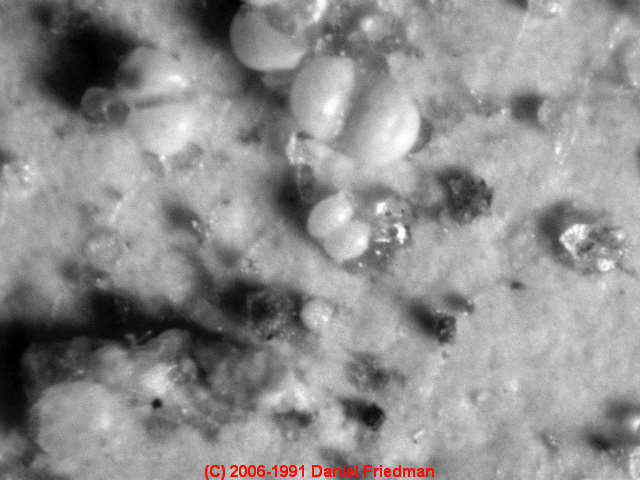
These details become more apparent in the laboratory under forensic microscopic examination of samples of failing paint.
Paint Resin Failure - paint resins separate out from the paint mixture, perhaps due to improper paint formulation, improper paint mixing, combining incompatible paints, or exposure to high temperatures during drying.
This defect is completely invisible on the painted surface and on failing paint chips, but it can be quite apparent during forensic microscopic examination of paint chips in the laboratory, as shown in the lab photograph here.
Paint Sagging or Running occur when paint is applied over glossy surfaces, or due to excessive paint thinning, due to application of too much paint on the surface, due to paint being applied to a dirty surface or being applied in weather below the recommended temperature. Proper application of paints and surface preparation will eliminate sags and runs.
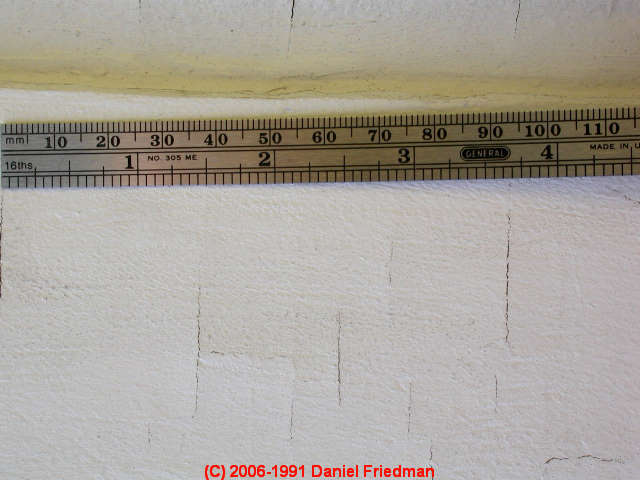
This is sometimes an indication of an inexperienced painter.
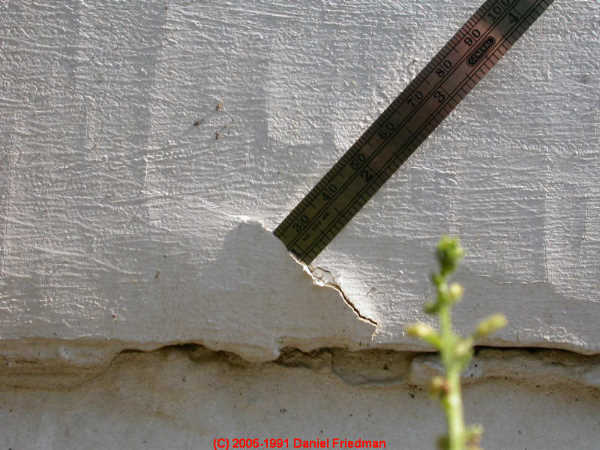
...

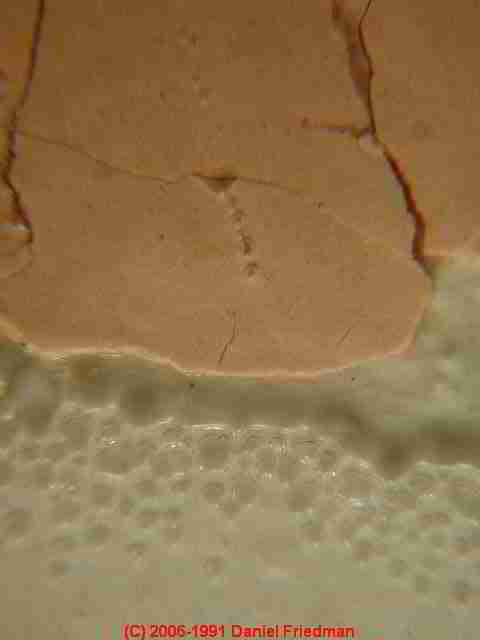
Paint Skim Coat - skim coating of building exterior surface which is in poor condition is not a reliable painting preparation method and is likely to lead to cracking failures in the skim-coated, painted surface, as shown in these photos.
Paint Spotting, brown or other stains bleeding through new paint - "surfactant leaching" - can cause spotting, possibly from painting a cool or damp surface or painting in cool or cold conditions.
See http://www.mcphersonpainting.com/leaching.htm and
also http://www.mcphersonpainting.com/tannin.htm which cites tannin staining, when tannic acid, such as oils in pine knots or cedar bleed through new paint.
Also see Rusting above.
 Surfactant leaching,: surfactants are chemicals added to paints to improve paint flow
and or to aid in formation of an emulsion.
As I stated above at "incompatible paints", surfactant leaching can occur, for example, if there is an incompatibility between
the primer coat and the finish coat.
Surfactant leaching,: surfactants are chemicals added to paints to improve paint flow
and or to aid in formation of an emulsion.
As I stated above at "incompatible paints", surfactant leaching can occur, for example, if there is an incompatibility between
the primer coat and the finish coat.
Paint chemists formulate primers and topcoats to work together as a tested and proven paint coating system.
See PAINT FAILURE SURFACTANT LEACHING for details
Tackiness and slow-dry - is caused by painting a second coat too soon, or painting in wet or foggy weather, or applying paint onto a damp surface. If using an alkyd, painting in an enclosed, un-vented area the painter can also cause this condition.
Thickness failures of painted surfaces: paint can build up to an excessive thickness, leading to cracking and peeling when a new coat is applied, as the under-coats have lost elasticity, or trap moisture or debris between paint layers.
You can see layers of paint quite easily in our page top photograph of a cross-section sample of a painted surface.
Measurement of the thickness of paint layers by microscopy is quick and reliable provided that the lab has properly calibrated their measurement reticule and measurement methods first using a stage micrometer.
...
Continue reading at PAINT FAILURE CHEMICAL TESTS or select a topic from the closely-related articles below, or see the complete ARTICLE INDEX.
Or see these
Paint Failure Analysis Lab Articles
- PAINT FAILURE, DIAGNOSIS, CURE, PREVENTION - home
- PAINT FAILURE DICTIONARY - illustrated list of all types of paint failures
- PAINT FAILURE LAB ANALYSIS
Suggested citation for this web page
PAINT FAILURE LAB ANALYSIS at InspectApedia.com - online encyclopedia of building & environmental inspection, testing, diagnosis, repair, & problem prevention advice.
Or see this
INDEX to RELATED ARTICLES: ARTICLE INDEX to PAINTS & STAINS & FAILURES
Or use the SEARCH BOX found below to Ask a Question or Search InspectApedia
Ask a Question or Search InspectApedia
Try the search box just below, or if you prefer, post a question or comment in the Comments box below and we will respond promptly.
Search the InspectApedia website
Note: appearance of your Comment below may be delayed: if your comment contains an image, photograph, web link, or text that looks to the software as if it might be a web link, your posting will appear after it has been approved by a moderator. Apologies for the delay.
Only one image can be added per comment but you can post as many comments, and therefore images, as you like.
You will not receive a notification when a response to your question has been posted.
Please bookmark this page to make it easy for you to check back for our response.
Our Comment Box is provided by Countable Web Productions countable.ca
Citations & References
In addition to any citations in the article above, a full list is available on request.
- Paint and Surface Coatings, Theory and Practice, R. Lambourne & T.A. Strivens, Ed., Woodhead Publishing Ltd., William Andrew Publishing, 1999 ISBN 1-85573-348 X & 1-884207-73-1 [This is perhaps the leading reference on modern paints and coatings, but is a difficult text to obtain, and is a bit short on field investigation methods - DF]
- Analysis of Modern Paints, Thomas J.S. Learner, Research in Conservation, 2004 ISBN 0-89236-779-2 [Chemistry of modern paints, overview of analytical methods, pyrolysis-gas chromatography signatures of basic modern paints and their constituents, Fourier transform infrared spectroscopy for paint analysis, direct temperature-resolved mass spectrometry, and analysis in practice - technical reference useful for forensic paint science, focused on art works -DF]
- "Moisture Control in buildings: Putting Building Science in Green Building," Alex Wilson, Environmental Building News, Vol. 12. No. 5. [Good tutorial, "Moisture 101" outlining the physics of moisture movement in buildings and a good but incomplete list of general suggestions for moisture control - inadequate attention given to exterior conditions such as roof and surface drainage defects which are among the most-common sources of building moisture and water entry.--DJF]
- PAINT FAILURE PROBLEMS AND THEIR CURE [PDF] Daniel L. Cassens and William C. Feist, National Forest Products Laboratory
- WHY HOUSE PAINT FAILS, [PDF] Mark Knaebe, US FPL, web search August 2010, original source: http://www.fpl.fs.fed.us/documnts/finlines/knaeb95a.pdf
- WHY PAINT JOBS FAIL [on file as /exterior/Why_Paint_Fails_Bennett.pdf ] - , web search, August 2010, original source: http://www.bennette.com/pdf/whyfail.pdf, four pages describing alligatoring, bleeding, blistering, etc. Bennette Corporation, P.O. Box 9088, Hampton, VA 23670, Phone: 757-838-7777, Toll Free: 800-869-2929
Fax: 757-827-0529, Email: info@bennette.com, Website: www.bennette.com [Dead link 2019/12/13] quoting:
Bennette Paint Manufacturing Company, Inc. is a Virginia corporation which was founded in Newport News, Virginia in 1966 by James P. Bennette, Sr. In 1984, Mr Bennette sold the company to his employees through an Employee Stock Ownership Plan (ESOP). Today the company has a modern manufacturing plant, research laboratory, central warehouse and general offices located at 401 Industry Drive, Hampton, Virginia. From these facilities the company is able to supply quality paints and coatings through its company owned distribution and service centers and authorized dealers located in Virginia, North Carolina and South Carolina. Bennette Paint Manufacturing Company, Inc. also owns and operates Bennette Equipment Company which specializes in the sale, service, and rental of paint spraying and pressure cleaning equipment. - Supplemental Guidelines for Removing Paint From Interior and Exterior Wood Surfaces [on file as "/exterior/Paint_Removal_USGSA.pdf ] - , US General Services Administration, Historical Preservation Technical Procedures, 06400-02, web search August 2010, original source: //w3.gsa.gov/web/p/Hptp.nsf/0/40aff5a115b6a9e5852565c50054b4f4?OpenDocument
- "Common Paint Problems," parkerpaint.com/Common%20Paint%20Problems.htmlparkerpaint.com/Common%20Paint%20Problems.html illustrates common paint failures - though their images and text appear to have been stolen from PPG -whose own original page www.ppg.com/getpaint/etraining/solver/exterior.html was DOA as of 2019/12/13 which catalogs paint failures and causes
- "Paint problem solver" from Lowes unfortunately abandoned and removed from their site as of 2019/12/13
- MILL GLAZE, MYTH or REALITY [PDF], R. Sam Williams, Mark Knaebe, US FPL, retrieved 2019/12/13 original source: fpl.fs.fed.us/documnts/finlines/willi01a.pdf
- paintlab.com is a lab offering paint chip failure analysis
- PPG Exterior Failures http://www.ppg.com/getpaint/etraining/solver/exterior.htm
- Analysis of Modern Paints, Thomas J.S. Learner, Research in Conservation, 2004 ISBN 0-89236-779-2 [Chemistry of modern paints, overview of analytical methods, pyrolysis-gas chromatography signatures of basic modern paints and their constituents, Fourier transform infrared spectroscopy for paint analysis, direct temperature-resolved mass spectrometry, and analysis in practice - technical reference useful for forensic paint science, focused on art works -DF]
- Art, Biology, and Conservation: Biodeterioration in Works of Art, Robert J. Koestler et als. Eds., Metropolitan Museum of Art, 2003, ISBN 1-58839-107-8
- Building Pathology, Deterioration, Diagnostics, and Intervention, Samuel Y. Harris, P.E., AIA, Esq., ISBN 0-471-33172-4, John Wiley & Sons, 2001 [General building science-DF - ** Particularly useful text **
- Dampness in buildings, Diagnosis, Treatment, Instruments, T.A. Oxley & E.G. Gobert, ISBN 0-408-01463-6, Butterworths, 1983-1987 [General building science-DF]
- Paint and Surface Coatings, Theory and Practice, R. Lambourne & T.A. Strivens, Ed., Woodhead Publishing Ltd., William Andrew Publishing, 1999 ISBN 1-85573-348 X & 1-884207-73-1 [This is perhaps the leading reference on modern paints and coatings, but is a difficult text to obtain, and is a bit short on field investigation methods - DF]
- Paint Handbook: testing, selection, application, troubleshooting, surface preparation, etc., Guy E. Weismantel, Ed., McGraw Hill Book Company, 1981, ISBN-10: 0070690618, ISBN-13: 978-0070690615, [Excellent but a bit obsolete paint theory and practice, also a bit light on field investigation methods, out of print, available used-DF]
How to select and apply the right paint or coating for any surface. The first major reference to help you choose the correct paint or other finish to do the job best on a particular surface exposed to a particular environment. Experts in the field give full advice on testing surface preparation, application, corrosion prevention, and troubleshooting. The handbook covers wood, metal, composites, and masonry, as well as marine applications and roof coatings. A ``must'' working tool for contractors, architects, engineers, specification writers, and paint dealers. - Paint and Surface Coatings, Theory and Practice, R. Lambourne & T.A. Strivens, Ed., Woodhead Publishing Ltd., William Andrew Publishing, 1999 ISBN 1-85573-348 X & 1-884207-73-1 [This is perhaps the leading reference on modern paints and coatings, but is a difficult text to obtain, and is a bit short on field investigation methods - DF]
Provides a comprehensive reference source for all those in the paint industry, paint manufacturers and raw materials suppliers, undergraduate and postgraduate students, and industrial paint users. R. Lambourne was in the Research Department at ICI Paints Division and the Industrial Colloid Advisory Group, Birstol University, UK. - Seeing Through Paintings, Physical Examination in Art Historical Studies, Andrea Kirsh, Rustin S. Levenson, Materials in Fine Arts, 2000 ISBN 99-051835 [ forensic science, technical reference, focused on art works - DF]
- Sealants, Durability of Building Sealants (RILEM Proceedings), J.C. Beech, A.T. Wolf, Spon Press; illustrated edition (1995), ISBN-10: 0419210709, ISBN-13: 978-0419210702
This book presents the papers given at the RILEM Seminar held at the Building Research Establishment, Garston, UK in October 1994. The book provides an opportunity for researchers to review up-to-date progress towards the achievement of the objectives of the standardisation of laboratory techniques of sealants in the variety of service conditions to which they are exposed. - Soiling and Cleaning of Building Facades (RILEM Report), L.G.W. Verhoef (Editor), Routledge; 1 edition (November 3, 1988), ISBN-10: 0412306700, USBN-13: 978-0412306709
The report of a comprehensive investigation by RILEM which examines all aspects of the cleaning of facades, subject to soiling by both biological and non-biological agencies. The contributors are international authorities working in this field giving essential advice to all those who need to know how to approach the problems connected with the soiling and cleaning of building facades. - Staining, Prevention of Premature Staining in New buildings, Phil Parnham, Taylor & Francis; 1996, ISBN-10: 0419171304, ISBN-13: 978-0419171300
The appearance of ugly staining early in a buildings life, ruins an otherwise pleasing appearance, tarnishes the image of the owners and gives rise to costly refurbishment works. In this book Phil Parnham raises a number of questions that should be considered whenever a new building is being designed or built. These are: * why has staining become so prominent; * what causes premature staining; which parts of new buildings are likely to be affected; * how can it be avoided? By using a number of highly illustrated case studies, the author answers these questions and ends by suggesting measures that should be taken by all design and construction professionals to prevent premature staining. - Understanding Ventilation, John Bower, The Healthy House Institute, ISBN 0-9637156-5-8, 1995 [General building science-DF - ** Particularly useful text. Mr. Bower has retired from the field but his book continues to be important]
- "Moisture Control in buildings: Putting Building Science in Green Building," Alex Wilson, Environmental Building News, Vol. 12. No. 5. [Good tutorial, "Moisture 101" outlining the physics of moisture movement in buildings and a good but incomplete list of general suggestions for moisture control - inadequate attention given to exterior conditions such as roof and surface drainage defects which are among the most-common sources of building moisture and water entry.--DJF]
- In addition to citations & references found in this article, see the research citations given at the end of the related articles found at our suggested
CONTINUE READING or RECOMMENDED ARTICLES.
Paint & Fiber Forensic Analysis, Diagnosis, Conservation
- Analysis of Modern Paints, Thomas J.S. Learner, Research in Conservation, 2004 ISBN 0-89236-779-2
[Chemistry of modern paints, overview of analytical methods, pyrolysis-gas chromatography signatures of basic modern paints and their constituents, Fourier transform infrared spectroscopy for paint analysis, direct temperature-resolved mass spectrometry, and analysis in practice - technical reference useful for forensic paint science, focused on art works. One of our most useful texts in forensic investigation of paint failures and paint problem diagnosis - for building investigators as well as art conservators. -DF]
Although oil remains an important binding medium in artists' paints, today's synthetic resins are being used with increasing frequency. This was true during much of the twentieth century, when artists such as David Alfaro Siqueiros, Jackson Pollock, and Pablo Picasso used commercial or industrial paints based on synthetic resins. The growing popularity of synthetic resin materials carries important implications for the conservation, preservation, and treatment of modern art.
This volume outlines the techniques that are currently employed to analyze the synthetic resins used in modern painting materials, such as pyrolysis-gas chromatography-mass spectrometry, Fourier Transform infrared spectroscopy, and direct temperature-resolved mass spectrometry. For each technique, results are given for standard samples of the principal classes of synthetic binding media, various pigments and extenders, tube paint formulations, and microscopic paint fragments taken from actual works of art.
Primarily intended for conservation scientists, conservators, researchers, and students of conservation, this book will also be of interest to other museum professionals. - Art, Biology, and Conservation: Biodeterioration in Works of Art, Robert J. Koestler et als. Eds., Metropolitan Museum of Art, 2003, ISBN 1-58839-107-8
Series of excellent research and advice articles on art work conservation of special use to conservators and also to building, artifact, and art forensic investigators. MOMA. - DF
Despite the perception that artworks are timeless and unchanging, they are actually subject to biological attack from a variety of sources—from bacteria to fungi to insects. This groundbreaking volume, which publishes the proceedings of a conference held at The Metropolitan Museum of Art in 2002, explores how the development of these organisms can be arrested while preserving both the work of art and the health of the conservator.
The richly illustrated text, containing the writings of over 40 scientists and conservators, is divided into sections on stone and mural paintings, paper, textiles, wood and archaeological materials, treatment and prevention, and special topics. The artworks and cultural properties discussed include, among many others, Paleolithic cave paintings, Tiffany drawings, huts built by early Antarctic explorers, and a collection of toothbrushes taken from Auschwitz victims. -- Robert J. Koestler is a research scientist at The Metropolitan Museum of Art; Victoria H. Koestler is a freelance writer and editor; A. Elena Charola is a freelance conservation scientist; and Fernando E. Nieto-Fernandez is a biologist at Old Westbury College, New York. - Cultural Heritage and Aerobiology, Methods and Measurement Techniques for Biodeterioration Monitoring, Paolo Mandrioli, Guilia Caneva, and Cristina Sabbioni, Eds., Kluwer Academic Publishers, 2003 ISBN 1-4020-1622-0
This is a translated and revised edition of the original Italian version. This book is the first to give a general overview of the application of aerobiology (the science that studies the biological components of the atmosphere) to the conservation of our cultural heritage. Aerobiological monitoring makes it possible to estimate the risks of degradation of artefacts of historical or artistic importance by airborne microorganisms (airborne spores and vegetative structures) according to the types of materials forming the artefacts, to the conditions of the microclimate and to the type of environmental pollution, thus enabling the planning of preventive or reparative intervention. Among the book's main features are: + Aspects of the biodeterioration of different materials (paper, wood, fabrics, parchment, leather, stone, glass, metals, plastic, etc.). + Methods for measuring environmental parameters, both physical (microclimatic) and chemical (pollutants). + Methods and techniques of aerobiological monitoring. + Specific problems concerning the different types of environments. Audience: The subject is thoroughly explored, thus supplying a useful tool to those who are in charge of the conservation of our cultural heritage (libraries, archives, museums, churches, hypogea, monuments, archaeological sites, etc.).
See our book review of this reference. - Exterior Paint Problems on Historic Woodwork [Copy on file as /exterior/Preservation_Brief_10_ Exterior_Paint_Problems_on_Historic_Woodwork.pdf ] - , Kay D. Weeks and David W. Look, AIA, U.S. Department of the Interior, National Parks Service Preservation Brief No. 10. Web search 02/01/2011, original source: http://www.nps.gov/hps/tps/briefs/brief10.htm
- Microscopy of Textile Fibres (Microscopy Handbooks, 32), P H Greaves, Garland Science; 1 edition (January 1, 1995), ISBN-10: 1872748244, ISBN-13: 978-1872748245
[We ordered our copy from the British publisher - now it's on Amazon.
These 3 fiber books have been essential forensic lab references supplementing our McCrone Research courses on forensic microscopy; also of use to textile conservators. - DF
An up-to-date practical guide to the properties and characteristics of textile fibres, with clear advice on sampling, specimen preparation and examination procedures. - Microscopy of Animal Textile Fibres, Alex Blakey Wildm, 1954
Hard to obtain, useful for forensic microscopy - DF - Modern Paints Uncovered (Getty Conservation Institute Symposium Proceedings), Thomas Learner, Getty Publications (March 1, 2008),ISBN-10: 089236906X, ISBN-13: 978-0892369065
Over the past seventy years, a staggering array of new pigments and binders has been developed and used in the production of paint, and twentieth-century artists readily applied these materials to their canvases. Paints intended for houses, boats, cars, and other industrial applications frequently turn up in modern art collections, posing new challenges for paintings conservators.
This volume presents the papers and posters from "Modern Paints Uncovered," a symposium organized by the Getty Conservation Institute, Tate, and the National Gallery of Art and held at Tate Modern, London, in May 2006. Professionals from around the world shared the results of research on paints that have been available to artists since 1930--the date that synthetic materials began to significantly impact the paint industry.
Modern Paints Uncovered showcases the varied strands of cutting-edge research into the conservation of contemporary painted surfaces. These include paint properties and surface characteristics, analysis and identification - Of Microbes and Art: The Role of Microbial Communities in the Degradation and Protection of Cultural Heritage, Kindle Edition, Springer; 1 edition (June 30, 2000), ASIN: B000VHV4FC
- Paint Handbook: testing, selection, application, troubleshooting, surface preparation, etc., Guy E. Weismantel, Ed., McGraw Hill Book Company, 1981
[Excellent but a bit obsolete paint theory and practice, also a bit light on field investigation methods, out of print, available used. Very useful reference for paint testing, selection, and paint failure diagnosis - focus on non-artistic use of paints such as on buildings, roofs, marine coatings. -DF]
How to select and apply the right paint or coating for any surface. The first major reference to help you choose the correct paint or other finish to do the job best on a particular surface exposed to a particular environment. Experts in the field give full advice on testing surface preparation, application, corrosion prevention, and troubleshooting. The handbook covers wood, metal, composites, and masonry, as well as marine applications and roof coatings. A ``must'' working tool for contractors, architects, engineers, specification writers, and paint dealers - Paint Magic, Jocasta Innes, Frances Lincoln; 4th edition (August 17, 2006), ISBN-10: 071122272X, ISBN-13: 978-0711222724 - Paint advice for home decoration, including painting techniques such as antiquing, bambooing, bleaching, color washing, combing, decorative painting, dragging, dyeing, gliding, graining, japanning, lacquering, lining, marbling, porphyry, rag-rolling, sponging, staining, stencilling, stippling, tortoiseshelling, trompe l'oeil, and vinegar painting - DF
- Paint and Surface Coatings, Theory and Practice, R. Lambourne & T.A. Strivens, Ed., Woodhead Publishing Ltd., William Andrew Publishing, 1999 ISBN 1-85573-348 X & 1-884207-73-1
[ This is perhaps the leading reference on modern paints and coatings, but is a difficult text to obtain, and is a bit short on field investigation methods. Encyclopedic reference on the composition, production, properties, use, and testing of paints and coatings - DF]
Provides a comprehensive reference source for all those in the paint industry, paint manufacturers and raw materials suppliers, undergraduate and postgraduate students, and industrial paint users. - Plant Biology for Cultural Heritage: Biodeterioration and Conservation, Giulia Caneva, Maria Pia Nugari, Ornella Salvadori, Getty Publications (January 15, 2009), ISBN-10: 0892369396, ISBN-13: 978-0892369393
- Quality Assessment of Textile, Karl Marshall, Kindle Edition, Springer; 2nd edition (October 31, 1993, ASIN: B00193F3BI
The damage which can occur in certain fibrous raw materials or during the production and storage of textiles is expertly described in this book by Karl Mahall. He particularly shows how to find concealed textile defects by using microscopic analysis. The examples represent typical cases that the author encountered during forty years of experience in the industry. Well-illustrated with impressive photographs, they invite you to follow each step and learn to apply the same methodology in practice. This book is especially useful as a manual for both chemical and textile engineers and quality engineers. It is also a useful reference for others in the textile industry in general. - Seeing Through Paintings, Physical Examination in Art Historical Studies, Andrea Kirsh, Rustin S. Levenson, Materials in Fine Arts, 2000 ISBN 99-051835 [ forensic science, technical reference, focused on art works - DF]
One of the best texts available for forensic investigation of the history, authenticity, and condition of paintings - DF - Building Pathology, Deterioration, Diagnostics, and Intervention, Samuel Y. Harris, P.E., AIA, Esq., ISBN 0-471-33172-4, John Wiley & Sons, 2001 [General building science-DF - ** Particularly useful text **
- Dampness in buildings, Diagnosis, Treatment, Instruments, T.A. Oxley & E.G. Gobert, ISBN 0-408-01463-6, Butterworths, 1983-1987 [General building science-DF]
- "Moisture Control in buildings: Putting Building Science in Green Building," Alex Wilson, Environmental Building News, Vol. 12. No. 5. [Good tutorial, "Moisture 101" outlining the physics of moisture movement in buildings and a good but incomplete list of general suggestions for moisture control - inadequate attention given to exterior conditions such as roof and surface drainage defects which are among the most-common sources of building moisture and water entry.--DJF]
- PAINT FAILURE PROBLEMS AND THEIR CURE [PDF] Daniel L. Cassens and William C. Feist, National Forest Products Laboratory
- WHY HOUSE PAINT FAILS, [PDF] Mark Knaebe, US FPL, web search August 2010, original source: http://www.fpl.fs.fed.us/documnts/finlines/knaeb95a.pdf
- WHY PAINT JOBS FAIL [on file as /exterior/Why_Paint_Fails_Bennett.pdf ] - , web search, August 2010, original source: http://www.bennette.com/pdf/whyfail.pdf, four pages describing alligatoring, bleeding, blistering, etc. Bennette Corporation, P.O. Box 9088, Hampton, VA 23670, Phone: 757-838-7777, Toll Free: 800-869-2929
Fax: 757-827-0529, Email: info@bennette.com, Website: www.bennette.com [Dead link 2019/12/13] quoting:
Bennette Paint Manufacturing Company, Inc. is a Virginia corporation which was founded in Newport News, Virginia in 1966 by James P. Bennette, Sr. In 1984, Mr Bennette sold the company to his employees through an Employee Stock Ownership Plan (ESOP). Today the company has a modern manufacturing plant, research laboratory, central warehouse and general offices located at 401 Industry Drive, Hampton, Virginia. From these facilities the company is able to supply quality paints and coatings through its company owned distribution and service centers and authorized dealers located in Virginia, North Carolina and South Carolina. Bennette Paint Manufacturing Company, Inc. also owns and operates Bennette Equipment Company which specializes in the sale, service, and rental of paint spraying and pressure cleaning equipment. - Supplemental Guidelines for Removing Paint From Interior and Exterior Wood Surfaces [on file as "/exterior/Paint_Removal_USGSA.pdf ] - , US General Services Administration, Historical Preservation Technical Procedures, 06400-02, web search August 2010, original source: //w3.gsa.gov/web/p/Hptp.nsf/0/40aff5a115b6a9e5852565c50054b4f4?OpenDocument
- "Common Paint Problems," parkerpaint.com/Common%20Paint%20Problems.htmlparkerpaint.com/Common%20Paint%20Problems.html illustrates common paint failures - though their images and text appear to have been stolen from PPG -whose own original page www.ppg.com/getpaint/etraining/solver/exterior.html was DOA as of 2019/12/13 which catalogs paint failures and causes
- "Paint problem solver" from Lowes unfortunately abandoned and removed from their site as of 2019/12/13
- MILL GLAZE, MYTH or REALITY [PDF], R. Sam Williams, Mark Knaebe, US FPL, retrieved 2019/12/13 original source: fpl.fs.fed.us/documnts/finlines/willi01a.pdf
- paintlab.com is a lab offering paint chip failure analysis
- PPG Exterior Failures http://www.ppg.com/getpaint/etraining/solver/exterior.html
- "Peeling Back Paint Layers For a Glimpse Into the Past," James Barron, The New York Times, 25 Feb 2010, p. A26
- [2]Runeberg, Ulrik, STAINING AND MICROBIOLOGICAL INFESTATION OF ACRYLIC PAINTINGS ON HARDBOARD [PDF] (2008),Conservator (Dipl. Rest./M.A.), Restaurierungszentrum der Landeshauptstadt Düsseldorf, Germany, Email: Rune-Ulrik@gmx.de Previously Museo de Arte Contemporáneo de Puerto Rico, San Juan Presented, April 2007 conference in Richmond Virginia, sponsored by the AIC (American Institute for Conservation), this paper discusses the staining and microbial infestation of acrylic paintings on hardboard. - private correspondence, ER <->DF 2020/01/05 - 2006/09/12. (Also see PAINT FALURE, DIAGNOSIS, CURE, PREVENTION) The following quotation is from the paper's abstract:
"Hardboard served as a common and popular support for many modern paintings that were carried out from the mid - 1920’s, and still is used occasionally in contemporary art. Many artists rejected hardboard as an inferior industrial construction material of low aesthetical value, whereas others considered the processed and compressed wood fiber boards to be a stable, light and economic alternative to solid wood panels and other rigid supports.
"From the conservator’s critical point of view, the many disadvantages of this type of support include: high acidity, hygroscope characteristics, tendency of ‘off-gassing’, (>tendency of) warping, occasional flaking of painting material in the case of tempered hardboard. The deterioration of paintings on hardboard depends on a number of factors including: the quality of the hardboard, prevailing storage conditions, and the preparation of the support by the artist. While there are many paintings on hardboard that are in very good condition, this paper will focus on those paintings that are heavily deteriorated and damaged.
"A very characteristic damage found on porous painting layers such as acrylic colour on hardboard, is the formation of stains. Generally, those stains are described without any differentiation as ‘fox-spots’. The examination of various paintings concerned led to the conclusion, that there exist different kinds of stains that need to be discriminated against each other, to ensure an appropriate conservation and restoration treatment.
"This paper aims to characterize and differentiate the stains, and will provide preventive and practical treatment proposals for the conservation and restoration of affected paintings. Questions such as ‘What are the stains composed of?’ and ‘Which may be the causes?’ will be addressed. Stains may consist of a variety of contents, such as: Ligneous residues, fungal infestation, bacterial activity, a combination of microbial and support induced discolouration [SID], a ‘symbiotic relation’ of ‘SID’ and fungal infestation, or the blooming of ingredients from the original painting materials. A range of microscopic analysis of the actual microbiological infestation of selected samples will be provided. The paintings that were examined, sampled and treated, are part of the Puerto Rican heritage, and were all kept in excessive humid tropical conditions, before they entered the Conservation Department of the Museum of Contemporary Art in Puerto Rico.
"Conservation treatment options of stained paintings on hardboard will be discussed. A high level of acidity (caused from SID and/or micro-organisms) may require measures of reduction, disinfection and neutralization. Treatment methods that reduce the ligneous stains and residues of micro-organisms, and neutralize affected areas in painting layers include stain removal through the application of soaking compresses (poultices), and de-acidification through alkaline material.
"Other aspects of deterioration, that do not have to do directly with the formation of stains, but also are typical for hardboard as painting support, will be mentioned briefly." - U.R. - In addition to citations & references found in this article, see the research citations given at the end of the related articles found at our suggested
CONTINUE READING or RECOMMENDED ARTICLES.
- Carson, Dunlop & Associates Ltd., 120 Carlton Street Suite 407, Toronto ON M5A 4K2. Tel: (416) 964-9415 1-800-268-7070 Email: info@carsondunlop.com. Alan Carson is a past president of ASHI, the American Society of Home Inspectors.
Thanks to Alan Carson and Bob Dunlop, for permission for InspectAPedia to use text excerpts from The HOME REFERENCE BOOK - the Encyclopedia of Homes and to use illustrations from The ILLUSTRATED HOME .
Carson Dunlop Associates provides extensive home inspection education and report writing material. In gratitude we provide links to tsome Carson Dunlop Associates products and services.
 | HOME | ABOUT | ASK a QUESTION | CONTACT | CONTENT USE POLICY | DESCRIPTION | POLICIES | PRIVACY | |
| © 2024 - 1985 Publisher InspectApedia.com - Daniel Friedman | |||||||||