
InspectAPedia® FREE Encyclopedia of Building & Environmental Construction, Diagnosis, Maintenance & Repair |
Question? Just ask us! InspectAPedia
|
 Guide to Building & Site History to Diagnose Paint Failures on buildings
- POST a QUESTION or COMMENT about how to spot & interpret onsite clues that may explain the failuire of paint on building exteriors or interiors
Site & building history as aids to diagnosing paint failure on buildings:
This article discusses how to study the site history of a building to gather key information used when diagnosing the cause of building paint job failures like peeling, cracking, chalking, or bubbling.
We provide a suggested paint failure checklist for gathering information about the building.
InspectAPedia tolerates no conflicts of interest. We have no relationship with advertisers, products, or services discussed at this website.
Paint Failure Checklist - Site History vs Paint Failures
We provide a detailed site checklist used when inspecting buildings with peeling, flaking, or other paint problems. We include photographs of paint failures on buildings and more photos of forensic paint laboratory examination of samples of failed paint useful to assist in diagnosing the probable cause of each type of paint failure.
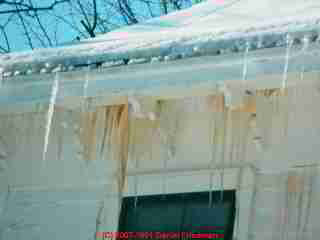
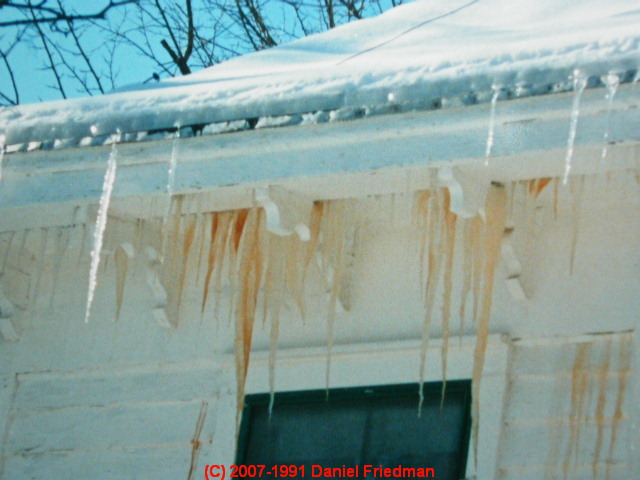
Our page top photo shows unambiguous evidence of ice dam leaks onto and into a building wall - certainly a contributor to paint failure on this structure and risking a hidden mold, insect damage, or rot problem as well.
- Building and Paint Job History
- Dates and type of construction of the building.
This may allow us to identify high moisture conditions, moisture traps, high stucco pH or paint applied over old poorly prepared surfaces. - History of the paint failure:
when was it first observed, where, in what form, and where has it increased - related to other events? - Mapping of failed and not-failed paint on various building areas, overlaid on the above list of possible causes, e.g. different building areas painted at different times or with different coatings or primers.
- Documentation:
was there an original job specification? are there any previous paint failure investigation reports, field inspections, paint testing lab reports obtained to date. Collect records and dates of payment for the painting work, for the ordering and delivery of types and quantities of paints and other supplies. - Dates and schedules of the entire painting procedure,
from surface preparation through priming and top coating. Weather history prior, during, and after these dates; dates and weather history when paint failure was first observed. - History of and identity of other paints used on building surfaces.
Possible use of incompatible paint types? - Sequence of building construction, events,
floods, building left open, weather, rain, ice dam leaks in freezing climates, outdoor temperature, humidity at time of application of coatings, including halts or interruptions in the work by weather or other cause. - Building Characteristics
- What is the substrate
- on what surface or surface materials has the paint been applied? - History of changes in the building:
additions to the structure, additions or changes in insulation amount or type of material (One case I investigated had sound paint on the exterior of an 1850's farm house, until the new owners blew in wall insulation. The next spring most of the paint peeled off.) - History of changes in the building's heating, cooling, plumbing systems,
including change to or from forced-air heating/cooling, steam heat, hot water heat or cooling capacity or usage pattern such as when new occupants change the level of A/C usage. - History of building leaks and water entry;
what building cavities did water or high moisture levels penetrate. - Painters
- What was the level of expertise
training, experience, and supervision of the painting crew? - How large was the painting crew,
which individuals performed which tasks, how many individuals were applying paint at any given time, and on what different areas of the building. - Is it possible to relate specific failures to an individual
and thus to variation in surface preparation or paint application methods by worker? - The size of the crew, schedule, paint quantities, and
paint delivery schedule
can assist in determining the order and rate of paint application and thus in evaluating the possible exposure of wet paint to specific weather or other site conditions on any given day during the painting project. - Does the painting supervisor or contractor
own and use a moisture meter?
a wet film paint thickness gauge? Contractors who are familiar with testing eqiupment may be more-expert. - Was the painter pushed to rush the paint job
start date, possibly running into bad weather, wet conditions, or insufficient stucco cure or primer cure? - Surface Preparation, Cleaning, and Testing
- What steps were taken in surface preparation,
and how did these methods vary by area on the building? Surface Preparation, back priming, sanding, caulking details: what were the selected coatings and what is the coating compatibility. - What was the use of primers, de-glossers, tinting agents,
"mildewcides" (properly, fungicides), water-proofing compounds? - Surface cleaning methods, chemicals,
use of power washers, too close (damage marks), too far (not clean), inconsistently, or mis-aimed (blew water into walls) - Where old paint was scraped,
were edges feathered? - How much old paint was left on the building?
before application of primer or top coat by percentage area, and by differing building exposures and conditions? - Were any paint tests performed
before the building was painted? Was there a paint hardness test or a paint adhesion test performed? - Was the painter pushed on total job cost
to the extent that s/he was encouraged to take shortcuts that led to improper surface prep or other failure causes? - Paint Characteristics
- Paint mixing details:
how was paint mixed, what methods were used? Were smaller containers dumped into a larger common container for mixing? Was all of each individual can content scraped into the mixer? - Compatibility of paints and coatings used,
vs. paints or coatings already on the surface
primer vs top coat(s) - What is the history of paint storage, purchase, and delivery
for the specific containers of paint used at the building: was the paint exposed to unusual conditions such as high heat, prolonged storage, or freezing? Do the paint delivery schedule and quantities inform the investigator about the sequence and possible dates of paint application? - What types of tinting agents,
mildewcides, or other additives were used and what may have been their effects on the paint? - What use was made of paint thinners?
Was the paint job cost so squeezed that the painter was encouraged to over-thin paints to try and extend coverage? - The Application of Paint to The Building
- Application or omission of primers,
de-glossers, etc. - Method of coating application
(spray, roller, brush, factory) - Sequence of painting and paint mixing, time between coats:
What are the history, application sequence, and other details of paint or stain application: dates, conditions, substances applied, application equipment and methods. - Paint quantities ordered and used:
does the paint quantity invoiced and paid-for match the quantity reported to have been used on the building? Does the paint quantity actually used match the square footage of coated area when using the rated paint coverage per gallon? - Painting Conditions, Weather
- Conditions at time of application of primer or paint,
such as wet weather, high temperature, freezing weather, wind, fog, rain, early morning dew, nearby construction or other dust-making activity (mowing or leaf grinding). - Did rain occur
shortly before, during, or after application of paint? - Was painting performed in hot sun
or in windy conditions?
See PAINTING in SUN or WIND - Document the highs, lows, and range of temperature,
humidity, as well as rain, sun, and wind conditions - Bonura, Tony, Steve Bussjeager, Lynne Christensen, George Daisey, Tom Daniels, Mark Hirsch, Charles J. Jourdain et al. "Finishes checklist: A guide to achieving optimum coating performance on exterior wood surfaces." JCT coatings tech. Vol. 1, no. 3 (Mar. 2004) (2004).
- Browne, Frederick Lincoln. SOME CAUSES OF BLISTERING AND PEELING OF PAINT ON HOUSE SIDING [PDF] (1953) USDA, US FPL, & University of Wisconsin
- Browne, F. L. "Behavior of house paints on different woods." Protective and decorative coatings (1945): 258-284.
- Browne, Frederick Lincoln. PROPERTIES OF WOOD THAT DETERMINE THE SERVICE GIVEN BY EXTERIOR PAINT COATINGS [PDF] (1930).
- Cassens, Daniel L., William C. Feist, FINISHING WOOD EXTERIORS Selection, Application, and Maintenance [PDF] (1986) USDA, USFS
Excerpt:
As a result of these potential problems, film-forming finishes, such as paint, solid-color stains, and varnish or other clear, film finishes should never be used on roofs. [And similar problems may occur on film forming paints on wood shingle walls - OPINION of Editor.]
The finish will deteriorate within a few months or years, resulting in an unsightly appearance that is difficult to refinish. Increased wood decay is also likely, because the film-forming finish can help to retain moisture in the shingle or shake.
Paint and solid-color stains are sometimes used on shake or shingle sidewalls, however. If roofs or sidewalls are to be finished, semitransparent penetrating oil-based stains provide the best alternative. These provide color without entirely concealing the grain and texture of the wood and are relatively long lived and easily renewed. They may last several years on roofs and longer on sidewalls. - Cassens, Daniel L., William C. Feist, DISCOLORATION of HOUSE PAINT - CAUSES & CURES [PDF] U.S.D.A. & US FPL, in Wood Finishing (un-dated) - original source: https://www.paint.org/wp-content/uploads/2021/09/Extractive-Bleed_Mar-2010.pdf
- Dwyer, Jack, Tony Bonura, Arnie Nebelsick, Sam Williams, and Christopher G. Hunt. INSTALLATION, CARE, AND MAINTENANCE OF WOOD SHAKE AND SHINGLE SIDING [PDF] (2011) General technical report FPL-GTR-202. Madison, WI: US Dept. of Agriculture, Forest Service, Forest Products Laboratory, 2011: 13 p. 202 (2011).
Excerpts:
Solid-Color Stains Solid-color stains (also called solid-body stains or opaque stains) are available in oil- and latex-based formulations.
They give more protection against UV radiation than semitransparent stains. However, solid-color stains do not penetrate wood; they form a film just as paints do. To get good service life, they need to have sufficient film thickness to avoid failing by flaking and peeling.
Prior to application, it is best to prime shakes or shingles with a stain-blocking primer prior to applying a solid-color stain to avoid extractives bleed (Fig. 15).
These stains perform best on textured or rough surfaces, but should not be used on a weathered surface (see Refinishing section).
Paint Paint is a film-forming opaque finish and provides the best surface protection against water and weathering. Good quality stain-blocking primers applied to all surfaces prior to installation offer the best protection against discoloration by water-soluble extractives.
(See discussion of back priming in Factory Finishing section.)
Top coat with good quality acrylic latex-based paint. As with solid-color stains, paints will not adhere to weathered surfaces. - Knabe, WHY HOUSE PAINT FAILS [PDF] (1995) The Finish Line, U.S. Forest Products Laboratory, (October 1995)
- LeVan, Susan, and Carlton A. Holmes. Effectiveness of fire-retardant treatments for shingles after 10 years of outdoor weathering. Vol. 474. US Department of Agriculture, Forest Service, Forest Products Laboratory, 1986.
- Page, David, and Tripti Singh. Durability of New Zealand grown timbers [PDF] New Zealand Journal of Forestry 58, no. 4 (2014): 26-30.
- Smulski, S. T. E. P. H. E. N. "Ensuring the Durability of Energy-Efficient Houses." Fine Homebuilding (2000): 72-77. [Includes discussion of painting wood shingles, back-priming, algae blooms.
- Van Vlack, C. H. SELECTING AND APPLYING PAINTS [PDF] (1939) USDA & U. Nebraska Agricultural College Extension Services
See "Painting and staining red cedar shingles on p. 40. - See additional citations at the page bottom REFERENCES
Reader Comments, Questions & Answers About The Article Above
Below you will find questions and answers previously posted on this page at its page bottom reader comment box.
Reader Q&A - also see RECOMMENDED ARTICLES & FAQs
Question: need help diagnosing this paint failure
I'm looking for someone who can help me diagnose the problems with the paint shown in this video: https://youtu.be/MIIoH3vtQ7A
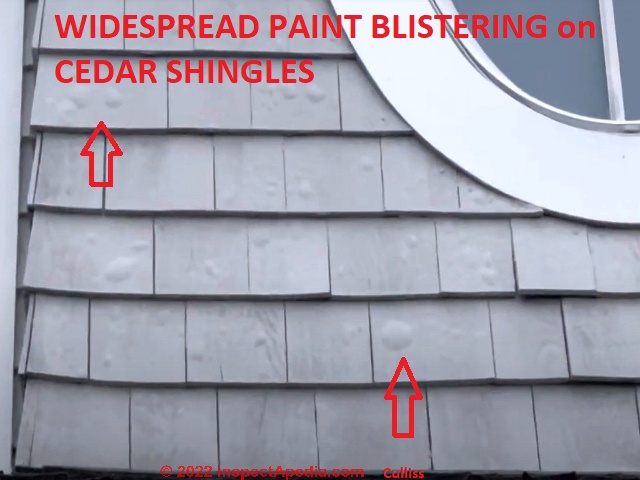
As background, the house was built in 2004 and the cedar siding had never been painted but had a "bleaching oil" on it. After 18 years, the house was power-washed with chlorine bleach to remove any mold from the shingles, which made them look like brand-new wood.
The house was then
(1) primed with an unknown type of primer and
(2) stained with Sherwin Williams Woodscapes solid-body stain.
The stain and primer can now be easily scratched off almost anywhere on the siding just using a fingernail.
Please let me know if you can recommend a course of action. I'm interested in having the paint tested to determine if they used an interior primer. - Anonymous by priavate email 2022-12-20
Moderator reply:
 ...
... 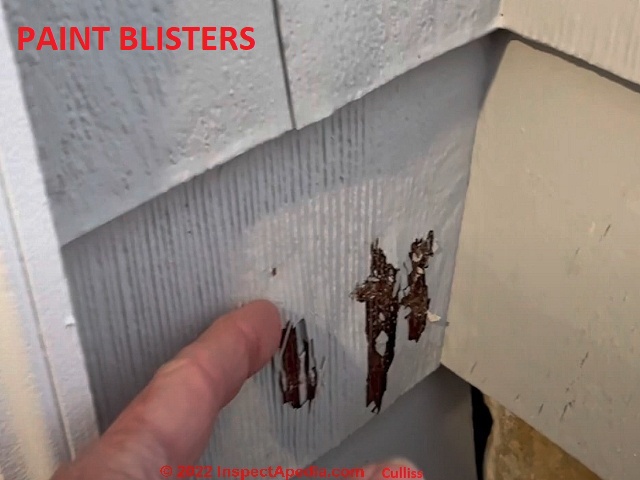
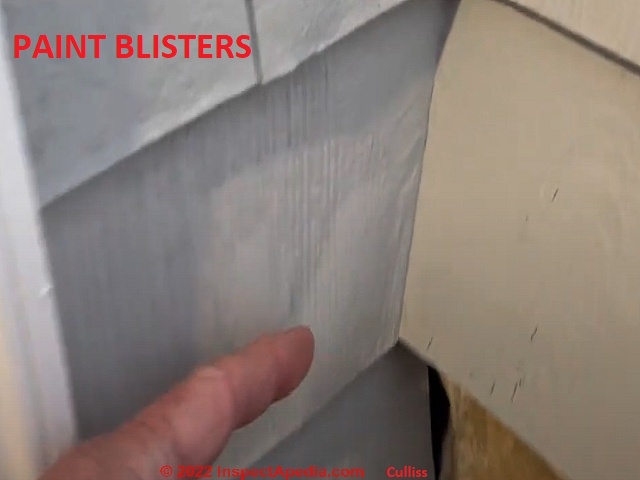
Above: gentle scraping with a fingernail opens large blisters in these painted cedar shingles on a home located in Rye, New Hampshire, in the U.S.
You should start by identifying the exact primer Sherwin Williams stain that were used.
You should also document the exact site conditions when the painting was done. Something as simple as priming too-soon after power washing (over wet wood) can cause extensive paint failure.
It's no surprise that paint may not bond well to cedar previously treated with a bleaching oil, but it's worth a call to Sherwin Williams to ask them for an opinion about applying their products on that base.
From your description, when you say the stain and primer can be easily scratched off, I'm interpreting that to mean that the failure isn't between top coat and primer, it's between primer and wood surface.
A variety of causes can produce that failure - as we list in our paint failure articles listed at the end of this page.
Have you read all of those?
It If not, they're worth a look.
Often you can see enough on-site to have a pretty confident diagnosis of the failure cause.
About paint labs: I don't have a recommendation.
I was disappointed to find that not many paint labs actually do the work that's needed to diagnose this sort of problem. The majority are focused on automotive paints, do some spectrographic analysis that's sophisticated and not always diagnostic, and skip a forensic microscopic examination of surface samples.
Under the microscope one can examine all five surface sides: the bare wood, the front and back of primer chips, the front and back of top coat chips - if these separate. If as I suspect the primer didn't bond to the wood, you'll see the under-side of the primer lacking in wood fibers. (As opposed to paint that was pushed-off of the surface by moisture).
If you find a lab willing and able to do that - by telephone discussion - that is worth pursuing.
If you agree I'll include a version of this conversation at one of the articles above (default is to keep you anonymous unless you want to be identified) to see if we can invite other helpful comments or suggestions.
Reader follow-up: cedar shingles were "clean and bare"
Thanks for your thoughtful reply. I'm not sure that bleaching oil was present on the original wood, but the wood was prepped through chemical power-washing to remove anything like that. I have read a lot of the information on your site, including those articles but they seemed to deal with mostly older houses with many layers of paint.
Our situation seems more unique in that the wood was essentially clean and bare. The articles addressing moisture seemed to focus on wicking through the ends of a board, but we were getting bubbles in the middle of the shingles away from the edges. Regardless, I truly appreciate your thoughts and will be working on this over the next several weeks.
I'll keep you posted on the case. Feel free to post it anonymously to your site for any feedback or comments from the community. I appreciate that as well
Moderator reply: Cost of repairing very extensive paint failure on cedar shingles should be compared with cost of complete shingle replacement
Thanks for the discussion It's true that the worst paint failures are usually in re-painting - hence the multi-layer focus but I'm very interested in new paint failures too.
The use of solid color stains and also paint as a finish surface on wood shingles or shakes is permitted and possible, provided the proper surface preparation is made and proper primer and paint choices are made. (Dwyer 2011) But so far we don't know what primer was used on your home.
If any sort of oil-containing treatment was used on cedar, in my OPINION, NO amount of power washing would remove all of that - it penetrates into the wood.
So the wood surface may be clean and bare but still oil-containing, even if the wood is brand new cedar shingles.
In fact painting cedar siding or shingles in general is difficult because there are also natural oils in the wood. In my OPINION that's why we (and others) think that using a penetrating, oil-based stain or a pigmented stain will perform better on cedar than any pigmented paint coating.
Particularly, if the failure is uniform over all surfaces independent of sun-exposure, independent of the exact day the coating was applied (if the whole house wasn't done in one day), etc. for other failure factors like sun or weather exposure, it's more-likely to be an incompatibility between the primer and the wood surface.
Sometimes the contractor is reluctant to give the details of what they used, or to admit that they over-thinned a coating or substituted a product different from what was contracted. And on occasion we find product labels in photos taken during job, on a can in the trash, etc.
If you can come up with those product specifics it'll be helpful. If not we're left in a more-speculative spot. Do keep me posted, and perhaps we can be helpful to one another. I may have suggestions and I'll learn from your comments too, thus improving the information we give to others.
Bottom line OPINION: blistered paint can occur if the surface was too hot when painted or when water is trapped behind the surface coating; any water-resistant or water impermeable film-forming finish used on cedar shingles is likely to perform poorly, leading to blistering and paint failure. It's for that reason that experts usually recommend a enetrating oil-based stain. (Cassens 1986)
Related research & technical articles on Paint Failures on Wood Shakes & Shingles
You might want to see
...
...
Continue reading at PAINTING MISTAKES or select a topic from the closely-related articles below, or see the complete ARTICLE INDEX.
Or see these
Recommended Articles
- EXTRACTIVE BLEEDING SIDING STAINS
- PAINT & STAIN GUIDE, EXTERIOR for a guide to the selection and proper application of paints and stains on exterior wood surfaces.
- PAINT FAILURE CASE PHOTOS, LAB
- PAINT FAILURE CASE PHOTOS, SITE
- PAINT FAILURE, DIAGNOSIS, CURE, PREVENTION - home
- PAINT FAILURE DICTIONARY - illustrated list of all types of paint failures
- PAINT FAILURE INDICATORS
Suggested citation for this web page
PAINT FAILURE - SITE HISTORY of at InspectApedia.com - online encyclopedia of building & environmental inspection, testing, diagnosis, repair, & problem prevention advice.
Or see this
INDEX to RELATED ARTICLES: ARTICLE INDEX to PAINTS & STAINS & FAILURES
Or use the SEARCH BOX found below to Ask a Question or Search InspectApedia
Ask a Question or Search InspectApedia
Questions & answers or comments about how to spot & interpret onsite clues that may explain the failuire of paint on building exteriors or interiors.
Try the search box just below, or if you prefer, post a question or comment in the Comments box below and we will respond promptly.
Search the InspectApedia website
Note: appearance of your Comment below may be delayed: if your comment contains an image, photograph, web link, or text that looks to the software as if it might be a web link, your posting will appear after it has been approved by a moderator. Apologies for the delay.
Only one image can be added per comment but you can post as many comments, and therefore images, as you like.
You will not receive a notification when a response to your question has been posted.
Please bookmark this page to make it easy for you to check back for our response.
Our Comment Box is provided by Countable Web Productions countable.ca
Citations & References
In addition to any citations in the article above, a full list is available on request.
- Paint and Surface Coatings, Theory and Practice, R. Lambourne & T.A. Strivens, Ed., Woodhead Publishing Ltd., William Andrew Publishing, 1999 ISBN 1-85573-348 X & 1-884207-73-1 [This is perhaps the leading reference on modern paints and coatings, but is a difficult text to obtain, and is a bit short on field investigation methods - DF]
- Analysis of Modern Paints, Thomas J.S. Learner, Research in Conservation, 2004 ISBN 0-89236-779-2 [Chemistry of modern paints, overview of analytical methods, pyrolysis-gas chromatography signatures of basic modern paints and their constituents, Fourier transform infrared spectroscopy for paint analysis, direct temperature-resolved mass spectrometry, and analysis in practice - technical reference useful for forensic paint science, focused on art works -DF]
- "Moisture Control in buildings: Putting Building Science in Green Building," Alex Wilson, Environmental Building News, Vol. 12. No. 5. [Good tutorial, "Moisture 101" outlining the physics of moisture movement in buildings and a good but incomplete list of general suggestions for moisture control - inadequate attention given to exterior conditions such as roof and surface drainage defects which are among the most-common sources of building moisture and water entry.--DJF]
- Supplemental Guidelines for Removing Paint From Interior and Exterior Wood Surfaces [on file as "/exterior/Paint_Removal_USGSA.pdf ] - , US General Services Administration, Historical Preservation Technical Procedures, 06400-02, web search August 2010, original source: //w3.gsa.gov/web/p/Hptp.nsf/0/40aff5a115b6a9e5852565c50054b4f4?OpenDocument
- "Common Paint Problems," parkerpaint.com/Common%20Paint%20Problems.htmlparkerpaint.com/Common%20Paint%20Problems.html illustrates common paint failures - though their images and text appear to have been stolen from PPG -whose own original page www.ppg.com/getpaint/etraining/solver/exterior.html was DOA as of 2019/12/13 which catalogs paint failures and causes
- "Paint problem solver" from Lowes unfortunately abandoned and removed from their site as of 2019/12/13
- MILL GLAZE, MYTH or REALITY [PDF], R. Sam Williams, Mark Knaebe, US FPL, retrieved 2019/12/13 original source: fpl.fs.fed.us/documnts/finlines/willi01a.pdf
- paintlab.com is a lab offering paint chip failure analysis
- PPG Exterior Failures Original source: www.ppg.com/getpaint/etraining/solver/exterior.html - sorry this is now a dead link and searching PPG's website http://corporate.ppg.com/ for "paint failure" returned nothing - Ed. 2022/12/20
- Our recommended books about building & mechanical systems design, inspection, problem diagnosis, and repair, and about indoor environment and IAQ testing, diagnosis, and cleanup are at the InspectAPedia Bookstore. Also see our Book Reviews - InspectAPedia.
- Analysis of Modern Paints, Thomas J.S. Learner, Research in Conservation, 2004 ISBN 0-89236-779-2 [Chemistry of modern paints, overview of analytical methods, pyrolysis-gas chromatography signatures of basic modern paints and their constituents, Fourier transform infrared spectroscopy for paint analysis, direct temperature-resolved mass spectrometry, and analysis in practice - technical reference useful for forensic paint science, focused on art works -DF]
- Exterior Paint Problems on Historic Woodwork [Copy on file as /exterior/Preservation_Brief_10_ Exterior_Paint_Problems_on_Historic_Woodwork.pdf ] - , Kay D. Weeks and David W. Look, AIA, U.S. Department of the Interior, National Parks Service Preservation Brief No. 10. Web search 02/01/2011, original source: http://www.nps.gov/hps/tps/briefs/brief10.htm
- Microscopy of Textile Fibres (Microscopy Handbooks, 32), P H Greaves, Garland Science; 1 edition (January 1, 1995), ISBN-10: 1872748244, ISBN-13: 978-1872748245
[We ordered our copy from the British publisher - now it's on Amazon.
These 3 fiber books have been essential forensic lab references supplementing our McCrone Research courses on forensic microscopy; also of use to textile conservators. - DF
An up-to-date practical guide to the properties and characteristics of textile fibres, with clear advice on sampling, specimen preparation and examination procedures. - Microscopy of Animal Textile Fibres, Alex Blakey Wildm, 1954
Hard to obtain, useful for forensic microscopy - DF - Modern Paints Uncovered (Getty Conservation Institute Symposium Proceedings), Thomas Learner, Getty Publications (March 1, 2008),ISBN-10: 089236906X, ISBN-13: 978-0892369065
Over the past seventy years, a staggering array of new pigments and binders has been developed and used in the production of paint, and twentieth-century artists readily applied these materials to their canvases. Paints intended for houses, boats, cars, and other industrial applications frequently turn up in modern art collections, posing new challenges for paintings conservators.
This volume presents the papers and posters from "Modern Paints Uncovered," a symposium organized by the Getty Conservation Institute, Tate, and the National Gallery of Art and held at Tate Modern, London, in May 2006.
Professionals from around the world shared the results of research on paints that have been available to artists since 1930--the date that synthetic materials began to significantly impact the paint industry.
Modern Paints Uncovered showcases the varied strands of cutting-edge research into the conservation of contemporary painted surfaces.
These include paint properties and surface characteristics, analysis and identification - Of Microbes and Art: The Role of Microbial Communities in the Degradation and Protection of Cultural Heritage, Kindle Edition, Springer; 1 edition (June 30, 2000), ASIN: B000VHV4FC
- Paint Handbook: testing, selection, application, troubleshooting, surface preparation, etc., Guy E. Weismantel, Ed., McGraw Hill Book Company, 1981
[Excellent but a bit obsolete paint theory and practice, also a bit light on field investigation methods, out of print, available used. Very useful reference for paint testing, selection, and paint failure diagnosis - focus on non-artistic use of paints such as on buildings, roofs, marine coatings. -DF]
How to select and apply the right paint or coating for any surface. The first major reference to help you choose the correct paint or other finish to do the job best on a particular surface exposed to a particular environment. Experts in the field give full advice on testing surface preparation, application, corrosion prevention, and troubleshooting.
The handbook covers wood, metal, composites, and masonry, as well as marine applications and roof coatings.
A ``must'' working tool for contractors, architects, engineers, specification writers, and paint dealers - Paint Magic, Jocasta Innes, Frances Lincoln; 4th edition (August 17, 2006), ISBN-10: 071122272X, ISBN-13: 978-0711222724 - Paint advice for home decoration, including painting techniques such as antiquing, bambooing, bleaching, color washing, combing, decorative painting, dragging, dyeing, gliding, graining, japanning, lacquering, lining, marbling, porphyry, rag-rolling, sponging, staining, stencilling, stippling, tortoiseshelling, trompe l'oeil, and vinegar painting - DF
- In addition to citations & references found in this article, see the research citations given at the end of the related articles found at our suggested
CONTINUE READING or RECOMMENDED ARTICLES.
- Carson, Dunlop & Associates Ltd., 120 Carlton Street Suite 407, Toronto ON M5A 4K2. Tel: (416) 964-9415 1-800-268-7070 Email: info@carsondunlop.com. Alan Carson is a past president of ASHI, the American Society of Home Inspectors.
Thanks to Alan Carson and Bob Dunlop, for permission for InspectAPedia to use text excerpts from The HOME REFERENCE BOOK - the Encyclopedia of Homes and to use illustrations from The ILLUSTRATED HOME .
Carson Dunlop Associates provides extensive home inspection education and report writing material. In gratitude we provide links to tsome Carson Dunlop Associates products and services.
 | HOME | ABOUT | ASK a QUESTION | CONTACT | CONTENT USE POLICY | DESCRIPTION | POLICIES | PRIVACY | |
| © 2024 - 1985 Publisher InspectApedia.com - Daniel Friedman | |||||||||