
InspectAPedia® FREE Encyclopedia of Building & Environmental Construction, Diagnosis, Maintenance & Repair |
Question? Just ask us! InspectAPedia
|
 Cable / Wire Rope Railings
Building Code Rules & Installation Specifications for Guardrail Cables
- POST a QUESTION or COMMENT about Building Code Rules & Installation Specifications for Guardrail Cables: Wire Rope Railings, spacing, tensioning, support, cable diameters, inspection, safety hazards, applications, & code approvals
Guide to cable railings or wire rope guardrails:
This article describes and includes illustrations of cable or wire rope railings or guardrails used along decks, balconies, walkways and stairways. We include definitions of guardrail, a handrailing or stairway handrail, and other terms that assist in understanding the building code, construction, and safety requirements that wire cable type railings must meet.
We describe the key installation features necessary for cable railings and we explain both the 4-inch sphere rule problem faced by cable railings and the ladder-effect or climbability problem that these systems must also address. Installing a cable railing according to the manufacturer's specifications for spacing, tension, support, and other parameters (described here) improve the safety of cable railings.
Where the presence of children argues against any sort of horizontally-run guard railing member, cable railing manufacturers can provide vertical cable railing designs.
InspectAPedia tolerates no conflicts of interest. We have no relationship with advertisers, products, or services discussed at this website.
Building Code & Manufacturer Specifications for Cable (Wire Rope) Used in Stair & Guardrail Installations
 What's a cable or wire rope railing? What's the difference between a guardrail and a handrail? Specifications for Installing Cable-Type Guard Railings along Balconies or Stairways.
Cable Railing Specifications: railing height, cable diameters, cable spacing, cable support & cable tensioning. Maximum Sphere Passage Rule vs.
Cable Type Guardrails & Stair Rails - Importance of Proper Cable Railing Spacing, Tension & Cable Railing Rigidity.
The Ladder Effect of Horizontal Cable Railings - climbing children & Safety Issues.
Article Series Contents
- DEFINITION of RAILING, GUARDRAIL, HANDRAIL, GRASPABILITY
- CABLE GUARDRAIL INSTALLATION SPECIFICATIONS
- CLIMBABILITY of GUARDRAILS: the LADDER EFFECT - separate article, child safety
- CABLE RAILING CODES, OPENINGS, LADDER EFFECT - separate article on cable guardrail codes & standards
What's a Railing? What's the difference between a guardrail and a handrail?
While cable "railings" are permitted under some building codes and by local building Inspectors we find that people speak a bit loosely about the definition of "railing" - and "cable railing".
It is important to be clear in our terminology as building codes specify different requirements for handrailings than for guardrailings in terms of construction, height, and graspability. [48][49][50][51][52]
Definition of Guard railings
Properly, questions about cable railings or wire rope rails are asking about a guard rail, a type of safety "fencing" or "railing" used along the outer side of balconies and stairways, not a "hand railing". Below in this article we discuss the installation and safety of cable-type guardrailings.
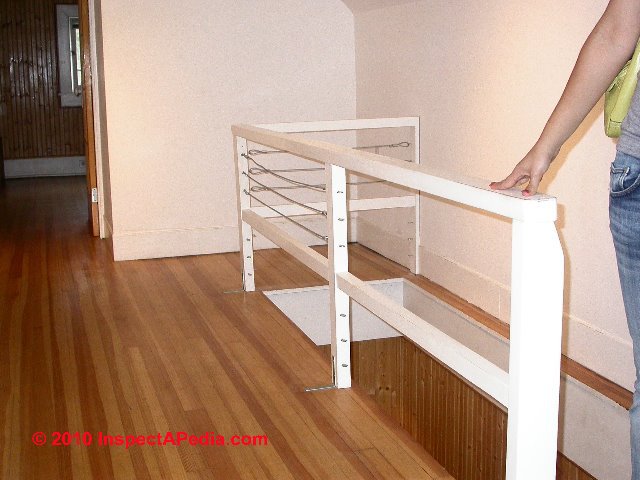
Our photo at left illustrates a home-made (and unsafe) cable guardrailing around the top of a stairwell opening in a New York home inspected by the author.
The cables were visibly slack, incomplete, and the entire assembly so wobbly that it would easily collapse if leaned-on or stumbled-against.
At GUARDRAILS ON BALCONIES & LANDINGS we provide details about all types of guard railings.
Definition of Hand Railings
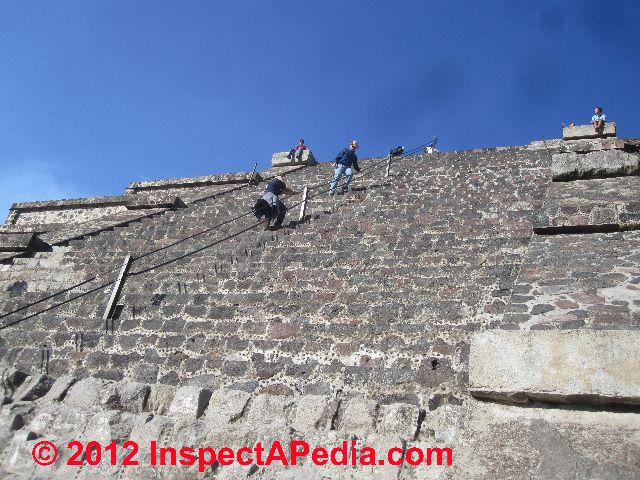
A handrail is a horizontal or sloping rail intended to be grasped by a person's hand for support when using a stairway and importantly, instinctively grasped in an attempt to arrest a fall.
Our photo above illustrates use of a wire cable "hand railing" along steps ascending the Pyramid of the Sun outside Mexico City.
Graspability of Wire or Rope Handrails
Watch out: A wire rope or wire cable in the typical dimensions used at railings (1/8-inch to 3/8-inch in diameter) is not a graspable handrailing by any of the building code standards because of its small diameter.
1003.3.3.11.3 Handrail grasp ability.
Handrails with a circular cross section shall have an outside diameter of at least 1.25 inches (32 mm) and not greater than 2 inches (51 mm) or shall provide equivalent grasp ability.
If the handrail is not circular, it shall have a perimeter dimension of at least 4 inches (102 mm) and not greater than 6.25 inches (159 mm) with a maximum cross-section dimension of 2.25 inches (57 mm).
Edges shall have a minimum radius of 0.125 inch (3.2 mm). - 2000 BOCA, ICBO, SBCCI
See HANDRAILS & HANDRAILINGS for details about hand railing building codes, construction, inspection, & safety concerns.
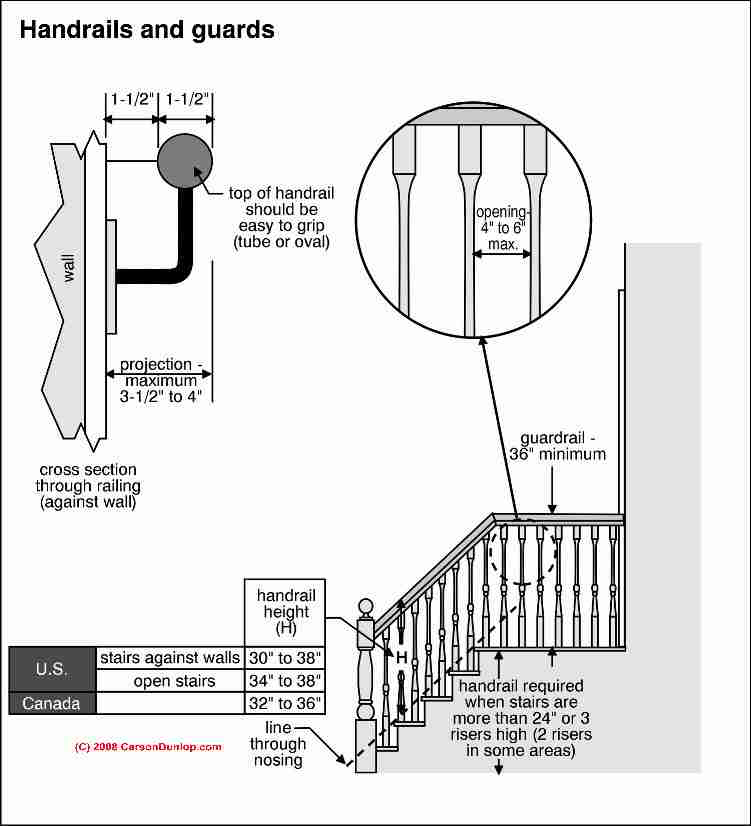
Stairway handrail & stair balusters & guard details are in the sketch shown above, provided courtesy of Carson Dunlop Associates, a Toronto home inspection & education company, and is used with permission.
Balusters (vertical posts comprising the barrier in guards and railings)
- Baluster opening between vertical members (maximum sphere passage <= 4 3/8")
- Baluster opening in triangular area below guard bottom rail and stair tread (maximum sphere passage <= 6")
Note that a "baluster" could be formed from both a rigid material (wood or metal) such as is shown in Carson Dunlop's sketch, or it might be formed by a properly-tensioned vertical cable.
The purpose of balusters is to form the guarding enclosure in a stair guard or balcony guard or "guardrail". In some designs balusters also provide structural support for the handrailing or for a guardrail top member.
Typical Hand-railing heights are:
- U.S. handrails for stairs with one side against a wall: 30-38"
- U.S. handrails at open stairs: 34-38" above the stairs
- Canadian stair handrails: 32-36" above the stairs
- Wall clearance: Handrails along a wall must have at least 1.5" of clearance between the inside surface of the rail and the wall surface.
- Railings should not project into the required width of the stairway by more than 4.5" at or below the handrail height above the stairs.
Specifications for Installing Cable-Type Guard Railings along Balconies or Stairways
Cable Railing Specifications: railing height, cable diameters, cable spacing, cable support & cable tensioning
 If you take a look at cable "railing" specifications provided by a company that sells components
for cable railing construction [such as Atlantis Rail, Keuka Studios, or Wagner Companies, three suppliers of cable railing systems, you'll see that the "railing" is really a guardrail comprised of
stainless steel horizontal cables of diameters of 1/8", 5/32", 3/16", and 1/4" depending on the application.
If you take a look at cable "railing" specifications provided by a company that sells components
for cable railing construction [such as Atlantis Rail, Keuka Studios, or Wagner Companies, three suppliers of cable railing systems, you'll see that the "railing" is really a guardrail comprised of
stainless steel horizontal cables of diameters of 1/8", 5/32", 3/16", and 1/4" depending on the application.
Horizontal cables are stretched tight, 3" o.c. to form a barrier and are supported by a combination of structural posts and intermediate posts spaced 42" o.c. to 48" o.c. depending on the manufacturer's recommendations.
At left a wire guardrail installed at a private residence in Tivoli, NY uses individual cable tensioning devices at each end of a three-sided cable railing. Each of these little cable guardrail tensioners is secured to the wooden post with three wood screws. I'm uncertain just how much rail tension can be achieved without pulling the tensioning device right off of the post to which it was attached.
[Click to enlarge any image]
Wire Rope or Cable Guardrail / Railing Height - Balconies & Walkways vs Stairs
The International Residential Code (IRC) requires a minimum 36-inch-high guardrail for all decks, balconies, or screened enclosures more than 30 inches off the ground. [48][49][50][51][52]
The guardrail top height is in most jurisdictions 36" high (or more) in residential applications and 42" high in commercial installations. Along a stairway the railing height is governed by different rules because of the need to grasp the railing during use of the stairs.
Handrails are required on all stairs more than four risers in height. Handrails cannot be less than 30 inches nor more than 42 inches above the nosing of the treads
Maximum Sphere Passage Rule vs. Cable Type Guardrails & Stair Rails - Importance of Proper Cable Railing Spacing, Tension & Cable Railing Rigidity
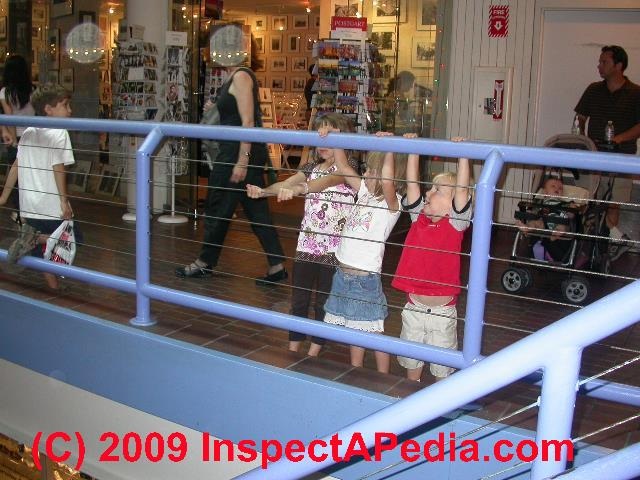
For child safety, the balusters or other decorative infill must be spaced less than 4 inches apart (a 4-inch-diameter ball should not pass between the balusters). [48][49][50][51][52]
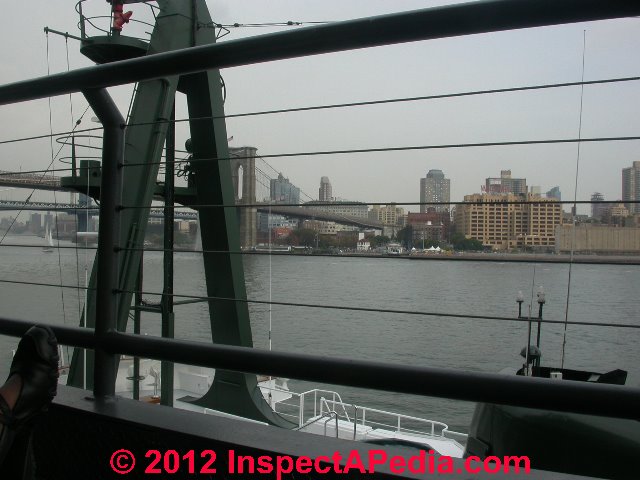
Above (see our first photo of two just above) is an unsafe guardrailing in New York City.
These horizontal cables are notably tempting for climbing by young children, and as I'll demonstrate below, keeping proper cable rail tension may be difficult enough that the opening between cables in this guardrail may be unsafe - too large.
Companies selling cable guardrailings point out that building codes (IBC and IRC) specify that the opening between vertical balusters or between horizontal railings (if the local code official will permit them) must be close enough together that a 4-inch sphere won't pass between them. [45][46][47]
Watch out: For horizontal guardrailing in-fill cables we point out that if the cable can be stretched or is not properly tensioned, the guardrail system may fail this 4-inch sphere test.

In comparison, the guardrailing shown in our ship-board photo above happens to be on a Seattle ferry and resists even active jumping climbing children. The mesh guardrail infill is small enough that little toes and shoes cannot easily climb the guardrail.
Also the largest opening between the bottom-most horizontal cable or guardrail member and an individual stair tread should not pass a 6-inch sphere. At this guardrail the opening was less than 3".
Cable or Wire Rope Spacing & Tension Are Critical for Safe Guardrails
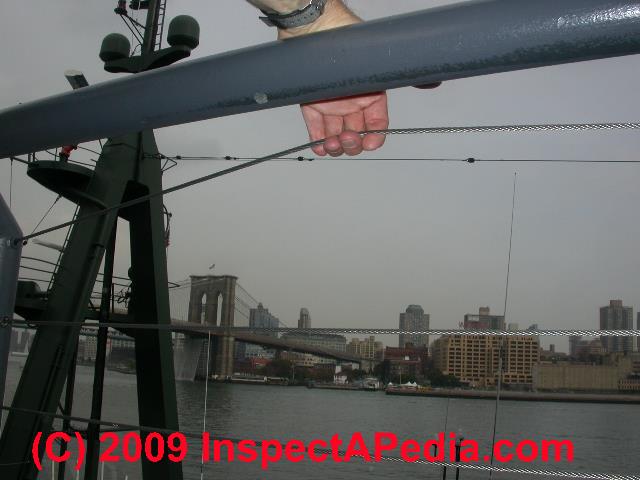
Our photo at above left shows an attractive railing with horizontal cables intended to permit a nice view of the Brooklyn NY skyline. We also demonstrate how easily the cables can be separated as well as how attractive this guard railing is to children.
To have a chance of meeting the 4" sphere rule (maximum sphere passage <= 4 3/8") the cables must be installed with adequate tension and rigidity to prevent deflection by climbing or playing children or other forces that might be anticipated.
If the cable spacing is more than 3" o.c.) or the cable horizontal span is too great, if the intermediate posts spaced too far apart (more than 42" of horizontal distance o.c.), or if the cables are not adequately tensioned, the system may fail this safety test. Using a heavier gauge cable (3/16" diameter instead of the minimum 1/8" diameter) can also add rigidity.
The supporting structural posts and intermediate bracing also need to be strong enough to handle the forces created by properly tensioned horizontal cables. Wagner points out that
An incredible amount of tension is generated on an end post when you have ten or more lines, each tensioned at 400 lbs. over a height of 36" to 42".
Often designers and fabricators inexperienced in cable railings will not recognize the amount of the tension applied to the posts.
The end result all too often is end posts which will bend considerably as the cables are being tensioned…or with a railing where the cables cannot be properly tensioned without an unacceptable amount of post deflection.
The posts to which hardware is mounted must be constructed so that they will not deflect perceptively as the cables are tensioned. [46]
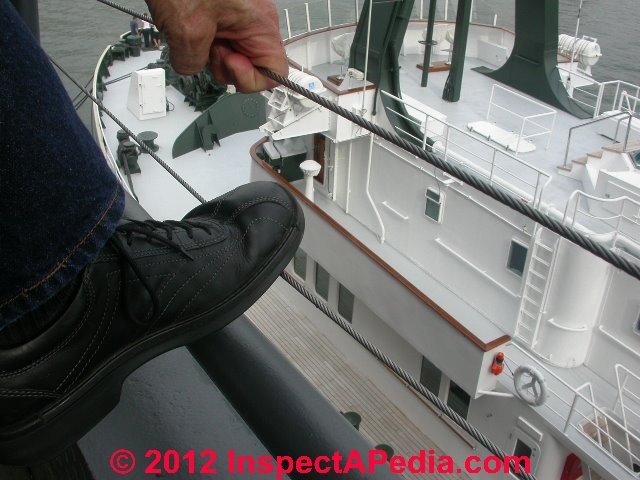
And where we have seen cable "guardrailings" installed, indeed a graspable and solid top rail was always provided. The top rail also provides a rigid horizontal support that prevents the whole system from collapsing as vertical posts would bend inwards as the horizontal cables are tightened.
Also, regular inspection of the tension and security of the cables is something I'd recommend, particularly in public areas where the system may be subjected to climbers and pushers.
At left we illustrate that these horizontal cables were very resistant to opening, and considerable force was required to cause enough deflection to pass a 4-inch sphere. Notice that a heavier gauge cable diameter was used (3/8"), adding to the cable rail's rigidity.
But below we illustrate another (residential) cable or wire guardrailing system that was easily deflected and opened and whose tensioners appear to be of limited ability.
Atlantis points out that using a cable tensioner such as their RailEasy™ device permits on-site cable cutting to proper length and adjustment to proper tension without risking slack sagging cables due to mis-cuts or mis-measurement. The company also describes the proper order of tightening the tension on the horizontal cables, starting at the center cable and then alternating above and below that point as each cable is tensioned. [45]
Just below I illustrate how easily some cable guardrail wires can be deflected with a bit of foot or hand pressure.
My opinion is that even tightening these cables to a specified tension cannot predict how wide an opening might occur when children climb on the cables unless the tension specification also includes factors for both vertical post spacing intervals and the total length of wires or unsupported wires that are used in the cable guardrail.
The cable tensioners illustrated earlier in this article were part of this deflected, cable guardrail.
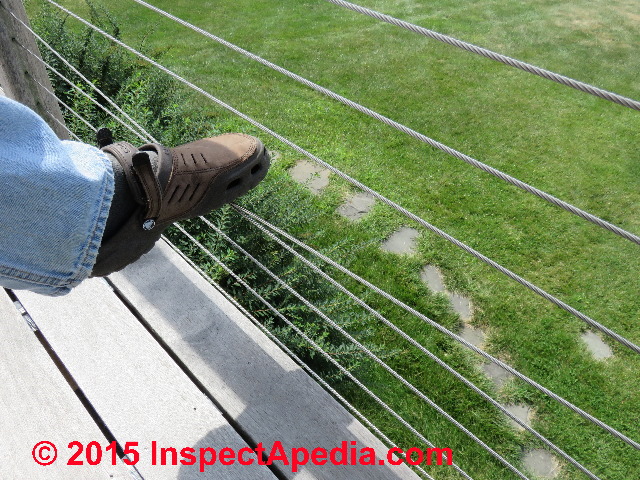
Other tensioning troubles occur: seeking very high tension in an effort to prevent spreading of the cables by children who may then might pass through the guardrail can bend posts or dislodge them unless the posts are of sufficient strength.
 The Ladder Effect of Horizontal Cable Railings - Safety Issues
This topic has moved to a separate article. See CLIMBABILITY of GUARDRAILS: the LADDER EFFECT - separate article
Research on Child Safety vs Cable Guardrails or Stair Railings
This topic is now at CHILD SAFETY & LADDER EFFECT
References on cable guardrailings, cable railing safety, design, construction & spacing specifications
This material is now at CABLE RAILING SAFETY RESEARCH
Reader Comments, Questions & Answers About The Article Above
Below you will find questions and answers previously posted on this page at its page bottom reader comment box.
Reader Q&A - also see RECOMMENDED ARTICLES & FAQs
On 2020-09-26 - by (mod) -
JD
Please see RAILING CODES in the ARTICLE INDEX
On 2020-09-25 by JD
Do cable railings conform to DOB residential code in NYC? If so, can you please point me to a citiation?
On 2018-11-27 Mark E. said:
do the job right and it's fine says a cable railing installer
Our company has been installing horizontal cable railings for years and have never had issues with kids being able to get their heads between cables or even close. We always do our cables with a 3" spacing and only 4-5' feet between posts. If your spacing is right and the cables are tightened properly, you'll never run into issues with these types of railings. Once a system is installed and has time to settle, it's always recommended to go back through and double check the tension. Just like guitar strings, cable can stretch a bit after it's installed.
Hardware is important as well, if you don't have quality hardware it could lead to the tension on cable loosening over time. We've bounced around to a bunch of different suppliers until we found ... Materials - they have really good prices on the products they offer. We've always been able to get quick help from them as well.
Watch out: even properly tensioned and spaced cable railings do nothing to eliminate the child climbing hazard.
On 2017-08-21 by (mod) - Even stretched tightly, over a wide span the cables can be separated and a child's body can pass through.
PS: Jim:
You commented on a cable railing article where you won't see vertical balusters and where even vertical cables would be unusual. I consider cable rails not the safest guard where there are small children around - that's why I included photos I've taken of kids climbing the horizontal cables.
Even stretched tightly, over a wide span the cables can be separated and a child's body can pass through.
Further, and a mere OPINION, I've often see installations were cables were installed too loosely or where no one was checking to keep them tight. There are photos of those conditions too.
On 2017-08-21 by Anonymous - balusters must be 4 ft o.c. for safety ?
Jim
We almost agree: 4" is the standard and acceptable baluster spacing free area in virtually all building codes and in the research that supports them, probably because no child's head will squeeze through that space, nor a child's body.
I do not agree with the 2 3/4" spacing and in fact my personal experience has found it dangerous. My godson Joshua, as a toddler, managed to step his foot between a pair of such close-spaced balusters. In a panic he twisted, could not get his foot out, and became frightened - even hysterical.
Luckily Josh's mom was close by, heard his screams, and ran to him with enough sense to keep him upright, as a fall could easily have broken his ankle or leg. She called me to come extract him from the foot trap formed by close-spaced balusters.
I love Josh and was anxious for him. I sped through Poughkeepsie, luckily not causing an auto accident enroute to untangle a baluster foot-trapped boy.
Just as I screeched to as top in Josh's driveway, Josh, calmed a bit by the supportive attention, simply twisted his foot back into the proper orientation and extricated himself from the balusters.
Too-close baluster spacing might be as dangerous as too-wide.
I would much appreciate any research or authorities that you can pass on that now supports your "current specification of 2 3/4" as the maximum guardrail or stairguard baluster spacing. Searching both Google and Google Scholar I could not find supporting research.
Thanks. I very much welcome content criticism, corrections, suggestions for anything you read at InspectApedia.com and I'll appreciate your help in getting us to some authoritative or expert information on the smaller spacing you recommend.
Daniel
Louis (1994) reported on an accident ascribed to too-wide baluster spacings.
Balusters, A., and B. Railings. "BALUSTRADE SYSTEMS SPECIFICATION 06447."
Louis, Dorothy M. "Safety and Health Concerns in Academic and Public Libraries." (1994).
On 2017-08-21 by Jim Abram
For child safety, the balusters or other decorative infill must be spaced less than 4 inches apart (a 4-inch-diameter ball should not pass between the balusters). [48][49][50][51][52] You should be careful when mentioning child safety as 4 inches is not child safe. . The current specification for child safety is a spacing of 2 3/4 inch maximum.
On 2017-08-21 by Jim Abram
For child safety, the balusters or other decorative infill must be spaced less than 4 inches apart (a 4-inch-diameter ball should not pass between the balusters). [48][49][50][51][52]
On 2017-07-05 by Larrie Bast
What is the building code number for commercial cable hand railings
On 2017-06-26 by T-Roy
how much of a gap should be between the cables?
I am building a deck on the back of my house and was wondering for safety reasons.
On 2017-06-12 by (mod) -
The guard has to withstand loading as discussed in this article series. That doesn't translate into a "top rail" per-se. E.g. where glass guards are approved they may have no top rail, just a top edge in the area between posts - in some jurisdictions.
Examples are at https://inspectapedia.com/Stairs/Guardrailing_Strength.php
On 2017-06-12 by Bob H
Structural integrity notwithstanding, is there any requirement (or minimum size) for a top rail (or "rail cap")? My current wooden deck rail, with conventional wooden balusters, has a horizontal top cap (a 2X4 laying flat), plus a second 2X4 (on edge for connecting the balusters to it), so I'm "looking at" a six inch view-blockage of the lake. My desire is to reduce that to as little as possible...safely.
On 2016-12-08 by (mod) - maximum span per cable railing wire
Tom I don't know the maximum span per wire for your specific product - I think it's specified by the manufacturer. I have seen that at least once after installation the wire needed to be tightened. A problem with long cable runs is that the tension on the posts (at ends or corners) between which you're tightening the cable will be subjected to very significant force.
Typical installation specifications require
Support stanchions every 4 feet
or you can add a cable stabilizer between adjacent cables on longer spacings up to 7 ft. (not recommended IMO)
On 2016-12-07 by Tom J
I am considering a 3/8-inch SS wire rope railing (stanchions at 4-foot intervals, rigid cap rail, 8 wire rope courses (non-coated) at 4-inch spacing, terminated by an eye at one end & tensioned by turnbuckle at the other). Nominal spans range from 10 feet to 120 feet. What should be the maximum span per wire? Will the wire rope "relax" after time under tension & need to be tightened up?
On 2016-08-2 by (mod) -
RE-posting
Thanks Steve, I'll be sure that key points in the IRC's position on horizontal "ladder effect" railings (including cable railings) is clear in the article above. Indeed it's both significant and interesting that guidance regarding an obvious child hazard: climbable guardrails, was amended to remove what experts previously agreed was a concern
Perhaps this was a concession to cable railing manufacturers and architects who like horizontal cabling either aesthetically or because the longer horizontal cable-pull runs are manifestly easier and more economical to install. We might both also look for research comparing hazard levels of vertical vs. horizontal cable guardrails that lack adequate tension to prevent deformation and opening.
(2 days ago) Steve Anzelc Dove Inspections said:
This has great history on removal of ladder effect from IRC in 3001
Question: is it necessary to connect the cable guardrail to each baluster?
(May 20, 2015) Anonymous said:
does stainless cable hardware have to be placed on each baluster? How many feet of stainless cable between tighteners to create maximum tension?
Reply:
Anon I cannot answer your tension question about an unknown design, but in general the object would be to support the cable at intervals and tighten it sufficiently that it will meet the guidelines for baluster spacing, head traps, etc. The specifics for your guardrail would have to consider the cable diameter and support spacing intervals as well as area where it's to be used. Note that the article above includes other warnings.
Anon: cable guardrails that are run horizontally extend between posts, not balusters. The post spacing is not specified but rather the post spacing plus cable railing tension should be close enough and tight enough to prevent deflection that exceeds the typical baluster 4-inch spacing guideline; nevertheless, because the horizontal cables are climbable the design is still hazardous for children.
Question:
(June 20, 2015) bibi said:
are cable railing system for front porch legal in new jersey (residential)?
Reply:
No.
Question:
(Oct 11, 2015) jackie said:
Hi I know the cable has to be about 4" apart but does anyone know what the local code is for post to post spacing? I live in orange county CA. I've been looking and can't find that. Spacing b/t cable is easy but what about post to post? Is there a code or is it whatever you feel like spacing them?
Reply:
Post spacing is not illustrated in the model codes that we cite in this article series; rather the post spacing for cable railings will be specified by the manufacturer and are a feature of the cable railing's tensioning system. Typically you'll see more-modest intermediate posts and heavier, reinforced posts at corners where tensioning hardware is installed; on longer runs indeed a reinforced intermediate post or posts may be required for proper cable tensioning.
...
Continue reading at CLIMBABILITY of GUARDRAILS: the LADDER EFFECT or select a topic from the closely-related articles below, or see the complete ARTICLE INDEX.
Or see these
Recommended Articles
- RAILING CODES & SPECIFICATIONS - home
- ADA STAIR & RAIL SPECIFICATIONS
- BALUSTERS, STAIR & RAILING CODES
- CABLE RAILINGS & GUARDRAILS - home
- GUARDRAIL CODES & STANDARDS - home
- GUARDRAIL & HANDRAIL STRENGTH & TESTING REQUIREMENTS
- GUARDRAIL on STAIRS, CONSTRUCTION
- GUARDRAILS on STAIRS, DESIGN
- HANDRAILS & HANDRAILINGS
- RETAINING WALL GUARDRAIL CODES & STANDARDS
Suggested citation for this web page
CABLE RAILINGS & GUARDRAILS at InspectApedia.com - online encyclopedia of building & environmental inspection, testing, diagnosis, repair, & problem prevention advice.
Or see this
INDEX to RELATED ARTICLES: ARTICLE INDEX to STAIRS RAILINGS LANDINGS RAMPS
Or use the SEARCH BOX found below to Ask a Question or Search InspectApedia
Ask a Question or Search InspectApedia
Try the search box just below, or if you prefer, post a question or comment in the Comments box below and we will respond promptly.
Search the InspectApedia website
Note: appearance of your Comment below may be delayed: if your comment contains an image, photograph, web link, or text that looks to the software as if it might be a web link, your posting will appear after it has been approved by a moderator. Apologies for the delay.
Only one image can be added per comment but you can post as many comments, and therefore images, as you like.
You will not receive a notification when a response to your question has been posted.
Please bookmark this page to make it easy for you to check back for our response.
Our Comment Box is provided by Countable Web Productions countable.ca
Citations & References
In addition to any citations in the article above, a full list is available on request.
- Best Practices Guide to Residential Construction, by Steven Bliss. John Wiley & Sons, 2006. ISBN-10: 0471648361, ISBN-13: 978-0471648369, Hardcover: 320 pages, available from Amazon.com and also Wiley.com. See our book review of this publication.
- [2] §3209. Standard Guardrails, California Building Code, provides description of how guard rails should be constructed. Web search 09/02/2011,original source: www.dir.ca.gov/title8/3209.html
- [3] Stephenson, Elliott O., THE ELIMINATION OF UNSAFE GUARDRAILS, A PROGRESS REPORT [PDF] Building Standards, March-April 1993
- [4] "Are Functional Handrails Within Our Grasp" Jake Pauls, Building Standards, January-February 1991
- [5] Access Ramp building codes:
- UBC 1003.3.4.3
- BOCA 1016.3
- ADA 4.8.2
- IBC 1010.2
- [9] Falls and Related Injuries: Slips, Trips, Missteps, and Their Consequences, Lawyers & Judges Publishing, (June 2002), ISBN-10: 0913875430 ISBN-13: 978-0913875438
"Falls in the home and public places are the second leading cause of unintentional injury deaths in the United States, but are overlooked in most literature. This book is unique in that it is entirely devoted to falls. Of use to primary care physicians, nurses, insurance adjusters, architects, writers of building codes, attorneys, or anyone who cares for the elderly, this book will tell you how, why, and when people will likely fall, what most likely will be injured, and how such injuries come about. " - [12] Slips, Trips, Missteps and Their Consequences, Second Edition, Gary M. Bakken, H. Harvey Cohen,A. S. Hyde, Jon R. Abele, ISBN-13: 978-1-933264-01-1 or ISBN 10: 1-933264-01-2, available from the publisher, Lawyers ^ Judges Publishing Company,Inc., www.lawyersandjudges.com sales@lawyersandjudges.com
- [13] Slips, Trips, Missteps and Their Consequences, Gary M. Bakken, H. Harvey Cohen, Jon R. Abele, Alvin S. Hyde, Cindy A. LaRue, Lawyers and Judges Publishing; ISBN-10: 1933264012 ISBN-13: 978-1933264011
- [14] The Stairway Manufacturers' Association, (877) 500-5759, provides a pictorial guide to the stair and railing portion of the International Residential Code. [copy on file as http://www.stairways.org/pdf/2006%20Stair%20IRC%20SCREEN.pdf ] -
- ANSI A1264.2
- ANSI B101
- ASTM D-21, and ASTM D2047
- UL-410 (similar to ASTM D-21)
- NSFI 101-B (National Floor Safety Institute)
- NSFI Walkway Auditing Guideline (WAG) Ref. 101-A& 101-B (may appear as ANSI B101.0) sets rules for measuring walkway slip resist
- OSHA - (Dept of Labor CFR 1910.22 does not specify COF and pertains to workplaces) but recognizes the need for a "qualified person" to evaluate walkway slipperiness
- ADA (relies on the ANSI and ASTM standards)
- [45] Atlantis Rail, division of Suncor Stainless, Inc., Atlantis Rail Systems 70 Armstrong Road Plymouth, MA 02360 Telephone: 508-732-9191 Toll free: 800-541-6829 Fax: 508-732-9798 Email: info@atlantisrail.com http://www.atlantisrail.com/cable-railing-how-to
- [46] The Wagner Companies 0600 West Brown Deer Rd. Milwaukee, WI 53224 Tel: 1-888-243-6914 Email: info@mailwagner.com Website: http://www.wagnercompanies.com http://www.wagnercompanies.com/site/Viewer.aspx?iid=1498&mname=Article&rpid=525
- [47] Keuka Studios: 1011 Rush Henrietta Town Line Rd. Rush, NY 14543 Phone: Toll Free (855) 454-5678 Main: (585) 487-6148 Fax: (585) 487-6150 E-mail: Jason@Keuka-Studios.com http://www.keuka-studios.com/
- [48] Building Code Rules for Stair Rail Cables - Wire Rope Guardrails & Stair Railings UBC 1003.3.3 1997
- [49] The International Building Code (IBC) International Residential Code (IRC)
- [50] ISO 9001:2008
- [51] 1003.3.3.11.3 Handrail grasp ability. Handrails with a circular cross section shall have an outside diameter of at least 1.25 inches (32 mm) and not greater than 2 inches (51 mm) or shall provide equivalent grasp ability. If the handrail is not circular, it shall have a perimeter dimension of at least 4 inches (102 mm) and not greater than 6.25 inches (159 mm) with a maximum cross-section dimension of 2.25 inches (57 mm). Edges shall have a minimum radius of 0.125 inch (3.2 mm).
- [52] BOCA National Property Maintenance Code 1993:
- PM-305.5 Stairs and railings: all interior stairs and railings shall be maintained in sound condition and good repair.
- Commentary: Handrails, treads and risers must be structurally sound, firmly attached to the structure, and properly maintained to perform their intended function safely. During an inspection the code official should inspect all stringers, risers, treads, and handrails.
- PM-305.6 Handrails and guards: Every handrail and guard shall be firmly fastened and capable of supporting normally imposed loads and shall be maintained in good condition.
- Commentary: This section provides for the safety and maintenance of handrails and guards. See Section PM-702.9 for additional requirements.
- PM-702.9 Stairways, handrails and guards: Every exterior and interior flight of stairs having more than four risers, and every open portion of a stair, landing or balcony which is more than 30 inches (762mm) high, nor more than 42 inches (1067mm) high, measured vertically above the nosing of the tread or above the finished floor of the landing or walking surfaces. Guards shall be not less than 30 inches (762mm) high above the floor of the landing or balcony.
- Commentary: Handrails are required on all stairs more than four risers in height. Handrails cannot be less than 30 inches nor more than 42 inches above the nosing of the treads (see Figure PM-702.9).
- Guards are required on the open side of stairs and on landings and balconies which are more than 30 inches above the floor or grade below. The guard must be at least 30 inches above the floor of the landing or balcony. Guards are to contain intermediate rails, balusters or other construction to reduce the chance of an adult or child from falling through the guard. If the guard is missing some intermediate rails or balustrades, it is recommended that the guard be repaired to its original condition if it will provide protection equivalent to the protection it provided when originally constructed.
- Our recommended books about building & mechanical systems design, inspection, problem diagnosis, and repair, and about indoor environment and IAQ testing, diagnosis, and cleanup are at the InspectAPedia Bookstore. Also see our Book Reviews - InspectAPedia.
- In addition to citations & references found in this article, see the research citations given at the end of the related articles found at our suggested
CONTINUE READING or RECOMMENDED ARTICLES.
- Carson, Dunlop & Associates Ltd., 120 Carlton Street Suite 407, Toronto ON M5A 4K2. Tel: (416) 964-9415 1-800-268-7070 Email: info@carsondunlop.com. Alan Carson is a past president of ASHI, the American Society of Home Inspectors.
Thanks to Alan Carson and Bob Dunlop, for permission for InspectAPedia to use text excerpts from The HOME REFERENCE BOOK - the Encyclopedia of Homes and to use illustrations from The ILLUSTRATED HOME .
Carson Dunlop Associates provides extensive home inspection education and report writing material. In gratitude we provide links to tsome Carson Dunlop Associates products and services.
 | HOME | ABOUT | ASK a QUESTION | CONTACT | CONTENT USE POLICY | DESCRIPTION | POLICIES | PRIVACY | |
| © 2024 - 1985 Publisher InspectApedia.com - Daniel Friedman | |||||||||