
InspectAPedia® FREE Encyclopedia of Building & Environmental Construction, Diagnosis, Maintenance & Repair |
Question? Just ask us! InspectAPedia
|
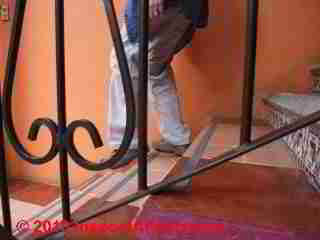 Catch & Snag Hazards at Stair Railings / Guards & Handrailings
Inspecting stairways for snag - trip hazards
- POST a QUESTION or COMMENT on snag or catch hazards along stair railings, guards, or handrails: building codes, regulations & safety
Catch & snag hazards along stairways:
stair rails or stair guards as well as some handrailings may be built with designs or even protrusions that can catch a person's clothes, handbag, or briefcase strap, contributing to a fall.
This article series provides building code specifications, sketches, photographs, and examples of stairway catch and snag safety defects used in inspecting indoor or outdoor stair railings or handrails and related conditions for safety and proper construction.
InspectAPedia tolerates no conflicts of interest. We have no relationship with advertisers, products, or services discussed at this website.
Snag Hazards in Stair Railings or Stair Guards
 Definition of a stair snag hazard
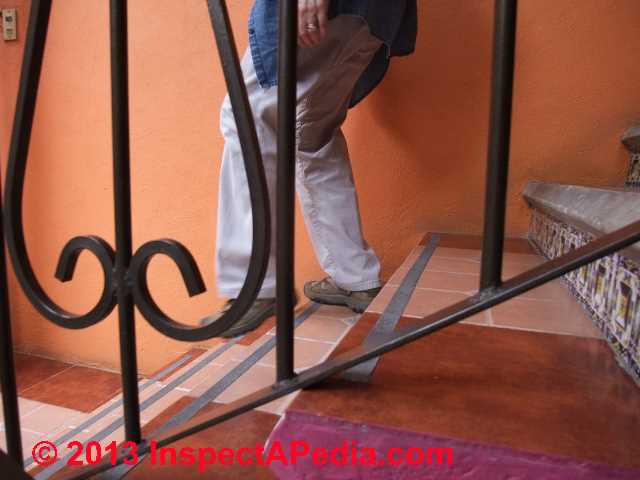
A stairway snag hazard is any projection or construction detail that is likely catch and hold components of a person's clothing or commonly-carried strapped and suspended items (briefcases, handbags), thus possibly causing or contributing to a fall along the stairway.
Let's be clear about the difference between a handrailing and a stair railing or stair guard.
A handrailing or handrail along a stair is intended for a person to grasp to stop a fall or to guide a person.
Handrailing codes do address catch & snag hazards
For handrailings (as opposed to residential stair guards or stair rails)_ there are ample and clear guidelines about handrailing size, height, shape, graspability, mounting, strength, continuity, smoothness etc. Indeed there can be a snag hazard at a handrailing, particularly at the railing ends, which is why handrailing returns are required at those locations.
Details are at HANDRAILS & HANDRAILINGS.
Code Citations Warning of Stairway Snagging Hazards Along Stair Railings or Guards
A guardrailing or stair railing or stair guard, which is what we are discussing here, is a vertical guard erected along the open side of a stairway to prevent people from falling off, and has somewhat different requirements.
The space between the handrailing and the walking surface of the steps is partly (or fully) enclosed for fall-safety, typically using vertical balusters, sometimes with a mid rail. Other guardrail enclosures are permitted such as certified plastic or glass.
A 2013 survey of model residential building codes and building codes for several U.S. states (CA, CT, NY, PA) left us looking for expert citations warning about snag hazards caused specifically by snag hazards along stair railings or stair guards.
Rules for residential stairway handrailing are clear about handrail continuity, projections, smooth graspable surfaces, and returns. But model and state building codes that we surveyed did not explicitly address snag hazards built into the guardrail itself.
We did find some general references to stair rails (railings or guardrails, as distinct from handrails) that imply continuity and smoothness.
Example Residential Building Code for Stair Railings (Stair Guards) do not Explicitly Cite Snag & Catch Hazards
This excerpt is from the Pennsylvania Building Code, § 47.232 shows that even within the codes there can be confusion about whether we are talking about the railing top - being used as a handrail - and the railing itself - being used as a safety enclosure.[39] And search of the entire PA code for "stair AND snag" produced no hits.
(a) Railings shall be not less than 42 inches in height from floor or ground level to the top of the top railing and shall be provided with an intermediate railing the center of which shall be midway between the floor or ground level of the space guarded and the top of the top railing. Railings shall be constructed in a permanent and substantial manner of wood, pipe, metal shapes or metal bars.
Reference should be made to Plates 1, 2 and 3 of the Appendix to this Subchapter. One or more sides may be hinged or supported in sockets if a rigidity equal to that of fixed installation is obtained. Railings shall be smooth and free from large or loose knots, protruding nails, bolts, splinters, fins, slivers and cracks.
All sharp corners shall be rounded and smoothed. The ends of railings shall not overhang the terminal posts unless such overhang does not constitute a projection hazard.
(b) Posts or uprights shall be spaced not more than 8 feet center to center. Reference should be made to Plates 1, 2, 3 and 5 of the Appendix.
(c) Railings made of wood, metal shapes or metal bars shall be placed on that side of the posts or uprights which afford the greatest support and protection. Reference should be made to Plate 3-B,C of the Appendix. - [39]
Similarly the Pennsylvania state building code on stair towers (§ 50.25. Stair towers) also does not describe snag hazards:
(h) Stairways, landings, balconies, open sided floors, and the like shall have well-secured handrails. The clear distance between handrail and wall or other obstruction shall be not less than 1 1/2 inches. Longitudinal rails or balusters or both shall be provided. Balusters shall be spaced not more than 6 inches apart.
Longitudinal rails shall not exceed 6 inches measured at right angles to the rails. The lowest rail shall be measured vertically from the tread nosing. - [40]
OSHA Workplace Building Codes Include Reference to Stair & Railing Snag Hazards
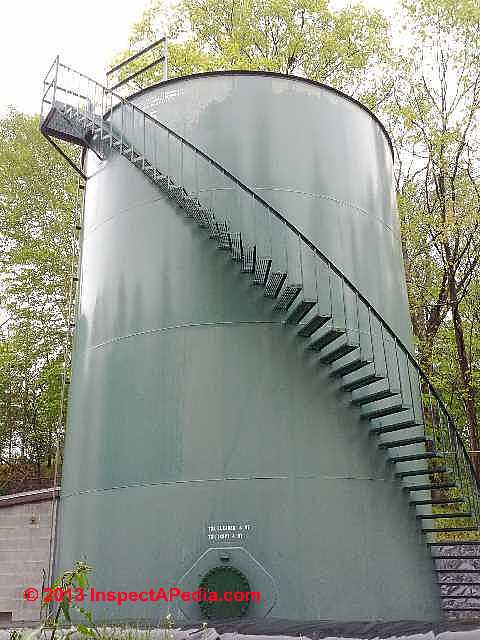
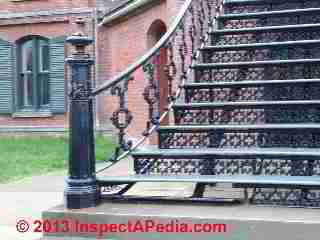
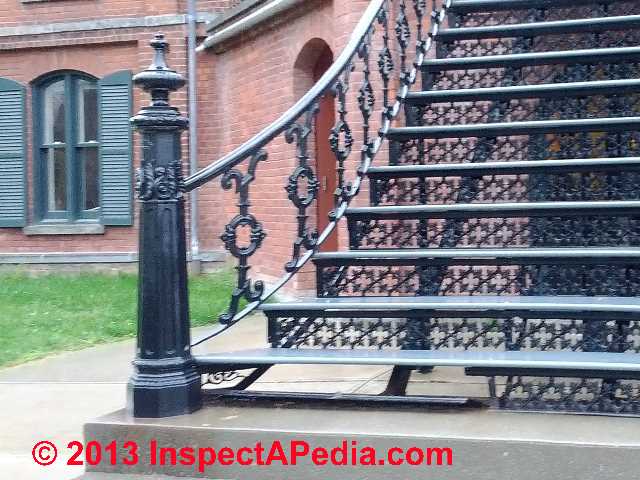
The OSHA code, which pertains to workplaces not residential buildings, does indeed warn about stair railing snag hazards. In our exterior spiral stairway photo at left, these stairs, representing a workplace environment, viewed at least from this distance, are not showing an obvious snag or catch hazard from the stair guard.
From OSHA(1926.1052) Requirements For Stairs
Stair rails must be installed on any stair way with 4 or more risers or rising more than 30", whichever is less.
Must be installed along unprotected or exposed edges of stairways.
Midrails or equivalent must be provided.
Must be able to withstand 200lbs force applied within 2' of top edge.
Top rail must be no lower than 36" or higher than 37".
All parts must be surfaces so as not to cause lacerations or punctures, and not to present a clothing snag hazard. [Emphasis ours]
Unprotected sides and edges of stairway landing must have guardrail system. - [41]
OSHA Stair Snag Safety Hazard Codes & Citations
- OSHA STAIRWAYS AND LADDERS A GUIDE TO OSHA RULES [PDF] (2003) OSHA 3124-12R
2003 - original source: osha.gov/sites/default/files/publications/osha3124.pdf
Excerpt also found in OSHA Safety and Health Regulations for Construction Subpart:1926 Subpart X Subpart Title:Stairways and Ladders Standard Number: 1926.1052 Title: Stairways.
OSHA 1926.1052(c)(8) Stairrail systems and handrails shall be so surfaced as to prevent injury to employees from punctures or lacerations, and to prevent snagging of clothing. - OSHA, WALKING-WORKING SURFACES AND PERSONAL PROTECTIVE EQUIPMENT (Fall Protection Systems), Final Rule, 81:82494-83006, [PDF] (2016) OSHA, retrieved 2022/01/30 original source: osha.gov/laws-regs/federalregister/2016-11-18
Excerpts:
Final paragraph (b)(6), like the proposed rule, requires that employers ensure guardrail systems are smooth-surfaced to protect workers from injury, such as punctures or lacerations, and to prevent catching or snagging of workers' clothing.
...
For example, employers may shape top rails and midrails so snag hazards do not exist.
...
Final paragraph (f)(3) requires that employers ensure handrails and stair rail systems are smooth-surfaced to protect workers from injury, such as punctures or lacerations, and to prevent catching or snagging of clothing, including protective clothing. OSHA revises the final provision to make it consistent with final (b)(6), for guardrail systems.
...
OSHA believes it is necessary to prevent or eliminate projection hazards so workers do not walk or fall into a protruding handrail or stair rail system and get injured. Projection hazards also can snag or catch workers' clothing or equipment and cause workers to lose their balance and fall on, or down, the stairway. A fall on a stairway could seriously injure, or even kill, a worker.
...
Sec. 1910.29 Fall protection systems and falling object protection-- criteria and practices. (a) General requirements. The employer must: ... (6) Guardrail systems are smooth-surfaced to protect employees from injury, such as punctures or lacerations, and to prevent catching or snagging of clothing.
...
(3) Surfaces. Handrails and stair rail systems are smooth-surfaced to protect employees from injury, such as punctures or lacerations, and to prevent catching or snagging of clothing.
Other References to Snag Hazards Along Stair Railings
Leibrock & Terry, in "Exterior Planning, Ramps, Stairs, and Elevators", a discussion of the construction of ramps that are wheelchair accessible, cite the importance of avoiding snag hazards that can catch clothing but also wheelchairs,walkers, etc. but as with the building codes, these writers address handrailings, not stair guards.
Each handrail should have an outside diameter of 1 ¼ in for the strongest and most comfortable grip for both children and most adults.
It must have rounded ends or return to the wall, floor, or post to minimize the chance that it will snag clothing and cause a fall. [42]
Our opinion is that stair guards should be constructed to avoid snag hazards that might catch a person's clothing, bag strap, or briefcase, but there is little doubt that there are many thousands of decorative stairways, especially ones built with wrought-iron detail-work, where this hazard was not considered.
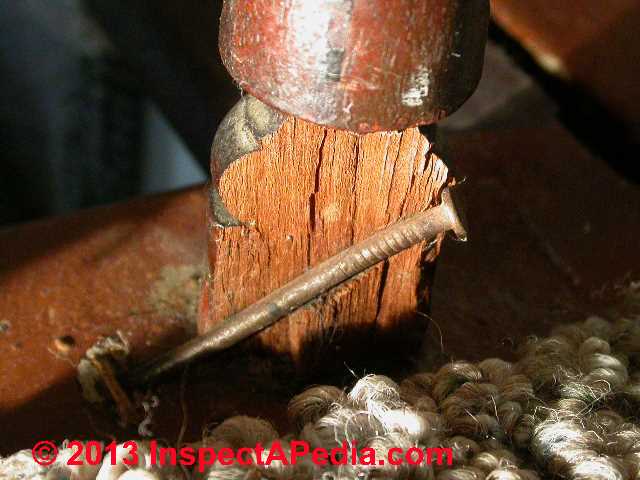
Our potential stairway snag photo above illustrates that grab and trip hazards along a stairway can arise from damage or deterioration, in this case an exposed nail head, not just from ornate scroll work or design details.
The proper construction and physical condition of the stair rail at any stairway should be an important part of the investigation conducted to understand the cause & extent of stair falls and fall-related injuries.
While it is readily apparent that a loose, broken, or defective guardrail on a deck, balcony, or landing can contribute to or even cause a bad fall, we sometimes find that the role of the stairrail in stair fall injuries is underestimated or missed entirely by people investigating such accidents.
Reader Comments, Questions & Answers About The Article Above
Below you will find questions and answers previously posted on this page at its page bottom reader comment box.
Reader Q&A - also see RECOMMENDED ARTICLES & FAQs
Comment: snag hazard at stair guard top
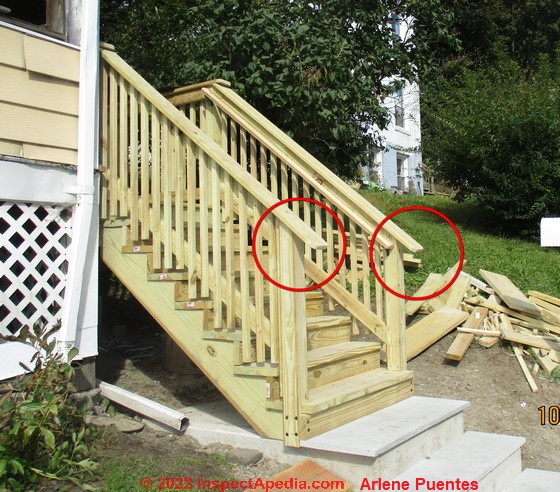 R311.7.8.4 "Handrail ends shall be returned or shall terminate in newel posts or safety terminals."
... this requirement is intended to assure that there isn't a catch for clothing, objects you're carrying or that might snag firefighter or other emergency equipment.
But see my photo: the handrail end returns to the newel post but there's still an end to catch clothing, etc. This handrail passed the local code enforcement inspection.
- Arlene Puentes, Kingston, N.Y.
Moderator reply: importance of local building officials as interpreters of building codes
Although the actual handrail's return (below that top wide flat 1x atop the stair guard) isn't visible we note Arlene's indication that there is a return, but still that flat board at the top of the stair guard forms a "catch" which, though not part of the handrail, could be a snag-hazard - moreso depending on its actual height above the walking surface.
In our OPINION we won't find an exact-reference to this hazard in the codes, that is a prohibition against projecting stair guard tops beyond the top and bottom newell, although there are ample general references to prohibiting "snag hazards" along stairs such as those cited in the model building codes and in OSHA standards given on this page.
Below in a close-up of this stair, handrail and stair guard top we show details of two hazards:
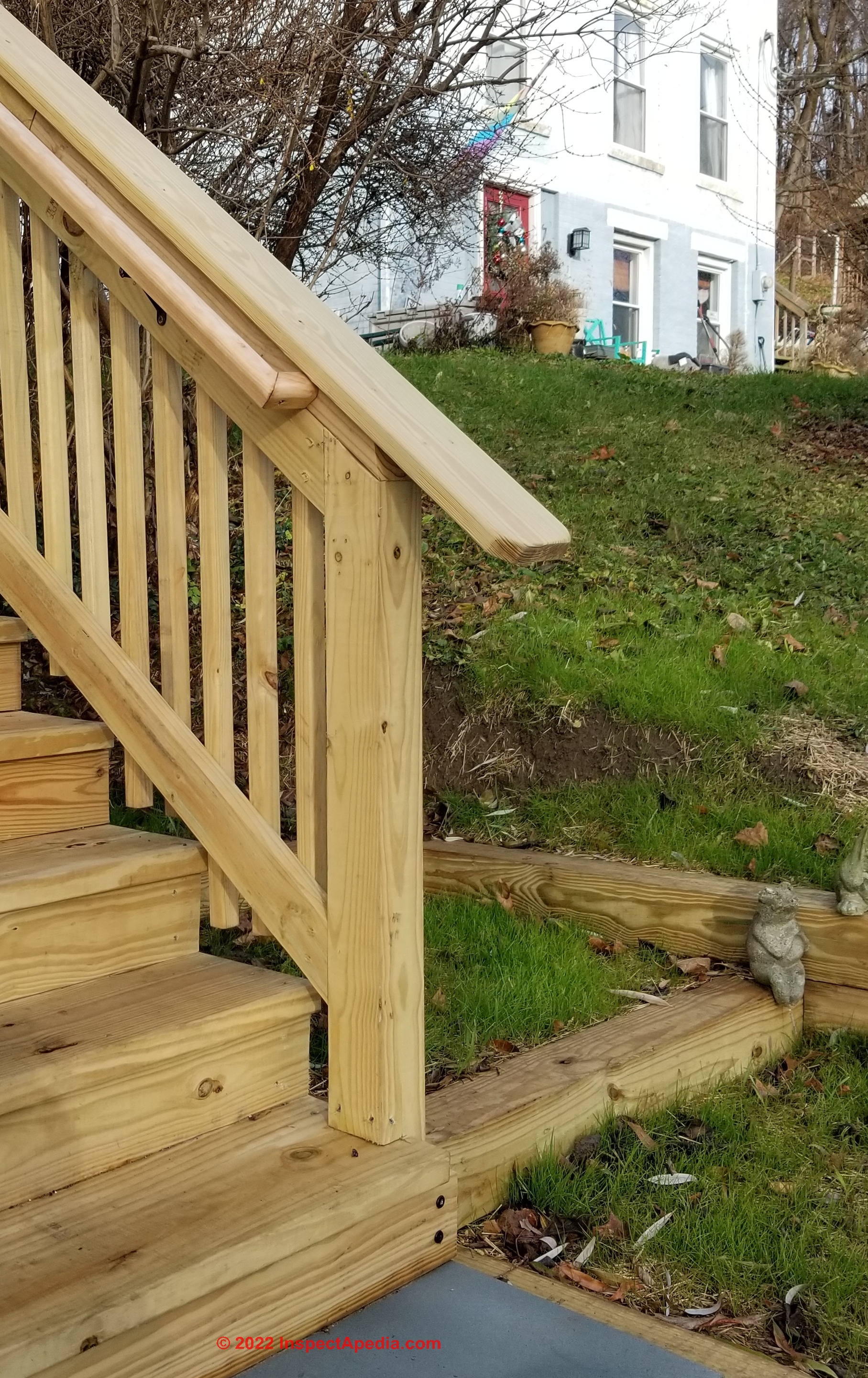
1. the stair guard top forms a snag hazard
The ends of railings shall not overhang the terminal posts unless such overhang does not constitute a projection hazard.
2. the handrail does not extend the full length of the stairway and stops well before the first step and riser.
Handrails shall be continuous the full length of the stairs and at least one handrail shall extend in the direction of the stair run not less than 12 inches (305 mm) beyond the top riser nor less than 12 inches (305mm) beyond the bottom riser.
- Uniform Building Code Stair Specifications: UBC 1003.3.3.6 1
This photo is a great example of why the local building code official is and should be the final legal authority: she has to interpret the intent of the code and to cite accordingly.
Arlene Puentes has served as the City of Kingston's Housing Rehabilitation Specialist, applying grant funds to help low to moderate income homeowners to make repairs on their homes. She is a frequent contributor of technical content at InspectApedia.com.
She can be contacted at October Home Inspections, and holds Five International Code Council Certifications,
New York State DOS Certified Code Enforcement Official
ASHI Member 210232,
NYS Home Inspector License No. 16000095212
...
Continue reading at SLIP TRIP & FALL HAZARD LIST, STAIRS, FLOORS, WALKS or select a topic from the closely-related articles below, or see the complete ARTICLE INDEX.
Or see these
Recommended Articles
- HANDRAIL EXTENSION REQUIREMENTS
- RAILING CODES & STANDARDS - home
- SLIP TRIP & FALL HAZARD LIST, STAIRS, FLOORS, WALKS
- STAIR CODES & STANDARDS - home
- STAIR CODE DETAILS
Suggested citation for this web page
SNAG HAZARDS on STAIRWAYS at InspectApedia.com - online encyclopedia of building & environmental inspection, testing, diagnosis, repair, & problem prevention advice.
Or see this
INDEX to RELATED ARTICLES: ARTICLE INDEX to STAIRS RAILINGS LANDINGS RAMPS
Or use the SEARCH BOX found below to Ask a Question or Search InspectApedia
Ask a Question or Search InspectApedia
Try the search box just below, or if you prefer, post a question or comment in the Comments box below and we will respond promptly.
Search the InspectApedia website
Note: appearance of your Comment below may be delayed: if your comment contains an image, photograph, web link, or text that looks to the software as if it might be a web link, your posting will appear after it has been approved by a moderator. Apologies for the delay.
Only one image can be added per comment but you can post as many comments, and therefore images, as you like.
You will not receive a notification when a response to your question has been posted.
Please bookmark this page to make it easy for you to check back for our response.
Our Comment Box is provided by Countable Web Productions countable.ca
Citations & References
In addition to any citations in the article above, a full list is available on request.
- Eric Galow, Galow Homes, Lagrangeville, NY. Mr. Galow can be reached by email: ericgalow@gmail.com or by telephone: 914-474-6613. Mr. Galow specializes in residential construction including both new homes and repairs, renovations, and additions.
- Thanks to reader Craig Sharp who contributed technical review & clarifications regarding the distinctions among handrailing, stair rail and guardrail 2/1/2-13.
- [1] Yale University Guidelines for Undergraduate Theatrical Productions and Special Events, Yale University’s Office of Undergraduate Productions, Office of the Fire Marshal, and Office of Environmental Health & Safety April 2005, web search 8/9/11, original source: http://www.yale.edu/oup/forms/pdf/guidelines.pdf
- [2] CUE40303 Certificate IV in Live Production, Theatre and Events (Technical Operations), Australian Government, Department of Education, Employment, and Workplace Relations, web search 8/9/11, original source: https://www.training.nsw.gov.au/cib_vto/cibs/documents/cue40303.pdf
- [4] Illustrated theatre production guide, John Holloway, Focal Press, 2002, ISBN 0240804937, 9780240804934
- [5] How to Build Theater Stairs, an Illustrated Guide, Ben Teague, www.benteague.com, Amateur Theatre Division, December 2004, web search 8/9/11, original source: http://www.benteague.com/features/Stairs.pdf
Note that Mr. Teague warns that his designs and advice do not comply with building codes. - [6] OSHA Publication 3124 - Stairways and Ladder, web search 12/21/11, OSHA Publications Office U.S. Department of Labor 200 Constitution Avenue, NW, N-3101 Washington, DC 20210 Telephone (202) 693-1888 or fax to (202) 693-2498. Original source: osha.gov/Publications/ladders/osha3124.html
- [7] Stephenson, Elliott O., THE ELIMINATION OF UNSAFE GUARDRAILS, A PROGRESS REPORT [PDF] Building Standards, March-April 1993
- [8] "Are Functional Handrails Within Our Grasp" Jake Pauls, Building Standards, January-February 1991
- [11] The Stairway Manufacturers' Association, (877) 500-5759, provides a pictorial guide to the stair and railing portion of the International Residential Code. [copy on file as http://www.stairways.org/pdf/2006%20Stair%20IRC%20SCREEN.pdf ] -
[11a] "Visual Interpretation Of The International Residential Code (IRC) 2006 Stair Building Code", The Stairway Manufacturers Association, [Portions of this document reproduce sections from the 2006 International Residential Code, International Code Council, Falls Church, Virginia.},
The Stairway Manufacturers Association website stairways.org provides free downloads of stairway handrailing profiles and dimensions - [12] Slips, Trips, Missteps and Their Consequences, Gary M. Bakken, H. Harvey Cohen, Jon R. Abele, Alvin S. Hyde, Cindy A. LaRue, Lawyers and Judges Publishing; ISBN-10: 1933264012 ISBN-13: 978-1933264011
- [13] Steps and Stairways, Cleo Baldon & Ib Melchior, Rizzoli, 1989.
- [14] The Staircase, Ann Rinaldi
- [15] Common Sense Stairbuilding and Handrailing, Fred T. Hodgson
- [16] Falls and Related Injuries: Slips, Trips, Missteps, and Their Consequences, Lawyers & Judges Publishing, (June 2002), ISBN-10: 0913875430 ISBN-13: 978-0913875438
"Falls in the home and public places are the second leading cause of unintentional injury deaths in the United States, but are overlooked in most literature. This book is unique in that it is entirely devoted to falls. Of use to primary care physicians, nurses, insurance adjusters, architects, writers of building codes, attorneys, or anyone who cares for the elderly, this book will tell you how, why, and when people will likely fall, what most likely will be injured, and how such injuries come about. " - [17] Slips, Trips, Missteps and Their Consequences, Gary M. Bakken, H. Harvey Cohen, Jon R. Abele, Alvin S. Hyde, Cindy A. LaRue, Lawyers and Judges Publishing; ISBN-10: 1933264012 ISBN-13: 978-1933264011
- [18] Slips, Trips, Missteps and Their Consequences, Second Edition, Gary M. Bakken, H. Harvey Cohen,A. S. Hyde, Jon R. Abele, ISBN-13: 978-1-933264-01-1 or ISBN 10: 1-933264-01-2, available from the publisher, Lawyers ^ Judges Publishing Company,Inc., www.lawyersandjudges.com sales@lawyersandjudges.com
- [20] Access Ramp building codes:
- UBC 1003.3.4.3
- BOCA 1016.3
- ADA 4.8.2
- IBC 1010.2
- [21] Access Ramp Standards:
- ADA (Americans with Disabilities Act), Public Law 101-336. 7/26/90 is very often cited by other sources for good design of stairs and ramps etc. even where disabled individuals are not the design target.
- ANSI A117.4 Accessible and Usable buildings and Facilities (earlier version was incorporated into the ADA)
- ASTM F 1637, Standard Practice for Safe Walking Surfaces, (Similar to the above standard
- [24]"The Dimensions of Stairs", J. M. Fitch et al., Scientific American, October 1974.
- [26] The Art of Staircases, Pilar Chueca
- [27 Building Stairs, by pros for pros, Andy Engel
- [28] A Simplified Guide to Custom Stairbuilding, George R. Christina
- [29] Basic Stairbuilding, Scott Schuttner
- [30] The Staircase (two volumes), John Templar, Cambridge: the MIT Press, 1992
- [31] The Staircase: History and Theories, John Templar, MIT Press 1995
- [32] Steps and Stairways, Cleo Baldon & Ib Melchior, Rizzoli, 1989.
- [33] BUILDING, FIRE, RESIDENTIAL CODES - The 2007 & 2010 California Building Code (Part 2), California Residential Code (Part 2.5) and the California Fire Code (Part 9) of Title 24 are available for viewing online via the following International Code Council web site link: California Codes, Title 24, Part 1, 6, 8, 10, 11 & 12 are also available for viewing and download in PDF form on the California website: 2007 Edition of the California Building Codes or see 2010 Edition (Effective Jan. 1, 2011) of the California building codes. For a summary page accessing all of the California building codes see http://www.bsc.ca.gov/pubs/codeson.aspx
- [34] "Guard Rail Height", CREIA, California Real Estate Inspection Association, Website: http://ask.creia.org, web search 8/1/12 original source: http://ask.creia.org/index.php?topic=424.0, December 2009
- [35] California Department of Industrial Relations - CA/OSHA: California Stair & Railing Code details: Subchapter 7. General Industry Safety Orders, Group 1. General Physical Conditions and Structures Orders, Article 2. Standard Specifications, Section 3214. Stair Rails and Handrails, web search 8/1/12, original source: http://www.dir.ca.gov/title8/3214.html
- [36] California Department of Industrial Relations - CA/OSHA: California Stair & Railing Code details: Subchapter 4. General Industry Safety Orders, Article 17. Ramps, Runways, Stairwells, and Stairs, Section 1626. Stairwells and Stairs., web search 8/1/12, original source: http://www.dir.ca.gov/title8/1626.html
- [37] California Building Code, Nonstructural Design Requirements, web search 08/01/12 original source: http://sanbruno.ca.gov/comdev_images/California_Building_Code.pdf
- [38] Uniform Building Code Stair Specifications: UBC 1003.3.3.6 1997 or later specify handrail requirements, railing heights, rail widths, baluster spacing, stairway types, and guardrail specifications.
- [39] Subchapter G. Railings, Toeboards, Open-Sided Floors, Platforms and Runways, Pennsylvania Code,
retrieved 2/7/2013, original source: http://www.pacode.com/secure /data/034/chapter47/subchapgtoc.html [copy on file] - [40] Pennsylvania Code, , 034 Pa. Code § 50.25. Stair towers., retrieved 2/7/2013, original source: http://www.pacode.com/secure/data/034/chapter50/s50.25.html [copy on file]
- [41] OSHA(1926.1052) retrieved 2/7/2013,
- [42] Cynthia Leibrock & James Evan Terry, "Exterior Planning, Ramps, Stairs, and Elevators", Universal Design: Exterior Wheelchair Ramps - Disaboom, retrieved 2/7/2013, original source: http://www.disaboom.com/wheelchair-ramps/exterior-planning-ramps-stairs-and-elevators copy on file]
- In addition to citations & references found in this article, see the research citations given at the end of the related articles found at our suggested
CONTINUE READING or RECOMMENDED ARTICLES.
- Carson, Dunlop & Associates Ltd., 120 Carlton Street Suite 407, Toronto ON M5A 4K2. Tel: (416) 964-9415 1-800-268-7070 Email: info@carsondunlop.com. Alan Carson is a past president of ASHI, the American Society of Home Inspectors.
Thanks to Alan Carson and Bob Dunlop, for permission for InspectAPedia to use text excerpts from The HOME REFERENCE BOOK - the Encyclopedia of Homes and to use illustrations from The ILLUSTRATED HOME .
Carson Dunlop Associates provides extensive home inspection education and report writing material. In gratitude we provide links to tsome Carson Dunlop Associates products and services.
 | HOME | ABOUT | ASK a QUESTION | CONTACT | CONTENT USE POLICY | DESCRIPTION | POLICIES | PRIVACY | |
| © 2024 - 1985 Publisher InspectApedia.com - Daniel Friedman | |||||||||