
InspectAPedia® FREE Encyclopedia of Building & Environmental Construction, Diagnosis, Maintenance & Repair |
Question? Just ask us! InspectAPedia
|
 Choose a Room Air Conditioner - BTU Chart
- POST a QUESTION or COMMENT about how to determine the necessary cooling capacity in BTUs for a room or building area cooled by a window air conditioner or a portable air conditioning unit
Air conditioner BTU requirements: this article provides an air conditioner BTU chart shows how to choose a room air conditioner for window or through-wall mounting.
We provide room air conditioner or window air conditioner BTU sizing & choice charts.
We also show how to actually calculate how much BTU cooling capacity you need based on building area or square feet, and we warn about dehumidification problems if you buy an air conditioner that is too big for the space you are cooling.
InspectAPedia tolerates no conflicts of interest. We have no relationship with advertisers, products, or services discussed at this website.
Typical BTU Cooling Capacity Range for Types of Room Air Conditioners
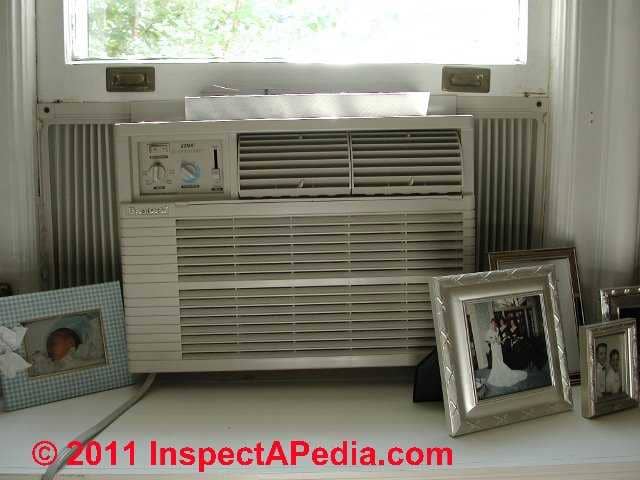
Portable, window, or through-wall air conditioners are typically described by their manufacturer as suited for:
- Single Room Air Conditioner Capacity - typically for rooms up to 20' x 20' or 400 sq.ft. in area. BTUs in this product range are typically from 6,000 BTUh to 10,000 BTUh.
- Portable room air conditioners - 7,500 to 14,000 BTUH, portable, using one or in some cases two flexible ducts to move heat from the room, through cooling coil and the compressor, to outdoors
- Multiple Room Air Conditioner Capacity - typically for a total area of up to 800 sq.ft. BTUs in this product range are typically from 10,000 BTUh to 16,000 BTUh.
- Large Capacity Air Conditioner Capacity - typically for multiple rooms or very large rooms up to a total area from 900 sq. ft. to 2,000 sq.ft. BTUs in this product range are typically from 16,000 to 28,000 BTUh.
- Central Air Conditioning - typically to cool an entire floor or multiple floors in a home.
Also see A/C TYPES, ENERGY SOURCES
Article Contents
Room Air Conditioner Sizing and Choosing Chart
The table below gives recommended air conditioning BTU's necessary to cool a single room. The data in the table assumes that the ceiling over the room is insulated and that the room is not over or is not itself a special heat-producing area such as a kitchen or boiler room.
Table 1: Base BTUs - Recommended Air Conditioner BTUs |
||||||||||
| Number of Rooms Cooled |
Room Area MINimum sq.ft. |
Room Area MAXimum sq.ft. |
BTUs Needed |
|||||||
| One Room | . | 100 | 4,000 - 6,000 | |||||||
| 100 | 180 | 6,000 - 7,500 | ||||||||
| 180 | 270 | 7,500 - 9,000 | ||||||||
| 270 | 400 | 9,000 - 10,500 | ||||||||
| Several Rooms | . | 400 | 10,500 - 12,000 | |||||||
| 400 | 500 | 12,000 - 13,500 | ||||||||
| 500 | 700 | 13,500 - 15,000 | ||||||||
| 700 | 800 | 15,000 - 16,500 | ||||||||
| Large Areas | . | 900 | 16,500 - 18,000 | |||||||
| 900 | 1000 | 18,000 - 19,500 | ||||||||
| 1,000 | 1,100 | 19,500 - 21,000 | ||||||||
| 1,000 | 1,100 | 19,500 - 21,000 | ||||||||
| 1,100 | 1,200 | 12,000 - 22,500 | ||||||||
| 1,200 | 1,500 | 22,500 - 24,000 | ||||||||
| 1,500 | 1,700 | 24,000 - 25,500 | ||||||||
| 1,700 | 1,900 | 25,500 - 27,000 | ||||||||
| 1,900 | 2,200 | 27,000 - 28,500 | ||||||||
Notes to the Table Above
Calculating BTU Requirements: instead of using the table above, and particularly where factors may make the table inadequate (examples are given just below) you may want to CALCULATE the BTU COOLING REQUIREMENT using the procedure given below in this article.
Ceiling height variations: BTU capacity tables for air conditioner selection typically assume typical 8 foot ceiling heights in residential spaces.
If your ceilings are significantly higher, say 14 feet or more, you may want to use the next larger room area size when selecting the BTUh capacity needed for your air conditioner, particularly if your building is located in a hot climate with higher heating loads.
Building heat gain rate variations: in locations of high heat gain or high solar gain such as a significant exposure to direct sunlight or many sun-facing windows, or for buildings with little insulation, you may need to select a higher-capacity air conditioner than given by the table.
How To Calculate the BTUs needed to cool a given space: follow this procedure:
- Calculate the total square feet to be cooled: Measure the size of the room (or rooms) to be cooled, to obtain total square feet.
Multiply room length by width for each room and if there are multiple rooms, add the room areas together to get a single number. - Read the Base BTUs needed from Table 1 below
- Add additional BTUs for these factors:
- + 4,000 BTUs for each room below a ceiling or roof which is not insulated
- + 4,000 BTUs for a home or residential kitchen included in the cooled area
- + 1,500 BTUs for each window which receives significant daily sunshine
- + 1,500 BTUs for a room over a kitchen or boiler room IF the kitchen or boiler room is actively producing heat during the cooling period
- + 600 BTUs per person over two, if more than two occupants will be occupying the room during the cooling period
- Subtract BTUs from the total required if these factors are present:
- - 1,000 BTUs if the room is on the shaded side of the building
- Calculate the final total BTUh needed from the above steps. This should place you in the right range of cooling capacity needed. Review the warning below about buying an oversized air conditioner.
How Much Cooling Capacity do we need Per Square Foot of Building Area? How Much Space can a Ton of Cooling Capacity Serve?
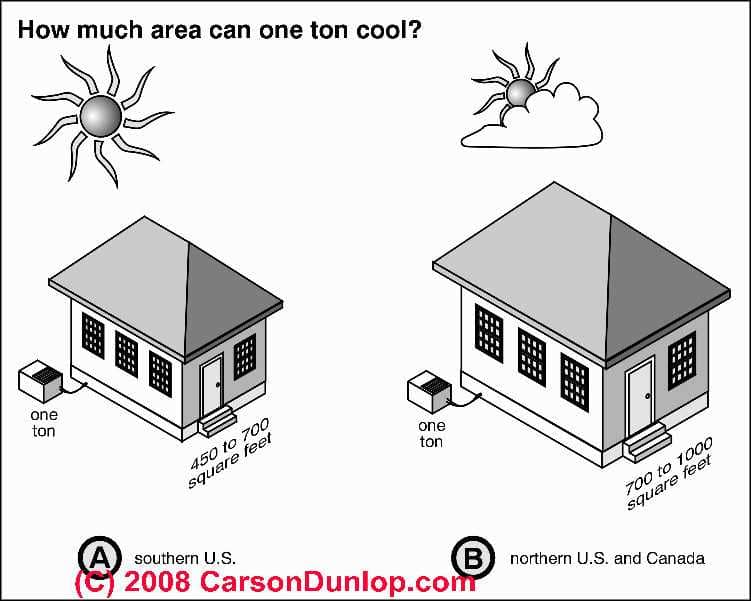
Maybe 450 sq.ft. to 1000 sq.ft. of a typical home can be cooled per ton of cooling capacity: that is, one ton (or 12,000 btuh) of air conditioning can cool about 500 sq.ft. of space. Sketch courtesy of Carson Dunlop Associates, a Toronto home inspection, education & report writing tool company [ carsondunlop.com ].
But the real answer is, it depends. Some of the factors that affect the ability of an air conditioner to cool a space need to be considered besides just the number of square feet. These include at least the following questions about air conditioning load and cooling requirements:
- What are the sun and heat characteristics of the geographic area where the building is located (southern U.S. vs. northern U.S. or Canada, for example)?
- How much direct sunlight is falling on the building?
- Is it bright hot sun or only partly sunny?
- What are the exterior colors of surfaces on which sunlight is falling?
- How well the building is insulated?
- How drafty is the building?
- How many occupants are in the building?
- What other heat sources (or cooling sources) are in the building?
- How high are the interior ceilings?
- How does air circulate within the occupied spaces?
- What defects in the air conditioning system need to be overcome, such as duct system errors or damage, dirty filters, blocked cooling coils, etc. ?
Watch out: Don't Buy an Oversized or "Too Big" Air Conditioner

Watch out: Do not buy an air conditioner which is oversized (too many BTUh) for the area you need to cool. You may think that bigger is better, but not in the case of air conditioning.
To make a room comfortable the air conditioner needs to both cool the room air AND dehumidify the room air.
If the air conditioner is too large for the space to be cooled, the temperature will drop quickly and the A/C unit will shut off before the air has become adequately dry. The room will be either too cold or too humid for comfort. Sketch courtesy of Carson Dunlop Associates, a Toronto home inspection, education & report writing tool company [ carsondunlop.com ].
More detail about how to diagnose and cure an air conditioner that is not dehumidifying can be found
Other types of portable or individual-area air conditioners
- Heating & Cooling units - capable of both cooling or heating a room using electricity. Basically these units are small heat pumps
that are mounted in a building window or wall. Heating/Cooling units will give two different BTUh figures, one for cooling and one for heating.
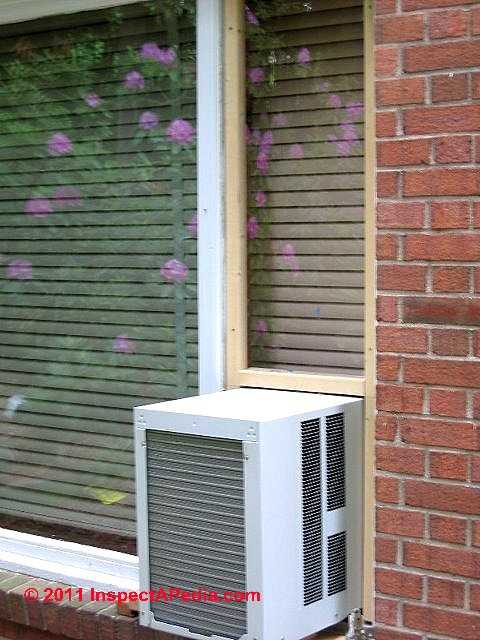
These figures will differ, for example, producing 18,000 BTUh in cooling mode but only 12,000 BTUh in heating mode. The difference between heating and cooling, and the amount of heat actually available will depend also on the outdoor temperatures when in heating mode (as with any heat pump system, the unit cannot provide heat below certain temperatures.)" - Slider or Casement Window units - narrow tall cooling systems which are designed to fit into the narrow space provided by casement or slider windows.
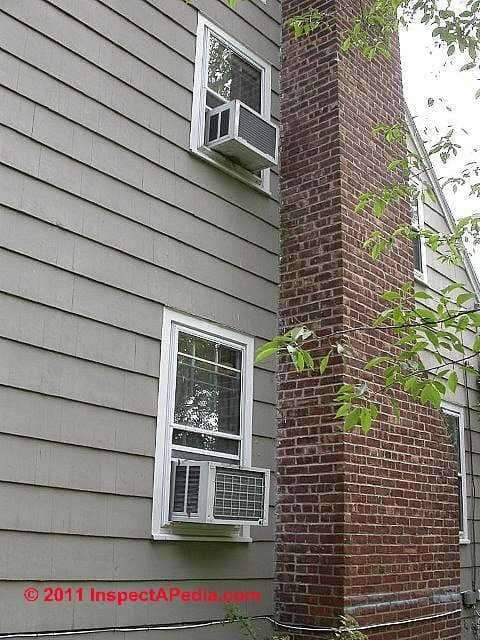
- Through-wall air conditioners - air conditioning units which are designed to be installed into a metal sleeve which is then itself installed in an opening cut into the building wall, leaving windows unobstructed, or perhaps for use in a room without a suitable window in which an air conditioner could be placed. BTU output is typically a bit more than the smallest window air conditioners but otherwise is similar in range.
- Portable room air conditioners - units on wheels which are plugged into an outlet but can be moved room-to-room and do not require a window for their exhaust.
These cooling units are of modest cooling ability, typically around 10,000 BTUh though some producers such as Sunpentown offer units up to 14,000 BTUh.
See PORTABLE ROOM AIR CONDITIONERS for details about portable room air conditioners.
See PORTABLE AIR CONDITIONER BTU CHART for sizing or choosing a portable air conditioner based on room size
How to Determine BTUs or Tons of Cooling Capacity of an Air Conditioner from its Data Tags
- See RATED COOLING CAPACITY for an explanation of how to determine the cooling capacity of an air conditioner that is already installed at a building or go directly to these links within that article:
FROM MODEL # - how to determine the BTU capacity or Tons of cooling capacity of an air conditioner from model number - FROM EQUIPMENT RLA # - how to determine the BTU capacity or Tons of cooling capacity of an air conditioner from the RLA number
- COOLING RULES OF THUMB - how to guesstimate how many tons or BTUs of cooling a building needs
A/C Size Mistakes: units too big or too small
- We discuss the air conditioning system sizing problem at AIR CONDITIONER BTU CHART
- Over-sized air conditioner problems are found at DEHUMIDIFICATION PROBLEMS
- We also introduce the oversized air conditioner problem at LOST COOLING CAPACITY.
- at ADDING A/C: RETROFIT SIZING we discuss home cooling system sizing mis-match on retrofit jobs.
- Also see WINDOW / WALL AIR CONDITIONERS.
Comments:
(Apr 17, 2011) arnold said: very usefull information it helps alot to understands airconditioners performance
(May 3, 2011) nova said: Thanks. Very important information for choosing the right air conditioner. I appreciate that.
(July 22, 2011) Susana said: Finally I found a website with all the information I needed about AC!!! Thank you!
...
Continue reading at BTU SIZING FAQS for AIR CONDITIONERS or select a topic from the closely-related articles below, or see the complete ARTICLE INDEX.
Or see these
Recommended Articles
- BTU CHART for AIR CONDITIONERS / HEAT PUMPS
- BTU CHART for HEATING FURNACES
- DEHUMIDIFICATION PROBLEMS if your A/C or heat pump system is over-sized it may not dehumidfy adequately.
- PORTABLE AIR CONDITIONER BTU CHART
- WINDOW / WALL AIR CONDITIONERS
Suggested citation for this web page
BTU CHART for AIR CONDITIONERS / HEAT PUMPS at InspectApedia.com - online encyclopedia of building & environmental inspection, testing, diagnosis, repair, & problem prevention advice.
Or see this
INDEX to RELATED ARTICLES: ARTICLE INDEX to AIR CONDITIONING & HEAT PUMPS
Or use the SEARCH BOX found below to Ask a Question or Search InspectApedia
Ask a Question or Search InspectApedia
Try the search box just below, or if you prefer, post a question or comment in the Comments box below and we will respond promptly.
Search the InspectApedia website
Note: appearance of your Comment below may be delayed: if your comment contains an image, photograph, web link, or text that looks to the software as if it might be a web link, your posting will appear after it has been approved by a moderator. Apologies for the delay.
Only one image can be added per comment but you can post as many comments, and therefore images, as you like.
You will not receive a notification when a response to your question has been posted.
Please bookmark this page to make it easy for you to check back for our response.
Our Comment Box is provided by Countable Web Productions countable.ca
Citations & References
In addition to any citations in the article above, a full list is available on request.
- Thanks to various industry and air conditioner sales publications and consumer pamphlets including Sears Kenmore(R) air conditioning sales
- Sunpentown International (SPT), 21415 Baker Parkway, City of Industry, CA 91789, 800-330-0388 / 909-468-5288, produces portable room air conditioners. Web search 12/31/2010. FAQ for portable room air conditioners: http://www.sunpentown.com/learnmore.html
- Our recommended books about building & mechanical systems design, inspection, problem diagnosis, and repair, and about indoor environment and IAQ testing, diagnosis, and cleanup are at the InspectAPedia Bookstore. Also see our Book Reviews - InspectAPedia.
- In addition to citations & references found in this article, see the research citations given at the end of the related articles found at our suggested
CONTINUE READING or RECOMMENDED ARTICLES.
- Carson, Dunlop & Associates Ltd., 120 Carlton Street Suite 407, Toronto ON M5A 4K2. Tel: (416) 964-9415 1-800-268-7070 Email: info@carsondunlop.com. Alan Carson is a past president of ASHI, the American Society of Home Inspectors.
Thanks to Alan Carson and Bob Dunlop, for permission for InspectAPedia to use text excerpts from The HOME REFERENCE BOOK - the Encyclopedia of Homes and to use illustrations from The ILLUSTRATED HOME .
Carson Dunlop Associates provides extensive home inspection education and report writing material. In gratitude we provide links to tsome Carson Dunlop Associates products and services.
 | HOME | ABOUT | ASK a QUESTION | CONTACT | CONTENT USE POLICY | DESCRIPTION | POLICIES | PRIVACY | |
| © 2024 - 1985 Publisher InspectApedia.com - Daniel Friedman | |||||||||