
InspectAPedia® FREE Encyclopedia of Building & Environmental Construction, Diagnosis, Maintenance & Repair |
Question? Just ask us! InspectAPedia
|
 Effectiveness of Air Filters
HEPA & MERV Ratings & Particle Size Filtration Rates
- POST a QUESTION or COMMENT about the effectiveness of air filters used on heating & cooling systems: how to assess air filter effectiveness.
Air filter efficiency or air filter effectiveness: definition of measurements of air filter effectiveness:
This article explains and explain various measurements of the effectiveness of different types of air filters for HVAC systems. We explain how to use air filters on HVAC systems, how to reduce indoor airborne dust, debris, pollen, even mold spores or allergens.
We explain and define MERV, HEPA and how to use these air filter ratings when choosing and installing air filters in an air conditioning or heating system. We also discuss the problem of reduced air flow or strangled or air starved air duct systems from over-filtration and how to correct that problem.
InspectAPedia tolerates no conflicts of interest. We have no relationship with advertisers, products, or services discussed at this website.
Measuring air filtration effectiveness - COVID-19 suggestions
 Discussed here: How to Assess the Effectiveness or Efficiency of Air Filters for Heating and Air Conditioning Systems.
Other Steps to Reduce Indoor Airborne Dust & Debris. Air Filter Design Basics: MERV, HEPA, How Air Filters Work. Definition of Air Filter MERV and what MERV means when buying an air filter.
What are typical air filter MERV Rating Values?. Definition of HEPA Filter & HEPA. Should You Install a HEPA or High MERV Filter on my Air Conditioner or Furnace?
Is There Such a Thing as Too-Much Air Filtration? Air-starved or "strangled" air ducts.
Air Filter Recommendations for COVID-19
Current air filter MERV ratings and air filtration suggestions useful during the COVID-19 pandemic were summarized by ASHRAE experts in December 2020, from which we excerpt here:
Why is it important to be talking about filters right now?
Along with the basic need for good IAQ for the good of the people breathing the air and any sensitive equipment in the indoor space, there are many reasons that are extremely relevant in 2020.
a. COVID-19
With the understanding that COVID-19-containing particles can stay in the air long enough to move into the breathing space and into HVAC systems, the desire to filter these particles out of the air is strong.
ASHRAE is recommending that MERV 13 filters be used where possible, with MERV-A 13-A or MERV 14 preferred.
This is pushing the use of higher efficiency filters in many buildings.
For locations that can’t upgrade the HVAC filter or increase outdoor air during winter, in-room units are recommended to add cleaning capability.
These units should include high MERV or better filters to remove most of these virus-laden particles.
b. Wildfires
With global warming, the wildfires seen on the West Coast are likely to be a continuing major problem. Air filters are needed to clean the air to help people breathe in fewer particles. Filters are also often used to help people with allergies and asthma.
c. Energy Costs, Especially with Global Warming
Using appropriate filters can lower the need for bringing in outdoor air. This lowers the costs for heating, cooling and conditioning outdoor air.
The filter used and its pressure drop will be important in determining how much energy savings can be achieved.
Run Your Air Handler to Take Advantage of Improved Filtration
Watch out: in the same article the authors noted that just installing improved air filtration will not improve indoor air quality if the building air is not moved through the filter system. That means running the air handler in heating, cooling, or circulation modes.
For residential buildings occupants may want to simply run their air handler fan continuously for part or all of the day by making use of the FAN ON controls available either on the thermostat or at the fan limit control right in the air handler.
If you're not sure how to do that see
FAN ON AUTO MAN Thermostat Switch
Source: Kathleen Owen, Fellow ASHRAE, member of the ASHRAE Epidemic Task Force, and Carolyn (Gemma) Kerr, Ph.D., Life Member ASHRAE., Debunking Myths About MERV, Air Filtration [PDF], ASHRAE Journal Newsletter, 8 December 2020, original source: https://www.ashrae.org/news/ashraejournal/debunking-myths-about-merv-air-filtration
Effects of a Cascade Air Filter Approach on Indoor Airborne Dust Levels
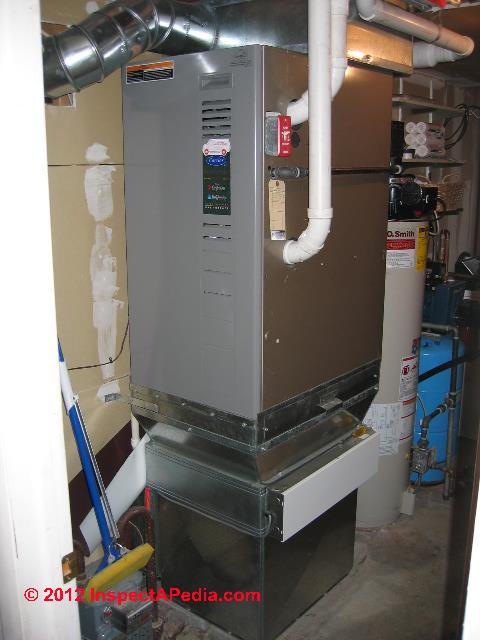
The air filter cascade system installation in our lab (photo at left) provided an opportunity for careful testing of its effect on indoor air quality in the lab, since unlike most building owners, we have an extensive set of indoor air quality monitoring equipment at hand for our IAQ and environmental work.
Details are provided at OPTIMUM INDOOR AIR FILTERS.
This cascade air filter heating system uses four levels of air filtration or cleaning:
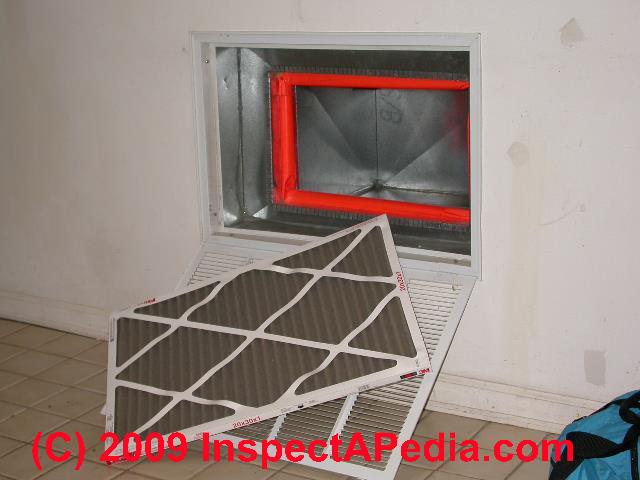
1. a low-cost 1-inch fiberglass or pleated paper air filter at the return air inlet grille (shown at left and represented by arrow #1 in the photo above) - this filter at the front end of the return air flow collects the most dust and debris and is replaced monthly during the heating season
2. A washable metallic air filter - extraneous but included with the system and retained as airflow was not a problem
3. An electrostatic air cleaner - a removable washable element is cleaned every year, more often if inspection shows that's needed.
4. A high efficiency HEPA-rated air filter - because this is the most costly air filter to replace, it was located after the washable electrostatic air cleaner - reducing the frequency with which this filter is replaced to about once a year
The airborne dust levels of all particle sizes dropped dramatically when the new system was installed (and the existing ducts cleaned as part of the project). Airborne particles in the 1-20 micron range were reduced by about 70%.
Simple subjective visual inspection of lab surfaces showed that dust accumulated at a much slower rate. The system was so successful that we made use of the air handler blower assembly and filters to control indoor dust year round.
Other Steps to Reduce Indoor Airborne Dust & Debris
Fix the air quality problem at its source: Properly installed air filtration can definitely reduce the level of airborne dust in buildings, as we have tested and measured in our lab and in other buildings.
But air filtration should not be relied on as a "cure" for sick buildings or for mold contamination.
Rather, it is more important to find and remove the problem source and to correct the conditions that caused the problem in the first place.
For mold concerns, see ACTION GUIDE - WHAT TO DO ABOUT INDOOR MOLD.
The US EPA takes a similar view:
However, air cleaners may not reduce adverse health effects completely in sensitive population such as children, the elderly, and people with asthma and allergies. For example, the evidence is weak that air cleaning devices are effective in reducing asthma symptoms associated with small particles that remain in the air, such as those from some airborne cat dander and dust mite allergens.
Larger particles, which may contain allergens, settle rapidly before they can be removed by filtration, so effective allergen control measures require washing sheets weekly, frequent vacuuming of carpets and furniture, and dusting and cleaning of hard surfaces.
There are no studies to date linking gas-phase filtration, UVGI, and PCO systems in homes to reduced health symptoms in sensitive populations.
That said, good air filtration on central air handling systems combined with our "fix the problem" advice above, can improve indoor air quality significantly.
Air Filter Design Basics: MERV, HEPA, How Air Filters Work
The Definition of Air Filter MERV and what MERV means when buying an air filter
MERV
is an acronym for "Minimum Efficiency Reporting Value".
The MERV rating on an air filter describes its efficiency as a means of reducing the level of 0.3 to 10 micron-sized particles in air which passes through the filter. Higher "MERV" means higher filter efficiency. The purpose of the MERV standard is to permit an "apples to apples" comparison of the filtering efficiency of various air filters.
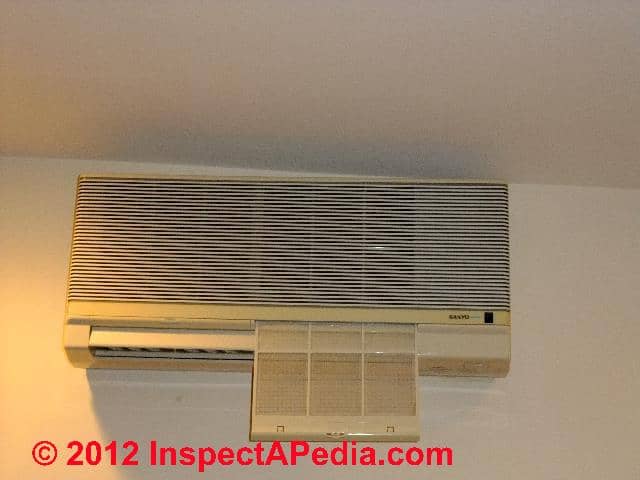
Don't expect the thin washable plastic air filters used on window or split system or portable air conditioners (shown at left) to operate with the same efficiency as more sophisticated filters.
Al Veeck, executive director of the National Air Filter Association has pointed out that MERV includes a broad range of small airborne particles described in 3 ranges:
- E1 - 0.3 to 1.0 micrometers
- E2 - 1.0 to 3.0 micrometers
- E3 - 3.0 to 10 micrometers
An air filter that is effective within the range of 0.3u to 10u will collect even the smallest mold spores (such as Aspergillus sp. & Penicillium sp. and larger particles such as pollen, and upwards to fiberglass insulation fragments.
Air filter efficiency
refers to the relative ability of a filter to remove particles of a given size or size range from air passing through the filter. If a filter were 100% efficient, none of the particles in a given size range would escape the filter and air which has passed through such a filter would contain zero particles.
Also see AIR FLOW RATE TYPICAL CFM Specifications for HVAC equipment.
MERV "Ratings":
Mr. Veeck also points out that MERV is a reporting value, not a filter rating value, although we find frequent referrals to "MERV Ratings" in various publications, including a Wikipedia entry on this topic.
The MERV Efficiency Rating [reporting] Scale
ranges from 1 to 16, with 1 being the lowest efficiency and 16 describing the highest efficiency. The particle size range addressed by the MERV scale is 3 to 10 microns. A logical inference is that if an air filter is removing particles down to 0.3 - 10 microns, it is certainly also at least that efficient at removing larger sized particles.
What are typical air filter MERV Rating Values?
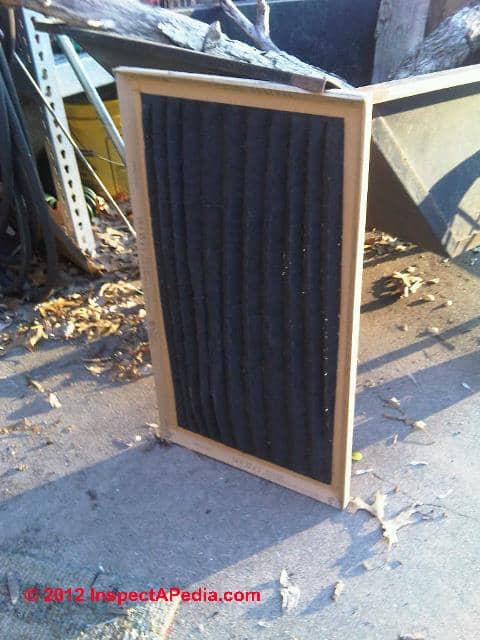
A very low-cost disposable fiberglass furnace filter may have a MERV rating of 1 to 4 - pretty low.
We provide examples of specific air filters and their efficiency
at Air Filter Efficiency, a section of our discussion
of AIR FILTERS, OPTIMUM INDOOR
A medium efficiency MERV pleated air filter
in the range of MERV 5-13 is, according to the US EPA, reasonably efficient at removing small to large airborne particles.
EPA also opines that: "Filters with a MERV 7-13 are likely to be nearly as effective as true HEPA filters at controlling most airborne indoor particles." We can't explain the overlap of these two statements except to speculate that the EPA writer was thinking that the MERV of an air filter is not constant - particle filtration improves as the filter gets dirtier.
EPA adds that medium efficiency air filters are generally less expensive than HEPA filters, and allow quieter HVAC fan operation and higher airflow rates than HEPA filters since they have less airflow resistance.
A high efficiency high MERV pleated air filter
in the MERV 13-16 range would be expected to remove smaller particles between 0.3u and 1.0u in size at about a 75% efficiency.
But before getting too excited about 75% looking not as good at 99.97% (see HEPA filtration discussed below) remember that in a heating or air conditioning system air is being recirculated through the filter system. So if each pass is removing 75% of the particles we want to capture, over time the heating or air conditioning filter system will do a good job of removing a very large amount of airborne dust.
This is exactly what we saw when we tested some filtering approaches in our forensic laboratory. The longer we ran the air handler fan the more dramatically we saw the airborne dust level drop in the test area.
The US EPA points out that higher efficiency filters with a MERV of 14 to 16, sometimes misidentified as HEPA filters, are similar in appearance to true HEPA filters, which have MERV values of 17 to 20. As you'll read below, you may not want to rush to install a HEPA filter on your central air conditioner or heating system.
What is a HEPA Filter?
The Definition of A "HEPA" rated air filter:
a HEPA filter (High Efficiency Particulate Air [Filter] or better put, High Efficiency Particulate Arresting [Filter])
has to meet more demanding US DOE standards than a high MERV air filter.
True HEPA rated air filters have a MERV of 17-20.
A HEPA filter is required to remove at least 99.97% of airborne particles down to 0.3u in size (in diameter or in their longest dimension). Any filter, high MERV or HEPA, can be expected to filter out larger particles with an efficiency above its rating.
Should You Install a HEPA or High MERV Filter on my Air Conditioner or Furnace?
So do we want to use a high MERV air filter or do we need to install a HEPA filter On our air conditioner or heating system air handler?
A high MERV air filter is much less costly than a HEPA filter and can be more effective over time in a residential or office air conditioning or heating system, but there are two warnings that have to be considered:
- Air filter bypass leakage
if the air filter does not fit properly and tightly, no matter how efficient it is, it may be leaking a significant of air around itself at the mounting, reducing the overall efficiency of the air filtration system. You can see this effect by noticing how much debris collects in the return air plenum behind the filter.
If at each filter change you see that the ductwork or return plenum is pretty clean, the filter is not bypassing much air. Some air filter manufacturers specialize in providing air filters that include a gasket to seal against air bypass leaks. - Air filter density and reduction in airflow:
some air filters may be so dense that the cubic feet per minute of air that can pass through them is reduced drastically.
EPA and also some HVAC designers point out that you won't usually find a true HEPA filter installed in residential HVAC ductwork or air handlers. That's because of both the size of true HEPA filters (they won't fit in the air handler) and the air flow restriction (a true HEPA may reduce airflow too drastically in a non-commercial HVAC system).
Before installing a very high MERV or a HEPA filter in your HVAC system, check with your air conditioner or heating system installer or service technician to review the intended air flow rate (in cubic feet per minute) of your system and on the effects of installing a better, more efficient but slower-air-passing filter.
An HVAC technician and some home inspectors have equipment that can easily measure the air flow rate at a given point in the system. In our lab experiments we made certain that the new air blower assembly we were installing and testing was able to move enough cfm of building air with the improved cascaded filter scheme we were testing.
Smaller airborne particles
than those covered by the HEPA or MERV rating might be filtered out with still
higher efficiency.
Their smaller mass means they may "stick" to the filter surface well but some filters, such as the budget lowest-cost fiberglass furnace filters, will pass these small filters right through when they are new, but filter out more of them as the filter surface becomes clogged and dirty with debris (leaving smaller and smaller openings through which air must pass.
Is There Such a Thing as Too-Much Air Filtration?
Will Return Air Vent Filters Suffocate Our Furnace or Air Conditioner?
We have a HEPA filter on both our downstairs and upstairs units. When we had a high efficiency Rheem furnace put in this summer, the technician told me that since I have HEPA filters, I don't needs filters on the return air vents. That it suffocates the system. Can you confirm this? - L.F.
Reply: Maybe
A competent onsite inspection by an expert usually finds additional clues that help accurately diagnose a problem. That said, here are some things to consider:
- Adding too many layers of filters
can, as your HVAC tech suggests, interfere with airflow, making the system have to run longer to satisfy the thermostat and thus increase heating and cooling costs.
You can determine if your HVAC system is "air starved" or "suffocated" with a given filter by having an HVAC technician make appropriate pressure measurements on either side of the air filter or at strategic locations in the duct system. There are some useful "amateur" ways to guess at this problem too.
See RETURN AIR REGISTERS & DUCTS, and if you want to increase air filtration it may be possible to do so by
also RETURN AIR, INCREASE in the HVAC system. - Of course by not filtering at the air returns
over time the system air ducts collect dust and dirt and on occasion you will need to pay for a duct cleanout operation (provided the ducts are metal and can in fact be cleaned). - Not all air filters even with the same particle rating have the same air-flow ability.
For example a deep pleated air filter may be able to pass a greater air flow (measured in cubic feet per minute at a given pressure) than a less-deep filter that actually provides less total filtering surface area. T
hat might be worth researching to see what will fit on your system. - We prefer to filter at centralized return air inlets
to keep the duct system clean, but if the duct system uses individual room return air inlets that can be just too much airflow obstruction. - Also see AIR FILTERS, OPTIMUM INDOOR.
So in sum what you were told is reasonable, but it was not the whole story.
This article series answers almost any question you might ask about air filters for heating or air conditioning systems. We explain how an air conditioning service technician will diagnose certain common air conditioning system failures or defects.
In these articles we are referring to filters installed on central air conditioning or central heating systems that move air through air handlers and duct systems. Standalone "air cleaners" are generally ineffective in buildings.
We include photographs to assist readers in recognizing cooling system defects.
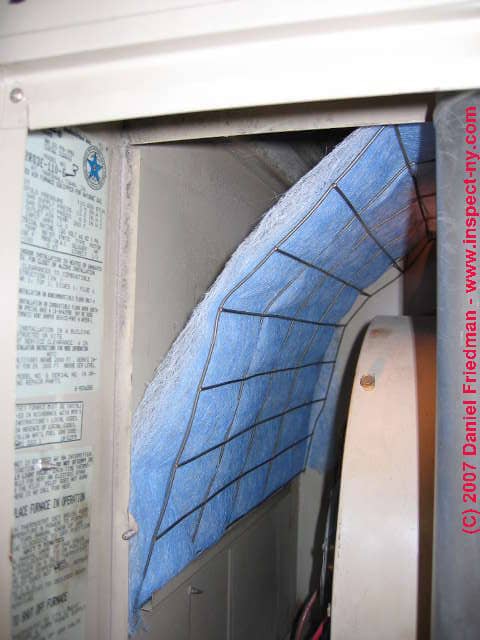
CONTSACT us to suggest text changes and additions and, if you wish, to receive online listing and credit for that contribution. [The page top photograph is of a low-MERV HVAC filter in an air handler.]
HVAC Air Filter Efficiency Research
- Li, Tianyuan, and Jeffrey A. Siegel. "In situ efficiency of filters in residential central HVAC systems." Indoor air 30, no. 2 (2020): 315-325.
- Nassif, Nabil. "The impact of air filter pressure drop on the performance of typical air-conditioning systems." In Building Simulation, vol. 5, no. 4, pp. 345-350. Tsinghua Press, 2012.
Abstract
Filters are used in heating, ventilation, and air-conditioning (HVAC) systems for both commercial and residential buildings to protect the equipment and improve indoor air quality in conditioned spaces. Although there are many benefits of using the air filter in an air-conditioning system, the resistance associated with it can increase fan energy use and may adversely affect air-conditioning system performance and efficiency.
The paper explores the impact of air filtration on energy consumption for a typical air-conditioning (AC) system with constant- or variable-speed fan. A whole building simulation model is used to simulate the annual energy consumption for various air-conditioning system capacities, different levels of filter cleanliness, and various filter minimum efficiency reporting values (MERV).
The results indicate that with a constant-speed fan, the cooling energy use increases as the filter gets dirty over time and the energy use in the fan may increase but this depends heavily on the investigated fan performance curve.
With a variable-speed fan, the fan energy use increases with a dirty filter but the cooling and heating energy uses are slightly affected. The fan energy use rise due to the dirty filter depends mainly on air system capacities, filter MERV ratings, and the degree of the filter cleanliness. - Sainath, Kasuba, Mohd Aamer Khan, Faraz UR Rehman Azhar, Mohamad Ayazoddin, and Mohd Abdul Omer Khan. "Overview of “HVAC Systems” in General Aspects." IJRASET”/Int. J. Res. Appl. Sci. Eng. 2, no. 12 (2014): 558-569.
Abstract:
The Management and Automation of a Commercial building Heating, Ventilation and Air Conditioning (H.V.A.C) System has got enormous benefits from the use of all the available information sources. The modern H.V.A.C using direct digital control methods have provided useful performance data from the building occupants. T
he untapped data can be cultivated with the help of modern maintenance management databases. This research work has got the integration and application of these fundamental sources of information, using some modern and novel techniques.
The cost and scalability of these techniques can be positively influenced by the recent technological advancement in computing power, sensors and databases. The important theme of this research paper is to increase the computational efficiency and practical usefulness of techniques, via some clever approximations.
Keywords: HVAC, Roof Top Units, Package Units, Mechanical Design Contractors, Economizers, HVAC Controls, Integrated Design, Energy Savings. - Walker, Iain S., Darryl J. Dickerhoff, David Faulkner, and William JN Turner. SYSTEM EFFECTS OF HIGH EFFICIENCY FILTERS IN HOMES [PDF] No. LBNL-6144E. Lawrence Berkeley National Lab.(LBNL), Berkeley, CA (United States), 2013.
Abstract:
Occupant concern about indoor air quality (IAQ) issues has led to the increased use of more effective air filters in residential heating and cooling systems. A drawback of improved filtration is that better filters tend to have more flow resistance.
This can lead to lower system airflows that reduce heat exchanger efficiency, increase duct pressure that leads to increased air leakage for ducts and, in some cases, increased blower power consumption.
There is currently little knowledge on the magnitude of these effects. In this study, the performance of ten central forced air systems was monitored for a year. The systems used either a Permanent Split Capacitor (PSC) or a Brushless Permanent Magnet (BPM) blower.
Each system was operated with a range of filter efficiencies ranging from MERV 6 (the lowest currently permitted in ASHRAE Standard 62.2) up to MERV 16. Measurements were recorded every ten seconds for blower power, filter pressure drop, supply and return plenum pressures together with plenum and indoor temperatures.
These detailed continuous measurements allowed observation of filter loading effects as well as the initial change in system performance when filters were swapped. The results of the field measurements were used in simulations to examine more general system performance effects for a wider range of climates.
The field tests showed that system static pressures were highly influenced by filter selection, filter loading rates varied more from house to house than by MERV rating and overall were quite low in many of the homes.
PSC motors showed reduced power and airflow as the filters loaded, but BPM motors attempted to maintain a constant airflow and increased their power to do so. The combined field test and simulation results from this study indicate that for MERV 10-13 filters the effects on energy use are small (<1%) over a wide range of performance conditions and climates.
However, using higher efficiency MERV 16 filters leads to problems in terms of potential for significantly increased energy use (>5%) and usability. In systems using low MERV filters that are already close to blower performance limits the addition of a MERV 16 filter pushed the blowers to their performance limits .
Reader Comments, Questions & Answers About The Article Above
Below you will find questions and answers previously posted on this page at its page bottom reader comment box.
Reader Q&A - also see RECOMMENDED ARTICLES & FAQs
On 2016-09-07 by (mod) - by (mod) - oor air filters can lead to the evaporator coil needing cleaned
Bob:
It would be odd to see no dust whatsoever, ever on an air filter unless the indoor air dust level was very low - such as a nice clean rental without carpeting, pets, and so on.
Even a rough filter that doesn't filter out ultra fine particles down in the 1u range will still collect house dust as that includes larger particles, hair, skin cells, fabric fibers, etc.
Inspect the cooling coil: if you see that it's dust-clogged then the filter may have been left off or may be leaky. Air bypass leaks around a filter can clog the coil as can damaged or dirty duct interior or duct insulation.
A leaky air filter can lead to dust and dirt on the evaporator coil - that needs to be cleaned
On 2016-09-07 by Bob C
In a rental with supplied air filters that never collect dust.
Have read that some of the least effective filters can actually lead to dust build up on the evaporator coil as they trap little to no dust at all.
Also have heard that they actually only work well once they start to trap dust, which could be months.
Are there instances where poor air filters can lead to the evaporator coil needing cleaned and or replaced even if the filters don't get dirty?
On 2014-04-03 by (mod) -
Angela, I haven't seen this issue come up before either, but I don't assume the tech is necessarily blowing smoke as you put it.
I may not understand the question correctly but it seems to me that the air filter is an add-on level of filtration beyond what the electrostatic filter is doing. Take a look at our article on cascading air filters to see if that describes your system:
https://InspectAPedia.com/aircond/Best_Air_Filter.php
Give us the brand and model of your electrostatic air filter and we (or you) ought to be able to read its specifications and operating and maintenance instructions - or to obtain them if you've not already got a copy on hand.
On 2014-04-02 by Angela
We have an electrostatic filtration system on our 90% furnace/14seer a/c system. The tech who was doing our a/c tuneup last week told me the replacement filters we purchased online were only 5000V system approved and our system was 7500V.
It sounds to me like he's shooting smoke up my patoot, as I can't find a single bit of information on the great Google about electrostatic filtration voltage ratings.
But in the interest of not frying my brand new system system, is there any validity to his statement or should I find a new HVAC company to work with?
If the statement IS valid, how do I determine the voltage rating on the filters, I can't seem to find it anywhere. draken.krafte@gmail.com
On 2012-11-20 by (mod) -
Zack,
Assuming you mean does it catch more fine particles, yes ... Up to a couple of thresholds.
Eventually the filter becomes so dirty it reduces the airflow capacity of the system,
And / or
Eventually some filters start releasing chunks of particles from their overloaded surfaces.
On 2012-11-18 by Zack
When an air filter is dirty is it working more efficiently?
Thanks
On 2012-08-04 by (mod) - To keep efficiency at its peak, use the most basic air filtration available
Jake, thanks for an interesting comment. But I'm not sure I agree with your thinking - or at least it may be that some other factors need to be considered.
Example: if we allow excessive dust to enter (through a marginal air filter) the duct work system the effect is deposition of dust on the squirrel cage blower fan blades, resulting in up to a 50% loss of air movement in the system.
So while I agree that housekeeping to minimize avoidable dust is a great idea, I must add that even in a clean home there weill be airborne dust and debris - fabric fibers, skin cells, pollen, road dust and debris; And the more we can keep this out of the ductwork and off of the blower fan the more efficient and effective will be the operation of the equipment when it is cooling or heating the building.
Finally, it is a fundamental part of at least some HVAC systems to include filtration specifically designed to improve indoor air quality by reducing the airborne particulate levels. Rather than subverting the system and giving up those benefits, I prefer to see a design that uses a cascade of air filters (appropriately matched to blower and duct capacity).
This allows a high level of filtration while putting a cheap, disposable air filter at the front end of the system to catch most of the debris - thus reducing system operating cost, keeping performance high, and making maintenance easy and cheap.
On 2012-07-31 by Jake
To keep efficiency at its peak, use the most basic air filtration available with the goal of protecting HVAC equipment only, and a good cleaning company to keep the dust down at the source. Unless overrated blowers are installed to deal with resistance in multiple filtering stages, it's false economy to rely on HVAC equipment to keep dust down.
On 2012-07-10 by (mod) -
Bing, your question reviews an important point - we can't install so much filtration that we block the aystem air flow - doing so reduces cooling effectiveness and efficiency. A flat fiberglass filter indeed offers low restriction on airflow (until it gets dirty);
In our lab, faced with this problem, when we were renovating the system and ductowrk, we made room to install a deep, pleated, high efficiency filter.
The pleated design, by giving more surface area to the moving air, can get back the loss of airflow that would otherwise occur through the more dense, high-filtration surface of the more effective filter.
For a still more effective approach take a look at "Cascading Air Filters" under OPTIMUM AIR FILTERS linked articles at upper page left.
On 2012-07-09 by BingBong
We have been using a cheap fiberglass filter for 7 years. Today we had the pleasant AC guy come out to tell us that we need to not only have our blower motor cleaned, but also our coils pulled out and cleaned as well. Cost .. ridiculous.
When we used the high efficiency filters we couldn't enough air through the system. We used the cheapies.. and they cost us by not filtering out the air enough. Of course the house is 12 years old and system has not ever been serviced. So.. I guess instead of paying yearly, we paid all at once.
On 2012-05-08 by Cooltech
We replace more blower motors, because people use wrong filters. Too much filtration will burn up blower motors, as will not changing your air filters as needed. Over filtering causes lack of air flow and can cause heating failures "over heating exchanger" and cooling failures "indoor coil freezing". More is not better.
On 2012-02-01 by cool
how can i measure the effectiveness of my air filter in aircon. im trying to do a study for my research. the one that have calculated results
On 2012-01-26 by georgegrund@msn.com
I caugh in the morning and there is this white dust on everything. Is this Abestos. I know the building has some in it somewhere but I don't know where?
What should I do. I have One Orek air purifir and one hepa and one inoic breeze still this white dust.
On 2011-07-12 by haitham
rich informations.... thanks alot
On 2011-06-22 by Banatu
Wow, just the information I was looking for and a whole lot more. Thanks!!
Comment: duct system pressure measurements: typically 0.5" w.c.
(July 16, 2015) Daniel F (mod) said:
Filters:
According to Brendon Reid's nice article on this
Filters
If you are really quoting a properly-made HVAC duct system static pressure measurement in inches of water column " wc then your number is a bit shocking. Most residential blowers won't create more than 0.9" wc. Your number sounds high, wrong, and likely to mean that the system is noisy and also return-air starved.
Typically we want to see 0.5 wc static pressure as a general rule of thumb. - see www.achrnews.com/articles/103710-interpreting-duct-static-pressure
- Brendan Reid is President of the Comfort Institute (CI), Bellingham, Wash. CI provides building science training and instruments for whole-house and air-distribution diagnostics and repair. He can be reached at 360-420-5049.
...
Continue reading at AIR FILTER for HVAC SYSTEMS or select a topic from the closely-related articles below, or see the complete ARTICLE INDEX.
Or see
- AIR FILTER LOCATION
- AIR FLOW RATE TYPICAL CFM Specifications for HVAC equipment
- AIR VELOCITY RATES TYPICAL FPM Specifications for HVAC equipment
- AIRBORNE PARTICLE SIZE DEFINITIONS & TYPES
- AIRBORNE PARTICLE SIZE TABLE
- AIR FILTER CLEANER EFFECTIVENESS for a discussion of the effectiveness of indoor air cleaners & purifiers & filter systems
Suggested citation for this web page
AIR FILTER EFFICIENCY at InspectApedia.com - online encyclopedia of building & environmental inspection, testing, diagnosis, repair, & problem prevention advice.
Or see this
INDEX to RELATED ARTICLES: ARTICLE INDEX to BUILDING INDOOR AIR QUALITY IAQ
Or use the SEARCH BOX found below to Ask a Question or Search InspectApedia
Or see
INDEX to RELATED ARTICLES: ARTICLE INDEX to AIR CLEANERS FILTERS PURIFIERS
Or use the SEARCH BOX found below to Ask a Question or Search InspectApedia
Ask a Question or Search InspectApedia
Try the search box just below, or if you prefer, post a question or comment in the Comments box below and we will respond promptly.
Search the InspectApedia website
Note: appearance of your Comment below may be delayed: if your comment contains an image, photograph, web link, or text that looks to the software as if it might be a web link, your posting will appear after it has been approved by a moderator. Apologies for the delay.
Only one image can be added per comment but you can post as many comments, and therefore images, as you like.
You will not receive a notification when a response to your question has been posted.
Please bookmark this page to make it easy for you to check back for our response.
Our Comment Box is provided by Countable Web Productions countable.ca
Citations & References
In addition to any citations in the article above, a full list is available on request.
- National Air Filter Association, Al Veeck, Executive Director, PO Box 68639,
Virginia Beach, VA 23471 Tel: 757.313.7400 Fax: 757.497.1895; Email: nafa@nafahq.org Web: www.nafahq.org/ - comments by email December 2010. Quoting from the association's website:
The National Air Filtration Association (NAFA) is the trade association for the air filter industry and is comprised of individuals and companies engaged in the sale, service and manufacture of air filtration products, worldwide. The Mission Statement of NAFA is "To conduct education and certification programs for members and end-user personnel; to provide forums for the exchange of information about technical standards, government regulations and product information; to educate end-users about the importance of air filtration and NAFA's certifications; to certify air filtration products; to set field performance standards for products; and to explore ways to increase business for NAFA members. - US EPA article on air filter efficiency: epa.gov/iaq/pubs/airclean.html 08/03/2010
- Lennox air conditioning and heat pump owners manuals for air conditioners, air handlers, furnaces, heat pumps, indoor air quality systems, packaged units, water heaters, zone controls and other controls such as thermostats, are provided by Lennox at http://www.lennox.com/support/manuals.asp
- Our recommended books about building & mechanical systems design, inspection, problem diagnosis, and repair, and about indoor environment and IAQ testing, diagnosis, and cleanup are at the InspectAPedia Bookstore. Also see our Book Reviews - InspectAPedia.
- Complete List of Air Conditioning & Heat Pump Design, Inspection, Repair Books at the InspectAPedia Bookstore.
- In addition to citations & references found in this article, see the research citations given at the end of the related articles found at our suggested
CONTINUE READING or RECOMMENDED ARTICLES.
- Carson, Dunlop & Associates Ltd., 120 Carlton Street Suite 407, Toronto ON M5A 4K2. Tel: (416) 964-9415 1-800-268-7070 Email: info@carsondunlop.com. Alan Carson is a past president of ASHI, the American Society of Home Inspectors.
Thanks to Alan Carson and Bob Dunlop, for permission for InspectAPedia to use text excerpts from The HOME REFERENCE BOOK - the Encyclopedia of Homes and to use illustrations from The ILLUSTRATED HOME .
Carson Dunlop Associates provides extensive home inspection education and report writing material. In gratitude we provide links to tsome Carson Dunlop Associates products and services.
 | HOME | ABOUT | ASK a QUESTION | CONTACT | CONTENT USE POLICY | DESCRIPTION | POLICIES | PRIVACY | |
| © 2024 - 1985 Publisher InspectApedia.com - Daniel Friedman | |||||||||