
InspectAPedia® FREE Encyclopedia of Building & Environmental Construction, Diagnosis, Maintenance & Repair |
Question? Just ask us! InspectAPedia
|
 How Air Filters Work
- POST a QUESTION or COMMENT about HVAC filters used to clean indoor air: how filters work to remove airborne particulates and contaminants
How do HVAC air filters work:
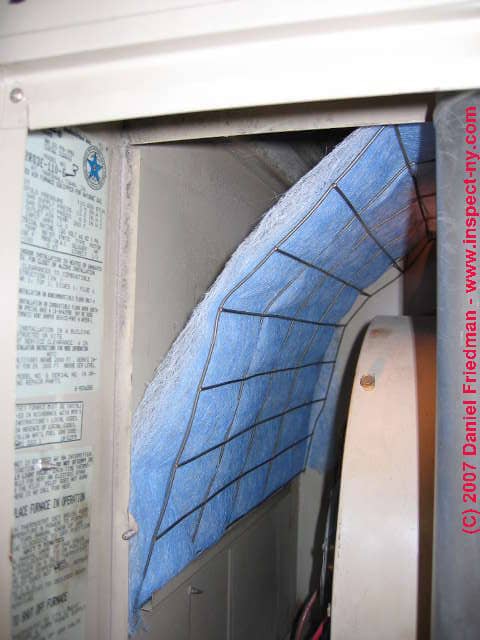
This article explains and explain just how air filters for HVAC systems actually work to trap and remove particles from indoor air. This website answers almost any question you might ask about air filters for heating or air conditioning systems. The page top photograph is of a low-MERV HVAC filter in an air handler.
InspectAPedia tolerates no conflicts of interest. We have no relationship with advertisers, products, or services discussed at this website.
How do air filters actually remove particles from the airstream?

Here we explain the three methods by which HVAC air filters work to capture and remove airborne particle contaminants from building air: impaction filtering, interception filtering, and diffusion filtering.
In these articles we are referring to filters installed on central air conditioning or central heating systems that move air through air handlers and duct systems. Standalone "air cleaners" are generally ineffective in buildings.
In articles at this website we explain how an air conditioning service technician will diagnose certain common air conditioning system failures or defects. We include photographs to assist readers in recognizing cooling system defects.
Contact us to suggest text changes and additions and, if you wish, to receive online listing and credit for that contribution.
Readers should also see
our INDOOR AIR QUALITY IMPROVEMENT GUIDE article series.
This photograph (above-left) shows a soiled surface of a conventional air filter up close. The fibers are clearly visible but not the openings through which air has to pass.
If we look at a high efficiency, high MERV or HEPA air filter under a microscope we'll see a mat of randomly crisscrossed fibers of filter material (fiberglass, polypropylene, paper, or other materials).
The space between the filter fibers will be larger than the smallest particle size which the filter is asserted to remove. So how do these filters stop the small particles? Let's look at three air filtration mechanisms in order of decreasing particle size:
- Impaction filtering: First, some airborne particles smack directly into a filter fiber, either because they happen to be on that unlucky (for them) trajectory or more likely because the particle is so large that it can't pass through the opening, or
part of the particle smacks into the filter fiber.
Air filter scientists call this method "impaction". Impaction captures larger particles which in a HEPA system are those larger than about 0.4u. - Interception filtering: Second, some airborne particles moving in the airstream past the filter happen to be close enough to a filter fiber that
they stick to it.
How close? the particle has to be closer to the filter fiber surface than one radius or diameter of the particle itself. In other words, a 2u particle which is only 1u away from a fiber will probably stick to the fiber.
Air filter scientists call this method "interception". Interception captures particles mostly in the 0.3u size to 0.1u size. - Diffusion filtering: Third, very small particles, say below 1u in size, collide with larger gas molecules swirling around in the air turbulence
caused by air moving by the filter fiber.
This collision, called "diffusion" in filter science, causes the particle to zig zag out of the airstream passing through the filter opening and to stick to the filter surface.
What airborne particle sizes are an IAQ concern?
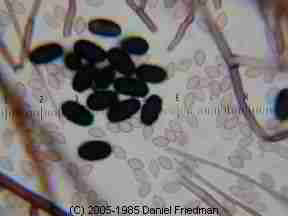
What mold, house dust dust, allergen fragment, mite fecal, cat dander, or other airborne particle sizes are a concern for indoor air quality?
In the photograph shown here the large black Stachybotrys chartarum mold spores can be seen against our eyepiece micrometer which, after calibration, shows that these particular spores were about 7u x 15u in size.
The brownish tubular structures are fungal hyphae. Another, smaller fungal spore is in the background. What's not addressed by some of the science in the air filtration and IAQ field is just what particle sizes are a worry.
In general, larger particles, say 30u or 50u or long fibers, say 200u, are so big that they tend to be filtered in the nose of a human breathing that air. (1u here means 1 micron in size).
A more complete discussion about the size and behavior of problematic indoor air particles which form an indoor air quality concern can be read at AIRBORNE PARTICLE SIZE DEFINITIONS & TYPES.
Reader Comments, Questions & Answers About The Article Above
Below you will find questions and answers previously posted on this page at its page bottom reader comment box.
Reader Q&A - also see RECOMMENDED ARTICLES & FAQs
Question:
(Mar 2, 2015) Jessica Allen said:
How offten should the fliter be checked and changed in a apartment G20 series unit?Is it normal for my heater to click 12 times be for it actually ignites?And every time i hear the ingnite noise what does that mean ? I have lived in this apartment 4 years and just recently it started clicking 12 or 15 times be for my heater kicks on Please help
Reply:
Jessica
On the air filter check and change schedule, the answer is it depends on the filter type and indoor dust level and hours of operation of the system that draws air through the filter. I would start with a monthly inspection. If the filter is not visibly clogged or dirty after the first month, check again in 30 days.
For trouble with the igniters on a gas furnace you should call your heating service technician as there are both reliability and safety concerns involved.
Also prepare your self by reviewing GAS IGNITER DIAGNOSIS & REPAIR
...
Continue reading at MISSING / LEAKY AIR FILTERS or select a topic from the closely-related articles below, or see the complete ARTICLE INDEX.
Suggested citation for this web page
HOW AIR FILTERS WORK at InspectApedia.com - online encyclopedia of building & environmental inspection, testing, diagnosis, repair, & problem prevention advice.
Or see this
INDEX to RELATED ARTICLES: ARTICLE INDEX to BUILDING INDOOR AIR QUALITY IAQ
Or use the SEARCH BOX found below to Ask a Question or Search InspectApedia
Or see
INDEX to RELATED ARTICLES: ARTICLE INDEX to AIR CLEANERS FILTERS PURIFIERS
Or use the SEARCH BOX found below to Ask a Question or Search InspectApedia
Ask a Question or Search InspectApedia
Try the search box just below, or if you prefer, post a question or comment in the Comments box below and we will respond promptly.
Search the InspectApedia website
Note: appearance of your Comment below may be delayed: if your comment contains an image, photograph, web link, or text that looks to the software as if it might be a web link, your posting will appear after it has been approved by a moderator. Apologies for the delay.
Only one image can be added per comment but you can post as many comments, and therefore images, as you like.
You will not receive a notification when a response to your question has been posted.
Please bookmark this page to make it easy for you to check back for our response.
Our Comment Box is provided by Countable Web Productions countable.ca
Citations & References
In addition to any citations in the article above, a full list is available on request.
- Thanks to Mark Cramer, Tampa Florida, for assistance in technical review of the "Critical Defects" section and for the photograph of the deteriorating gray Owens Corning flex duct in a hot attic. Mr. Cramer is a Florida home inspector and home inspection educator.
- Thanks to Jon Bolton, an ASHI, FABI, and otherwise certified Florida home inspector who provided photos of failing Goodman gray flex duct in a hot attic.
- Modern Refrigeration and Air Conditioning, A. D. Althouse, C.H. Turnquist, A. Bracciano, Goodheart-Willcox Co., 1982
- Principles of Refrigeration, R. Warren Marsh, C. Thomas Olivo, Delmar Publishers, 1979
- US EPA article on air filter efficiency: epa.gov/iaq/pubs/airclean.html 06/18/2010
- Wikipedia Web: https://www.wikipedia.org/ provided background information about the definition of HEPA and airborne particle interception.
- Our recommended books about building & mechanical systems design, inspection, problem diagnosis, and repair, and about indoor environment and IAQ testing, diagnosis, and cleanup are at the InspectAPedia Bookstore. Also see our Book Reviews - InspectAPedia.
- Complete List of Air Conditioning & Heat Pump Design, Inspection, Repair Books at the InspectAPedia Bookstore.
- In addition to citations & references found in this article, see the research citations given at the end of the related articles found at our suggested
CONTINUE READING or RECOMMENDED ARTICLES.
- Carson, Dunlop & Associates Ltd., 120 Carlton Street Suite 407, Toronto ON M5A 4K2. Tel: (416) 964-9415 1-800-268-7070 Email: info@carsondunlop.com. Alan Carson is a past president of ASHI, the American Society of Home Inspectors.
Thanks to Alan Carson and Bob Dunlop, for permission for InspectAPedia to use text excerpts from The HOME REFERENCE BOOK - the Encyclopedia of Homes and to use illustrations from The ILLUSTRATED HOME .
Carson Dunlop Associates provides extensive home inspection education and report writing material. In gratitude we provide links to tsome Carson Dunlop Associates products and services.
 | HOME | ABOUT | ASK a QUESTION | CONTACT | CONTENT USE POLICY | DESCRIPTION | POLICIES | PRIVACY | |
| © 2024 - 1985 Publisher InspectApedia.com - Daniel Friedman | |||||||||