
InspectAPedia® FREE Encyclopedia of Building & Environmental Construction, Diagnosis, Maintenance & Repair |
Question? Just ask us! InspectAPedia
|
 Gasketed Air Filters, Dirt in HVAC Systems,
Washable Air Filters
- POST a QUESTION or COMMENT about using gasketed & washable air filters and their effects of dirt & debris in HVAC duct systems.
Gasketed air conditioner or heating filters, leaky air filters, washable air conditioning or heater air filters: This article explains and explain leaky air filters and the value of gasketed air filters, followed by comments on the effectiveness of washable air filters.
This website answers almost any question you might ask about air filters for heating or air conditioning systems.
We explain how an air conditioning service technician will diagnose certain common air conditioning system failures or defects. In these articles we are referring to filters installed on central air conditioning or central heating systems that move air through air handlers and duct systems.
Standalone or portable "air cleaners" or "air purifiers" are generally ineffective in buildings. We include photographs to assist readers in recognizing cooling system defects.
InspectAPedia tolerates no conflicts of interest. We have no relationship with advertisers, products, or services discussed at this website.
The Benefits of Gasketed Air Filters on HVAC Systems
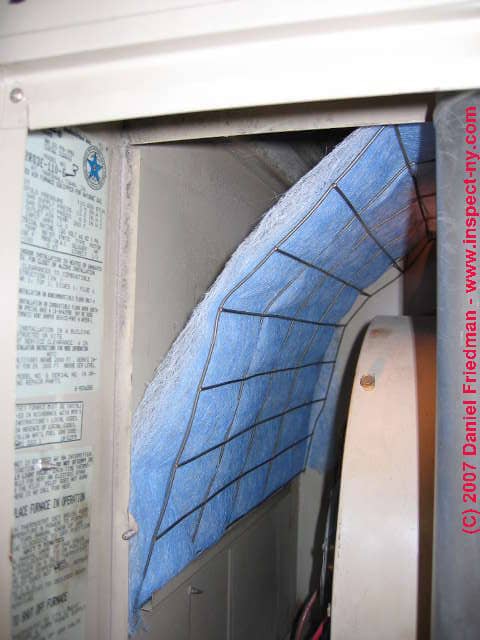
The page top photograph is of a low-MERV HVAC filter in an air handler.
A gasketed heating or air conditioning system air filter improves the filter effectiveness. The benefits of a high efficiency air filter material when used in an air handler and duct system are not fully realized if air bypasses the filter around its installation frame due to poor fit or poor installation.
The filter shown here is not a high quality gasket-type air filter. [Click to enlarge any image]
That's why some manufacturers emphasize the value of air-sealing gaskets on their products.
Simple observations made in the field will make for agreement with the manufacturers that filter bypass is an issue at some heating or air conditioning installations.
When changing an air filter at a return air inlet or at an air handler, when the old filter has been removed, take a look inside the return duct at the return register, or inside the return plenum at the air handler, to see just how much debris is passing the filter.
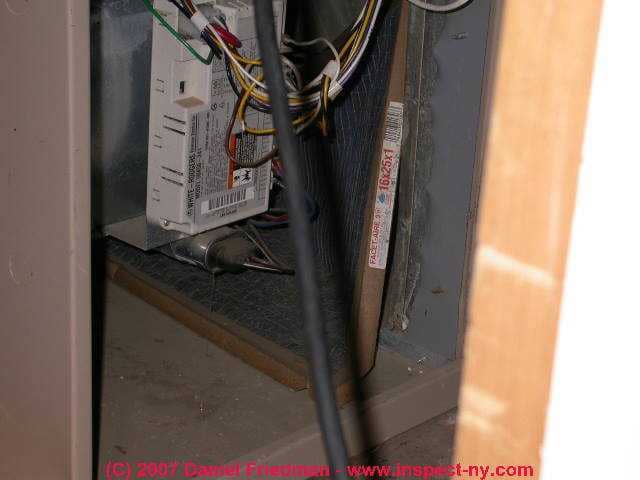
[The photograph above shows how a badly-fit HVAC air filter can not only leak bypass air into the blower compartment but also it can collapse right into the blower fan - this is a potential fire hazard!]
Implications of dust and debris in the return air plenum
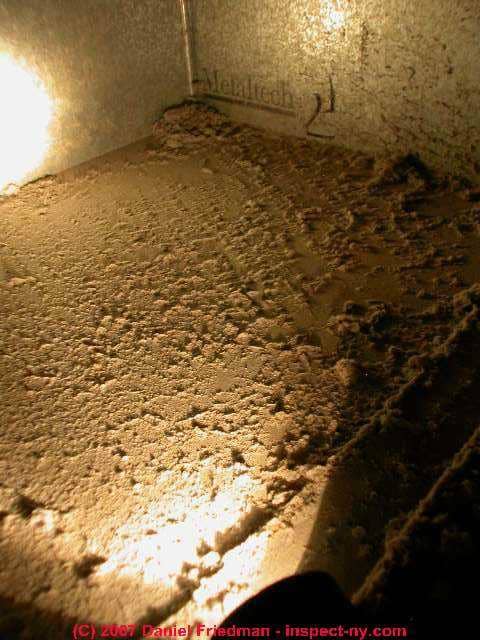
On an old heating or air conditioning system where filters have been ineffective, not properly installed, leaky, or not maintained and changed on schedule, we often find quite a bit of debris entering the air handler and duct system.
This is in fact so common that most HVAC installers and technicians consider dirty ducts to be "normal".
And they're quite correct: typical house dust that has collected inside of a duct system is not normally a toxic substance.
But
1) a high level of dust and debris inside of an air handler or duct system indicates that system filtration has not been effective,
2) the dust level indicates that the system has been delivering dust and debris to the occupants providing poorly-filtered air, and
3) there is an increased risk of mold in the
duct or air handler system if moisture enters the system from a leak or from air conditioning condensate mishandling.
How Good are Washable air filters for heating and air conditioning systems
Washable re-usable air filters are very appealing from a cost viewpoint. I would look for data to indicate whether or not the washable filter runs at a lower MERV or filtering efficiency.

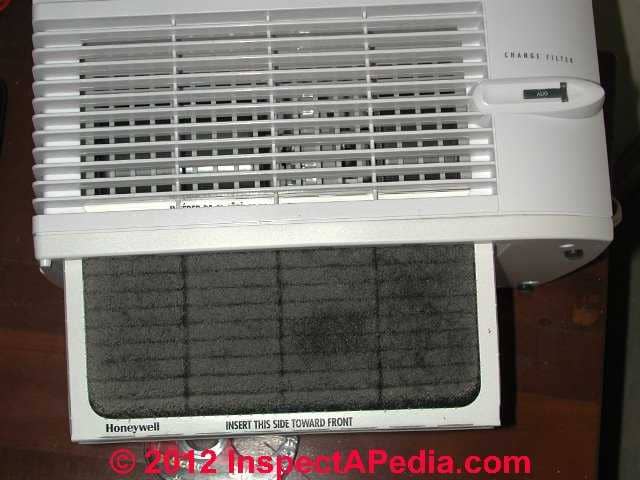
In our cascaded filter proposal (discussed at this website) we included and continued to use a washable filter that came with the equipment since it was not reducing the airflow CFM, but we preceded it with other filters for different purposes.
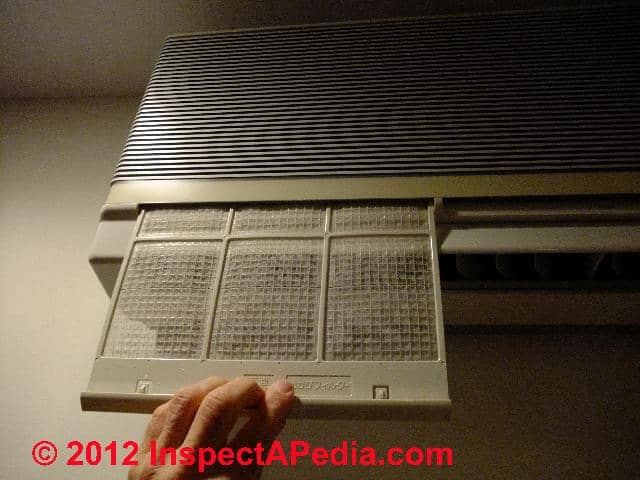
The photograph at above left shows a typical washable metal air filter used in central air conditioning systems, and at above right is a washable foam air conditioning filter used in a portable room air conditioner. Other types of washable air filters are available as well.
At left we illustrate a plastic and nylon washable air filter used in both window air conditioners and in wall-mounted split system air conditioner units.
Unlike the foam type air filter shown above, these plastic and nylon air filters withstand repeated cleaning without disintegrating.
The efficiency of these filters increases as debris begins to settle on the filter surface, but eventually the improvement in air filtration efficiency is offset by reduced airflow - so clean the air filters in accordance with the cooling unit manufacturer's instructions - typically monthly during constant use.
A metallic air filter (shown ) is not very efficient (effective) at trapping airborne particles when it is clean, though efficiency improves as it gets dirty. Other pleated, fabric or paper air filters that are also washable are more efficient at trapping airborne debris.
Be sure to read AIRBORNE PARTICLE SIZE DEFINITIONS & TYPES for a description of the sizes and behaviors of some of the common particles that are an indoor air quality concern.
...
Continue reading at MISSING / LEAKY AIR FILTERS or select a topic from the closely-related articles below, or see the complete ARTICLE INDEX.
Or see these
Recommended Articles
Suggested citation for this web page
GASKETED AIR FILTERS at InspectApedia.com - online encyclopedia of building & environmental inspection, testing, diagnosis, repair, & problem prevention advice.
Or see this
INDEX to RELATED ARTICLES: ARTICLE INDEX to BUILDING INDOOR AIR QUALITY IAQ
Or use the SEARCH BOX found below to Ask a Question or Search InspectApedia
Or see
INDEX to RELATED ARTICLES: ARTICLE INDEX to AIR CLEANERS FILTERS PURIFIERS
Or use the SEARCH BOX found below to Ask a Question or Search InspectApedia
Ask a Question or Search InspectApedia
Try the search box just below, or if you prefer, post a question or comment in the Comments box below and we will respond promptly.
Search the InspectApedia website
Note: appearance of your Comment below may be delayed: if your comment contains an image, photograph, web link, or text that looks to the software as if it might be a web link, your posting will appear after it has been approved by a moderator. Apologies for the delay.
Only one image can be added per comment but you can post as many comments, and therefore images, as you like.
You will not receive a notification when a response to your question has been posted.
Please bookmark this page to make it easy for you to check back for our response.
Our Comment Box is provided by Countable Web Productions countable.ca
Citations & References
In addition to any citations in the article above, a full list is available on request.
- Thanks to Mark Cramer, Tampa Florida, for assistance in technical review of the "Critical Defects" section and for the photograph of the deteriorating gray Owens Corning flex duct in a hot attic. Mr. Cramer is a Florida home inspector and home inspection educator.
- Thanks to Jon Bolton, an ASHI, FABI, and otherwise certified Florida home inspector who provided photos of failing Goodman gray flex duct in a hot attic.
- Modern Refrigeration and Air Conditioning, A. D. Althouse, C.H. Turnquist, A. Bracciano, Goodheart-Willcox Co., 1982
- Principles of Refrigeration, R. Warren Marsh, C. Thomas Olivo, Delmar Publishers, 1979
- Refrigeration and Air Conditioning Technology, 5th Ed., William C. Whitman, William M. Johnson, John Tomczyk, Cengage Learning, 2005, ISBN 1401837654, 9781401837655 1324 pages
- Air Conditioning SEER - New DOE Air Conditioner and Heat Pump Efficiency Standard
- Wikipedia Web: https://www.wikipedia.org/ provided background information about the definition of HEPA and airborne particle interception.
- Our recommended books about building & mechanical systems design, inspection, problem diagnosis, and repair, and about indoor environment and IAQ testing, diagnosis, and cleanup are at the InspectAPedia Bookstore. Also see our Book Reviews - InspectAPedia.
- Complete List of Air Conditioning & Heat Pump Design, Inspection, Repair Books at the InspectAPedia Bookstore.
- In addition to citations & references found in this article, see the research citations given at the end of the related articles found at our suggested
CONTINUE READING or RECOMMENDED ARTICLES.
- Carson, Dunlop & Associates Ltd., 120 Carlton Street Suite 407, Toronto ON M5A 4K2. Tel: (416) 964-9415 1-800-268-7070 Email: info@carsondunlop.com. Alan Carson is a past president of ASHI, the American Society of Home Inspectors.
Thanks to Alan Carson and Bob Dunlop, for permission for InspectAPedia to use text excerpts from The HOME REFERENCE BOOK - the Encyclopedia of Homes and to use illustrations from The ILLUSTRATED HOME .
Carson Dunlop Associates provides extensive home inspection education and report writing material. In gratitude we provide links to tsome Carson Dunlop Associates products and services.
 | HOME | ABOUT | ASK a QUESTION | CONTACT | CONTENT USE POLICY | DESCRIPTION | POLICIES | PRIVACY | |
| © 2024 - 1985 Publisher InspectApedia.com - Daniel Friedman | |||||||||