
InspectAPedia® FREE Encyclopedia of Building & Environmental Construction, Diagnosis, Maintenance & Repair |
Question? Just ask us! InspectAPedia
|
 Air Conditioning Condensate Pumps
Types, Location, Piping, Installation
- POST a QUESTION or COMMENT about the installation, inspection, troubleshooting & repair of air conditioner condensate pump systems used to remove HVACR condensate
Air conditioner condensate pump guide:
This air conditioning repair article discusses the inspection of air conditioning condensate pumps & condensate pump control systems, including their proper installation.
This is part of our installation, inspection, & troubleshooting guide for condensate piping, traps, drains, condensate pumps, and the detection and hazards of air conditioning system condensate leaks in buildings.
InspectAPedia tolerates no conflicts of interest. We have no relationship with advertisers, products, or services discussed at this website.
Condensate Drain Pump Installation & Repair
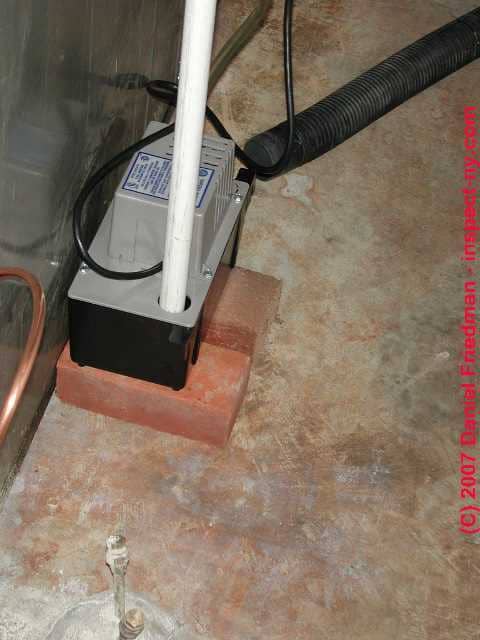 Air conditioner / heat pump, or other condensate pumps are a convenient way to collect and dispose of the condensate produced by an air conditioning system when the air handler/cooling coil are located in a building location where the cooling condensate cannot be drained
away by gravity.
Air conditioner / heat pump, or other condensate pumps are a convenient way to collect and dispose of the condensate produced by an air conditioning system when the air handler/cooling coil are located in a building location where the cooling condensate cannot be drained
away by gravity.
The most common situation is the need to dispose of air conditioner condensate produced by an air handler which is installed in a building basement or crawl space.
[Click to enlarge any image]
Article Contents
- CONDENSATE PUMP OPERATION
- CONDENSATE PUMP LOCATION
- CONDENSATE PUMP ATTACHMENT to AIR HANDLER
- CONDENSATE PUMP SAFETY SWITCH WIRING
- CONDENSATE TRAY SENSOR SWITCH PROBLEMS
- CONDENSATE TEMPERATURES
- CONDENSATE PUMP INSPECTION DEFECTS
- CONDENSATE PUMP MANUALS & SOURCES - manufacturers & where to buy a condensate removal pump
How an Air Conditioner Condensate Pump Works
Air conditioner condensate is water removed from the building air as that warm, moisture-containing air moves across the cooling coil in the building's air conditioning system's air handler or blower unit. The photograph shown here is of a common air conditioner condensate disposal pump.
It's a little hard to see the pump's drain tube but it's that clear plastic tube in the upper left of this photo. If you are really alert you may have noticed those two capped-off copper tubes protruding from the concrete floor in the foreground of this photo.
This pair of tubes is a convincing indication that there was an oil tank, probably a buried oil tank, installed at this property - a topic that needs further investigation. See OIL TANKS, our oil storage tank information article, for details on that topic. Don't let our focus on any individual building concern make us miss another, possibly important discovery.
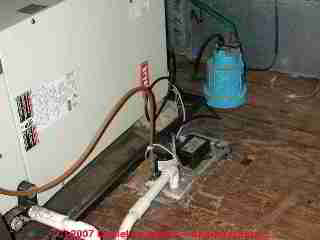
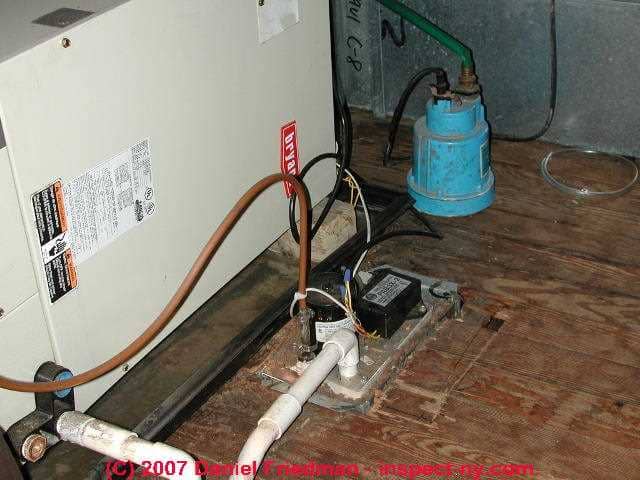
The air conditioner condensate pump photo at the very top of this page shows an air conditioning condensate pump installed in an attic where it was used to move condensate across to a final condensate disposal point.
The white piping is a gravity drain that moves condensate from the attic air conditioner air handler down into the condensate pump reservoir.
We can't see much of the condensate reservoir because the installer placed this pump down into the attic floor (so that she could drain condensate into it by gravity).
The copper tube looping in the air is the drain line through which the condensate pump is moving condensate out of its reservoir to a disposal point. You can also see the black electrical wire bringing power to the condensate pump. The black round motor with a white label is the motor that powers the condensate pump.
The black rectangular device is a voltage transformer that converts the building's 120V to the voltage needed by the pump motor.
In the background of this interesting photograph ,we see a blue sump pump with a green garden hose connected to it. We surmise that the owner had previously tried to use this sump pump to remove condensate from the attic air handler. Stains suggest that the attic floor has previously been wet by air conditioner condensate spillage, perhaps leading to the more careful condensate pump installation shown here.
Sequence of Steps in the Operation of an Air Conditioner Condensate Pump
- Moisture laden warm air moves across the cooling coil
in the air conditioner. As the air is cooled, moisture leaves the cooler air and condenses on the surface of the cooling coil. - Moisture on the surface of the cooling coil drips
into a collector tray inside the air conditioner's air handler or blower unit - Moisture, or now we'll call it water or air conditioner condensate, flows
out of the collector tray into a drain opening and downwards in a pipe or perhaps a flexible tube where the water is conducted to the entry opening of an air conditioning condensate pump unit. - The air conditioner condensate pump includes a small water reservoir
which receives the condensate from the air conditioner.
As the water level rises inside this small reservoir a float switch located there is lifted by the rising water. - When the water level inside the air conditioning condensate pump rises to a nearly full level,
the float switch turns on a small electric motor (the air conditioner condensate pump requires electricity to work and has to be plugged in). - The air conditioner condensate pump motor and pump move water out
of the air conditioner condensate pump reservoir upwards in a drainage pipe or tube, usually flexible plastic tubing. - The air conditioner condensate pump drain tube conducts the water
produced by the system upwards to a building drain or in some conditions, outside, where it is disposed of as wastewater.
Proper and Improper Places to Route and Connect an Air Conditioner Condensate Pump Drain Line
Here is an excerpt from the Uniform Mechanical Code pertaining to the disposal of air conditioning condensate: "Section 310.0, 310.1 Condensate Disposal.
Condensate from air washers, air cooling coils, fuel-burning condensing appliances, the overflow from evaporative coolers and similar water supplied equipment or similar air conditioning equipment shall be collected and discharged to an approved plumbing fixture or disposal area.
If discharged into the drainage system equipment shall drain by means of an indirect waste pipe.
The waste pipe shall have a slope of not less than 1/8 inch per foot (10.5 mm/m) or one percent slope and shall be of approved corrosion-resistant material not smaller than the outlet size as required in either Section 310.3 or 310.4 below for air-cooling coils or condensing fuel-burning appliances, respectively.
Condensate or waste water shall not drain over a public way.
To clarify, an indirect waste pipe is something that is upstream of a trap. That means we cannot dump into anything downstream of a trap. That would include the main plumbing vent stack - a common error in disposing of air conditioner condensate in attic installations. [Thanks to Al Carson, Carson Dunlop Associates, Toronto]
Acceptable methods to dispose of air conditioning condensate from a condensate pump
- Building drains with an air gap:
The air conditioning condensate pump drain line should be routed to a building drain using an air gap such as that which is used by washing machines.
Often we'll see the AC condensate drain line simply routed over to a washing machine drain in the basement. - A building sump pump:
often the air conditioning condensate pump drain line is routed across a basement to a basement sump pump system where the condensate wastewater joins other water which is collected and pumped out of the building by a larger sump pump.
Air conditioning condensate drain connections which are not recommended or are not best practice
- Air conditioner condensate spillage on basement floors
is often found where an installer simply places the condensate pump drain line on the building floor where it ends near a floor drain.
The nice feature of running condensate into a floor drain is that during the cooling season we're assuring that we keep the floor drain trap (let's hope there's a trap) primed with water, avoiding a sewer gas backup.
Of course this means in dry weather or winter weather when the air conditioner is not running and the trap dries out, we may have a problem with radon or sewer gases entering through the dry floor trap.
But a more common problem we find is that the plastic drain tube has been kicked aside and we see condensate running across the floor. In some buildings we've found that this wet condition has caused damage to building flooring, paneling, or drywall, leading to a mold contamination problem. - Airtight drain connections
Best practice will not connect an air conditioner condensate pump directly by an airtight piped connection to a sewer line without an air-gap.
We don't want a possible sewage backup to send wastewater backwards down into the condensate pump and out of the pump's overflow opening onto the building floors.
We understand the terms "indirect waste pipe" in the code citation above to refer to this condition and to the need for an air gap.
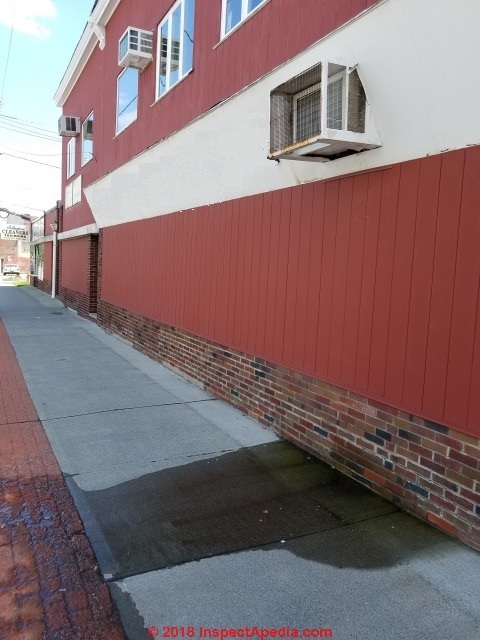
- Air conditioner condensate spillage on sidewalks
is often found where the installer simply routed the condensate pump drain through a building wall to the outdoors in an urban area.
We also see this condition almost without fail in urban and commercial settings where there is a transom-mounted air conditioner whose back-end simply drips onto the sidewalk below. Such installations are in violation of common plumbing codes such as that cited just above.

- AC condensate spillage into temporary containers
seems completely ridiculous, but that's what we found in a florist's walk-in cooler. The employees had to remember to empty the 5-gallon joint-compound bucket which the air conditioner installer used as his destination for the system condensate.
Also see WALK IN COOLER REPAIR
Naturally sometimes people forgot, or were at home asleep when the bucket overflowed, ran below the cooler floor and into the building where it caused a mold contamination problem.
Condensate disposal systems should be designed to work without human intervention.
Where do I attach a condensate pump?
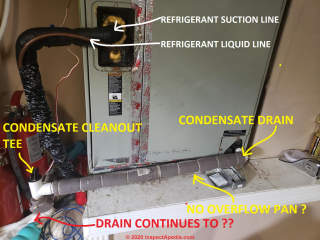 Question: 2020/05/17 Todd Neidhardt said:
Where do I attach a pump to? Can I go and buy one and install my self the condensation pump at lowes?
My unit shuts off as the drain fills with water they want 500 plus to install fro ac guy was trying to do it myself
Moderator reply:
Todd
Your HVAC system shows a condensate drain exiting the unit at its lower right (as sits in your photo), crossing along the bottom with some slope (as it should), teeing into a small cleanout fitting with a black cap, and continuing into a drain that exits the photo at lower left.
But
Watch out: it seems to me that you already have a condensate drain installed. It is quite possible that your system is shutting off because that drain is clogged.
When an air handler is installed without a condensate overflow pan below the unit, instead the building may be protected from condensate leak damage by a switch inside the air handler.
When that switch, sitting on the air handler bottom, senses water filling the internal condensate pan, it shuts off the unit to avoid leak damage.
So if that's happening, the proper repair is to find and fix the clog in the existing condensate drain line.
If you need a condensate pump to lift the condensate to a disposal location, that is, if your drain doesn't already dispose of condensate to an acceptable location, you'd let that drain (shown at lower left) empty into the condensate pump's reservoir, then attach a tube to the condensate pump's outlet and route that tube to an acceptable drain.

If you do need to buy a condensate pump, a typical pump alone, such as this Diversitech condensate pump [above], costs less than $50. U.S. and is available at HVAC suppliers, plumbing suppliers, and building supply stores like Lowes and Home Depot.
Below we show a typical air conditioner or heat pump condensate pump indoors.
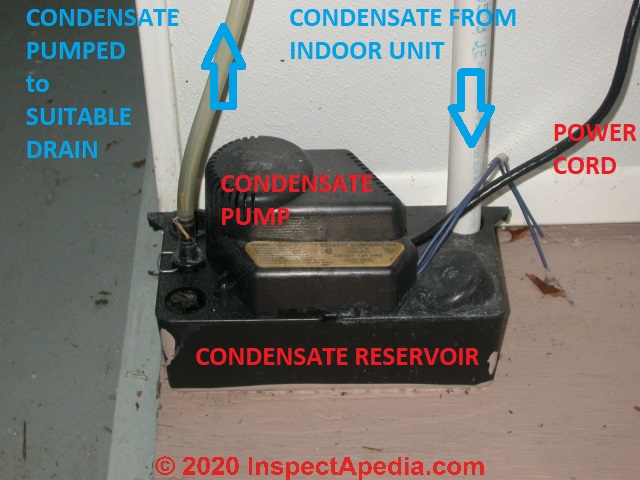
The condensate pump simply sits on the floor in this installation. It receives into its reservoir condensate from a drain attached to the air handler and pumps the condensate to a suitable drainage location.
Reader follow-up:
Todd said:
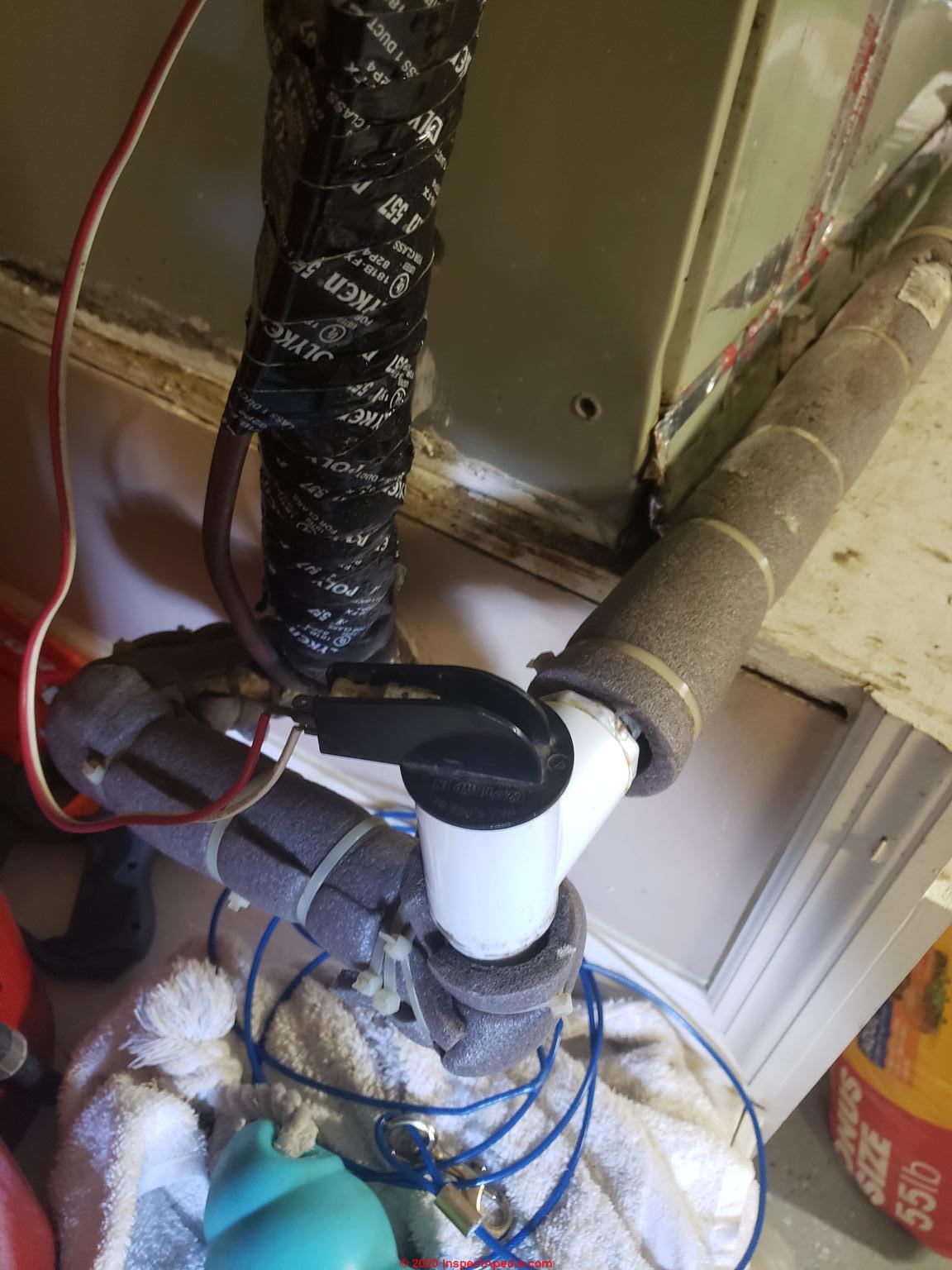
Can I attach the pump to the tee? What is happening is water is not being pushed out faster enough so thermostat shuts down thank you and sorry for all the questions.
Moderator Reply:
Todd,
You should first examine the entire condensate drain to be sure it's not blocked and that it slopes between 1/8" and 1/4" to its drain destination. Otherwise we're going to some trouble to add on complexity to a system that should be working perfectly well on its own.
If you find that your condensate drain cannot work by gravity, that's when you need a condensate pump.
If that's the case, you can cut the condensate drain at any convenient location, then let it drain DOWN INTO the condensate pump reservoir, and let the pump move condensate to the desired drain location
Condensate Pump High Water Safety Switch Function & Wiring

Above: a simple wiring illustration showing how the condensate pump high water safety switch is wired between the thermostat red wire and the air handler control board.
A more detailed example is given below.
Some condensate pumps include a pair of low voltage wires connected to a condensate pump safety overflow cutoff switch designed to turn off the air handler in the event that the condensate pump stops working for any reason.
Manufacturers and other sources may call this feature a
- Condensate pump high water switch
- Condensate pump high water safety switch
- Condensate pump pilot duty high water dry contact
- Condensate pump automatic shutoff switch
If the condensate pump is unable to dispose of the condensate draining from the air handler's cooling coil, a float switch, usually wired in series with the thermostat wires that turn on and off the air handler on a call for cooling, will shut down the blower or air handler unit to prevent a disastrous condensate overflow leak that might cause costly damage or mold contamination in a building.
To use a condensate pump safety switch to shut down an air handler completely, the pump's safety switch low voltage wires are connected to the thermostat wires coming from the room thermostat to the air handler's control board, as we will explain in detail here. In summary:
- The red 24VAC wire from the thermostat is cut or "interrupted" and the wire end from the thermostat is connected to the COM terminal at the condensate pump
- The remaining lead from the red 24VAC thermostat wire (that ultimately goes to the air handler's control board) is then connected to the RUN terminal at the condensate pump.
In essence you've interrupted the red thermostat wire between thermostat and air handler control board with the wires or terminals for the condensate pump safety switch so that if that switch opens it will turn off the air handler.
If your condensate pump safety switch also has an ALARM terminal, that connects to a separate audible alarm to tell building occupants that the condensate pump has shut down their air conditioner or heat pump.
This condensate pump safety switch feature is not always used, and other methods such as a condensate overflow pan with sensor or a condensate overflow pan with a separate drain are other methods to protect a building from condensate overflow problems.
Condensate Pump High Water Switch Wiring Details
Watch out: to avoid risk of shock or injury or damage, follow the instructions for your specific condensate pump and brand. You will see that the high water level switch can ONLY be wired to a Class II low voltage circuit. These low voltage wires will be small in diameter and may be black in color. Never connect these low voltage wires to a line voltage (120VAC or 240VAC) circuit.
Keyed to the illustration above, using the Little Giant VCMA CONDENSATE PUMP MANUAL [PDF] as an example, here above is the wiring diagram and below the wiring instructions for the high water safety switch wiring.
Watch out: Note that the terminal names and wiring details vary among condensate pump safety switches so be sure to read the instructions for your specific condensate pump brand and model.

Two options for connecting the high level switch on a condensate pump
- Shut Down the Air Handler: The switch is factory wired to the NO and COM terminals.
This will open (break) a low voltage electrical circuit when the switch is activated by a high water level in the reservoir.
This can be used to stop the condensing unit(s) of the heating/cooling system.
Refer to the thermostat and heating/cooling unit’s Operating Manual for expected switch operation and wiring connections.
Connect the switch leads (7) in series with the thermostat circuit as specified in the manual.
- Sound an Alarm: The switch can be reconfigured to the NC terminal to close a low voltage circuit
in the event of high water level, activating an external alarm or relay (purchased separately).
Use the following procedure if an NC configuration is required:
Remove the pump’s motor cover (4).
Support the switch and carefully change the lead from the NO terminal to the NC terminal (3).
Re-install the motor cover.
Connect the switch leads in series with the low voltage external component as specified in the component’s manual.
Place the included “Attention Service Technician” label in a visible location.
- Little Giant, Franklin Electric Co, Oklahoma City OK, 73157-2010 USA Tel: 800-701-7894, Web: littlegiant.com
Condensate Tray Sensor Switch Problems
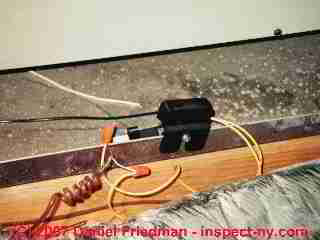 Reader Question: Bad condensate sensor switch shuts down the air conditioner system
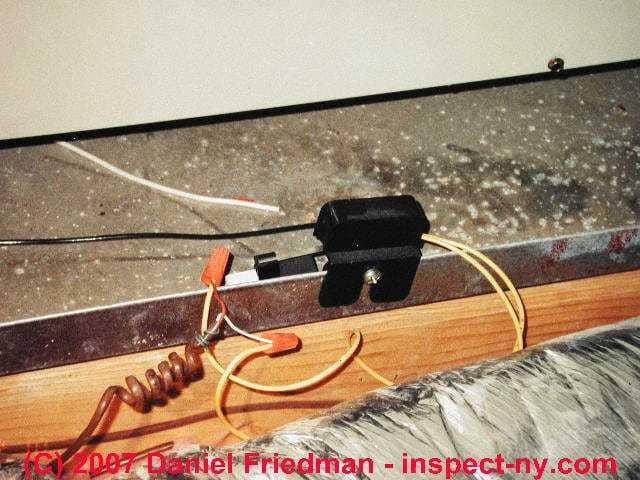
One of the condensate switch went bad, thereby shutting down the system.
I have to jumpered the A/C line (yellow) to the hot (24 volts-red) on the ignition board to get the system to come back on while shopping for a new switch or pump.
I set the condensate pump to "continuous run" as a temporary measure to prevent flooding, but risk burning out the motor to the condensate pump.
- Yaga 8/13/11
Reply:
Yaga
Watch out: there are serious risks from condensate leaks into a building if you bypass or "hot wire" the condensate overflow tray sensor switch.
Those include: condensate leak overflow, building damage, and expensive and unhealthy mold contamination or damage, electrical short circuits if wiring gets wet, and probably other hazards I've not thought of.
Condensate Pump Operating Temperature Range
Question: maximum water temperature that can pass through the condensate pump
2016/07/20 Anonymous asked:
What is the maximum water temperature that can pass through the condensate pump. I have a Honeywell true steam humidifier that needs to be emptied and the maximum temperature gets to 140F.
Reply:
Condensate pump temperature range
Anon: a typical HVAC condensate-handling pump can accept a maximum water temperature of 40oC / 104oF (Aspen pumps) or in some cases up to about 140F° (Diversitech pumps)
But there are other pumping systems designed for use with heating boilers or steam condensate that might better suit you. For example an Aspen (brand) hot water / condensate pump can handle temperatures to 80oC / 176oF.
What else goes wrong with air conditioning condensate pumps
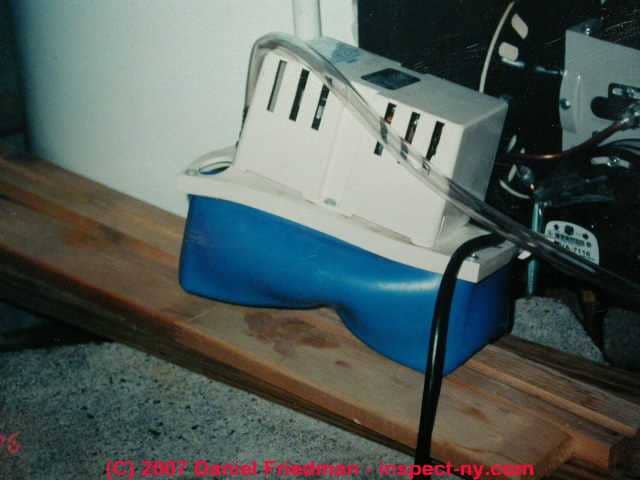
In our experience these little devices are pretty reliable and useful. But a few things do go wrong, some more often than others.
- Kinked or clogged condensate removal tubes
can prevent the condensate pump from discharging its water successfully. When this happens air conditioning condensate will just spill out of the pump reservoir into the building. Watch out for kinks in the pump drain tubing, and watch out for low loops in the tubing that collect algae, dirt, or other muck that can clog the tube. - Poorly secured condensate pumps
in a few locations have been found moved by occupants (kids) or tipped over or even stepped on as you can see in the photo above. This unit was working fine, it just looked ugly. - Burned up condensate pump motors
have never been reported to us nor have we found one, but it's possible.
Condensate Pump Manuals, Sources, Types
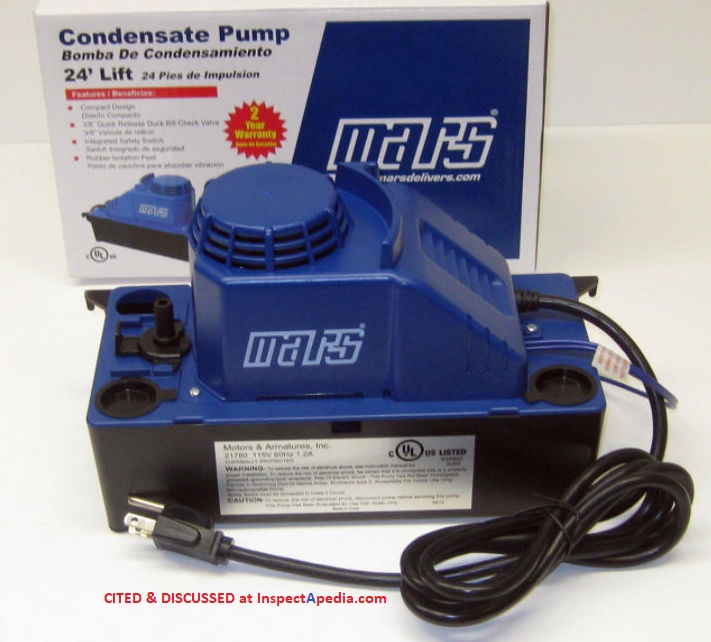 Condensate removal pumps vary not only in cost but in construction materials (plastic, aluminum, other), lift capacity, pumping rate, reservoir size, condensate pump motor horsepower, and supply voltage.
Here are some condensate pump sources that include higher-temperature handling pumps for hot condensate, higher-lift condensate removal pumps and commercial grade heavy-duty condensate removal pumping equipment.
HVAC condensate lift or disposal pumps are widely sold at plumbing suppliers, HVAC suppliers, some electrical suppliers, and at building supply stores such as Home Depot, Lowes and Menards.
Illustration: The 21780 Mars Condensate Removal Pump with Safety Switch 24' Lift 125 GPH 115 Volt.
[Click to enlarge any image]
- Actrol Pty Ltd., Blackburn Head Office, VIC 19 King Street Blackburn 3130 Melbourne Australia, Tel: 03 9894 1033 Email: enquiries@actrol.com.au Website: http://www.actrol.com.au/ Actrol Sauermann Mini Condensate Pumps, Australia, Tel: 1300 228 765
- Aspen® Pumps Ltd Apex Way, Hailsham, East Sussex, BN27 3WA United Kingdom Tel: +44 (0) 1323 848842 Website: http://www.aspenpumps.com/
- ASPEN MINI-LIME PUMP DATA SHEET [PDF] (2017) Mini Lime Univolt Mini-Split Condensate Pump Kit 100-230v 83859 (ASP-MLF-UNI), Rectorseal Co., 2601 Spenwick Drive, Houston, TX Tel: 800-231-3345 800-441-0051 Web: rectorseal.copm/aspenpump.html
- ASPEN MINI-LIME CONDENSATE PUMP WIRING GUIDE [PDF]
- ASURITY BG 101 OVERFLOW SWITCH INSTRUCTIONS [PDF] Asurity, Asurity 3039 Premiere Pkwy Suite 600, Duluth, GA 30097 USA, Email: customerservice@diversitech.com Tel: (800) 995-2222
- ASURITY BG-301-302 Overflow Switch INSTRUCTIONS [PDF]
- ASURITY CC-1 OVERFLOW SWITCH INSTRUCTIONS [PDF]
- ASURITY SOS-1 SAFETY OVERFLOW SWITCH INSTRUCTIONS [PDF]
- BARNES BC-SERIES CONDENSATE PUMP INSTALLATION MANUAL [PDF] Models BC-15, BC-20S with Pilot Duty High Water Dry Contact,
Crane Pumps & Systems, Inc., 420 Third Street, Piqua, Ohio 45356 USA
83 West Drive, Brampton, Ont. Canada L6T 2J6 (937) 778-8947 (905) 457-6223 Fax (937) 773-7157 Fax (905) 457-2650, Web: cranepumps.com - Blue Diamond, BDP MITSI MANUAL BLUE DIAMOND CONDENSATE PUMP MANUAL [PDF] +1 770 831 1122 info@bluediamondpumps.com www.bluediamondpumps.com
- Carrier 554421 VCMA Condensate Pump
- DiversiTech Corporation 6650 Sugarloaf Parkway #100 Duluth, GA 30097 USA, Tel: (800) 995-2222 Website: http://www.diversitech.com/
- EZTrap AC CONDENSATE DRAIN EZ TRAP INSTALLATION INSTRUCTIONS [PDF] RectorSeal® 2601 Spenwick Drive - Houston, TX 77055 ph: 713.263.8001 - 800.231.3345 fax: 713.263.7577 - 800.441.0051 www.rectorseal.com
- Drummond Condensate Pumps, sold by Harbor Freight
- Franklin Electric,
9255 Coverdale Road
Fort Wayne Indiana 46809 U.S.A.
+1 260-824-2900 phone
+1 260-824-2909 fax Website:
franklin-electric.com
Little Giant Condensate Pumps, Franklin Electric - address above. - Hartell PlenumPlus dual-voltage solid-cast aluminum body condensate pumps, commercial grade
- IDEAL HEATING, UNIVERSAL CONDENSATE PUMP INSTALLATION INSTRUCTIONS [PDF] (2023) Ideal Boilers Ltd., National Avenue, Hull, East Yorkshire, HU5 4JB Tel 01482 492251 Fax 01482 448858 Registration No. London 322 137 Ideal Commercial Technical Helpline: 01482 498376 Ideal Parts: 01482 498665 idea USA, Web: Idealheating.com
- Lennox / Diversitech condensate pump - see DiversiTech - address above
- Liberty Condensate Removal Pumps, sold at Home Depot stores & other outlets
- Little GIANT VCMA CONDENSATE PUMP MANUAL [PDF] (2020) Franklin Electric, cited above.
- Little GIANT, VCMA-10, VCMA-15, VCMA-20 CURP-20ULS CONDENSATE PUMPI INTRUCTIONS [PDF] (2009)
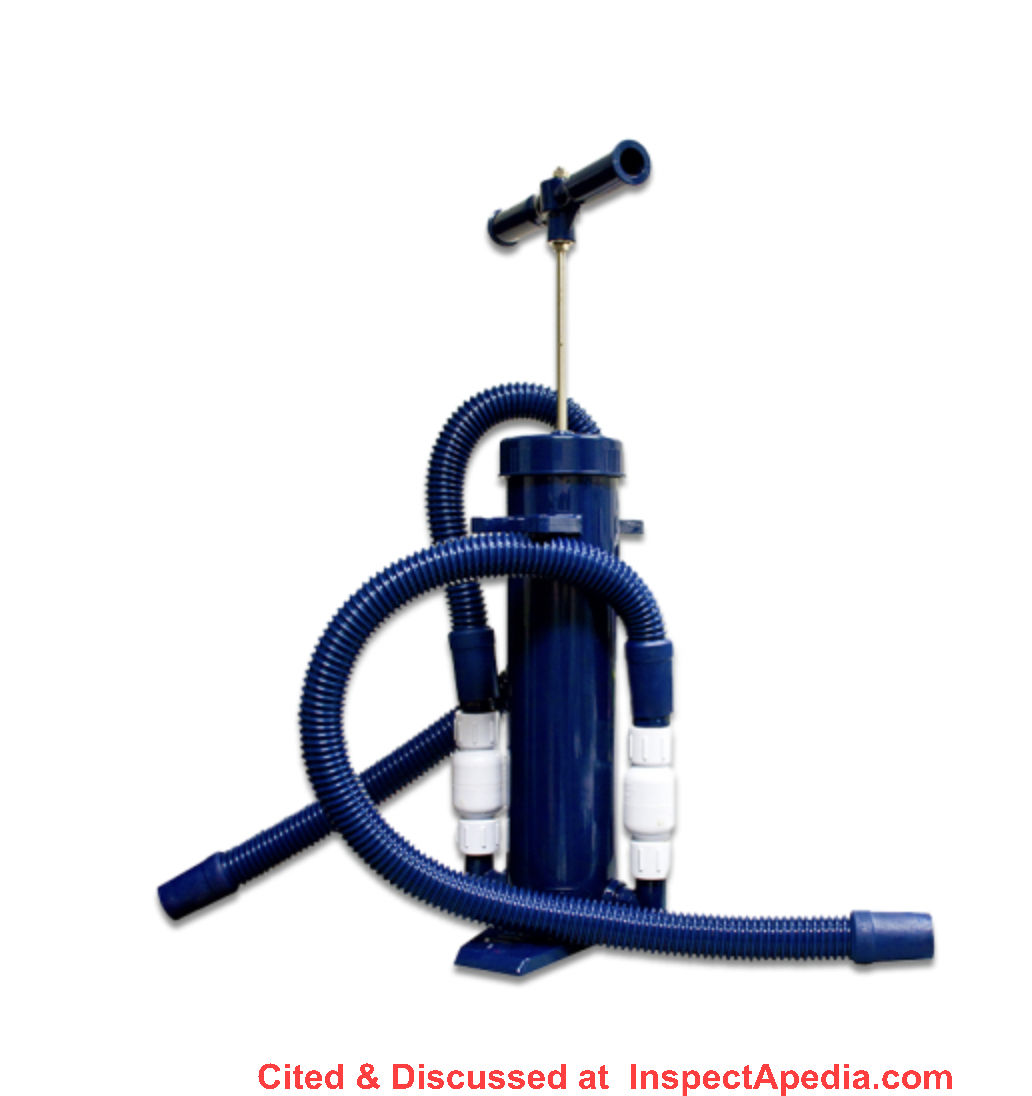
- MIGHTY PUMP INSTRUCTION MANUAL PDF] is a manual pump that is used to clean or clear out a debris-clogged A/C or heat pump condensate drain.
RectorSeal, LLC, 2601 Spenwick Drive, Houston, Texas 77055-1035, USA Tel: 713-263-8001 /1-800-231-3345 Web: rectorseal.com
The kit from acdrainpump.com includes a reversible, hand operated pump and flexible inlet and outlet hoses designed along with an adapter to connect the pump to a 3/4" condensate drain line. Email: nfo@ACDrainPump.com Web: acdrainpump.com - Mitsubishi X87-177 Maxi-Blue Condensate Pump
- MITSUBISHI ELECTRIC Air CONDITIONING FOR BUILDING APPLICATION DRAIN WATER LIFT-UP KIT PAC-KE05DM-F INSTALLATION MANUAL [PDF]
- MITSUBISHI CONDENSATE DRAIN PUMP IO MANUAL [PDF] Model PAC-SH94DM-E PKA-RP.KAL PKFY-P.VKM-E
- MITSUBISHI ELECTRIC PAC-SK01DM-E CONDENSATE PUMP IO MANUAL [PDF]
- MITSUBISHI SPLIT-SYSTEM HEAT PUMP OPERATION MANUAL [PDF] SLZ-KF09, KF12, KF15, KF18NA
- Phoenix Condensate Pump
- Mars Condensate Removal pump, models available for 120VAC & 240VAC - shown above.
- RECTORSEAL EZ TRAP CONDENSATE DRAIN LINE INSTRUCTIONS [PDF]
- REFCO COMBI CONDENSATE PUMP 3004146 INSTRUCTION MANUAL [PDF] REFCO Manufacturing Ltd.
Industriestrasse 11
6285 Hitzkirch - Switzerland
Telefon +41 41 919 72 82
Telefax +41 41 919 72 83
info@refco.ch
www.refco.ch
Note: this condensate pump can be installed inside the indoor wall-mounted unit of a split system air conditioner or heat pump. - Saniflo SaniCondens Condensate Pumps, sold at Home Depot stores & other outlets, including SaniCondens 0.03 hp removal pump
- Sauermann SI-1801 23 ft lift 230VAC condensate removal pump
- STAR CONDENSATE PUMP INSTRUCTION MANUAL [PDF] (2018) Model SW1077, Star Water Systems, 85 North Oak St., Kendallville IN 46755 USA Tel: 800-742-5044 web: starwatersystems.com
Above: a typical wiring diagram for a condensate pump safety switch, excerpted from Wayne's manual cited below.
- WAYNE CONDENSATE PUMP INSTRUCTIONS & PARTS MANUAL [PDF] (2018) WCP85 is capable of handling up to 85 gallons per hour. Wayne Sewage Pumps - can accommodate large condensate volumes and produce higher lift capacity, Wayne/Scott Fetzer Co., Web: waynepumps.com
Excerpt:
A condensate unit removes condensation from air conditioning and high efficiency furnaces. The compact design of the unit consists of a 3/8" ID discharge and 6 ft. long power cord. The unit also contains a safety switch to automatically shut off HVAC equipment in the event of a failure. (Additional wiring required). Intended for indoor use only.
Reader Comments, Questions & Answers About The Article Above
Below you will find questions and answers previously posted on this page at its page bottom reader comment box.
Reader Q&A - also see RECOMMENDED ARTICLES & FAQs
On 2021-04-04 - by (mod) - field reports of de-zincification corrosion and leaks at brass PEX pipe connectors
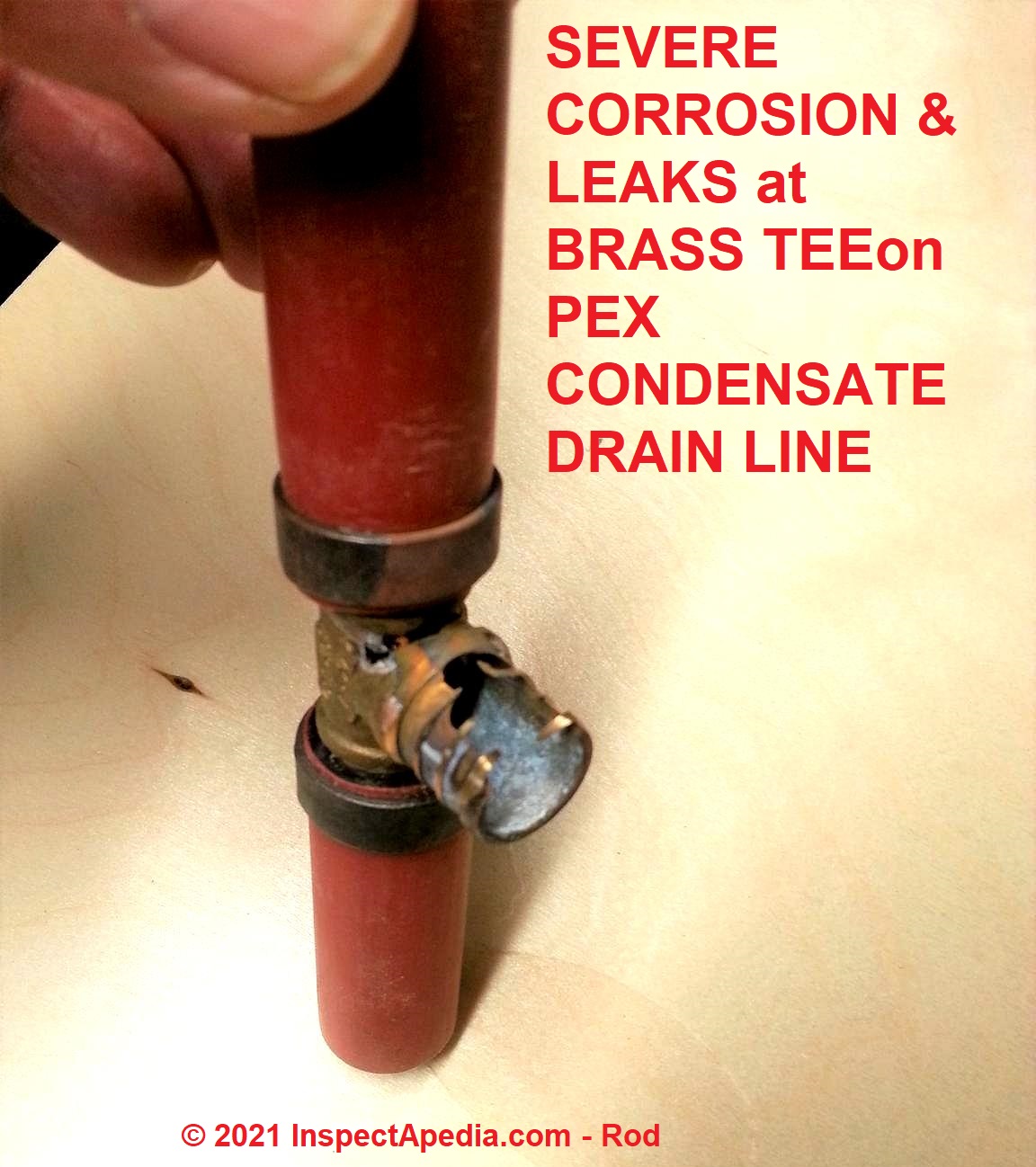 @Rod,
@Rod,
Thank you for the helpful field failure report of severe corrosion at a brass PEX connecting tee handling gas furnace condensate;
I'll be sure to keep your photo and report with that topic whose link I'll give here;
Can you see if there is a brand or identification mark of any kind on that corroded brass Tee?
I ask because you'll see there was a well-known brass connector corrosion, leak failure problem a while back -
see details
at PEX BRASS CONNECTOR LEAKS - field reports of de-zincification corrosion and leaks at brass PEX pipe connectors, elbows & tees.
I'll copy this conversation over to that page to invite comment from others who have seen this problem.
And I agree that corrosivity of condensate from a condensing gas furnace is a concern - as has been noted in research going back at least half a century. Some examples are given at your comment and photo and my reply also now copied at
the brass connector corrosion article I just cited above.
On 2021-04-03 by Rod
My 10 year old (+or -) gas furnace has a condensate pump. The installer used a 3/4" pex w/ brass fitting between the furnace and pump, which I recently discovered was completely eaten through. The immediate fix is replacing the fitting with a plastic one, but who knows what this has done to my cast iron drain pipe!
I think condensate neutralizers should be required by code (if they're not) and installed as a matter of course. They're a lot cheaper than fixing leaking pipes.
On 2021-03-14 - by (mod) - condensate pump started making a grinding sound
@scott,
Yes that's a likely possibility; you might, however, check first that there is no debris blocking or clogging the pump impeller.
On 2021-03-13 by scott
My condensate pump started making a grinding sound. It is probably 30 years old and I am guessing that the pump is worn out. Does this make sense?
On 2021-02-04 - by (mod) - is mechanicals room considered habitable space
Jag
Provided that your condensate pump has adequate capacity to handle the maximum info from the two pieces of equipment that serves as perfectly reasonable and is common practice to use a condensate pump to serve more than one device.
So it makes perfect sense for your condensate pump failure detection system to shut off both appliances.
I certainly don't consider a mechanicals room habitable space, but the final legal authority on the question is your local building code inspector.
On 2021-02-04 by jag70
Hi. I have two appliances that require condensate pump in my application - hvac and heat pump water heater (2 gal/day est.) Code requires the unit be wired to shut off if the condensate pump fails. First my pump in a frequently used mechanical room in my finished basement off the laundry (wine fridge and freezer are in there.)
Is that considered an "uninhabitable space" ? The HVAC is already installed and wired to shut off if the existing condensate pump fails.
When adding the heat pump hot water heater, can I use the same one and have both units shut off if it fails or does the shut off requirement suggest I should have the water heater on its own? Thank you in advance.
On 2020-05-31 - by (mod) - am I OK using a simple cheap condensate pump?
John
If the condensate was simply being "disposed-of" by sending it under the floor slab into the soil below, that's a poor practice that is asking for trouble, not only in an ultimate blockage but also in possibly adding to basement or lowest floor moisture and mold risks.
To install a condensate pumping system that up eight feet and then runs 40 feet away is perfectly reasonable; just be sure you select a pump with adequate lift and gpm pumping capacity.
We list several of those pumps in the article above.
Using a cheap anything might work, but might also prove more-costly in the long run in poor reliability. If the potential cost of a condensate leak onto the building floor is high, in my OPINION it's worth using a better quality pumping system.
Paying too much or paying too little are both mistakes to avoid.
On the general question of how much should you pay for a product or service readers might find this of interest, where we use consulting fees as an example:
HOW MUCH SHOULD YOU PAY
On 2020-05-31 by John
Hi. The condensate from my central air drains directly into a hole that was drilled into the concrete slab.
It backs up sometimes into the basement so I want to install a condensate pump.
My question is, my sump pit is 40 feet from the furnace. I want to run the hose along the ceiling joists and then down into the sump pit. Is it okay for the hose to run horizontally 40 feet after being pumped up 8 feet using a cheap $40 pump?
On 2020-04-05 - by (mod) - sources & types of condensate traps for air conditioner and heat pump condensate drains & pumps
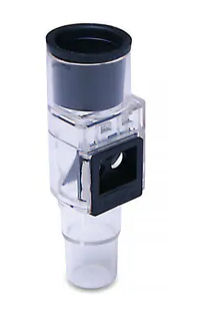 Agreed - you may need to find an adapter if you choose a condensate trap that's different in diameter than your existing condensate drain line.
However many condensate drain traps are already sized to fit a typical HVAC condensate drain tube or pipe diameter and some of these products are sold with bushings or adapters to fit all common condensate drain sizes.
Here are additional condensate drain traps that can let your drain empty to the outside without permitting leaks or backups indoors
Rectorseal EZ Trap® 14 x 5/8 in. Mini Waterless in-line trap shown below - 5/8" diameter.
For the Rectorseal EZ Trap
See these
Below is another condensate drain trap product that may work - choose which is easiest for you to find:
Supco RLC051 Waterless Trap for Condensate Line (shown below)
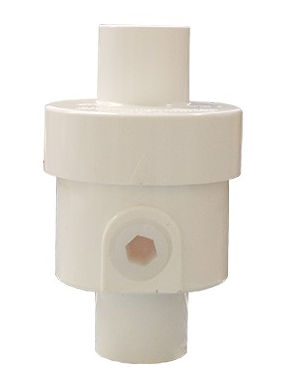
and here are
- AC CONDENSATE DRAIN EZ TRAP INSTALLATION INSTRUCTIONS [PDF] for a similar model
With the SUPCO condensate line trap its dimension is "3/4" slip internal or 1" fitting external connection- with bushings can connect to 1/2", 1.25", 1.50" and 2" tubes"
Also, shown below is this Rinnai Condensate Trap 222053
Thanks for asking -
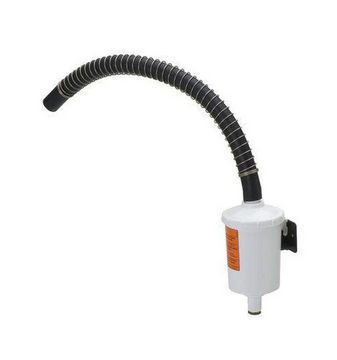
On 2020-04-05 by Matthew
I think that EZT-180 would be perfect, is there one with a male push in connector for 3/8” tubing? Or I’ll need to find an adapter for it?
Thanks so much! I’d like to find one that has a connection to the 3/8” vinyl tubing on each end to just cut the tube and install it easily.
On 2020-04-05 - by (mod) - How do I get the condensate line to drain completely after each pumping?
 Sure Matthew - and thanks for asking.
You need an air admittance valve (AAV) or "air inlet valve", or "studor vent" or "v-200" to use some synonyms, that allows air into the high-routed drain line but that will not allow water out when the condensate pump is running.
An example is the EZ-Trap 83180 Mini Waterless In-line Trap EZT-180 shown here.
Oatey and Studor and Toto are widely-used brands of air admittance valves so those companies may also have a small-diameter version that fits your drain line. Also Rectorseal, Pro-Vent, Irrigation King, and Wal-Rich make similar devices.
Details and typical AAV installation instructions (using plumbing systems as an example) are
On 2020-04-05 by Matthew
I have a condensate drain line from my HVAC unit in my crawl space that gravity drains to my side yard which doesn’t get much sun and causes a wet marshy area in the grass.
I’ve installed a condensate pump to pump the condensate to a sunny area around my patio, which is about 50 feet away and slightly higher than the elevation of the pump.
I routed the discharge tubing straight up from the pump about three feet and then down through the crawl space wall to the yard where I want it to drain.
My question is, the pump runs and shuts off and there is still significant water left in the discharge line but it doesn’t drain because it’s basically got an air lock on the tube when the pump shuts off.
How do I get the line to drain completely after each pumping? Is there a way to add a high point vent to introduce air to the tubing so the condensate isn’t air locked?
On 2019-04-13 8 - by (mod) - air in the sump would be causing suction on the condensate line
Dave
It sounds as if your sealed sump pit needs an air admittance valve to let air into the pit so that during pumping it's not sucking on the condensate drain line.
See AIR ADMITTANCE VALVES AAVs - are described there
Also check with the manufacturer of your sump and pit-container; there may be a special check valve that works in that set-up.
On 2019-04-11 by Dave
We have a tankless water heater where the condensate is routed to a sealed sump pit with a radon system.
The air in the sump would be causing suction on the condensate line and thus the inside of the tankless water heater. Does anyone have thoughts on the appropriateness of this setup? Thanks in advance.
On 2017-10-13 - by (mod) - condensate pump sits in plastic container - ok?
Marsha a typical condensate pump is indeed a combination of plastic reservoir and pump float switch and controls.
However I can't guess if your installation is safe and code compliant. Certainly if electrical components that are not intended to be wet are soaked or sprayed with water the installation would most-likely be unsafe.
On 2017-10-13 by Marsha
Sump pump being used to manage A/C water.
Pump sits in plastic container by ac. Is this allowed per code or normal operations in a home?
On 2017-06-25 - by (mod) - condensate pump only works if thermostat fan control switch is set to ON
Sounds as if the pump is improperly wired to take power from The fan circuit.
Switch the pump to an always-on circuit or power source so that the pump's own float control can turn the pump on or off as needed.
On 2017-06-24 by Scott
My condensate pump works fine as long as the fan for the a/c is set to "ON" if we set it to "AUTO" the pump never turns on and just fills up and spills on the floor. What's wrong here?
On 2017-01-07 - by (mod) - continuous overflow of water from a whole house humidifier?
Dave
This doesn't sound quite right to me. If your whole house humidifier is spilling water into the duct system or anywhere else, then it is not working properly. The risk is damage to the equipment that could in turn make it unsafe.
On 2017-01-06 by Dave Engel
I'm thinking about installing a whole house humidifier onto the gas furnace, and see that when it is on there is a continuous flow of water. Will the condensate pump handle this constant use OK?
On 2016-07-30 - by (mod) -
Anon
Please see CONDENSATE TEMPERATURES for a detailed answer to your question.
On 2016-07-30 by Anon
What is the maximum water temperature that can pass through the condensate pump. I have a Honeywell true steam humidifier that needs to be emptied and the maximum temperature gets to 140F.
...
Continue reading at CONDENSATE DRAINS, CODES or select a topic from the closely-related articles below, or see the complete ARTICLE INDEX.
Or see CONDENSATE PUMP FAQs for questions & answers about condensate pump installation, inspection, troubleshooting, & repair and that were posted originally on this page.
Or see these
Recommended Articles
- CONDENSATE HANDLING, HVAC - home
- CONDENSATE LEAKS
- CONDENSATE PUMPS
- CONDENSATE DISPOSAL, IMPROPER
- CONDENSATE DRAINS, CODES
- CONDENSATE DRAIN CLEAN & DE-CLOG
- CONDENSATE DRAIN INSULATION REQUIREMENTS
- CONDENSATE DRAIN PROBLEMS
- CONDENSATE DRIP TRAY DEFECTS
- CONDENSATE PAN SWITCH LOCKOUT
- Legionella BACTERIA & HVAC EQUIPMENT
- CONDENSING BOILER/FURNACE CONDENSATE DRAIN
- FLOOR DRAIN / TRAP ODORS
- PUMPS USED in BUILDINGS
- SUMP PUMP MANUALS
- WATER PUMP & TANK I&O & REPAIR MANUALS
Suggested citation for this web page
CONDENSATE PUMPS at InspectApedia.com - online encyclopedia of building & environmental inspection, testing, diagnosis, repair, & problem prevention advice.
Or see this
INDEX to RELATED ARTICLES: ARTICLE INDEX to AIR CONDITIONING & HEAT PUMPS
Or use the SEARCH BOX found below to Ask a Question or Search InspectApedia
Ask a Question or Search InspectApedia
Try the search box just below, or if you prefer, post a question or comment in the Comments box below and we will respond promptly.
Search the InspectApedia website
Note: appearance of your Comment below may be delayed: if your comment contains an image, photograph, web link, or text that looks to the software as if it might be a web link, your posting will appear after it has been approved by a moderator. Apologies for the delay.
Only one image can be added per comment but you can post as many comments, and therefore images, as you like.
You will not receive a notification when a response to your question has been posted.
Please bookmark this page to make it easy for you to check back for our response.
Our Comment Box is provided by Countable Web Productions countable.ca
Citations & References
In addition to any citations in the article above, a full list is available on request.
- [6] Simpson Strong-Tie, "Code Compliant Repair and Protection Guide for the Installation of Utilities in Wood Frame Construction", web search 5/21/12, original source strongtie.com/ftp/fliers/F-REPRPROTECT09.pdf, [copy on file as /Structures/Framing/Simpson_Framing_Protectors.pdf ]. "The information in this guide is a summary of requirements from the 2003, 2006 and 2009 International Residential Code (IRC), International Building Code (IBC), International Plumbing Code (IPC), International Mechanical Code (IMC), 2006 Uniform Plumbing Code (UPC) and the 2005 National Electrical Code." broad. Puerto Rico and the U.S. Virgin Islands enforce one or more of the I-Codes.
- [7] 2006 ICC Model Building Code Chapter 3, General Regulations, New Jersey Mechanical Code, web search 8/2/2012, original source: http://www2.iccsafe.org/states/newjersey/NJ_Mechanical/PDFs/2006_Chapter%203-General%20Regulations.pdf
Quoting about the ICC:
The International Code Council (ICC) was established in 1994 as a non-profit organization dedicated to developing a single set of comprehensive and coordinated national model construction codes.
The International Code Council is a member-focused association dedicated to helping the building safety community and construction industry provide safe, sustainable and affordable construction through the development of codes and standards used in the design, build and compliance process. Most U.S. communities and many global markets choose the International Codes.
The International Codes, or I-Codes, published by ICC, provide minimum safeguards for people at home, at school and in the workplace. The I-Codes are a complete set of comprehensive, coordinated building safety and fire prevention codes. Building codes benefit public safety and support the industry’s need for one set of codes without regional limitations.
Fifty states and the District of Columbia have adopted the I-Codes at the state or jurisdictional level. Federal agencies including the Architect of the Capitol, General Services Administration, National Park Service, Department of State, U.S. Forest Service and the Veterans Administration also enforce the I-Codes. The Department of Defense references the International Building Code for constructing military facilities, including those that house U.S. troops, domestically and a ... - Our recommended books about building & mechanical systems design, inspection, problem diagnosis, and repair, and about indoor environment and IAQ testing, diagnosis, and cleanup are at the InspectAPedia Bookstore. Also see our Book Reviews - InspectAPedia.
- Complete List of Air Conditioning & Heat Pump Design, Inspection, Repair Books at the InspectAPedia Bookstore.
- In addition to citations & references found in this article, see the research citations given at the end of the related articles found at our suggested
CONTINUE READING or RECOMMENDED ARTICLES.
- Carson, Dunlop & Associates Ltd., 120 Carlton Street Suite 407, Toronto ON M5A 4K2. Tel: (416) 964-9415 1-800-268-7070 Email: info@carsondunlop.com. Alan Carson is a past president of ASHI, the American Society of Home Inspectors.
Thanks to Alan Carson and Bob Dunlop, for permission for InspectAPedia to use text excerpts from The HOME REFERENCE BOOK - the Encyclopedia of Homes and to use illustrations from The ILLUSTRATED HOME .
Carson Dunlop Associates provides extensive home inspection education and report writing material. In gratitude we provide links to tsome Carson Dunlop Associates products and services.
 | HOME | ABOUT | ASK a QUESTION | CONTACT | CONTENT USE POLICY | DESCRIPTION | POLICIES | PRIVACY | |
| © 2024 - 1985 Publisher InspectApedia.com - Daniel Friedman | |||||||||