
InspectAPedia® FREE Encyclopedia of Building & Environmental Construction, Diagnosis, Maintenance & Repair |
Question? Just ask us! InspectAPedia
|
 Air Conditioning Cooling Coil / Evaporator Coil Diagnosis & Repair
- POST a QUESTION or COMMENT about cooling coils (evaporator coils) in air conditioners, heat pumps, refrigeration systems
Air conditioner & heat pump cooling coil or evaporator coil diagnosis & repair:
This article discusses the diagnosis and repair of cooling coil or evaporator coil problems that occur in the air conditioning or heat pump air handler unit such as frost or icing, dirt, blockage, refrigerant leaks, or improper sizing.
Topics here include frost or ice build-up on cooling coils and its effect on cool air flow and mold. Frost or ice formation at air conditioning compressor/condenser units. Ice and condensate problems in air conditioning duct work, why it forms, how bad it can get, how to prevent it.
Frosting & non-frosting evaporator coil designs. How frosting type evaporator/cooling coils are defrosted.
Dirt or debris-blocked cooling coil/evaporator coil cleaning & repair methods.
Types of evaporator coils/cooling coils: dry vs flooded evaporator coil design differences; frosting vs non-frosting cooling coils & frosting-coil defrosting methods & controls. How cooling coils are changed-out or replaced.
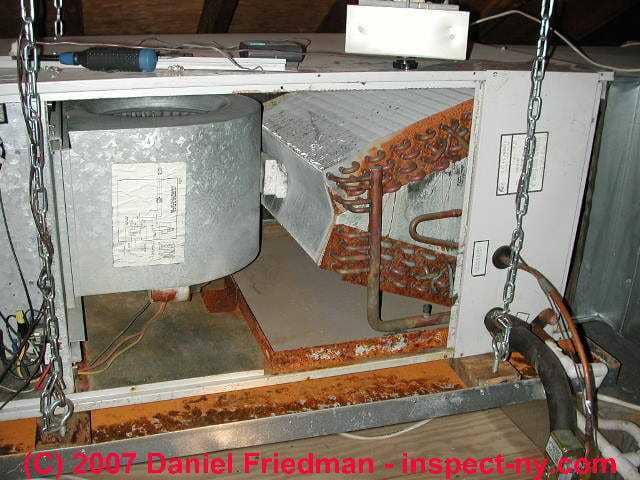
Our photo at page top shows the cooling coil in the attic air handler component of a central air conditioning system.
InspectAPedia tolerates no conflicts of interest. We have no relationship with advertisers, products, or services discussed at this website.
Cooling Coil (Evaporator Coil) Basics for Air Conditioning & Heat Pump Systems
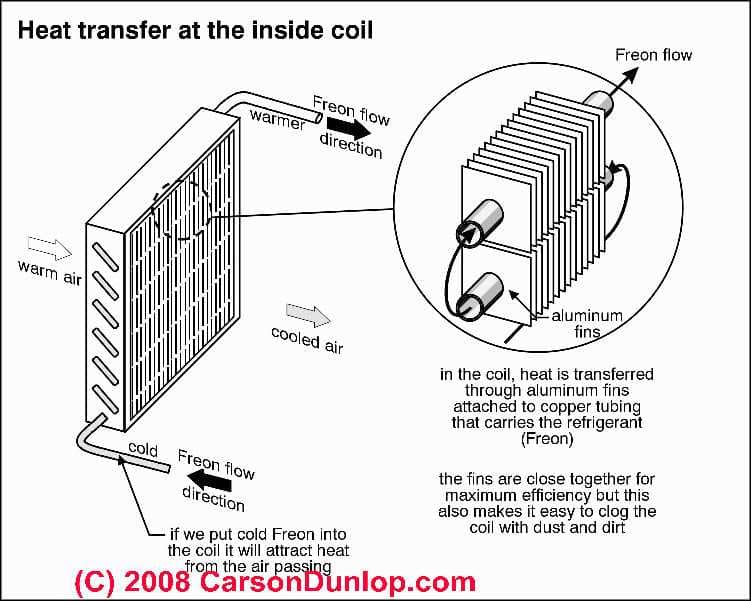 The cooling coil or evaporator coil is where building indoor air cooling actually takes place.
The liquid air conditioning refrigerant entering the cooling coil through the metering device (a capillary tube or THERMOSTATIC EXPANSION VALVE) is increasingly changed to gas form as it "boils" or evaporates as the liquid refrigerant flows through the cooling or "evaporator" coil, so that at the end of the cooling coil the refrigerant is totally in gaseous form.
[Click to enlarge any image]
This state change (liquid to gas refrigerant) absorbs energy, cooling the tubing and fins of the cooling coil and thus indirectly, cooling and dehumidifying indoor air that is blown across the coil.
A cooling coil which is blocked by debris or ice and frost, or which is damaged can obstruct air flow and reduce air conditioning system output. The air conditioning system evaporator coil and problems include ice and frost build-up, dirt or debris blocking air flow through the coil, and damaged or leaky cooling coils.
We also discuss how cooling coils may be cleaned in-place and what to watch out for during that procedure. Cooling coils which are part of an air conditioning retrofit installation onto an existing warm air heating system can also present special problems of sizing and air flow, discussed further at ADDING A/C: RETROFIT SIZING.
Sketch of heat transfer at the inside coil, also called the cooling coil or evaporator coil, courtesy of Carson Dunlop Associates, a Toronto home inspection, education & report writing tool company [ carsondunlop.com ].
If ice, dirt, or damage block air flow across or through the cooling coil (evaporator coil) in an air conditioner, the cool air output will be substantially reduced or may even stop entirely.
Below we describe how the cooling coil works, what goes wrong with this component, and how its problems are diagnosed by simple visual inspection (inside of the air handler) or by some simple temperature measurements.
How To Inspect, Test, & Diagnose Cooling Coil (Evaporator Coil) Air Conditioner or Heat Pump Problems
 Where to look for cooling coil problems:
First, make a visual inspection of the cooling coil. Most air handlers provide an access panel or cover that can be removed to give at least partial view of the cooling coil surfaces.
Turn off electrical power to the system to be safe from electrical shock.
On opening an access cover or panel on the air handler you can recognize the cooling coil from our photos and sketches shown here and elsewhere on this website. You may need to use a flashlight and mirror to see the coil surfaces.
Remember to inspect the cooling coil from the incoming-air side - the side of the coil facing the blower fan assembly. That's because any dirt or debris entering the coil will come principally from this direction. If you inspect the wrong side of the coil it may look perfectly clean even though it is totally blocked by debris on its other surface.
DIRTY COOLING COIL / EVAPORATOR COIL has photos of just how blocked a cooling coil can become in an air conditioner or heat pump.
Here are some common defects to look for at the evaporator coil (cooling coil) in an air conditioner or heat pump:
- Dirt or debris blocking air flow through the coil (DIRTY COOLING COIL / EVAPORATOR COIL)
- Ice or frost formation blocking air flow through the coil (FROST BUILD-UP on AIR CONDITIONER COILS)
- Damaged cooling / evaporator coil fins over more than 10% of the coil surface, blocking air flow (shown in our photo at left in this case, the damage is to a condensing coil, not an evaporator coil). Small areas of damaged cooling fins can be straightened and cleaned-up using a cooling coil comb.
Cooling coils with extensive physical damage such as shown in our photograph need to be replaced. - Evidence of refrigerant leaks (visual evidence may include stains from refrigerant oil left at the point of leakage)
Cooling Coil (Evaporator Coil) Leaks, Condensing Coil Leaks: if your A/C system used to work fine but now is blowing only warm air, it is possible that you have lost refrigerant in the system. A refrigerant leak can occur anywhere in the refrigerant piping system, in the cooling coil, or in the condensing coil.
You'll need an HVAC technician to find and repair the leak problem. If the leak is in a refrigerant line it can usually be soldered and sealed and the system re-charged. If the leak is in a cooling coil or condensing coil, the coil probably needs to be replaced.
We explain this topic in more detail below at Air Conditioner Refrigerant Problems
- REFRIGERANT LEAKS, LOW REFRIGERANT, WRONG TEMPERATURES.Also see REFRIGERANT LEAK DETECTION and REFRIGERANT LEAK REPAIR.
- Evidence of mold growth on organic debris on the coil or elsewhere in the blower compartment
See MOLD GROWTH in AIR HANDLERS - Presence of unusual materials on the coil surface such as rodent debris, bird feathers and debris, fiberglass insulation, large trash fragments like paper or leaves confirming a duct or air filter problem.
Some of these may indicate potentially serious health risks such as rodent or bird feces and debris which risk bacterial and viral hazards in building air.
See LEAKS, RODENTS in AIR HANDLERS - Obvious coil-to-air-handler size mismatch of an add-on cooling coil onto an existing warm air system
See ADDING A/C: RETROFIT SIZING - Evaporator coil or cooling leaks or holes: if an evaporator coil is leaking (or also if the condensing coil is leaking) you'll find out pretty quickly as refrigerant will be lost and the cooling system will stop providing cool air. You'll need expert diagnosis by an HVAC service technician.
- A lot depends on where the refrigerant leak has occurred and what caused the leak. If the cooling coil has a single point leak caused by some mechanical damage (one of our readers accidentally drilled a hole in his coil while trying to drill a drain hole in his air handler), it may be possible to find the hole and repair it using silver solder.
- If the refrigerant leak is in copper tubing anywhere in the cooling or heat pump system that is not too close to an evaporator coil or condensing coil, it should be possible to solder a repair, then evacuate and recharge the cooling system.
- If the refrigerant leak is in copper tubing in or close to the cooling coil (or in a condensing coil) a solder repair is hard to complete because the heat of the soldering process tends to de-solder other nearby connections. It might be possible if the technician is very expert and if s/he knows how to keep nearby surfaces cooled (we've used a wet rag).
- If the refrigerant leak is in an aluminum part, soldering aluminum is more tricky and may not be feasible. Ordinary procedures using a torch, for example, just melt the aluminum. Expert welders use inert gas welding methods.
- If the refrigerant leak is due to severe corrosion anywhere in an HVAC system we're not optimistic that a solder repair is possible. The conditions that caused a corrosion-related leak are likely to have thinned and weakened other parts. The cost of an attempted repair may be wasted.
- Replacement of the cooling coil (or condensing coil) is more often going to be recommended by your HVAC technician because of these difficulties.
Temperature measurements at the cooling coil:
see OPERATING TEMPERATURES for a discussion of where and how air temperature measurements are made to diagnose cooling coil or other air conditioner operating problems.
Below we introduce some of the more common air conditioner or heat pump cooling coil or evaporator coil defects and repairs.
Air flow requirements across the air conditioning evaporator coil: if airflow is weak for any reason (dirty coil, duct system defects, blower fan defects, dirty blower squirrel cage fan), the air conditioning system will not operate properly.
Some experts write that there should be between 350 and 400 cubic feet of air per minute (CFM) moving across the evaporator (cooling) coil for each ton of air conditioner capacity.
One ton of cooling or heating capacity = 12,000 BTUH so if your AC unit or heat pump is a 24,000 BTUH unit it is a "two ton" unit and needs to see 700 to 800 CFM of air across the evaporator coil.
Some home inspectors and air conditioning service technicians carry a small airflow meter that can actually measure this number with fair accuracy. (The same tool is nice for comparing air flow and balancing air flow at various building supply ducts and registers.
How Air Conditioning & Heat Pump Evaporator Coils (Cooling coils) are Cleaned
Evaporator coil cleaning often requires cutting refrigerant lines, removal of the coil and other components for cleaning, and reinstallation, pulling a vacuum on the refrigerant lines, and recharge with refrigerant.
Such service and repair may involve significant expense, although there are some "in place" cleaning methods using foams and sprays that are a simpler procedure. See DIRTY HVAC COIL CLEANING PROCEDURES for details of this topic.
FROST BUILD-UP - Frost Build-up on the Evaporator Coil in an Air Conditioner
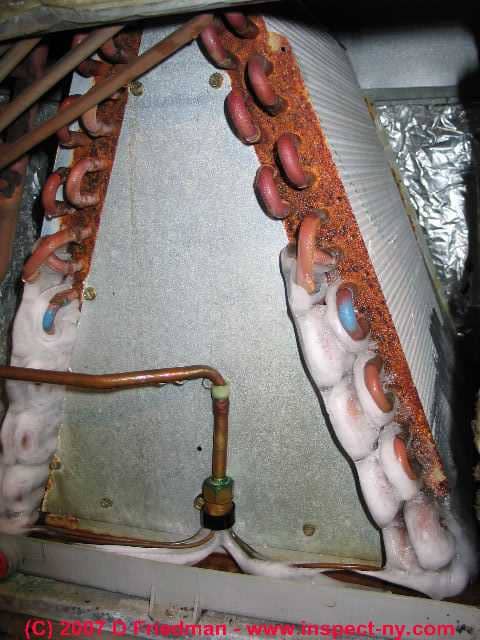
The ice or frost formed on a cooling coil in an air conditioner air handler unit is usually caused by an improper refrigerant charge, possibly by inadequate air flow across the cooling coil, or by a thermostatic expansion valve (TEV) or other air conditioner or heat pump control defect.
Ice blocks air flow through the coil, thus reducing air conditioner output; if the ice formation is extreme nearly all of the airflow across the coil is blocked and the air conditioner system runs but does not produce cool air flowing into the occupied space.
Frost and ice can also form on refrigerant tubing at other locations, and frost and ice can form inside air conditioning duct work itself, leading to troublesome leaks into the building.
Details of what causes frost on air conditioning equipment, what problems that creates, and how to diagnose and repair icing or frost on cooling coils or other air conditioner parts are provided
at FROST BUILD-UP on AIR CONDITIONER COILS.
This article explains locations and causes of condensate, frost or ice formation in air conditioning systems, air handlers, compressor/condensers, refrigerant lines, and in air ducts.
Note that frost formation at some cooling coils (not air conditioners or dehumidifiers) may be normal. We discuss frosting and non-frosting cooling coil types and coil defrosting methods further
at FROSTING VS. NON-FROSTING TYPES OF EVAPORATOR COILS
BLOCKED COOLING COIL - Air Conditioner Evaporator Coil Blocked by Debris or Dirt
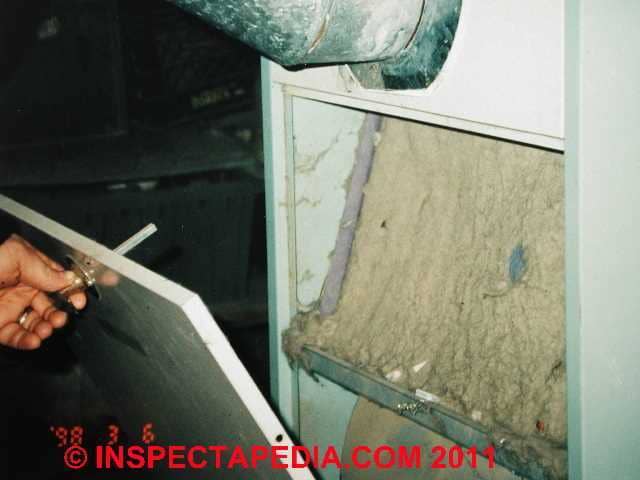
Watch out: something as simple as a blocked or dirty air filter or dirty cooling coil can lead to frost build-up on the cooling coil. That's because the reduced airflow over the cooling coil may permit it to run colder than normal.
Clogged Air Conditioner filters can lead to lost cooling capacity first, because the clogged filter reduces the air flow
through the system, meaning that you'll feel less air flow at the supply registers than was previously present, and second because the low air flow may lead to partial or completed frost blockage of the cooling or evaporator coil in the air handler.
See AIR FILTERS for HVAC SYSTEMS for details.
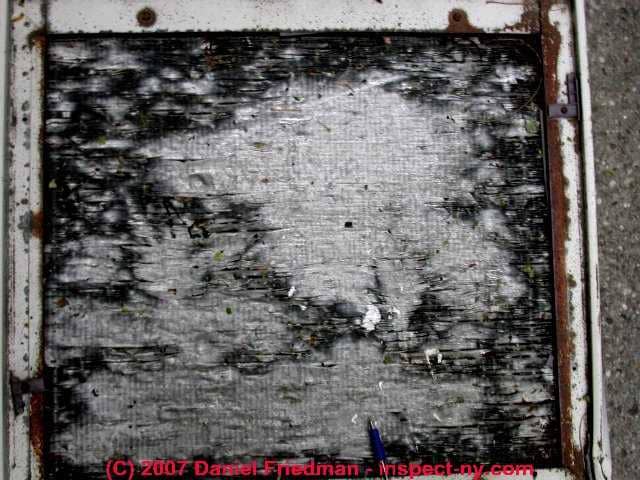
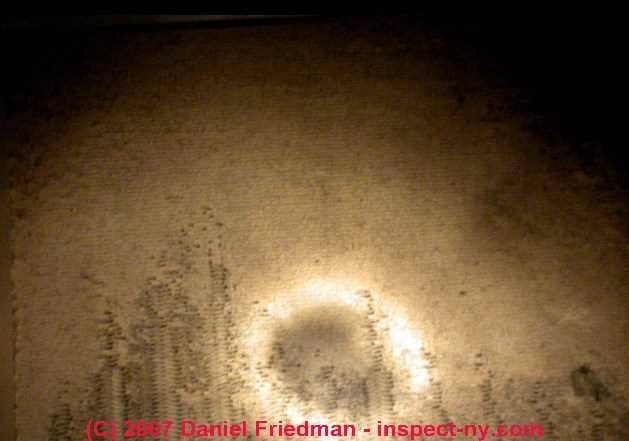
Ice is not the only (nor even the most common) cause of blocked air flow in an air conditioner. This photograph shows how easily debris can stick to and clog the inlet side of the cooling coil in an air conditioning system. This evaporator coil was nearly totally blocked with dust and debris. How does this happen?
There was no air filter installed in the system. Ordinary house dust is comprised largely of fabric fibers and skin cells.
These and other debris in building dust such as soot and organic particles like pollen and mold spores all join to form a gray mat on the fins of the cooling coil in an air handler.
Debris sticks particularly quickly to this surface because of the combination of close spacing of the cooling fins (about 1/16" apart) and the fact that condensate forming on the coil keeps the surface damp.
Details about the detection and cleaning of dirt and debris which block an air conditioner cooling coil are
at DIRTY COOLING COIL / EVAPORATOR COIL.
Air Filter problems: not enough air coming out of air conditioning ducts?
Check for a very dirty, blocked air filter or blower fan.
See AIR FILTERS for HVAC SYSTEMS
and AIR HANDLER / BLOWER UNITS
Temperature Measurements at the Cooling or Evaporator Coil
Reader Question: what should the air temperature be when leaving the cooling coil of an air conditioning system?
What is normally the air temperature leaving the evaporator?
I never looked into it but I think it should be as close to 32F (freezing) as possible (-- with out reaching freezing - Not to cause ice accumulation on the evaporator fins).
I want to put a thermometer by the evaporator fins and see how good the air cooling is, its probably an good indirect way to see if there is sufficient refrigerant in the system or if there is air or other gases mixed in with it -- making the cooling inefficient. - E.K.
Reply: look at the air temperature drop across the cooling coil rather than looking for an absolute or specific air temperature
Air temperature leaving the evaporator: there may be some standards that I don't know (probably are) but the way I look at it, because of variation in refrigerants, air speed across the evaporator, and temperature of the incoming air aimed at the evaporator, we look more at the temperature difference across the evaporator to see if it's doing its job.
Figure that 15-20 degF would be a good temperature drop across the coil for a typical air conditioning system.
Other experts add that the temperature difference across an evaporator (cooling coil) may be as little as 14 degF or as much as 22 degF.
To a beginner HVAC service tech [DF] it was striking to see how dramatic and critical was the effect of airflow across the evaporator coil on coil behavior and coil frosting or icing.
During an ACTUAL CASE refrigeration system diagnosis [1] (the coil was icing over and the system was not cooling) I sought to adjust the TEV to bring the frost line to the end of the cooling coil where it belonged. But one learns immediately that only if the blower fan was sending air across the cooling coil could one expect the system to behave as designed.
Without that airflow, at just about any TEV setting of refrigerant flow rate into the evaporator coil the coil would ice up quickly.
Temperature measurements at the cooling coil: see OPERATING TEMPERATURES for a detailed discussion of where and how air temperature measurements are made to diagnose cooling coil or other air conditioner operating problems.
Types of Evaporators or Evaporator Coils or Cooling Coils: Dry vs Flooded Evaporator Coil Designs
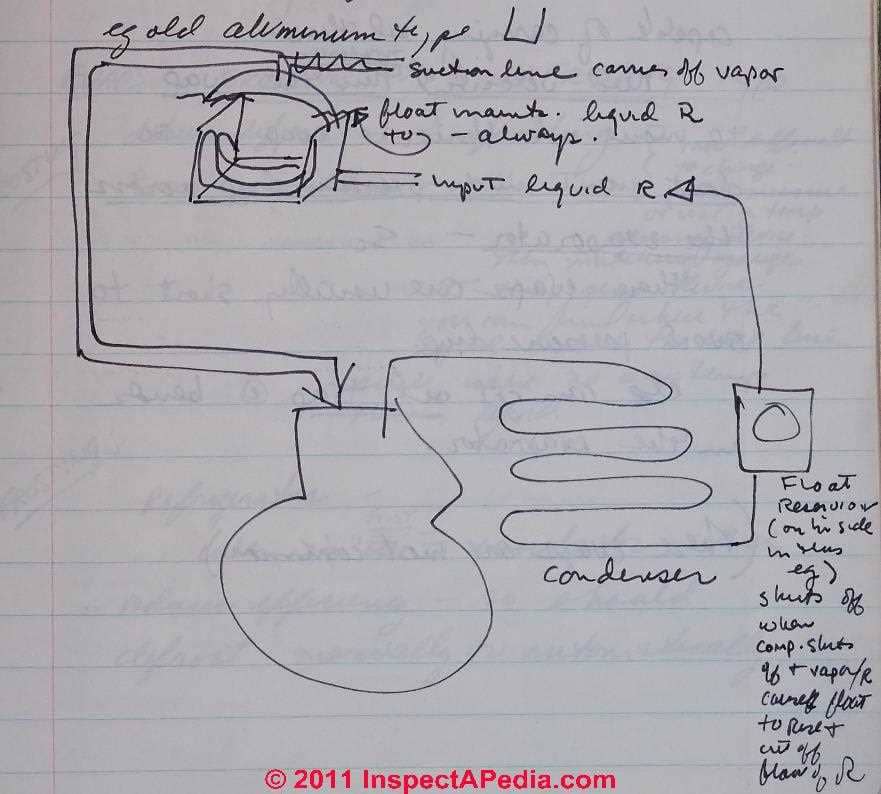 There are two types of evaporators used in refrigeration systems: flooded and dry evaporator coils.
Dry Evaporator Coils: in a dry evaporator coil design, all of the refrigerant entering the evaporator coil enters as a vapor (or gas).
In a dry type evaporator coil (or cooling coil) the refrigerant oil travels constantly in the system along with the refrigerant, and some oil is discharged into the condenser. That is, only liquid refrigerant can actually carry oil.
In the evaporator the refrigerant is vaporized and the oil travels through, but the vapor is less capable of actually carrying the oil through the coil.
For the oil to pass through we need refrigerant gas velocity and turbulence in the evaporator coil, so we do not want much pressure drop across the evaporator coil.
Therefore dry evaporator type coils are usually short - to avoid much pressure drop.
Otherwise we get oil traps at the bends in the evaporator coil.
These are the more common type of evaporator coil or cooling coil in refrigeration systems. So, for example, for a small air conditioner that has to be packed into a small space, to keep the evaporator length short the manifold system may used to run several short evaporator loops in parallel - to avoid long individual tubing runs that might cause an ensuing refrigerant pressure drop and oil traps in the system.
[An oil trap will clog or prevent refrigerant flow through the evaporator and thus will prevent the system from working. A symptom might be loss of cooling and high refrigerant pressures on the high side]
Flooded Evaporator Coils: in a flooded evaporator coil design, the evaporator is constantly full of refrigerant, whether the cooling system is "on" or "off". See our cooling coil sketches shown here.
Frosting vs. Non-Frosting Types of Evaporator Coils
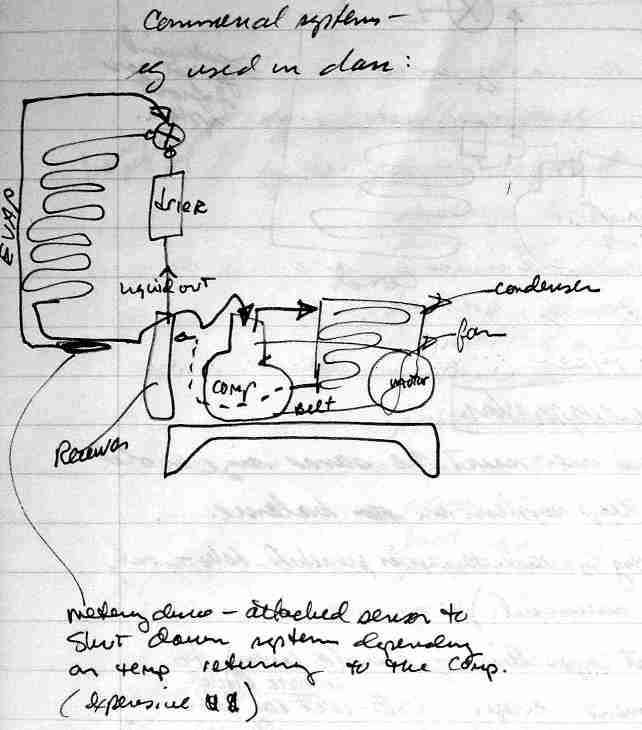
Our sketch shows the basic layout of a commercial refrigeration system. Here we detail the difference between frosting and non-frosting evaporator coils and we explain how frosting-type systems must be defrosted to keep working.
Non-Frosting Evaporator or Cooling Coils - No Defrosting Needed
Dehumidifiers are examples of non-frosting type cooling coil designs. These devices are basically little "air conditioners" or cooling systems in their design (though their warm air output is exhausted directly into the same space). The dehumidifier system is a refrigeration system designed such that the coil will never form ice or frost.
Room air conditioners (portable or window or through wall units) are also examples of non-frosting type cooling coil designs.
These "frost-proof" or non-frosting systems (in normal operation) ar more difficult to charge: you must use a precisely measured charge or a temperature-sensing device and matching gauge with the temperature-sensing device - you find where the liquid ends in the evaporator line - where there is no further change in temperature in the evaporator coil tubing, there is no more liquid refrigerant present.
If you see ice or frost on these cooling coils it's an abnormal condition that needs to be diagnosed and repaired.
See our diagnostic advice
at FROST BUILD-UP on AIR CONDITIONER COILS
Defrosting Methods for Cooling Coils (Evaporator Coils) in Refrigeration Systems
Frosting Evaporator or Cooling Coils Require a Defrost Cycle
Examples of frosting evaporator coils or cooling coils include refrigerators (or freezers). When more than 1/4 of the surface is ice or frost that condition acts as an insulator that reduces the efficiency of the appliance, so the appliance will have to defrost itself - either automatically or manually.
There are two defrosting methods commonly used in frosting-evaporator coil designs:
Defrost by electrical resistance heating (common on refrigerators, including frost-resistance for door faces and jambs using extra resistance heating elements in those areas too);
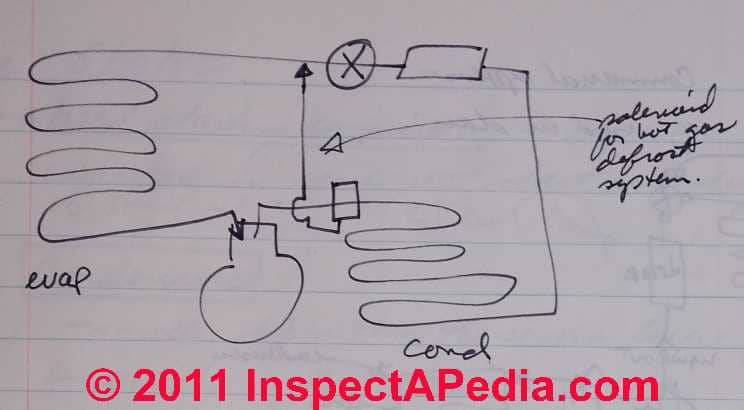 Defrost by hot gas: a solenoid in the compressor discharge line shuts [sketch above left] down vapor from the condenser and deposits high pressure/high temperature refrigerant gas directly into the evaporator coil, bypassing the refrigerant metering valve (TEV or cap tube).
The problem with dumping high temperature refrigerant vapor into the cold (iced, needs defrosting) evaporator is that it causes it to begin to condense - back pressure of the gas goes up and head pressure at the condenser goes down - now liquid refrigerant can back up to the compressor (where it would cause damage).
To avoid compressor damage from liquid refrigerant during this defrost cycle we add heat at the end of the evaporator coil (cooling coil) to insure that refrigerant reenters the compressor as a vapor, never as a liquid.
Typically, setting a maximum of 20 minutes of defrost cycle adds protection against warming up food in the refrigerator or freezer where this design is used.
The refrigeration compressor continues to run during the defrost cycle in the hot gas method case, but the compressor will not keep running during the defrost cycle in the electrical resistance defrost cycle method.
When is cooling coil frosting abnormal?
Note that on dehumidifiers and air conditioners or heat pumps frost or ice formation on the cooling coil is not normal and is an indication of the need for repairs. See our diagnostic advice at FROST BUILD-UP on AIR CONDITIONER COILS
How cooling coils are changed-out or replaced
When an evaporator coil or cooling coil needs replacement (perhaps because the old one is damaged or leaky):
- Because replacing a cooling coil or evaporator coil is a lot of work (and costly) first see if the old coil can be preserved. Combs can straighten out damaged cooling coil fins if they are not corroded too badly; and special epoxies are available to seal punched holes - a moderately successful repair attempt.
If the coil is leaking due to corrosion, epoxy is probably a waste of time - replace the coil. - The new cooling coil must be the same size as the old one it replaces in order to keep the system in balance.
- A short copper line is connected to the coil (at the factory) - use a wet rag or a flare block as a heat sink to avoid putting excess heat on this copper line (which may be connected to an aluminum coil by epoxy) during soldering the new evaporator coil to the existing refrigerant supply and suction lines.
- On newer HVAC and refrigeration systems you will usually have to cut out the old coil in place, removing both the coil and the foam poured around it. On older systems there may be screws and an access panel, usually on the freezer side of the coil in that equipment.
Reader Comments, Questions & Answers About The Article Above
Below you will find questions and answers previously posted on this page at its page bottom reader comment box.
Reader Q&A - also see RECOMMENDED ARTICLES & FAQs
On 2020-06-29 - by (mod) -
James
It's common to see a 90 degree turn into horizontal ductwork at the top or bottom of an air handler unit, but if your setup is going to require multiple such elbows I'd look for a way to minimize those turns as they restrict air flow.
On 2020-06-29 by James
My a/c is a split system with the furnace & evap mounted horizontal in the attic. I have enough ceiling height (6ft) to stand the furnace & evap coil upright but a little tight to add the supply duct work on top. Is it acceptable to put an supply elbow on the furnace and install the evap horizontally? Didn't know if there are any real disadvantages to locating the evap coils just a few feet away from the furnace outlet.
Thanks,
JD
On 2020-05-30 - by (mod) -
Bi
If you're sure that the condensate drain line is not blocked but you are seeing condensate in the secondary or overflow drain pan then I would look for a leak in the primary condensate drip tray or pan. You might be able to make a temporary patch by cleaning the hole or opening and patching with foil tape But ultimately you need that then replaced. Let me know what you find.
On 2020-05-30 by Bipin Patel
Our HVAC is in the attic and I noticed that water is coming from the evaporator drain plate on a collector plate.
The drain pipe is pretty clean and no issue with it
Is anyone can help to fix this problem?
On 2018-01-12 - by (mod) -
Betty,
I think you'd need to document a health hazard and notify your association in writing of the problem. In my opinion, in addition, adding a perfume to indoor air is never more than a cover-up, it will not ever remove a problem, if there is one, and it is also my experience that scents and perfumes can be a serious hazard to asthmatics.
On 2018-01-12 by Betty
My condo used dryer sheets to blow the smell of them through the bldg. Tjose are do full of chemicals & not healthy. What can I go to get that stopped? Thank you.
On 2018-01-10 - by (mod) -
Jim
If you see enough frost that air passage through the coils is being blocked I'd call for service; I'd then suspect low refrigerant. (or a bad defrost cycle or control on the unit)
On 2018-01-10 by Jim
I reside in West Central Arizona, the outside temp now in early morning Jan is around 50-55 degrees as the sun is rising .
When I have my heat pump on providing warm air to the inside of my home I noticed frost on the outside unit coils where the sun is not shinning on the coils with frost.
Is this normal or does it ALWAYS indicate a possible refrigerate leak in the system? My 5 tn Lenox system also has an air handler in the attic.
The system is providing warm air to the inside of my home & it cuts off at the desired setting I have set on the thermostat in the hallway.
I have checked the warm air coming out of the inside vents & the temp of that air is between 80-90 degrees depending on where I direct the red laser beam & which room I am in.
Do I need to be concerned about the frost on the outside coils on the main A/C unit ?
Thank you,
On 2017-10-23 - by (mod) -
Jennifer
See MANUALS & PARTS GUIDES - HVAC https://inspectapedia.com/heat/HVAC_Manuals_Air_Conditioners_Boilers_Furnaces.php
On 2017-10-15 by Jennifer
Looking for a manual for Comfortmaker / Snyder General indoor cased coil system DCAPA030!! Help!!! Please!
On 2017-10-23 - by (mod) -
Long
The acid isn't disposed-of by evaporation so much as by use of a foaming cleanser that is collected from a drip tray below. Or other cleaners such as CalBrite from Nu-Calgon include specific instuctions that I'll refer you to in the article on DIRTY COIL CLEANING PROCEDURES https://inspectapedia.com/aircond/Cooling_Coil_Cleaning.php
On 2017-10-14 by Longkissgoodnt@aol.com
To clean the coil with acid inside the house, when you restart the air conditioning do you have to go outside for a certain time for the acid to evaporate?
On 2017-10-10 - by (mod) -
yes
On 2017-10-10 by Usha
Can accident cause damage
Question:
(Apr 28, 2015) Shakil said:
I want to assemble an air conditioner.I have have the condenser and evaporator coils.Can anyone please help me in this project?I am confused about compressor.If need i can give you size and picture of my coils..please help me.
If your air conditioning or heat pump system has lost its cooling capacity or won't start
see REPAIR GUIDE for AIR CONDITIONERS.
See COOLING CAPACITY, RATED of air conditioning equipment if the system seems to be working but is inadequate to cool your building.
Page top photo of an iced-up air conditioning evaporator coil are courtesy Guy Benfante.
...
Continue reading at DIRTY COOLING COIL / EVAPORATOR COIL or select a topic from the closely-related articles below, or see the complete ARTICLE INDEX.
Or see these
Recommended Articles
- AIR HANDLER / BLOWER UNITS - home
- COOLING COIL or EVAPORATOR COIL
- DIAGNOSTIC GUIDE A/C or HEAT PUMP
- DIAGNOSTIC DETAILS A/C or HEAT PUMP
- FROST BUILD-UP on AIR CONDITIONER COILS
- REFRIGERANT GASES & PIPING
- REFRIGERANT LEAK REPAIR
- DIAGNOSTIC GUIDE A/C or HEAT PUMP
- DIAGNOSTIC DETAILS A/C or HEAT PUMP
- AIR CONDITIONING & HEAT PUMP SYSTEMS
- WATER & ICE IN DUCT WORK
- WET CORRODED DUCT WORK
Suggested citation for this web page
COOLING COIL or EVAPORATOR COIL at InspectApedia.com - online encyclopedia of building & environmental inspection, testing, diagnosis, repair, & problem prevention advice.
Or see this
INDEX to RELATED ARTICLES: ARTICLE INDEX to AIR CONDITIONING & HEAT PUMPS
Or use the SEARCH BOX found below to Ask a Question or Search InspectApedia
Ask a Question or Search InspectApedia
Try the search box just below, or if you prefer, post a question or comment in the Comments box below and we will respond promptly.
Search the InspectApedia website
Note: appearance of your Comment below may be delayed: if your comment contains an image, photograph, web link, or text that looks to the software as if it might be a web link, your posting will appear after it has been approved by a moderator. Apologies for the delay.
Only one image can be added per comment but you can post as many comments, and therefore images, as you like.
You will not receive a notification when a response to your question has been posted.
Please bookmark this page to make it easy for you to check back for our response.
Our Comment Box is provided by Countable Web Productions countable.ca
Citations & References
In addition to any citations in the article above, a full list is available on request.
- Thanks to Ato Guy Benfante, Chesapeake, VA 8/26/07 for the photograph of an ice-blocked air conditioning system evaporator coil and for his suggestion that we provide an air conditioning system troubleshooting FAQ.
- Mark Cramer Inspection Services Mark Cramer, Tampa Florida, Mr. Cramer is a past president of ASHI, the American Society of Home Inspectors and is a Florida home inspector and home inspection educator. Mr. Cramer serves on the ASHI Home Inspection Standards. Contact Mark Cramer at: 727-595-4211 mark@BestTampaInspector.com
- John Cranor [Website: /www.house-whisperer.com ] is an ASHI member and a home inspector (The House Whisperer) is located in Glen Allen, VA 23060. He is also a contributor to InspectApedia.com in several technical areas such as plumbing and appliances (dryer vents). Contact Mr. Cranor at 804-873-8534 or by Email: johncranor@verizon.net
- Wikipedia Web: https://www.wikipedia.org/ provided background information about the definition of HEPA and airborne particle interception.
- [1] at Example Refrigeration Equipment Field Diagnosis & Repair: Thermostatic Expansion Valve we include an old case history of observations made during tests and adjustments of the TEV on a commercial refrigeration cooler/freezer - way back during refrigeration school in 1982 [DJF].
- Our recommended books about building & mechanical systems design, inspection, problem diagnosis, and repair, and about indoor environment and IAQ testing, diagnosis, and cleanup are at the InspectAPedia Bookstore. Also see our Book Reviews - InspectAPedia.
- Complete List of Air Conditioning & Heat Pump Design, Inspection, Repair Books at the InspectAPedia Bookstore.
- Modern Refrigeration and Air Conditioning, A. D. Althouse, C.H. Turnquist, A. Bracciano, Goodheart-Willcox Co., 1982
- Principles of Refrigeration, R. Warren Marsh, C. Thomas Olivo, Delmar Publishers, 1979
- Refrigeration and Air Conditioning Technology, 5th Ed., William C. Whitman, William M. Johnson, John Tomczyk, Cengage Learning, 2005, ISBN 1401837654, 9781401837655 1324 pages
- In addition to citations & references found in this article, see the research citations given at the end of the related articles found at our suggested
CONTINUE READING or RECOMMENDED ARTICLES.
- Carson, Dunlop & Associates Ltd., 120 Carlton Street Suite 407, Toronto ON M5A 4K2. Tel: (416) 964-9415 1-800-268-7070 Email: info@carsondunlop.com. Alan Carson is a past president of ASHI, the American Society of Home Inspectors.
Thanks to Alan Carson and Bob Dunlop, for permission for InspectAPedia to use text excerpts from The HOME REFERENCE BOOK - the Encyclopedia of Homes and to use illustrations from The ILLUSTRATED HOME .
Carson Dunlop Associates provides extensive home inspection education and report writing material. In gratitude we provide links to tsome Carson Dunlop Associates products and services.
 | HOME | ABOUT | ASK a QUESTION | CONTACT | CONTENT USE POLICY | DESCRIPTION | POLICIES | PRIVACY | |
| © 2024 - 1985 Publisher InspectApedia.com - Daniel Friedman | |||||||||