
InspectAPedia® FREE Encyclopedia of Building & Environmental Construction, Diagnosis, Maintenance & Repair |
Question? Just ask us! InspectAPedia
|
 Asbestos HVAC Ducts & Furnaces
Identification & Assessment of Asbestos In Heating and Cooling Duct Work
& Air Handlers
- POST a QUESTION or COMMENT about asbestos materials on or inside of heating or air conditioning air ducts or air handlers & blower units
Asbestos in or on HVAC ducts (air ducts or heating and cooling ductwork) or inside the air handler (blower unit) itself is a possible hazard for which we provide information, photos, & links to additional documents.
This article shows how to recognize asbestos materials in heating and air conditioning ducts, vibration dampers, chimneys, and flues, and air handlers or blower compartments, and it identifies potential asbestos fiber release or carbon monoxide hazards in buildings where certain asbestos and cement-asbestos transite pipe materials are used for ducts or for heating appliance chimneys and vents.
This is part of our article series that describes the inspection of residential air conditioning systems (A/C systems) to inform home buyers, owners, and home inspectors of common cooling system defects.
Page to photo: white asbestos paper used as an insulating wrap on old metal air ductwork.
InspectAPedia tolerates no conflicts of interest. We have no relationship with advertisers, products, or services discussed at this website.
Asbestos Materials on or in the Air Conditioning or Heating System Duct Work
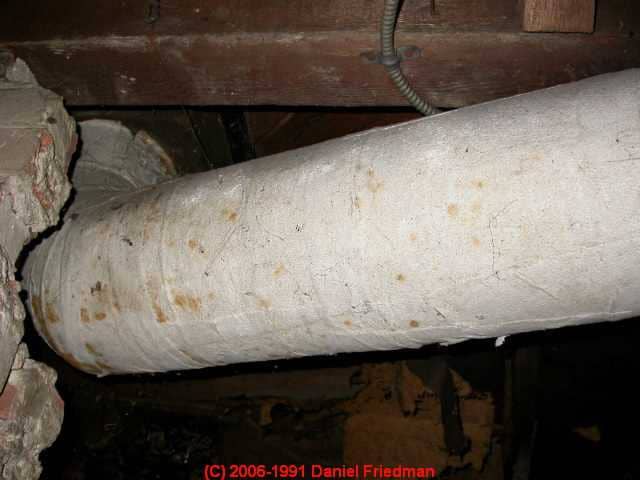
 The photograph shows asbestos paper heating duct wrap.
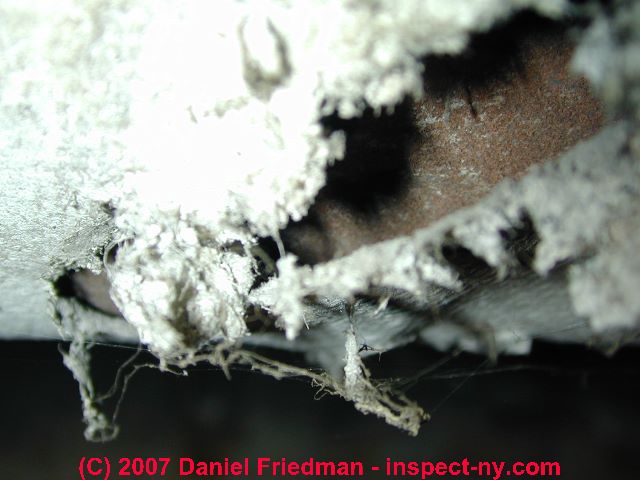
Asbestos in these locations is a possible hazard which may require special attention, particularly if the paper has been damaged as we show here - where it may shed asbestos particles into occupied space.
Asbestos paper used as HVAC air duct wrap or sealant typically is about 15% chrysotile asbestos.
Depending on its location and on the effectiveness of and location of air filters in the heating or air conditioning system and also particularly if that paper is in the air path and more-so if it's damaged, the asbestos paper may be releasing asbestos particles into HVAC system air as it circulates into the building.
Here we also warn about signs of amateur asbestos removal which may merit additional testing and cleanup work.
Also see ASBESTOS PAPER INSULATION on DUCTS and
see VIBRATION DAMPENERS for more discussion of this possible asbestos source.
Asbestos - Ductwork Types & Materials
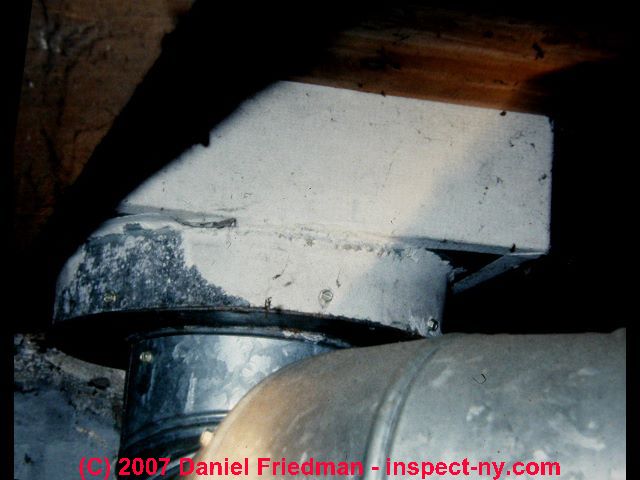
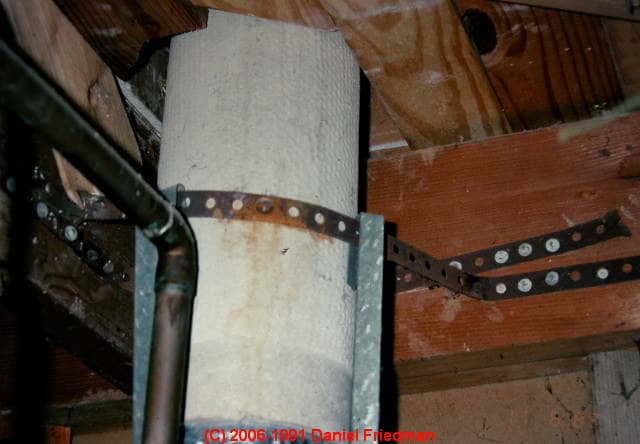
 Another example of asbestos duct wrap is shown in this photograph.
During an inspection of the heating or air conditioning duct system and air handler, look for what may be asbestos containing insulating material on the heating system.
- Asbestos materials inside return air duct passages, such as asbestos-wrapped plumbing pipes between floor joists - illustrated in this article, this is one of the two potentially most-hazardous asbestos locations in HVAC systems
- Cement asbestos transite pipe used as HVAC air ducts, often set in slabs but also run through building areas; note that this material may also have been used as a chimney or chimney flue -
see TRANSITE PIPE AIR DUCT ASBESTOS RISKS - White corrugated asbestos paper insulating material used as an insulating liner on the interior of some air handlers and occasionally inside HVAC ducts
- White "paper" wrapped on outside of some heating ducts and register connections
-
see ASBESTOS PAPER DUCT INSULATION - White woven material used as flexible joint between some heating ducts
-
see ASBESTOS DUCT DAMPENERS - White woven material used as flexible joint in the vibration damper between air handler the duct work -
see ASBESTOS DUCT DAMPENERS - Cement asbestos "millboard" used as a partial heat shield on wall/ceiling surfaces -
see CEMENT ASBESTOS SHEET PRODUCTS
Asbestos Materials Inside Air Return Ducts
 Often the space between floor joists, ceiling joists, or even wall studs is simply covered over with sheet metal and used as an air return duct in HVAC systems.
Occasionally we find other asbestos materials routed inside these spaces, sharing the HVAC system air path to route pipes that have themselves been insulated with asbestos wrap or lagging.
Photo: we have pulled down the aluminum sheet metal that was nailed across a pair of joists supporting the floor over the basement of a Haddonfield New Jersey home. Inside we see water-damaged cloth-wrapped asbestos pipe insulation in poor condition.
Watch out: this condition risks distributing asbestos into the building's air and thus exposing occupants to airborne asbestos.
Because this places potentially friable asbestos material right in the building's HVAC air path the air conditioner or heating system in such buildings is at risk of producing and distributing asbestos in air blown into the occupied space.
This is therefore a potentially dangerous source of indoor airborne asbestos. The risk of distributing asbestos into the building interior air depends on the kind of asbestos-containing materials in the return duct and their condition.
For example, cement asbestos transite pipe air ducts or flues that are un-damaged are likely to shed considerably less asbestos particles than corrugated paper pipe wrap or asbestos pipe lagging that has been damaged by leaks or by mechanical disturbance.

A reader asked if there was an asbestos-exposure risk from having these acoustic ceiling tiles used (probably as an "insulation" liner) inside of the air supply ducts in his home.

While it's unusual, on occasion the space between floor or ceiling joists or wall studs was also covered-over for use as heating air supply ductwork in some older homes.
If the ceiling tiles shown above contain asbestos this would be an asbestos-exposure risk for building occupants. More discussion of these ceiling tiles in air ductwork is
Asbestos Liner Inside Metal HVAC Ducts
1960s Asbestos PAPER Core Spiral Metal / Foil Covered Ducts
 Question: do you think this metal duct interior liner is asbestos?

I am getting different opinions on [whether or not ] my duct work [contains an asbestos paper liner].
Do you think [this duct uses ] asbestos ?
And if it is asbestos is it dangerous?
The home where this ductwork was installed was constructed in New Jersey in 1967.
Thanks -Anonymous by private email 12/12/2017
Reply: corrugated asbestos paper used as liner in metal HVAC ducts
I think I see metal ductwork on the floor of an attic of an older building.
Your first photo shows metal ductwork that is crushed and bent. In that condition it's not usable and may not be safe.

I zoomed in to see as much as I could of the duct liner in the second of your photos that I will show below.
It's uncommon to find hemp (burlap) reinforced corrugated asbestos paper insulation inside of metal ductwork but that is certainly what it looks like to me.
And indeed in the U.S. the Illinois DEC indicates that asbestos was used as both an insulation and an air leak sealant both on the exterior of HVAC ducts and in the duct interiors.
In sum, my best guess is that this is an asbestos duct material about 3/16" thick that is covered on both sides with metal foil or very thin aluminum constructed in a spiral wind pattern. It's the closer look (yellow arrow in the photo below) that shows what looks like corrugated asbestos paper comprising the body of this duct wall.
It would be helpful to have more information including the country and city where the building is located, whether this is a private home or something else, and the age of the home. I'd also like to see a photo of the furnace but I suspect it's long gone.
Usually one can not say for certain whether a material is asbestos or not without a lab test. But there are some cases where there was no non-asbestos look-alike product.
 One of these is asbestos insulating paper which is gray, has a characteristic texture and is flat where used on the outside of hvac ducts and also is in a corrugated paper form on piping. You can see some examples at
ASBESTOS PIPE-INSULATION - this article shows corrugated asbestos paper (used here as a pipe wrap) that you will see virtually duplicated in pattern in the corrugated paper exposed at the left end of the duct section in your photo.
ASBESTOS PAPER DUCT INSULATION - shows the use of flat asbestos paper on duct exteriors.
In any event, rather than face a costly asbestos removal project to modify the duct work, what I would expect any sensible contractor to suggest is something that's needed in any event, regardless of the duct insulation: the duct you show is crushed, damaged, not usable.
It would make sense to bag and remove the duct sections intact, with as little disturbance as possible.
If your heating system needs to run ducts through an attic space it would make sense to install new metal ductwork with exterior insulation.
Watch out: What makes asbestos a health hazard or not depends on the exposure of people in the building to asbestos dust. I can see that some of the ductwork has already been removed as your photo shows it on a porch floor. And I agree that such damaged ductwork should be properly removed from the home.
If, in the removal of this damaged ductwork, the remediator is not creating a dusty mess then the risk levels are very low.
That's why when you are removing old ductwork that appears to contain asbestos you want to do it by taking out intact duct sections rather than doing anything aggressive (chopping, sanding sawing) that creates a lot of dust.
Advice if Asbestos Has Been Released In Your Building
The following is excerpted from advice from the Oregon DEA
If you think a significant amount of asbestos has been released in your home:
- Close off the part of the home where the release occurred.
- Close off air ducts and vents.
- Shut windows.
- Tape bottoms of doors to prevent draft.
- Contact a licensed asbestos abatement contractor or DEQ for information on what to do next.
Health impacts that are typically associated with being exposed to asbestos comes primarily from working for long periods of time around very high concentrations of fibers. Your health should not be impacted by a single exposure to asbestos fibers, but if you are concerned, please consult your doctor. - (Oregon DEQ 2017)
Watch out: the U.S. Environmental Protection Agency previously provided various asbestos remediation and removal or encapsulation guidelines but as of December 2017 an online search for commonly-indexed documents is producing hung connections - you may be able however to obtain printed copies from your local EPA office.
Example of US EPA Asbestos Documents Not Loading: Guidelines for Asbestos: NESHAP Demolition and ... - epa nepis http://nepis.epa.gov/Exe/ZyPURL.cgi?Dockey=50000LP9.TXT
More Photos of Metal/Foil HVAC Ducts that Use Asbestos - ca 1967
 ...
... 
The foil and asbestos HVAC ducts shown here were provided by InspectApedia.com reader Sam in August 2021 and are also discussed in the Reader Q&A section found at
ASBESTOS PAPER DUCT INSULATION
 ...
... 
[Click to enlarge any image]
Asbestos Paper On or In Heating and Cooling Ducts
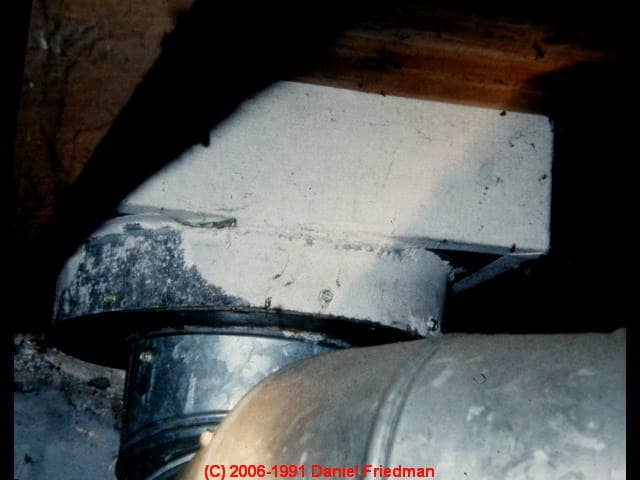 Asbestos on Ducts, Health Concern: While there may be no conclusive data nor studies which evaluate hazards regarding the mere presence of this material in residential buildings, it is generally considered by the scientific community to be a potential health risk if building occupants are likely to be exposed to significant levels of airborne asbestos dust.
If there is asbestos paper wrap on the exterior of HVAC ducts the risks are low, as we will explain below.
Watch out: If there is asbestos paper or a corrugated asbestos insulation liner inside of HVAC ducts that is likely to be hazardous. Such ductwork should be removed intact (by a qualified contractor) and replaced.
Watch out: demolition or removal of asbestos-covered or asbestos-lined HVAC ducts requires use of appropriate asbestos removal procedures including containment of the dust and debris and steps to avoid building cross-contamination into other areas.
The asbestos paper "insulating" duct wrap such as shown in several of these photographs is typically 55% chrysotile asbestos (as defined in OAR 340-248-0010(5)). Contractors who remove such ductwork without following proper procedures may be liable to civil penalties and litigation. (Oregon DEQ to Gelber 2016).
Asbestos paper on the outside of HVAC Air Ducts
Asbestos paper like that shown here was often used both to insulate HVAC ducts and to seal openings against air leaks.
So we see this paper wrapped around the air supply register (first photo in this article-section), or asbestos paper wrapped around the ductwork itself. Photo below courtesy of an InspectApedia.com reader.

We also find narrow strips of asbestos paper that was wet and then wrapped around joints in HVAC ducts to seal against air leaks.

When this paper is on the exterior of an HVAC air supply duct the risks of blowing asbestos into the building's HVAC air system are low. That's because when the air conditioner or heating system blower unit is running the supply duct interior will be under positive pressure. Any small openings that expose the exterior asbestos paper wrap to the duct interior will be blowing out - away from the duct interior.
However if this asbestos paper is on the exterior of a return air duct, because the return duct will normally be under negative pressure when the air handler or blower unit is running, there is some risk that asbestos could be drawn into the returning air. However the absolute risk from intact asbestos-paper exterior duct wrap over a small opening in return ducts is probably very small.
More significant exposure risks occur when such materials are actually inside the ductwork or inside of the air handler itself - for which we give examples in this article series.
More identifying photographs and information about the use of asbestos paper on heating and cooling air ducts, and advice on what to do about asbestos paper duct wrap are found
at ASBESTOS PAPER DUCT INSULATION.
Economic Impact of Asbestos on or in HVAC Ducts
Asbestos heating system insulation is also a potential economic risk as future buyers may be concerned about this material. Disposal costs for this material are increasing.
Depending on condition and location of asbestos material, treatment ranges from doing nothing to complete removal. Removal could involve significant costs.
You should obtain proper technical information and health and safety guidelines before attempting to do anything with this material. It is the breathing of fibers when this material is disturbed, not its mere presence, which is considered a health risk.
When the material is not found in living areas in poor condition, treatment is not usually an emergency and you have ample time to become informed, obtain estimates, and select a course of action.
Asbestos Inside or at the Air Handler of Furnaces or Air Conditioners
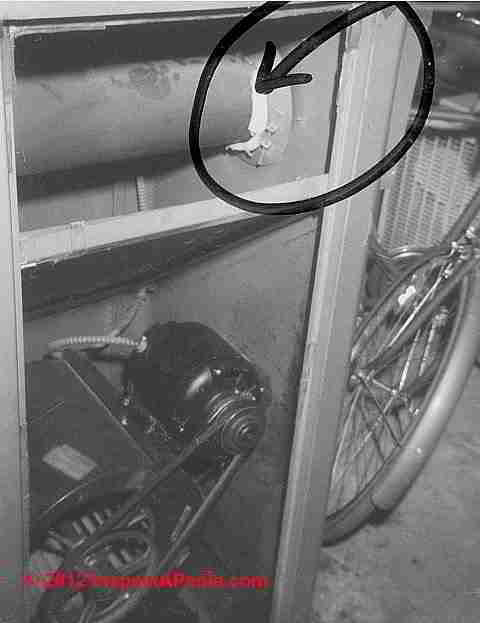 Among asbestos products used in heating or air conditioning air handlers and blowers, we suspect that vibration dampeners, especially in undamaged condition, are likely to release much lower levels of asbestos particles into the HVAC system air than the softer insulating materials found in some air handlers themselves.
Details are at VIBRATION DAMPENERS
We have observed friable asbestos inside older warm air heating furnaces made by Williamson (corrugated asbestos paper insulation inside the air handler of an older unit) and by Armstrong (asbestos insulation around the flue vent connector passage through the air handler's blower compartment side wall - photo shown at left), and in some other brands of heating equipment.
We have also found asbestos insulation in the air handler of some Armstrong furnaces.
But in our OPINION even in the air handler, depending on the size or amount, condition (undamaged), and location, the release into building air of asbestos from these sources may be very difficult to detect - suggesting that in those cases it is at very low levels, below measurable effect.
Exhaust flue passing through return air plenum: a warning
Watch out: if there are corrosion leaks or any other openings in the flue vent connector where it passes through the furnace return air side, depending on the blower location, several very dangerous conditions can occur, including carbon monoxide production at the burner due to back pressure, or the reverse: negative air pressure (such as will occur in the furnace shown) when the blower is running can extract combustion gases right out of the flue and draw them into building air being passed through the furnace heat exchanger.
Asbestos Fabric in HVAC Duct Dampeners
Below is a photo of a coated (note the silver color) asbestos-fabric air handler vibration damper. This fabric is right in the air pathway and should probably be removed.
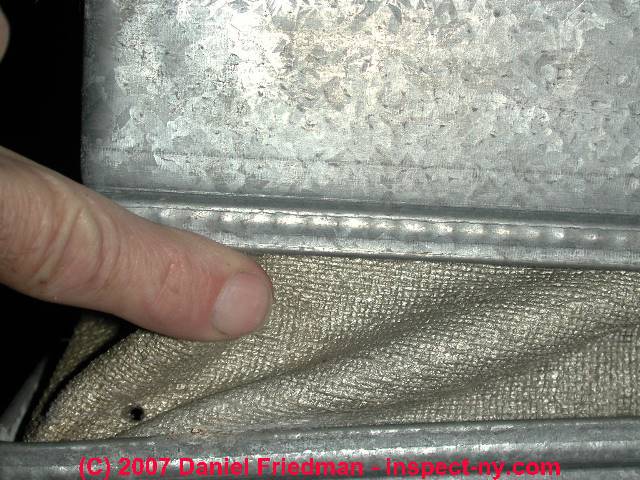
See details at VIBRATION DAMPENERS
TRANSITE and SONNO-DUCT Air Conditioning or Heating Duct Material Warnings
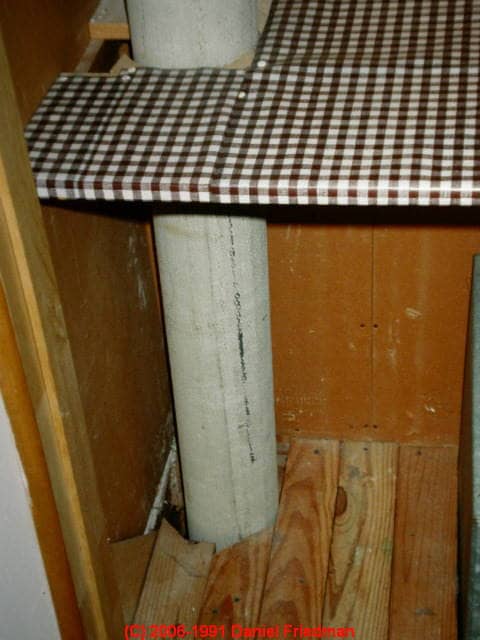
Asbestos fiber release and carbon monoxide hazards
While the transite pipe shown here was in use as an exhaust flue (what is the fire rating and fire clearance required?), this material was also used in some buildings for in-slab duct work -
see SLAB DUCTWORK .
Caution: Down flow furnace in building with concrete slab and with perimeter duct work raises questions: what is the duct work made of ? Is asbestos material found right in the air pathway in a building? If so there are higher risks of airborne asbestos contamination in that building than otherwise.
Transite chimney Carbon Monoxide Hazards: where used for chimneys in buildings, transite pipe may form a very serious, potentially fatal carbon monoxide hazard due to chimney blockage.
We explain how and why the carbon monoxide poisoning hazard develops in our article
at TRANSITE ASBESTOS CHIMNEYS, DUCTS, PIPES where we provide additional photographs of this material.
Transite Duct Asbestos Hazards: if used for air ducts transite pipe may be a an asbestos hazard, particularly where the ducts become softened by water exposure (such as air ducts located in floor slabs), potentially releasing asbestos fibers into the building air.
See TRANSITE PIPE AIR DUCT ASBESTOS RISKS for details.
Sonno Duct (spun composition material) may have absorbed water, collapsed, and be blocking the duct line and potentially inviting a termite infestation or a mold contamination problem in the building.
More identification photographs of transite pipe in buildings can be found
at TRANSITE PIPE AIR DUCT ASBESTOS RISKS
Asbestos cement sheets were also used in some buildings to construct rectangular heating supply and return air ducts as weas documented by Elizalde:
- Elizalde, Ruben Rodriguez. ASBESTOS PRESENCE in 20th CENTURY BUILDINGS [PDF] (2022) Journal of Engineering and Applied Sciences Technology. SRC/JEAST-189. DOI: doi. org/10.47363/JEAST/2022 (4) 152 (2022). - retrieved 2023/12/09, original source: onlinescientificresearch.com/articles/asbestos-presence-in-20th-century-buildings.pdf
"Figure 18: Fiber Cement Chimney Ducts, Protected with Asbestos Sheets for Thermal Insulation, in a Residential Building in Madrid, Spain (author’s Photograph)." - illustrated below.

Suggestions for Handling Asbestos On or Inside Air Ducts on Heating or Cooling Systems

- Asbestos on the Exterior of HVAC supply ducts:
When asbestos paper or fabric is on the outside of an air supply duct, that duct is, with respect to the asbestos covering, never sucking asbestos fibers IN, it's only trying to blow them AWAY - and that only IF the wrap is covering actual leaks or holes in the ductwork.
So the risks in that direction are small.
My expectation and thus OPINION in this case is that the level of airborne asbestos in the building and that could be attributed to this particular asbestos source is most-likely to be below the limits of detection. However if the material is in a location where it can be damaged and/or spread into occupied space it needs to be addressed, as described below.
Often intact asbestos-paper-wrapped air ducts might be left in place and encapsulated by a suitable paint, coating, or wrap.
Exterior asbestos paper duct wrap or tape that is damaged or disturbed presents a risk of asbestos contamination.
- Asbestos on the Exterior of HVAC return ducts:
If there is asbestos wrap on the outside of HVAC return ducts, as those may be under negative pressure, if there are openings in the ductwork covered by loose or damaged asbestos material, asbestos could be drawn into the HVAC system and redistributed into the occupied space - a potential hazard.
I would consider removing such ducts and replacing them as described below. - Asbestos Inside of HVAC Ducts or Air Handlers:
If there is asbestos material in the actual air path such as inside HVAC ducts (which is rare) or inside the actual HVAC air handler (which was true on some older furnaces) then that is much more likely to be a source of hazardous levels of airborne asbestos in the building.
In my opinion such asbestos-lined ducts or air handlers should be replaced.
The removal of any insulation inside of a furnace can make the heater unsafe, risking over-temperatures, equipment damage, flue gas leaks, even fires. Where we encountered this situation the furnace manufacturer would not warrant the heater when its insulation was modified in the field.
There are spray-in coating "solutions" sold for HVAC ducts that purport to create a new duct interior liner. In my OPINION I'm uncertain about the long-term safety and reliability of spray-in duct liners.
In virtually all HVAC systems it is very difficult if not impossible for a building owner or manager to regularly inspect the interior of the ductwork. Such inspection requires cutting of openings and use of a duct inspection camera system.
One cannot be sure that the spray adequately reached and covered all of the duct interior. One also cannot be certain that some section of that spray-on coating has not later fallen away from the duct interior when the interior asbestos duct insulation to which it was applied itself falls away.
Building occupants are left thinking that a safety hazard has been addressed when it may in fact be a continuing hazard.
See WARNING ABOUT ASBESTOS in the AIR HANDLER for photos & details.
What to Do about Asbestos-Wrapped HVAC Duct Exteriors
 [OPINION - as this advice would change when informed by specific site conditions]
Photo: corrugated paper in an amateur installation on the exterior of a heating air duct in a New York home, provided by an InspectApedia reader. We think this asbestos insulation and heating duct were added in 1963 or 1964. [Click to enlarge any image]
IF the asbestos material is not falling off and creating a mess,
AND
IF the asbestos duct wrap material is not in a location where it's likely to be banged, moved, damaged (thus creating a hazard) and it is not in the air path of the HVAC equipment
THEN
You can usually leave supply duct insulation in place, coating it with a spray-on paint, coating, or wrapping it if it's in a location where it can be wrapped with any suitable duct seal, even aluminum tape.
For the asbestos-insulated HVAC duct shown above, an option might be to box in the exposed ductwork to prevent damage. IF this were a return-air duct I'd replace the duct and its asbestos lining rather than risk drawing asbestos debris into the heating system's air path.
ELSE

[this means there is probably a reason to remove the asbestos material]
If your asbestos-paper-wrapped HVAC ducts look like our photo you'll see that the duct itself is badly rusted, the asbestos wrap is in poor condition, and there seems to be an efflorescence or other bloom forming on the insulation as well. This ductwork should be replaced.
The least disruptive and least expensive way to remove the material is to work carefully to remove the ductwork itself that is covered in asbestos, in intact sections, with absolute minimum number of cuts or disturbances, for bagging and disposal.
That process is perhaps done by a professional using negative air control to avoid cross contamination, proper bagging and legal disposal, followed by damp wiping and HEPA vacuuming to remove any questionable dust.
If You Are Facing A Significant Asbestos Insulated Duct Abatement Project Cost
First: confirm that the material is indeed asbestos and that its condition or location requires its removal.
If the asbestos-suspect material seen in a building is confirmed as actual asbestos or an asbestos-containing product, depending on its condition and location, treatment ranges from doing nothing to complete removal.
Professional asbestos removal would involve significant costs and is the recommended course of action where asbestos materials are damaged, friable, in a location subject to damage, in an occupied space, and/or in an unoccupied location where asbestos debris is likely to be carried into occupied space by human traffic or by the operation of heating and cooling equipment.
A number of asbestos treatment options are available where asbestos material is found in a building.
Choice of treatment can make a big difference in possible costs of handling the material. You should obtain proper technical information and health and safety guidelines before attempting to do anything with this material.
Question: does this duct or vent wrap look like asbestos?

(July 15, 2018) Does this contain asbestos? said:
I found this in the attic. The HVAC guys thinks it might have been part of the old ductwork.
Not sure where it leads to, but suspecting that it leads to a hole in a kitchen closet (maybe where the old furnace sat). Now the new furnace sits in the attic. Does this look like asbestos to you?
This Q&A were posted originally at ASBESTOS PIPE INSULATION
Reply:
I'm not sure what that is either, as the photo is a bit blurry.
It looks a little too thin to be transite cement asbestos that could have been a flu or air duct.
Most likely what your photo shows is asbestos paper covering what was a connection in an HVAC duct or a vent duct.
Watch out: in any event an HVAC duct or an exhaust vent duct that simply dumps into the attic is not functional and could also be unsafe.
References for Asbestos Paper Duct Wrap & Asbestos HVAC Duct Hazards
- Abatement, Traditional Asbestos. "section 02 82 11 Traditional Asbestos Abatement." In Specifications For Bldg# 1, 5th Floor/sleep Clinic/bldg# 16 Conf., p. 259864. 2012.
- Abatement, Asbestos. "SECTION 02.82. 00 ASBESTOS ABATEMENT."
- Abatement, Asbestos. "1.1. 3 Related Work." Issued For Construction Documents Va Project No. 523a5-12-308 Date: 07/13/11 (1911).
- "Asbestos in the Home", U.S. EPA, https://www.cpsc.gov/en/Safety- Education/Safety-Guides/Home/Asbestos-In-The-Home/
- "Asbestos, a Guide for New Jersey Residents", State of New Jersey Department of Health & Senior Services, retrieved 5/1/14, original source: http://www.state.nj.us/health/iep/documents/asb_in_home_full.pdf
- Barman, Waldemar J. "Air conduit." U.S. Patent 2,108,159, issued February 15, 1938.
- Froehlich, Phillip A., and Bruce A. Hollett. "Evaluation of glove bag containment and asbestos abatement clearance: Methodologies for asbestos removal." Applied Occupational and Environmental Hygiene 8, no. 11 (1993): 937-944.
- Hunting, Katherine L., and Laura S. Welch. "Occupational exposure to dust and lung disease among sheet metal workers." British journal of industrial medicine 50, no. 5 (1993): 432-442.
- Marc, Henri M. "Manufacture of ducts." U.S. Patent 2,434,465, issued January 13, 1948.
- Oberta, Andrew F. Asbestos Control: Surveys, Removal, and Management. Vol. 23. ASTM International, 2005.
- Oregon DEQ to Gelber, Notice of Civil Penalty Assessment and Order
No. AQ/AB-NWR-16-086, [PDF] Oregon Department of Environmental Quality 811 SW 6th Ave
Portland, OR 97204-1390
(503) 229-5696, (June 28,2016), retrieved 2017/12/14, original source: http://www.oregon.gov/deq/nr/070616christophergelber.pdf
Excerpt: ... issued you a total civil penalty of $28,800 for failing to hire a licensed contractor to perform an asbestos abatement project and openly accumulating friable waste material.
The violations occurred in February and March 2016 when you disturbed and removed asbestos-containing thermal system insulation associated with the heating ventilation air condition (HVAC) ducting system while managing renovations at a residence in Portland ... - Oregon DEA, "Asbestos Information for Homeowners" [web page] retrieved 2017/12/14, original source: http://www.oregon.gov/deq/Hazards-and-Cleanup/Pages/Asbestos-for-Homeowners.aspx
Research on the Use of Asbestos Liners In or On HVAC Ducts
Supporting research confirms that there were asbestos paper duct liners made with reinforcement of hemp
- Callan, William D. "Knockdown sectional air conduits." U.S. Patent 2,916,054, issued December 8, 1959.
- Conroy Addison B. Hewett, Alvin E., "Flexible duct." U.S. Patent 2,726,682, issued December 13, 1955.
Excerpt:
We may also employ fabric of asbestos, nylon, rayon, jute, sisal, hemp, or other fibrous material. - Fluke, Gordon A. "Thermal insulation for piping and equipment." (1957).
Gives specifications for asbestos cloth used in a variety of applications including HVAC. - Morris, Harold H. "Reinforced plastic." U.S. Patent 2,836,529, issued May 27, 1958.
Excerpt:
The other reinforcing longitudinal fibrous materials should likewise be resistant to the heat of polymerization of the resin, and for a stiffer product should have high tensile strength, and may include glass fibers, slag wool,
Patented May 2'3, i953 asbestos fibers, wood cellulose fibers, hemp, jute, ramie, kapok, sisal, flax, cotton, silk, hair, nylon, viscose rayons, other synthetic fibers, or the like, in the form of chopped random short fibers, mats, rovings, yarns, strands, filaments, fabrics, cloth, or the like. - Rock, Robert B., "Furnace assembly." U.S. Patent 2,158,338, issued May 16, 1939.
Excerpt:
The numerals I and 2 represent the inner and outer metallic shells respectively, of the furnace for encasing the insulation 3 which may be of any suitable character such as asbestos, rock wool or the like, sufficient insulation being employed to prevent appreciable heat loss to the surrounding medium. - Rosato, Donald V., and Dominick V. Rosato. Reinforced plastics handbook. Elsevier, 2004. - Rosato's antecedent was a key author about asbestos, cited and re-published at ASBESTOS BIBLIOGRAPHY
- Tise, Thomas H. "Air conditioning conduit." U.S. Patent 2,032,103, issued February 25, 1936.
Excerpt:
A further object is to provide a conduit, for air conditioning apparatus, which is formed of reinforced asbestos and coated or treated with a high grade, high melting point asphalt.
A still-further object is to provide a relatively flexible, or comparatively rigid, conduit, for air conditioning apparatus, the walls of which are of laminated construction and include asbestos in at or corrugated sheets, woven or [fi]brous reinforcing material, corrugated board of ordinary commercial type, adhesive binders, and sheet, foil, or impregnated metallic coatings, all in various associations and combinations.
List of Companies Known to Have Produced Asbestos HVAC Duct Products
- Celotex Corp.
- Duro Dyne Corp.
- Georgia-Pacific Corp.
- Grant Wilson Corp.
- H.B. Fuller Corp.
- J-M Manufacturing Co.
- Johns Manville Corp.
- Nicolet Corp.
- Rich Tex Inc.
- Turner & Newall Corp.
- W.R. Grace Corporation
- See details at ASBESTOS PRODUCING COMPANIES & TRUSTS
Example Home Inspection Report Text on Asbestos on Heating Equipment
These are examples of additional text used in home inspection reports where asbestos material is observed:
HEAT.030 - Asbestos Materials on Heating System - Summary
Safety Recommendation: We observed what may be asbestos containing insulating material on the the heating distribution system.
Do not disturb the material and do not allow others who are not trained and qualified to disturb or attempt to remove it.
Improper asbestos removal efforts can create health hazards by contaminating building areas with asbestos dust and debris.
You should obtain proper technical information and health and safety guidelines before attempting to do anything with this material. It is the breathing of fibers when this material is disturbed, not it's mere presence, which is considered a health risk.
When asbestos containing material (ACM) is not found in living areas in poor condition, treatment is not usually an emergency and you have ample time to become informed, obtain estimates, and select a course of action.
Usually the lowest risks from asbestos in a residential building where the material is in good condition is to leave it in place and to encapsulate or cover it.
Typical examples of uses of asbestos on residential heating systems include
- Cement asbestos "millboard" used as a partial heat shield on wall/ceiling surfaces
- White or gray corrugated insulating material on and hanging from pipes
- White asbestos pipe lagging - paste material surrounding certain plumbing joints
- White "paper" wrapped on outside of some heating ducts
- White woven material used as flexible joint between some heating ducts
- White woven material used as flexible joint in the vibration damper between air handler the duct work
Depending on condition and location of asbestos material, treatment ranges from doing nothing to encapsulating it to complete removal. Removal and disposal of asbestos in buildings can involve a significant expense.
HEAT.031 - Asbestos - material unconfirmed; choice of treatment affects costs
If the material is confirmed as asbestos, depending on its condition and location, treatment ranges from doing nothing to complete removal.
Removal would involve significant costs and is generally the preferred course.
A number of treatment options are available. Choice of treatment can make a big difference in possible costs of handling the material. You should obtain proper technical information and health and safety guidelines before attempting to do anything with this material.
ASBESTOS.810 - Improper/Incomplete Asbestos Removal - Warnings
Watch out:
Removal has not followed approved methods and procedures: we saw that piping has not been cleaned nor sealed, and that the suspect material has been left in some places - details not found when materials were removed by trained professionals.
Unprofessional removal of controversial materials in a building may raise health, legal, or marketing concerns for future property owners. You should attempt to obtain documentation regarding who did what to the property regarding this topic. Additional testing to assure that no hazards or legal issues remain, may involve significant expense.
Reader Comments, Questions & Answers About The Article Above
Below you will find questions and answers previously posted on this page at its page bottom reader comment box.
Reader Q&A - also see RECOMMENDED ARTICLES & FAQs
On 2023-02-25 by InspectApedia Editor - Asbestos joint sealant tape was a paper-like material
@Louise,
One of your photos is too dark to see much, another is a bit blurry, so difficult to say for sure.
Asbestos joint sealant tape was a paper-like material. If yours is actually an adhesive tape, it may be a newer product.
See our responses to the questions from reader PK above on this page in the Reader Q&A section where we talk about potential risk and treatment IF it is asbestos tape.
Also read more about it at
ASBESTOS PAPER WRAP ON AIR DUCTS
On 2023-02-25 by Louise
Good day! I have attached photos of duct tape, from a home that was built in 1960. The round duct is hot air, and the square duct is the cold air return. I don’t know if this tape has asbestos. Thank you for you time….
 ...
... 
...

On 2022-02-13 by Inspectapedia Com Moderator
@Jimchait,
Possibly - one can't say from just the photo.
What are the country and city where this furnace is installed, and what are the age of the building and age of the furnace?
On 2022-02-13 by Jimchait
I need to replace this entire furnace and ductwork in order to add air conditioning to the system. Do these white tentacle-like ducks look like asbestos?

On 2021-12-14 by Inspectapedia Com Moderator - transite is an asbestos-cement product
@Andy,
a bit blurry but that does look a lot like transite: an asbestos-cement product.
You should also read
SLAB DUCTWORK
On 2021-12-14 by Andy
These photos are of a floor supply register in my home built in 1954. My home is on a concrete slab in Northeast Ohio (specifically Lorain County - west of Cleveland). This view from inside the register appears to show the paper lining duct running the length. Excuse the debris.
Do you think there is asbestos in this? Looks very similar to other linings posted with asbestos. Thank you!

On 2021-10-31 by inspectapedia.com.moderator
@LL,
I'm sorry I don't think anyone can give you a definitive answer from just your texts and photos,
but from zooming in on some of them I see what looks like mineral wool, which is itself not an asbestos product. Be sure you read our other articles warning about the dangers of ducts in slabs.
On 2021-10-30 by LL
These photos are of a floor supply register of a home built on concrete slab. They show the view straight down into the floor opening, then the lateral run of the duct through the slab. It looks like metal wrapped with some sort of insulation.
Do you think there is asbestos in any of these components? The home was built in 1954 in Illinois.
 ...
... 
On 2021-09-29 by inspectapedia.com.moderator - have the ducts inspected by a camera system
@AJ,
The speculative answer without a shred of information about your specific building would in my opinion not be useful.
If you're concerned about asbestos in your ductwork in previously inaccessible sections, though that would be uncommon, your best bet is to have the ducts inspected by a camera system.
On 2021-09-29 by AJ
Our home was built 1984 by neighborhood builder in Orange County CA. What do you think the chances are there is asbestos in ductwork? I was under the impression we had ALL ductwork replaced when we moved in.
Now I find out they didn't touch some that goes through an untouchable (without removing drywall) section of wall and into and including that in kitchen ceiling. I am concerned and my husband says none in what they removed so we fine. ANy thoughts?
On 2021-09-11 by inspectapedia.com.moderator - Hazards of Asbestos-containing Transite Pipe HVAC Ducts
@Mike,
Yes
take a look at
ASBESTOS TRANSITE PIPE AIR DUCT - Hazards of Asbestos-containing Transite Pipe HVAC Ducts: duct collapse, mold, radon, asbestos fiber release
On 2021-09-11 by Mike
My ducts in house just bought are in floor and in slab they look like card board type
Material. could these be asbestos
On 2021-05-07 by (mod) - why remove rather than encapsulate asbestos insulated duct
@PK,
I'm inclined to agree with the opposition to encapsulation.
OPINION: For every problem that faces an expensive and troublesome repair we always see the natural development of a whole industry of magic bullets that are, in comparison, quicker, cheaper, easier.
Unfortunately in many cases the magic bullet misses the target or kills an innocent bystander at great expense and with poor results.
While there is an excellent application of encapsulation on asbestos that is external to HVAC systems or on piping - where the target can be seen and its condition easily monitored, spraying an encapsulant inside of ducts, a magic bullet proposed for asbestos as well as for mold contamination and leak damage, things don't look so appetizing.
We cannot easily see every precise detail of the encapsulation from the get-go and have to worry that it may be incomplete.
And similarly monitoring its durability over time can be difficult, expensive, maybe even impossible for hard-to-access areas inside an HVAC system.
People may ignore a hazard because they think it has been successfully addressed only to discover much later that the success was not as complete as was hoped. So that false sense of security can carry its own cost.
On 2021-05-07 by PK
Thanks for your opinions.
We have about 2 square feet of material in each of the 5 registers. That seems to be enough to consider removing and replacing duct pieces where possible to limit the disturbance of fibers in the hvac system.
So far, 2 companies have recommended removing the tape and mentioned encapsulation would not be recommended because it could degrade. Interesting. I may get a few more recommendations.
On 2021-05-06 - by (mod) -
@PK,Except for cases where the amount of asbestos paper or cloth duct seal is very small,
I expect it to be less expensive to remove entire sections of register or duct that have asbestos paper or cloth wrap or seal than it would be to try to remove the asbestos material itself.
Working carefully a professional might remove metal duct components by separating at a non-asbestos-covered joint, or in the worst-case, disturbing only a few joints to do the disassembly .
A remediator might also choose to spray-sealant on some of the material before handling it, thus making dust control easier.
Asbestos in plaster is a different matter; if you can leave it un-disturbed, as it's not particularly friable, that's the most-recommended approach.
Let me know what your removal company expert thinks.
On 2021-05-06 by PK
thanks for the comments. Had it tested a yesterday and it's positive for asbestos. 85%.
Really curious to get your thoughts on the best removal process. Sounds like you believe it's better to remove the ducts and not disturb the tape in the duct system. That does seem safer but possibly more expensive. FYI the plaster around the registers is also positive for asbestos.
On 2021-05-05 - by (mod) -
@PK,Perhaps someone sprayed paint on that material in hope of reducing entraining of asbestos fibers in the air.
If it's truly asbestos and in the air path you will probably want to have those duct sections removed intact - so as to minimize disturbance and release of asbestos) and then have new registers installed.
As all of that adds up to a significant cost I'd suggest having a sample tested first.
Let me know what you're told and I may have further suggestions.
On 2021-05-05 by PK
I found presumed ACM inside my hvac registers at the floor level. I realize this is rare but it looks identical to other asbestos paper/tape in the home. It looks like it's been painted grey/brown/black in at least 5 registers. The material is frayed on the edges and missing small fragments. 30's Home. Any thoughts?
(Comment and image re-posted by moderator after accidental deletion - sorry)

On 2021-05-05 - by (mod) -
@Barbara Finwall,just use the "Add Image" button you see below the window where you type a comment.
When a window opens on your computer select the image file on your computer
then click the Comment button
@Barbara Finwall,
If there is need for an asbestos removal project it is usually smartest to use someone who is trained, and depending on the regulations that pertain where you live, someone who is licensed to do the work.
Such steps add greatly to the cost of what would otherwise be a trivial easy mechanical process of simply removing some material.
Costly building jobs always generate an industry of cheaper magic bullets that rarely hit the target.
Time and again I've seen amateur asbestos removal jobs that cross-contaminated the building or that left the work half-done, thus generating a final cleanup cost that was far higher than if the job had been done right the first time.
One reason that the price for an asbestos abatement job seems absurd Lehigh is that the contractor is required both by regulation and by the moral need to protect her workers to use methods and procedures that are safe such as using personal protective gear, setting up negative air and containment for the work area, and appropriate before and after testing for cross-contamination. All of them
On 2021-02-26 by Barbara Finwall
I don't know how to add a photo to my comment which I just sent.
I've been given a ridiculously high estimate for replacing furnace and ducts and other things i can't understand but what worries me the most is the asbestos
I've gotten a quote for just cleaning out the asbestos but not from an expert. Does it look like asbestos can be getting in my house through the heater ducts? I also have pest control but that doesn't seem to be working.
...
Continue reading at ASBESTOS PAPER DUCT INSULATION or select a topic from the closely-related articles below, or see the complete ARTICLE INDEX.
Or see ASBESTOS DUCTS, HVAC FAQs - questions & answers posted originally at this page.
Or see these
Recommended Articles
- ASBESTOS HVAC DUCTS - Guide to Identification of Asbestos Materials On or In Heating and Cooling Duct Work: carbon monoxide hazards of transite chimneys and vents
- ASBESTOS INSULATION
- ASBESTOS TESTING LAB LIST if you need to have asbestos-suspect material tested
- ASBESTOS TEXTILES - includes asbestos cloth vibration dampeners used on duct systems
- ASBESTOS TRANSITE PIPE AIR DUCT - Hazards of Asbestos-containing Transite Pipe HVAC Ducts: duct collapse, mold, radon, asbestos fiber release
Suggested citation for this web page
ASBESTOS DUCTS, HVAC at InspectApedia.com - online encyclopedia of building & environmental inspection, testing, diagnosis, repair, & problem prevention advice.
Or see this
INDEX to RELATED ARTICLES: ARTICLE INDEX to ASBESTOS HAZARDS
Or use the SEARCH BOX found below to Ask a Question or Search InspectApedia
Ask a Question or Search InspectApedia
Questions & answers or comments about asbestos materials on or inside of heating or air conditioning air ducts.
Try the search box just below, or if you prefer, post a question or comment in the Comments box below and we will respond promptly.
Search the InspectApedia website
Note: appearance of your Comment below may be delayed: if your comment contains an image, photograph, web link, or text that looks to the software as if it might be a web link, your posting will appear after it has been approved by a moderator. Apologies for the delay.
Only one image can be added per comment but you can post as many comments, and therefore images, as you like.
You will not receive a notification when a response to your question has been posted.
Please bookmark this page to make it easy for you to check back for our response.
Our Comment Box is provided by Countable Web Productions countable.ca
Citations & References
In addition to any citations in the article above, a full list is available on request.
- In addition to citations & references found in this article, see the research citations given at the end of the related articles found at our suggested
CONTINUE READING or RECOMMENDED ARTICLES.
- Carson, Dunlop & Associates Ltd., 120 Carlton Street Suite 407, Toronto ON M5A 4K2. Tel: (416) 964-9415 1-800-268-7070 Email: info@carsondunlop.com. Alan Carson is a past president of ASHI, the American Society of Home Inspectors.
Thanks to Alan Carson and Bob Dunlop, for permission for InspectAPedia to use text excerpts from The HOME REFERENCE BOOK - the Encyclopedia of Homes and to use illustrations from The ILLUSTRATED HOME .
Carson Dunlop Associates provides extensive home inspection education and report writing material. In gratitude we provide links to tsome Carson Dunlop Associates products and services.
 | HOME | ABOUT | ASK a QUESTION | CONTACT | CONTENT USE POLICY | DESCRIPTION | POLICIES | PRIVACY | |
| © 2024 - 1985 Publisher InspectApedia.com - Daniel Friedman | |||||||||