
InspectAPedia® FREE Encyclopedia of Building & Environmental Construction, Diagnosis, Maintenance & Repair |
Question? Just ask us! InspectAPedia
|
 Duct Damage: Mechanically-damaged HVAC Ducts
HVAC ducts damaged by crushing, flooding, mechanical cleaning
- POST a QUESTION or COMMENT about the types of damage found in HVAC air ducts
Mechanically-damaged HVAC ducts:
This article describes damaged HVAC ducts due to some mechanical activity such as stepping on a duct and crushing it, or improper and too-aggressive duct cleaning methods that damage duct interior surfaces, liners, or binding resins. While metal ductwork can usually be cleaned successfully, fiberglass-lined HVAC ducts and flex duct are likely to be destroyed by aggressive, mechanical cleaning.
This article series discusses duct system defects such as missing air conditioning cool air supply or return air registers, undersized air conditioning duct openings, improper cooling duct routing, cooling (or heating) air duct corrosion, leaky air duct connections, defective heating or cooling ductwork materials such as Goodman gray flex-duct, some Owens Corning Flex-duct, and asbestos-containing air conditioning or heating duct work.
InspectAPedia tolerates no conflicts of interest. We have no relationship with advertisers, products, or services discussed at this website.
Photo Guide to Damaged HVAC Air Ductwork
Article Contents
[Click to enlarge any image]
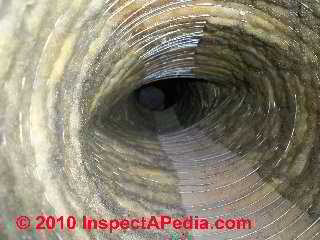
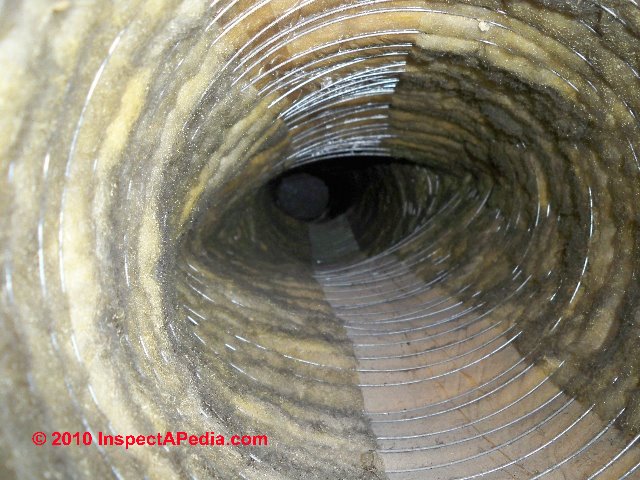
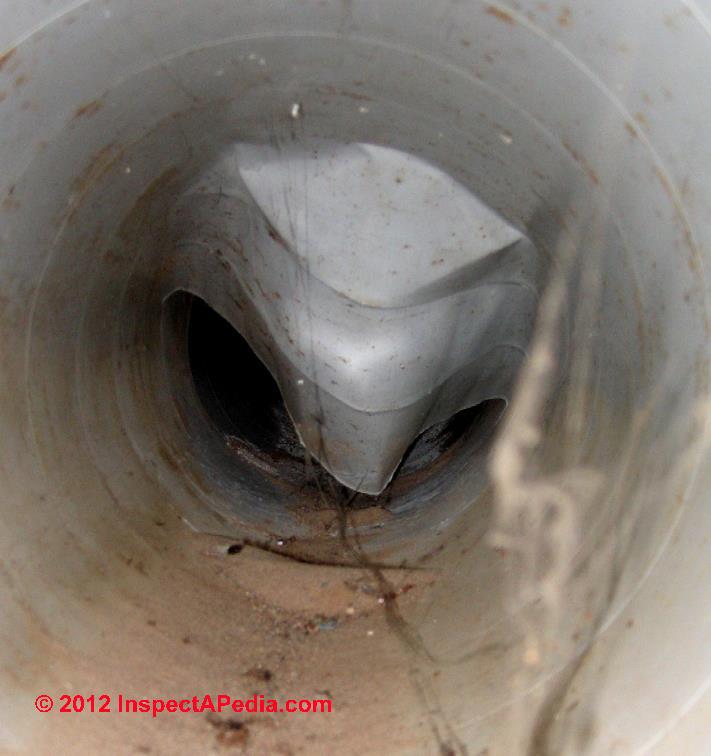
At left our photo, provided by reader Steven King, shows the interior of fiberglass-lined flexduct that has been crushed, perhaps by having been stepped-on?
The result is reduced heating or cooling air flow, reduced building occupant comfort, and higher heating or cooling system operation cost.
Most flex duct has a plastic or mylar liner in the duct interior and does not show exposed fiberglass as in Mr. King's photo.
Damaged Flex-Duct
At the above example of crushing flex duct we were also concerned that the exposed fiberglass in the duct appears to have been mechanically damaged, perhaps by a too-aggressive attempt at duct cleaning that may result in higher levels of airborne fiberglass duct insulation fragments in the building.
Other crimping and blockage or support problems found in flexduct installations are discussed
at DUCT ROUTING & SUPPORT.
Damaged blocked combination of fiberglass flex duct & metal ductwork
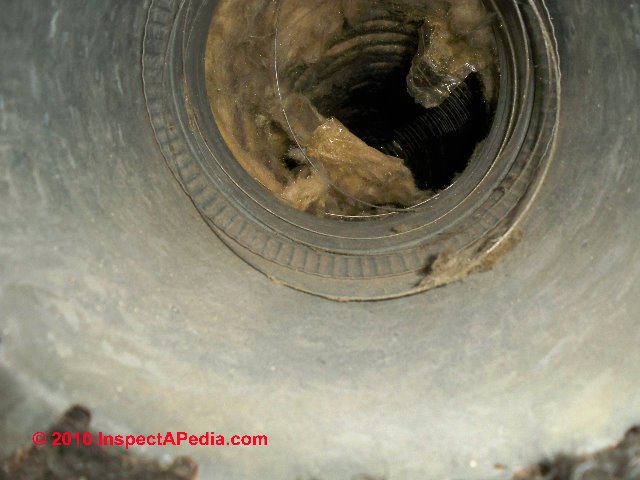
This photo shows the connection of fiberglass flex duct to a metal HVAC duct component. The fiberglass flex duct has been badly damaged.
As this photograph of duct damage was taken at the same installation as the example above, we suspect that an inexperienced duct cleaner has been at work here.
Other examples of flex-duct damage are at ALLOY SYSTEMS FLEXDUCT, OWENS CORNING FLEXDUCT, and OWL FLEXDUCT where we describe loss of the plastic duct exterior or interior liner.
Water flooding in ductwork also ruins it and is discussed at WET CORRODED DUCT WORK and at WATER & ICE IN DUCT WORK
Rust damage to HVAC air duct systems
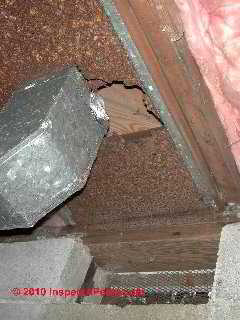
The rusted out duct photo at left shows a common return air duct system in some older homes: space between the floor joists was used as an air passage, sometimes also for supply air.
But when the metal sheeting nailed across the floor joist bottoms has rusted out, severe air leaks occur.
In a supply duct the result is higher heating or cooling costs. In a return air duct a hole such as the one shown in our photo can cause unhealthy or unsafe conditions by drawing other unanticipated air into the duct system (in this case next to a crawl space vent we are basically heating outdoor air and blowing it into the living area).
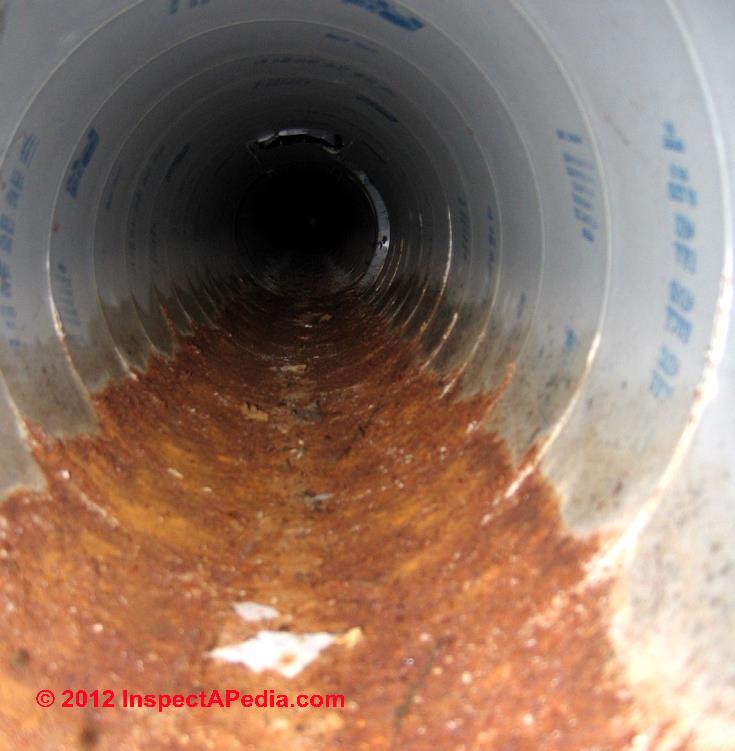
At below right we illustrate the rust (and rodent infestation) found in an in-slab metal spiral air duct.
SLAB DUCTWORK - catalogs the functional and environmental problems found when HVAC air ducts are routed in or below floor slabs
Watch out: large improper openings in return ductwork, whether from rust or any other causes, can cause building backdrafting and dangerous carbon monoxide hazards.
See UNSAFE DUCT OPENINGS
and
see BACKDRAFTING HEATING EQUIPMENT.
and SUPPLY DUCT AIR LEAKS for additional examples of these problems.
Also see LEAKY DUCT CONNECTIONS.
Other Duct System Damage Topics are listed in the links listed at the ARTICLE INDEX the bottom of this article under
DUCT SYSTEM DESIGN SIZE & DEFECTS; some of those links are described below.
- Air filter or other item that has been sucked into the duct system will block air flow and can risk a fire if drawn into the blower assembly fan,
DIRTY AIR FILTER PROBLEMS are perhaps the most common cause of unsatisfactory airflow in an HVAC system. - Blower Fan: dirty blades on a squirrel cage blower assembly fan significantly reduce the blower fan's ability to move air into the HVAC system from the return-air side as well as reducing its ability to push conditioned air into the occupied space.
DIRTY A/C BLOWERS - Fire damper that has become stuck in the closed or partly-closed position interferes with proper airflow through the system
FIRE & SMOKE DAMPERS, AUTOMATIC - Flex duct defects: Collapsed sections of flex duct block or stop airflow in either supply or return air systems
DUCT ROUTING & SUPPORT - Insulation loose in air ducts: Collapsed duct interior insulation,
FIBERGLASS DUCT, RIGID CONSTRUCTION - Leaks in the supply air duct system are a very common HVAC duct defect that results in poor heating or cooling air flow.
LEAKY DUCT CONNECTIONS
- Return air inlets: Return air inlet grilles that are obstructed with dirt, debris, or furniture or that are improperly located or are just too small mean that because the heating or cooling system is "starved for air", the supply air flow into occupied spaces will also be reduced.
See RETURN AIR REGISTERS & DUCTS - SLAB DUCTWORK - functional and environmental problems found in HVAC air ducts in or below floor slabs
- Spiral metal duct work damage (photo at left): rust and collapse when found in floor slabs. See the slab ductwork link just above.
- Transite air ducts: Crushed or collapsed transite duct
See TRANSITE PIPE AIR DUCTS - Zone dampers that are stuck partly closed obstruct air supply into that building area, or if stuck "open" when the zone damper should be closed, airflow to other building areas will be reduced.
See ZONE DAMPER CONTROLS - Also see UNDERSIZED RETURN DUCTS.
Illustrations of a leaky cast iron sewer line that sent sewer gases into the building's transite (asbestos cement) heating duct system can be seen
at
TRANSITE PIPE AIR DUCTS
and
Damaged or Lost HVAC Duct Exterior Insulation
Reader Question: is this normal wear on the insulation on my duct work? Should I be worried about mold contamination?
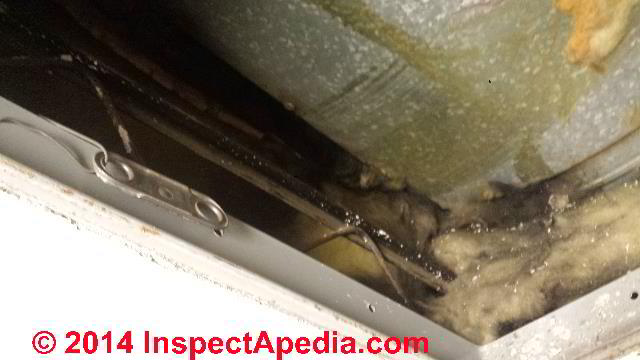 ...
...
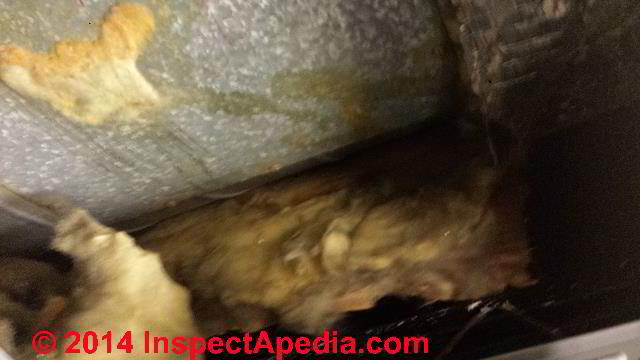
Had an insulation question. Hopefully you are able to view the attached pictures. Do you think this is normal wear to the insulation around the Duct work or should I be concerned about the possibility of mold contamination? - J. 3/31/2014
Reply:
I'm not sure what I'm looking at in your photos but it looks as if fiberglass insulation has been lost around the outside of galvanized metal HVAC ductwork.
If that's so the results are increased operating costs & risk of in-duct condensation and moisture-related problems (mold for example).
If your HVAC system ductwork used fiberglass on its interior and that has been damaged
see DUCTS DAMAGED DURING CLEANING.
For a discussion about whether or not you can find mold in fiberglass - yes -
see FIBERGLASS INSULATION MOLD
and see
Causes of mold growth in HVAC ductwork - mold in air ducts
at WHY DOES MOLD GROW in INSULATION? for a discussion of possible mold growth in fiberglass insulation in general.
Generally if I see ducts like this I expect that all of the original installation was on the duct exterior - where it doesn't produce much of a particle hazard to air flowing inside the ducts except in the event of duct leaks in the return air system.
See AIR LEAKS in RETURN DUCTS.
Hazards of Un-Lined or Raw Fiberglass-Lined HVAC Ducts
Reader Question: Un-lined Flex Ducts Exposes Fiberglass in My Home - is this OK?
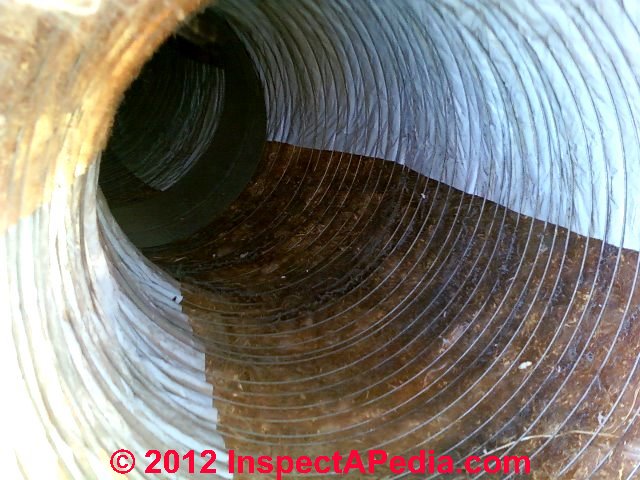
I have some pictures that I think you maybe interested and perhaps help others determining what is happening or has happened to the flexduct.
It is similar to the ones above but have a clearer view.
Some only have an est. 6 in wide strip of inner lining or none at all.
I want to know if an inner lining should exist or not?
Did the inner lining erode?
Is it a manufacture defect or faulty installation work?
I have attached my photos. You are welcome to use them on your website if it can help someone. Perhaps, it could help someone properly come to a conclusion and solution. Your assistance and help would be greatly appreciated. Sincerely, - A.G. 10/11/2012
Reply: Cleaning, Maintenance, Repair/Replace or Re-Line Suggestions for Un-Lined or Incompletely-lined Flex-Duct
A competent onsite inspection by an expert usually finds additional clues that help accurately diagnose a problem with an HVAC system, duct work, or often other more urgent building concerns that an owner or occupant may not have noticed. That said, I have taken a look at your photos and from what I can see:
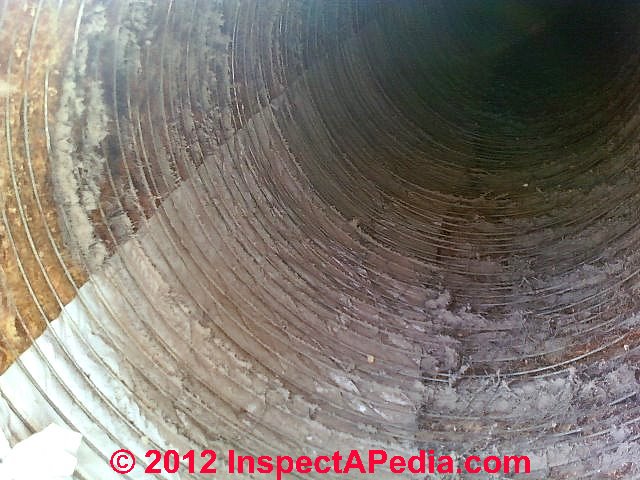 ...
... 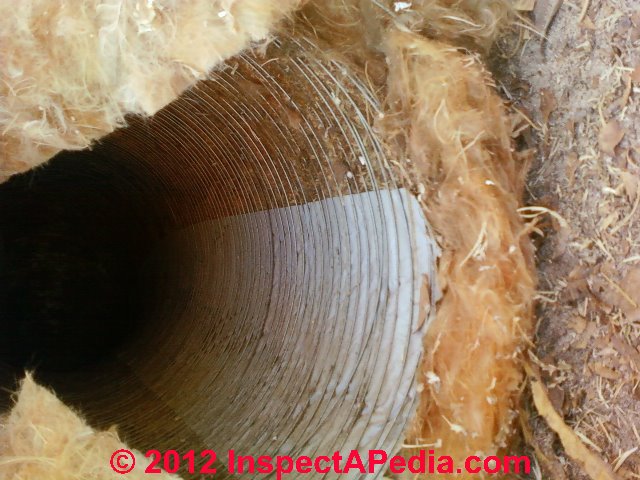
- There appears to be a partial omission of a complete (full surface coverage) plastic or vinyl liner inside sections of the flex-duct that you photographed, leaving what appears to be fibrous insulation, most likely fiberglass, exposed in the air path.
- Some photos show the accumulation of dust inside the ductwork - normal and quite common in HVAC ducts and moreso when a rough surface is exposed to airflow through the system, and still moreso if the system does not make use of an adequate air filter at the return air inlet.
- A closer examination might change this opinion, but from your photos there does not seem to be any sort of coating (as an alternative to an internal plastic liner) that reduces the pick-up of fiberglass into the airflow through this system. (There are other fiberglass duct products that make use of a surface coating to minimize fiber release.)
Yes, normally flex-duct used in HVAC systems includes a plastic or vinyl interior liner and an external cover as well, leaving the fiberglass duct insulation sandwiched between the two. In my OPINION and based on your pictures
- It does not look as if the missing flex duct liner was due to mechanical damage - as I see that where no plastic liner is visible, there are straight edges along the apparently-missing liner - not something that would normally happen by a cleaning attempt for example; Nor is missing flex duct liner an installation defect, unless you want to argue that the installer should have noticed that the flex duct seemed peculiar and should have questioned its use.
- Either this is an unfamiliar flex duct product (please send me photos of any product labels or markings for further research) that omits an interior liner, or it shows an unusual manufacturing method (perhaps an attempt at using coated fibers), or it is a manufacturing defect.
- This duct work cannot be cleaned - which is often the case even with lined flex-duct as the material is fragile enough to be damaged by many mechanical cleaning processes;
- It is possible (but by no means certain) that building air delivered through this system will have extra levels of fiberglass fragments. I opine that that result is not certain because we don't know the extent of actual mechanical damage to the exposed fiberglass (if any), we don't know if the fiberglass was coated to resist particle release, and we thus can't say what particles may be released into the air stream.
My recommendations for un-lined HVAC flex duct:
- Do not attempt any mechanical cleaning of this flex duct as you would surely increase the fiber relase from it
- Do replace readily-accessible flex duct sections that have fiberglass exposed on the duct interior or for that matter also any visibly damaged ductwork; Consider replacing all of it - a much greater cost if you have to remove flex-duct that is routed through walls or ceilings where it is not readily accessible;
- Use a duct interior sealant? Because replacing ductwork routed through inaccessible building cavities is very costly, you might ask a local HVAC duct service or cleaning company if they have experience using a spray-sealant on the interior of ductwork;
in my OPINION this is a second choice to replacement because of the difficulty of accessing and coating all surfaces and because of the risk of a false sense of security that a problem has been "fixed" when it hasn't: we can't know that later the coating doesn't fall away. But the economics can make duct sealant coatings an attractive choice. - Make sure that air filters are properly installed and maintained in the system;
- If there is an indoor dust complaint, consider testing the dust to see if the forensic lab traces significant levels of dust particles back to a sample of the duct insulation itself. For a simple inexpensive procedure to test house dust,
see DUST SAMPLING PROCEDURE.
Fiberglass HVAC Ducts Damaged by Mechanical Cleaning
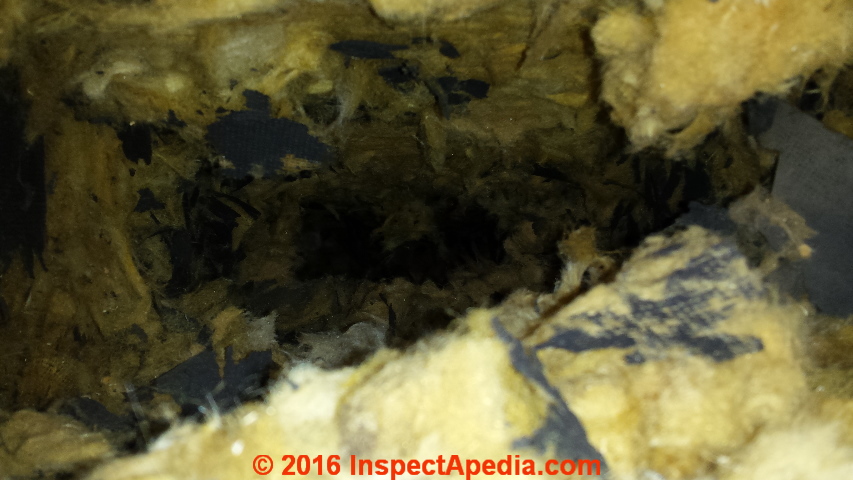

[Click to enlarge any image]
Question: did my duct cleaning company ruin my ductwork by using a mechanical cleaner?
Here are photos from inside the main heating duct showing damage from duct cleaning. Some were taken from the end of the duct and others from a removed vent. - Anonymous Reader-contribution 2016/11/05
Reply:
The ducts you show are a mess and beyond economical repair. You'll want to see every foot of ductwork as it would make no sense to do only a partial repair.
See DUCT CLEANING ADVICE for details about the problem of damage to ducts during duct cleaning.
Reader follow-up:
FYI, the duct cleaning company sent a tech to inspect the damage to the main heat duct (which my local HVAC co estimated at $2500.00 to replace). Surprisingly, the duct cleaning co. is sending a contractor to replace the duct, including an insulation wrap - outside this time. - Anonymous, 11/11/2016
Reader Comments, Questions & Answers About The Article Above
Below you will find questions and answers previously posted on this page at its page bottom reader comment box.
Reader Q&A - also see RECOMMENDED ARTICLES & FAQs
How to submit duct damage photos to InspectApedia
(Oct 11, 2012) Mrs. Woodstock said:
I have some pictures that I think you maybe interested and perhaps help others determining what is happening or has happened to the flexduct.
It is similar to the ones above but have a clearer view. Some only have an est. 6 in wide strip of inner lining or none at all. I want to know if an inner lining should exist or not? Did the inner lining erode? Is it a manufacture defect or faulty installation work? Where can I submit my pics?
Reply:
Mrs. W.
Just use the CONTACT US link found near the top or bottom of any InspectApedia page
Question: six feet of damaged ductwork - health concerns?
I live in CA and had a new AC System installed about 7 years ago. I had it serviced by the company that installed it the first 5 years or so and they sold out to another company. Since then I have used that company until the last service. The company that came out told me the first 5 or 6 six feet of my duct was the old original Fiberglass duct.
I didn't think much about it at the time, but I recently had my ducts cleaned. This company told me the same thing and advised me to contact the installing company. They are now in AZ , and the company that took their clients won't respond to me. I have been told this could be dangerous.
Can you tell me what government agency I would contact to see if there is anything I can do about it? My wife and I and our two dogs all have bad allergies and it could be related. Thank You for your response. - R.B. 3/24/2013
Reply:
RB,
I'm not sure what government agency is going to get involved in the case you described, though you might obtain some advice from your local health department. For some help in deciding if it is appropriate to hire an environmental expert to examine your home for allergens, mold, or other health risks that could contribute to the allergy complaints you cite, please take a look
at MOLD / ENVIRONMENTAL EXPERT, HIRE ?.
Just from your description we can have no idea if the ducts are hazardous, or if so, in what form. Indeed if the ductwork was fiberglass lined and was mechanically damaged by improper cleaning it might make sense to replace it.
Replacing 6 feet of ductwork does not merit expensive testing, site analysis, etc. - the cost of such work would be far more than the cost of six feet of ducting.
...
Continue reading at DUCT ROUTING & SUPPORT or select a topic from the closely-related articles below, or see the complete ARTICLE INDEX.
Or see these
Recommended Articles
- AIR HANDLER FIBERGLASS INSULATION
- AIRBORNE PARTICLE & MOLD LEVELS in DUCTWORK
- BLOWER LEAKS, RUST & MOLD - causes of leaks & mold in HVAC ducts
- DIRTY A/C BLOWERS - leaks, rodents, & mold in air handler units
- DUCT CLEANING ADVICE
- DUCTWORK CONTAMINATION
- FIBERGLASS AIR DUCT MOLD TEST
- FIBERGLASS HAZARDS
- FIBERGLASS HVAC DUCTS - home
- SLAB DUCTWORK
- WHY DOES MOLD GROW in INSULATION? - photos and test results examining suspected mold on the surface of fiberglass-lined HVAC ductwork.
Suggested citation for this web page
DUCT DAMAGE, MECHANICAL at InspectApedia.com - online encyclopedia of building & environmental inspection, testing, diagnosis, repair, & problem prevention advice.
Or see this
INDEX to RELATED ARTICLES: ARTICLE INDEX to HVAC DUCT SYSTEMS
Or use the SEARCH BOX found below to Ask a Question or Search InspectApedia
Ask a Question or Search InspectApedia
Try the search box just below, or if you prefer, post a question or comment in the Comments box below and we will respond promptly.
Search the InspectApedia website
Note: appearance of your Comment below may be delayed: if your comment contains an image, photograph, web link, or text that looks to the software as if it might be a web link, your posting will appear after it has been approved by a moderator. Apologies for the delay.
Only one image can be added per comment but you can post as many comments, and therefore images, as you like.
You will not receive a notification when a response to your question has been posted.
Please bookmark this page to make it easy for you to check back for our response.
Our Comment Box is provided by Countable Web Productions countable.ca
Citations & References
In addition to any citations in the article above, a full list is available on request.
- Thanks to Mark Cramer, Tampa Florida, for assistance in technical review of the "Critical Defects" section and for the photograph of the deteriorating gray Owens Corning flex duct in a hot attic. Mr. Cramer is a Florida home inspector and home inspection educator.
- Thanks to Jon Bolton, an ASHI, FABI, and otherwise certified Florida home inspector who provided photos of failing Goodman gray flex duct in a hot attic.
- Engineering toolbox properties of water - http://www.engineeringtoolbox.com/water-thermal-properties-d_162.html and email: editor.engineeringtoolbox@gmail.com web search 09/16/2010
- Thanks to Scott at SJM Inspect for suggesting this EPA document and for technical editing remarks regarding our air conditioning website, SJM Inspection Service LLC, serves the entire state of CT, sjminspect.com 203-543-0447 or 203-877-4774 5/16/07
- Thanks to reader Steven King for photographs and discussion of damaged ductwork, November/December 2010.
- Reference: Modern Refrigeration and Air Conditioning, A. D. Althouse, C.H. Turnquist, A. Bracciano, Goodheart-Willcox Co., 1982
- Reference: Principles of Refrigeration, R. Warren Marsh, C. Thomas Olivo, Delmar Publishers, 1979
- "Air Conditioning & Refrigeration I & II", BOCES Education, Warren Hilliard (instructor), Poughkeepsie, New York, May - July 1982, [classroom notes from air conditioning and refrigeration maintenance and repair course attended by the website author
- Thanks to Chris Van Rite, Vice President Sales, M&M Manufacturing Company, 4001 Mark IV Parkway Fort Worth, TX 76106, Office (817) 348-2241 Cell (817) 825-2363 - cvr@mmmfg.com - Mr. Van rite provided the HVAC & Duct System references listed just below 2/9/2009
- Consortium for Energy Efficiency (CEE) - http://www.cee1.org/resid/rs-ac/hvac_press_kit.pdf
- Air Diffusion Council (ADC) - http://www.flexibleduct.org/
- Static Pressure Losses in 6, 8, and 10-inch Non-Metallic Flexible Ducts,
Weaver, K.; Culp, C.
Texas A&M University Energy Systems Laboratory http://txspace.tamu.edu/handle/1969.1/5275 - A Study of Pressure Losses in Residential Air Distribution Systems, Bass Abushakra, Iain S. Walker, Max H. Sherman, Lawrence Berkeley National Laboratory - http://eetd.lbl.gov/ie/pdf/LBNL-49700.pdf
- ENERGY STAR® Homes Technical Standards - http://www.energystarhomes.com/documents/tech_standards.pdf
- ASHRAE Advanced Energy Design Guide for “Small Office buildings”, “Retail buildings” & “K-12 School buildings” available currently as a free download from ASHRAE Publications Store http://www.ashrae.org/publications/page/1604 (do not copy this PDF)
- Our recommended books about building & mechanical systems design, inspection, problem diagnosis, and repair, and about indoor environment and IAQ testing, diagnosis, and cleanup are at the InspectAPedia Bookstore. Also see our Book Reviews - InspectAPedia.
- Complete List of Air Conditioning & Heat Pump Design, Inspection, Repair Books at the InspectAPedia Bookstore.
- In addition to citations & references found in this article, see the research citations given at the end of the related articles found at our suggested
CONTINUE READING or RECOMMENDED ARTICLES.
- Carson, Dunlop & Associates Ltd., 120 Carlton Street Suite 407, Toronto ON M5A 4K2. Tel: (416) 964-9415 1-800-268-7070 Email: info@carsondunlop.com. Alan Carson is a past president of ASHI, the American Society of Home Inspectors.
Thanks to Alan Carson and Bob Dunlop, for permission for InspectAPedia to use text excerpts from The HOME REFERENCE BOOK - the Encyclopedia of Homes and to use illustrations from The ILLUSTRATED HOME .
Carson Dunlop Associates provides extensive home inspection education and report writing material. In gratitude we provide links to tsome Carson Dunlop Associates products and services.
 | HOME | ABOUT | ASK a QUESTION | CONTACT | CONTENT USE POLICY | DESCRIPTION | POLICIES | PRIVACY | |
| © 2024 - 1985 Publisher InspectApedia.com - Daniel Friedman | |||||||||