
InspectAPedia® FREE Encyclopedia of Building & Environmental Construction, Diagnosis, Maintenance & Repair |
Question? Just ask us! InspectAPedia
|
 HVAC Ducts in Floor Slabs: problems, hazards, diagnosis, repair
- POST a QUESTION or COMMENT about HVAC air ducts placed in or below concrete floor slabs
HVAC ductwork in floor slabs: this article describes heating and air conditioning ducts that have been placed in or beneath concrete floor slabs.
HVAC air ducts located inside concrete slab floors invite a surprisingly broad range of building problems that fall into two broad categories: functional troubles such as lack of air flow or collapsed ductwork, and environmental problems such as radon, odors, flooding, mold, insects, and where transite - cement asbestos - ductwork was used, asbestos particle contamination.
Here we catalog and illustrate the common problems found with in-slab ductwork & how those hazards may be recognized. We describe steps taken to repair or abandon in-slab air ducts.
InspectAPedia tolerates no conflicts of interest. We have no relationship with advertisers, products, or services discussed at this website.
Problems with HVAC air ducts placed in or below concrete floor slabs
How to Recognize that heating or air conditioning ducts have been routed through or beneath a concrete floor slab
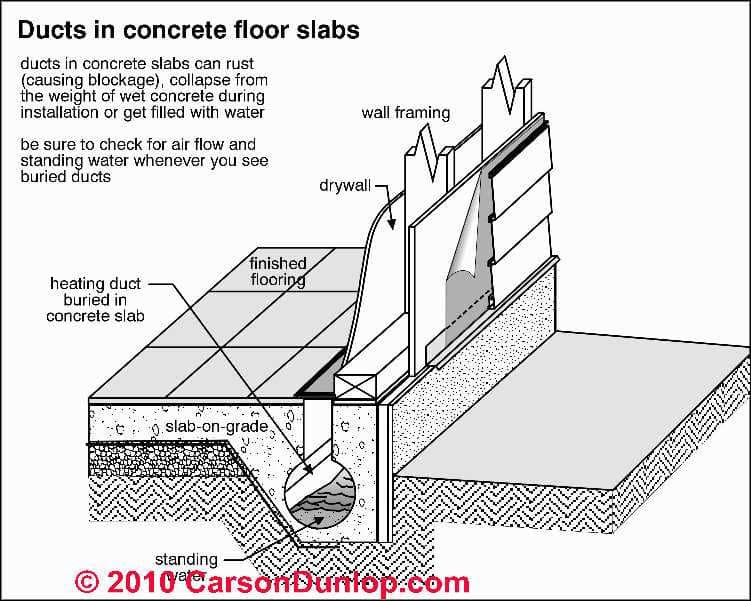
HVAC air ducts located inside concrete slab floors invite a surprisingly broad range of building problems that fall into two broad categories: functional troubles such as lack of air flow or collapsed ductwork, and environmental problems such as radon, odors, flooding, mold, insects, and where transite - cement asbestos - ductwork was used, asbestos particle contamination.
Sketch above was provided courtesy of Carson Dunlop Associates a Toronto Ontario home inspection educator and home inspection firm.
[Click to enlarge any image]
It's easy to recognize that in-slab or below floor slab HVAC ducts are or were used in the design of a building's heating or cooling air duct system, and it's not difficult to evaluate the condition of those ducts by a combination of visual inspection and observation of operating problems (lack of air flow) or environmental problems such as odors.
Steps in detecting the presence of in-slab HVAC ductwork
- Recognize that the building uses air ducts for heating, cooling, or both
- Observe the presence of air supply or return registers in the lowest floors of the building
- Observe that the lowest floors of the building were constructed as concrete slab on grade. Note that in some buildings the lowest floor may have been constructed as a wood framed structure on-grade or over a very low, inaccessible crawl space rather than on a concrete slab.
Simply stomping on or tapping the floor may suggest that the floor itself is not set directly on concrete, or you may deduce the probable floor construction by inspection of the building exterior (presence of crawl space vents) or building dimensions (first floor is located more than a foot above grade level.
Using a hand-held camera for HVAC duct inspection
We have had good success inspecting the condition of in-floor and in-slab HVAC ducts using a simple digital camera that can be placed or held into the duct to take a quick look where a person's head cannot possibly fit for inspection.
Our photos just below demonstrate exploring the condition of an air duct in a concrete floor slab by inserting our camera (with wide angle lens) into the duct system through a floor register.
Naturally you won't see every inch of the duct this way and you could miss collapses or other in-slab duct problems.
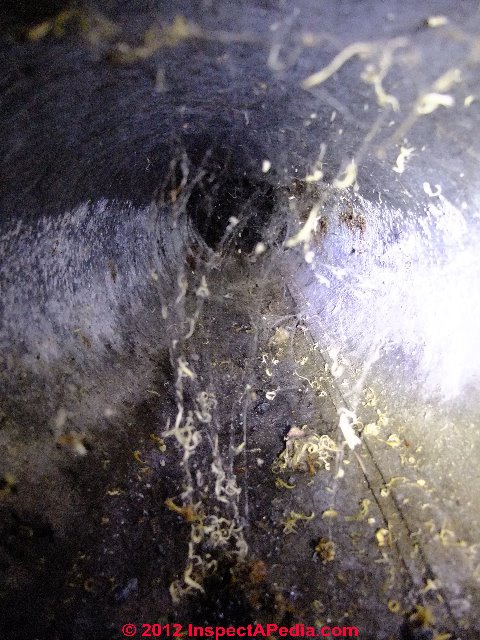
...
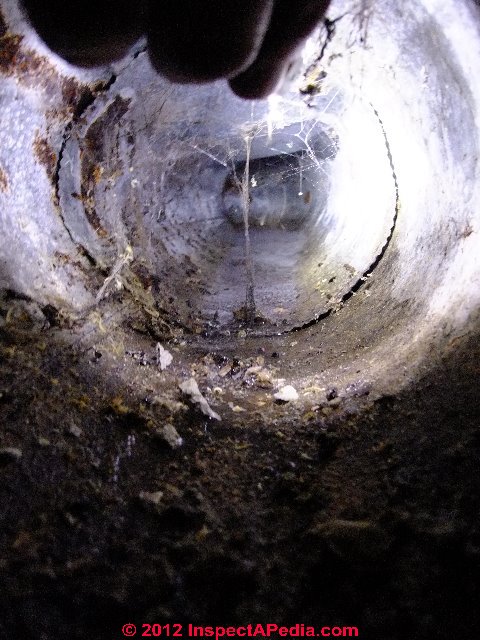
Check the air handler and other mechanical system components

An additional and important indicator of a building HVAC duct design that makes use of in-slab air ducts is illustrated at our photo and is explained in more detail just below.
Take a close look at the air handler (blower unit) located on the lowest floor of the building, often in a basement or on occasion in a crawl space.
Inspecting the warm air furnace shown in the left side of our photographs, we noticed that both the bottom of the furnace itself and an air duct appeared to penetrate the floor slab of the building.
Below in an additional photo you'll see what we found - the return air plenum of the furnace was located below slab and below ground, as well as return air ductwork - both had been flooding.
HVAC Air Ducts Routed in Concrete Floor Slabs - why they are trouble
Our photo just above and our investigation photo (shown at left) illustrate how you may spot an air duct routed through the building floor slab and how you may spot trouble too.
In this case the furnace return air plenum was also located below the concrete floor. The air duct system in this building had been subject to periodic flooding, as illustrated in our second photo (below right).
A description of the health and functional problems that may be traced to air ducts that were routed in a concrete floor slab as well as our advice on how to properly abandon and seal in-slab air ducts are found at DUCT in CONCRETE FLOOR.
There we describe concerns with ductwork run in floor slabs in the article above, including risks of air duct collapse that interferes with air flow through the system, water leaks into the in-slab duct system (not a problem unique to transite ducts), and rodent or insect infestations or even mold contamination.
Odor complaints may be traced to the duct system because of these problems (DUCT & AIR HANDLER ODORS).
Hopefully needless to say, flex duct should never be buried underground nor set into concrete slabs. [13]
Catalog of Functional Problems Found in In-Slab HVAC Ductwork
Air Flow Problems in HVAC Ducts Due to Collapsed in-Slab Ductwork
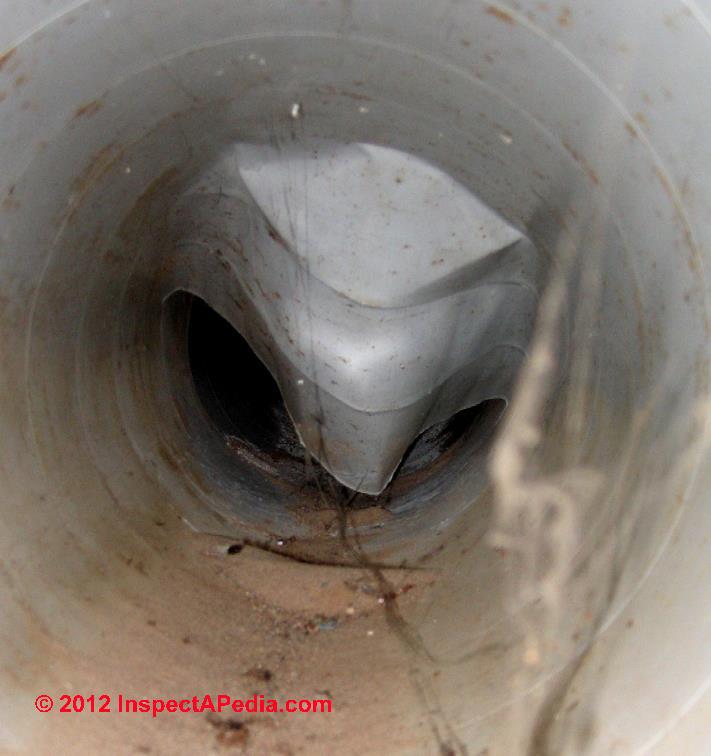
Air flow rates of heating or cooling air delivered by in-slab ductwork can become substantially reduced and ultimately blocked completely by
- rodents or other animals that may invade the ductwork, nesting or even dying therein
- crushed or collapsed ducts in the slab
- debris loaded in-slab ductwork
- water flooded in-slab ducts
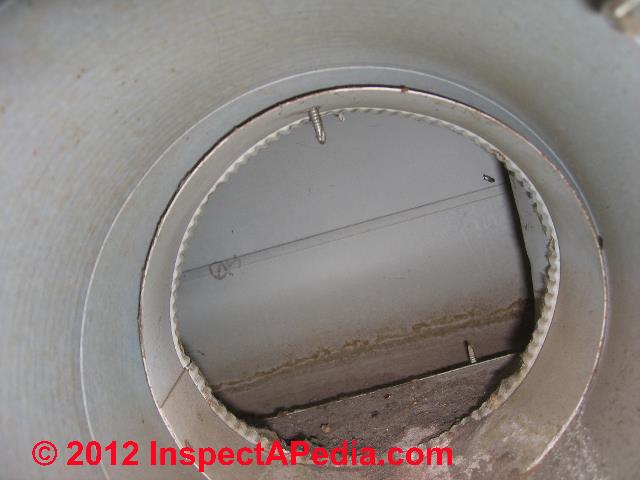
At left and below, reader-contributed photographs of problems in spiral metal ductwork routed in a concrete floor slab illustrate collapsed blocked ductwork (photo at left) and severe rust, and HVAC duct flooding history (below left) .
In both of these spiral metal ductwork photos (left and below left) you can see actual holes in the duct bottom - admitting ground water, vermin, other contaminants.
We discuss and illustrate disconnected heating or air conditioning duct defects
at DUCT CONNECTIONS. We also show additional images of the interior of crimped or squashed flexduct
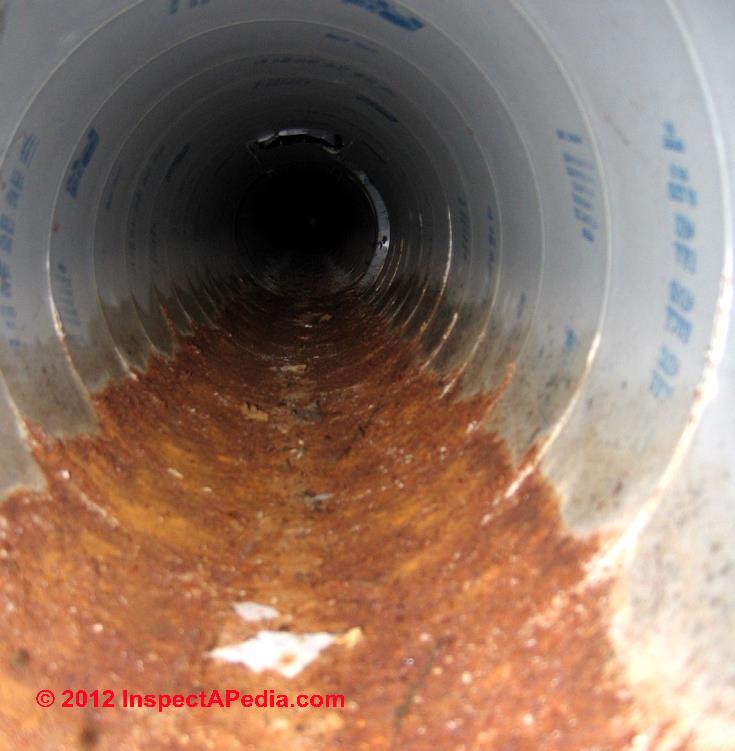
Rust flakes from rusty heating or air conditioning ducts themselves are unlikely to be much of a health hazard - these particles are pretty big, not easily airborne, and probably won't be found at high levels in indoor air except in unusual circumstances.
But rust in ducts is a problem indicator, showing quite clearly that the duct system has been wet.
Dust & normal air duct debris: The chief components of house dust, which will certainly collect within a duct system include fabric fibers and skin cells, often also including starch fragments and other organic debris.
Watch out: The combination of organic debris within a duct system and water (indicated by rusty ducts or duct registers) indicates a possible risk of mold or bacterial hazards within the air conditioning or heating system.
Since blowing air through the system can pick up and distribute these hazards
to occupants of the building, wet or previously-wet duct work is a potential health hazard to building occupants.
Condensation, Water & Flooding Problems in HVAC Ducts Placed In or Below Concrete Floor Slabs
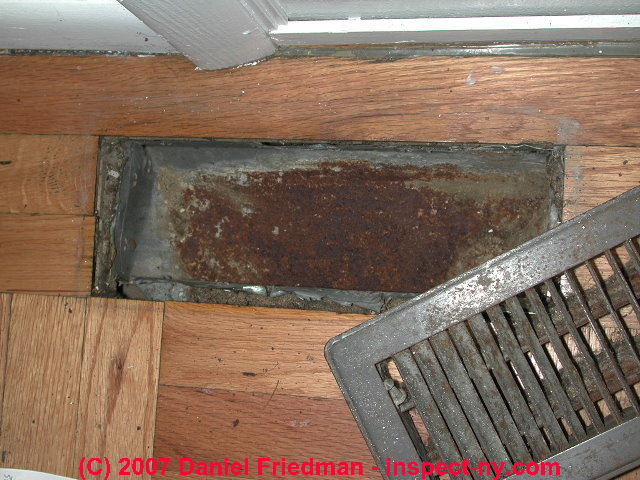
Water accumulates in in-slab or below-floor air ducts from
- condensation during the cooling season, exacerbated if the ductwork is being used for air conditioning and more so if it is inadequately insulated
- leaks into the duct system from ground water seeping under the floor
- leaks into the duct system from nearby plumbing drain defects
- actual area flooding of the home (photo below)
In addition to blocking air flow, moisture or water in the duct system invites allergenic or pathogenic mold growth therein as well as bacterial or other health hazards that can be transmitted to the occupied space in the building as air moves through the duct system.
Inspect in-slab ductwork first through the floor registers (above left) and better, using a good light or mirrors or a camera system such as the Chim-Scan or plumbing drain camera.
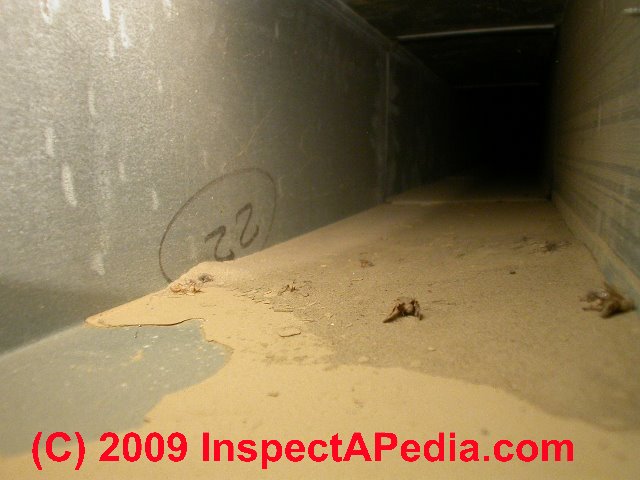
The mud in the air duct shown above confirmed a history of building flooding that sent flood waters inside the HVAC duct system.
Also see WET CORRODED DUCT WORK. Water flooding in ductwork also ruins it and is discussed in detail
at WATER & ICE IN DUCT WORK.
Catalog of Environmental Problems Found in In-Slab Air Ducts Used for Building A/C or Heating Systems
Indoor Air Quality Problems Traced to In-Floor Slab HVAC Ducts
Air quality hazards of in-slab duct systems include rodent infestations in ductwork, dirt and debris accumulation which then is returned to the building indoor air or that serves as a breeding ground for pathogens, radon gas hazards, and water leaks into the duct system which can in turn generate a mold or bacterial hazard or can cause softening, collapse, and blockage of the in-slab transite pipe duct. All of these are described individually and in greater detail within this article.
While there are companies offering duct cleaning and duct sealing services, we remain cautious that such a "sealing" project creates a false sense of confidence that no remaining duct issues exist, causing the occupants to miss the discovery of future leaks and in-duct problems.
A description of the health and functional problems that may be traced to air ducts that were routed in a concrete floor slab are found
Asbestos Hazards Found at In-Slab HVAC Ductwork
Transite pipe, which contains significant percentage of asbestos fibers, was often used for heating ducts and on occasion heating and cooling ducts in older buildings.
Transite pipe used as HVAC ducts or air ducts for heating and air conditioning was often installed buried in a concrete floor slab - methods that placed the asbestos-cement transite piping below or in a building floor slab.
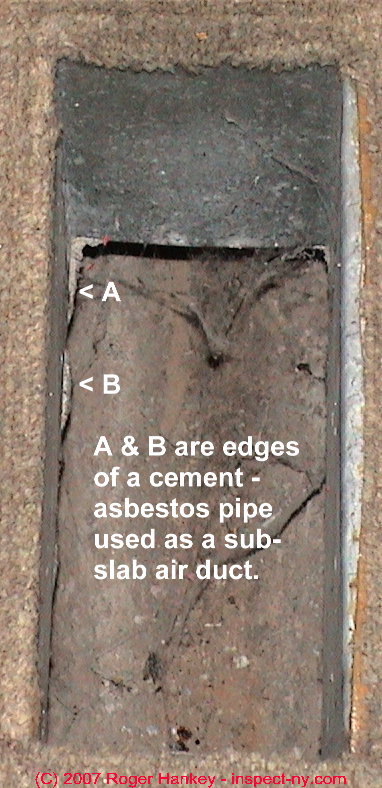
Asbestos-containing transite pipe HVAC ducts were also used in exposed areas such as shown in the crawl space photograph at the top of this page. And transite pipes were also used as flues or chimneys for some heating equipment, usually where gas fired heaters were installed.
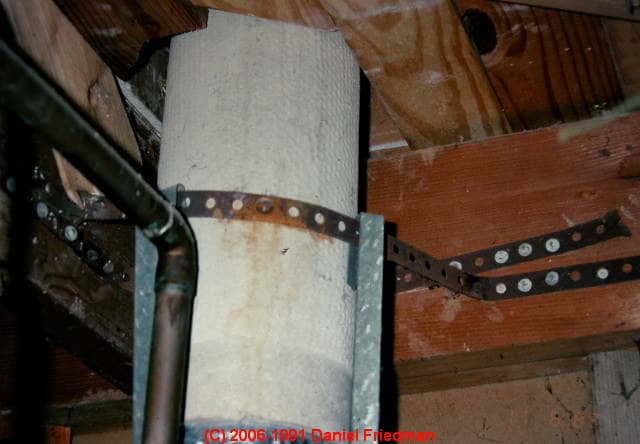
Transite Duct Asbestos Hazards: if used for air ducts transite pipe may be a an asbestos hazard, particularly where the ducts become softened by water exposure (such as air ducts located in floor slabs), potentially releasing asbestos fibers into the building air. [21][22][23][24][25][26][27]
See TRANSITE PIPE AIR DUCT ASBESTOS RISKS for details.
Readers concerned with ice or water leaks into or out of HVAC ductwork should also s
see WET CORRODED DUCT WORK and
see WATER & ICE IN DUCT WORK as well
as FROST BUILD-UP on AIR CONDITIONER COILS where we describe build-up of ice on the cooling coil in air conditioning air handler units.
Photo of transite duct material shown above is provided courtesy of Thomas Hauswirth, a Connecticut home inspector.
Also see:
- ASBESTOS DUCTS, HVAC - Guide to Identification of Asbestos Materials On or In Heating and Cooling Duct Work: carbon monoxide hazards of transite chimneys and vents
- TRANSITE PIPE AIR DUCT ASBESTOS RISKS - (continued below) Hazards of Asbestos-containing Transite Pipe HVAC Ducts: duct collapse, mold, radon, asbestos fiber release
- TRANSITE PIPE CHIMNEYS & FLUES - Guide to Identifying Asbestos Transite Chimneys & Flues & their Hazards in buildings
Dirt & Debris Collection Hazards in HVAC Ducts Placed in Floor Slabs
Our photos below illustrate very dirty, debris-laden HVAC air ducts. At below left you will also see evidence of rodent infestation in the duct - a collection of seeds probably left by a squirrel or mouse. At below right the fiberglass-duct was invaded by plant roots and appears to be collapsing.
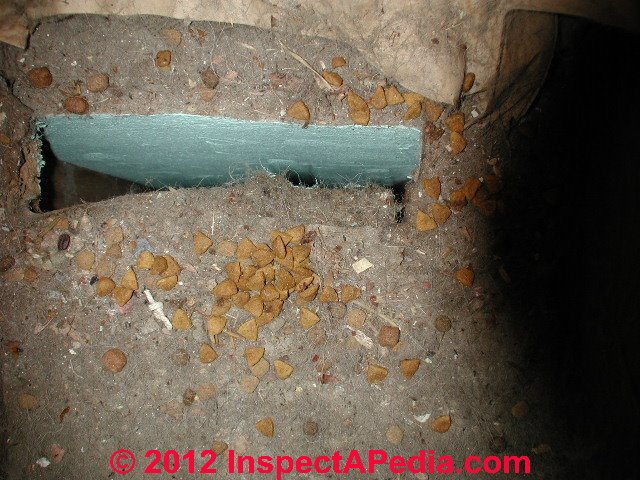
Don't panic about dirt or debris in HVAC ducts. It is normal for some dust and debris to collect within the air handling system, though by installing and maintaining air filters at the air return registers you can minimize debris and dirt in the ducts themselves.
See details at AIR FILTERS for HVAC SYSTEMS.
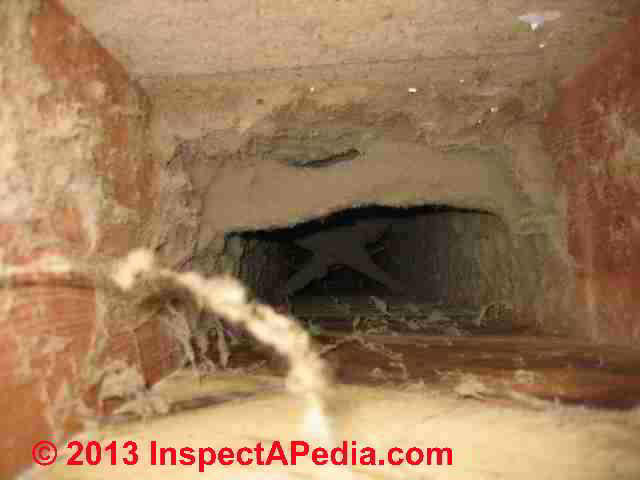
"Normal" dust and debris we find inside of air ducts is dominated by fabric fibers, skin cells shed by human occupants, perhaps some food or starch granules, and if the ducts are made from fiberglass, fiberglass particles will be present.
Watch out: however if these duct debris materials are wet from any water source they may become a breeding ground for mold or other pathogens, and of course if the ducts are invaded by rodents or flooded by sewage they are unsanitary and are a health hazard to building occupants.
Mold Hazards Occurring in Slab-Routed Heating or Cooling Ducts
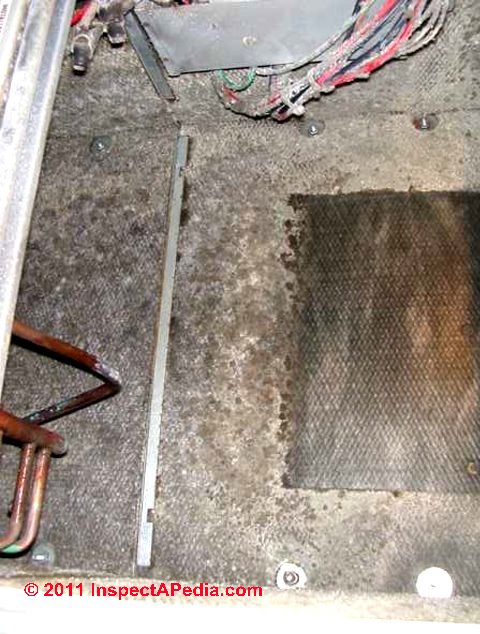
Because an air duct routed through a floor slab is more likely to contain moisture from condensation or water from leaks or floods, that moisture, combined with normal organic dust and debris found in ductwork can increase the chances of mold contamination in slab-ductwork.
at AIRBORNE PARTICLE & MOLD LEVELS in DUCTWORK we describe how to measure the level of mold or other airborne contaminants found in HVAC ducts.
Also see WHY DOES MOLD GROW in INSULATION?.
Watch out: don't assume that because mold has been detected in an HVAC duct system that the mold is the principal source of IAQ hazards in the building.
Modest amounts of Cladosporium sp. are quite common in air handlers where condensate blows off of the cooling coil.
And mold isolated from a duct system may have entered from a far more serious mold reservoir located elsewhere in the building. Expert investigation may be warranted.
See MOLD / ENVIRONMENTAL EXPERT, HIRE ?.
Odor & Smell Problems Traced to HVAC Ducts Routed in or below floor slabs
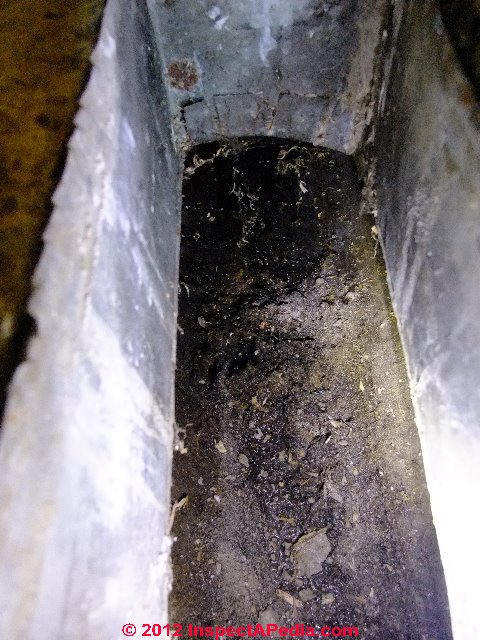
The catalog of odors and gases in buildings that may be traced to an origin in the ductwork is lengthy and includes both odors/gases that originate within the duct system itself and odors or gases that are transported between building areas by the HVAC system.
In addition to the aesthetic issues of mold, rodent, or sewer gas smells, these, along with odorless gases such as carbon monoxide can be serious even potentially fatal
Take a look at the dirt and black sludge on the bottom of the air duct visible through this floor register. We suspected that the duct system had been repeatedly flooded by ground waters, possibly including organic debris or even sewage that could contribute to an indoor odor complaint.
Odor complaints may be traced to the duct system because of these problems
Radon Hazards Occurring at In-Slab HVAC Duct Systems
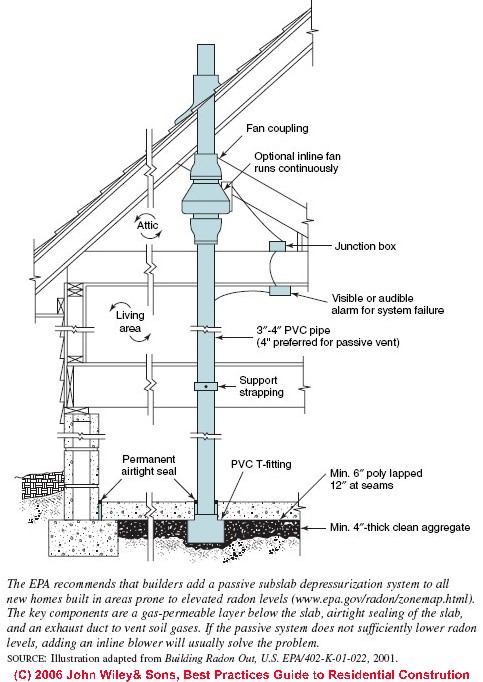
Radon entry through in-slab duct systems: can occur in areas where radon is present at problem levels in the soils. In particular, because a return air duct is often at negative pressure (when the blower is operating), the movement of radon gas from the soil into the building air through a leaky in-slab duct can be significant, certainly greater than the movement into the building from other openings such as through a basement slab crack.
[Click to enlarge any image]
As reported in Best Practices Guide to Residential Construction (Steve Bliss, J Wiley & Sons) :
The EPA and the U.S. Geological Survey have rated every county in the United States as Zone 1 to 3 for radon risk. Links to state maps with county by- county risk levels can be found at www.epa.gov/ radon/zonemap.html.
The EPA recommends that all homes in Zone 1 counties be built with radon-resistant features, which can be easily upgraded to a radon remediation system if needed.
Seal ducts and air-handling units Where Radon Gas is Present. Placing any return-air ductwork under the concrete slab is not recommended, since this will tend to draw radon into the ductwork and distribute it around the house.
If supply ductwork must pass through a subslab space, it should be seamless or sealed airtight with durable aluminum tape or duct mastic.
Details are at HOW to REMOVE INDOOR RADON
and at DEFEATING RADON part 3 - Key spots to seal, to stop radon gas leaks into buildings. [28][29][30]
Rodent Problems: Rats, Mice, Snakes, other Animal Contamination in HVAC Ducts Routed in or Below Floor Slabs
During a careful site inspection you may find reason to look further into the air duct system interior for contamination rodents.
Below our photograph illustrates such an example: the presence of maple leaf seeds and other organic debris entering the HVAC duct chaseway.
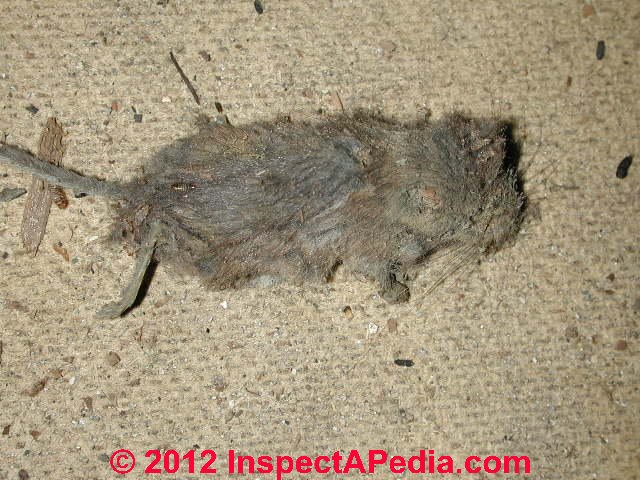
Below is one of the (dead) mice along with mouse droppings found in an HVAC air duct and air handler system.
Potential health concerns from mice and rats include not only fleas or odors, but potential pathogens such as hantavirus.
Sewer gas leaks into HVAC ducts located in or below floor slabs
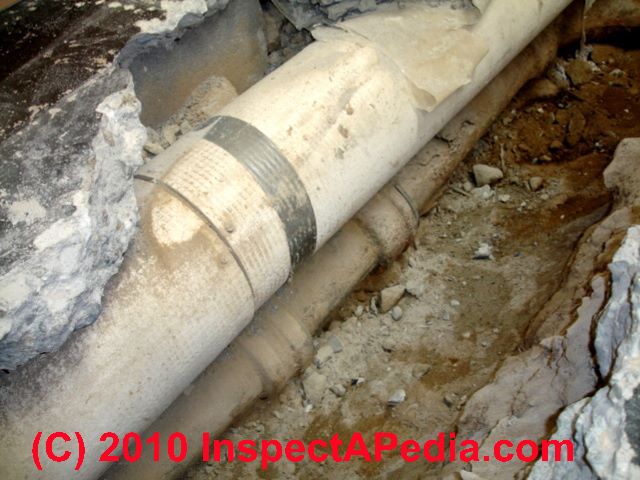
Sewer Gas entry into the HVAC duct system through in-slab transite asbestos ductwork:
A reader (Conrad) provided us with the photographs and case history of the successful track-down of sewer gas odors in a building.
See SEWER GAS ODORS
The case began with a complaint of sewer gas odors in the building's heating duct work system.
As reader Conrad discovered while tracking down the odor of sewer gas that was appearing in a home's in-slab ductwork, placing in-slab ducts close to sewer piping (or septic system piping ) invites any future sewer gases leaking out of the piping right into the HVAC duct system.
The owner tracked the sewer gas odor that was coming out of the building's heating ducts to a break in the sewer piping located in the same floor.
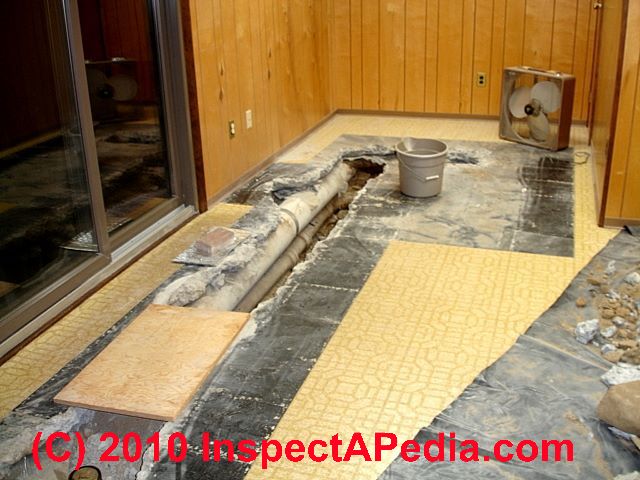
The repair of the sewer gas odor involved jack-hammering out the floor slab, removing and replacing the leaky cast iron sewer pipe, and repairing the floor. Because of the inconvenience and cost of relocating these air ducts or converting to an alternate heating distribution method, the owner elected to retain the transite in-slab floor ducts.
This case of cast iron drain leaking sewer gas into a transite asbestos heating air duct is illustrated in more detail
at CAST IRON DRAIN PIPING and details about the case including more pictures and notes on how the building owner tracked the sewer smell to the basement floor slab (and transite heating ducts in the slab) can be read
at CAST IRON DRAIN LEAK, ODOR, REPAIR.
Watch out: sewer gases may include multiple hazards including the risk of exploding methane gas and possible bacterial pathogens as well as VOCs that can be a respiratory irritant.
Also see SEWAGE CONTAMINATION in BUILDINGS.
How to Install (or not-install) HVAC Ducts in Slabs
Common Original Installation Mistakes for In-Slab Ductwork
Based on a history of complaints of contaminants entering in-slab HVAC ducts, the choice of this design is at best a higher-risk approach to heating and air conditioning duct installation in buildings and at worst, a catastrophe that should have been avoided entirely.
A review of in-slab ductwork installation guidelines from several manufacturers and HVAC contractors can inform us about what goes wrong from the start with in-slab duct systems. Here are some errors during original in-slab ductwork installation that show up as trouble later. You'll notice that most of these address water entry or condensation in the duct system.
- Too-Deep In-Slab HVAC Duct Installations: the HVAC duct system must always be located above the high water table for the soils below the building.
Otherwise duct flooding and contamination are likely. - Too-Fast Disasters in Duct-Slab Installation: experts warn that the weight of thick slab pours onto metal and some other duct materials can cause the duct to partially or even totally collapse during pouring and construction of the surrounding concrete slab.
Concrete around in-slab ducts needs to be poured in a sequence of layers or steps with allowance of intervening time to permit each layer to set up and harden. - In-slab HVAC Duct Float-Up: if the duct slab system is not tied down before a concrete pour it may float-up causing high and low spots, water accumulation spots, or even disconnection of the duct segments leading to partial blockages and future leaks into the system.
- In-Slab HVAC Duct Vapor Barriers: in laying out the in-slab duct system vapor barriers must be provided between the ductwork and the surrounding gravel fill, insulation, and concrete;
Omitting the vapor barrier invites moisture into the in-slab duct system. In more than 40 years of building inspection, disassembly, and forensic investigation, I [DF] have not once encountered the presence of a vapor barrier nor even insulation around an in-slab duct system built in the 1940s through the 1980's. - In slab HVAC duct slope: In-Slab duct system trenches that are not sloped to a drain point will permit water to accumulate in the duct at low spots where it breeds mold, bacteria, or other pathogens.
Curiously none of the installation procedures we reviewed included a detail on how water was to be removed from the in-duct slab low point much less how its presence was to be detected. - In-slab HVAC duct reinforcement: Inadequate structural reinforcement around in-slab duct systems can result in crushing or settlement and thus breaks and leaks into and out of the duct system.
- In-Slab HVAC Duct Sealers: the interior surfaces of some in-slab air duct systems is coated with a sealant after placement or installation; experts advise that a water-based sealant should not be used in underground duct installation, presumably because the designers know perfectly well that future water entry or condensation is likely to occur - an event that will damage the sealant inviting further leaks and contamination.
Codes, Standards, Guidelines for In-Slab HVAC Duct Design
- 2015 IRC CHAPTER 26 DUCT SYSTEMS [PDF] Section M1601 DUCT CONSTRUCTION as adopted by the state of Utah, retrieved 2019/10/03 original source: https://up.codes/viewer/utah/irc-2015/chapter/16/duct-systems#16
Excerpt:
M1601.1.2 Underground Duct Systems
Underground duct systems shall be constructed of approved concrete, clay, metal or plastic. The maximum duct temperature for plastic ducts shall not be greater than 150°F (66°C).
Metal ducts shall be protected from corrosion in an approved manner or shall be completely encased in concrete not less than 2 inches (51 mm) thick.
Nonmetallic ducts shall be installed in accordance with the manufacturer's instructions. Plastic pipe and fitting materials shall conform to cell classification 12454-B of ASTM D 1248 or ASTM D 1784 and external loading properties of ASTM D 2412.
Ducts shall slope to an accessible point for drainage.
Where encased in concrete, ducts shall be sealed and secured prior to any concrete being poured.
Metallic ducts having an approved protective coating and nonmetallic ducts shall be installed in accordance with the manufacturer's instructions. - American Concrete Institute, "Guide for Concrete Floor and Slab Construction" [at Amazon.com], (2004), ISBN-10: 0870311514 ISBN-13: 978-0870311512
- Bauman, Fred, and Tom Webster. "Outlook for underfloor air distribution." [PDF] Center for the Built Environment (2001). - Note: this article is about using crawl spaces not under-slab ductwork. The authors, arguing for the benefits of this system, in our opinion, fail to address any of the common problems found with HVAC ducts routed through rarely-entered, less rarely-inspected spaces. Abstract:
Underfloor air distribution (UFAD) is an innovative technology that uses the underfloor plenum below a raised floor system to deliver space conditioning in offices and other commercial buildings. The use of UFAD is increasing in North America because of the benefits that it offers over conventional ceiling-based air distribution. - Carino, Nicholas J., and Mary Sansalone. "Detection of voids in grouted ducts using the impact-echo method." ACI Materials Journal 89, no. 3 (1992).
Abstract:
The impact-echo method was used to detect simulated voids in grouted post-tensioning tendon ducts cast in a 1-m (39.4-in.) thick concrete wall specimen. The study was part of a program sponsored by CANMET (Ottawa) to evaluate nondestructive test methods based on stress wave propagation.
The locations of the voids in the ducts were not known until after their results had been reported to the principal investigator of the project.
The impact-echo method successfully located most of the voids. The study provided impetus for additional experimental and analytical studies to better understand the interaction of stress waves with voids in cylindrical duct. It also highlighted the need to increase testing speed and develop a method to automate signal interpretation. - JLC Online, "Abandoning Old Underslab Ductwork", Journal of Light Construction, Retrieved 12 Sept 2015, original source: http://forums.jlconline.com/forums/forum/jlc-online-expert-forums/building-science/839-abandoning-old-underslab-ductwork
- Koschenz, Markus, and Viktor Dorer. "Interaction of an air system with concrete core conditioning." Energy and Buildings 30, no. 2 (1999): 139-145.
Abstract: In Europe, hydronic concrete core systems are being increasingly used for room conditioning systems. The concrete slab acts as heat accumulator and permits dissipation of the load using, for instance, cooling towers. When using such systems the external climatic conditions limit the achievable water temperature. The convective loads, however, directly affect the room air temperature and reduce the storable part of the load.
The ventilation system also has a large influence on the energy related operation of such a system. Moreover, the dimensions of the concrete slab and the layout geometry of the water pipes, especially the spacing, are important factors for the design of the system. A model is described which can be used to illustrate the transient two dimensional heat flow in such a construction.
This method is suitable for simple hand calculations, but can also be integrated into existing building simulation programs without having to modify the program code. Thus, the complete system can be designed for practical applications to ensure optimum operation. In addition, this paper describes the interrelationship between heat storage capacity and pipe geometry.
Finally, criteria are listed for suitable application of concrete slab cooling and further aspects are listed that need to be considered in connection with these systems. - McGill Air Flow, LLC., "Uni-Coat™ Installation Guidelines for Installing Underground Duct", McGill AirFlow, LLC, McGill AirFlow Headquarters One Mission Park Groveport, Ohio 43125 614/829-1200, Email: marketing@mcgillairflow.com, Website: mcgillairflow.com, the U.S. Company has offices in many U.S. states, - retrieved 12 Sept 2015, original source: http://www.mcgillairflow.com/textDocs/uniCoat/uc_install.htm
- Park, Robert, and William L. Gamble. Reinforced concrete slabs. John Wiley & Sons, 2000.
- Schickert, Martin, Martin Krause, and Wolfgang Müller. "Ultrasonic imaging of concrete elements using reconstruction by synthetic aperture focusing technique." Journal of Materials in Civil Engineering 15, no. 3 (2003): 235-246. Abstract:
The main purpose to use ultrasonic pulse echo techniques for concrete are the following testing B;problems: Injections faults in tendon ducts because they lead to a loss of the basic protection of the tendon steel and can result in corrosion damage Compaction faults or honeycombing because they reduce the concrete strength. They influence the static stability beginning from a diameter of about 50 mm. - Sullivan, John F. "Air duct boot." U.S. Patent 4,773,197, issued September 27, 1988.
- Werner, Henry H., "Concrete slab and embedded duct structure." U.S. Patent 2,783,639, issued March 5, 1957.
- partial excerpt:
Heretofore in building constructions employing reinforced concrete slabs as structural units for the floors and the like, in order to provide the necessary services for the building, such as electric lighting, telephones, radio, inter-communications, radiant heating and cooling, air conditioning and soundproofing and the like, many expedients have been followed.
Some have resorted to the installation of an underfloor duct system in afill on top of the structural concrete slab for distribution of the wiring. Such ducts are necessarily shallow in order to avoid excessive fill and because of the cost they are spaced considerable distances apart, for example, four to six feet. Thus they cover only a minimum of floor space, and allow minimum flexibility. - Zhu, Jinying, and John S. Popovics. "Imaging concrete structures using air-coupled impact-echo." Journal of engineering mechanics 133, no. 6 (2007): 628-640.
How to Seal or (Best) Abandon HVAC Ducts Routed In or Below a Floor Slab
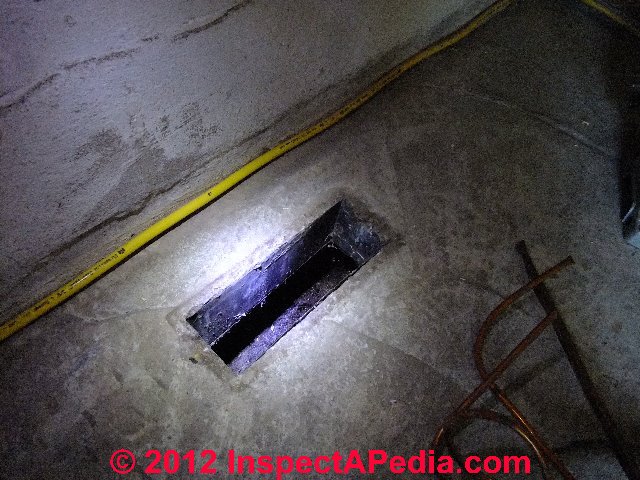
Two principal approaches to correcting hazards associated with environmental or heating or air conditioning system functional problems traced to air ducts in floor slabs are discussed here:
- Application of an internal sealant to the air ducts - possibly useful, with caveats described below.
We do not recommend this approach as there are questions about its thoroughness, durability, reliability. - Abandonment of the floor slab ductwork entirely, filling in the in-slab ducts and installing alternative heating or cooling distribution system(s) aboveground: very much the preferred approach, but probably more costly
Our starting point for proper abandonment of the in-slab air duct system shown at left was this floor register in the home's garage. Years of accumulated organic and other debris (odors, IAQ complaints) combined with a modest radon gas concern to lead a prior owner to begin abandonment of this duct system.
But he had left floor registers open to the building - failing to close them off (we fill with concrete) and inviting ongoing IAQ problems.
Duct Interior Sealants: apply an internal transite HVAC air duct sealant
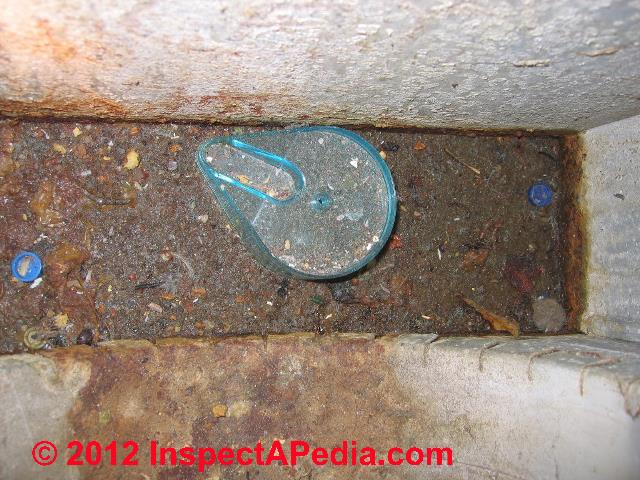 There are spray coating duct-sealants that some contractors offer as an in-duct sealant/spray. The contractor extends a spray wand into the HVAC ducts to deliver a coating that, if perfectly successful, can prevent or at least reduce the risk of asbestos fiber release into the building air.
And Andrew Oberta has described standards methods for repairing asbestos-cement products including underground transite piping.[5]
A down-side with in-slab ductwork is the difficulty in accessing for application of the spray and difficulty in inspection in the future to see what's going on inside the duct: collapsing walls, sealant falling off of duct interior, flooding, mold, asbestos-releasing scraps, rodents, etc.
Our in-slab air duct photo shows evidence of a history of floods in the duct system as well as rodents (the rodent poison).
A second concern is that even if the coated transite air duct interior surfaces appear to have been treated successfully, especially with in-slab ducts we are not assured that the in-slab ducts remain clean, dry, and undamaged in the future nor that the transite duct interior coating remains bonded to the duct surfaces.
See SLAB DUCTWORK
But given the history of concerns with the product, in particular with in-slab ducts, we would give strong consideration to abandoning in-slab ductwork entirely.
Reader Question: best way to seal in-slab ducts when abandoning them - how to minimize radon hazards in the slab ductwork
Rod said:
Dan, I have Sub Slab air returns in my Tucson home (my delivery ducts are above slab) which appear to be rectangular metal ducting.
I have Radon levels of about 5.5+ if I leave the air handler fan always on and about 3.5 if I leave it off (we're not into the cooling season yet so I have the option of having it not run at all for now). I don't have a problem abandoning the returns as I can raise the air handler and build a new plenum below and make returns that vent directly into the room.
However sealing for Radon, I'm thinking I'd like to put a high density plastic sheet or panel in the vent and then pour concrete over that rather than just using concrete, less permeable to gas. Have you seen anything like this done?
flag like
Reply:
Rod,
I agree with your plan to abandon the in-slab ducts. Not only are there the issues we've discussed in the article above, but where radon gas is a concern, the fact that the ducts are at negative air pressure when the HVAC system is running increases the risk of radon gas entry into the home.
I appreciate too your interest in making a well-sealed abandonment procedure for the slab ductwork. But I'm not sure of the practicality of placing a plastic sheet or panel in the vent. If you mean simply covering the vent opening into the building with plastic in the process of filling the whole duct, that's reasonable. But I don't think it'd be easy to line the entire duct in that manner - because of what I usually find is limited access.
You could alternatively hire a duct sealing company to spray the whole duct interior with a plastic coating/sealant before filling the entire HVAC duct with concrete throughout its run.
My OPINION, which is just that as we have no data, is that the lining step is unnecessary. If you fill the duct completely with concrete it ought to be at least as well sealed as the rest of the basement floor slab where there are no ducts.
Further, 5.5 pCi/L is a very low level, as the action level is just 4 pCi/L - I'm not sure that added and costly measures would be justified. (We realize the true radon level number varies by weather, season, and more significantly air movement patterns in the building.)
I would:
1. completely fill the return ducts with concrete
2. seal any other basement slab cracks or other obvious radon entry points
3. perform a long term measurement, for a year, or else for shorter intervals representing seasons when there are likely to be more upwards air currents in the home (upstairs windows open, heating season, exhaust fans in use).
4. Based on the results of 3, do nothing else, or if necessary, install a mitigation system (sub-slab suction exhaust)
(May 15, 2014) Rod said:
No, it would be to cover the opening of the duct, not to try and line the duct. Do you really have to fill the whole thing?
If I felt like I had a more serious radon problem, I'd be tempted to try and plug each end of the returns and stub a 4 - 6" pvc pipe through the plug so I could use the existing duct space as part of the slab depressurization system, since it's obviously leaky.
Anyway I was hoping to construct plugs in the duct not fill it.
Reply: why fill the whole in-slab duct
Rod, a reason for filling the whole duct is to prevent other duct cavity areas from taking up radon from the soil below and leaking it into the home. But sure, if a duct runs under a sound, un-cracked slab, you could just fill the duct opening.
See "How to Abandon in-slab and other transite asbestos HVAC air ducts" and the accompanying photos in the article above. With a good seal of concrete and no cracks, the addition of a plastic sheet isn't helping and might be a source of cracks.
Also see PVC HVAC DUCTS
(Sept 11, 2014) Rob said:
What would you do once the ducts are sealed? How would you run heat to the closed off areas?
Reply: getting heat into areas of abandoned in-slab ducts
We describe various alternatives in this article series - the best solution to getting heat into the areas no longer served by in-slab duct depend on the building and what's most convenient:
- new ducts through walls, ceilings
- conversion to forced hot water
- spot heat using electric baseboard
How to Abandon in-slab and other transite asbestos HVAC air ducts
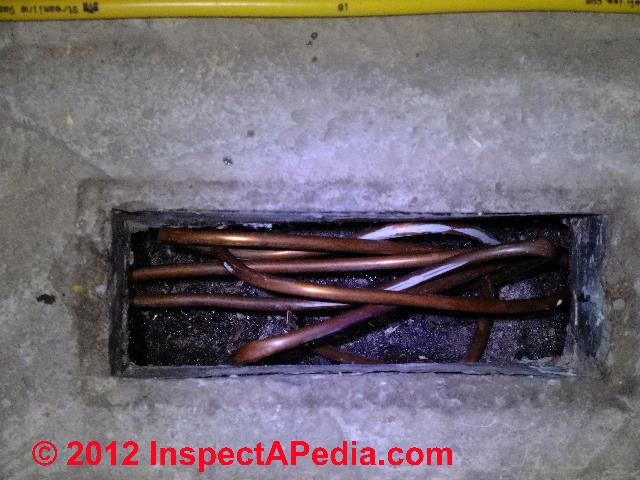
We recommend abandoning in-slab HVAC air ducts, including transite asbestos cement HVAC ducts, reasoning that there are multiple indoor air quality and potential health as well as functional concerns with such installations.
We described concerns with ductwork run in floor slabs in the article above, including risks of air duct collapse that interferes with air flow through the system, water leaks into the in-slab duct system (not a problem unique to transite ducts), and rodent or insect infestations or even mold contamination.
The photos below illustrate a continuation of abandonment of the in-slab air duct whose floor register was illustrated at the start of this section.
Our photos above illustrate how we prepared for sealing of ductwork run in a concrete floor slab. Working at the air supply register we used metal scrap to form a support for a section of drywall cut to fill the air supply register. We pushed this assembly down about 2-inches into the register in order to allow for a 2-inch thick concrete plug (shown below).
Even if the in-slab transite air duct system appears to be in "good condition" there is risk of asbestos fiber release (though in our OPINION the fiber release from intact cement asbestos materials is probably quite low).
Even if the transite air ducts look ok now, the risk of future leaks, infestations, and damage remain, and risk exposure of the building occupants to the problems described here. In addition, where the transite ducts have become softened by water entry or have suffered mechanical damage, there is a risk of increased level of airborne asbestos in the building served by the ductwork.

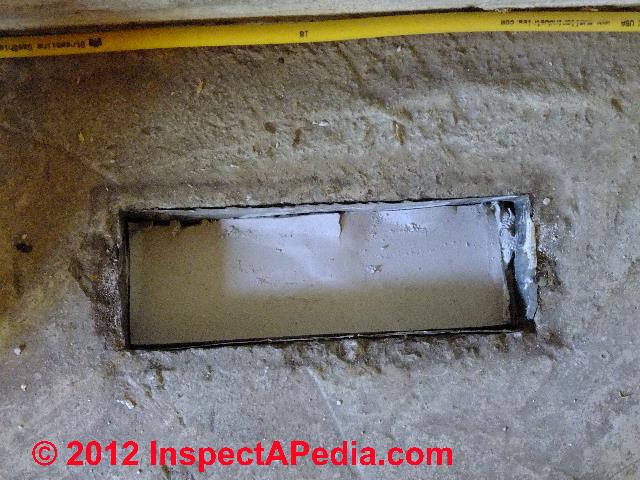
Our photo (left) illustrates the last stage of an in-slab heating system air duct that we abandoned and sealed, using concrete. Rather than try to fill the entire in-slab duct, we used the combination of metal scraps and drywall to provide a backer for concrete (shown in photos above).
We then poured into the air register opening in the concrete floor slab.
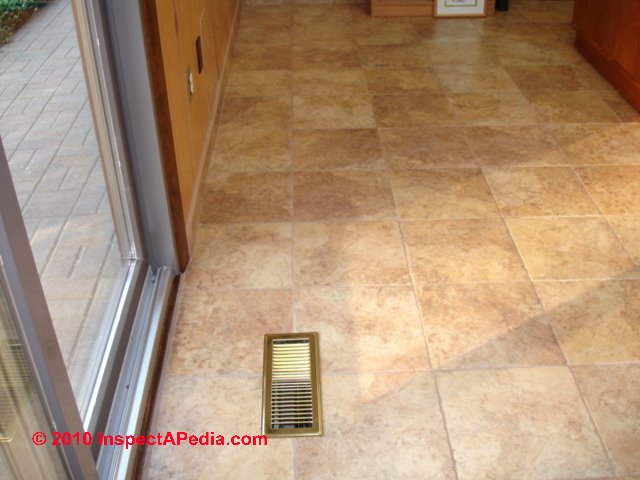
In other sections of this home the concrete floor, originally covered with carpeting, was re-covered using ceramic tile, adding a final layer of sealant as well as a cosmetic improvement.
More examples of duct routing & support troubles are provided
at DUCT ROUTING & SUPPORT.
We discuss and illustrate disconnected heating or air conditioning duct defects
at DUCT CONNECTIONS.
We also show the interior of crimped or squashed flexduct
at DUCT DAMAGE, MECHANICAL.
When abandoned, in-slab ductwork of any material can usually be left in place. However where radon gas is an issue, we seal the ducts at the air delivery registers in the building floor slab, as well as sealing any slab cracks that may allow radon gas to enter the building at increased levels.
Reader Question: what's the best way to abandon in-slab ducts? What about other water leaks up through the slab or foundation?
Wow!! We finally found someone who understands our struggles with in floor ducts. I'm really hoping you can help.
Bought a house 8 years ago built in 1960, thought it was great that the basement had in floor ducts so it would be warmer in the winter.
Photo at left of a wet and rusted and grubby in-slab duct supply register bottom is from InspectApedia.com files.
That winter we purchased two furnaces, one for the main floor and one inverted one for the basement. Spring thaw came and we heard water bubbling in the ducts and it was overflowing on the floor. The previous owners didn't disclose of this problem but anyhow, it's our problem now.
For the past eight years we've had water in the ducts during spring thaw or when we've had torrential rain. We've been the human sump pumps with our shop vac that has an aspirator that takes the water out of the ducts out the window to our yard.
We didn't want to fill it in we like the feature and we just bought a new furnace. But fast forward to our current state and we are finally waving the white flag. We've added two sump pits in the house and we're still getting water in the ducts.
We've had quite a winter season with significant snow fall, we're getting older and don't want to keep pumping out water not including the health risk we've been exposed. Good thing we're not in the basement too often and the furnace is set at 57 degrees so it only turns on when it's really cold.
We would like to fill it in with concrete, we've had a structural engineer look at our basement and he recommended a certain mix of concrete but didn't mention about the metal rebar. Do you insert that only on the vents or the whole area? There is no one in our area that is an expert on this so we're hoping you can help or direct us to someone that can.
Also, do you think that when we fill the ducts with concrete, would the water seep through our walls instead?
Thank you for your time and we look forward to your reply, - S. & G. L. 3/13/2013
Reply:
Let's divide your question & our comments into some subtopics:
Structural reinforcement requirements when filling in-slab ducts with concrete?
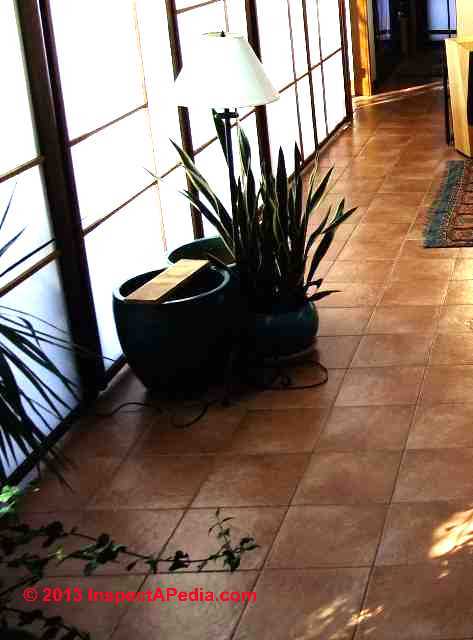
I cannot imagine why it would be necessary to install re-bar or any other structural reinforcement into the in-slab duct openings before filling the ducts with concrete.
You may have been misled by a photo I used in the article above
at HOW to ABANDON IN-SLAB & OTHER TRANSITE ASBESTOS HVAC DUCTS.
But the purpose of this material was not at all structural.
Rather it was to hold in place a backer (I used a section of drywall) to place about 3-inches down into the floor register opening so that I wouldn't need much concrete to fill and seal just the floor opening itself.
As you will read below, the decision about whether to just seal the register openings in the slab or to fill in the entire duct passage depends on several variables.
In the example home to which my photo (at left) pertains, no area of the original concrete slab was left with cracks or openings that made us worry about contaminants entering the building through the duct passage.
The finish flooring (other than in the garage) was ceramic tile as you can see in our photo.
We filled the HVAC ducts at the supply registers and then sealed that surface by installation of a new ceramic tile floor. There were not worrisome slab cracks, the slab upper surface is above grade, and there was no history of water entry coming up through the slab ducts into the building. Your case and your worry are different.
Best way to abandon in-slab HVAC ducts where water leaks are a concern
Indeed in some of our photo examples I have sealed in-slab HVAC ducts just at the supply register - but I only did this in a location (a dry garage floor) where there was no evidence that I might be leaving a dangerous reservoir of sewage, mold, dead rodents, bacteria under a floor up through which (via other cracks or openings) contaminants might enter the home.
- Fill in the duct passage in homes with water entry problems.
Other approaches to sealing or abandoning in-slab HVAC ducts are discussed in the article above, but overall, in my OPINION best would be to fill the entire in-slab duct channel with concrete; a high-portland cement mix will be most-resistant to water passage, but we'd best keep these limitations in mind so you're not disappointed after this repair: - Debris on the sides and bottom of the in-slab ducts will most likely prevent a really good water-tight bond between the four sides of the new concrete (or round sides if your ducts are round) that is poured through the duct system.
- Water leaks may continue: depending on other building details such as the height of the upper surface of the floor slab above ground, water pressure and quantity in soils around the home, and surely some other factors I haven't yet thought-of, it is indeed possible that once you fill this channel running through the slab the same water problem will simply reappear at other slab penetrations or even higher up on the building foundation walls (if the building foundation also is partly below grade-level).
Therefore your worry about an ongoing water problem is appropriate. Without more details about your home, its site, roof drainage, surface contours, the actual sources of water that has been entering the home through the in-slab ductwork, I can't be confident I've got a complete understanding of your situation, but here are some things you should consider:
How to make sure water does not come into the building through the slab or foundation
- Fill in the entire in-slab duct run: In addition to filling the entire slab duct passage (because we expect that to significantly reduce leak openings into the slab from below even if it won't fully seal them) also
- Consider installing a sump pit and sump pump at the low-end of the ductwork, making sure that the bottom of the sump opening is well below the bottom of the slab. Pipe the sump pump discharge to a location where when it disposes of water that water won't just run back around the foundation. If you have frequent power outages you may need battery backup or even generator backup for your sump.
Watch out: You are balancing the risk of water flooding the building through the sump pit (during a power loss) with the benefit of lowering the water table under the ducted and leaky slab. This is not the best choices for all cases like yours (it depends in part on the assessment of whether or not you can seal the slab and don't risk other water entry), and in general sumps are not my first choice for de-watering a basement or floor slab. Butt sometimes the cost-benefit of a sump pump is appealing.
Of course don't bury the sump - make a safe cover and keep this system accessible for inspection & repair. The sump can provide extra insurance against water leakage up through the remains of the filled-in slab ductwork; also depending on site conditions and building construction, a sump can actually lower the water table under an area of building leakage.
See SUMP PUMPS for details. - Fix the water sources outdoors: it is almost always most effective to find and fix the water entry source from outside the building, rather than waiting for it to enter and then pumping it away. That means paying attention to roof runoff, surface grading, and any other sources of outdoor water and snowmelt.
Watch out: when ground is frozen it is almost entirely the top surface contouring that determines where surface water, roof runoff, and snowmelt water goes. Don't pile snow up against the house where it forms a water trap.
See WATER ENTRY in BUILDINGS - our home page for this topic.
Reader Comments, Questions & Answers About The Article Above
Below you will find questions and answers previously posted on this page at its page bottom reader comment box.
Reader Q&A - also see RECOMMENDED ARTICLES & FAQs
On 2022-10-18 by EJ Sorrell - fill in the plenum when abandoning transite ductwork?
Should I fill in the plenum when abandoning transite ductwork ? I am trying to figure out if I should just seal the registers or also the plenum
Should the area directly underneath the air handler/furnace (the deepest point where all the ducts meet ) and be filled with concrete as well as the openings to the supply registers?
On 2022-10-18 by InspectApedia (Editor) -
@EJ Sorrell,
I see all the individual registers and also the floor opening into an air handler which perhaps is what you are referring to as the plenum.It's really worth reading the articles on this subject so that you can be more completely informed than just an off the cuff or excerpt type reply. And sometimes it's best to completely fill in the end slab system so that you're eliminating water and other under slab concerns. At the very least you want to seal all the openings in the floor.
On 2022-08-25 by Greg - how thick and what is the diameter of a 16-inch PVC pipe used for in-slab return duct?
I have to run a 16in return under the slab about 12 feet. Was wondering how thick the pvc pipe has to be?16 inches round would
On 2022-08-25 by InspectApedia-911 (mod) - ducts in slabs tend to be a problem
@Greg,
You'll see in this article why ducts in slabs tend to be a problem - to be avoided.
A 16" PVC pipe, Schedule 40 weight, would have an outside dimension of 16" and an inside dimension of 14.94 inches.
On 2022-06-18 by Jewell - history of water in floor vents and ducts - what do I do?
I inherited my mom's slab house in toronto ontario, we get winters.
there is history of water in floor vents during snow melt especially, I'm concerned. Thinking of filling them in but wondering where new ducts would go?
There is no attic space and square footage is limited. Also wondering if I should be adding a Sump Pump?
Also there is definitely problems with grading, downspouts etc that need to be addressed, problem is I will be taking possession in September, I have no idea what to expect for costs and how to address these issues before laying down new floor and renovations, need to know what to budget for.
On 2022-06-18 by InspectApedia-911 (mod) - suggestions on filling in ducts as well as an understanding of the hazards
@Jewell,
Please do take a look at the article above - as it includes suggestions on filling in ducts as well as an understanding of the hazards.
Just where replacement heat distribution ducts (or something else) should run in a home with in-slab ductwork depends on the specifics of the building as well as on choice of heating system.
In some cases people opt to run hot water heating lines as pipes are smaller and easier to route to various building areas = less obtrusive; that's particularly appropriate where the old forced warm air heating furnace was old and at end of life.
I would not in any case continue to use in-slab ducts.
It would make sense to have a thorough home inspection done before hiring contractors to do anything. That will help you set priorities of repair work and may avoid wasting money on unnecessary repairs or on something that has to be torn out soon afterwards to repair something else.
3 Priority categories:
- Dangerous
- Doesn't work
- Damaging the building in a costly and rapid way
Everything else: you're in control of your wallet
Call a sharp home inspector, maybe one of the inspectors from our friends Carson Dunlop Associates (you can find their contact info at the page-bottom Citations & References -or my friend and an independent Toronto home inspector, Terry Carson, Toronto Ontario Home Inspector: 416-440-0062 4 or others in Toronto found at HOME INSPECTORS-CANADA
All of those people have contributed technical content to this website and are my friends; we have NO financial nor other business relationship with any products or services discussed at this website.
On 2022-01-26 by Travis B - what's the best way to fill in ducts in a slab with concrete?
I have in slab ductwork that we are abandoning. I want to fill with concrete. What is the best way to fill the ducts entirely? Should I just have a concrete contractor come pump them full or can I just pour five gallon buckets down at a time?
On 2022-01-26 by Inspectapedia Com Moderator - is it functionally necessary to fill in all of the in-slab ducts completely?
@Travis B,
It's unlikely that manually pouring buckets of concrete into your in-slab ducts will be sufficient to push it all the way through all of the ducts; to do that you'd probably need to hire a concrete company who can pump concrete into the duct system with a hose.
I'm not sure that it's functionally necessary to fill in all of the in-slab ducts completely.
If a camera inspection shows most of the duct runs are not leaking water such as to threaten the building, I might pour concrete into the ducts at each of the floor registers. Typically you could fill just a few feet of duct at the register using this method.
I would at least consider the complete fill-in IF a duct inspection camera showed damage, cracks, breaks, and leaks under the slab throughout the home.
On 2022-01-10 by Denny Brown - gravel and asphalt shingles forming in-slab ductwork?
My house is on a slab and the duct work is made of concrete. There is gravel and what appears to be asphalt shingles in the bottom with more gravel on top of that. Is this a normal application? I am also having water pouring into my ventilation system
On 2022-01-11 by Inspectapedia Com Moderator - collapsed ductwork
@Denny Brown,
NO that sounds like very strange construction or perhaps collapsed ductwork.
BE SURE to read the explanation of the problems with ducts in slabs given above on this page.
On 2021-12-15 by Steve - I appreciate all the info here - what a wealth of knowledge! about in-slab HVAC ducts
Great info here; it makes me feel much better to read "We've been the human sump pumps with our shop vac ..." after spending last night sucking water out of our duct after being completely surprised to find it.
I assume the water is a result of poor drainage from the house though I'm wondering if this problem has existed for a long time without us noticing or if it's new. It did rain a lot recently, though we have had larger storms before.
Question: We've sucked as much water out as we can and are running the heater to try to dry things out as much as possible otherwise. Is there anything else we should do in the short term?
For the long term, I can look into sealing that portion of the system, though it does make me nervous that if the water intruded there that we may make things WORSE elsewhere as mentioned in the article.
I'll also look into what I can do to get water away from the house - gutter extensions, etc. There definitely was pooling water near the house since the hardscape isn't sloped sufficiently to shed the water away from the house.
On 2021-12-16 by Inspectapedia Com Moderator - how to properly abandon and seal in-slab air ducts
@Steve,
If the only water that you have found was in ductwork under a floor slab, that is to say if no components of your house such as drywall or trim or walk have these have been wet then it's appropriate to be focused for now on the in slab ductwork.
A description of the health and functional problems that may be traced to air ducts that were routed in a concrete floor slab as well as our advice on how to properly abandon and seal in-slab air ducts are found at DUCT in CONCRETE FLOOR.In the meantime to speak more directly to your question, you might measure the humidity level in your house to be sure that it's in normal range. And of course inspect your home talked about and be sure you don't have other leaks that you had not previously noticed.
You might have your furnace blower inspected and cleaned and of course change your air filters, and inspect any above ground ductwork for cleanliness.
On 2021-12-31 by Steve
@Inspectapedia Com Moderator, Thank you for the response - I got into the crawl space and was able to see where water was entering the slab portion of the house. There is definitely water coming into the crawl space and then into the chase where HVAC ducting enters the slab; this seems to be the lowest point and a low resistance path for water to take.
I've started focusing my efforts on exterior drainage starting with a surface and downspout drainage system to move water far, far away from the house. As you said, no other components of the house appear to have gotten wet - so hopefully once the exterior drainage issue is solved and the chase / crawl space is thoroughly dried out the problem will be solved.
I'm amazed at the volume of water - though we have had multiple days of heavy rain, including a 200 year storm event and our high clay soil seems to just be fully saturated with water and hasn't had a break to dry out. Thank you again for your time and response.
On 2021-12-31 by Inspectapedia Com Moderator
@Steve,
Very often the primary source of building water entry is roof spillage around the foundation - gutters not working;
That concentrates a huge amount of water right at the foundation walls.
When grade doesn't slope away that traps that spillage against the building.
Even if there were footing drains intended to take that water away, they fail: they are likely to be overloaded and ultimately clogged by that overloading.
On 2021-12-04 by Pye
@Inspectapedia Com Moderator,
The top part is definitely PVC pipe. I can't say what is at the bottom. I'm a 63 yo disabled female so I'm looking for the easiest way for me to deal with this in the short term and while filling it in with rocks and topping off with cement is undoubtedly the RIGHT way to deal with it (and that is what I told my son should probably be done),
it would require ripping out most of the closet that currently sits on top of it plus a lot of physical labour that I am no longer really up to any more. Also I have visions of the rock sliding down that horizontal whatever-it-is over time and the cement on top subsiding, possibly that's just little old woman paranoia.
There were actual pieces of PVC broken off in that cubby hole under the bottom of the "closet" so definitely the top part is PVC. For the last 25 years (since whenever the original furnace was replaced) or so that has all been behind vertical grates where I assume cold air return ducts were - the ducting itself, if it ever existed, is long gone.
There may be signs of in-floor ducts under the carpet, the tile obscures everything where it has been laid (and it was not original to the house, I would guess given the time of construction that was originally sheet vinyled).
I guess it doesn't matter what it was originally IF it is OK for me to just wallboard over the mess. It is at least 3' deep and I am concerned about future moisture issues because it is so freaking deep and I don't know what's down there.
With the grates installed (I will attach pictures again), any moisture back there would have dissipated but if I close it off with wallboard it COULD build up. This is in Lubbock TX and its well under the house - doesn't rain a lot here, so again, that may be old lady paranoia speaking.
I guess my other option is to just put the grates back and continue to ignore it but given the amount of filth that built up back there over the years, that doesn't seem like a great option either. BTW it was just the duct GRATES I took down when painting, any ducting was itself long gone.
I suspect the small duct you see at the top left of the first photo is for the dryer, the laundry backs on this mess (the dryer is vented into the attic, yes, that's what I said, into the attic which is allowed by code here and yes I will be fixing that).
So those are the three solutions I can see - #1 do it right and fill it in; #2 leave it as is but cover with wallboard; #3 put the grates back up and just continue to ignore it the same way it has been ignored for decades.
#1 would be my preference if I were 20 years younger but given that's not happening, #2 is my first choice, but if #2 is a horrible idea then I'll most likely go with #3 I guess unless you tell me that's also a horrible horrible idea.
If #1 is really necessary any pointers on exactly how to do that would be great. EG rock size and layering of fill material. There are no quarries anywhere near here so laying hands on rock and gravel is a problem.
On 2021-12-04 by Inspectapedia Com Moderator
@Pye,
I wouldn't just add wallboard over an opening like that, I would first fill with concrete to at least a depth of a foot.
We describe that in our article on abandoning ducts in slabs.
On 2021-12-03 by Pye - just bought a house with ducts in slab - what to do?
I recently purchased a house built in the 90s that had a furnace closet that had been converted to a closet closet (furnace moved to a utility closet in the garage).
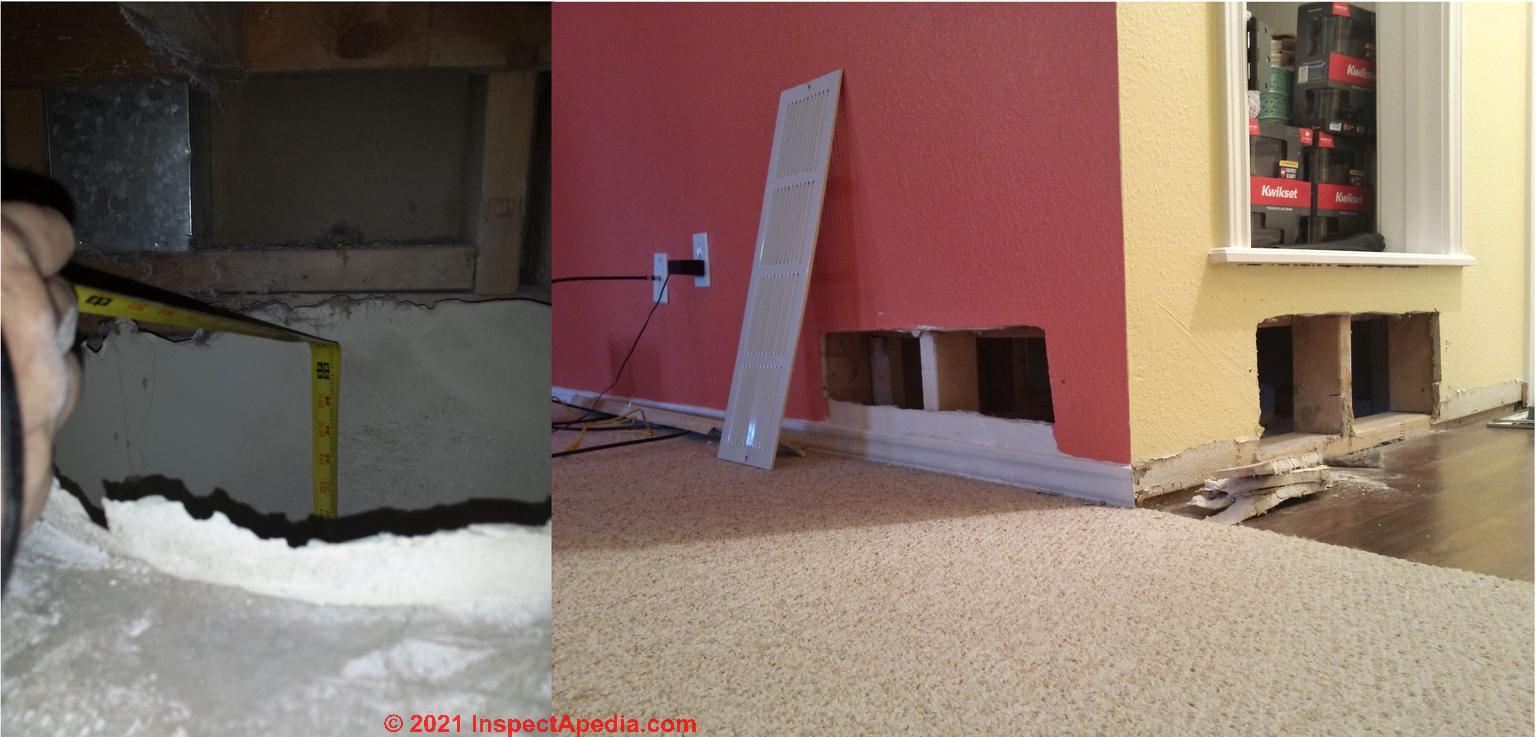
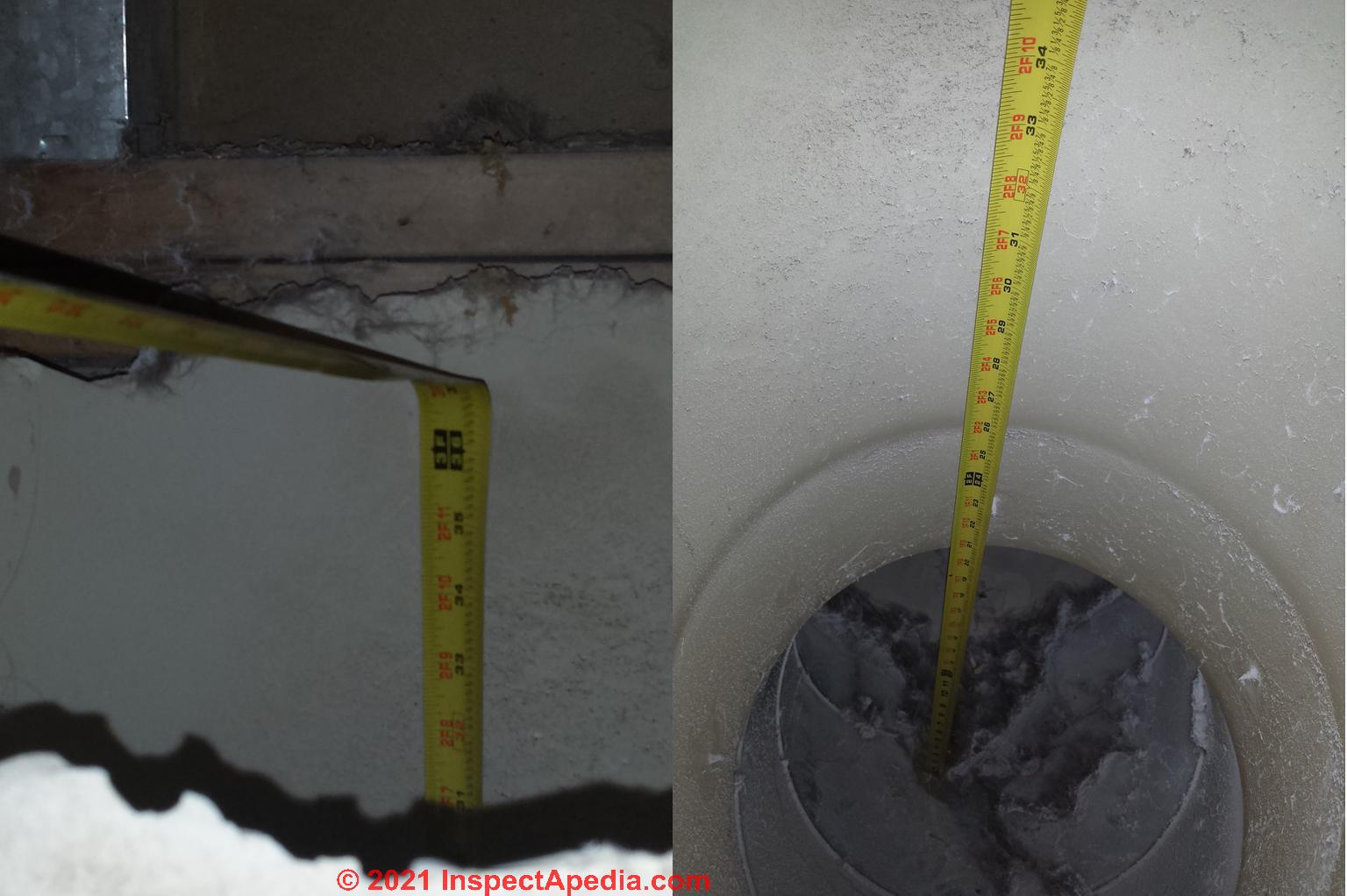
I had the house painted shortly after purchase in the course of which we removed two ducts under this closet on the front wall in the hallway and on a side wall in the living room at floor level, to discover a lot of filth and a 15" PVC pipe that is all smashed up and about 3' deep. Pictures attached. I assume this had something to do with the original furnace. Ducts for the functioning furnace are in the ceiling. Bathrooms and kitchen were tiled by the original homeowner, there is carpet everywhere else.
I have seen no sign of in floor ducts but there may be some sign under the carpets which we have not yet pulled up. I had assumed the thing in the closet was for cold air return but now I have no idea.
This thing is at least 3' deep and it looks like it may be going off horizontally at the bottom, I can't really tell.
So the questions are, what the heck was this for (if you can guess) and what the heck do I do about it now?
Can I just box around it - I am wallboarding over where the grills were mounted on the wall, it was all just open space and dirt back in there - or had I better do something more definitive about it (and if so, what)?
There was 30 years of dirt, dust, and dirty-dusty-cobwebs or something worse behind those grills and it seems dust and dusty odor is still hanging in the air since I tried to clean it out yesterday. Even with all the windows open. Even over the paint smell from the paint job that was finished 2 days ago.
On 2021-12-03 by Inspectapedia Com Moderator
@Pye,
That doesn't look like PVC to me - I see what looks like a spiral assembly pattern and a papery-like material.
If the home had no in-slab ducts then what you set could have been an air return or a combustion air supply, or ... something else.
Why not fill it with stone and cement? Or if you're really curious you could follow it using a sewer line camera first, before abandoning it.
On 2021-12-04 by Pye
@Inspectapedia Com Moderator,
I have read that entire article several times and have not found a passage or passages describing exactly how to do this.
What little I HAVE been able to glean from disparate bits and pieces and what you say above makes it sound like I have to pump concrete down that hole until it stops running and hope nothing collapses or shifts somewhere down the line and/or over time. I don't have the equipment or the money to try to fill with concrete a 15" diameter hole that is over 3' deep and then joins with a horizontal duct of unknown length and diameter.
Probably that's why it was left the way it is, which is apparently the case for every single house in this subdivision.
I guess it will just have to go on as it is.
To be a little clearer: The instructions you DO give are to fill a heating vent in the floor to a depth of 2" with concrete. That is a much smaller area that would be nowhere near as deep as this ginormous hole into the earth under that closet @ 15" x >3' deep plus the horizontal run.
I would be comfortable with doing what is described in the article, but my situation is not only a much larger hole that goes way deeper and way further back but also is lined at the top with PVC down to the level of whatever that horizontal duct it runs into is, so at least 2' from what I can tell of slippery PVC that concrete won't bind with.
Concrete shrinks - admittedly not a whole lot but it does shrink and I am concerned that even if I were to fill that hole with rubble to within a foot of the top and then pour concrete, that concrete won't even remotely bind with the PVC liner.
Shrinkage is something a bit over a half inch per 100 feet which is tiny but combined with the smooth PVC walls I feel like chances are a plug like that in a PVC pipe would not be stable over time. Possibly that "time" is longer than I'm likely to live anyway and/or the instability I fear is either insignificant or nonexistant. But its not the same situation as described in that article.
At best I feel like I would somehow have to manage to chip out that PVC pipe down to at least 18", after of course totally tearing out the closet so I could even get at it. Also would still have to fill the bottom with rubble up to a foot below the top of the slab.
I fear it is too big a project all things considered, if I'm right to be concerned about that PVC liner, shrinkage, and slippage.
So I'll just have to leave it alone, I guess.
On 2021-12-04 by Inspectapedia Com Moderator - Problems to avoid by filling and sealing abandoned ducts in slab
@Pye
Thank you for the helpful discussion.
The reason I prefer to fill and seal abandoned ducts in slabs is to reduce the chances of a future problem with
- radon gas
- building water entry
- mold contamination sending harmful mold or MVOCS up into the occupied space
- avoid possible surprise drafts
- avoid pest havens or pest entry points especially for mice and occasionally bigger critters
The amount of trouble and expense for sealing a single opening is usually trivial;
For the 2-inch concrete seal example we give in this article, there was a small rectangular hot air supply duct in a concrete floor slab; the duct made a right-turn down near the bottom of the slab, less than 12" down.
We stuffed newspaper to form a backer and to reduce the amount of concrete needed, and we left about 2-inches from the floor surface or concrete slab surface down to our temporary stuffed-backer.
Then we filled concrete atop that to bring concrete in the abandoned duct opening up level with the existing floor slab.
You can certainly do the same with your PVC pipe.
While some contractors offer an expensive concrete pumping option to fill entire runs of abandoned under-floor-slab ductwork, usually that's not necessary nor cost justified. I would consider that more troublesome and expensive step in buildings subject to rising flood waters but otherwise I'd take the simpler approach I've outlined.
On 2021-10-29 by Jay - does this cement duct contain asbestos?
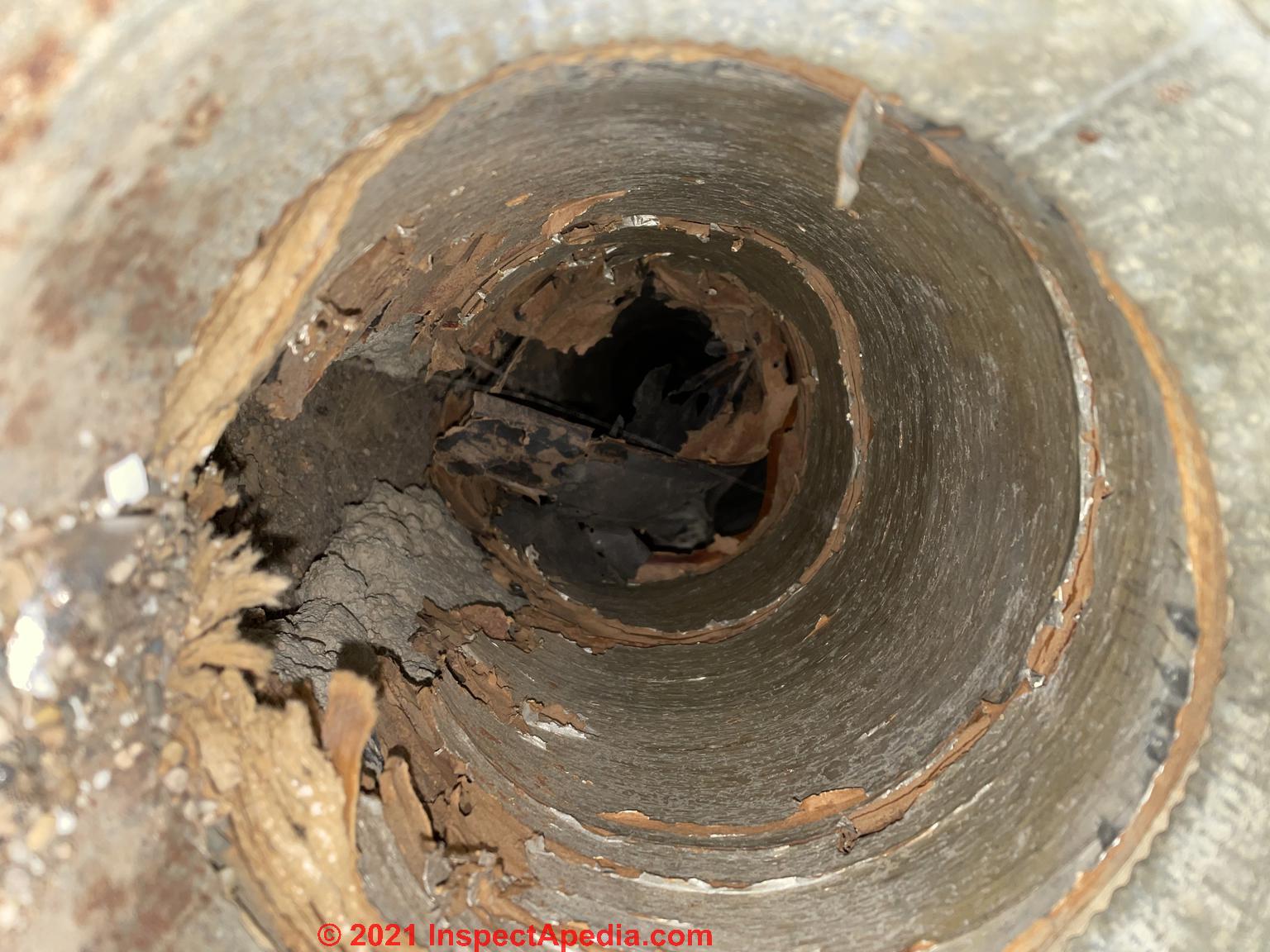
Wondering if this in cement duct looks like it contains asbestos?
On 2021-12-03 by Inspectapedia Com Moderator - cement duct looks like it contains asbestos
@Jay,
If that's transite ductwork from before 1986 in the U.S., ... yes.
But what we THINK we see is a terrible HVAC duct that was probably a flex duct product or paper-wrapped something that looks disintegrated by rust.
If that's right, it's not transite - which is an asbestos-cement product, it's metal duct that's shot.
It looks to as if some poured concrete oozed into the duct and the duct interior is blocked by duct fragments.
If this is a duct in slab it's one to abandon.
On 2020-10-07 by Anon - in slab duct problems: cracks, gravel, rodents, bugs, smells - covered by insurance?
Re-posting from private email:
I have a home in Indianapolis built in the mid 50's, the in slab ducts have become quite a problem. I can look in my ducts with my phone and see very large cracks, showing pea gravel where foundation was poured. I have rodent problems in my ducts, many insects and a musty smell. Was curious if my home owners insurance would cover any of these issues? - Anonymous 2020/1-0/05
Moderator reply;
Thing to do would be to ask them. But I am doubtful - ordinary homeowners insurance will not usually cover original defects in construction of a building.
However **IF** an expert testified that the damage to your in-slab duct system was caused by an event that is covered by your HO policy, such as fire, flood, or earthquake (if your policy included those endorsements) THEN you might have basis for a claim.
On 2020-02-13 by Mickey - ants in around the HVAC supply vents in my home
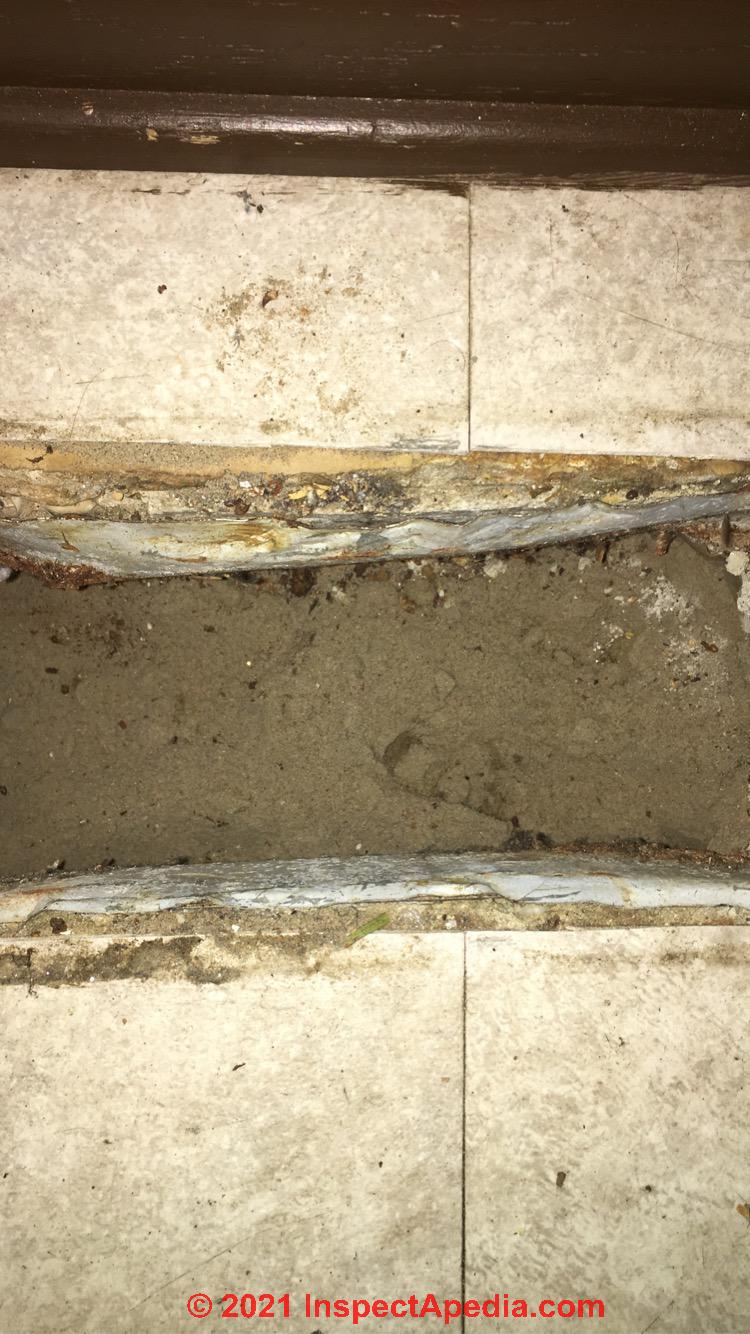
I had been noticing ants in around the vents in my home so I removed them to vacuum them as I assumes they were dirty.
This is what I found. The ducts are rusted away completely and there is nothing but dirt from under the slab.
This is a rental home and I’m seriously concerned that this may be an issue that the owner won’t want to fix
This Q&A were posted originally at WET CORRODED DUCT WORK
On 2020-02-13 by mod) - metal duct register rusted away to dirt/soil below slab - health hazard
I suspect you are right on all counts.
That looks like a health concern to me. All of the building's heated or cooled air is blowing simply over dirt below a slab. Any leakage into that area or invasion by pests or chemicals to treat pests all add up to health risks.
See details at SLAB DUCTWORK
On 2020-06-19 by Sylvia - unpleasant smells coming out of ducts when the heat
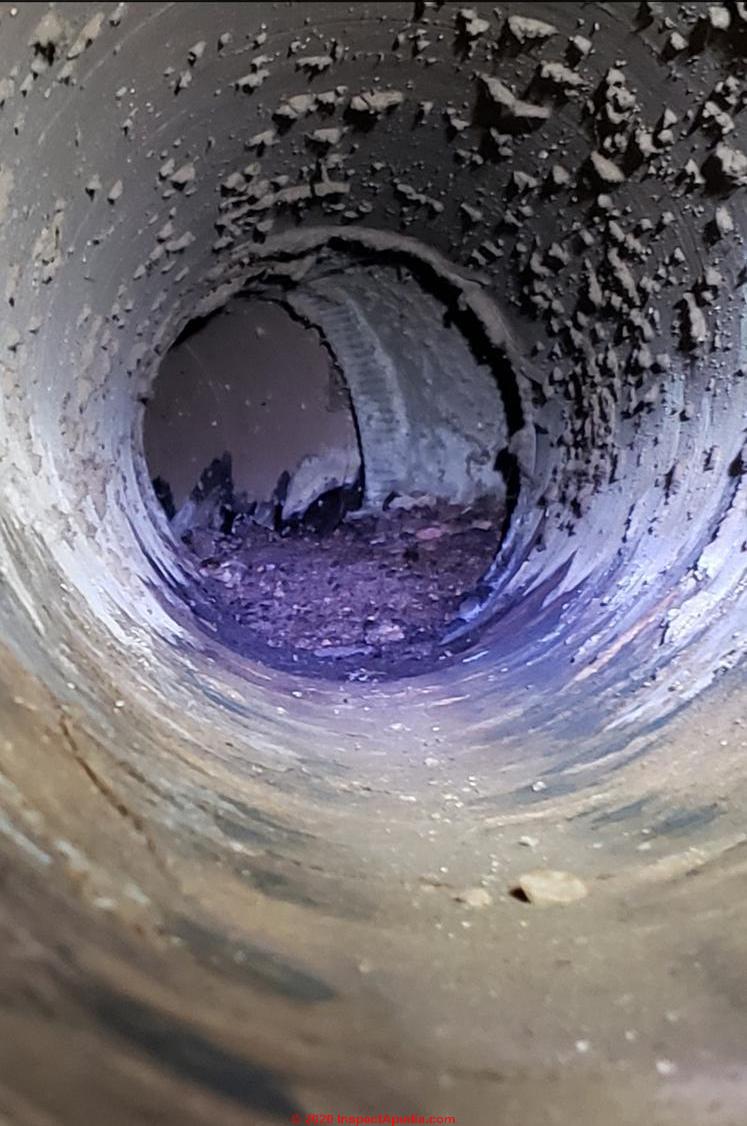
I own a ranch style home that is in a concrete slab, and I get unpleasant smells coming out when the heat is on and I believe there are mice in the ducts. How can I check the condition and detect problems in the duct work in the slab?
On 2020-06-19 - by (mod) -
Sylvia
You can have a duct company or plumber who has one, run a remote camera through the system to examine it. But as you'll read in the article above on this page, if your ductwork is in the slab we recommend that it be abandoned and sealed for several reasons you can read in the article.
On 2020-06-14 - by Anonymous - sewage leak into heating ducts.
 Re-Posting
Anonymous said:
Need help figuring out possible slow sewage leak into heating ducts. I have lots of photos and videos. Just somebody please help. We have a house on a concrete slab. No crawl spaces. In order to see into the vent we had to rip out the whole furnace (which we did already see added photo.)
We got a new furnace installed. The last 3 months, we have been trying to figure out why water has been pooling in a specific vent. Fruit flies or sewage flies have been breeding down there as well.
This Q&A were posted originally at SEWER SEPTIC ODORS in HVAC DUCTS
Moderator reply:
Anon:
That in-slab duct is unsanitary and not entirely functional. I'd abandon it.
See notes on in-slab ductwork hazards & solutions beginning above on this page.
On 2020-03-31 by Marcella - Termites in slab HVAC ductwork
Termites in slab HVAC ductwork in guest bedroom and main bath. 3 years straight. We closed off vent in bedroom and think that's what moved the termites to bathroom. Terminix pulls back metal at opening, sprays a foam inside. Gets rid of termites for few days/hours, then back again. I can always tell when termites are back because of the smell.
Terminix had also dug a "trench" around the area where the rooms are but that has not helped either. Terminix has been out 5 times since February when termites first appeared. What can be done to get rid the termites?
On 2020-03-31 by (mod) - significance of Termites in slab HVAC ductwork
Marcella
It sounds as if you do need a more-thorough inspection and treatment, plus, as you'll read in the article above, some serious thought to abandoning the in-slab ductwork.
Above we explain why we abandon slab ductwork: leaks, rot, attack path for insect, mold, odors;
Watch out: I'd add that I'd be rather nervous about breathing air in a home whose conditioned air is blowing through ductwork treated with a termiticide.
Termites rely on wood-soil contact. Your inspection needs to include a survey of all of those points.
On 2020-02-19 by Aaron Burnham - what can be done with respect to air-conditioning in the summer if I abandon in slab ducts?
Great information on duct work in concrete, and I'm thinking about going with the heated water baseboard option in my 70 year old ranch/slab in Cleveland Ohio. At the risk of sounding uninformed, what can be done with respect to air-conditioning in the summer?
On 2020-02-19 - by (mod) -
I prefer either using split systems or of course ducts that do not run in the slab but rather in walls and ceilings
On 2019-10-06 by Jim E - 4 to 6 inches of water in my underground cement air return.
Ths 4 to 6 inches, not 40 to 6.:-)
I currently have 4 to 6 inches of water in my underground cement air return. I have no clue how the water got there. Any suggestions?
I live in a very dry and arid location in Scottsdale Arizona so I know it's not because of rain or watering the lawns.
On 2019-10-06 - by (mod) -
4 to 6 inches of water in my underground cement air return
Jim
Sorry but from etext alone I can't say for sure why your underground return air duct is flooded; Considering that you're in a dry area and have had no rain and have not run a watering system that could have flooded the duct from outside, I'd be looking for a plumbing source such as condensate drainage or a leak supply or drain line.For example readers have on occasion found a sewer line that leaked into the duct system. Or an A/C condensate system that leaks into the ducttwork
Combine looking for those potential sources with pumping out the duct and inspecting it using a sewer line camera. LEt me know what you're told.
...
Continue reading at WATER & ICE IN DUCT WORK or select a topic from the closely-related articles below, or see the complete ARTICLE INDEX.
Or see SLAB DUCTWORK FAQs - questions & answers posted originally at this page.
Or see these
Recommended Articles
- ASBESTOS TRANSITE DUCTWORK
- DUCT & AIR HANDLER ODORS
- PVC HVAC DUCTS
- SLAB DUCTWORK
- WATER & ICE IN DUCT WORK
- WET CORRODED DUCT WORK
Suggested citation for this web page
SLAB DUCTWORK at InspectApedia.com - online encyclopedia of building & environmental inspection, testing, diagnosis, repair, & problem prevention advice.
Or see this
INDEX to RELATED ARTICLES: ARTICLE INDEX to HVAC DUCT SYSTEMS
Or use the SEARCH BOX found below to Ask a Question or Search InspectApedia
Ask a Question or Search InspectApedia
Try the search box just below, or if you prefer, post a question or comment in the Comments box below and we will respond promptly.
Search the InspectApedia website
Note: appearance of your Comment below may be delayed: if your comment contains an image, photograph, web link, or text that looks to the software as if it might be a web link, your posting will appear after it has been approved by a moderator. Apologies for the delay.
Only one image can be added per comment but you can post as many comments, and therefore images, as you like.
You will not receive a notification when a response to your question has been posted.
Please bookmark this page to make it easy for you to check back for our response.
Our Comment Box is provided by Countable Web Productions countable.ca
Citations & References
In addition to any citations in the article above, a full list is available on request.
- [16] Manual D—Residential Duct Systems – Air Conditioning Contractors of America (ACCA)
- [18] Uniform Mechanical Code, 2003 Edition, Appendix A: Standard for Installation of Factory-Made Air Ducts
- [19] Florida Mechanical Code, Section 610: Air Distribution Systems
- [20] Thanks to Indoor Air Care Corp., for their photograph of flooded flex-duct. The Southhampton NY company can be reached at 866 580-MOLD
- In addition to citations & references found in this article, see the research citations given at the end of the related articles found at our suggested
CONTINUE READING or RECOMMENDED ARTICLES.
- Carson, Dunlop & Associates Ltd., 120 Carlton Street Suite 407, Toronto ON M5A 4K2. Tel: (416) 964-9415 1-800-268-7070 Email: info@carsondunlop.com. Alan Carson is a past president of ASHI, the American Society of Home Inspectors.
Thanks to Alan Carson and Bob Dunlop, for permission for InspectAPedia to use text excerpts from The HOME REFERENCE BOOK - the Encyclopedia of Homes and to use illustrations from The ILLUSTRATED HOME .
Carson Dunlop Associates provides extensive home inspection education and report writing material. In gratitude we provide links to tsome Carson Dunlop Associates products and services.
 | HOME | ABOUT | ASK a QUESTION | CONTACT | CONTENT USE POLICY | DESCRIPTION | POLICIES | PRIVACY | |
| © 2024 - 1985 Publisher InspectApedia.com - Daniel Friedman | |||||||||