
InspectAPedia® FREE Encyclopedia of Building & Environmental Construction, Diagnosis, Maintenance & Repair |
Question? Just ask us! InspectAPedia
|
 Heating or Air Conditioning Duct Ice-up, Duct Flood Damage, Duct Water Leaks & Mold
- POST a QUESTION or COMMENT about the detection, cause, effects, and cure of water or ice formation or flooding in HVAC ducts
Water, condensate, or ice formation in air conditioning or heating ductwork:
Here we explain the causes and cures for problems of condensation, water, or ice formation in heating or air conditioning system duct work.
We describe and include photographs of various sources of water, leaks, or flooding in HVAC ducts and we describe the IAQ and health problems that these conditions can cause, along with recommended solutions.
InspectAPedia tolerates no conflicts of interest. We have no relationship with advertisers, products, or services discussed at this website.
Causes of Condensation, Water or Ice Formation in Duct Work, What Happens, How to Prevent Condensate, Icing, Leaks in & From Ducts
Warm Indoor Air Convection Currents Entering Cool HVAC Ducts
 Article Contents
- WATER & ICE IN DUCT WORK. - Sources & causes of water or condensation inside or on the outside of air conditioning ducts
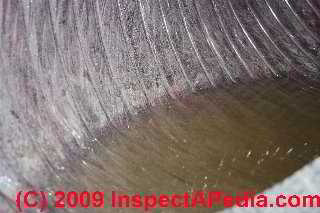
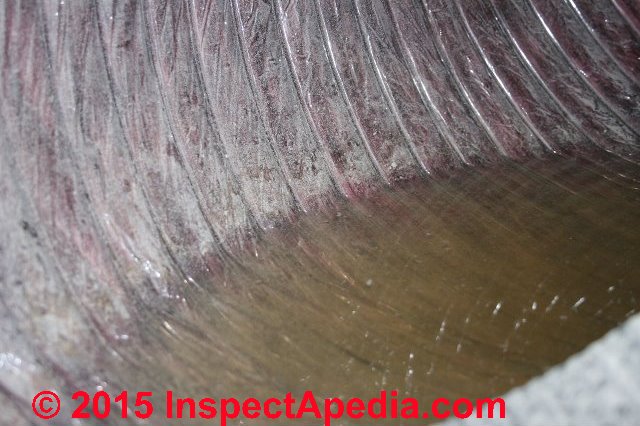
Our page top photo, courtesy of Indoor Air Care, shows water inside of flexible ductwork. Are these due to roof leaks, condensate leaks into the duct system from the air handler, or condensate due to convection air currents entering the HVAC duct during the heating season?
In freezing climates such as New York where some homes route their top floor HVAC ducts along the attic floor, sometimes that ductwork is not well insulated and just as it gets too hot in summer (increasing the cost of air conditioning), in winter the same ducts become too cold, increasing heating costs.
But something else funny can happen in homes with attic ducts that are used only for air conditioning.
One of our clients called us to investigate a claim that had resulted in litigation against the company who had installed a new roof on their home.
The owner claimed that the roof was leaking. The roofer claimed that the roof was perfect. What was curious was that the roof "leaked" only at the end of winter, and at times when there had been no rain and when there was no melting snow on the rooftop.
Sources of Ice Formation in HVAC Ducts
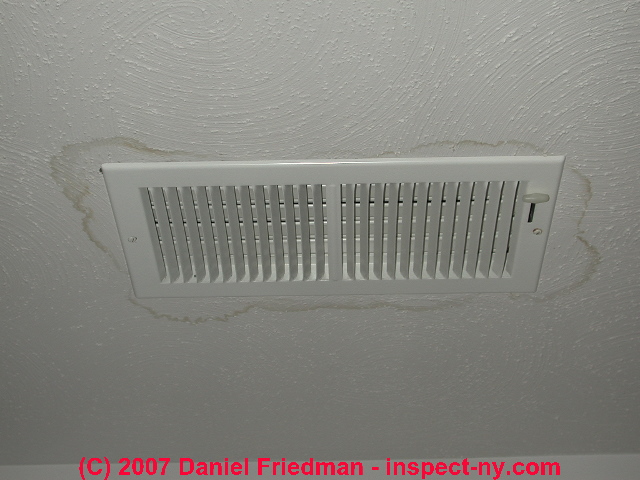
We observed the following causes of ice in the air ducts that ultimately showed up as leak stains on ceilings:
- There were leak stains at most of the top floor air conditioning ceiling-mounted supply registers. (Photo at left)
- There were leak stains at the top floor ceiling mounted return air register
- The home had hot water baseboard heating and used its ductwork only for air conditioning during the summer
- The home had a problem of chronic basement water entry and was in general pretty damp, even in winter
- Inspecting the home's attic and the duct work in the attic I was astonished to find that in the dead of winter the ducts had about 2" of solid ice in the bottom of the ductwork! Ice was thickest closest to the supply or return registers and was thinnest in the middle of the duct runs
- [Have you guessed yet?] Inspecting back out of the attic and at the supply registers on the second floor, all of them were open - which is pretty common - few people think to close off un-used air conditioning supply registers in winter.
The duct ice problem was occurring because warm moist air was circulating by convection during winter, rising up into both the supply and return registers, flowing through the duct work, and leaking out of an open air handler. As the warm moist air entered the attic, the ducts were absolutely freezing cold. Moisture first condensed, then formed ice inside the duct system.
Ice accumulated in the duct system throughout the winter a little at a time, until it was several inches thick.
When the weather warmed all that ice in the ducts melted and leaked back out into the upper floor in a stunning flood. The owners, who were not thinking particularly clearly about whether or not it was raining or whether or not there was melting snow on the roof, saw that it was "raining inside" out of their air conditioning ducts and through other ceiling locations (since the ducts were not water tight there was leakage out of the ducts at other areas besides just at the supply and return air registers.
The solution to this problem had these components:
- Close off all of the (no longer in use) ceiling mounted supply and return ducts at the end of the air conditioning season since they were not needed for heating. This
stopped the flow by convection movement of warm house air into the un-used A/C duct system. (Warm air rises up into a cool space.)
WARNING: DO NOT close off air duct registers if your ductwork is being used for warm air heating in cold weather. - Identify the sources of building leaks, high building moisture levels, or ongoing water problems such as basement water entry and fix them so that the building is not abnormally damp. (Stop providing high levels of moisture un-wanted in house air.)
- Support flexible ductwork properly - be sure that flex-duct is not hanging or sagging in crawl spaces and attics - sags will easily collect water and are potential mold harbors as well.
The roofing contractor was happy with this solution and the building owner was relieved as well. Perhaps because their roof had previously been leaking, before it was replaced, when they saw water coming through their top floor ceilings they thought that it was still leaking. Of course the ice in ducts problem won't occur in homes which use the same duct system for winter heating, nor will it occur in climates where freezing weather is uncommon, though we still might see some surprising in-duct condensation in some cases.
Water or Condensate Leaks into HVAC Ductwork
Water leaks into rooftop commercial ducts are common if the ducts were not properly installed and sealed against the weather. Especially when duct insulation is located inside of the HVAC ducts water leaking into the system invites mold and pathogenic growth in the HVAC system.
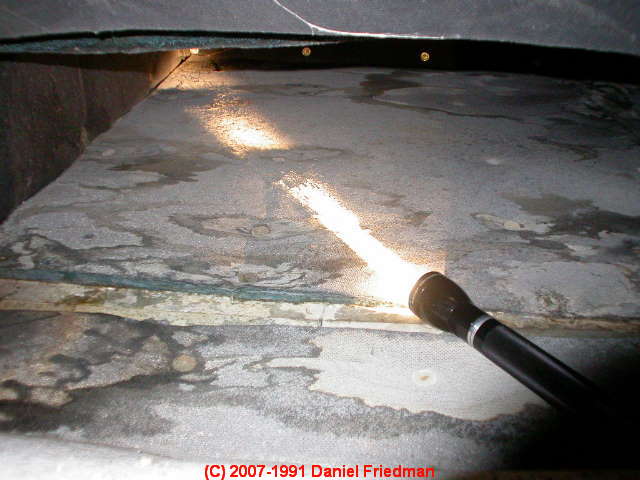
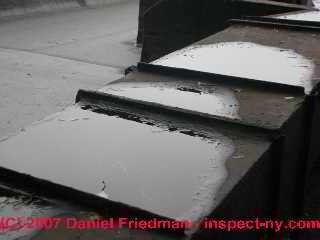
Our photos show water stains on duct interior insulation (above left) and ponding on a tar-coated rooftop commercial HVAC duct system (above right).
Central HVAC humidifiers may also leak into air handlers and ductwork
If you are using a central humidifier, typically turned on during dry winter months, be sure that it is not leaking onto your furnace heat exchanger - a source of costly damage and potentially a dangerous rust hole and heat exchanger leak of carbon monoxide into building air.
An improperly located or mal-adjusted central humidifier can blow excessive moisture into the HVAC duct system, a potential source of duct damage or mold growth in the air handling system.
See more warnings at CENTRAL HUMIDIFIERS in BUILDINGS
Central Air Conditioning Cooling Coil Condensate May also leak into air handlers and ductwork
It's common, especially in very humid areas, for condensate to blow off of the cooling coil and into the HVAC duct system.
See BLOWER LEAKS, RUST & MOLD for details.
As reader Joe Hartoebben pointed out, this problem may be more serious if the air handler's condensate drain pan and drain piping are not working properly as the combination of high humidity (typical for example in Florida) and inadequate condensate handling will invite the blower to send condensate water droplets blowing down the duct system.
Inadequate ceiling vapor barriers or ind adequate attic-run air conditioning ductwork
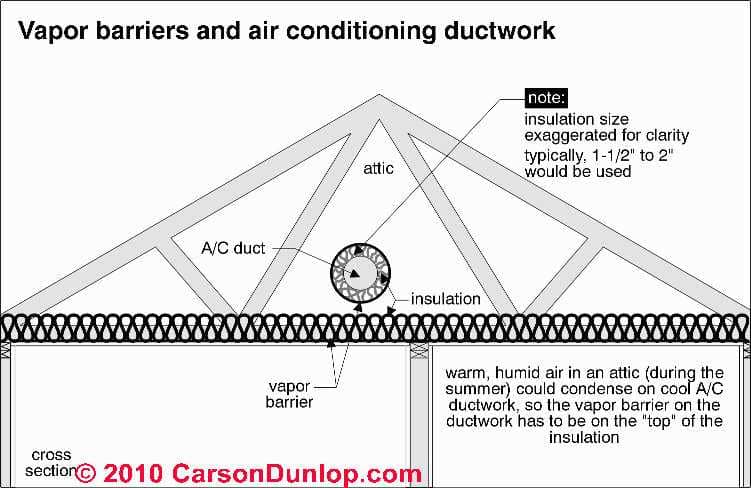
The sketch at left explains what happens if attic air conditioning ductwork is not properly insulated or if insulation has been damaged, torn, lost, or simply omitted on air conditioning duct sections.
The illustration also explains why the vapor barrier on air conditioning ducts is located on the exterior or "outside" of the duct.
Sketch at left courtesy of Carson Dunlop Associates, a Toronto home inspection, education & report writing tool company [ carsondunlop.com ].
Building Floods May Include HVAC Ducts
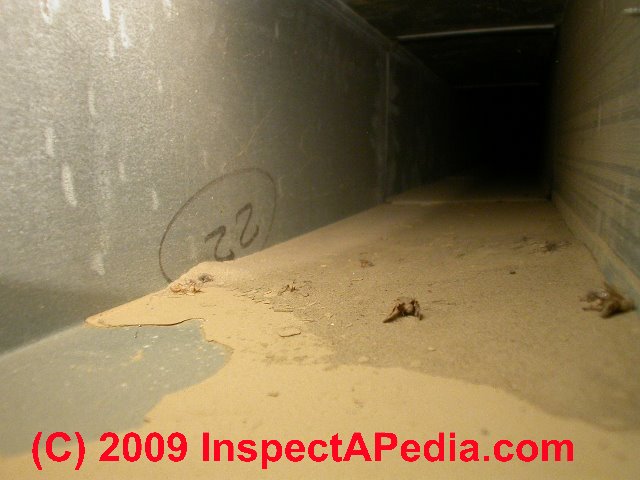
Building floods may wet HVAC duct interiors, especially ducts located on lower building floors or in basements and crawl spaces.
Our photo (left) shows mud in the metal duct work in a residential basement of a home that had been flooded.
Following flood exposure metal ductwork should be inspected, cleaned, and sanitized.
Flex-duct that has been wet for any reason should be replaced.
Other Causes of Ice Formation in Duct Work, What Happens, How to Stop and Prevent Air Conditioner System Ice Formation
In freezing climates such as New York where some homes route their top floor HVAC ducts along the attic floor, sometimes that ductwork is not well insulated and just as it gets too hot in summer (increasing the cost of air conditioning), in winter the same ducts become too cold, increasing heating costs. But something else funny can happen in homes with attic ducts that are used only for air conditioning.
One of our clients called us to investigate a claim that had resulted in litigation against the company who had installed a new roof on their home. The owner claimed that the roof was leaking. The roofer claimed that the roof was perfect. What was curious was that the roof "leaked" only at the end of winter, and at times when there had been no rain and when there was no melting snow on the rooftop.
What we observed was the following causes of ice in the air ducts:
- There were leak stains at most of the top floor air conditioning ceiling-mounted supply registers.
- There were leak stains at the top floor ceiling mounted return air register
- The home had hot water baseboard heating and used its ductwork only for air conditioning during the summer
- The home had a problem of chronic basement water entry and was in general pretty damp, even in winter
- Inspecting the home's attic and the duct work in the attic I was astonished to find that in the dead of winter the ducts had about 2" of solid ice in the bottom of the ductwork! Ice was thickest closest to the supply or return registers and was thinnest in the middle of the duct runs
- [Have you guessed yet?]
- Inspecting back out of the attic and at the supply registers on the second floor, all of them were open - which is pretty common - few people think to close off un-used air conditioning supply registers in winter.
The duct ice problem was occurring because warm moist air was circulating by convection during winter, rising up into both the supply and return registers, flowing through the duct work, and leaking out of an open air handler. As the warm moist air entered the attic, the ducts were absolutely freezing cold. Moisture first condensed, then formed ice inside the duct system.
Ice accumulated in the duct system throughout the winter a little at a time, until it was several inches thick.
When the weather warmed all that ice in the ducts melted and leaked back out into the upper floor in a stunning flood. The owners, who were not thinking particularly clearly about whether or not it was raining or whether or not there was melting snow on the roof, saw that it was "raining inside" out of their air conditioning ducts and through other ceiling locations (since the ducts were not water tight there was leakage out of the ducts at other areas besides just at the supply and return air registers.
The solution to this problem had two components:
- Close off all of the ceiling mounted supply and return air ducts (at the registers) at the end of the air conditioning season since they were not needed for heating. This stopped the flow by convection movement of warm house air into the un-used A/C duct system. (Warm air rises up into a cool space.)
- Identify the sources of high indoor moisture (such as basement water entry) and fix them so that the house is not abnormally damp. (Stop providing high levels of moisture un-wanted in house air.)
The roofing contractor was happy with this solution and the building owner was relieved as well. Perhaps because their roof had previously been leaking, before it was replaced, when they saw water coming through their top floor ceilings they thought that it was still leaking. Of course the ice in ducts problem won't occur in homes which use the same duct system for winter heating, nor will it occur in climates where freezing weather is uncommon, though we still might see some surprising in-duct condensation in some cases.
OK to Just Use the A/C or Heat to Dry Out Flooded HVAC Ducts?
Reader Question: Hurricane Sandy flooded fiberglass heating ducts in our crawl space - can't we just run the heat to dry them out?
 During hurricane Sandy the sump pump in my crawl space failed and my fiberglass heating ducts were partially submerged for two days before the water was pumped out. I replaced the sump pump and got an estimate of $7600 to replace the ducts. This may not be covered by insurance. Is it essential to replace the ducts or will the heating air dry them out sufficiently to avoid mold?
- I.E.
During hurricane Sandy the sump pump in my crawl space failed and my fiberglass heating ducts were partially submerged for two days before the water was pumped out. I replaced the sump pump and got an estimate of $7600 to replace the ducts. This may not be covered by insurance. Is it essential to replace the ducts or will the heating air dry them out sufficiently to avoid mold?
- I.E.
Reply: Running heat to dry out flooded ductwork is a risky proposition and may be unsafe, as we explain here
A competent onsite inspection by an expert usually finds additional clues that help accurately diagnose a problem with water entry, ductwork or an HVAC system. That said, here are some things to consider in deciding how to handle flooded ducts after Hurricane Sandy or similar events:
What are the Risks when Duct Systems are Flooded?
The risk of flooded ductwork, assuming that the air handler, furnace, and controls were not themselves flood-damaged as well, includes more than potential mold growth inside the HVAC system. Floodwaters usually contain sewage and sewage pathogens that can also be a source of serious infections or illnesses.
Even when materials wet by sewage-contaminated waters have dried, dust from the dried materials is likely to be unsanitary and to contain pathogens that can in turn cause illness.
When contaminated dust blows through the duct system it first contaminates the rest of the HVAC system - blower fans, air handler, plenum chambers, heat exchanger, filter systems, other ductwork, supply and return registers. And when such duct reaches room air and can be breathed by occupants it presents a health hazard.
Those same health and HVAC contamination hazards are repeated as a mold risk. Duct insulation that is actually mold contaminated may or may not be *visibly*contaminated, as you can read in our article about fiberglass insulation mold
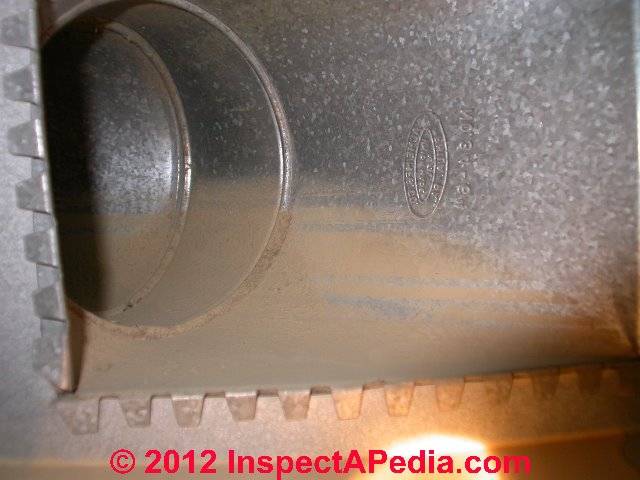
Metal ductwork that is accessible can often be cleaned (photo above left) but any external duct insulation that was wet or contaminated will need to be replaced. Other types of ductwork that cannot be reliably or safely cleaned after flooding are described below.
Other Problems Occur due to Ductwork Flooding, including
Incomplete duct cleaning and replacement: we saw this water-soaked fiberglass-lined HVAC duct at an office building where the owners had been assured that all previously wet ductwork had been replaced and that there were no leaks into the duct system.
Insulation that has become wet and soggy can sag, collapse, block the ductwork completely, or partially block ductwork increasing air conditioning or heating costs and reducing system effectiveness.
Loose fragments of duct insulation, if drawn into the blower assembly, can jam the blower fan, leading to a fire.
The problems with wet HVAC ducts due to flooding include more than water, sewage pathogens, and mold contamination risk. There is also the problem of mud and silt that enter flooded duct systems. I've found inches of fine muddy silt on the bottom of ductwork in flooded buildings I've inspected.
Dirt and debris blowing through the duct system clogs the blades of the squirrel cage fan type blower fan in the air handler, reducing air flow, causing air conditioning or heating system malfunctions as a result, and of course also reducing system effectiveness and increasing system operating cost. Details are at DIRTY A/C BLOWERS
That same dirt and debris in the duct system is likely to block the cooling coil if the system includes air conditioning, causing icing and malfunction described
at DIRTY COOLING COIL / EVAPORATOR COIL
Advice for Salvaging Flooded Ductwork - Avoid Running the HVAC System
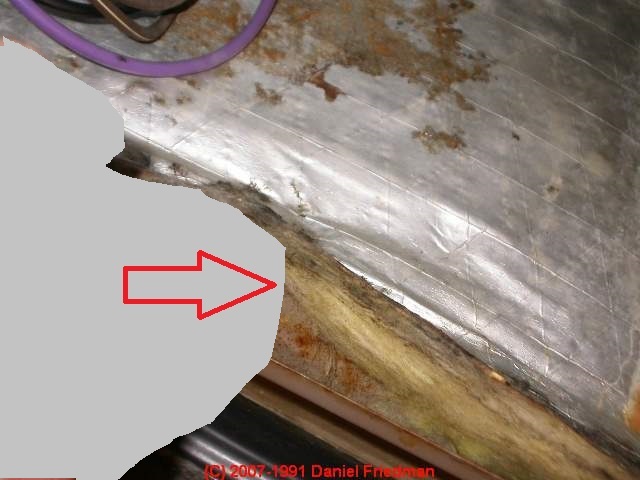 Just what actions are needed regarding your flooded air ducts depend on the following:
Did anyone run the heating or air conditioning system after it was flooded and before it was inspected and cleaned?
If so the entire system is a candidate for professional cleaning and sanitizing for the reasons we explained above. It's best not to run heating or air conditioning, even if it's operational, if that system has been flooded, or if the building has known mold contamination, until those problems have been addressed, as doing so contaminates the system and spreads airborne pathogens increasing the risk to building occupants.
As you can see in our photo (left) fiberglass insulation in this air handler is quite vulnerable to wetting and contamination by floodwaters.
We might make an exception to that advice if experts on site determine that the benefit from running the heating or air conditioning system to speed building dryout are worth the costs in damage to the system itself, and of course provided that appropriate cleaning or replacement steps are going to follow.
This situation might arise following widespread flooding or disaster when there are simply not enough free-standing air movement, fans, dehumidifiers and building dryout equipment to service all of the buildings in need.
What sections of ductwork were actually flooded - certainly all sections that were wet by floodwaters need to be addressed?
Important in Deciding how to Treat Flooded Ductwork is the Question: of what are the HVAC ducts constructed and where are they located?
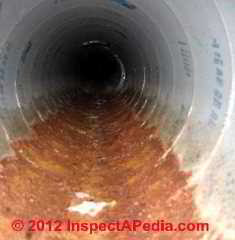
Metal hvac ducts that have external fiberglass insulation may be salvageable by removing flood-wet external insulation, professionally cleaning and sanitizing the ductwork, and installing new external insulation.
Incidentally, in our opinion ducts routed in or below building first floor slabs (photo at left) should be abandoned and replaced regardless of their construction materials.
Metal ductwork that used internal (usually fiberglass) insulation is probably not cost-feasible to salvage given the labor of removing and re-installing internal duct insulation liners.
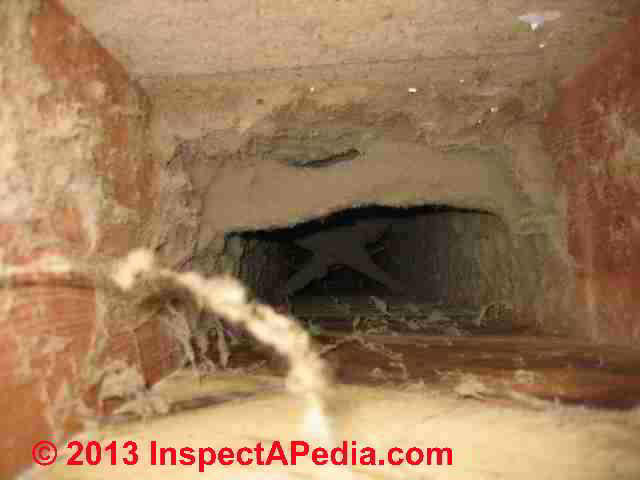
HVAC ducts made entirely of fiberglass and that have been flooded should be replaced.
Even though the exterior of of all-fiberglass air ducts is usually coated with aluminum foil and a binder coats on the interior surface, those materials are not designed to prevent absorption of floodwaters.
And those materials cannot be mechanically cleaned without causing further damage to the ducts (and release of fiberglass fragments into building air).

Flex duct that has been flooded should be replaced.
Impact of HVAC Duct Routing & Location on Cleaning & Restoration Costs
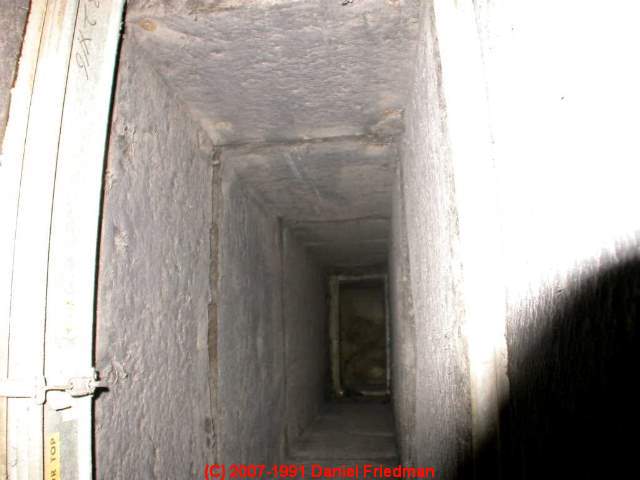 Vertical ductwork run through walls means extra costs to clean or replace.
Ductwork that runs through accessible areas is of course less costly to inspect, clean, or replace. HVAC ductwork running through closed building cavities such as ceilings or walls also needs to be addressed.
In a flooded building whose floors and walls were wet, demolition required to open and clean wall cavities will also expose wall or ceiling duct work for assessment and cleaning or replacement.
Vertical, fiberglass-lined ducts such as those shown in our photo (left) cannot be mechanically cleaned, and because they run through finished building wall cavities,
unfortunately the cost to remove and replace the material will be significant.
Ductwork that runs through inaccessible walls, floors, ceilings that were not flooded should nevertheless be considered in restoring the building to safe habitable operation.
IF the HVAC system was not run, thus not contaminating those duct systems, and if they were not wet by storm or flood waters, they are probably usable.
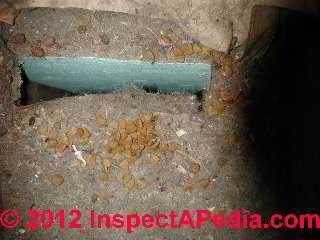
HVAC return air ducts run horizontally under floors or ceilings are particularly likely to have accumulated mud or floodwater debris (as you saw in our muddy flooded duct photo above).
In older buildings often return ducting was constructed using the space between floor joists, nailing sheet metal over the bottom edge of joists.
Often we find these return ducts loaded with decades of dust, debris, mouse droppings, even squirrell nests.
Soaking these materials is inviting production of more pathogens, viral or bacterial hazards.
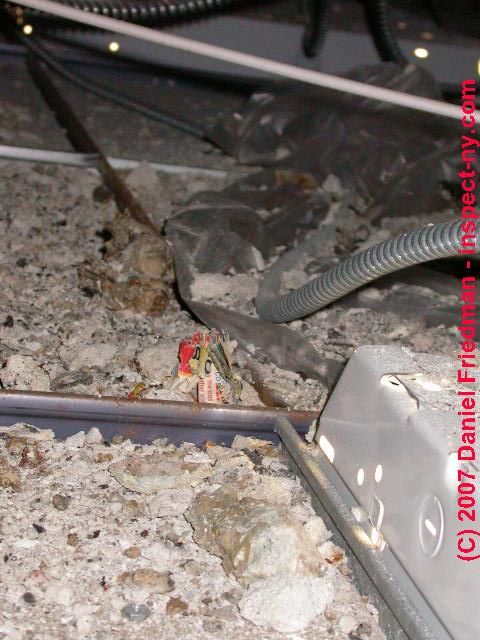
HVAC return air ducts run through areas above suspended or "drop" ceilings that have been contaminated by floodwaters should be addressed by removing the suspended ceilings and complete cleaning of return registers as part of post-flood building restoration.
As our photo illustrates, in some buildings, particularly older offices, there may have already been an accumulation of unsafe (lead paint chips, asbestos) fragments and debris along with other hazards in these areas.
Soaking these materials is inviting production of more pathogens, viral or bacterial hazards.
What about Just Spraying a Sanitizer or a Coating Inside the Flooded Ductwork?
What about just spraying a sanitizer or a coating that seals the internal surfaces of fiberglass ductwork? This approach is worth considering for ducts that were not actually flooded but are suspect of contamination and not easily cleaned or replaced.
However there are some warnings to keep in mind, including the difficulty of assuring that absolutely all surfaces are coated and sealed and difficulty of assuring that the sealed surfaces remain intact throughout the remaining life of the building.
We have inspected sealed ductwork in which it was quite obvious that the spray procedure did not find and cover all of the contaminated surfaces and we have found other sealed ductwork in which later "sealed" sections fell away.
Both of these defects exposed building occupants to air contaminated by mold or sewage pathogens or other pathogens that can occur in some duct systems (such as due to bird or rodent invasions).
More examples of damage caused by water and flooding to HVAC ducts are
at WET CORRODED DUCT WORK where you will see photos of more rusted or deteriorated ducts.
Reader Comments, Questions & Answers About The Article Above
Below you will find questions and answers previously posted on this page at its page bottom reader comment box.
Reader Q&A - also see RECOMMENDED ARTICLES & FAQs
Question: what product will fix the water leak in this exhaust vent
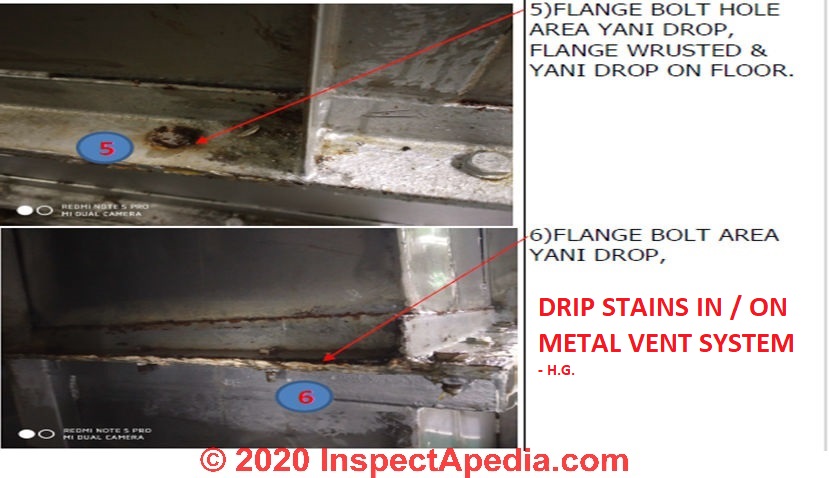 2020/06/30 by private email:
Please observe the below issue Water leakage in exhaust duct (MS metal flange),
Please suggest the Suitable solution for below issue in your product. - HG by private email, India
Moderator reply: find and fix the condensate or leak source of water in the exhaust vent
Sorry, but we cannot provide a product or service that will solve the water dripping in the exhaust vent in your photo.
In my opinion, no individual "product" would be the proper solution for this problem.
Instead, and having to speak generally as we have no information even about the kind of exhaust vent in your photo, my advice is to find the leak or mis-routing of condensate or missing insulating causing the condensate formation where it should not.
More details about these issues are
Please also see WET CORRODED DUCT WORK
We do not sell anything. No products, no services.
InspectAPedia.com provides building and environmental diagnostic and repair information.
In order to absolutely assure our readers that we write and report without bias we do not sell any products nor do we have any business or financial relationships that could create such conflicts of interest.
On 2019-03-29 by (mod) -
I would not bury ducts below grade, period.
On 2019-03-19 by JumbliahJones
We have a house built in the 20's that does not have conventional drain tile and sure foundation (mortared stone coated in concrete). Under-house flex and rigid duct was dug into the 10" clearance between ground and joists. Of course, flooding ruined it all.
I have dug out the crawl to 40" clearance, leaving three feet support around load-bearing walls. I have removed all duct, insulation, and plastic. I am now looking to replace the duct (I will also install sumps). Fearing more flooding, I have talked with an HVAC installer that has recommended BlueDuct--expensive, but leakproof.
I am willing to pay the price, but there are two questions I have: I see no information on BlueDuct being used without being buried; and the cost is so prohibitive that I can replace the conventional ductwork twice for the price of BlueDuct! Any ideas would be helpful.
On 2018-12-12 by (mod) - had water blow in through the attic during hurricane Florence
JOAnn You'll need an onsite inspection that makes an actual visual assessment of all of the materials involved - one that your insurance company will accept.
Generally soaked wall to wall carpet, drywall, insulation, are replaced, and possibly ductwork, depending on what material was used and whether or not it can be cleaned.
On 2018-12-12 by Jo Ann
We had water blow in through the attic during hurricane Florence which collapsed several areas of the ceiling. We have a hvac return in the attic. We're sure the return was wet during the 3 days the storm hung over the area.
Also with the collapsed ceilings we had water that soaked carpet and flooring and we are fearful the water drained in through the duct registers. How can we get this assessed so insurance will cover a new system if the air handler got wet as well as the ductwork
On 2018-01-14 by (mod) - return air is in the concrete foundation/slab - water leaks in
JB
Take a look at SLAB DUCTWORK https://inspectapedia.com/aircond/Ducts_in_Slabs.php
There are indeed duct lining sprays but not I nor any expert with whom I have discussed this concern has ever expressed confidence in such a band-aid approach.
We cannot know that the entire duct interior has been coated and sealed adequately, we cannot know that it adhered everywhere, and we cannot be confident that in the future some "sealer" section does not collapse or fall away from water, water pressure, soiling and contamination, or another failure that in turn leaves the occupants thinking the problem was solved when it was not.
On 2018-01-12 by JB
Situation: my house's return air is in the concrete foundation/slab.
Problem is that with heavy rain, the ground water leaks through/in this return air duct work. I don't have a USB inspection endoscope to locate the exact source, but my main question comes down to repair, what's the most cost-effective solution?
I want to avoid busting up the concrete to replace anything, but don't really want to fill the return air with concrete and put a new system in the attic for fear of $$.
Isn't there a spray that can reseal the return air?
On 2017-09-14 17 by (mod) - cannot dry out wet insulation in HVAC ducts thoroughly nor quickly enough to avoid mold
Great question, Anon.
The problem is that most-likely you cannot dry out wet insulation in HVAC ducts thoroughly nor quickly enough to avoid mold or other contamination such as bacterial growth if ductwork has been flooded.
You would need to remove all ice, water, condensate, humidity down to a safe level, say 15%, in about 24 hours or at the most 48 hours after duct insulation has been wet.
The concerns are
1. the system will not remove enough water and moisture quickly-enough
2. there is just no way to know, nor assume that even if some duct inside areas are "dry" there are not other elbows, corners, bends, connections that remain wet and become a mold hazard, worse, a clandestine one that troubles building occupants who think that the entire duct system is clean.
Similarly, sanitizing procedures generally won't address flooded ductwork problems.
On 2017-09-14 by Anonymous
befor replacing ducts why not siphon water out of duct then run a/c unit on.
On 2017-03-22 by (mod) - water in in floor heating ducts (we have a slab).
It sounds as if the home remediation may be incomplete as flooded -in-slab ducts are likely to be a mold or pathogen reservoir;
You don't have to dig up in slab ducts to abandon them. Search InspectApedia.com using the box just above, to find SLAB DUCTWORK to see a series of articles discussing the problem and various solutions. Yes none are cheap.
On 2017-03-22 by Ruthie
We had a flood in 2011 caused by sink valve leak.Got home and all house flooded a few inches with water in in floor heating ducts (we have a slab).
Insurance covered remediation of home but nothing ever replaced w air ducts or register boxes. Now I see rust spots opening to gravel below house. Heating co cant replace register boxes w/o a mason digging up floor for all registers. We can get a new upflow furnace and new ceiling vents but this will get expensive. Suggestions?
On 2016-07-21 by (mod) - replace any flex duct if its insulation got wet.
I would replace any flex duct if its insulation got wet.
On 2016-07-21 by Sheila
My washer hose became disconnected and water went down an air vent and into my flex duct. Cut the duck work the next day and drained water. Should I replace or what should I do?
Question: I Fixed Condensation Problems in my HVAC Ducts, but Now I Have Metal Chimney Condensation To Cure
First I must thank you for your article on condensation in conditioner ducts that are in the attic and not used for heating
- see details at WATER & ICE IN DUCT WORK
I had the same problem as in your article and had several AC techs and a P.E. look at the problem and not one of them could come up with answer.
Since I blocked the return and register grills the problem disappeared. Perhaps you could suggest an answer to another problem.
I have a gas boiler and a separate gas hot water heater in the basement. I have a metal chimney into which they are connected. The chimney goes up through the roof. The chimney extends about three feet below where the boiler flue and gas flue are connected. I am getting condensation dripping out of the bottom of the chimney pipe - there is not a large amount and it appears to be coming down the inside of the chimney and then leaking out. Any suggestions? Thank you for your help. F. D. - Mattituck NY
Check These Chimney Safety Worries First
A competent onsite inspection by an expert usually finds additional clues that help accurately diagnose a problem. That said, here are some things to consider:
- You will want to be sure to distinguish between a water or rain leak into the flue - a problem you'd fix by fixing a chimney cap or flashing - and a chimney leak due to condensation (occurs where there's no rain nor melting snow)
- If it's condensation there is either a chimney problem (too cold, wrong flue size) or an equipment operating problem (insufficient combustion air or draft or a similar problem) - details are
at CHIMNEY WET TIME & CORROSION
Watch out: I'm afraid that those conditions are likely to be unsafe and could include a carbon monoxide hazard - so be sure you've got working CO detectors.
Question: condensate pan leaks
(July 22, 2014) JOE said:
I have a dual heat pump setup, is it normal for the attic heat pump air condition over flow pan under unit to keep water in it.
Reply:
Joe if the overflow pan has water in it then there's a problem to find and fix.
Either the main condensate drain is not draining
or
water is entering the condensate overflow pan when it should be going into the main drain pan
or
there is a leak in the air handler drain pan
...
Continue reading at WET CORRODED DUCT WORK or select a topic from the closely-related articles below, or see the complete ARTICLE INDEX.
Or see these
Recommended Articles
- BLOWER LEAKS, RUST & MOLD
- FROST BUILD-UP on AIR CONDITIONER COILS
- FLOOD DAMAGE REPAIR PRIORITIES
- HEATING EQUIPMENT, FLOOD DAMAGE REPAIR
- WATER & ICE IN DUCT WORK
- WET CORRODED DUCT WORK
Suggested citation for this web page
WATER & ICE IN DUCT WORK at InspectApedia.com - online encyclopedia of building & environmental inspection, testing, diagnosis, repair, & problem prevention advice.
Or see this
INDEX to RELATED ARTICLES: ARTICLE INDEX to HVAC DUCT SYSTEMS
Or use the SEARCH BOX found below to Ask a Question or Search InspectApedia
Ask a Question or Search InspectApedia
Try the search box just below, or if you prefer, post a question or comment in the Comments box below and we will respond promptly.
Search the InspectApedia website
Note: appearance of your Comment below may be delayed: if your comment contains an image, photograph, web link, or text that looks to the software as if it might be a web link, your posting will appear after it has been approved by a moderator. Apologies for the delay.
Only one image can be added per comment but you can post as many comments, and therefore images, as you like.
You will not receive a notification when a response to your question has been posted.
Please bookmark this page to make it easy for you to check back for our response.
Our Comment Box is provided by Countable Web Productions countable.ca
Citations & References
In addition to any citations in the article above, a full list is available on request.
- In addition to citations & references found in this article, see the research citations given at the end of the related articles found at our suggested
CONTINUE READING or RECOMMENDED ARTICLES. - Thanks to Indoor Air Care Corp., for their photograph of flooded flex-duct. The Southhampton NY company can be reached at 866 580-MOLD
- Thanks to Joe Hartoebben, Hartoebben Integrated Services, for suggesting possible sources of condensation or moisture found on overhead ceiling registers in an air conditioning ductwork system.
- Modern Refrigeration and Air Conditioning, A. D. Althouse, C.H. Turnquist, A. Bracciano, Goodheart-Willcox Co., 1982
- Principles of Refrigeration, R. Warren Marsh, C. Thomas Olivo, Delmar Publishers, 1979
- Refrigeration and Air Conditioning Technology, 5th Ed., William C. Whitman, William M. Johnson, John Tomczyk, Cengage Learning, 2005, ISBN 1401837654, 9781401837655 1324 pages
- Our recommended books about building & mechanical systems design, inspection, problem diagnosis, and repair, and about indoor environment and IAQ testing, diagnosis, and cleanup are at the InspectAPedia Bookstore. Also see our Book Reviews - InspectAPedia.
- In addition to citations & references found in this article, see the research citations given at the end of the related articles found at our suggested
CONTINUE READING or RECOMMENDED ARTICLES.
- Carson, Dunlop & Associates Ltd., 120 Carlton Street Suite 407, Toronto ON M5A 4K2. Tel: (416) 964-9415 1-800-268-7070 Email: info@carsondunlop.com. Alan Carson is a past president of ASHI, the American Society of Home Inspectors.
Thanks to Alan Carson and Bob Dunlop, for permission for InspectAPedia to use text excerpts from The HOME REFERENCE BOOK - the Encyclopedia of Homes and to use illustrations from The ILLUSTRATED HOME .
Carson Dunlop Associates provides extensive home inspection education and report writing material. In gratitude we provide links to tsome Carson Dunlop Associates products and services.
 | HOME | ABOUT | ASK a QUESTION | CONTACT | CONTENT USE POLICY | DESCRIPTION | POLICIES | PRIVACY | |
| © 2024 - 1985 Publisher InspectApedia.com - Daniel Friedman | |||||||||