
InspectAPedia® FREE Encyclopedia of Building & Environmental Construction, Diagnosis, Maintenance & Repair |
Question? Just ask us! InspectAPedia
|
 Definition of Indoor Air Particle Sizes & Types
What airborne particle sizes are hazardous? Coronavirus droplet size & transmission
- POST a QUESTION or COMMENT about particles found in indoor air and dust - ranges of airborne particle sizes and their related health risks
Guide to airborne & dust particle sizes:
Here we give a definition of Problem Particle Sizes & Types in Indoor Air, the definition of micron, common indoor air particle sizes in microns, and how they behave indoors.
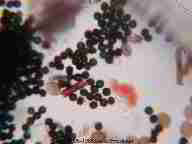
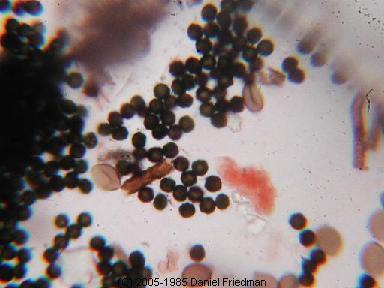
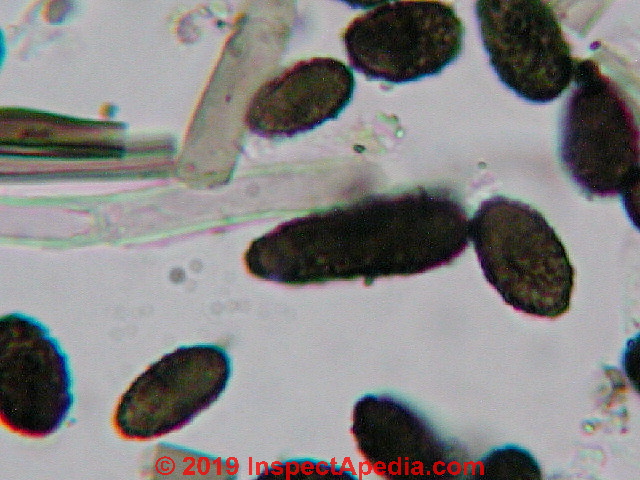
The page top photograph shows what is probably Aspergillus niger black mold spores, 2-4u in diameter, along with those lemon-shaped and nice looking Chaetomium sp. mold spores. More details and a close-up photograph of these particles are given just below.
InspectAPedia tolerates no conflicts of interest. We have no relationship with advertisers, products, or services discussed at this website.
What airborne particle sizes are an IAQ concern?
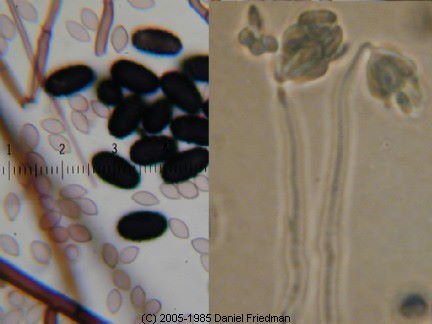
At left are large black ovate Stachybotrys chartarum mold spores and smaller Pen/Asp mold spores.
Aspergillus niger is often a toxic mold; Chaetomium sp. mold spores are likely to be at least allergenic.
[Click to enlarge any image]
Definitions of PM particle sizes and What Particle Sizes are Considered Air Pollutants or Hazardous
Particle sizes, when airborne particulates are considered as respiratory hazards or "pollution", are popularly discussed also using PM (Particulate Matter) particle sizes as follows:
PM-10 Particles
Definition of PM10: particles in the size range of 10 to 2.5 microns in diameter, or PM10 to PM2.5 inhalable particles.
Diameter is used to refer to the particle width, so a PM10 particle that is 10u wide might be of greater dimension in length.
These particles may be in liquid or solid form.
Examples of PM10 particles:
As an example or reference point: the width of a human hair ranges from as thin as 17u to as fat as 181 u. As another reference point, 10u is ten times the size of a common small UFFI particle that may be created when an existing section of UFFI insulation is disturbed during remodeling or demolition.
PM10 particles are also referred to in the literature as coarse particles.

Illustration: a comparison of the sizes of small particles, from PM 2.5 (2.5 microns) such as soot, to PM 10 (10 microns) such as dust and smaller pollen and mold spores to the thickness of a human hair (between 50 and 70 microns) and to a typical grain of fine beach sand that is about 90 microns across. - source: U.S. EPA.
PM-2.5 Particles
Definition of PM2.5: particles with diameters that are generally less than 2.5 micrometers in diameter are referred to as PM2.5 sometimes written as <PM2.5
PM2.5 particles are also referred to in the literature as fine particles.
Examples of PM2.5 particles
Smoke, outdoor haze, some mold spores such as some species of Aspergillus sp. or Penicillium sp. We also find talc particles in the PM2.5 range and we may find crushed or damaged fiberglass particles in the PM2.5 size range though normally fiberglass particles are considerably larger.
Source: U.S. EPA, "PARTICULATE MATTER (PM) POLLUTION, PARTICULATE MATTER (PM) BASICS, WHAT IS PM, AND HOW DOES IT GET INTO THE AIR?" [PDF], retrieved 2018/07/06, original source: https://www.epa.gov/pm-pollution/particulate-matter-pm-basics
Watch out: note that PM-2.5 refers to particles that are equal to OR LESS THAN 2.5 microns in size, meaning that that size category extends down to very small particles, even to individual viruses, though in air a typical virus such as coronavirus variants is not likely to survive unless it is protected by the constituents in a liquid droplet such as those expelled by a talking, singing, coughing or sneezing coronavirus-contagious human.
Recent work studying the airborne transmission of COVID - coronavirus notes that for purposes of studying transmission of viral infections like COVID in the Delta and Omicron variants, a "droplet" of liquid expelled from a human's lung may be as small as a quarter of one micron or 0.25u in diameter. - Zimmer, Carl, THE CORONAVIRUS IN A TINY DROP, [PDF] The New York Times, Dec. 2021 p. D8, reporting on research on how the Delta and Omicron variants of the coronavirus spread.
To understand the role of droplets in virus spread, a live animated version of this helpful article can be seen at https://www.nytimes.com/interactive/2021/12/01/science/coronavirus-aerosol-simulation.html?searchResultPosition=1
What mold, house dust, allergen fragment, mite fecal, cat dander, or other airborne particle sizes are a concern for indoor air quality?
In the photograph shown above on this page, the large black Stachybotrys chartarum mold spores can be seen against our eyepiece micrometer which, after calibration, shows that these particular spores were about 7u x 15u in size.
But take a closer look at that photo, shown again below:
The brownish tubular structures in our photograph are fungal hyphae. Another, smaller fungal spore is in the background.
While the EPA illustration just above gives dust, pollen, and mold as examples of particles in the PM10 range, in fact in the lab we find some of the most harmful mold spores in the Penicillium and Aspergillus families include species are much smaller, down to as little as just above 1micron in diameter, putting them in the PM 2.5 range where we also find harmful combustion products such as soot.
What's not addressed by some of the science in the air filtration and IAQ field is just what particle sizes are a worry.
In general, larger particles, say 30u or 50u or long fibers, say 200u, are so big that they tend to be filtered in the nose of a human breathing that air. (1u here means 1 micron in size).
Definition of "Small" Airborne Particles & Their Hazards
Small airborne particles, say in the range of 5u (5 microns) and below are so tiny that they tend to be breathed more deeply into the lungs and might be more of a pulmonary (lung) health or IAQ concern for some building occupants.
For purposes of discussing air pollution and health concerns around airborne particles, those particulates that are 2.5u and smaller are considered small and particularly dangerous.
Certainly some air filters which capture large particles may nonetheless pass the smaller ones right on into the "conditioned" air.
New York Times has reported an increased concern among scientists who study the potential dangers of very small airborne particles. But the concern is not entirely new.
"Fine atmospheric particles - smaller than one thirtieth of the diameter of a human hair - were identified more than 20 years ago as the most lethal of the widely dispersed air pollutants in the United States. Linked to both heart and lung disease they kill an estimated 50,000 Americans each year." [The article continued to focus on secondary aerosols that may be more dangerous than previously thought.] [2]
A 2012 study found that on days when concentrations of traffic pollutants were elevated, the risk of stroke among humans increased by 30%[4] and a separate study in 2006 reported a link between short-term exposure to air pollution and cardiovascular disease[5]. The traffic-related air pollutants identified in the first studies included black carbon (BC), carbon monoxide (CO), NO2, ozone (O3), PM [particulate matter] smaller than 2.5um in aerodynamic diameter, and sulfur dioxide (SO2).[6]
In summary, these results support the hypothesis that elevated levels of particulate air pollution, less than the current limits set by the Environmental Protection Agency, are associated with an increase in the rate of hospital admission for the exacerbation of [congestive heart failure] CHF.[5]
In 2012 the NY Times further reported on a study that reported:
"The smallest particles of pollution, those finer than 2.5 microns in diameter ... are particularly effective in infiltrating the body. There is some evidence that they can even penetrate the brain through nasal passages... linking pollution to cognitive decline" [3][7]]
Of interest, as we discuss in our review of HOW AIR FILTERS WORK, is the observation that very very small particles in the less-than-one-micron range are actually captured more easily by some air filter technologies than the 2.5u range small particles just named here or the larger 20-50u sized airborne particles named next.
Larger airborne particles
Perhaps in the 20-50u size, larger airborne particles, which affect a person by carrying allergenic proteins or fungal mycotoxins into the body, might be still a concern (in unfiltered or otherwise contaminated building air) even though they get stuck in the nose or upper respiratory tract.
Larger particles trapped in the nose, smaller ones enter the lungs
Some allergists, including my cousin Ed Friedman, have told us that they can tell by the nature of a patient's complaint what they're probably allergic to and what size and types of particles are in the patient's environment. When inhaled in a breath of air, these comparatively large fungal spores are more likely to be trapped in a person's nose.
If a patient has chronic rhinitus, for example, they may be responding to large mold spores like Alternaria sp. which may be as big as 15 x 50u.
If a patient has lower respiratory complaints (pulmonary or in the lungs) they might be responding to very small mold spores like some of those in the Aspergillus sp. or Penicillium sp. size range, which we often see in our lab can be down into the 1u range in size. The photograph shows some Alternaria sp. mold spores which are pretty big.
Typical Stachybotrys chartarum "toxic black mold" spores that have received lots of media attention and public worry are a rather large warty, sticky mold spore (intended to be spread by cows walking through moldy straw) which is oval and is usually about 10 x 20u in size.
Stachybotrys chartarum's still more irritating family member, Memnoniella echinata is a round black spore of about 10-12u in diameter.
Stachybotrys chartarum and Memnoniella echinata are not normally airborne mold spores, so if we find one or both of these in building air or in settled building dust or in the HVAC system, most likely a surface with that mold growing on it is or was nearby and it has been recently disturbed, say by demolition activity conducted without proper dust management.
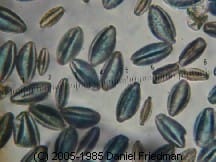
Pollen grains
Shown above are some stunning and still larger poppy pollen seeds collected outside of our forensic lab in Poughkeepsie, NY.
Pollen grains vary considerably in size but generally are bigger than many mold spores. Ragweed pollen might be about 20u in diameter.
Let's compare the size of a bumble bee to pollen grains.
Below, as a point of reference for scale, we see light colored pollen grains sprinkled over this bumble bee who was foraging among flowers of a home at Two Harbors, Minnesota.

A bumble bee is typically about 1.5 to 2.5 cm in length (0.6 to 1 inch). While pollen grains vary widely in size from the smalles (2.5u) to largest (over 200u), the yellow-white pollen grains scattered on this bumble bee and appearing as pale yellow-white dots in this photo are probably in the 20u size range.
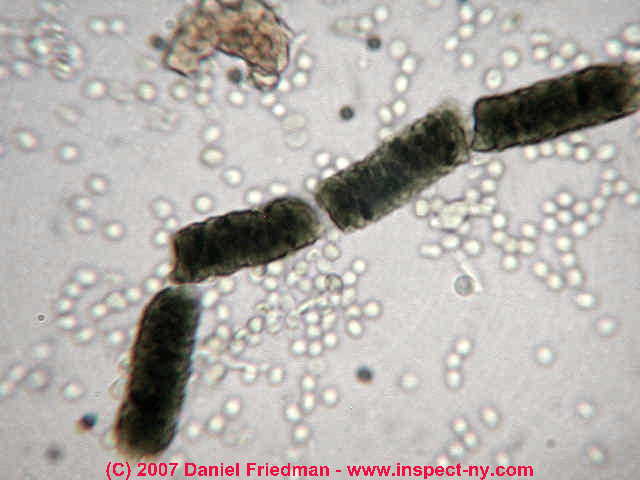
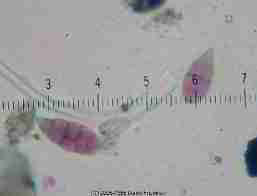
A guanine-containing dust mite fecal pellet and other insect fecals vary in size but some are pretty big, maybe 30 x 150u, much bigger than most mold spores, as are most pieces of dog or cat dander.
The photograph provided here shows both common dust mite fecal pellets and, in the same photo you can see much smaller and nice for comparison, some hyaline (colorless) Aspergillus sp. or perhaps Penicillium sp. mold spores which are in the one-micron size range.
Often when we examine an indoor dust sample in the microscope and when we look closely at mite or some other insect fecal pellets, we observe that the pellets are comprised of mold spores that the insect has been eating. U
sually those same mold spores are present in the dust sample.
But when the mold spores themselves are not seen in the sample, we know that mold was nearby, and our little insect assistants have provided us with the evidence of the presence of of indoor mold.
Eating at least some kinds of mold spores apparently does not bother them one bit.
Definition of a micron - how big is a micron?
How big is a one micron particle? How easily do such particles move throughout a building?:
Just as a few points of reference comparing particle sizes,
- Fiberglass insulation fibers, intact, and undamaged tend to be quite large in length, similar to human hair, though we find that fiberglass fiber diameters varying widely down to close to 1um in some cases. These long fibers constitute "large" particles and are not generally breathed deeply into the respiratory system.
However crushed, walked on, or mechanically damaged fiberglass insulation can produce much smaller particles down to a few microns in size (measured across the particle's longest dimension) or perhaps even smaller.
These ultra-small particles may be more dangerous, may be breathed more deeply into lungs, and may remain airborne at higher concentrations for much longer periods of time than their long large parents.
(See FIBERGLASS DETECTION in BUILDING AIR & DUST) - Thanks to reader AG for suggesting that clarification was needed. - A human hair might typically be about 50 to 80um in diameter
- A human red blood cell is about 8um.
- Aspergillus sp. and Penicillium sp. mold spores range from 1um to perhaps 8um typically
- Many Cladosporium sp. and Stachybotrys sp.mold spores may be 10um to 20um (and range in shape from spherical to oblate to longer particles)
- Most bacteria are smaller. E. coli is about 2um (viruses are much smaller).
("u" or "um" here means micron or 1/1,000,000 of a meter or a millionth of a meter or about 1/25,400ths of an inch if you prefer).
A one-micron Aspergillus sp. mold spore is so small that we find that they move in the air like a gas, right up from a moldy crawl space and through the building, and these particles tend to stay airborne much longer than their larger cousins. In absolutely still air (which never ever occurs inside a normal building), such a particle might remain airborne for more than 40 hours.
Walking outside (where there is plenty of air movement and plenty of mold spores), a person is breathing in a few of these spores with each breath.
Fungal spores may be amplified indoors if there are problems with the heating or air conditioning systems
Breathing in a lot of some kinds of mold spores or other particles can be a problem wherever one is, but indoor allergens, toxic spores, or other irritants may be more of a problem indoors where they are not diluted by outdoor air and where some people spend lots of time.
Indoors, these problem particles are being picked up by a heating or air conditioning system, blown through the duct work, amplified in quantity by ductwork or air handler conditions, and then delivered personally to people in the living space.
Still Smaller Particles that May be Found in Indoor Environments
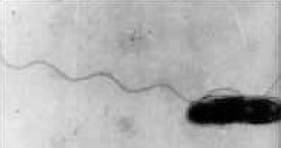
Bacteria - for an example see Legionella BACTERIA & HVAC EQUIPMENT - photo at left.
Nanomaterials - see NANOMATERIALS HAZARDS
Also see AIRBORNE PARTICLE ANALYSIS METHODS
And see our discussion of ultra-small particles
We provide a lot of information about finding, cleaning up, testing, and preventing problem mold in buildings:
see our MOLD INFORMATION website.
Exposure Limits for Small Airborne Particles Sizes PM10 & PM2.5
Current National Ambient Air Quality Standard exposure limits for the small ranges of airborne particles including Coarse Particles of size PM10 and Fine Particles of size smaller than PM2.5 are given here.
U.S. EPA PM Exposure Limits = small particle exposure limits
- Current U.S. annual airborne PM < 2.5 particle exposure limit : 12 μg/m3
based on the 3-year average of annual mean PM2.5 concentrations. (Since December 2012, effective 18 March 2013) - Current U.S. daily [24-hour] airborne PM < 2.5 particle exposure limit: 35 μg/m3
based on the 3-year average of the annual 98th percentile concentrations. (Since September 2006) - Current U.S. annual airborne PM10 concentration exposure limit: 50 μg/m3
based on an annual average (July 1997, Revoked in September 2006) - Current U.S. daily [24-hour] airborne PM10 concentration exposure limit: 150 μg/m3
based on a 24-hour average. (Since July 1997)
OSHA Respirable Dust Exposure Limits
Note: in the U.S., OSHA regulates certain particulates (eg. asbestos, silica, zinc oxide or metal dusts) and other dusts that may be considered toxic due to contaminants such as dust contaminated with PCBs, but does not give an exposure limit or PEL for many types of dusts. Instead OSHA gives an exposure limit for " soluble / non-toxic dusts as nuisance particulates" or for "particulates not otherwise classified".
These OSHA PELS or exposure limits are given as follows:
- Total particulate matter
- 5-mg/m3 limit for respirable particulates for all particulates not otherwise regulated (not in force CDC 2011)
- >10 mg/m3 (Grain dust)
- >15 mg/m3 (Nuisance dust) 8-hour TWA limit of 15 mg/m3, measured as total particulate (not in force CDC 2011)
- Respirable dust: 5 mg/m3
Airborne Particle Size Exposure Limits by Particle Size Range
- AIR QUALITY STUDY San Miguel de Allende
- ASBESTOS EXPOSURE LIMITS (PELS) TLVs RBCs & RELs [web page]
- Davenport, Coral, "E.P.A. Says It Will Review Rules on Soot", The New York Times, p. A21, 11 June 2021
- U.S. CDC, NIOSH, Particulates (N . OSHA comments from the January 19, 1989 Final Rule on Air Contaminants Project extracted from 54FR2332 et. seq. This rule was remanded by the U.S. Circuit Court of Appeals and the limits are not currently in force. Centers for Disease Control, retrieved 2018/07/20, original source: https://www.cdc.gov/niosh/pel88/dusts.html
- U.S. EPA PARTICULATE MATTER (PM) BASICS [PDF] U.S. Environmental Protection Agency, retrieved 2021/06/11 original source: https://www.epa.gov/pm-pollution/particulate-matter-pm-basics
- U.S. EPA, WHAT ARE THE AIR QUALITY STANDARDS FOR PM ? [PDF], U.S. Environmental Protection Agency, Region 1: New England, retrieved 2018/07/20, original source: https://www3.epa.gov/region1/airquality/pm-aq-standards.html
Excerpts:
In July 1997, after evaluating hundreds of health studies and conducting an extensive peer-review process, EPA established PM standards that specifically addressed particles smaller than 2.5 microns (PM2.5).... On December 14, 2012, EPA finalized an update to the National Ambient Air Quality Standard for PM2.5. The annual [airborne PM 2.5 particle exposure] standard was reduced from 15 μg/m3 to 12 μg/m3.
The daily [airborne PM 2.5 particle exposure] standard and standards for PM10 were retained. The revised 2012 PM standard became effective on March 18, 2013.
Primary standards set limits to protect public health, including the health of "sensitive" populations such as asthmatics, children, and the elderly.
Secondary standards set limits to protect public welfare, including protection against decreased visibility, damage to animals, crops, vegetation, and buildings. - New York State DOH, FINE PARTICLES PM 2.5 QUESTIONS & ANSWERS [PDF], New York State Department of Health, retrieved 2018/07/20, original source: https://www.health.ny.gov/environmental/indoors/air/pmq_a.htm
Excerpts:
Fine particulate matter (PM2.5) is an air pollutant that is a concern for people's health when levels in air are high. PM2.5 are tiny particles in the air that reduce visibility and cause the air to appear hazy when levels are elevated.
Outdoor PM2.5 levels are most likely to be elevated on days with little or no wind or air mixing. The New York State Departments of Health (DOH) and Environmental Conservation (DEC) alert the public by issuing a PM2.5 Health Advisory when PM2.5 concentrations in outdoor air are expected to be unhealthy for sensitive groups.
The term fine particles, or particulate matter 2.5 (PM2.5), refers to tiny particles or droplets in the air that are two and one half microns or less in width.
Like inches, meters and miles, a micron is a unit of measurement for distance. There are about 25,000 microns in an inch.
The widths of the larger particles in the PM2.5 size range would be about thirty times smaller than that of a human hair. The smaller particles are so small that several thousand of them could fit on the period at the end of this sentence. - Hong Kong EPD, Guidelines on the Estimation of PM2.5 for Air Quality Assessment in Hong Kong [PDF] Government of Hong Kong, Environmental Protection Department, Retrieved 2018/07/20, original source: https://www.epd.gov.hk/epd/english/environmentinhk/air/guide_ref/guide_aqa_model_g5.html
- Kloog, Itai, Bill Ridgway, Petros Koutrakis, Brent A. Coull, and Joel D. Schwartz. LONG-AND SHORT-TERM EXPOSURE TO PM2. 5 AND MORTALITY: USING NOVEL EXPOSURE MODELS [PDF] Epidemiology (Cambridge, Mass.) 24, no. 4 (2013): 555. Retrieved 2018/07/20, original source: https://www.ncbi.nlm.nih.gov/pmc/articles/PMC4372644/
Excerpt: For short-term exposure, we found that for every 10-μg/m3 increase in PM2.5 exposure there was a 2.8% increase in PM-related mortality (95% confidence interval [CI] = 2.0–3.5). For the long-term exposure at the grid cell level, we found an odds ratio (OR) for every 10-μg/m3 increase in long-term PM2.5 exposure of 1.6 (CI = 1.5–1.8) for particle-related diseases. Local PM2.5 had an OR of 1.4 (CI = 1.3– 1.5), which was independent of and additive to the grid cell effect. - Donham, Kelley J., Peter S. Thorne, George M Breuer, Wendy Powers, Shannon Marquez, Stephen Reynolds, "Chapter 8. Exposure Limits Related to Air Quality and Risk Assessment " [PDF[ University of Iowa Department of Public Health, retrieved 2018/07/20, original source https://www.public-health.uiowa.edu/ehsrc/CAFOstudy/CAFO_8.pdf
- OSHA, PERMISSIBLE EXPOSURE LIMITS [PDF], retrieved 2018/07/20, converted to PDF, original source: https://www.osha.gov/dte/grant_materials/fy11/sh-22224-11/7_Health_Env_Control.pptx
Cites: OSHA Subpart D - Occupational Health & Environmental Controls (1926.50 - 66) subsection 50(c) pertains to gases, vapors, fumes, dusts & mists - employee exposure.
Excerpt: Exposure of employees to inhalation, ingestion, skin absorption, or contact with any material or substance at a concentration above those specified in the "Threshold Limit Values of Airborne Contaminants for 1970" of the American Conference of Governmental Industrial Hygienists, shall be avoided. - Pai, Sidhant J., Therese S. Carter, Colette L. Heald, and Jesse H. Kroll. UPDATED WORLD HEALTH ORGANIZATION AIR QUALITY GUIDELINES HIGHLIGHT THE IMPORTANCE OF NON-ANTHROPOGENIC PM2.5 PDF] Environmental Science & Technology Letters 9, no. 6 (2022): 501-506.
- WHO AIR QUALITY GUIDELINES FOR PARTICULATE MATTER, OZONE, NITROGEN DIOXIDE AND SULFUR DIOXIDE (2005) [PDF], World Health Organization, retrieved 2018/07/02, original source: http://apps.who.int/iris/bitstream/handle/10665/69477/WHO_SDE_PHE_OEH_06.02_eng.pdf?sequence=1
Reader Comments, Questions & Answers About The Article Above
Below you will find questions and answers previously posted on this page at its page bottom reader comment box.
Reader Q&A - also see RECOMMENDED ARTICLES & FAQs
Question: Should I cover up mold in my basement - risk of contaminating HVAC system with mold?
I am currently looking into purchasing a home that has a leaking furnace and some mold in the basement because of a power outage causing a water pack up after a sump pump failure and subsequent backup. Most of the drywall with the mold was removed but there is still a little left (that I can see -- who know how much I can't).
My original plan was to gut the basement, treat any and every surface down with an anti fungal wash, and let it dry out with a dehumidifier for a few months. After that was completed, I would replace the furnace and have the ducts cleaned.
However, the FHA is requiring that I replace the missing drywall and furnace before they sign off in it.
I'm a bit unsure as to whether or not its a good idea to cover up the mold only to expose it after the FHA clears it and have it circulating thru the new furnace and clean ducts when I start tearing it down.
Is this safe? Will the air filter on the furnace stop the mold from being spread thru the house and ducts once replaced? Should I walk away from the deal? - Jay 11/16/11
Reply:
Jay. it sounds as if you need to
- complete the demolition
- complete the mold cleanup, including use of any encapsulant sprays applied after actual cleaning has been completed
- complete HVAC cleanup and furnace replacement
- do not RUN the HVAC system until after a successful post remediation inspection and test
- then replace the drywall
No mold remediation project should be "covering up the mold"
The reason I don't want to run the furnace before mold cleanup is complete and the success of the cleanup is confirmed by inspection and testing is that we otherwise risk contamination of the new furnace and cleaned ductwork.
...
Continue reading at INDOOR AIR QUALITY IMPROVEMENT GUIDE or select a topic from the closely-related articles below, or see the complete ARTICLE INDEX.
Or see these
Recommended Articles
- ACCURACY OF AIR TESTS for MOLD
- AIR POLLUTANTS, COMMON INDOOR
- AIR POLLUTANTS, HEALTH EFFECTS
- AIRBORNE MOLD SPORE COUNT GUIDE - home
- AIRBORNE PARTICLE LEVELS vs IAQ - home
- AIRBORNE PARTICLE ANALYSIS METHODS
- AIRBORNE PARTICLE COUNT VARIATION CAUSES
- AIRBORNE PARTICLE COUNT VARIATION EXTENT
- AIRBORNE PARTICLE COUNTS in DUCTWORK
- AIRBORNE PARTICLE COUNTS vs SAMPLER HEIGHT
- AIRBORNE PARTICLE COUNTS vs WINDOWS, DOORS
- AIRBORNE PARTICLE & MOLD LEVELS in DUCTWORK
- AIRBORNE PARTICLE & MOLD TEST ACCURACY
- AIRBORNE PARTICLE SAMPLING USES
- AIRBORNE PARTICLE SIZE DEFINITIONS & TYPES
- AIRBORNE PARTICLE SIZE TABLE
- AIRBORNE PARTICLES in INDOOR AIR, CHART
- DUST SAMPLING PROCEDURE
- FIBERGLASS HAZARDS - home
- INDOOR AIR QUALITY IMPROVEMENT GUIDE - home
- INDOOR AIR QUALITY METHODS COMPARED
- LAB PROCEDURES MICROSCOPE TECHNIQUES
- SOOT HAZARDS in BUILDINGS
- TEST KIT for DUST, MOLD, PARTICLES: INSTRUCTIONS
Suggested citation for this web page
AIRBORNE PARTICLE SIZE DEFINITIONS & TYPES at InspectApedia.com - online encyclopedia of building & environmental inspection, testing, diagnosis, repair, & problem prevention advice.
Or see this
INDEX to RELATED ARTICLES: ARTICLE INDEX to AIR CLEANERS FILTERS PURIFIERS
Or use the SEARCH BOX found below to Ask a Question or Search InspectApedia
Or see
INDEX to RELATED ARTICLES: ARTICLE INDEX to BUILDING INDOOR AIR QUALITY IAQ
Or use the SEARCH BOX found below to Ask a Question or Search InspectApedia
Or see
INDEX to RELATED ARTICLES: ARTICLE INDEX to MOLD CONTAMINATION & REMEDIATION
Or use the SEARCH BOX found below to Ask a Question or Search InspectApedia
Ask a Question or Search InspectApedia
Try the search box just below, or if you prefer, post a question or comment in the Comments box below and we will respond promptly.
Search the InspectApedia website
Note: appearance of your Comment below may be delayed: if your comment contains an image, photograph, web link, or text that looks to the software as if it might be a web link, your posting will appear after it has been approved by a moderator. Apologies for the delay.
Only one image can be added per comment but you can post as many comments, and therefore images, as you like.
You will not receive a notification when a response to your question has been posted.
Please bookmark this page to make it easy for you to check back for our response.
Our Comment Box is provided by Countable Web Productions countable.ca
Citations & References
In addition to any citations in the article above, a full list is available on request.
- [5] Particulate Air Pollution and Hospital Admissions for Congestive Heart Failure in Seven United States Cities", Wellenius, Gregory A., The American journal of cardiology, ISSN 0002-9149, 02/01/2006, Vol. 97 No. 3 p. 404
- [6] "Traffic-Related Air Pollution and QT Interval: Modification by Diabetes, Obesity, and Oxidative Stress Gene Polymorphisms in the Normative Aging Study", Emmanuel S. Baja, Joel D. Schwartz, Gregory A. Wellenius, Brent A. Coull,Antonella Zanobetti, Pantel S. Vokonas, Helen H. Suh, Environmental Health Perspectives, Vol. 118, No. 6 (JUNE 2010), pp. 840-846
In summary, this study documents the association between elevated short-term exposure to traffic-related pollution and prolonged QTc, a marker of ventricular arrhythmias commonly associated with heart attack, among older men. The study also showed that traffic-related pollutants is related to prolonged QTc, given the generally significant association findings for BC, NO2, and CO (Aim et al. 1999; Chan et al. 1991). Furthermore, older men with few genetic variants related to oxidative stress appear to be better protected from QTc prolongation with traffic exposure than older men with high genetic variants related to oxidative stress. Moreover, the study provides further evidence that traffic pollutants via the oxidative stress pathway may play a crucial role in cardiopulmonary toxicity. - [7] "
Exposure to Particulate Air Pollution and Cognitive Decline in Older Women", Jennifer Weuve, MPH, ScD; Robin C. Puett, MPH, PhD; Joel Schwartz, PhD; Jeff D. Yanosky, MS, ScD; Francine Laden, MS, ScD; Francine Grodstein, ScD, Archives of Internal Medicine, Vol. 172 No. 3 p. 216, 02/13/2012, citation: Arch Intern Med. 2012;172(3):219-227. doi:10.1001/archinternmed.2011.683 Quoting article abstract:
Chronic exposure to particulate air pollution may accelerate cognitive decline in older adults, although data on this association are limited. Our objective was to examine long-term exposure to particulate matter (PM) air pollution, both coarse ([PM 2.5-10 μm in diameter [PM(2.5-10)]) and fine (PM Less Than 2.5 μm in diameter [PM(2.5)]), in relation to cognitive decline. The study population comprised the Nurses' Health Study Cognitive Cohort, which included 19 409 US women aged 70 to 81 years. We used geographic information system-based spatiotemporal smoothing models to estimate recent (1 month) and long-term (7-14 years) exposures to PM(2.5-10), and PM(2.5) preceding baseline cognitive testing (1995-2001) of participants residing in the contiguous United States. We used generalized estimating equation regression to estimate differences in the rate of cognitive decline across levels of PM(2.5-10) and PM(2.5) exposures. The main outcome measure was cognition, via validated telephone assessments, administered 3 times at approximately 2-year intervals, includ-ing tests of general cognition, verbal memory, category fluency, working memory, and attention. Higher levels of long-term exposure to both PM(2.5-10) and PM(2.5) were associated with significantly faster cognitive decline. Two-year decline on a global score was 0.020 (95% CI, -0.032 to -0.008) standard units worse per 10 μg/m(3) increment in PM(2.5-10) exposure and 0.018 (95% CI, -0.035 to -0.002) units worse per 10 μg/m(3) increment in PM(2.5) exposure. These differences in cognitive trajectory were similar to those between women in our cohort who were approximately 2 years apart in age, indicating that the effect of a 10-μg/m(3) increment in long-term PM exposure is cognitively equivalent to aging by approximately 2 years. Long-term exposure to PM(2.5-10) and PM(2.5) at levels typically experienced by many individuals in the United States is associated with significantly worse cognitive decline in older women. - In addition to citations & references found in this article, see the research citations given at the end of the related articles found at our suggested
CONTINUE READING or RECOMMENDED ARTICLES. - "IgG Food Allergy Testing by ELISA/EIA, What do they really tell us?" Sheryl B. Miller, MT (ASCP), PhD, Clinical Laboratory Director, Bastyr University Natural Health Clinic - ELISA testing accuracy: Here is an example of Miller's critique of ELISA - betterhealthusa.com/public/282.cfm - Townsend Letter for Doctors and Patients
The critique included in that article raises compelling questions about IgG testing assays, which prompts our interest in actually screening for the presence of high levels of particles that could carry allergens - dog dander or cat dander in the case at hand.
- www.tldp.com/issue/174/IgG%20Food%20Allergy.html - contains similar criticism in another venue but interestingly by the same author, Sheryl Miller. Sheryl Miller, MT (ASCP), PhD, is an Immunologist and Associate Professor of Basic and Medical Sciences at Bastyr University in Bothell, Washington. She is also the Laboratory Director of the Bastyr Natural Health Clinic Laboratory. - Allergens: Testing for the level of exposure to animal allergens is discussed at animalhealthchannel.com/animalallergy/diagnosis.shtml (lab animal exposure study is interesting because it involves a higher exposure level in some cases
- In addition to citations & references found in this article, see the research citations given at the end of the related articles found at our suggested
CONTINUE READING or RECOMMENDED ARTICLES.
- Carson, Dunlop & Associates Ltd., 120 Carlton Street Suite 407, Toronto ON M5A 4K2. Tel: (416) 964-9415 1-800-268-7070 Email: info@carsondunlop.com. Alan Carson is a past president of ASHI, the American Society of Home Inspectors.
Thanks to Alan Carson and Bob Dunlop, for permission for InspectAPedia to use text excerpts from The HOME REFERENCE BOOK - the Encyclopedia of Homes and to use illustrations from The ILLUSTRATED HOME .
Carson Dunlop Associates provides extensive home inspection education and report writing material. In gratitude we provide links to tsome Carson Dunlop Associates products and services.
 | HOME | ABOUT | ASK a QUESTION | CONTACT | CONTENT USE POLICY | DESCRIPTION | POLICIES | PRIVACY | |
| © 2024 - 1985 Publisher InspectApedia.com - Daniel Friedman | |||||||||