
InspectAPedia® FREE Encyclopedia of Building & Environmental Construction, Diagnosis, Maintenance & Repair |
Question? Just ask us! InspectAPedia
|
 Return Air Duct Leaks
- POST a QUESTION or COMMENT about Air Conditioning or Heating System Air Duct Defects - return air problems
Air leaks or obstructions in return air ducts of an HVAC system:
This article describes the inspection of the defects in return air registers & ducts for heating or cooling systems (HVAC) such as missing air conditioning cool air supply or return air registers, undersized air conditioning duct openings, improper cooling duct routing, cooling (or heating) air duct corrosion, leaky air duct connections, defective heating or cooling ductwork materials.
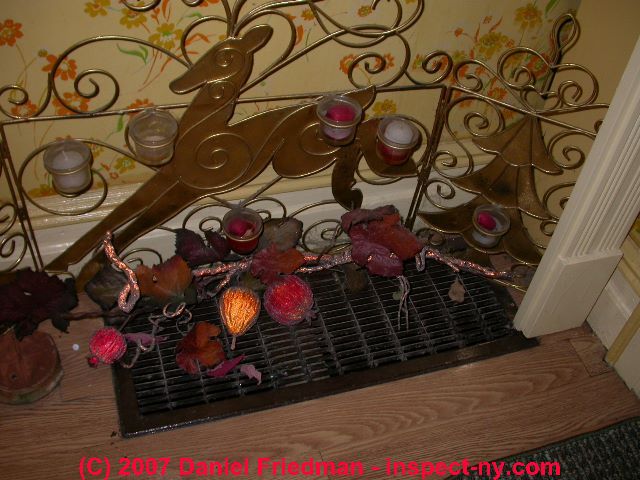
The photograph above shows a single central return air duct located outside of the apartment which the duct system intends to serve. This installation prevents recirculating of air through the air handler for heating or cooling and results in poor air flow and increased heating and cooling costs for the apartment owners.
The master document, of which this is a chapter, describes the inspection of residential air conditioning systems (A/C systems
InspectAPedia tolerates no conflicts of interest. We have no relationship with advertisers, products, or services discussed at this website.
Return Duct Air Leaks & What They Mean
 When the air conditioning or heating system is in operation, return ducts are under negative pressure
(since the blower in the air handler is drawing air in to the cooling or heating unit). at Soffit Cool Air Blast we describe a more egregious case of duct work that was missing entirely.
When the air conditioning or heating system is in operation, return ducts are under negative pressure
(since the blower in the air handler is drawing air in to the cooling or heating unit). at Soffit Cool Air Blast we describe a more egregious case of duct work that was missing entirely.
Take a look at the flooding crawl space and rusty leaky ducts on dirt in our field photo (left). This crawl area suffered from flooding, sewer backups, and mold. This is not a good place from which to draw air into the building.
Missing return ducts mean that:
- The system is drawing return air from spaces other than the conditioned space
- The air conditioning or heating system operating costs are increased
- There is the potential for drawing un-wanted dust, mold, pathogens, or even combustion gases or flue gases into the system and therefore moving these into the living space
HVAC Return Air Duct Leaks & Obstructions that Reduce Return Air Flow Rates
Technical note: The D'Arcy-Weisbach equation for pressure and head loss can be used to calculate the actual pressure loss due to friction in a building piping or air duct system.
The Engineering Toolbox provides the D'Arcy-Weisbach formula:
Δp = λ (l / dh) (ρ v2 / 2)
where
Δp = pressure loss (Pa, N/m2), and
l = length of duct or pipe (m) and
dh = hydraulic diameter (m) and finally,
ρ = density (kg/m3).
We discuss this formula and also provide supply a table of supply and return duct sizing
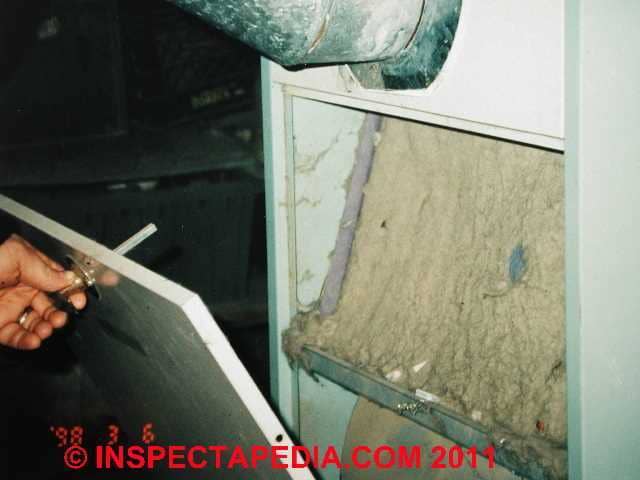
- Air filters that are debris clogged
or an air filter that has collapsed can cause a fire if drawn into the blower assembly fan,
DIRTY AIR FILTER PROBLEMS are perhaps the most common cause of unsatisfactory airflow in an HVAC system. - Blower Fan:
dirty blades on a squirrel cage blower assembly fan significantly reduce the blower fan's ability to move air into the HVAC system from the return-air side as well as reducing its ability to push conditioned air into the occupied space.
See details at DIRTY A/C BLOWERS - Flex duct defects:
In addition to punctures or loss of insulation that then lead to tears in the flex duct walls, collapsed sections of flex duct block or stop airflow in either supply or return air system
See this example: GOODMAN GRAY FLEXDUCT - Insulation loose in air ducts:
Collapsed duct interior insulation,
See examples of this problem
at FIBERGLASS DUCT, RIGID CONSTRUCTION - Leaks in the supply air duct system
are a very common HVAC duct defect that results in poor heating or cooling air flow.
See LEAKY DUCT CONNECTIONS - Return air inlets:
Return air inlet grilles that are obstructed with dirt, debris, or furniture or that are improperly located or are just too small mean that because the heating or cooling system is "starved for air", the supply air flow into occupied spaces will also be reduced.
See RETURN AIR REGISTERS & DUCTS for more information - Transite air ducts:
Crushed or collapsed transite duct
Read TRANSITE PIPE AIR DUCT ASBESTOS RISKS that may contain asbestos
and are often found buried in slabs, collapsed or allowing leakage or entry of duct system contaminants
See SLAB DUCTWORK - Zone dampers that are stuck
partly closed obstruct air supply into that building area, or if stuck "open" when the zone damper should be closed, airflow to other building areas will be reduced.
See ZONE DAMPER CONTROLS
...
Continue reading at LEAKY DUCT CONNECTIONS or select a topic from the closely-related articles below, or see the complete ARTICLE INDEX.
Or see these
Recommended Articles
- AIR FLOW TOO WEAK
- AIR LEAK NOISES
- AIR LEAKs in SUPPLY DUCTS
- AIR LEAKS in RETURN DUCTS
- AIR FLOW IMPROVEMENT, HVAC
- AIR FLOW MEASUREMENT CFM - how to measure HVAC system air flow
- DUCT SYSTEM DESIGN SIZE & DEFECTS - home
- ENERGY AUDIT STANDARDS for ENERGY RATINGS how HVAC system air leaks are measured & quantified
- RETURN AIR, INCREASE
- REGISTER & DUCT LOCATION
- RETURN AIR REGISTERS & DUCTS - home
- UNDERSIZED RETURN DUCTS
Suggested citation for this web page
AIR LEAKS in RETURN DUCTS at InspectApedia.com - online encyclopedia of building & environmental inspection, testing, diagnosis, repair, & problem prevention advice.
Or see this
INDEX to RELATED ARTICLES: ARTICLE INDEX to HVAC DUCT SYSTEMS
Or use the SEARCH BOX found below to Ask a Question or Search InspectApedia
Ask a Question or Search InspectApedia
Try the search box just below, or if you prefer, post a question or comment in the Comments box below and we will respond promptly.
Search the InspectApedia website
Note: appearance of your Comment below may be delayed: if your comment contains an image, photograph, web link, or text that looks to the software as if it might be a web link, your posting will appear after it has been approved by a moderator. Apologies for the delay.
Only one image can be added per comment but you can post as many comments, and therefore images, as you like.
You will not receive a notification when a response to your question has been posted.
Please bookmark this page to make it easy for you to check back for our response.
Our Comment Box is provided by Countable Web Productions countable.ca
Citations & References
In addition to any citations in the article above, a full list is available on request.
- Engineering toolbox properties of water - http://www.engineeringtoolbox.com/water-thermal-properties-d_162.html and email: editor.engineeringtoolbox@gmail.com web search 09/16/2010
- "Flexible Duct Media Fiberglas™ Insulation, Product Data Sheet", Owens Corning - see owenscorning.com/quietzone/pdfs/QZFlexible_DataSheet.pdf
"Owens Corning Flexible Duct Media Insulation is a lightweight, flexible, resilient thermal and acoustical insulation made of inorganic glass fibers bonded with a thermosetting resin." - Our recommended books about building & mechanical systems design, inspection, problem diagnosis, and repair, and about indoor environment and IAQ testing, diagnosis, and cleanup are at the InspectAPedia Bookstore. Also see our Book Reviews - InspectAPedia.
CONTINUE READING or RECOMMENDED ARTICLES.
- Carson, Dunlop & Associates Ltd., 120 Carlton Street Suite 407, Toronto ON M5A 4K2. Tel: (416) 964-9415 1-800-268-7070 Email: info@carsondunlop.com. Alan Carson is a past president of ASHI, the American Society of Home Inspectors.
Thanks to Alan Carson and Bob Dunlop, for permission for InspectAPedia to use text excerpts from The HOME REFERENCE BOOK - the Encyclopedia of Homes and to use illustrations from The ILLUSTRATED HOME .
Carson Dunlop Associates provides extensive home inspection education and report writing material. In gratitude we provide links to tsome Carson Dunlop Associates products and services.
 | HOME | ABOUT | ASK a QUESTION | CONTACT | CONTENT USE POLICY | DESCRIPTION | POLICIES | PRIVACY | |
| © 2024 - 1985 Publisher InspectApedia.com - Daniel Friedman | |||||||||