
InspectAPedia® FREE Encyclopedia of Building & Environmental Construction, Diagnosis, Maintenance & Repair |
Question? Just ask us! InspectAPedia
|
 Air Conditioning & Heat Pump System Components Guide
Describe the indoor & outdoor parts of an A/C or Heat Pump System
- POST a QUESTION or COMMENT about the components that are found on heat pumps and air conditioners
HVAC heating, ventilation, air conditioning & refrigeration system component identification guide:
This article lists and explains the function of the basic components of an air conditioning or heat pump systems and provides detailed inspection, diagnostic, and repair advice. We include photographs to assist readers inrecognizing cooling system defects.
InspectAPedia tolerates no conflicts of interest. We have no relationship with advertisers, products, or services discussed at this website.
Basic Air Conditioning & Heat Pump Components Inspection List, Photos, Sketches
 Example home inspection report language is provided to describe common air conditioning system components and their defects.
If your air conditioning or heat pump system has lost its cooling capacity or won't start
see REPAIR GUIDE for AIR CONDITIONERS.
See COOLING CAPACITY, RATED of air conditioning equipment if the system seems to be working but is inadequate to cool your building.
Contact us to suggest text changes and additions and, if you wish, to receive online listing and credit for that contribution.
At PARTS of an AIR CONDITIONING SYYSTEM & HOW A/C WORKS we explain the main parts of an air conditioning system and we described the sequence of steps that make an air conditioner work to cool indoor air.
Below we begin a more detailed A/C system inspection list of air conditioning system components. If your air conditioning system is not working properly, see REPAIR GUIDE for AIR CONDITIONERS
Conventional cooling systems include the following components:
The air conditioning system (and heat pump) components introduced here are discussed in detail and are illustrated by photographs and drawings throughout this website using the links at the left of these pages.
We explain how to inspect, diagnose, repair, or select, purchase, and install air conditioning systems or their individual parts and components.
List of Indoor Components of an Air Conditioning or Heat Pump System
 ...
...
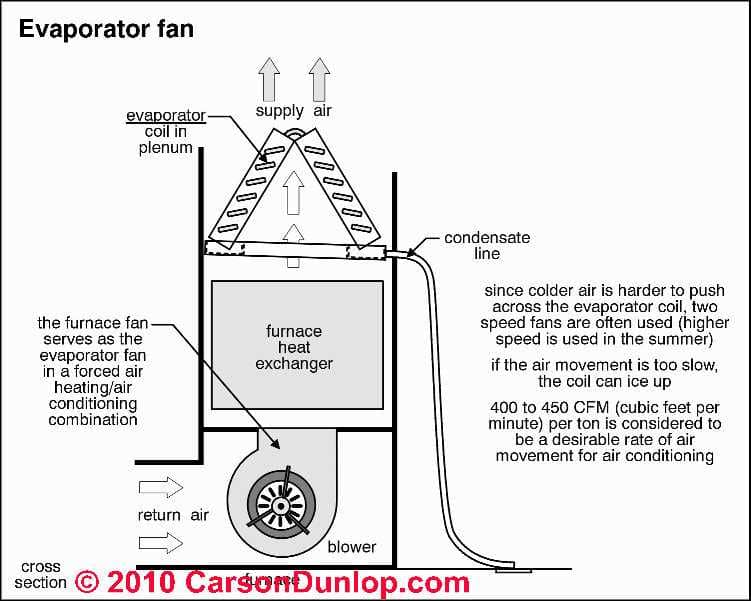
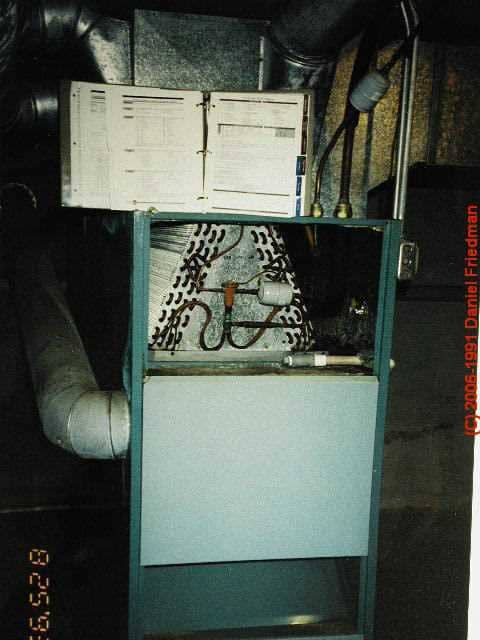
- AIR HANDLER / BLOWER UNITS (AHU) (shown at left above and in the Carson Dunlop Associates sketch below) which typically includes the following
- Condensate system: water, or condensate is produced when we cool warm moist air by blowing it over the evaporator coil. The condensate runs down the coil to a collecting pan which drains to piping used to route condensate to an approved drain for disposal
- Condensate pumpOn some air conditioning systems a small pump is used to collect and then pump condensate up to a building drain or other location for disposal. Condensate pumps are needed for systems which cannot dispose of the condensate by simple gravity flow down a drain line.
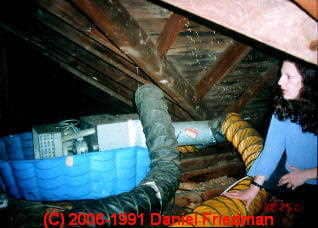
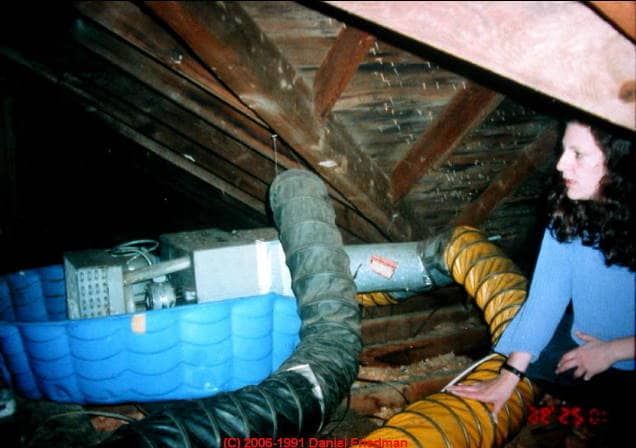
- Condensate overflow pan or tray is a container placed below the air handler when that unit is located in an attic or in other
building locations where condensate leakage or overflow would otherwise spill onto building floors or into a building ceiling.
The condensate overflow pan is a safety device intended to prevent unwanted spillage; normally it does not contain condensate. The condensate overflow pan should have either an independent drain to an approved location or a float switch to shut down the air conditioner should the pan become full. - Blower fan (evaporator fan) in a blower compartment circulates building air into itself from the return ducts and return plenum, and moves that air across the evaporator coil and onwards to the supply plenum and supply ducts in the building. Blowers may be single speed, multiple speed, or variable speed, and may need to move air at different rates if the blower is used for both heating and cooling in the same duct system. Some air blowers are also rated for continuous operation.
- Electrical controls for an air conditioning system include shut-off switch(es) for service at the unit and fuses or circuit breaker(s) at the electrical panel. The fuse or circuit breaker protects the air conditioner circuit from overheating due to an overcurrent or other electrical failure.
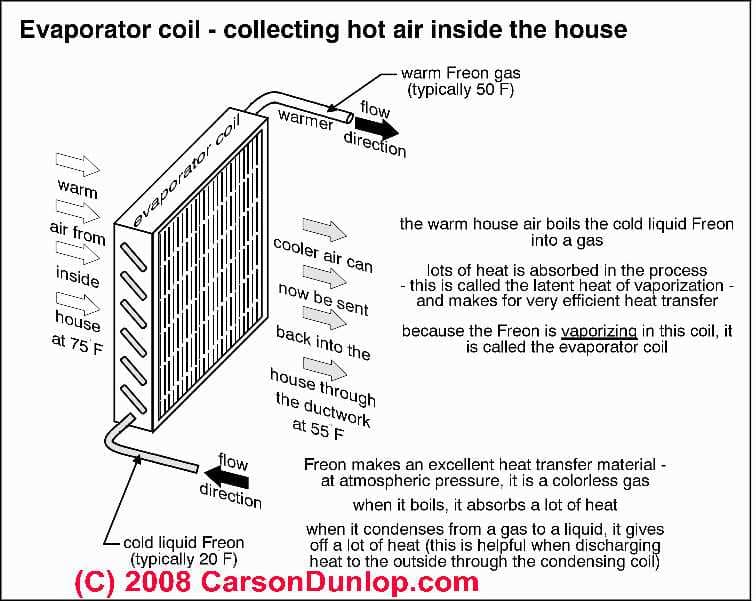
- EVAPORATOR COIL or COOLING COIL (also called the "cooling coil" is connected to high pressure and low pressure (suction) refrigerant lines.
High pressure refrigerant liquid, released into the cooling coil by the thermal expansion valve changes state from a liquid to a gas, causing a drop in temperature of the refrigerant and thus cooling the evaporator coil so that when we move air across the coil the air will, in turn, be cooled.
Sketch courtesy of Carson Dunlop Associates, a Toronto home inspection, education, & report writing tool company. - Return Plenum, connected to return duct system, is the air receiving compartment which provides air to the blower fan.
- Supply plenum connected to supply duct system, is the air collecting compartment to which building supply ducts are connected. Think of the return plenum and supply plenum as junction boxes to which return ducts or supply ducts respectively can be connected.
- Support system is the means by which an attic-mounted air handler is supported or held in place, for example by being suspended from the roof rafters (a quiet installation) or perhaps by being placed on supporting wood beams laid across ceiling joists.
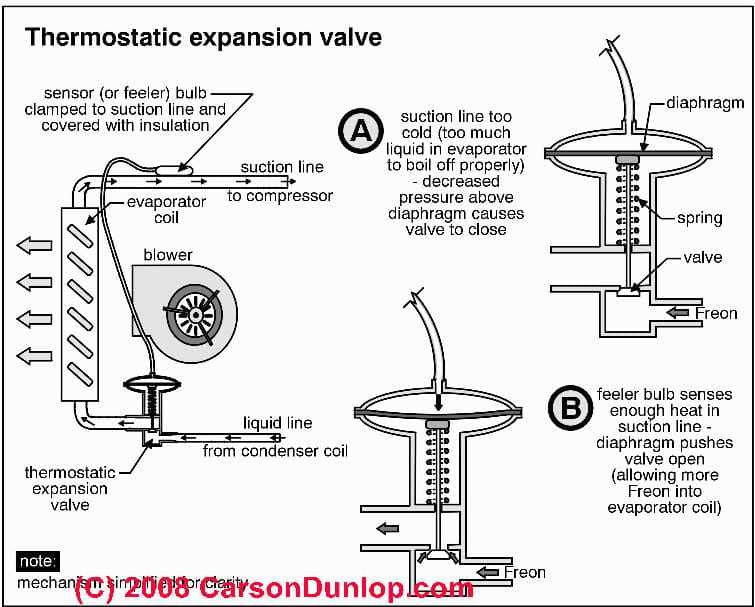
- Thermal expansion valve: an air conditioner thermal expansion valve is a device located at the cooling coil and connected between the incoming refrigerant line and the refrigerant
inlet to the cooling coil in the air handler.
The air conditioning system thermal expansion valve or "TEV" is a metering device which regulates the flow of refrigerant from the incoming high pressure side (from the compressor/condenser) into the low pressure side (in the cooling coil).
Sketch courtesy of Carson Dunlop Associates, a Toronto home inspection, education, & report writing tool company.
- Air Filters located at the return duct air inlets, at one or more central return air inlets, or at the air handler unit itself are used to remove dust and debris from building air.
- Access ports to duct interior Commercial ducts and some residential duct systems may have inspection/cleaning access ports; residential HVAC ducts may have plugs indicating that the ducts have been cleaned in the past.
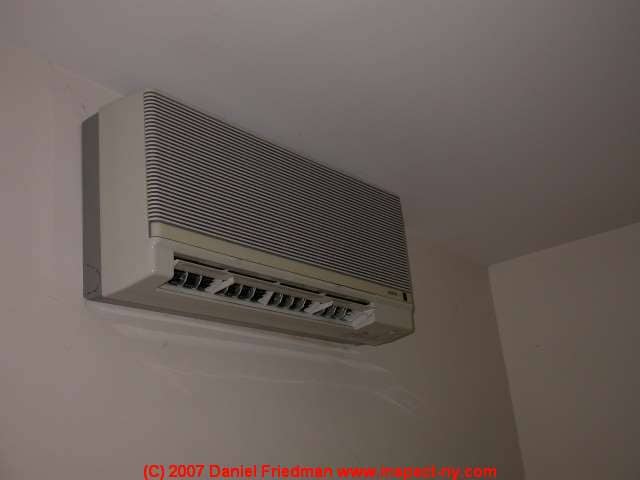
- Ductless air conditioning systems, which may also be called "split A/C systems" may employ one or more wall mounted cooling units such as shown at right above
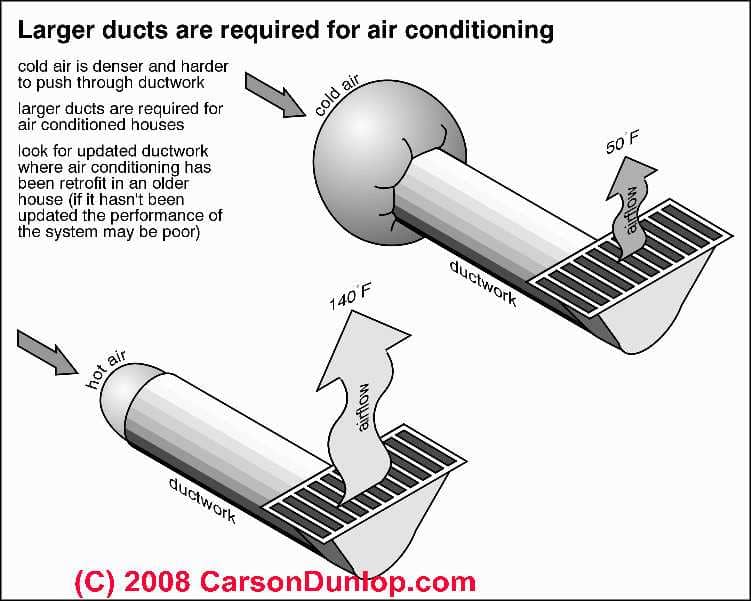
- Return air ducts and registers collect warm moist air from the occupied space and return it to the air handler unit. Some
air conditioning installations do not provide return air registers and ducts in every room and use one or more "central air return inlets"
instead.
Central air returns are most common on air conditioning retrofit installations (adding A/C to an existing building). Sketch courtesy of Carson Dunlop Associates [ carsondunlop.com ] [Click to enlarge any image] - Supply air ducts and supply air registers deliver cooled air to the occupied space.
Supply registers have the dual function of spreading out and directing the air flow into a location and permitting the regulation of air flow by opening or closing the register. Some air conditioning duct systems use small-diameter, "high velocity" ducts to deliver conditioned air to the living space. - Supply air balancing dampers, manual and motorized zone dampers may be installed inside the supply ducts at varying locations in to permit balancing the air flow among different duct sections and thus among different building areas.
- Thermostat(s) are used to turn the air conditioning on and off and to set the desired indoor temperature. One thermostat will be located in each different air conditioning zone and will control an individual air handler unit's operation.
These components are discussed in detail and are illustrated by photographs and drawings throughout this website using the links at the left of these pages.
List & Photos of Outdoor Air Conditioning & Heat Pump System Components
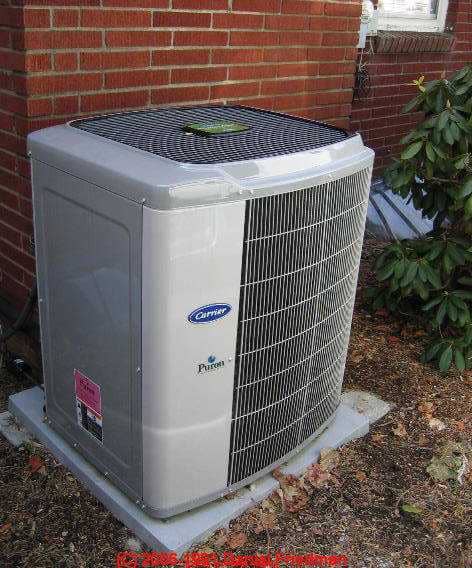
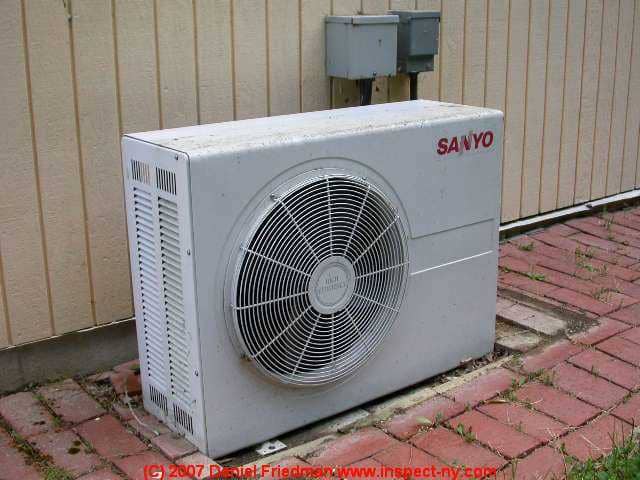
Above we show two typical compressor/condenser units outdoors. The main internal components of the compressor/condenser unit are listed below:

Compressor motor - on residential units this is normally a hermetically-sealed motor-compressor combined in a single unit like the Carrier(TM) unit shown at above left.
If a ductless split-system is installed an outside compressor/condenser unit is still required, typically containing the
very same functions but perhaps more compact, looking like the Sanyo(TM)
unit shown at above right. Sketch courtesy of Carson Dunlop Associates, a Toronto home inspection, education & report writing tool company [ carsondunlop.com ].
An air conditioning compressor is a specialized pump which draws refrigerant gas back to the compressor/condenser unit
from the in-building air handler and evaporator coil.
The compressor compresses the returning low-pressure refrigerant gas to a high pressure
(and high temperature) form.
In a "split" air conditioning
system, multiple indoor evaporator coils and blower units may be served by a single outdoor compressor unit such as the Sanyo unit shown
at the top of this page.
That unit was handling the compressor/condenser function for two wall-mounted, ductless indoor cooling units, one of which is
shown in the second photo at "List of Indoor Components" above. Split systems like this do not make use of ductwork.
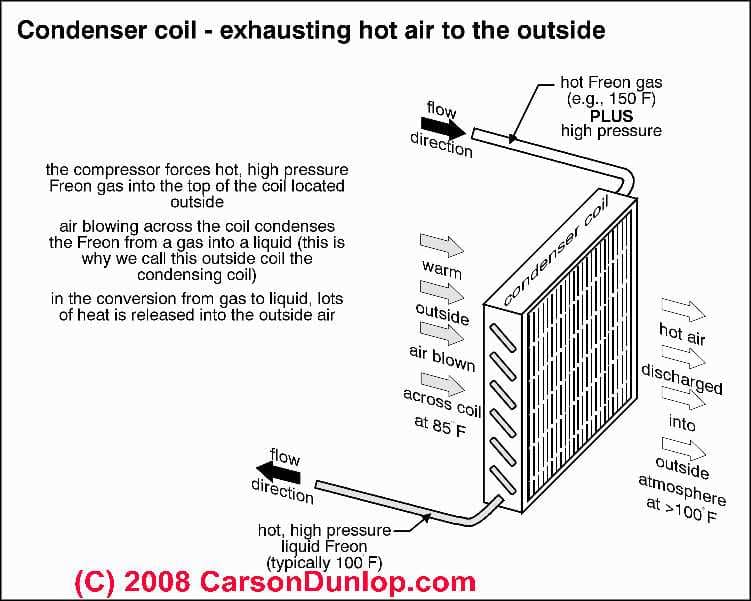 Sketch of the condenser coil courtesy of Carson Dunlop Associates, a Toronto home inspection, education & report writing tool company [ carsondunlop.com ].
Condensing coil receives high pressure refrigerant gas from the compressor and cools this refrigerant gas back to a liquid state.
Electrical controls: shut-off switch(es) for service at the unit are provided to permit maintenance and repair of the equipment. Circuit breaker(s) at the electrical panel protect the circuit supplying power to the air conditioning system.
Fan an outdoor cooling fan in the compressor/condenser unit moves outdoor air across the condensing coil to cool it and assist in condensing the high pressure, high temperature refrigerant gas back into a liquid.
It is this process which completes the transfer of heat through the refrigerant from indoor air to outdoor air as the compressor/condenser unit compresses and then cools the refrigerant back to a liquid.
Refrigerant lines: these pipes, typically made of copper, include a low-pressure "suction line" which returns low pressure refrigerant gas from the indoor evaporator coil (cooling coil) outlet to the outdoor compressor motor inlet.
 The high pressure refrigerant line connects the compressor outlet to the outdoor condensing coil inlet (gas) and further connects the condensing coil
outlet to the indoor thermal expansion valve which meters high pressure refrigerant into the "low-side" evaporator coil (cooling coil)
in the air handler unit in the building.
The high pressure refrigerant line connects the compressor outlet to the outdoor condensing coil inlet (gas) and further connects the condensing coil
outlet to the indoor thermal expansion valve which meters high pressure refrigerant into the "low-side" evaporator coil (cooling coil)
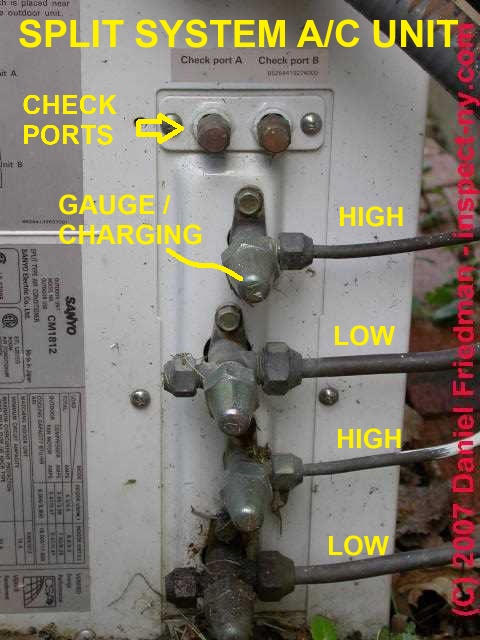
in the air handler unit in the building.Service valves or ports are usually present on the refrigeration lines near the compressor. These valves permit testing the condition of the air conditioning system and permit removal, replacement, or additions to the refrigerant in the system.
This photograph of a split system compressor/condenser outdoor unit shows four refrigerant lines and their sets of service ports. The larger diameter copper pipes are the low pressure or suction lines and the smaller diameter pipes are the high pressure lines returning refrigerant to the indoor cooling units.
The screw caps visible at the piping connectors where they enter the unit can be removed to provide access to special connecting valves to which the service technician can connect her set of gauges to measure system operating pressures on these lines.
Do not mess with these refrigerant service ports unless you're a trained A/C service technician. You may lose refrigerant or contaminate the system, leading to improper system operation or a costly service call.
These components are discussed in detail and are illustrated by photographs and drawings throughout this website using the links at the left of these pages.
Reader Comments, Questions & Answers About The Article Above
Below you will find questions and answers previously posted on this page at its page bottom reader comment box.
Reader Q&A - also see RECOMMENDED ARTICLES & FAQs
On 2020-10-20 - by (mod) -
Pete
I can't be confident of offering an answer to this problem as I don't have the full picture, but in general, a modest deflection of exhaust from the condenser unit may be ok provided you're confident that you are not so obstructing the air flow as to prevent the unit from operating properly. Start by looking at the specific clearance distances given by the manufacturer of your Trane unit - in the IO manual for your unit.
Also see CLEARANCE DISTANCE, HVAC https://inspectapedia.com/aircond/HVAC_Clearance_Distances.php
On 2020-10-20 by pete
I have a Trane heat pump similar to model XV20i. The unit is located about 4 feet from stairs leading into my home. When it snows, air from the unit blows snow onto my steps. Is there something I can use not to block the air flow but to direct it downwards? I just need it on the one side facing the steps.
On 2017-07-23 by Collins
I was confused about a 3 phase condensing unit that has no neutral links and also the connection box has no contactors or run/start capacitors just terminals. I want to understand how to connect the wires for compressor to start
On 2016-06-20 - by (mod) - contact Teco in Australia
Sure Grover, directly from the manufacturer, Teco, who produces various HVAC equipment in Australia.
Teco's window AC units are described at http://www.teco.com.au/room-air-conditioners
In Sydney contact
TECO Australia Pty Limited
335-337 Woodpark Road,
Smithfield NSW 2164
Tel: 61 2 9765 8118
Fax: 61 2 9765 8185
Email: sales@teco.com.au
The company has offices in other major Australian cites as well.
For spare parts contact Teco at http://www.teco.com.au/service-enquiry - or call them at 1300 660 037 for parts and wiring diagrams, Australia-wide
On 2016-06-20 by grover
can I get a wiring diagram of 18000 btu 220v teco mod# LA1875BFS window unit.capacitors taken off,5 wires loose
On 2015-07-31 by jkosephine
what courses and air conditioner compressor to bust open like a bomb
On 2015-06-27 by Darren
Dan, I had someone out and he said that it would need to be brazed as you indicated. Wow..one mistake and now my expenses just went up and money is tight. I am trying to locate the parts so I can buy them myself and then have the repair. Its frustrating because i cant locate the exact part for my furnace.
I tired but with little luck. i am not the expert as you can tell but was hoping there would be a better solution. At $95 an hour I worry about a huge bill. Thanks for your help though and suggestion.
On 2015-06-27 - by (mod) -
Darren
You can buy HVAC fittings and parts from your local HVAC supplier but for the case you describe I'm doubtful that you can do this correctly without hiring a service technician.
We do not *solder* air conditioning refrigerant lines, we use a higher temperature and stronger silver solder or brazing process. Furthermore making such a repair will cause formation of contaminants inside the tubing so that a cleaning procedure and installation of a filter/drier on the refrigerant piping will be needed as well as the proper refrigerant charge.
On 2015-06-27 by Darren
I a so happy I can read this stuff and now know what I need. I have a GE Ambassador Mark 2 Furnace. While putting in a new hot water heater the check valve caught my Cooling coil and it snapped off from the furnace.
All the Freon leaked out. I attempted to solder this back together which I did but there is a leak.
The coil is 1/4 inch and I still have the original brass fitting but it looks like the tube snapped inside the male part still attache to the furnace
. I need that part so I can fix it. A new coil would be expensive and a new furnace even more. I need help ;locating a new fitting for the cooling coil....Can someone help me please?
Thank you kindly,
Darren
dst.ledger@hotmail.com
On 2015-06-17 - by (mod) -
We're talking opinion and lacking grammar and syntax, Howard.
An AC unit won't work without refrigerant, but refrigerant is a gas, not a physical mechanical or electrical component. It's not a "supply" in that refrigerant is not consumed - it recycles through the system.
In sum to make a useful answer one would have to agree on a definition of component. For example, an automobile engine will not work (at least not more than about a minute) without lubricating oil. Is the oil a component?
Merriam Webster gives this too-brief definition of "Component"
Full Definition of COMPONENT
1 constituent part : ingredient
On 2015-06-16 by Howard
Is the refrigerant itself considered a component or part of the a/c system?
On 2015-06-05 by saad khan
how is mechanisam of split ac system
...
Continue reading at A/C INSPECTION CHECKLIST - OUTDOOR UNIT or select a topic from the closely-related articles below, or see the complete ARTICLE INDEX.
Or see these AIR CONDITIONER / HEAT PUMP COMPONENT FAQs - questions & answers posted originally at this article.
Or see these
Recommended Articles
Suggested citation for this web page
AIR CONDITIONER COMPONENT PARTS at InspectApedia.com - online encyclopedia of building & environmental inspection, testing, diagnosis, repair, & problem prevention advice.
Or see this
INDEX to RELATED ARTICLES: ARTICLE INDEX to AIR CONDITIONING & HEAT PUMPS
Or use the SEARCH BOX found below to Ask a Question or Search InspectApedia
Ask a Question or Search InspectApedia
Try the search box just below, or if you prefer, post a question or comment in the Comments box below and we will respond promptly.
Search the InspectApedia website
Note: appearance of your Comment below may be delayed: if your comment contains an image, photograph, web link, or text that looks to the software as if it might be a web link, your posting will appear after it has been approved by a moderator. Apologies for the delay.
Only one image can be added per comment but you can post as many comments, and therefore images, as you like.
You will not receive a notification when a response to your question has been posted.
Please bookmark this page to make it easy for you to check back for our response.
Our Comment Box is provided by Countable Web Productions countable.ca
Citations & References
In addition to any citations in the article above, a full list is available on request.
- In addition to citations & references found in this article, see the research citations given at the end of the related articles found at our suggested
CONTINUE READING or RECOMMENDED ARTICLES. - Thanks to Scott at SJM Inspect for suggesting this EPA document and for technical editing remarks regarding our air conditioning website, SJM Inspection Service LLC, serves the entire state of CT, sjminspect.com 203-543-0447 or 203-877-4774 5/16/07
- Our recommended books about building & mechanical systems design, inspection, problem diagnosis, and repair, and about indoor environment and IAQ testing, diagnosis, and cleanup are at the InspectAPedia Bookstore. Also see our Book Reviews - InspectAPedia.
- Complete List of Air Conditioning & Heat Pump Design, Inspection, Repair Books at the InspectAPedia Bookstore.
- Modern Refrigeration and Air Conditioning, A. D. Althouse, C.H. Turnquist, A. Bracciano, Goodheart-Willcox Co., 1982
- Principles of Refrigeration, R. Warren Marsh, C. Thomas Olivo, Delmar Publishers, 1979
- In addition to citations & references found in this article, see the research citations given at the end of the related articles found at our suggested
CONTINUE READING or RECOMMENDED ARTICLES.
- Carson, Dunlop & Associates Ltd., 120 Carlton Street Suite 407, Toronto ON M5A 4K2. Tel: (416) 964-9415 1-800-268-7070 Email: info@carsondunlop.com. Alan Carson is a past president of ASHI, the American Society of Home Inspectors.
Thanks to Alan Carson and Bob Dunlop, for permission for InspectAPedia to use text excerpts from The HOME REFERENCE BOOK - the Encyclopedia of Homes and to use illustrations from The ILLUSTRATED HOME .
Carson Dunlop Associates provides extensive home inspection education and report writing material. In gratitude we provide links to tsome Carson Dunlop Associates products and services.
 | HOME | ABOUT | ASK a QUESTION | CONTACT | CONTENT USE POLICY | DESCRIPTION | POLICIES | PRIVACY | |
| © 2024 - 1985 Publisher InspectApedia.com - Daniel Friedman | |||||||||