
InspectAPedia® FREE Encyclopedia of Building & Environmental Construction, Diagnosis, Maintenance & Repair |
Question? Just ask us! InspectAPedia
|
 SEER Defined, Explained, Calculated
Air Conditioning SEER Energy Efficiency Ratings Explained - HVAC Dictionary
- POST a QUESTION or COMMENT about the Energy Star Program's SEER and EER definitions and other HVAC equipment energy efficiency ratings
Air Conditioner & Heat Pump Efficiency Ratings:
This article explains air conditioning SEER energy efficiency ratings for air conditioners and heat pumps along with related terms like BTUs, Watts and hourly operating cost, in easy to understand language.
InspectAPedia tolerates no conflicts of interest. We have no relationship with advertisers, products, or services discussed at this website.
SEER Ratings Explained: Determine Seasonal Energy Efficiency of Air Conditioning Systems
 What are air conditioning SEER energy efficiency ratings?
How do we compare differences in seasonal energy efficiency or operating costs of different brands or models of air conditioners? What is a BTU or British Thermal Unit? How do we convert Watts to Joules?
Here is an Air Conditioning & Heating System Dictionary giving definitions of BTU, Joule, latent heat, latent heat of vaporization, latent heat of condensation, latent heat of solidification, SEER, sensible heat, specific heat,Definitions of Watts, watt hour, volts, amps, power factor.
Definition of latent heat of vaporization.Definitions of AFUE, BTU, BTUH, EER, SEER, HSPF and other energy usage and equipment efficiency measurements.
Definition of SEER - Seasonal Energy Efficiency Ratio
SEER stands for "Seasonal Energy Efficiency Ratio. This is a measure of the energy efficiency of the air conditioning system. SEER ratings permit consumers to compare operating costs of various cooling systems and products.
SEER = [Total Cooling Output Over the Cooling Season] / [Total Electrical Energy Input Over the Cooling Season]
Higher air conditioning SEER rating means more efficient,
or in other words lower energy cost to cool the building. Older air conditioning systems are likely to have a lower SEER (perhaps 5 or 6) than a newer more efficient system (perhaps SEER=10).
But beyond comparing SEER ratings, a look at the building insulation, air leakage, and the layout, insulation, and adequacy of the air conditioning duct system are likely to have a very large, usually determining effect, on the operating cost of air conditioning systems in buildings.
Here are the U.S. Government's Energy Star Program definitions of SEER and EER: [1]
Seasonal Energy Efficiency Ratio (SEER):
This is a measure of equipment energy efficiency over the cooling season. It represents the total cooling of a central air conditioner or heat pump (in Btu) during the normal cooling season as compared to the total electric energy input (in watt-hours) consumed during the same period. SEER is based on tests performed in accordance with ARI 210/240.48
In the U.S. SEER is defined as the ratio of cooling energy in BTUs (presumably BTUs/hour) to energy consumed in watt-hours. SEER definitions may vary between the U.S. and other countries. In the E.U. a similar standard, ESEER or European seasonal energy efficiency ratio is used.
Energy Efficiency Ratio (EER):
This is a measure of the instantaneous energy efficiency of cooling equipment. EER is the steady-state rate of heat energy removal (e.g., cooling capacity) by the equipment in BTUH divided by the steady-state rate of energy input to the equipment in Watts.
The EER ratio is expressed in output BTUH per input Watt (Btuh/Watt). EER is based on tests performed in accordance with ARI 210/240 and typically assumes an outside temperature of 95 °F and inside air temperature measured at the return plenum of 80 °F at 50% relative humidity.
Watch out: Be sure to start with the right BTUH rating from your equipment.
Take a look at the data tag on your air conditioner or heat pump and notice that you may be given both input BTUH and output BTUH. EER is calculated as ratio of output BTUH to input electrical energy in Watt Hours.
Adding a little complexity, the EER ratio assumes an outdoor temperature of 95 °F, an indoor air temperature measured at the return air plenum of 80 °F, and an indoor air relative humidity of 50%.
Adding more complexity, the EER ratio is a ratio of two different units of measure: BTUs per Hour and Watt Hours.
The Energy Star Program's SEER and EER definitions and equipment ratings have caused some confusion around just what the SEER rating means for individual air conditioner components versus the SEER or EER for the whole A/C system.
We report and answer questions about SEER, EER, and COP and related topics throughout the rest of this article.
Coefficient of Performance (COP):
COP (CP in some texts) is the ratio of amount of heating or cooling provided by the equipment to the work required to do so. COP = heat (or cooling) delivered in BTUs/hour divided by the electrical energy consumed to do so, measured in BTUs/hour. How do we do that? 1 Watt of electrical energy consumed for an hour (one Watt-Hour) = 3.413 BTUs/hour.
COP is a nicer measure than EER in that it doesn't mix types of units. Both units in the COP ratio must be in the same unit of measure. Higher COP means a more efficient system or lower operating cost. We can use all BTUs or all Watts in calculating the COP.
1 BTU/hr = 0.29307107 Watt hours.
That is, if we ran a 1 BTU / Hour cooling for one hour it would use 0.29307107 watts. Or 10,000 BTUH = 2930 Watts of electrical energy/hour.
1 Watt/hr = 3.412 BTUs/Hour. That is, if we ran a 1-watt / hour cooling system for an hour it'd provid us with a pathetic 3.4 BTUs of cooling over that period.
- If we had a 10,000 output BTUH air conditioner that'd be 10,000 BTUs/hr = 2,930 Watts /hr.
- If we had a 3,000 Watt/hour air conditioner that'd be 10,236 BTUs/hr.
We can calculate the EER if we start with the unit-less COP measurement.
EER = 3.41214 x COP
If you're not already nauseous, in the following ugly way we can calculate EER from SEER, assuming a stead-state temperature and humidity environment we cited earlier:
EER = -0.02 x SEER2 + 1.12 x SEER - source: Wikipedia, Relationship of SEER to EER to COP, retrieved 2016/08/22 original source: https://en.wikipedia.org/wiki/Seasonal_energy_efficiency_ratio
BTUs and BTUs/hour along with Input BTUH and Output BTUH are defined in detail
at DEFINITION of HEATING, COOLING & INSULATION TERMS where we also describe other energy measures such as calories, latent heat, superheat, sensible heat, specific heat, Joules and Watts and the relationship of BTUs to Tons of cooling capacity.
WATTS and WATT-HOURS along with other electrical terms are further defined
at DEFINITIONS of ELECTRICAL TERMS
SEER in the E.U. - ESEER
ESEER is defined over at the crowd-written Wikipedia site as follows:
ESEER = (EER@100% load × 0.03) + (EER@75% load × 0.33) + (EER@50% load × 0.41) + (EER@25% load × 0.23) - source: Wikipedia, retrieved 2016/08/22, original source: https://en.wikipedia.org/wiki/European_seasonal_energy_efficiency_ratio citing in turn Saheb (2006) that you can find atReferences or Citations
Reader question: components in whole AC system energy efficiency
(June 10, 2014) Scott Defelice said:
Hello, I was quoted a 16 seer 2.5 ton system and when installed the label says 14.5 seer. The hvac guy says its because the 16 seer rating is achieved by adding the 14.5 of the condenser and the coil with a txv is 1.5 seer for a total system rating of 16. Is this on the level?
Reply:
The SEER rating of the equipment is what the manufacturer has printed on its label.
I don't understand added-together SEER ratings for mulitiple individual pieces of equipment and in my opinion that would be a misleading tactic, perhaps intended as a sales gimmick.
Give the manufacturer a call and let us know what they say.
In my opinion SEER ratings apply to specific pieces of equipment. You don't add, average or mulitply the ratings of multiple pieces of equipment. Such a calculation, to be valid, would be a bit more complex, involving equipment usage.
Reader Question: relationship of equipment SEER rating and duct system
(Aug 18, 2014) Sam said:
Is there a relationship between the SEER rating and the size of the ducts that deliver the air from the A/C unit to each room?
If so, is there a maximum SEER rating to be considered when buying a new unit? If so, what is the size of the duct vs SEER rating?
Reply:
What an excellent question, Sam.
No ... and yes.
The "no" answer is that SEER is defined based on the equipment itself - and specified by the manufacturer for each product model. The manufacturer can't include possible snafus or variations in HVAC duct design since those are widely variable and an unknown back at the factory.
The "yes" answer is that TRUE HVAC seasonal operational efficiency and thus operating costs will vary widely for the exact same equipment installed under different conditions.
So leaky HVAC ducts, uninsulated ducts, under-sized supply or return ducts, dirty air filters, and similar variables all will have an effect on how long equipment has to run to reach a thermostat set point and thus will affect operating costs.
To be more clear, we need to keep separate the operating efficiency of a compressor/condenser or fan/coil unit themselves from the many factors that affect true heating or cooling costs. I'd argue that factors outside of the manufacturer's box not only are widely variable but can't be included in SEER ratings.
HSPF Heat Pumps Need a Special Energy Efficiency Rating Factor
The Energy Star program also provides a performance rating factor for heat pumps since those units, unlike straight air conditioning systems, operate through both heating and cooling seasons:
Heating Seasonal Performance Factor (HSPF):
This is a measure of a heat pump's energy efficiency over one heating season. It represents the total heating output of a heat pump (including supplementary electric heat) during the normal heating season (in Btu) as compared to the total electricity consumed (in watt-hours) during the same period. HSPF is based on tests performed in accordance with ARI 210/2401.
Also see our definition at HSPF at the end of this article.
We note that because electrical energy costs vary widely in different areas of North America, and because in some areas the electric utility may give preferential rates (reduced rates) for people using electric heat, the HSPF number may need adjustment for your area.
at Other Heating & Air Conditioning System Performance Measurements & Standards we define other heating and cooling terms such as AFUE and HSPF.
Also see ENERGY STAR PROGRAM and for tips on how to cut air conditioning or heat pump operating costs,
and see AIR CONDITIONING HEAT PUMP SAVINGS.
Standard Required Air Conditioner or Heat Pump SEER Ratings
Currently (2012) in the U.S. new HVAC products are required to have a SEER rating of 13 or better.
Equipment is readily available with a SEER of "up to" SEER 16, possibly higher from some manufacturers.[12]
How Much Energy Does an Air Conditioning System Use?
How to Calculate Energy Usage using an Air Conditioner's SEER rating
A concise way to translate SEER number directly into energy cost is SEER 10 = 10 BTUs/Watt Hour. In other words, an air conditioner that has a SEER rating of 10 will provide 10 BTUs of cooling per WattHour (Wh) of operation.
So if our air conditioner has a SEER of 9, it is less efficient than an A/C unit with a SEER of 10 because our SEER 9 air conditioner produces 9 BTUs of cooling for the same Wh of operation. That is, we've kept the energy consumption (one Wh) the same, but we got less cooling output.
Let's define Watts and BTUs so we can better understand these air conditioner figures of SEER efficiency, BTUs, Watts, and air conditioning operating cost calculations.
What is the SEER for Older Air Conditioners?
Older air conditioning systems are likely to have a lower SEER (perhaps 5 or 6) than a newer more efficient system (perhaps SEER=10).
But beyond comparing SEER ratings, a look at the building insulation, air leakage, and the layout, insulation, and adequacy of the air conditioning duct system are likely to have a very large, usually determining effect, on the operating cost of air conditioning systems in buildings.
Testing Requirements for SEER Ratings for Air Conditioners & Heat Pumps
According to the ENERGY STAR program requirements,
Testing Requirements: Manufacturers are required to perform tests and self-certify those product models that meet the ENERGY STAR guidelines.
Partner agrees to perform energy-efficiency tests for residential ASHPs, central air conditioners, and gas/electric package units under rating conditions in accordance with ARI 210/240.
For EER, manufacturers agree to perform energy-efficiency test based on ARI Standard 210/240-94, Operating Condition A: 95°F outdoor air temperature, 80°F dry bulb/67°F wet bulb indoor coil air entering conditions.
The HSPF and SEER ratings shall be identical to the levels reported on the Federal Trade Commission (FTC) Energy guide Label.
It is EPA’s intention to utilize the CEE Directory of ARI Verified Equipment to determine which equipment qualifies for ENERGY STAR. Any manufacturers that do not participate in the ARI certification program will be expected to submit product information directly to EPA for listing on the www.energystar.gov web site.[1]
How do we calculate watts, volts, and amperage for an electrical device like an air conditioner?
Watt hours (Wh), sometimes written W.h, can measure either electrical energy produced, say by a power station, or Watts can measure the amount of electrical energy consumed (say at a light bulb or an air conditioner in our home). For air conditioners, the A/C units' total Wh is the energy used in running the air conditioning system for an hour.
Details are
at DEFINITION of WATTS and
Also see DEFINITIONS of ELECTRICAL TERMS for details about volts, watts, amps, and power factor.
Watts (W) as used in a simplified manner here and by electricians, is a measure of electrical power and is expressed by any of the formulas shown below. [All forms of power are measured in units of Watts, W, but this unit is generally reserved for real power (see definitions further below.]
DC circuits: W = V x I (this is a simplified formula and is technically exactly correct for DC circuits. For AC circuits,
- V*I=VA not watts. In an AC circuit, things are more complicated. An electrical load in an AC circuit will typically use both real power - P - and reactive power - Q - (definitions below).
AC circuits: Watts W=V*I*PF where PF = power factor
See DEFINITIONS of ELECTRICAL TERMS for details about volts, watts, amps, and power factor.
Also see AMPS & VOLTS DETERMINATION "How to estimate the electrical service ampacity and voltage entering a building".
Reader Daniel Mann adds that "Watts is correctly shown as Watts-Voltage times Current times power factor. Since power factor varies all over the place,..." [W = V x I] "perpetuates misinformation".
We include additional more technical explanation of power factor, real power, apparent power, complex power, and reactive power as we elaborate
at DEFINITIONS of ELECTRICAL TERMS.
Lots of electrical appliances include a label providing the appliance's wattage, and in the case of heating and air conditioning equipment, lots of other details are provided too.
See A/C DATA TAGS for details.
BTUs and A/C or Heat Pump SEER Ratings
A BTU is a measure of heat energy, or the amount of heat given off when a unit of fuel is consumed. One BTU is the amount of heat energy we need to raise the temperature of one pound of water by one degree Fahrenheit. One BTU also is defined as 252 heat calories (this is not the same as food calories).
When talking about air conditioners or heaters, we talk about the A/C unit's BTUh capacity - the number of BTUs of cooling (lowering rather than raising temperature) it can produce in an hour of running.
When we are heating a building BTUs describe heat given off by consuming fuel or energy from some source (electricity, natural gas, LP gas, oil, etc.) of which some portion is delivered to the building occupied space.
See AFUE
and HSPF
When we are cooling a building, or when we are describing an air conditioner or heat pump's rated capacity (in BTUs), we are describing the removal of a quantity of heat from the building - or really from the building's air.
Also see DEFINITION of HEATING, COOLING & INSULATION TERMS where we further discuss and define BTUs, Calories, and other energy measures.
at DEFINITION of BTUs you can see a table of BTUs translated into other measurements:
Based on the definition of BTUs above, BTUH describes the number of BTUs of energy produced (as heat) or removed (by air conditioning) in one hour.
BTUs as Tons of Air Conditioning or Cooling Capacity
One ton of air conditioning capacity produces the same cooling ability as melting one ton of ice in 24 hours.
Details are at BTUs BRITISH THERMAL UNIT DEFINITION
To assist in choosing the right sized air conditioner, we provide a typical air conditioner sizing chart
Watch out: more is not always better. Don't buy an air conditioner that is too big: if you install a system that is too powerful (too many tons of cooling capacity) the building will be less comfortable than if you install a properly-sized air conditioner.
Too many tons of air conditioning mean the system will shut off on short cycles and won't run long enough to reduce the indoor humidity to a comfortable level.
Details are at DEHUMIDIFICATION PROBLEMS
How Much Electricity Does An Air Conditioner Use Per Hour?
How much electricity our air conditioner uses per hour is easy to calculate. Let's assume that the data tag on our air conditioner says that the unit is a 5000 BTUh device with a SEER rating of 10. This means our A/C unit will produce 5000 BTUs of cooling in an hour of running.
Since SEER=10 means that 10 BTUs used per Wh, then
5000 BTUh / 10 SEER = 500 Watts per hour that our A/C unit will use.
How Much Electricity Does An Air Conditioner Use in one Cooling Season?
A common example we use (because the math is easy) is to assume we have 125 days of cooling season during which we run the air conditioner for eight hours per day.
8 x 125 = 1000 hours of cooling operation over a season
500 Wh (watts used per hour) x 1000 (hours per season) = 500,000 Wh per season
So we are using 500,000 Watt Hours of energy (electricity) per cooling season. We divide this by 1000 to convert to Kilowatts since that's how our electrical bill will express our electricity usage.
500,000 Wh / 1000 = 500 kWh or kilowatt hours per season of use
That's how much electricity we're using over the cooling season.
Reader question: translate difference in SEER ratings into difference in energy costs to operate an air conditioner
(May 28, 2014) Esther Tauber said:
How does the difference of a seer of 16 and 18 translate into cost of electricity
Reply:
A difference of 2 between two SEER ratings translates into about $13. per year of savings based on an electricity cost of 0.08 U.S. per KWH. The actual electricity cost difference will of course vary depedning on electrical rates in your area.
at OPERATING COST we determine the actual dollar cost of running an air conditioner either by the hour of by the season of use. It's easy to get from that data to actual air conditioning operating costs in dollars.
Also see AIR CONDITIONING HEAT PUMP SAVINGS for suggestions on cutting A/C or heat pump operating cost.
How to Find Out the SEER Rating for Your Air Conditioner or Heat Pump
Reader Question: I'm trying to find the SEER rating on my Carrier condenser.
1/30/2014 Kevin said: I'm trying to find the SEER rating on my Carrier condenser. Is it supposed to be on the data tag somewhere? thanks
Reply: Where the SEER Rating for your HVAC equipment
Good question, Kevin, thanks.
No we do not generally see the SEER rating encoded nor explicit on an HVAC equipment data tag. Rather it is in the product literature.
And by agreement, the HSPF and SEER ratings shall be identical to the levels reported on the Federal Trade Commission (FTC) Energy guide Label.
Energy guide labels are usually a large, easy to spot yellow label found on new air conditioners, heat pumps, water heaters, and appliances.
See APPLIANCE EFFICIENCY RATINGS
In our discussion of DATA TAGS on AIR CONDITIONERS we noted about EERs and SEERs that
The Energy Efficiency Ratio of cooling equipment is basically the amount of electricity you consume to obtain a given amount of cooling ability. It's expressed as (KW per hour of electricity used) / Thousand BTUs - this number is probably not going to be found on the equipment itself but may be in its documentation.
I THINK that a reason for this is that the net SEER rating for a given air conditioner or heat pump depends on how a combination of components operates together while certain individual components might be used in more than one set-up.
SEER Example for Carrier's Infinity Split System Air Conditioners & High Efficiency Gas Furnaces
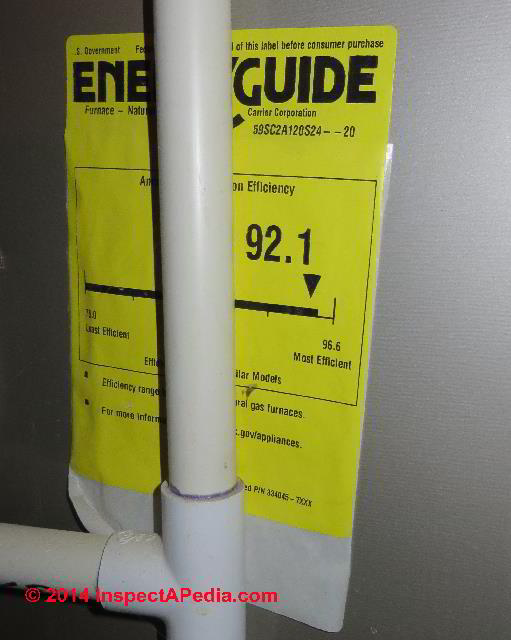
 Example 1: Carrier's Infinity Split System air conditioners are rated by the company at SEER 16.5 (Model 24ANB6) to 21 (Model 24ANB1)
This data will not usually be found on the data tag though you will see it on a separate yellow sticker - the Energy Guide label that often is on a different side of the equipment (photo at left).
Photo courtesy Eric Galow, Galow Homes, Poughkeepsie, New York.
But for some manufacturers there is a clue to SEER right in the model number.
The Infinity Model 24ANB1 is designated with MODEL NAME INFINITY21 while the Infinity Model 24ANB6, rated at a seer of 16.5 is designated with MODEL NAME INFINITY16.
You can for this series only roughly approximate SEER by noting the model name. For example within the Infinity product line by Carrier, two Infinity Models designated INFINITY17 are rated at SEER 18.
In 2012 Carrier reported that
Introduced in 2011, the Infinity heat pump with Greenspeed intelligence is the highest heating efficiency ducted, air source heat pump on the market with a Heating Seasonal Performance Factor (HSPF) efficiency rating up to 13.
The Infinity heat pump delivers up to 69 percent higher heating efficiency in the three-ton size. - 8/8/2012, Carrier Corp. retrieved 1/30/14 original source: http://www.carrier.com /homecomfort/en/us/news/news-article/ carrier__infinity__heat_pump_with_greenspeed__intelligence.aspx
Example 2: Carrier high efficiency gas furnace Energy Guide Sticker
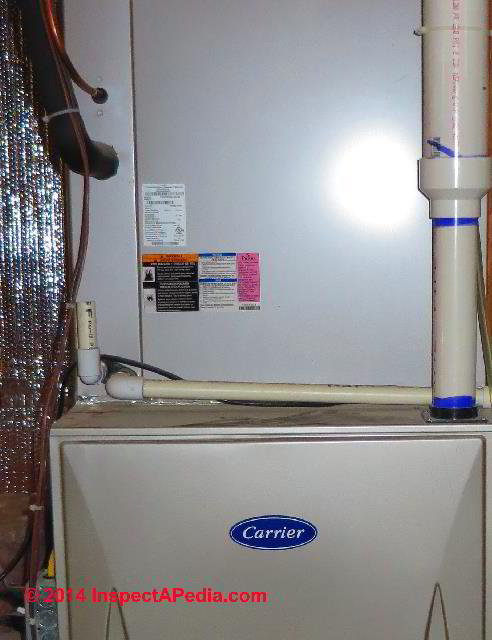 Our photographs above and at left illustrate the real world case of trying to find and read the energy guide sticker on a new appliance.
At left we see my red arrow pointing to the equipment data tags on the front of a Carrier high efficiency gas furnace.
Nowhere in sight is the Energy Efficiency tag.
Around the side of this unit and partly obscured by the condensate drain system we found the yellow Energy Guide tag that gives this heater's estimated annual efficiency rating - an impressive 92.1, as you can read in our yellow Energy Guide sticker photograph above.
What does "Up to" mean in a SEER Rating?
Adding honesty to SEER ratings, companies typically state in the product literature "Up to SEER nn" recognizing that the actual energy efficiency in practice and in specific installations will vary.
In advertising law, "up to" claims, to be legally defensible, sport a number that must be met by at least ten percent of actual cases.
OH - and if you email to me me the model number I'll dig up that specific seer. Send along a photo of the data tags on your equipment if you can - use the CONTACT link at the top or bottom of any of our pages.
Question: I purchased a 16 SEER system. The unit outside has an energy rating of 14 SEER. Did my contractor install the wrong unit?
I purchased a 16 SEER system. The unit outside has an energy rating of 14 SEER.
The company tried to tell me that the coils add 2 SEER to the overall system. I think that they are lying, and that they installed the wrong unit. What is the correct answer? - Michelle
Reply: Definition of Central Air Conditioner, Split System & Gas / Electric Cooling Systems SEER ratings.
SEERS are not additive without the manufacturer saying-so. Each piece of equipment has its own individual SEER rating.
Any individual piece of equipment has a SEER rating that's calculated by dividing its cooling output for a typical cooling season by the total energy consumed.
If you drive a Ferrari that gets 11 mpg and you also have a Honda 250 motorcycle that gets 29 mpg that does not mean that you can simply add the two MPG's together and say your fleet has an MPG of 40!
Just consider that different pieces of individually-rated SEER numbers may run for different percentages of the time and consume different total amounts of energy. It simply doesn't make sense to add those apples and oranges together.
Rely on the product labels and check with the manufacturer about the combined SEER of your compressor/condenser unit and air handler unit
Michelle, the US EPA / Energy Star program's definition of SEER given at the top of this page describes the
"... total cooling of a central air conditioner or heat pump (in Btu) during the normal cooling season as compared to the total electric energy input (in watt-hours) consumed during the same period..."
For purposes of the ENERGY STAR program, Central Air Conditioner is defined as the combination of both indoor and outdoor components and you should have received an ENERGY STAR SEER number for that whole system.
Definition of Central Air Conditioner:
A central air conditioner model consists of one or more factory-made assemblies which normally include an evaporator or cooling coil(s), compressor(s), and condenser(s).
Central air conditioners provide the function of air-cooling, and may include the functions of air-circulation, air-cleaning, dehumidifying or humidifying. [1]
But unless your central air conditioning system is a "Matched Assembly" [defined below], it is likely that the SEER definition for your central air conditioner does not address the confusion that can arise when your inside unit air handler (which includes the evaporator or cooling coil you mention) and compressor/condenser (the outside unit) may have separate individual SEER ratings.
Each of those two major system components will be on or off (running or not) at different times during a cooling cycle, depending on a variety of factors.
Matched Assembly [central air conditioning or heat pump system]:
A matched assembly is a model combination that is listed in the ARI Directory of Certified Equipment or for which the manufacturer has published energy efficiency data that includes rated SEER and EER levels, and in which both the condenser unit and evaporator coil are installed simultaneously.
A matched assembly shall also include the air handler, furnace, or other component that is used to determine the rating according to ARI 210/240.
If your installer did not install a Matched Assembly central air conditioning system, and if the installer did not provide you with documentation [not just an oral statement or claim] of the overall SEER rating for your central air conditioner, to obtain a SEER rating for the combined system you'd need to consult the manufacturer and make some assumptions about the on-off time of each of these components.
For combinations of air handlers and compressor/condenser units intended to be sold as a complete, installed, system, the manufacturer may be able to give you an overall SEER rating for that system.
Or maybe not not. Given the Energy Star definition of Central Air Conditioners and SEER, it it would not be accurate to simply add a few SEER points to the compressor/condenser unit's SEER based on an opinion about other system components.
See SEER RATINGS & OTHER DEFINITIONS
Nor are component SEER ratings additive - you don't just add them together to get an overall system SEER. Not without the manufacturer's agreement.
We can save some potential embarrassment - don't assume your installing company has been dishonest (as you put it) without first asking the manufacturer for clarification.
The U.S. Government's Energy Star Program's discussions and documents about the SEER rating program (and SEER targets for newly installed equipment) suggests that folks in both government and industry are aware that the lack of clarity or of technical details in SEER rating definitions is a source of potential misunderstandings between consumers and their installing contractors. [2]
Notice that for a split system air conditioning system, the ENERGY STAR definition is more clear about the necessity to combine the major components in arriving at a SEER rating, as it refers explicitly to the ... actual condenser-evaporator coil combination of the split system.
Definition of Split System [air conditioner or heat pump system]:
A split system is an ASHP or central air conditioner with separate indoor (evaporator) and outdoor (condenser) units. For split systems, the energy-efficiency rating of a particular split system is based on the actual condenser-evaporator coil combination of the split system. [1]
Also for completeness we include:
Gas/Electric Package [Combined Air Conditioning & Heating] Unit:
A single package unit with gas heating and electric air conditioning that is often installed on a slab or roof.[1]
Also see ENERGY STAR PROGRAM and
For tips on how to cut air conditioning or heat pump operating costs, see AIR CONDITIONING HEAT PUMP SAVINGS.
...
Continue reading at AFUE DEFINITION, RATINGS or select a topic from the closely-related articles below, or see the complete ARTICLE INDEX.
Or see SEER RATINGS & OTHER DEFINITIONS FAQs - questions and answers posted originally on this page
Or see these
Recommended Articles
- ENERGY SAVINGS in BUILDINGS - home
- ENERGY STAR PROGRAM
- RATED COOLING CAPACITY
- SEER RATINGS & OTHER DEFINITIONS
Suggested citation for this web page
SEER RATINGS & OTHER DEFINITIONS at InspectApedia.com - online encyclopedia of building & environmental inspection, testing, diagnosis, repair, & problem prevention advice.
Or see this
INDEX to RELATED ARTICLES: ARTICLE INDEX to AIR CONDITIONING & HEAT PUMPS
Or use the SEARCH BOX found below to Ask a Question or Search InspectApedia
Ask a Question or Search InspectApedia
Try the search box just below, or if you prefer, post a question or comment in the Comments box below and we will respond promptly.
Search the InspectApedia website
Note: appearance of your Comment below may be delayed: if your comment contains an image, photograph, web link, or text that looks to the software as if it might be a web link, your posting will appear after it has been approved by a moderator. Apologies for the delay.
Only one image can be added per comment but you can post as many comments, and therefore images, as you like.
You will not receive a notification when a response to your question has been posted.
Please bookmark this page to make it easy for you to check back for our response.
Our Comment Box is provided by Countable Web Productions countable.ca
Citations & References
In addition to any citations in the article above, a full list is available on request.
- Saheb, Yamina, Sulejman Becirspahic, Simon, Jerome, "Effect of the Certification on Chillers Energy Efficiency" [PDF], IEECB, Frankfurt Germany 2006, retrieved 2016/08/22, original source: http://www.eurovent-certification.com/fic_bdd/pdf_fr_fichier/1150796026_Review_85_-_Effect_of_Certification.pdf
- [1] U.S. Government EnergyStar Program, ENERGY STAR Program Requirements for ASHPs and Central Air Conditioners – FINAL DRAFT, found at http://www.energystar.gov/ia/partners/prod_development/revisions
/downloads/ac_ashp/Final_Draft_CAC_ASHP_Eligibility_Criteria.pdf - Air-Conditioning and Refrigeration Institute. Standard 210/240 “2003 Standard for Unitary Air-Conditioning and Air-Source Heat Pump Equipment.”
- [2] SoCalEdison Comments for ASHP/CAC Options Paper, Web search 07/22/2011 - SoCalEdison.pdf, note that by its name this article contains comments by a representative from SoCalEdison in response to a request for input to help EnergyStar develop an HVAC standard for 2006, but neither addressee nor writer are fully identified. SoCalEdison is an acronym for Southern California Edison, an Edison International Company and one of the largest electric utilities in the United States. According to SoCalEdison, "Residential and commercial air conditioning is responsible for the largest share of peak [electrical energy] demand in California,contributing approximately 33% of peak demand." [citation:
http://asset.sce.com/Regulatory/Energy%20Efficiency%
20Filings/SCE2507COMPREHENSIVEHVAC.pdf ] - also see the Kema -Xenergy energy use citation just below. - [5] Kema -Xenergy, “California Statewide Residential Sector Energy Efficiency Potential Study,” April 2003,
and Kema-Xenergy, “California Commercial Sector Energy Efficiency Potential Study,” July 2002. Base
information is factored by 0.367 to get SCE portion of savings. - [6] Thanks to Scott at SJM Inspect for suggesting this EPA document and for technical editing remarks regarding our air conditioning website, SJM Inspection Service LLC, serves the entire state of CT, sjminspect@optonline.net 203-543-0447 or 203-877-4774 5/16/07
- [7] Thanks to reader Michael V. for commenting on watt, volt, amp calculations, August 2009.
- [8] Thanks to reader Daniel Mann, P.E. for commenting on W=VxI and the power factor or PF, February 2010
- [9] Thanks to reader Robert for pointing out a typographical error in our latent heat of vaporization of water to steam at 212 degF, September 2010
- In addition to citations & references found in this article, see the research citations given at the end of the related articles found at our suggested
CONTINUE READING or RECOMMENDED ARTICLES.
- Carson, Dunlop & Associates Ltd., 120 Carlton Street Suite 407, Toronto ON M5A 4K2. Tel: (416) 964-9415 1-800-268-7070 Email: info@carsondunlop.com. Alan Carson is a past president of ASHI, the American Society of Home Inspectors.
Thanks to Alan Carson and Bob Dunlop, for permission for InspectAPedia to use text excerpts from The HOME REFERENCE BOOK - the Encyclopedia of Homes and to use illustrations from The ILLUSTRATED HOME .
Carson Dunlop Associates provides extensive home inspection education and report writing material. In gratitude we provide links to tsome Carson Dunlop Associates products and services.
 | HOME | ABOUT | ASK a QUESTION | CONTACT | CONTENT USE POLICY | DESCRIPTION | POLICIES | PRIVACY | |
| © 2024 - 1985 Publisher InspectApedia.com - Daniel Friedman | |||||||||