
InspectAPedia® FREE Encyclopedia of Building & Environmental Construction, Diagnosis, Maintenance & Repair |
Question? Just ask us! InspectAPedia
|
 Types of Air Conditioners
Photo Guide to Types of Air Conditioning Systems & A/C Energy Sources
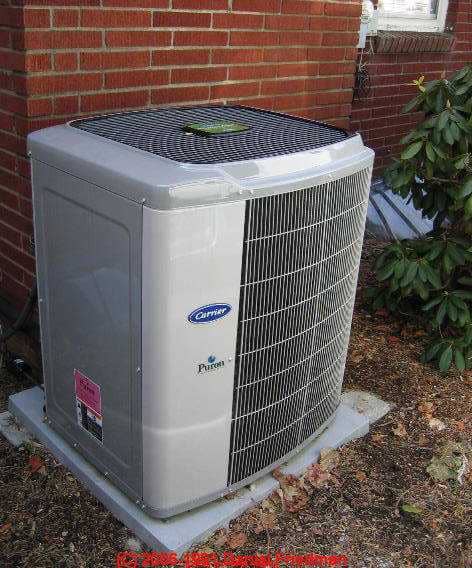
- POST a QUESTION or COMMENT about the different types of air conditioning or cooling or heat pump systems: what are the different system designs, approaches, types, their properties, and how they are identified, repaired, maintained
Guide to types of air conditioners & cooling or heat pump systems:
Photographs & descriptions of different types of air conditioning and cooling systems are provided here. We also illustrate the difference between air-cooled and water cooled air conditioners and evaporative coolers or swamp coolers.
This article series answers most questions about inspecting, troubleshooting, and repairing central air conditioning systems. We describe how to inspect residential air conditioning systems (A/C systems) to inform home buyers, owners, and home inspectors of common cooling system defects.
InspectAPedia tolerates no conflicts of interest. We have no relationship with advertisers, products, or services discussed at this website.
A/C ENERGY SOURCES - Air Conditioning System Type by Energy Source
[Click to enlarge any image]
Air conditioning systems use these common energy sources to physically cool the condensing coils and thus the refrigerant [Click to enlarge any image]
Article Contents
- AIR CONDITIONER TYPES, ENERGY SOURCES
- BASEMENT VERTICAL Central Air Handlers
- HOME MADE Air Conditioning Systems
- HORIZONTAL Attic or Crawl Space Air Handlers
- PORTABLE Room Air Conditioners
- ROOFTOP-mounted Air Conditioners / Heat Pumps
- SPLIT SYSTEM or DUCTLESS Air Conditioners
- SWAMP COOLERS & WATER COOLED Air Conditioners
- WALL CONVECTOR Units, Heating / Air Conditioning
- WINDOW / WALL -Mounted Room Air Conditioners
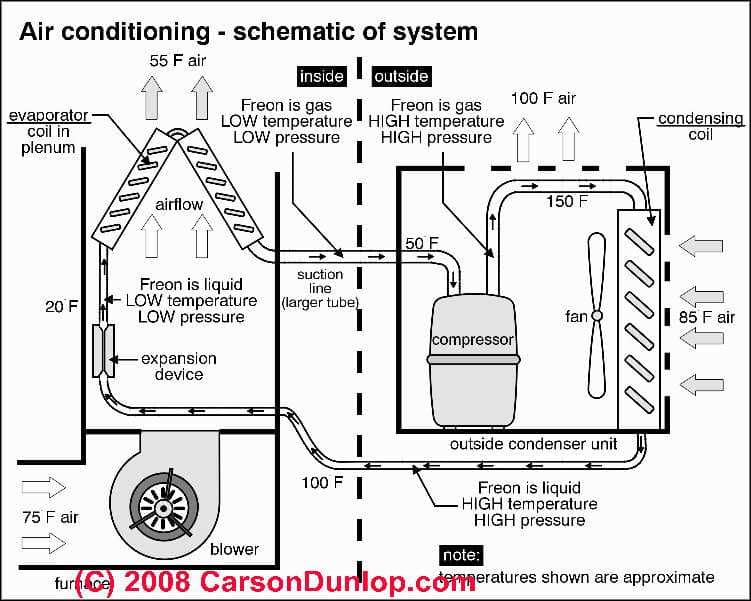
Schematic of a Typical Air-Cooled Air Conditioner or Heat Pump System
Air-cooled air conditioner systems: refers to the use of air to cool the compressor and the condenser coil used to return the refrigerant gas to a liquid state.
These split systems usually have an inside evaporator cooling coil installed to work along with the blower and duct system which might also be sitting
atop a heating furnace. The outside half of the equipment contains the compressor and condenser coil.
Carson Dunlop's schematic shows how refrigerant moving through the system as a gas or liquid moves heat from inside the building (at the evaporator coil in an air handler) to outside the building (at the condenser unit's condensing coil).
The schematics of an air-cooled air conditioning system shown in this article are compliments of Carson Dunlop Associates, a Toronto home inspection, education, & report writing tool company.
Water Cooled Air Conditioners vs Swamp Coolers - A Simple Comparison
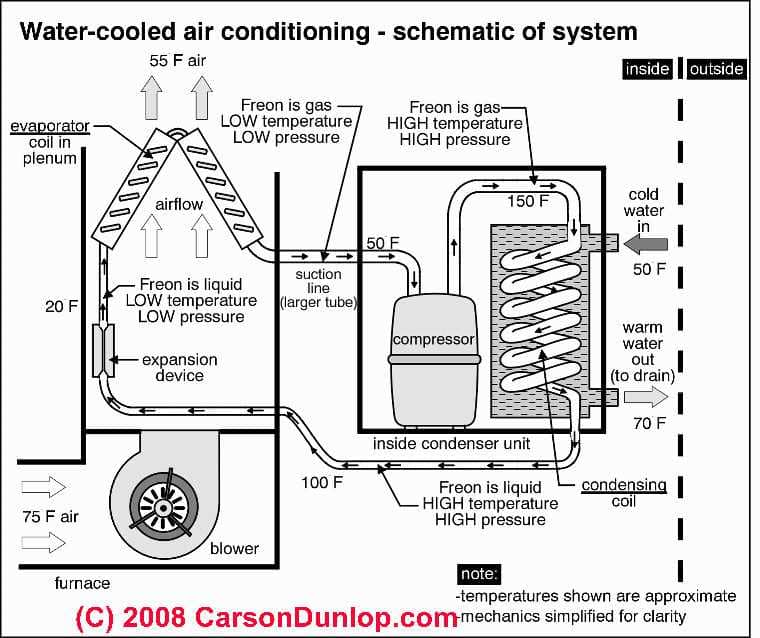
Water cooled air conditioning systems: these work in a manner similar to the system listed above, but use water as a chiller to remove heat from the high temperature
gas in the (usually but not always outside) compressor/condenser unit.
The schematic of a water cooled air conditioning system shown at left is compliments of Carson Dunlop Associates
As with the air-cooled air conditioning system above, this schematic describes an air conditioner that uses refrigerant and coils to move heat from indoors to outside.
But instead of moving heat from the condensing coil into air blown across the coil outdoors, we're moving heat into water circulated around a condensing coil.
Evaporative Coolers - Rooftop Cooling Units
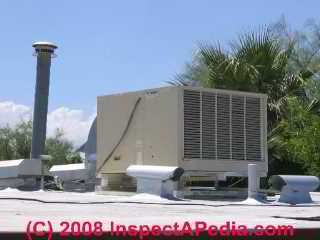
Evaporative coolers, also called "swamp coolers" rely on the evaporation of water to cool building air, rather than the movement of a refrigerant through cooling coils.
Cooling towers, swamp coolers, and even a simple window fan blowing air across a pan of water and into a room are types of evaporative cooling systems.
Swamp coolers systems may use less energy than a refrigerant-gas and compressor type air conditioner but they'll only work where the ambient humidity is low enough to make it easy to evaporate water, such as in Arizona and other areas of the Southwest and Mexico.
We discuss swamp coolers & evaporative coolers in detail at EVAPORATIVE COOLING SYSTEMS.
Gas Chiller Air Conditioning Systems: these systems operate by the same principles as the above units, but they use heat to cause the refrigerant gas to change states rather than compression and expansion by a compressor motor. (Some refrigerators, including ones used in recreational vehicles also operate on this principle, as they can cool without requiring electricity to operate a compressor. Ammonia was the traditional gas used for this type of system.)
Photographs of Types of Air Conditioning Systems
Photos of Typical Residential Central Air Conditioning System
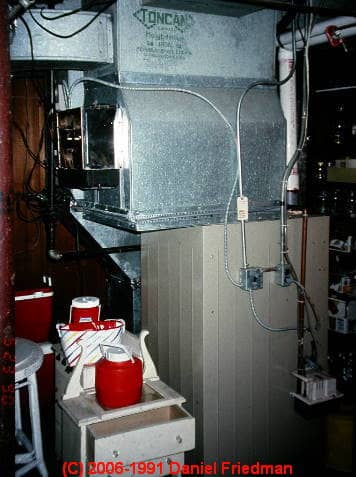
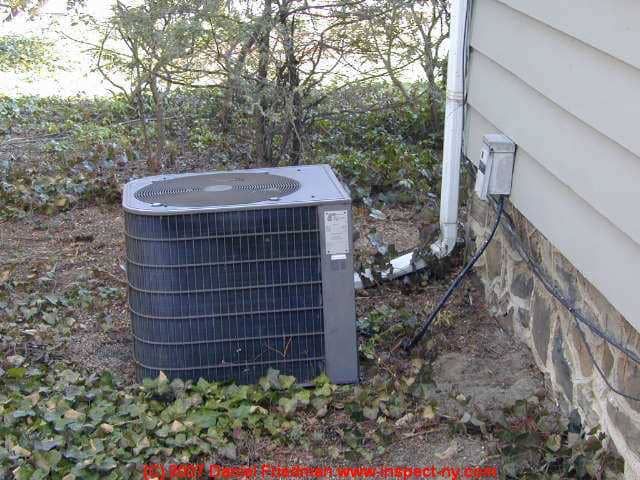
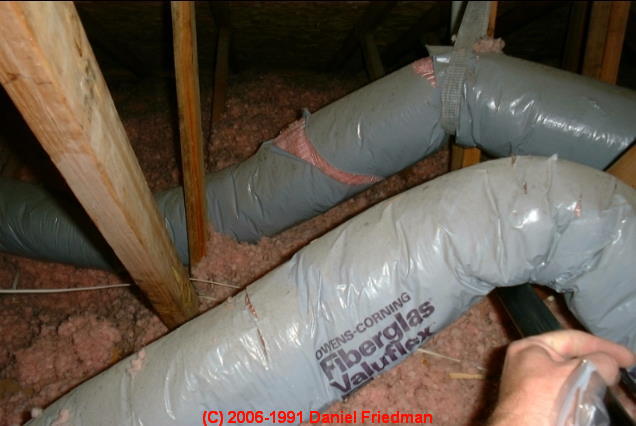
The most common central residential air conditioning system incorporates an indoor air handler unit or AHU which draws building air through return ducts from the living space, cools it by moving the air across an evaporator coil, and sends cooled and dehumidified air back into the living area through supply ducts and registers.
Liquid refrigerant is released into the interior of the evaporator coil, changing its state from liquid to gas and thereby cooling the evaporator coil (which in turn cools and dehumidifies air which is blown across the coil).
Refrigerant used to cool the evaporator coil runs in independent piping, usually copper, from the evaporator coil outside to a compressor and condenser unit where the refrigerant is repressurized, cooled, and returned back inside to the evaporator coil as a liquid. The photos (above) show a basement AHU, an outdoor compressor/condenser, and flex-duct in an attic.
In the above-left photo, the basement AHU has been retrofitted with an air conditioning unit which by simple inspection is probably improperly designed and mismatched to the size and air flow character of the original air handler - notice how the A/C plenum is much larger than the blower compartment.
In the above-right photo the compressor unit looks OK on casual inspection but there seems to be no pad, the unit is slightly tipped, and while we can't see the refrigerant lines, that taut electrical wire makes me wonder if there is a lack of extra slack (a loop) in the refrigerant lines to permit movement - a refrigerant leak and system failure may be coming soon.
In the third photo above, this particular flex duct product, one previously produced by Owens Corning(R) is defective and disintegrates on exposure to hot areas. [Owens Corning flex duct failure photo courtesy of Mark Cramer Tampa FL]
Photos of the Horizontal Attic or Crawl Space Air Handler Unit for Central Air Conditioning
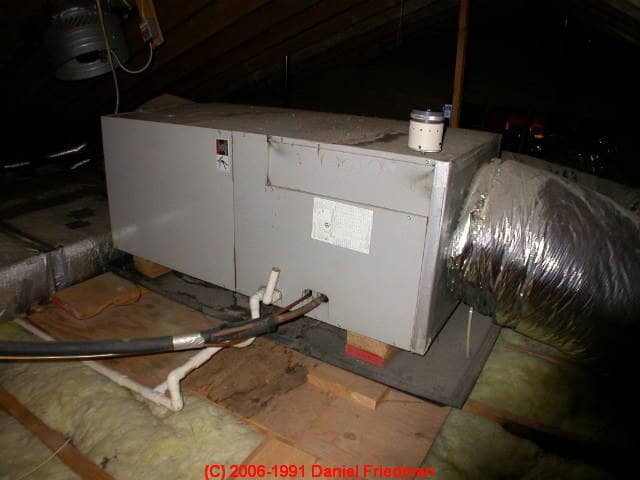
Attic air conditioning equipment for residential air conditioning systems includes an air handler unit such as the one shown in this photo, combined with an outside compressor/condenser such as the one shown earlier above.
Attic-mounted central air equipment may have different defects and problems than a similar unit located in a lower building floor or basement.
The residential central air conditioning equipment components are the same in an attic unit as a typical basement unit except that they are arranged horizontally rather than vertically.
Horizontal crawl space air handlers are found below homes in some areas and use equipment of the same design as horizontal attic A/C units (shown here).
Watch out: locating air handling equipment or ductwork in wet or moldy areas such as some crawl spaces is asking for an indoor air quality problem. And if access to the air handler in an attic or crawl space is limited, then service of the equipment will also be limited, poor, or more costly.
Photos of Independent Split Systems or Ductless Air Conditioning or Heat Pumps
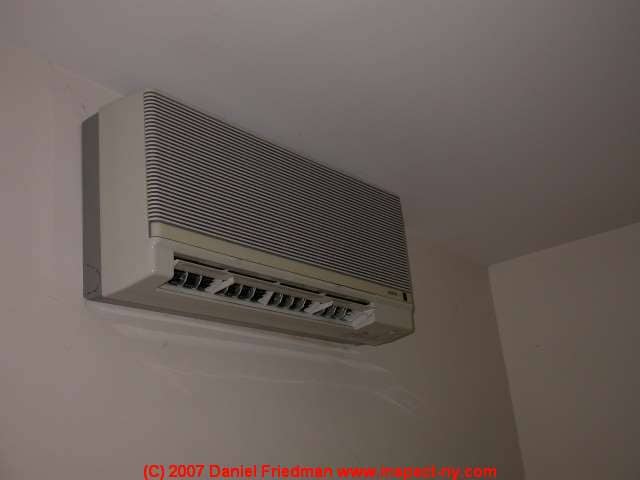
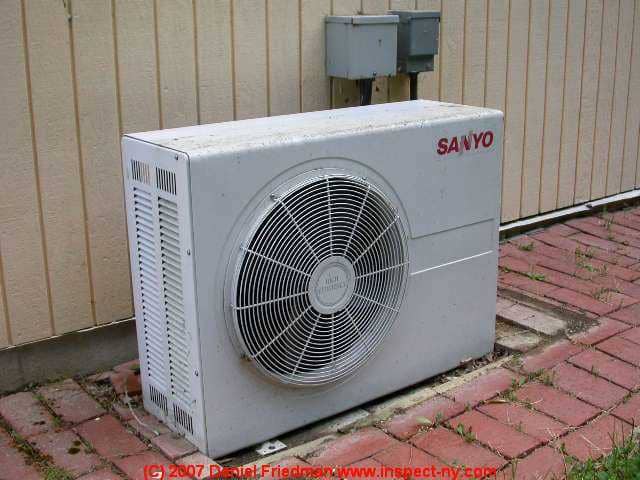
Ductless air conditioning systems do not make use of an air handler connected to duct work to distribute conditioned air the for central cooling and/or heating. These include ductless systems mounted on roofs or in attics and wall-mounted units (shown here) which may typically an indoor fan and evaporator coil to produce cooled and dehumidified air, but which route refrigerant to an outside compressor/condenser unit.
See more details at SPLIT SYSTEM AIR CONDITIONERS & HEAT PUMPS.
Photos of Portable or Ductless Air Conditioning or Heat Pumps
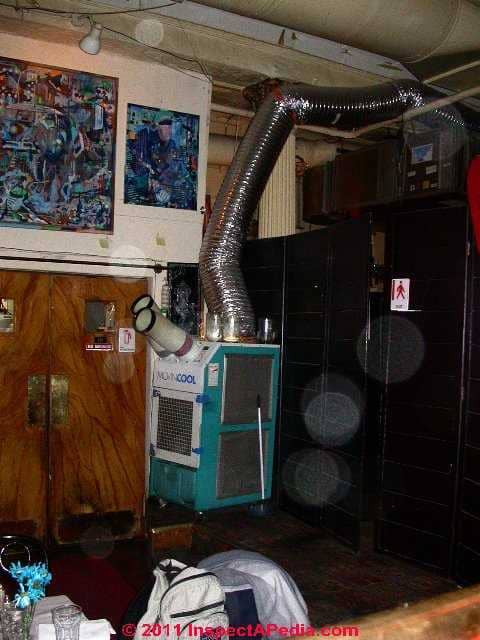
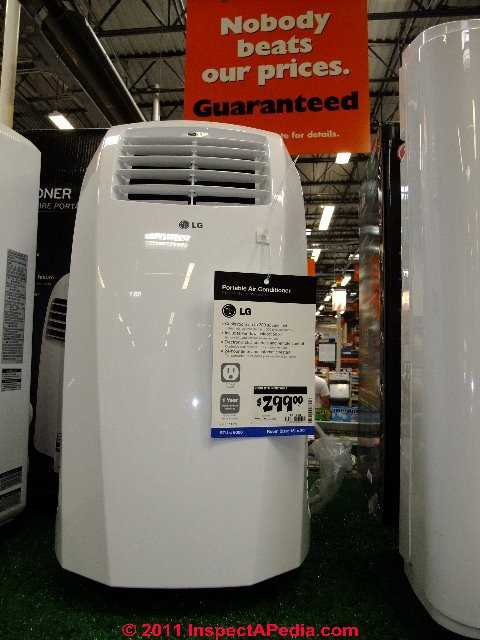
Portable or ductless air conditioning systems such as the units shown above work by exhausting warm room air through a window or flex duct section connected to an outdoor opening. If you use such a unit without providing a warm air exhaust to outdoors the effectiveness of the cooling system is of necessity limited. Condensate produced by cooling the air also needs to be drained by gravity, by emptying a reservoir, or by connecting a condensate pump.
- Do not cover the air discharge on these units or the equipment won't work and may even be damaged
- The manufacturer recommends unplugging the unit from its electrical connection before servicing
- These portable air conditioner units should be connected to a single-outlet electrical circuit. And if electrical power to the unit is interrupted, leave the equipment off for at least three minutes before re-starting.
Photos of Wall Convectors: HVAC units for heating and air conditioning
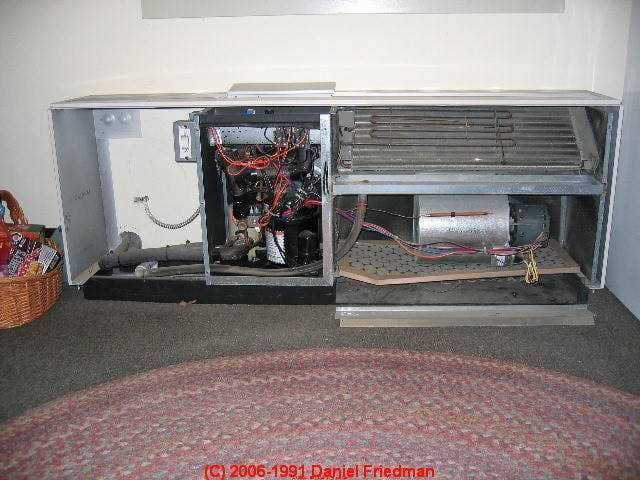
Wall convectors are often used for both heating and cooling in commercial installations and high-rise apartment buildings.
The unit shown has its own compressor mounted right in the cabinet, visible at lower center in
the photo.
Wall-mounted heating and cooling convector installations may be designed with one central heater or
cooling system which feeds multiple units with chilled or heated water
or possibly refrigerant from a single remote heating and cooling heat pump.
Details about wall convectors used for heating or cooling and about convector blower fans are found at WALL CONVECTORS HVAC and also at FAN COIL & FAN CONVECTOR HEATERS & HYDRONIC COILS
Photos of Commercial rooftop-mounted combined air conditioning or heat pump units
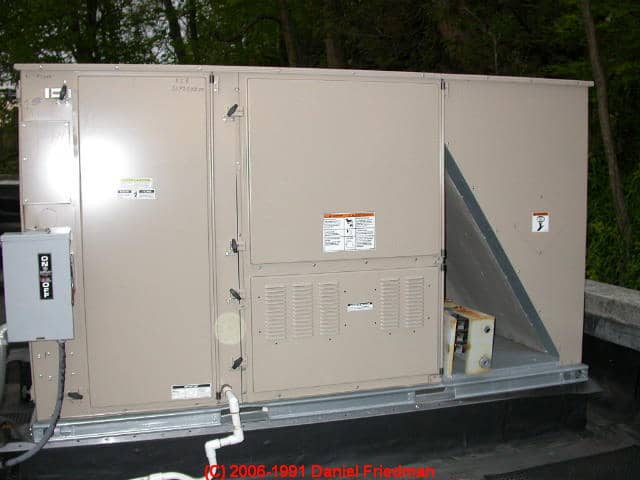
Rooftop mounted central air conditioning systems may include both the cooling unit (evaporator coil, blower fan, filters) and the compressor/condenser unit in one package. .
Alternative HVAC designs may combine all components except for the duct work in a rooftop mounted unit such as the one shown above where it was mounted on a flat roof over offices at a commercial building.
Details are at ROOFTOP HVAC UNITS
Window-Mounted Air Conditioners: Photos of Window or Wall-Mounted or Portable Room Air Conditioners
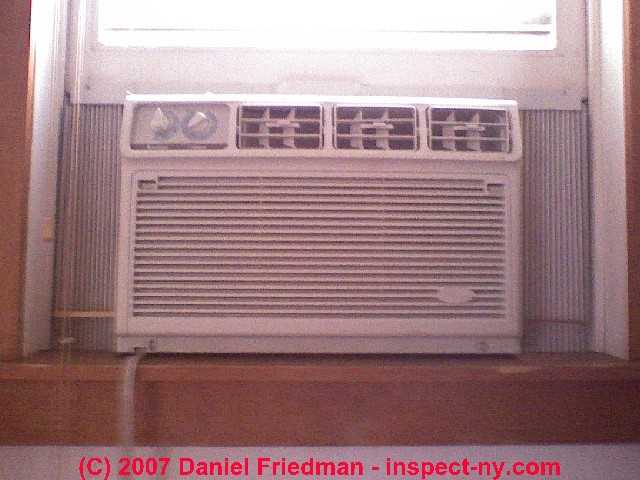
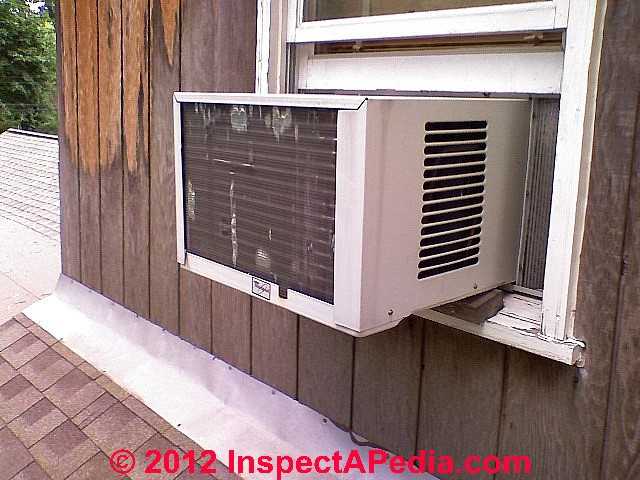
The window-mounted air conditioner in these photographs is a small 8,000 BTUh unit but it was installed in a strategic location at the top of a second floor stair.
It is able to cool the entire second floor of this home (one large, very well-insulated room) and additional cool air flows down the stairwell to also deliver cool and dehumidified air to the lower floor of this home.
The photo of the exterior of this unit shows that there has been some damage to the cooling fins of the condensing coil on the back of the unit, but not enough to warrant action.
at AIR CONDITIONER BTU CHART we describe how to determine the BTU capacity you'll need when choosing a window ari conditioner.
Photos of a Home Made Central Air Conditioning System
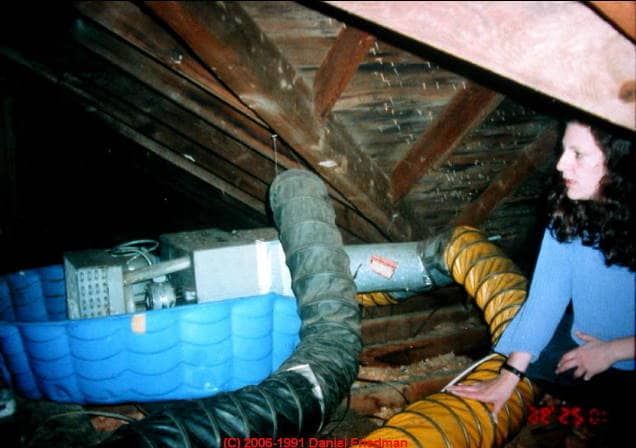
Do-It-Yourself Home made air conditioning systems can produce some systems that seem to cool the building but at high cost and with building damage, such as this goofy example may actually work but not without problems. This system used a window air conditioner placed in a home's attic.
Manhole ventilation duct (liberated from New York City) was used along with a home made hood attached to the air conditioner to blow cool air into the home through a ceiling register. The air conditioning condensate was collected in the blue plastic kiddie pool seen in the photo, and drained by gravity to a plumbing vent stack.
Nothing about the system was proper, safe, nor very effective, and in addition, the attic moisture conditions were terrible as you can see from the blackened plywood roof sheathing. The system was admirable for its creativity however.
Other home made cooling systems such as evaporative coolers using a simple pan of water in front of a window fan can be effective and inexpensive in hot dry climates such as the southwestern United States
...
Continue reading at AGE of AIR CONDITIONERS & HEAT PUMPS or select a topic from the closely-related articles below, or see the complete ARTICLE INDEX.
Or see AIR CONDITIONER TYPES, ENERGY SOURCE FAQs - questions & answers posted originally on this page.
Suggested citation for this web page
AIR CONDITIONER TYPES, ENERGY SOURCES at InspectApedia.com - online encyclopedia of building & environmental inspection, testing, diagnosis, repair, & problem prevention advice.
Or see this
INDEX to RELATED ARTICLES: ARTICLE INDEX to AIR CONDITIONING & HEAT PUMPS
Or use the SEARCH BOX found below to Ask a Question or Search InspectApedia
Ask a Question or Search InspectApedia
Try the search box just below, or if you prefer, post a question or comment in the Comments box below and we will respond promptly.
Search the InspectApedia website
Note: appearance of your Comment below may be delayed: if your comment contains an image, photograph, web link, or text that looks to the software as if it might be a web link, your posting will appear after it has been approved by a moderator. Apologies for the delay.
Only one image can be added per comment but you can post as many comments, and therefore images, as you like.
You will not receive a notification when a response to your question has been posted.
Please bookmark this page to make it easy for you to check back for our response.
Our Comment Box is provided by Countable Web Productions countable.ca
Citations & References
In addition to any citations in the article above, a full list is available on request.
- Thanks to Mark Cramer, Tampa Florida, for assistance in technical review of the "Critical Defects" section and for the photograph of the deteriorating gray Owens Corning flex duct in a hot attic. Mr. Cramer is a Florida home inspector and home inspection educator.
- Thanks to Jon Bolton, an ASHI, FABI, and otherwise certified Florida home inspector who provided photos of failing Goodman gray flex duct in a hot attic.
- Thanks to Scott at SJM Inspect for suggesting this EPA document and for technical editing remarks regarding our air conditioning website, SJM Inspection Service LLC, serves the entire state of CT, sjminspect.com 203-543-0447 or 203-877-4774 5/16/07
- Our recommended books about building & mechanical systems design, inspection, problem diagnosis, and repair, and about indoor environment and IAQ testing, diagnosis, and cleanup are at the InspectAPedia Bookstore. Also see our Book Reviews - InspectAPedia.
- Complete List of Air Conditioning & Heat Pump Design, Inspection, Repair Books at the InspectAPedia Bookstore.
- Modern Refrigeration and Air Conditioning, A. D. Althouse, C.H. Turnquist, A. Bracciano, Goodheart-Willcox Co., 1982
- Principles of Refrigeration, R. Warren Marsh, C. Thomas Olivo, Delmar Publishers, 1979
- Refrigeration and Air Conditioning Technology, 5th Ed., William C. Whitman, William M. Johnson, John Tomczyk, Cengage Learning, 2005, ISBN 1401837654, 9781401837655 1324 pages
- In addition to citations & references found in this article, see the research citations given at the end of the related articles found at our suggested
CONTINUE READING or RECOMMENDED ARTICLES.
- Carson, Dunlop & Associates Ltd., 120 Carlton Street Suite 407, Toronto ON M5A 4K2. Tel: (416) 964-9415 1-800-268-7070 Email: info@carsondunlop.com. Alan Carson is a past president of ASHI, the American Society of Home Inspectors.
Thanks to Alan Carson and Bob Dunlop, for permission for InspectAPedia to use text excerpts from The HOME REFERENCE BOOK - the Encyclopedia of Homes and to use illustrations from The ILLUSTRATED HOME .
Carson Dunlop Associates provides extensive home inspection education and report writing material. In gratitude we provide links to tsome Carson Dunlop Associates products and services.
 | HOME | ABOUT | ASK a QUESTION | CONTACT | CONTENT USE POLICY | DESCRIPTION | POLICIES | PRIVACY | |
| © 2024 - 1985 Publisher InspectApedia.com - Daniel Friedman | |||||||||