
InspectAPedia® FREE Encyclopedia of Building & Environmental Construction, Diagnosis, Maintenance & Repair
|
Question? Just ask us! InspectAPedia
|
 Air Conditioning & Heat Pump Data Tags
Data-Tag Decoders: BTUs, Tons, Equipment Age
- POST a QUESTION or COMMENT about how to determine the age of an air conditioner or heat pump
HVAC data tag decoding: This article explains and translates all of the data found on information tags and stickers used on air conditioning and heat pump equipment. This article series answers most questions about air conditioning systems.
This article provides help in decoding air conditioner, boiler, furnace, heat pump, water heater data tags and determining the age, model, or specifications of that equipment.
Find and read the data tag on air conditioners or heat pumps to determine Air conditioner BTUs, Tons, Age: decoded on data tags. Air conditioner electrical requirements & refrigerant needs. Air conditioner cooling capacity coded in model numbers. Air conditioner and heat pump manufacturer's information; serial number gives A/C age.
InspectAPedia tolerates no conflicts of interest. We have no relationship with advertisers, products, or services discussed at this website.
A/C DATA TAGS - Air conditioner & heat pump data tags de-coded
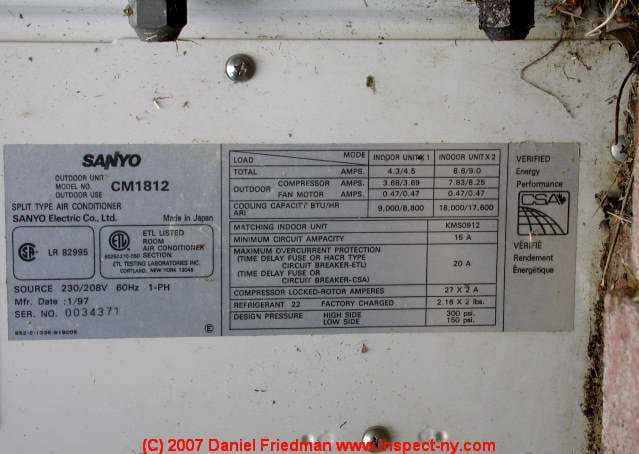
 Here we explain the meaning of each of the data names and contents of typical air conditioner system data tags. We include examples of how to make use of the data to estimate equipment age, capacity, and even its condition. (Not all of the terms we define below will appear on all equipment or motor tags.)
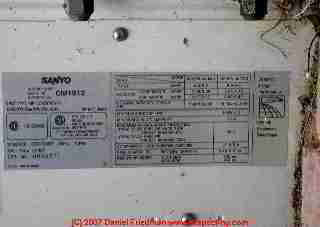
The photo at page top shows the main data sticker from a 1997 split system air conditioning compressor/condenser unit.
[Click to enlarge any image]
This model, made by Sanyo, Inc., provides easy-to-read basic data about the system including its year of manufacture, refrigerant, electrical requirements, and service information.
Article Contents
- DATA TAGS on AIR CONDITIONERS
- DATA TAGS - what information is provided
- ALPHABETICAL LIST of HVACR DATA TAG DECODERS HVACR Air Conditioning & Heat Pump Equipment Data Tags & Decoders Sorted by Brand
- REFERENCES Books providing data tag decoding guides for HVAC equipment
- CONFUSING or MisReading Letters & Numerals on Old HVAC Equipment Data Tabs
- OTHER TAGS & stickers on air conditioners and heat pumps
- See individual product MANUALS & PARTS GUIDES - HVAC as individual device manuals and pages we host for each HVAC brand also include data tag decoders
What Information is Provided by a Data Tag on an Air Conditioner or Heat Pump?
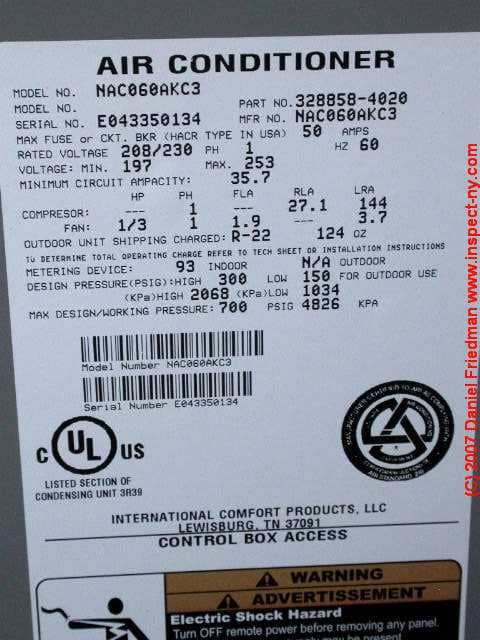
The photo shown above is for a conventional (non-split) residential air conditioning compressor unit.
Unless it has been painted-over or lost, on most air conditioners and heat pumps, a metal, foil, or plastic tag or data sticker is usually affixed to the outdoor air conditioner or heat pump compressor/condenser housing.
Depending on the age and equipment manufacturerthe format and content of data on this tag varies, but typically the tag will allow you to discover some or all of the considerable amount of data listed here:
- Manufacturer:
The air conditioning equipment manufacturer.
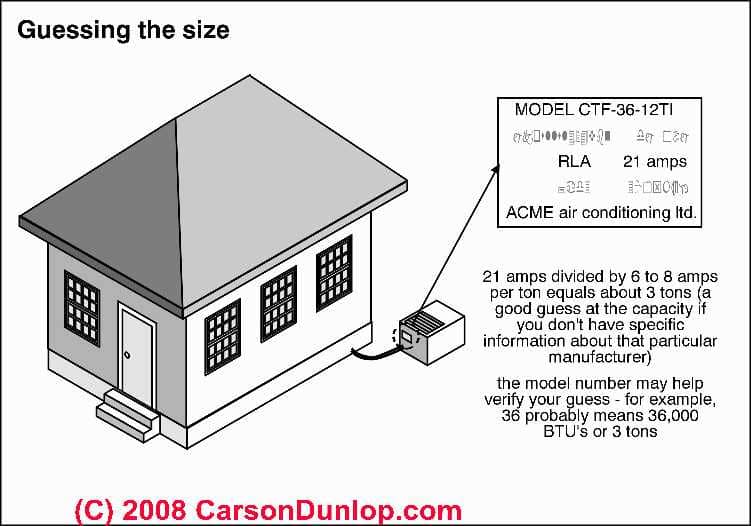
Sketch at left on guessing the size of an air conditioner system is compliments of Carson Dunlop Associates, a Toronto home inspection, education & report writing tool company [ carsondunlop.com ]. As we cite atReferences or Citations , Carson Dunlop also provide a Technical Reference Guide with extensive details that aid in decoding HVAC equipment serial numbers and data tags. - Model Number, Serial Number, and Cooling Capacity:
sometimes cooling capacity is coded into the model number but on most newer units including the Sanyo compressor shown here, cooling capacity is stated explicitly. On older equipment the BTUH cooling capacity may be encoded in the model numbers.
RATED COOLING CAPACITY discusses how to read the cooling capacity in BTUH or tons from air conditioning or heat pump tags. The serial number of modern HVAC equipment encodes the year and month of manufacture - thus the age of the equipment is shown. For equipment where the month and year of manufacture is not stated in plain English, Carson Dunlop Associates provides a Technical Reference Guide manual that decodes that data. - Voltage
or VAC for the compressor and separately for the blower fan. In addition to specifying voltage, the cycles (50HZ or 60HZ) and current phases (typically one phase for residential equipment) may be specified. - Branch Circuit Selection Current- BCSC:
recommended for determining the required size of the branch circuit conductors (wiring) supplying the equipment. - Locked Rotor Amperage - LRA
specifies the maximum current that the motor will draw when the motor's rotor is unable to move [locked] (or under any other condition). [NEC Table 430-152-A]. LRA on an air conditioning compressor describes the amperage drawn by the motor briefly during motor startup.
Locked rotor amperage is also called inrush current. Because it takes a lot of energy (torque) to get the still parts of an electric motor turning, LRA will always be higher than the current used to keep the motor turning once it has started (FLA or RLA).
This is particularly true if the motor has an additional load (resistance to turning) at startup, such as trying to start an air conditioning compressor against refrigerant head pressure inside the compressor unit.
The LRA of electric motors is 700% - 850% of rated current of the motor (or in some sources 5 to 7 times greater than RLA or FLA - a lot. The motor's circuit breaker, especially on an air conditioning system which can draw high initial amps (LRA) will be sized to protect the electrical wiring of the motor circuit, but the breaker also will be chosen to tolerate a brief, high initial current draw to avoid nuisance tripping.
In other words, the inrush current, because it is brief, does not need to figure in the selection of the wire sizing when wiring or fusing the motor, except to avoid nuisance tripping.
The relationship between the LRA and full load amperage (FLA) varies depending on the design of the electric motor being rated. Motors built to NEMA standards are assigned codes A through H. Each letter can be translated into multiplier x FLA to give LRA.
To assist in avoiding nuisance tripping during compressor startup when high current is drawn momentarily, A/C compressor circuit breakers may be permitted to be one size larger than the circuit breaker required by the wire size itself.
LRA also affects the choice of the electric motor starter. Finally, an air conditioner motor will also draw its LRA current if the motor is frozen or stuck or has bad bearings - which we hope will quickly trip the circuit breaker or blow the circuit fuse. -- Thanks to Patrick Greaux for requesting clarification of LRA. - Minimum Circuit Ampacity - MCA:
MCA can be used to determine the required size of branch circuit conductors (wiring and also control switches) supplying the equipment. [For example, using NEC Table 310-16 in the 60 degree column as required in 110-14]. However some experts recommend using BCSC.
[Using the "minimum permitted" sized wire rather than the optimum-size to a compressor may save a few dollars at installation but may increase system operating costs and it may be less safe than using a larger conductor.] - Maximum Fuse or HACR type Breaker:
specifies the maximum overcurrent protection or MOP to be used to protect the equipment. The permitted ampacity of the equipment electrical circuit protection (fuse or circuit breaker amps) expressed as MOP or Maximum Overcurrent Protection. If MOP is specified, the breaker or fuse protecting the equipment should match this number.
A hermetic compressor draws varying amounts of current as its internal pressure changes during operation. Current draw is higher when starting the motor, and highest if the motor is starting against its highest back pressure such as when a unit is turned off and then back on in the middle of operation.
Because fusing an air conditioning compressor at the minimum level can result in blown fuses or tripped breakers during these intervals of heavy current draw during compressor startup, compressors are either protected by a slow-blow fuse or a somewhat larger than minimum circuit breaker.]
On some older equipment MOP is not specified. Only in the case that MOP is not specified can the overcurrent protection required be determined by the alternative means: [RLA OR BCSC whichever is greater x 175%], or if the compressor keeps tripping that device or blowing that fuse, RLA x 225% might be used.
The National Electrical Code (NEC) specifies the degree to which a breaker or fuse may exceed the RLA. - Rated Load Amperage or Running Load Amperage - RLA,
also called Rated Load Current or RLC on some equipment. This is the manufacturer's anticipated load during normal usage, that is, the current drawn when the motor is running normally. RLA is usually similar to FLA in amount.
Typically RLA is about about 64% of the maximum load current. See NEC section 440-2.
We sometimes can guess the size (tons of cooling capacity) of an air conditioning compressor by dividing the RLA number by 6, 7, or 8.
For example a compressor RLA of 21 amps may be about 3 tons of cooling capacity (21/7).
For more accurate means of determining air conditioner cooling capacity by several means including decoding the data tag, see COOLING CAPACITY, RATED.
In air conditioning systems, typically a motor provides about one horsepower (HP) per ton of cooling capacity. - Full Load Amperage - FLA
full load motor current draw, level at which the motor can be operated without damage. FLA is similar to RLA in amount.
The FLA amperage is the current the motor will draw when the motor is loaded up to its rated horsepower. If an electric motor is running at less than its rated horsepower it will draw less than its FLA current.
If an electric motor is trying to run at more than its rated horsepower, it will draw more than its FLA current.
A technician can measure the actual motor amperage (current draw) and compare it to the FLA to quickly tell if a motor is overloaded - in the case of air conditioning a running current draw above FLA may mean that the compressor is near its end of life. - Maximum Continuous Current - MCC
not usually supplied, this is the most current that the compressor can draw without being damaged. [Typically about 150% of RLA.] - BTUH Cooling Capacity:
The A/C system cooling capacity, either explicitly stated in thousands of BTU's (British Thermal Units) per hour (BTUH) or implicitly given by other data, or coded in the unit's model number. - The month and year of manufacture,
possibly also encoded in the unit serial number. Since the typical life of an A/C compressor is about ten years, one would like to know the probable age of the equipment.
- EER The Energy Efficiency Ratio
of cooling equipment is basically the amount of electricity you consume to obtain a given amount of cooling ability.
It's expressed as (KW per hour of electricity used) / Thousand BTUs - this number is probably not going to be found on the equipment itself but may be in its documentation.
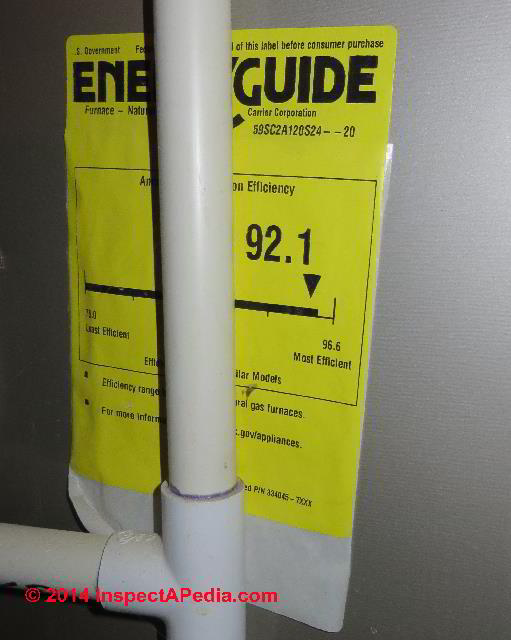
You will usually find this data in the bright yellow EnergyGuide sticker that is more often on a side of the equipment rather than encoded in the equipment's own data tag.
Details are at SEER RATINGS & OTHER DEFINITIONS - Refrigerant type
is shown somewhere on every air conditioner, heat pump, or other cooling compressors. The tag shown here notes that the system uses [the now obsolete] R22 refrigerant. - Voltage
- the voltage at which the motor is intended to be operated. Motors can normally operate fine at voltages within 10% of the rated voltage level on the data plate. - Month and year of manufacture
is shown either explicitly as on the Sanyo compressor data tag shown here or this data may be encoded in the unit's serial number.
Carson Dunlop Associates provides a manual that decodes more of that data so that you can know the age of the compressor or air handler.
That is, the date of its manufacture, not the date of its installation. - The installation date
of air conditioning equipment may be recorded on a service company's data tag, on receipts, or even inked inside of the steel cabinet of the equipment.
Modified, damaged, or torn air conditioning equipment information data tags
can make age, capacity, and repair of any equipment more difficult. For the air conditioning compressor unit shown here, all we know is that the manufacturer was Singer. Model numbers and serial number appear to have been cut away from the data tag. Why?
Sometimes when equipment data labels are removed or obscured a building buyer or a home inspector may raise a concern that the unit installed was different than that which the was ordered or that it is of questionable origin. On rare occasion that might be the case..
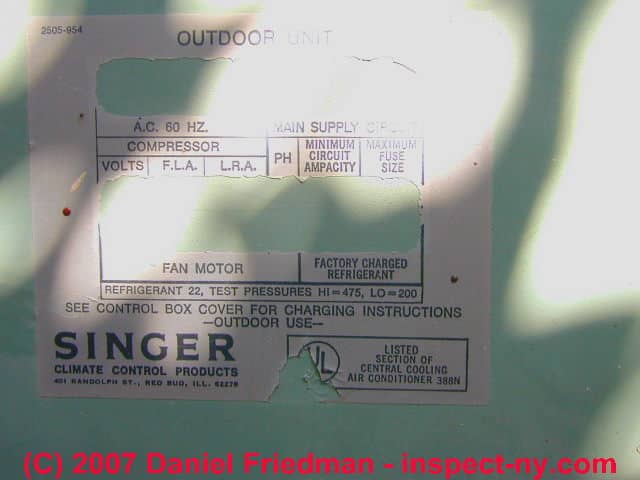 But Ratib Baker, a member of member of Refrigeration Service Engineers Society (RSES), informs us that during the 1980's HVAC equipment manufacturers used a type of label which lacked UV resistance, faded, cracked, and eventually peeled away from the equipment, making equipment identification and ordering of replacement parts difficult.
Mr. Baker wrote (October 2008) that in the 1980's "the [HVAC compressor] label's protective mylar surface was damaged by the printing of the model and serial numbers and the electrical data which allowed the UV from the sun to destroy those areas.
Upon discovering that they did not stand up to weather, most manufacturers started putting a second label inside the electrical compartment. Eventually better labels were designed, but some of the better manufacturers still put a second label in the unit."
Where a data tag or label on equipment is damaged or missing, check further for more label data including inside the unit's enclosure.
Service technicians may have written the model and serial number data in indelible marker, or the manufacturer may have provided a second data label inside the unit - check HVAC equipment with lost or damaged labels to see if you can find that data elsewhere.
You may also find equipment identification details in the installation and service manuals for the equipment if those have been kept in the building. Look around the indoor equipment for those documents.
What we can say from the label in the photograph above is that by 2007 when the photo was taken by an ASHI inspector, this particular equipment was at least 23 years old - older than its usual anticipated life expectancy: the Singer brand On air conditioners was dropped in 1984.
Alphabetical List of HVACR Air Conditioning & Heat Pump Equipment Data Decoders
Here we focus on decoding the age of some HVACR equipment by finding that in the device serial number. Often the heating or cooling capacity is also encoded as a number (thousands of BTUs/hour) or a letter that decodes to a number. Details are in the age decoder guides given above.
Often you will find very detaild data tag decoding help for your specific brand and model air conditioner or heat pump by consulting its manual.
See MANUALS & PARTS GUIDES - HVAC - alphabetical list of manuals & guides sorted by manufacturer, free downloads
Alphabetic Index to Data Tag Decoders by Brand
A - B - C - D - E - F - G - H - I - J - K - L - M - N - O - P - Q - R - S - T - U - V - W - X - Y - Z
Also see MANUALS & PARTS GUIDES - HVAC - home - Master Index to All Brand Names & HVAC manuals, wiring diagrams, installation and repair guides
A
Amana Air Conditioning Data Tags
The year of manufacture is encoded as a letter in the serial number.
12B234567
B = 1971 / 1981 / 1991 / 2001 etc.
L = 1972 / 1982 ... etc
A = 1973 ... etc
C = 1974 ... etc
K = 1975 ... etc
H = 1976 ... etc
O = 1977 ... etc
R = 1978 ... etc
S = 1979 ... Etc
E = 1970, 1980, etc.
American Standard / Trane Age Decoding formats:
- American Standard 8 Digit Serial Number Age Decoder: MYY-45678 where M is an encoded month and YY is a two-digit year. Example: J14-45678 decodes to September 2014.
Months are encoded Alphabetically as follows: A=Jan, B=Feb, C=Mar, D=Apr, E=May, F=Jun, G=Jul, H=Aug, J=Sept, K=Oct, L=Nov, M=Dec - YY01ABCDE where YY are the two digits of the year of manufacture; example 1401ABCDE= 2014
- LYY12345 where L = manufacturing location and YY are the two digits of the year of manufacture; example L1403939 = 2014
- More data tag decoding formats for this brand are
at AMERICAN STANDARD AGE MANUALS & PARTS GUIDES
B
Bryant Air Conditioner Data Tag Age Decoder
After 1979, the week of production is encoded in digits 1 & 2 of the serial number, and the year of production is encoded in digits 3 or 3&4 of the serial number.
Eg. 5214AX31929 decodes as week 53 of 2014
WWYAX12345 decodes as follows
WW = sequential week within year, 01-52
Y = year as follows
R S T U V W X or Y = 1964 -> 1971 (e.g. S = 1965)
A B C D E F G or H = 1972 -> 1979
C
Carrier Air Conditioner or Heat Pump Age Decoder
 [Click to enlarge any image]
Also see Carrier contact information and manuals at CARRIER Air Conditioners, Boilers Furnaces
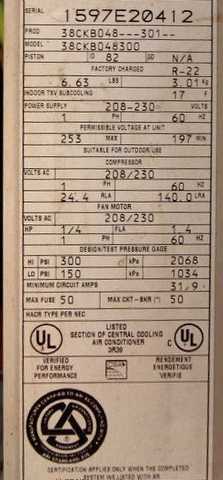
Carrier 1980-present: week and year are encoded in the first four digits of the serial number as WWYY1234567
Carrier equipment produced in the 1970's MY12345678 encoded the month and year as a letter (month) and single digit (year) where A=January -> M = December. e.g. A9xxxxxx = January 1979
Carrier equipment produced in the 1960's Y123456789 encoded just the year of manufacture as a single digit (year) in the first position of the serial number, e.g. 9xxxxxx = 1969.
Reader Question: where is the SEER rating on my Carrier Condenser unit?
(Jan 30, 2014) Kevin said:
I'm trying to find the SEER rating on my Carrier condenser.
Is it supposed to be on the data tag somewhere?
Reply:
Good question, Kevin, thanks.
No we do not generally see the SEER rating encoded nor explicit on an HVAC equipment data tag. Rather it is in the product literature.
I THINK that a reason for this is that the net SEER rating for a given air conditioner or heat pump depends on how a combination of components operates together while certain individual components might be used in more than one set-up.
Example: Carrier's Infinity Split System air conditioners are rated by the company at SEER 16.5 (Model 24ANB6) to 21 (Model 24ANB1)
BUT for some manufacturers there is a clue to SEER right in the model number. The Infinity Model 24ANB1 is designated with MODEL NAME INFINITY21 while the Infinity Model 24ANB6, rated at a seer of 16.5 is designated with MODEL NAME INFINITY16.
You can for this series only roughly approximate SEER by noting the model name. For example within the Infinity product line by Carrier, two Infinity Models designated INFINITY17 are rated at SEER 18.
Adding honesty to SEER ratings, companies typically state in the product literature "Up to SEER nn" recognizing that the actual energy efficiency in practice and in specific installations will vary.
In advertising law, "up to" claims, to be legally defensible, sport a number that must be met by at least ten percent of actual cases.
In our article on SEER (search InspectApedia for the title
Air Conditioning SEER Energy Efficiency Ratings Explained - HVAC Dictionary
I will add this Q&A and if I can find more details I will elaborate there on where & how to find the SEER of your equipment - thanks again. Daniel
OH - and if you give me the model number I'll dig up that specific seer. Send along a photo of the data tags on your equipment if you can - use the CONTACT link at the top or bottom of any of our pages.
Reader Question: age & data tag decoding for Command Aire equipment
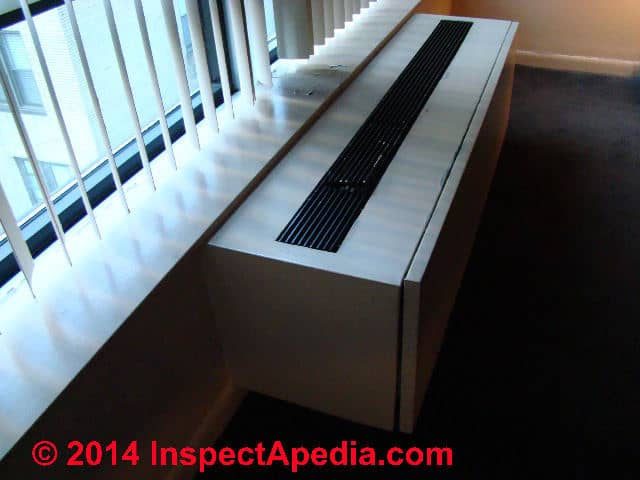
I am looking to replace a 30+ year old cooling/heating wall convector from a New York high-rise apartment unit.
Attached is the current unit in operation, and there a total of four (4) located in separate spaces within the unit.
[Click to enlarge any image]
 ...
... 
Can you please tell me if you know what kind of a unit this is from the poor quality photo (Command-Air(?)), and if there are modern replacements I can look into that possibly can be controlled from a wall plate control next to a light switch (for example). - D.C. 8/21/2014
Reply:
I'm not what I'm looking at in your photo.
But some basic information about wall convector units used for heating and/or cooling is at
Typically in a high rise apartment the energy source for heating and cooling will be piped from a common building source. You'll want to know what your building supplies before thinking about replacing the equipment.
Reader Follow-up:
The photo was a poor shot of the model label sent by the contractor currently remodeling the apartment. The units are enclosed within a built-in wooden lacquer cabinet, similar to the attached photos show.
I was trying to make out the unit name, and I believe it is an early 80’s Command-Aire model, about 62” wide by 12” deep. I’ve also attached a stand-alone model, with the controls on top beneath the grill.
I’m not sure about the building supply details yet, since I have not received information from the contractor, but I’m just trying to find a comparably model to replace this unit(s). I believe the overall size and top diffuser gives me a head start to look into a Trane Type AK model, just to start comparing.
Reply:
Command Aire brand was later bought by Trane - so when you know what type and model you've got installed that'd be a place to start looking for a compatible replacement.
When you have a clear image of the unit's data tag you'll see brand, model, serial number that will decode into just what is installed. There's little point in looking for equipment and prices before you know what kind of equipment works with your building's infrastructure.
Coleman HVAC Data Tags
- Coleman - see COLEMAN HVAC http://www.colemanac.com/
Command Aire Data Tag BTUh Capacity Decoding
For example, Command Aire included heat pumps (which you may not have)
SWPR 261 thru 611 water source heatpumps.
The three digit number following SWPR 261 indiates the unit BTUs
261 = 24000 BTUh
281 = 30000 BTUh
361= 36000 BTUh
411 = 42000 BTUh
511= 49000 BTUh
611= 62000 BTUh
Contact Trane (commercial / residential) at
(800) 945-5884
American Standard Heating & Air Conditioning
Customer Relations
20 Corporate Woods Dr.,
Bridgeton, MO 63044
Website: http://www.trane.com
Command Aire brand was bought by Trane - see Trane under T on this page.
D
E
F
Fedders Air Conditioner or Heat Pump Age Decoder
Month and year are encoded as alphabetic letters in the last two positions of the serial number, beginning with A = September and A = 1966
G
Reader Question: age of a GE air condenser unit
Could you help us determine the age of a General Electric central air condenser.
Model TA36H1F01 S/N 205100925
This unit appears to be extremely old, but would appreciate any help you can give me. - John 6/1/12
Reply:
John, Carson Dunlop's Technical Reference Guide has several pages of GE equipment data decoding information, including the observation that
beginning in 1944 GE coded the age in the last three digits of the serial number, with the year in the third from last position.
But the GE serial number codes on air conditioners & heat pumps used letters (N-Z = months Jan-Dec) and Year A-Y = 1944-1964, then repeated). Your serial number does not conform to the known codes for General Electric air conditioners. GE used letters not digits for month and year as I explained above.
Is it possible you are mis-reading a letter "Z" as a numeric "2" or a P or R as a "9" and an "S" as a "5" ?
Examples of troubles reading old fuzzy or partly obscured serial numbers or model numbers on HVAC equipment are in our article just above. So if your 2 and 5 are really SS the unit could be as old as May 1959 or perhaps more likely, as recent as 1980.
Send us a sharp focused photo of the entire label if you can and I'll comment further.
The Model Number you provided indicates in the two digits following the TA (TA36) 36,000 BTU/h
GE no longer makes A/C units - heat pumps were sold to Trane, Canada.
Also see GE GENERAL ELECTRIC WATER HEATER AGE
Goettel Air Conditioner Age
See GOETTL AIR CONDITIONER AGE & MANUALS
Goodman Data Tag HVAC Age Decoder
- YYMM567890 where YY = year of manufacture and MM = month of manufacture
H
See
- HAIER & HAIER AMERICA Air conditioners, dishwashers, other appliances, electric motors
- Hall Neal Furnace Company, ceased operation in 1966
- HALLMARK FURNACES (Boyertown Furnace)
- HARSCO INDUSTRIAL PATTERSON KELLEY BOILERS
- HARTLEY BOILER WORKS
- Hastings HVAC, unit & duct heaters
- HEARTHSTONE BOILERS also wood stoves, fireplace inserts, gas heaters
- HEAT CONTROLLER BOILERS (HCI) (also see CENTURY)
I
J
K
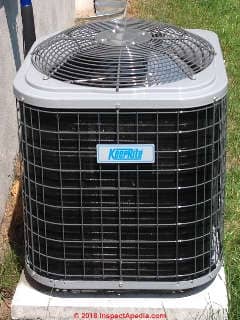
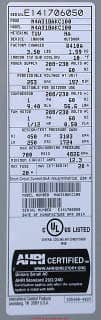
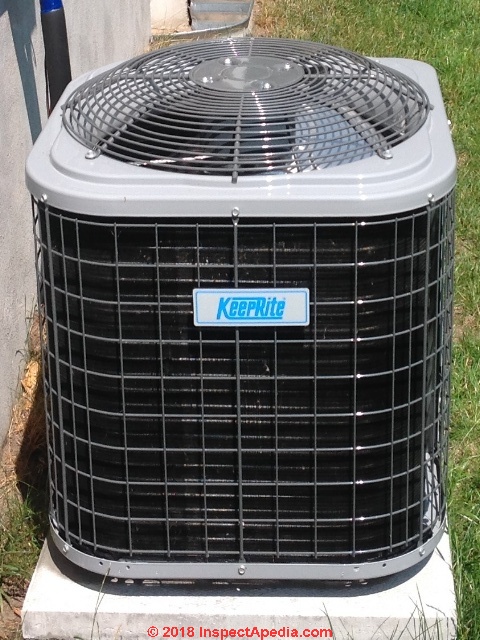
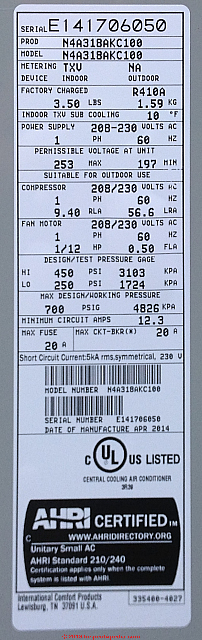
KeepRite Air Conditioner / Heat Pump Data Tags
KeepRite is a brand belonging to International Comfort Products, Lewisburg TN 37091 USA Website: https://www.keeprite.com/
International Comfort Products is part of UTC Climate Controls & Security that is in turn a unit of United Technologies Corporation.
[Click to enlarge any image]
 ...
... 
L
Lennox Air Conditioner or Heat Pump Age Decoder
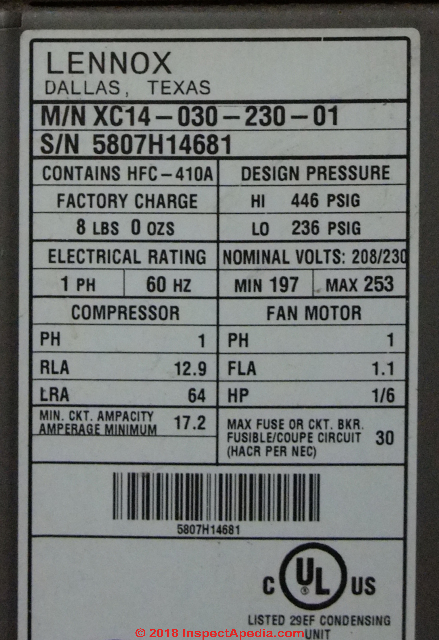
FFYYM345678
Since about 1974, digits 3 & 4 indicate year & digit 5 indicates month of production where the months are encoded beginning with A = January
Additionally, the first to digits - FF - identify the manufacturing plant wher the equipment was produced.
Also see contact information for Lennox and Lennox HVAC manuals for downloading
at LENNOX HVAC MANUALS & PARTS GUIDES Air Conditioners, Furnaces, Heat Pumps
Luxaire Heating & Air Conditioning Data Tags
- Luxaire - see LUXAIRE HEATING & AIR CONDITIONING - also see parent Daikin Industries DAIKIN GLOBAL
M
Mitsubishi Air Conditioner & Heat Pump Data Tags
 ...
... 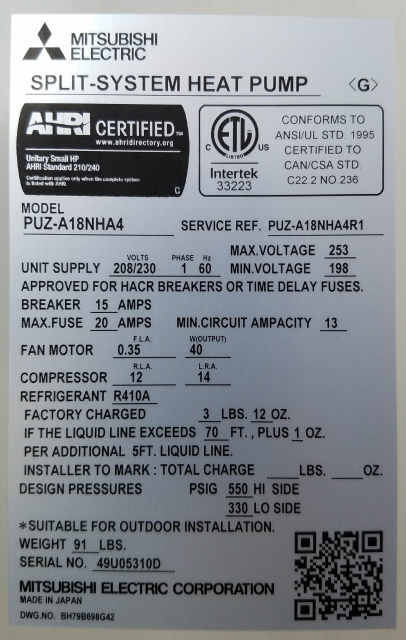
- See contact information and manuals at MITSUBISHI HVAC including Split Systems
N
See individual product MANUALS & PARTS GUIDES - HVAC as individual device manuals include data tag decoders
O
PQ
Payne HVAC Age Decoder
- Payne HVAC equipment age, 1980-present: week and year are encoded in the first four digits of the serial number as WWYY1234567
- .Also see Carrier Data Tag Decoding under the letter C at DATA TAGS on AIR CONDITIONERS
- Also see CARRIER AIR CONDITIONERS BOILERS FURNACES AGE MANUALS
- Also see BRYANT HVAC AGE MANUALS & PARTS GUIDES
R
Rheem & Ruud Air Conditioner or Heat Pump Age Decoding
Style 1: 12345WWYY
Last four digits of the serial number encode week of manufacture and year of manufacture as xxxxxWWYY
Style 2: FMMYY12345 where MM is the month of manufaacture and YY is the year of manufacture; F may be the manufacturing plant ID
Style 3: AB1C234DMMYY where where MM is the month of manufaacture and YY is the year of manufacture;
More Rheem data tag decoding details are
at RUUD & RHEEM HVAC AGE & MANUALS - A/C, Heat Pumps, Furnaces
S
Samsung Mini Split Age Decoder information in data tag
Serial Number : P1BW6XXXXX is translated as P1BYM12345
The 4th Digit is Y or the year of manufacture :
M = 2018 L = 2017 K = 2016 J = 2015 H = 2014 G = 2013 F = 2012 E = 2011 D = 2010 C = 2009 B = 2008 A = 2007 Z = 2006 Y = 2005 X = 2004, W = 2003, T= 2002, R= 2001, N= 2000, K= 1999, J= 1998, H= 1997
The 5th Digit is M or the month of manufacture : 1= Jan, 2= Feb, 3= March, 4= April, 5= May, 6= June, 7= July, 8= August, 9= Sept, A= Oct, B= Nov, C= Dec
Sanyo Split System Air Conditioner / Heat Pump Data Tags
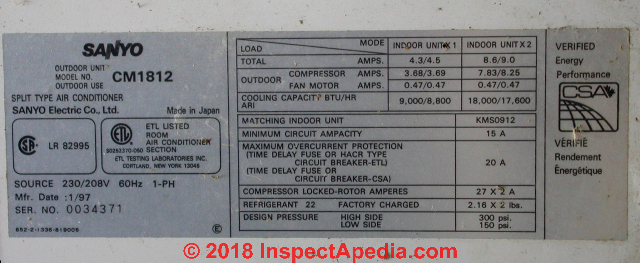
[Click to enlarge any image]
Singer Air Conditioner Data Tag Decoder
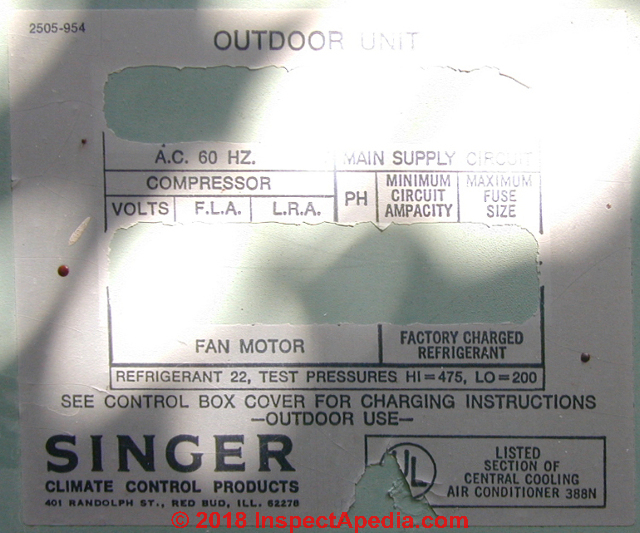
Watch out: in our OPINION if you encounter HVAC equipment whose data tags have been deliberately cut to remove product identification information you should assume that something fishy has been going on.
See details at SINGER HVAC MANUALS & PARTS
T
Tempstar
Trane Air Conditioner or Heat Pump Age Decoder
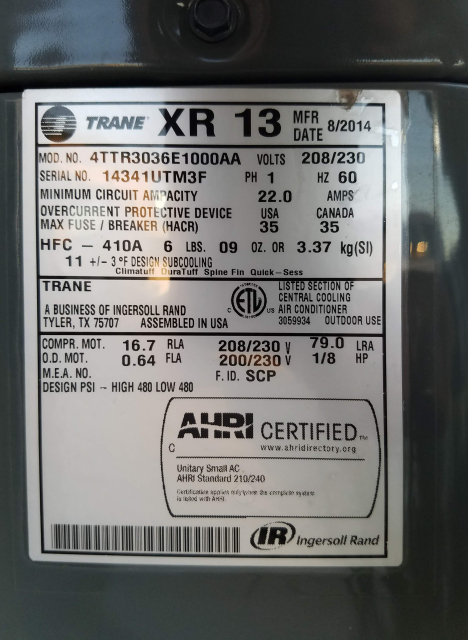
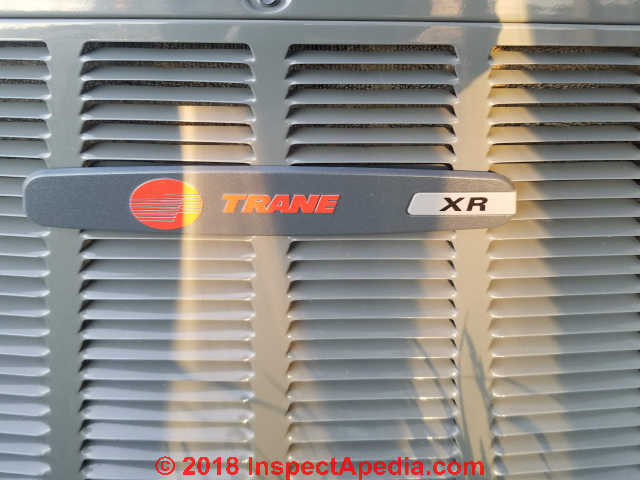
Above: Trane XR 13 data tag photographed near Kearney, Kansas
On later model Trane HVAC equipment the year of production is stamped as a four-digit year in the upper or lower right corner of the data tag.
Example 12/2015 decodes to 12 = December 2015 = year of manufacture
Other Trane Serial Number Formats & Decoders
- MYY-12345 where
M is an alphabetic code as follows A= Jan, B= Feb, C= March, D= April, E= May, F= June, F= July, H= August, J= Sept, K= Oct, L= Nov, M= Dec
YY is a two-digit year code for which you will have to guess the decade by other information such as building age, data tags, or reasonableness
Example:
C05-87345 decodes to C = March and 05 = 2005 - XYYM12345 decodes as
YY is a two-digit year code for which you will have to guess the decade by other information such as building age, data tags, or reasonableness
M is an alphabetic code as follows A= Jan, B= Feb, C= March, D= April, E= May, F= June, F= July, H= August, J= Sept, K= Oct, L= Nov, M= Dec
Example:
X05F-12345 decodes to 05 = 2005 and F = June using the same month codes as given just above
- YWWD1A23B decodes as
Y = year code 2000-2009
WW = week number (week 01 - 52)
D = work day within week - YYWWD1A23B decodes as
YY = year code 2010 - 2018
WW = week number (week 01 - 52)
D = work day within week - AYYM12345 decodes as
YY numeric year 01-09 for an un-specified decade
M is A= Jan, B= Feb, C= March, D= April, E= May, F= June, F= July, H= August, J= Sept, K= Oct, L= Nov, M= Dec - 1980's model Trane HVAC equipment encodes a single digit of year in the last position of the serial number or "sequence number"
123456Y
Y = Year between 1980 and 1989 encoded as follows:
0 = 1980, P = 1981, Q = 1982, R = 1983, S = 1984, T = 1985 U = 1986 V = 1987 W = 1988 X = 1989 (Note: this decoder fdor this decade is uncertain - citation needed)
- Other 1980's Trane HVAC equipment data tags encode a decade indicator "H" followed by a two digit year-in-decade indicator nn
HYY1234Z56
Example: H061234Z56 decodes as
H = decade 1980's
06 = year 6 or 1986 - 1970's model Trane HVAC equipment encodes the year and month as a single digit and single letter at the beginning of the serial number, as
YM12345 where
Y is a one-digit year used betwen1970 and 1979
M is an alphabetic code as follows A= Jan, B= Feb, C= March, D= April, E= May, F= June, G= July, H= August, J= Sept, K= Oct, L= Nov, M= Dec - For GE heating boilers made after 1982 and sold by Trane may encode the equipment manufacture date in one of these formats:
123456YWW
Y is encoded as an alphabetic letter T (perhaps for Trane) for 1982 (or by some sources 1981)
WW is the sequential week within year (01-52)
For GE Heating boilers made before 1982 see GE GENERAL ELECTRIC
For Trane manuals and specifications and contact information
see TRANE AIR CONDITIONERS & HEAT PUMPS - also see AMERICAN STANDARD AGE MANUALS & PARTS GUIDES boilers & furnaces for manuals used for both Trane & American Standard furnaces
U-V
Unitary Products Corp. HVAC Data Tag Decoder
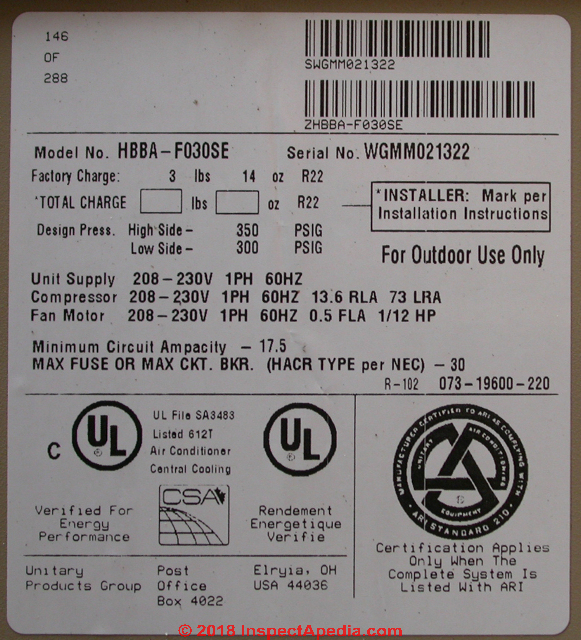
The U.S. Unitary Products Group (website http://www.upgnet.com/site/welcome.asp ) markets air conditioning and heat pump equipment under the following brands:
- Coleman - see COLEMAN HVAC http://www.colemanac.com/
- Luxaire - see LUXAIRE HEATING & AIR CONDITIONING - also see parent Daikin Industries DAIKIN GLOBAL
- York - see YORK INTERNATIONAL AC & HEATER Manuals, York International - http://www.yorkupg.com/
See UNITARY PRODUCTS HVAC - for manuals and contact information or see the individual brands listed above.
See also contact information and manual download sources at DAIKIN GLOBAL, Daikin Mini Split A/C, marketed in the U.S. until 1988p
In the U.S. a "unitary" lineup is offered by Daikin in the North American residential market.
W
Whirlpool Corporation Equipment Data Tag Translator
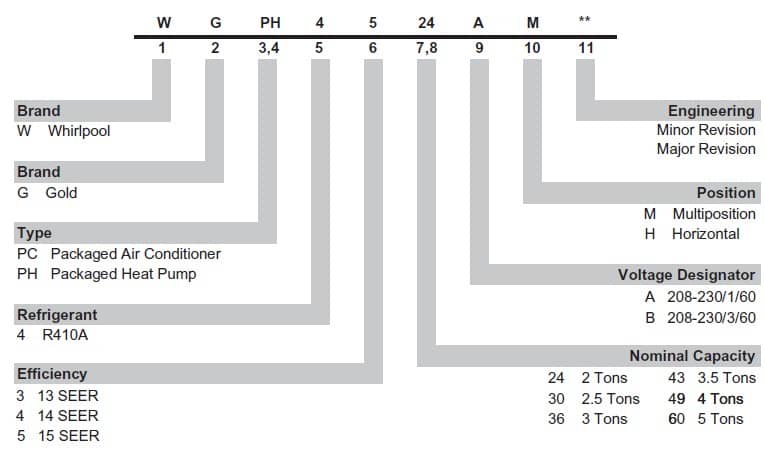
Source: Whirlpool WGPH45 Packaged Heat Pump, Product Specifications [17]
[Click to enlarge any image]
Whirlpool air conditioner and heat pump brand, type, refrigerant, SEER, and other data including heating or cooling capacity in tons is encoded in the model number positions as shown in the illustration above.
XYWW1234356
The age of Whirlpool air conditioners or heat pumps are encoded in the first four positions of the serial number as a decade and year (one alphabetic digit, one numeric digit) and week of manufacture (two numeric digits).
where Y = Year as follows: G = 1970's, H = 1980's, I = 1990's, J = 2000s, K = 2010s
where WW = week number
Example: J752XXXXX = 2007, week 52.
W-X-Y-Z
See individual product MANUALS & PARTS GUIDES - HVAC as individual device manuals include data tag decoders
York HVAC Data Tag Information
York - see YORK INTERNATIONAL AC & HEATER Manuals
Where to Buy Carson Dunlop Associates' Technical Reference Guide decodes equipment data tags for air conditioners, heat pumps, etc.
Carson Dunlop Associates' Technical Reference Guide (below) provides the most extensive HVAC equipment data tag decoder & other information to determine the age of boilers, furnaces, water heaters, air conditioners, and heat pumps by decoding the product serial number.
For the most complete and very detailed HVAC equipment data tag and age decoding information anywhere (about 128 manufacturers & brands), Alan Carson and Bob Dunlop, of Carson Dunlop, Associates, Toronto, have provided us with (and we recommend) Carson Dunlop Weldon & Associates'
Technical Reference Guide - to manufacturer's model and serial number information for heating and cooling equipment
Special Offer: Carson Dunlop Associates offers InspectAPedia readers in the U.S.A. a 5% discount on any number of copies of the Technical Reference Guide purchased as a single order. Just enter INSPECTATRG in the order payment page "Promo/Redemption" space.
The Carson Dunlop Technical Reference Guide provides both equipment data tag decoding data and also manufacturer contact information as well as historical dates for many brands of heating and cooling equipment
. Included in the manufacturers listed are also makers of ancillary equipment such as controls, circulator pumps, etc., not just boilers, furnaces, and heat pumps themselves.
References for HVAC controls & switches
- See OPERATING CONTROLS, A/C & HEAT PUMP Air Conditioning A/C System Operating Controls & Overcurrent Protection discusses the electrical power controls, fusing, fuse sizing, and amperage or current measurements on air conditioning equipment
(in the section on SAFETY CONTROLS On that page). - A/C - HEAT PUMP CONTROLS & SWITCHES - Switches and Controls on a typical split system with indoor and outdoor components were listed in the first chapter at A/C COMPONENT LIST
- MANUALS & PARTS GUIDES - HVAC - alphabetical list of manuals & guides sorted by manufacturer, free downloads
Watch out for Confusing or Mis-Reading Letters & Numerals on Old HVAC Equipment Data Tabs
Especially when equipment is old or has been located outside where its data tag can become obscured, faded, or damaged, it is easy to confuse as certain numeric digits some alphabetic characters, and vice versa.
Our table below gives some confusion examples to watch for. So if information about model numbers or serial numbers for a given manufacturer specifies that that company use a mix of alphabetic and numeric characters (E.G. General Electric), and you see only numeric, look again to see if you're making a mistake.
Table of HVAC Data Tag De-Coding Errors |
|
| Numeric Character | Confused With alphabetic or numeric |
| Numeric 0 - zero | Alphabetic O |
| 1 | I |
| 1 | L |
| 2 | S |
| 2 | Z |
| 3 | E (reading upside down) |
| 3 | 8 |
| 5 | S |
| 6 | 9 (reading upside down) |
| 6 | G |
| 7 | 2 |
| 8 | B |
| 9 | 6 (reading upside down) |
Other information tags and stickers on air conditioners and heat pumps
Service and refrigerant connections
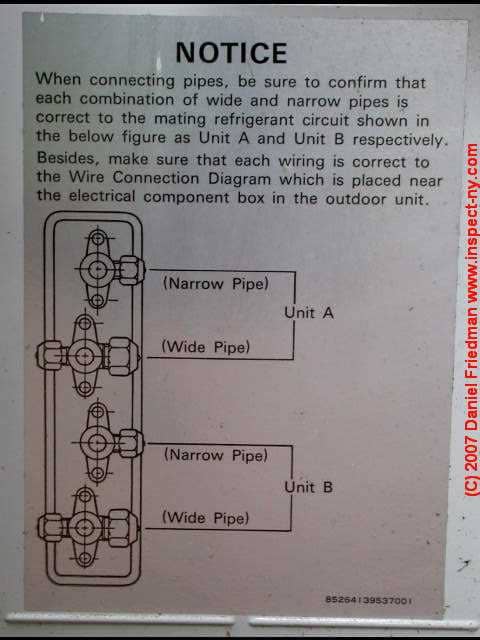
Service information and/or refrigerant piping hook-up may be provided by a separate sticker on the air conditioner compressor/condenser unit, such as the piping arrangements shown on this split-unit compressor side.
More critical service data such as refrigerant type and operating pressures are recorded in the main data tag shown earlier.
Air conditioner or heat pump basic wiring diagrams
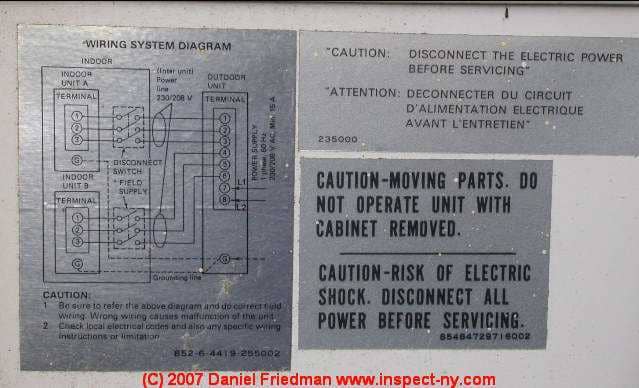
A basic hook-up wiring diagram may be provided by the manufacturer on a separate sticker on the air conditioner compressor/condenser unit such as this one from the Sanyo unit.
Air conditioner or heat pump safety warnings
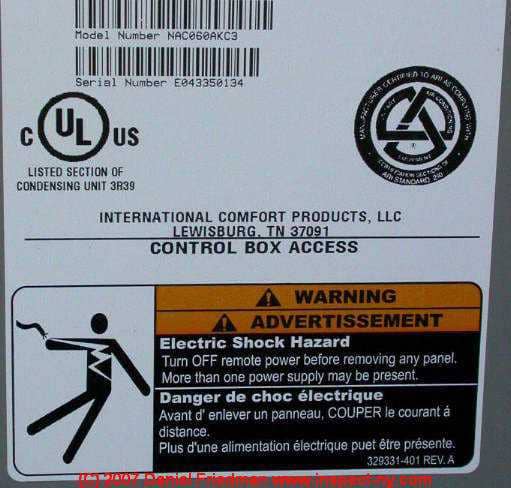
Safety warnings for consumers and service people also appear on tags or stickers on modern air conditioning and heat pump units, such as shown in the photo above.
Data information tags on commercial air conditioning and heat pumps
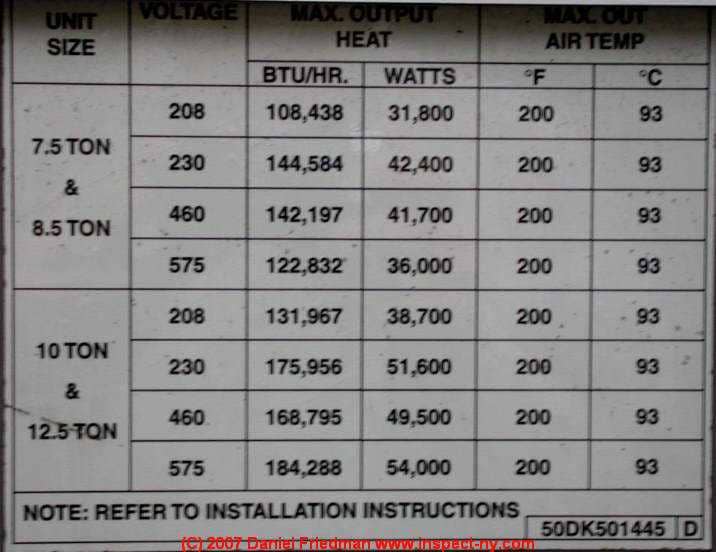
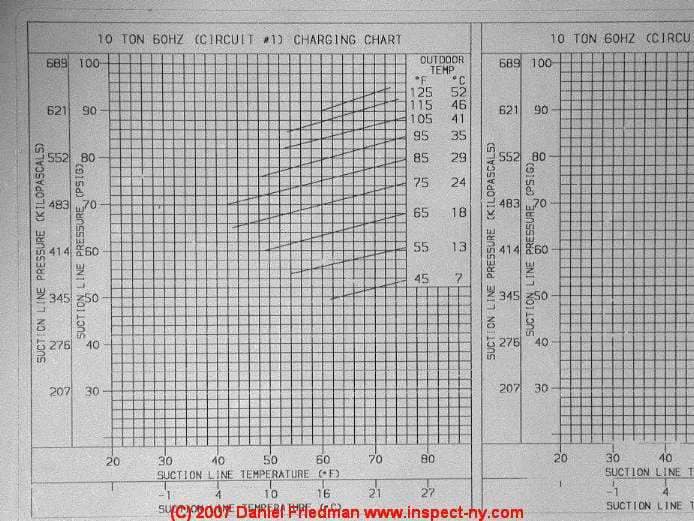
Commercial air conditioning or A/C/Heat pump units such as the rooftop unit from which these data tag photos were taken often provides additional and critical capacity and service data.
[Click to enlarge any image]
The first or left hand tag shows the equipment's operating capacity in both BTUH and watts, and shows a maximum air temperature at the unit. The second photo at right shows a refrigerant charging chart that must be consulted by the service technician who monitors suction line (low pressure or return line) temperature and pressure.
Reader Comments, Questions & Answers About The Article Above
Below you will find questions and answers previously posted on this page at its page bottom reader comment box.
Reader Q&A - also see RECOMMENDED ARTICLES & FAQs
On 2021-03-22 - by (mod) -
@Jesus,
Each air handler or indoor blower unit and each outdoor compressor condenser unit will have its own unique serial number
On 2021-03-21 by Jesus
Are all condenser/air handler serial numbers the same or are they unique
On 2018-05-21 - by (mod) -
Copeland
CR22K6-PFV is an air conditioner/ heat pump compressor model
The "98A41716 H" might be a serial number - though without knowing the HVACR equipment brand and model a guess of "1998" as a date of manufacture is a wild shot in the dark.
On 2018-05-21 by Copeland
CR22K6-PFV 378 ? 98A41716 H
On 2017-07-30 by Okot Charles
Enter your comment here not clear
On 2017-05-22 - by (mod) -
Perry,
With the apology that I'm not as expert as a senior HVAC tech with more experience, yes I think your assessment is reasonable in this regard:
The absence of a high current draw argues against a seized motor bearing or shaft or pumping against abnormally high head pressure.
You want the installation and operation manual fodr your RUUD equpment.
Some Ruud equipment will be found from Rheem - and at this web page
https://inspectapedia.com/heat/HVAC-Manuals-Air-Conditioners-Boiler-Furnaces-P-S.php#Ruud
On 2017-05-21 by Perry Hendrickson
I have a RUUD model UAMB-048JAZ built in 04/00. Current draw is 17 amps peak during run versus the tag R.L.A. 19.3 amps. High side pressure is 270 psi vs. tag Design Press. 300 psi. The compr outlet temp is 167 F and condenser coil outlet is about 88 F. Ambient temp is 85 F and 70% humidity (Houston, TX). Return temp to compressor is about 60 F. All this seems within acceptable performance. A technician told me the run amps are too high and I should replace the unit.
My readings seem to say I don't yet need a new unit. Is my assessment reasonable? I know when it gets hotter and high humidity, the unit will run harder and may draw even higher amps. What I read above seems it is OK to run at RLA of 19.3 amps listed on the tag continuously in the cycle. Is that correct? I can monitor as our temps rise to see the change in amps draw.
On 2017-02-21 - by (mod) -
I'm not sure how to answer "legal" questions as that's the decision of your local building code inspector, naomie.
But I'm doubtful that the installation is the best. The outdoor heat pump compressor/condenser unit needs free air circulation and clearance space above and around it to work properly. Putting a compressor condenser unit udner a mobile home surrounded by a skirt is highly unlikely to be a proper installation.
Details are at https://inspectapedia.com/aircond/HVAC_Clearance_Distances.php CLEARANCE DISTANCE, HVAC
On 2017-02-21 by naomie
I replaced my old hvac with an air handler and a heat pump, the air handler was installed under the mobile home is this legal ?
...
Continue reading at SEER RATINGS & OTHER DEFINITIONS or select a topic from the closely-related articles below, or see the complete ARTICLE INDEX.
Or see DATA TAGS on AIR CONDITIONERS FAQs - questions & answers about data tags on air conditioners and heat pumps
Or see these
Recommended Articles
- AGE of a BUILDING
- AGE of AIR CONDITIONERS & HEAT PUMPS
- AGE of HEATERS, BOILERS, FURNACES
- AGE of PLUMBING MATERIALS & FIXTURES
- ARCHITECTURE & BUILDING COMPONENT ID
- DATA TAGS on HEATING EQUIPMENT
- FURNACE AGE DECODING CHART - PDF
- LIFE EXPECTANCY of AIR CONDITIONER or HEAT PUMP
- LIFE EXPECTANCY of FAN / WALL CONVECTOR
- LENNOX HVAC products Age PDF
- MANUALS & PARTS GUIDES - HVAC - home - Master Index to All Brand Names & HVAC manuals, wiring diagrams, installation and repair guides
- WATER HEATER AGE & MANUALS - tables & books decoding all brands.
- WATER HEATER AGE DETERMINATION CHART - PDF
- WATER HEATER Life Expectancy Comparisons
Suggested citation for this web page
AGE of AIR CONDITIONERS & HEAT PUMPS at InspectApedia.com - online encyclopedia of building & environmental inspection, testing, diagnosis, repair, & problem prevention advice.
Or see this
INDEX to RELATED ARTICLES: ARTICLE INDEX to AIR CONDITIONING & HEAT PUMPS
Or use the SEARCH BOX found below to Ask a Question or Search InspectApedia
Ask a Question or Search InspectApedia
Try the search box just below, or if you prefer, post a question or comment in the Comments box below and we will respond promptly.
Search the InspectApedia website
Note: appearance of your Comment below may be delayed: if your comment contains an image, photograph, web link, or text that looks to the software as if it might be a web link, your posting will appear after it has been approved by a moderator. Apologies for the delay.
Only one image can be added per comment but you can post as many comments, and therefore images, as you like.
You will not receive a notification when a response to your question has been posted.
Please bookmark this page to make it easy for you to check back for our response.
Our Comment Box is provided by Countable Web Productions countable.ca
Citations & References
In addition to any citations in the article above, a full list is available on request.
- Thanks to Scott at SJM Inspect for suggesting this EPA document and for technical editing remarks regarding our air conditioning website, SJM Inspection Service LLC, serves the entire state of CT, sjminspect.com 203-543-0447 or 203-877-4774 5/16/07
- Thanks to Patrick Greaux 02/02/2009 for suggesting clarification of LRA - Locked Rotor Amperage.
- [18] N Lu, YL Xie, Z Huang, "Air Conditioner Compressor Performance Model", U.S. Department of Energy, August 2008, [copy on file as PNNL-17796.pdf] Available to the public from the National Technical Information Service, U.S. Department of Commerce, 5285 Port Royal Rd., Springfield, VA 22161 ph: (800) 553-6847, fax: (703) 605-6900 email: orders@ntis.fedworld.gov online ordering: http://www.ntis.gov/ordering.htm
- In addition to citations & references found in this article, see the research citations given at the end of the related articles found at our suggested
CONTINUE READING or RECOMMENDED ARTICLES.
- Carson, Dunlop & Associates Ltd., 120 Carlton Street Suite 407, Toronto ON M5A 4K2. Tel: (416) 964-9415 1-800-268-7070 Email: info@carsondunlop.com. Alan Carson is a past president of ASHI, the American Society of Home Inspectors.
Thanks to Alan Carson and Bob Dunlop, for permission for InspectAPedia to use text excerpts from The HOME REFERENCE BOOK - the Encyclopedia of Homes and to use illustrations from The ILLUSTRATED HOME .
Carson Dunlop Associates provides extensive home inspection education and report writing material. In gratitude we provide links to tsome Carson Dunlop Associates products and services.
 | HOME | ABOUT | ASK a QUESTION | CONTACT | CONTENT USE POLICY | DESCRIPTION | POLICIES | PRIVACY | |
| © 2024 - 1985 Publisher InspectApedia.com - Daniel Friedman | |||||||||