InspectAPedia.com InspectAPedia®
Google
InspectAPedia
 

Free Encyclopedia of Building & Environmental Inspection, Testing, Diagnosis, Repair

Ask a Question or Search InspectAPedia

  • HOME
  • AIR CONDITIONING
  • DAMAGE ASSESSMENT
  • ELECTRICAL
  • EXTERIORS
  • HEATING
  • HOME INSPECTION
  • INTERIORS
  • PLUMBING
  • ROOFING
  • SEPTIC SYSTEMS
  • STRUCTURE
  • WATER SUPPLY
  • ENERGY SAVINGS
  • ENVIRONMENT
  • INDOOR AIR IAQ
  • INSULATION
  • MOLD INSPECT TEST REMOVE
  • NOISE
  • ODORS
  • SOLAR ENERGY
  • VENTILATION
  • EXPERTS DIRECTORY
  • CONTACT US


InspectAPedia ® Home

AIR CONDITIONING & HEAT PUMP SYSTEMS

AGE of AIR CONDITIONERS & HEAT PUMPS
AIR CONDITIONER TYPES, ENERGY SOURCES
AIR FILTER EFFICIENCY
AIR FILTERS, FIBERGLASS PARTICLES
AIR FLOW MEASUREMENT CFM

BLOWER FAN OPERATION & TESTING
BOOKSTORE - Air Conditioning "How To" Books

CAPACITORS for HARD STARTING MOTORS
CAPILLARY TUBES
CIRCUIT BREAKER SIZE for A/C or HEAT PUMP
CLEANING & Legionella BACTERIA
CONDENSING COIL
COOLING LOAD REDUCTION by ROOF VENTS
CRITICAL DEFECTS on A/C SYSTEMS

DEFINITION of Heating & Cooling Terms
DEW POINT TABLE - CONDENSATION POINT GUIDE
DIAGNOSE & FIX AIR CONDITIONER / HEAT PUMP
DUCTS - Asbestos
DUCT INSULATION, Asbestos Paper
DUCT INSULATION for SOUNDPROOFING
DUCT SYSTEM NOISES
DUST, HVAC CONTAMINATION STUDY

ELECTRIC MOTOR OVERLOAD RESET SWITCH
EVAPORATOR COIL or COOLING COIL
EVAPORATIVE COOLING SYSTEMS

FAN NOISES

GAUGE, REFRIGERATION PRESSURE TEST

HEAT LOSS (or GAIN) in buildings

INSPECTION CHECKLIST - OUTDOOR UNIT
INSPECTION LIMITATIONS, A/C SYSTEMS

LOST COOLING CAPACITY
LOW VOLTAGE TRANSFORMER TEST

MOTOR OVERLOAD RESET SWITCH
MOLD in AIR HANDLERS & DUCT WORK

OPERATING COST, AIR CONDITIONER
OPERATING DEFECTS, AIR CONDITIONING

REPAIR & DIAGNOSTIC FAQs for A/C
RETROFIT SIZING for A/C or HEAT PUMPS

SYSTEM OPERATION

WATER COOLED AIR CONDITIONERS

More Information

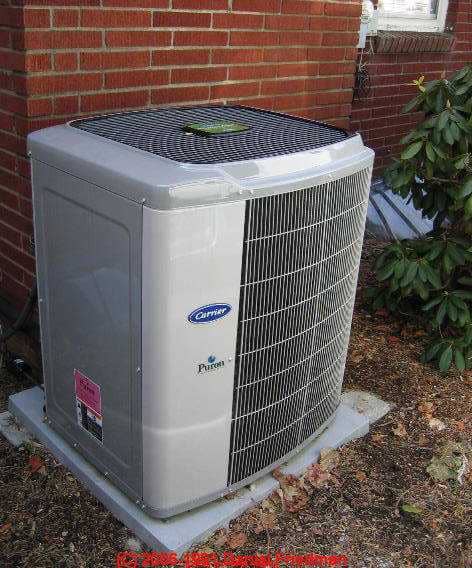
Photograph of  This new compressor was placed directly against
a brick wall. One third of its condenser coil cooling ability was blocked. Air Conditioning & Heat Pump Compressor/Condenser Unit: inspection, diagnosis, repair or replacement guide
     

  • COMPRESSOR & CONDENSING COIL, A/C - CONTENTS: Guide to troubleshooting an air conditioner or heat pump compressor/condenser unit
    • How does an air conditioner compressor and condensing coil work?
    • What is the "Compressor" unit in an air conditioner or heat pump system?
    • What are the components of the outdoor compressor/fan-coil unit on an air conditioner?
    • Air conditioner or heat pump compressor motor crankcase heaters
    • Air conditioner compressor problem diagnosis & repair guide
    • Air conditioner condenser compressor fan diagnosis & repair
    • Loss of air conditioner or refrigerator cooling capacity
    • Types of air conditioner or heat pump compressors & compressor designs
    • When is an air conditioner or heat pump compressor or fan/coil unit at or near end of its life?
  • Questions & Answers about HVAC compressors & condensers: the condensing unit
  • References

Click to Show or Hide Related Topics

  • AIR CONDITIONING & HEAT PUMP SYSTEMS - home
  • A/C COMPONENTS
  • AIR HANDLER / BLOWER UNITS
  • BTU CHART for AIR CONDITIONERS / HEAT PUMPS
  • CLEARANCE DISTANCE, HVAC
  • COMPRESSOR & CONDENSING COIL, A/C
    • BURNED-OUT COMPRESSOR
    • CAPACITORS for HARD STARTING MOTORS
    • CONDENSING COIL REPAIR REPLACE
    • CONTACTOR RELAY DIAGNOSIS & REPAIR
    • CONTROL CIRCUIT BOARD, A/C
    • CRANKCASE HEATERS
        ELECTRIC MOTOR DIAGNOSTIC GUIDE
    • FAN, COMPRESSOR/CONDENSER UNIT
    • HARD STARTING COMPRESSOR MOTORS
    • INSPECTION CHECKLIST - OUTDOOR UNIT
    • INSTALLATION ERRORS, COMPRESSORS
    • LEVELING REQUIREMENTS, COMPRESSOR
    • LONG-ON CYCLING AC COMPRESSOR
    • MOTOR OVERLOAD RESET SWITCH
    • NOISES, COMPRESSOR CONDENSER
    • Pressure Controls & Safety Switches
    • PRESSURE READINGS, COMPRESSOR
    • REPLACING A COMPRESSOR
    • SHORT CYCLING AC COMPRESSOR
    • TIGHT or SEIZED AC COMPRESSORS
  • CONDENSATE HANDLING, A/C
  • CONTROLS & SWITCHES, A/C - HEAT PUMP
  • CONDENSING COIL REPAIR REPLACE
  • COOL OFF HEAT THERMOSTAT SWITCH
  • COOLING CAPACITY, RATED
  • COOLING COIL or EVAPORATOR COIL
  • DATA TAGS on AIR CONDITIONERS
  • DEHUMIDIFICATION PROBLEMS
  • DUCT SYSTEM & DUCT DEFECTS
  • DUCTLESS AIR CONDITIONERS & HEAT PUMPS
  • EDUCATION & CLASSES, HVAC SCHOOLS
  • ELECTRIC MOTOR DIAGNOSTIC GUIDE
  • EXPANSION VALVES, REFRIGERANT
  • FAN, AIR HANDLER BLOWER UNIT
  • FAN AUTO ON Thermostat Switch
  • FAN, COMPRESSOR/CONDENSER UNIT
  • FAN CONVECTOR HEATERS - HYDRONIC COILS
  • FROST BUILD-UP on AIR CONDITIONER COILS
  • GAUGE, REFRIGERATION PRESSURE TEST
  • HEAT PUMPS
  • HUMIDITY LEVEL TARGET
  • MANUALS & PARTS GUIDES - HVAC
  • MINI SPLIT AIR CONDITIONERS & HEAT PUMPS
  • NOISE AIR CONDITIONER / HEAT PUMP
  • ODORS in AIR HANDLERS & DUCT WORK
  • OPERATING TEMPERATURES
  • PORTABLE ROOM AIR CONDITIONERS
  • PRESSURE READINGS, REFRIGERANT
  • REFRIGERANTS & PIPING
  • REPAIR GUIDE - A/C or Heat Pumps
  • REPAIR TOPICS A/C & HEAT PUMPS
  • ROOFTOP A/C / HEAT PUMP
  • SEER RATINGS & OTHER DEFINITIONS
  • SPLIT SYSTEM Ductless Air Conditioners
  • SWAMP COOLERS
  • THERMOSTATS, HEATING / COOLING
  • THERMOSTATIC EXPANSION VALVES
  • WALL CONVECTORS Heating / Cooling
  • WINDOW / WALL AIR CONDITIONERS
InspectAPedia tolerates no conflicts of interest. We have no relationship with advertisers, products, or services discussed at this website.

Air conditioner compressor unit diagnosis & repair guide: this article discusses the outdoor components of air conditioners and heat pumps: how the air conditioning compressor-condenser unit works; the detection of defects in air conditioning compressor and condensing units, including evaluation of air conditioner compressor noises, hard starting, lost cooling capacity, and detection of a burned out compressor or A/C compressors at or near end of their life. Maintenance tips including attention to compressor support pads and avoiding air conditioning refrigerant leaks are also addressed.

Green links show where you are. © Copyright 2013 InspectAPedia.com, All Rights Reserved. Author Daniel Friedman.

How do Air Conditioning Compressor / Condenser Units Work?
What is the "Compressor" unit in an air conditioner or heat pump system?

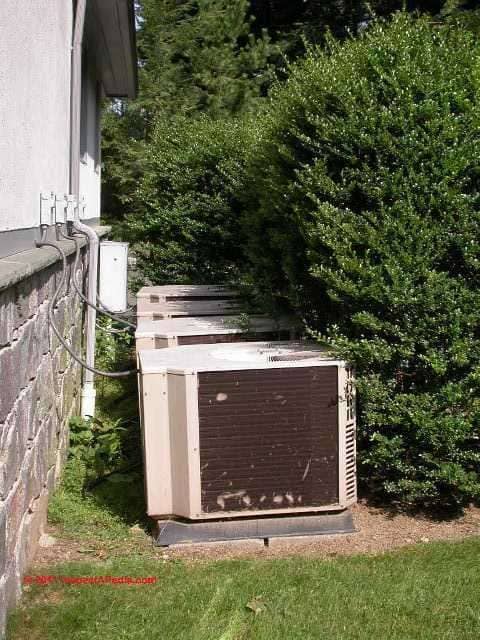
Air conditioning compressors overgrown with shrubs (C) Daniel Friedman

In a nutshell, the air conditioner compressor, condenser, fan unit is the "outdoor" half of an air conditioning or heat pump installation that uses a compressor motor (below right) to compress refrigerant gas to high pressure, sending the pressurized gas through cooling coils (condensing coils) where aided by air movement drawn by the condenser unit fan, the gas is returned to a liquid refrigerant state. The process of compressing and then condensing the refrigerant back from a gas to a liquid also moves heat out of the refrigerant and into outdoor air. We explain this process in detail below.

The outdoor half of a typical air conditioning system (shown at below left) is a unit containing the refrigerant compressor and condensing coil and a cooling fan. In our photo the gray screened area covering one side of the condensing coil of the first compressor in this row is easily visible. The compressor motor itself (below-right) is not visible unless the covers of this unit are removed.

Do I Need a New A/C or Heat Pump Compressor Unit?

Watch out: before assuming that the compressor motor or the entire HVAC compressor/condenser unit needs replacement, be sure you (or more likely your trained, qualified HVAC repair technician) has checked for simple and lower-cost problems such as a bad start/run capacitor, contactor relay switch, control board, or even just a loose wire or similar component.

What is the Average Life of an Air Conditioning or Heat Pump Compressor ?
Air conditioning compressors overgrown with shrubs (C) Daniel Friedman

Just how long should an air conditioning or heat pump compressor unit or motor last?

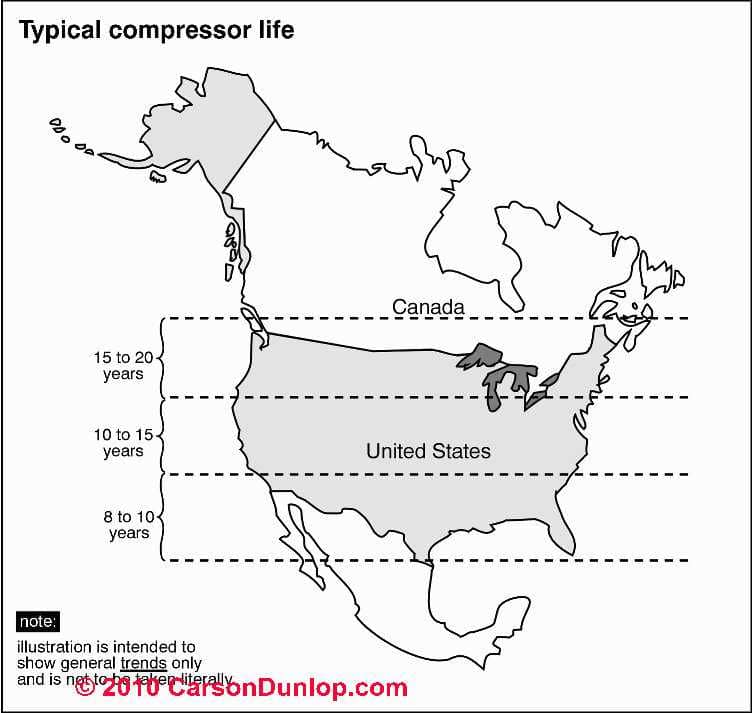
There is not a single right answer. The typical life of an A/C compressor ranges from 10-20 years, as you can see in Carson Dunlop Associates' sketch at left.

But besides the climate (how hard and how many days a year the compressor unit has to work), other factors can be very important including

  • Compressor/condenser location: putting the unit where air flow is blocked causes the system to work harder, increases operating costs, and reduces compressor motor life
  • Failure to install inspect, maintain, and repair the equipment can include factors that reduce compressor life such as
    • Liquid slugging of the compressor by an improper refrigerant charge or by a misadjusted thermostatic expansion valve
    • Improperly routed or sloped refrigerant tubing, loss of lubricating oil
    • Dirt in the system, for example following replacement of a burned-out compressor motor
    • Frequent low voltage conditions at the electrical power supply
    • A bad start-run capacitor leaving the compressor spending lots of time trying to start its motor
    • Other A/C or heat pump compressor/condenser unit problems listed in our detailed repair guide (page left links under COMPRESSOR & CONDENSING COIL, A/C)

See INSPECTION CHECKLIST - OUTDOOR UNIT for a simple checklist for the outdoor compressor/condenser unit. Also see DIAGNOSE & FIX AIR CONDITIONER / HEAT PUMP where we include some suggestions for diagnosing compressor or condenser fan and coil problems that can mean intermittent or totally lost cooling capacity of your system. Initial, simple diagnostic checks of the air conditioning compressor are also described at Compressor failure diagnosis. For a discussion of the indoor components of an air conditioning or heat pump system see AIR HANDLER / BLOWER UNITS.

If your air conditioning or heat pump system has lost its cooling capacity or won't start see REPAIR GUIDE for AIR CONDITIONERS. See How to determine the cooling capacity of air conditioning equipment if the system seems to be working but is inadequate to cool your building. Contact us to suggest text changes and additions and, if you wish, to receive online listing and credit for that contribution.

Air conditioning compressors overgrown with shrubs (C) Daniel Friedman Air conditioning compressors overgrown with shrubs (C) Daniel Friedman

Even with the covers off you wont' see much of the actual air conditioner compressor motor: A/C compressor motors in residential and most commercial systems are hermetically sealed motors - that is, the motor is encased in a sealed steel can - all you'll see is a black metal container with metal (usually copper) tubing and some wires running to it.

That's the compressor motor. In our illustration of a hermetically-sealed residential compressor motor (above right), the smaller cylinder to the right of the compressor is a filter/dryer built onto this replacement unit.

Below we will sketch the internal parts of this air conditioner compressor motor.

How the Air Conditioning Compressor/Condenser Unit Works to Move Heat from Indoors to Outside

Schematic of an air conditioner compressor unit showing inspection points (C) Carson DunlopThe A/C Compressor: The air conditioning compressor motor is a pump which draws sensible heat laden refrigerant gas from the building's indoor components (evaporator or "cooling coil" in the indoor air handler) through the larger diameter refrigerant suction line into the compressor where that pump compresses the low pressure refrigerant gas to high pressure and higher temperature.

Raising the coolant (refrigerant) temperature above outdoor ambient temperature causes heat to flow from the coolant (flowing out of the compressor and through the outdoor A/C condenser coil) into outdoor air. (Heat always flows from warmer to cooler substances).

Sketch courtesy of Carson Dunlop Associates.

As we explain at THERMOSTATIC EXPANSION VALVES, it is the flow restriction provided by a cap tube or by a TEV in the refrigerant piping system that allows the A/C compressor pump to raise the system pressure and thus increase the temperature at which the coolant changes state. In other words, the TEV or cap tube allows the compressor to reduce refrigerant pressure on the LOW side of the metering device and raise refrigerant pressure on the HIGH side of the metering device.

Incidentally, A/C compressors can only accept and compress refrigerant in gas form. In fact the refrigerant vapor is superheated to be sure that there is no liquid at the pump - lest the pump be damaged. If liquid refrigerant were to flow into the compressor motor it would most likely cause catastrophic damage.

The A/C Condenser: The high pressure high temperature refrigerant gas leaves the outdoor compressor and enters the outdoor condensing coil where it is cooled to a liquid state by the condensing unit fan that blows outside air across the condensing coil or by immersion of the condensing coil in cooling water in some designs.The heat produced in these steps is transferred to the outside by a fan which blows outside air across the condensing coil. The liquid refrigerant is then able to return to the indoor components for cooling and dehumidifying the building interior.

Definition of an Air Conditioner or Heat Pump

An air conditioner or heat pump compressor is a basically a motorized pump which moves refrigerant gas from the indoor cooling coil (where it has evaporated to cool indoor air blowing over that coil) to the outdoor compressor/condenser where the gas is compressed and cooled back to a liquid form. Refrigerant gas moves from the indoor air handler cooling coil to the outdoor compressor via the larger refrigerant "suction line". Liquid refrigerant returns from the outdoor compressor/condenser to the in-building air handler and evaporator coil. Evaporating liquid refrigerant inside the indoor cooling coil cools and dehumidifies indoor air. Condensing refrigerant gas outdoors at the compressor/condenser effectively is moving heat from indoors to the outdoor air. [During heat pump "heating" cycles the process is reversed, moving "heat" from outdoor air to the indoor coil.]

The diagnosis and repair of various defects in the air conditioning compressor/condenser unit are discussed in detail using the links provided at the left of this page. Here is more detail about the components of the air conditioner or heat pump compressor/condenser unit:

Heat pumps are described separately and in more detail at HEAT PUMPS.

What are the Components of the Outdoor Portion of a Central Air Conditioning System - the Air Conditioning Compressor Unit?

  1. Photograph of  this air conditioning compressor sketch shows and labels the basic
components of an A/C compressor unit.The Air Conditioning Compressor Itself - on residential units the A/C compressor motor is most often a hermetic motor-compressor combined in a single sealed unit like the Carrier™ unit shown at left.

    You cannot actually see the individual A/C compressor parts because at least on residential air conditioners or heat pumps, the entire assembly is enclosed. Sketch from Carson Dunlop Associates.

    If a ductless split-system air conditioner is installed an outside compressor unit is still required, typically looking like the Sanyo™ unit shown at the top of this page.

    If a "portable" indoor air conditioner is in use, all of these parts may be inside of a single portable cooling unit, usually mounted on wheels. Portable air conditioner units use a duct and fan system to blow to outdoors the heat that has been extracted from indoor air.

    Window air conditioners also contain all of these parts in a single unit, but by hanging the window unit in a window or in a wall opening, the device has ready access to outdoor air into which it ultimately is transferring heat from indoors.

    How does an air conditioning compressor motor work?

    The job of the compressor/condenser unit is to recompress warm refrigerant gas (pulled from the indoor air handler cooling coil) back to a liquid refrigerant that can be returned to the indoor cooling coil once again. When the room thermostat calls for cooling, both the indoor blower or air handler and the outdoor compressor/condenser begin to work. Control circuits and a contactor relay turn on the outside compressor/condenser motor and its outdoor cooling fan as well.

    The air conditioning or heat pump compressor compresses the incoming refrigerant to a high pressure gas and moves that gas into the condensing coil described just below. Typically a piston moves up and down inside of a cylinder inside the compressor motor, drawing in refrigerant gas on the down stroke of the piston, and compressing the refrigerant gas on the up stroke of the piston. (Some refrigeration compressors such as those made by Frigidaire™ used a rotary compressor design that we found durable and powerful enough to lead us to salvage and re-use these motors for other purposes.

    The refrigerant gas leaves the compressor at high pressure and at high temperature (since compressing a gas will raise its temperature). In most air conditioning or heat pump compressors, a piston moves up and down to draw in and then compress refrigerant gas, moving refrigerant vapor from the incoming low side to the outgoing high side of the compressor.

    The refrigerant gas leaving the compressor (and entering the condensing coil) will contain both heat that the refrigerant absorbed at the evaporator coil (heat from air in living space of the building), and additional heat produced at the compressor by the process of compressing the gas. The refrigerant gas is thus heat laden with sensible heat (heat that we can measure) from the living area and compressor heat from the compressor motor.

    Low side and high side refer to the low-pressure and high-pressure areas of the air conditioning equipment and are defined in more detail at SEER RATINGS & OTHER DEFINITIONS where we also explain sensible heat and other air conditioning terms.

    Refrigeration and Air Conditioning Theory: In an air conditioning system, pressure is used to change (increase) the vaporization point (state change from liquid to gas) or condensation point (state change from gas to liquid) of the refrigerant. On the A/C system's high side (high refrigerant gas pressure side of the system), the condensation point must be some temperature above ambient outdoor air temperature (if air is being used to cool the condensing coil) or condensation of the refrigerant gas back to a liquid will not occur.

    Creation of high side & low side in a refrigeration system: The restriction in refrigerant flow created by the thermostatic expansion valve (TEV, discussed below) [or on many systems simpler CAPILLARY TUBES] located close to the evaporator coil (cooling coil) allows the compressor to raise the pressure and increase the temperature at which the refrigerant (coolant) will change state (from liquid to gas in the cooling coil, and from gas back to liquid in the condensing coil).

    This restriction in refrigerant flow at the TEV is what allows the compressor a pressure difference between the high side and low sides of the system. Evaporator coil is defined at A/C COMPONENTS and discussed further at AIR HANDLER / BLOWER UNITS. TEVs, AEVs, manual and adjustable expansion valves, and float valves are discussed at THERMOSTATIC EXPANSION VALVES. Capillary tubes for metering refrigerant are discussed separately at CAPILLARY TUBES.

    Room air conditioners such as window or through wall mounted units, and some other refrigeration equipment such as a home refrigerator, use a capillary tube (cap tube) instead of a thermostatic expansion valve. A cap tube is simply a small diameter tube used to meter liquid refrigerant from the "high" side of the system into the cooling coil (the start of the low side of the system). Unlike a TEV, a cap tube is fixed in output and cannot be adjusted.

    State changes of refrigerant are what remove heat: Refrigeration systems rely on two state changes of the refrigerant: gas to liquid, and liquid back to a gas. It is these state changes of the refrigerant that move sensible heat from one side of the air conditioning system to the other: by absorbing BTUs of heat during evaporation (in the evaporator coil) and by releasing BTUs of heat during condensation (in the condenser coil).

    R12 refrigerant has a boiling point of -21 degF (change of state from liquid to gas vapor) and R22 has a boiling point of -41 degF.

    State change of refrigerant gas to liquid: The state change of the air conditioning refrigerant from a high pressure high temperature gas back to a liquid occurs inside the outdoor condensing coil. This state change (gas to liquid) releases energy in the form of heat which is blown into outdoor air (or transferred into water). Note: the compressor has to produce high enough output pressure that the gas moving through the condensing coil moves at a good velocity in order to scrub the entire condensing coil tubing surface and thus transfer its heat out through the condensing coil tubing into ambient air (or water).

    State change of refrigerant liquid to gas: the state change from a liquid refrigerant to a low pressure gas occurs in the indoor evaporator or cooling coil, absorbing energy in the form of heat (the heat in indoor air being blow across the evaporator coil), thus moving heat from the indoor air into the refrigerant gas in the system. For example, R12 changes state at -21 degF; R22 changes state at -41 degF.
    Watch out: use safety glasses when handling refrigerant gases. Getting a liquid refrigerant in your eye can cause serious permanent eye damage.

    So summing up this theory and practice of air conditioning, the job of the air conditioning compressor is to reduce pressure on the low side (cooling side) of the system and to increase pressure on the high side (warming side) of the system. These pressure differences move refrigerant through the system and enable it to change states from liquid to gas (at the TEV and in the evaporator coil) and from gas to liquid (in the condensing coil). This process moves heat (absorbed by the evaporator coil inside the cooling or refrigerated area) through the condenser coil and into outside air (or water).

    Special oil used in air conditioning & refrigeration compressor motors

    Air conditioning and refrigeration compressors use a special oil which does not react with the refrigerant liquid or gas in the system. The oil may mix and travel with the refrigerant however, and some cooling systems are designed for deliberate movement of the compressor oil in order to lubricate some parts such as refrigerant metering valves or compressor valves.

  2. Refrigerant lines:

    The larger diameter refrigerant suction line connects the indoor evaporator coil outlet to the compressor inlet. The larger refrigerant line (located on the low side of the system) reduces system pressure and causes vaporization of the refrigerant (so that sensible heat is absorbed and the suction line feels cool to the touch). Refrigerant returning to the compressor from the evaporator coil and through the refrigerant low pressure suction line, is in the form of a low pressure, low temperature gas.

    Most air conditioning compressors are designed only to pump gas vapors, not liquid refrigerant (which could damage compressor internal parts).

    The refrigerant gas entering the compressor at its inlet port is said to be heat laden, that is, it was at a low-enough temperature to have absorbed heat from the evaporator coil in the living area.

    The smaller-diameter high pressure refrigerant lines connect the compressor outlet and the condensing coil inlet and also move refrigerant liquid in it's cooled, condensed and now liquid state from the outlet of the condensing coil to the thermal expansion valve (basically a refrigerant metering device) and the evaporator coil inlet in the air handler unit in the building. This smaller (in diameter) refrigerant piping or tubing (located on the high side of the air conditioning system) reduces volume and thus increases pressure and temperature in the lines (so that sensible heat can be transferred to ambient outdoor air or water if a water-cooled air conditioner system is in use).

    Service valves or ports are usually present on the refrigeration lines near the compressor. to permit testing the condition of the air conditioning system and permit removal, replacement, or additions to the refrigerant in the system.

  3. Air conditioning condensing coil schematic (C) Carson DunlopCondensing coil (shown at left) receives high pressure refrigerant gas from the compressor and cools this refrigerant gas back to a liquid state. Sketch from Carson Dunlop Associates.

    Typically refrigerant leaves the compressor and enters the outdoor condensing coil at about 100 psi and about 95 degF. These pressures vary of course by type of refrigerant, ambient temperatures, compressor details, etc.

  4. Outdoor cooling fan moves outdoor air across the condensing coil to cool it and assist in condensing the high pressure, high temperature refrigerant gas back into a liquid.

    It is this process which completes the transfer of heat through the refrigerant from indoor air to outdoor air as the compressor/condenser unit compresses and then cools the refrigerant back to a liquid.

    See FAN, COMPRESSOR/CONDENSER UNIT for help in diagnosing and fixing problems with the outdoor compressor/condenser fan and fan motor.

    Watch out: as we explain at BURNED-OUT COMPRESSOR, if the condensing unit fan is not working the compressor itself may shut down or even be ruined by overpressure or over temperature. Also see NOISES, COMPRESSOR CONDENSER where some noise problems are traced to the cooling fan .

  5. Electrical shut-off switch(es) for service at the unit are provided to permit maintenance and repair of the equipment. Below we describe the basic electrical switches and controls on air conditioners and heat pumps. See A/C - HEAT PUMP CONTROLS & SWITCHES for details.

    Circuit breaker(s) at the electrical panel protect the circuit supplying power to the air conditioning system. Typically separate circuit breakers (or fuses) power the compressor/condenser unit and the indoor air handler/blower assembly.

    A/C Compressor control board (C) D Friedman
    Air conditioner / heat pump control circuit board (typically a "control board" shown in our photo at left) and a contactor relay (shown in our photo below) are used in the compressor/condenser to turn it off and on in response to the indoor thermostat's call for cooling.

    While diagnosing a circuit or component problem within an air conditioner or heat pump control board is beyond the skill of most homeowners, a simple visual inspection might show you that the control board has been visibly burned, broken, or damaged. Of course the board may look OK and still be damaged.

    See CONTROL CIRCUIT BOARD, A/C for details.


    A/C Compressor control board (C) D FriedmanA/C heat pump Contactor Relay: A/C and heat pump systems use a contactor relay (circled at left) because the little 12-24V wall thermostat circuit and switches are not capable of handling the higher voltage used by the compressor/condenser motors.

    The contactor relay is basically a low-voltage-operated switch [typically 12-14 volts] controlled by the low-voltage room thermostat) that switches a heavier-duty electrical relay to give 120V or 240V electrical power to the compressor/condenser unit.

    Most A/C and heat pump contactor relays use an electromagnetic 24-volt two-pole contactor relay that is rated for 30 amps. The "two poles" simply means that the relay switches two electrical wires simultaneously - which is what you'd expect if your heat pump motor is running on 240 Volts.

    See details at CONTACTOR RELAY DIAGNOSIS & REPAIR

    Also see A/C - HEAT PUMP CONTROLS & SWITCHES

    Watch out: Some of our readers report successfully replacing minor electrical components such as switches, relays, and contactors. But unless you are qualified to do so we do not recommend trying to do work on electrical systems and components in your home as there are potentially fatal electrical shock hazards. Because air conditioner compressor/condenser units include start/run capacitors (see CAPACITORS for HARD STARTING MOTORS), even when you have turned off power you can get a nasty shock if you're not careful.

    Also see SAFETY for ELECTRICAL INSPECTORS and Using DMMs & VOMs Safely.

  6. HVACR Compressor Motor Crankcase Heater Warnings

  7. Air conditioner or heat pump compressor motor crankcase heaters:

    A crankcase heater is used to warm an air conditioner or heat pump compressor motor to help protect against liquid slugging damage to the compressor and to assure that lubrication oil residing in the compressor motor base will be distributed properly when the compressor motor first starts operation. Not all compressor models use a crankcase heater. For models that do use a crankcase heater to permit system operation without damage at lower temperatures, manufacturers give power-on requirement warnings such as the following:

    Furnish power to crankcase heater a minimum of 24 hr before starting unit. To furnish power to heater only, set thermostat to OFF and close electrical disconnect to outdoor unit. NOTE: On 24ANA7 models, starting the compressor without a minimum of 12 hours of crankcase heat prior to initial start--up may result in a compressor chattering noise and possible damage to the compressor.
    [2]

All of the above-listed air conditioner or heat pump components are discussed in detail throughout this website using the links at the left of these pages.

Air Conditioner or Heat Pump Compressor Unit Safety, Damage, & Environmental Warnings

Using Carrier installation instructions for the Carrier 24ANA unit as an example [2] and quoting:

[Compressor/Condenser] Unit Operation & Safety Hazard

Failure to follow this caution may result in minor personal injury, equipment damage or improper operation. To prevent compressor damage or personal injury, observe the following

  • Do not overcharge system with refrigerant.
  • Do not operate unit in a vacuum or at negative pressure.
  • Do not disable low pressure switch
  • Dome temperatures may be hot in scroll and bottom temperatures may be hot in recip.

Environmental Hazard Warnings - Failure to follow this caution may result in environmental damage.

Federal regulations require that you do not vent refrigerant to the atmosphere. Recover during system repair or final unit disposal.

Minimum Air Conditioner Compressor Unit Observations for an Air Conditioner Home Inspection Report

Example home inspection report language for an air conditioning compressor:

  • The compressor and fan operated normally.
  • The rated cooling capacity, estimated age and general condition of the unit are reported below.

    OR
  • We did not operate this equipment because ... Therefore you should ...
    [... explanatory text inserted by inspector]

Types of air conditioner or heat pump compressors & compressor designs

Sealed Compressors
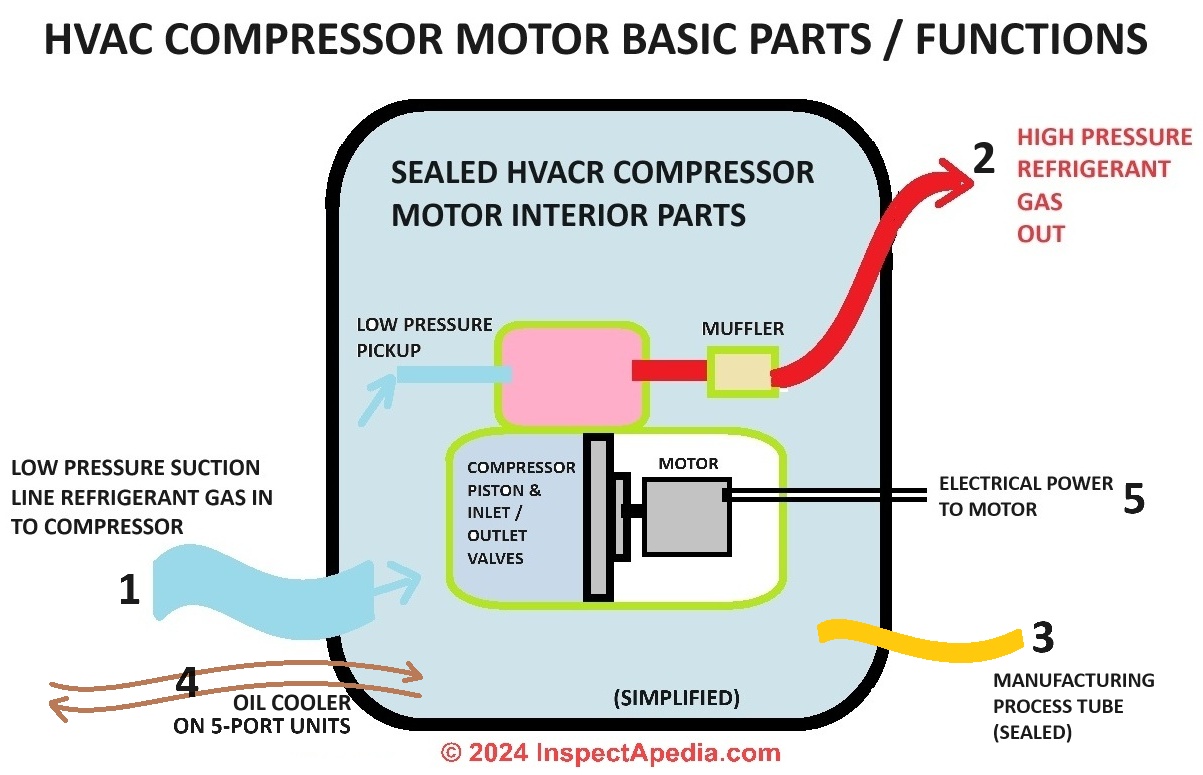
Sealed unit air conditioner heat pump compressor motor schematic (C) D FriedmanSealed air conditioning or heat pump compressors enclose both the driving electric motor and the mechanical compressor engine itself within a hermetically sealed "can".

Sealed compressors cannot be opened for repair in the field and are normally replaced entirely when needed.

The diagnosis of a sealed compressor relies on external observations and measurements such as current draws (amps) of the compressor motor and the operating pressures the equipment can achieve.

While a sealed hvac compressor unit can't be field-repaired, the unit can be replaced as an entire system, and in some cases the damaged unit can be traded in for an allowance on the replacement compressor.

What are those three tubes seen welded or soldered to the hermetically sealed HVAC compressor can? There are three tubes you'll find on a typical sealed compressor unit:

  1. A suction line (generally larger in diameter - low side line) - receives low pressure refrigerant gas from the cooling coil
  2. A condenser line (generally smaller in diameter - high side line) - sends high pressure refrigerant gas as compressor output to the condensing coil
  3. A third line, blocked off, not used in the field - the process tube. This tube is used by the manufacturer of the compressor unit to test and charge the system.
  4. 5-port HVAC or refrigeration compressors: include a low side, high side, and process tube and two more tubes that send oil through an oil cooler or oil cooler condenser. The oil cooler condenser lines will always be close together and close to the bottom of the unit (to pick up oil to be cooled) - that's how you can identify which of those tubes coming in and out of the sealed compressor are doing which jobs.

Watch out: if you are carrying a refrigerator or freezer in other than upright position, that is if you have to place the unit on its side, place it so that the low side (suction side) refrigerant lines are facing "up" so as not to drain oil or liquid refrigerant into a line where it does not belong and where it may block a cap tube.

If you make a mistake and carry the appliance in the wrong position, you would be smart to leave it in the upright or operating position for a few hours before turning it on to avoid forcing a slug of oil into (and blocking) the CAPILLARY TUBES often used on home refrigerators or freezers. Leaving the system upright allows oil that may have leaked into the refrigerant line to drain back into the compressor motor. If you turn on the system too soon the risk is that you push this oil into the cap tube where it may remain or be hard to get out or worse, you may leak oil into the reed valves where they will be damaged when the compressor motor is turned on.

Open type refrigeration compressors

Open type refrigeration compressors are commonly found on automotive air conditioning systems. The motor that drives the actual compressor (the mechanical engine that compresses refrigerant gas) is physically separate from the compressor and is located outside of it. Typically a motor drives the compressor via a belt and pulley system (cars and some commercial refrigeration systems).

This is why you should run your automobile air conditioner from time to time even out of the cooling season - to lubricate the shaft seal around the compressor motor/pulley - that's a spot where refrigerant may leak out at a dried seal.

Semi-sealed HVAC compressors

Semi-sealed compressors can be disassembled and repaired, as can the open type above.

Air Conditioner / Heat Pump Compressor Valves - two common designs

All compressors have a suction and a discharge valve to control refrigerant flow through the unit.

Reed Valve refrigeration compressor motors

Often the valve is a reed design - in which case the bottom reed is the intake valve and a top mounted reed is the discharge reed or valve that discharges out through a noise muffler into the condenser piping and coil.

It is these valves that can be destroyed if liquid refrigerant is sent through the compressor.

Rotary valve refrigeration compressor motors - Frigidaire rotary compressor motors
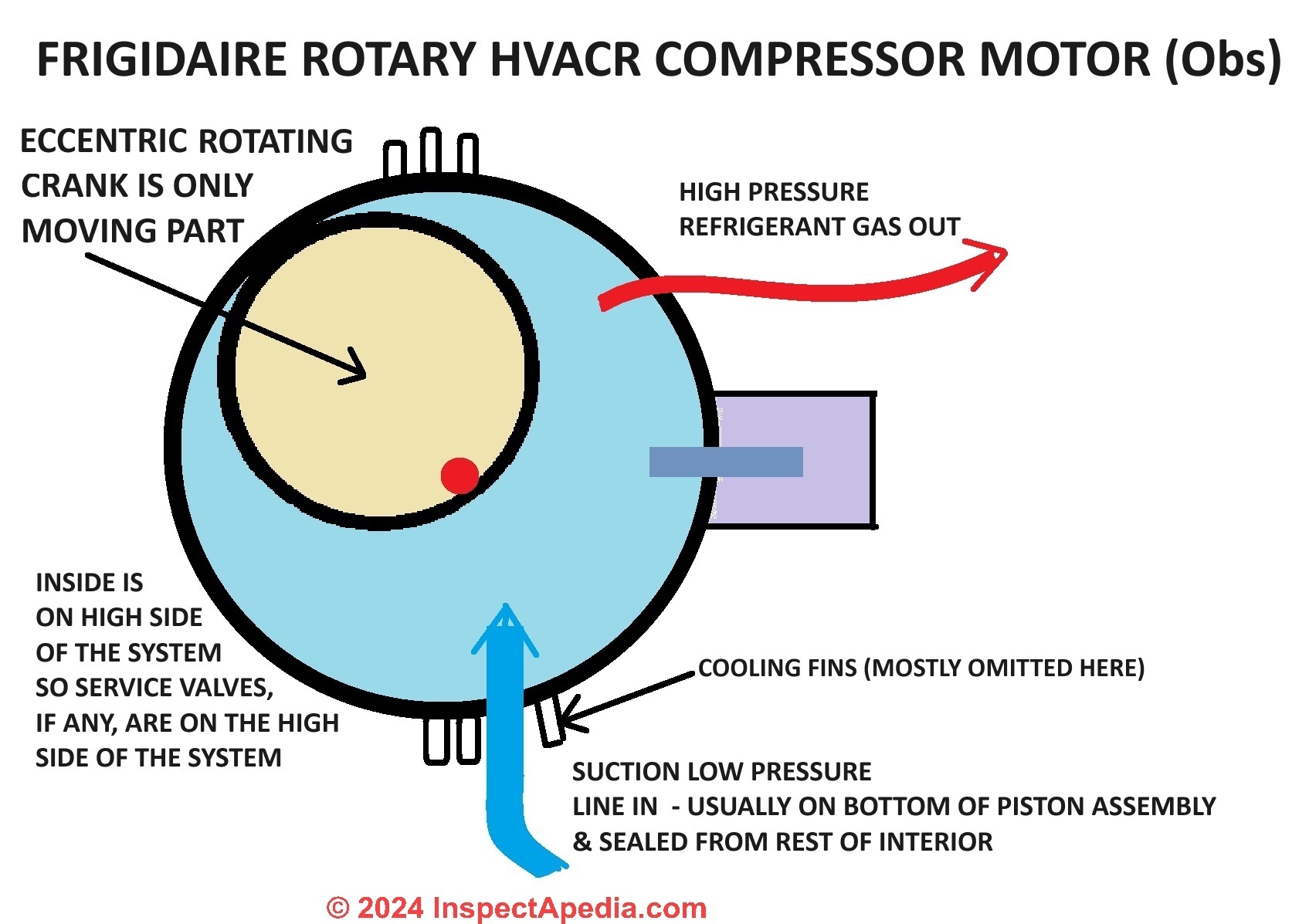
Frigidaire eccentric crank rotary compressor design sketch (C) D FriedmanSome other refrigeration compressor valve designs are quite different from these simple reeds, including an old and very successful eccentric crank system: the rotary compressor motor design patented by Frigidaire™ and used in refrigerators for several decades.

This compressor motor design was used in a range of Frigidaire equipment and appliances including refrigerators and some air conditioners. The durability of the design stems at least in part from its simplicity: a simple eccentric crank (see our sketch at left) is the only moving part in the motor.

On this compressor motor the inlet or suction line is generally found on the bottom of the unit, feeding directly into the bottom of the piston assembly and sealed from the rest of the chamber. The interior of the compressor chamber (sketch note and arrow at left) is on the HIGH side of the system. So service valves, if they are installed at all, are placed on the high side of the system there.

Frigidaire eccentric crank rotary refrigeration compressor motors were remarkably durable and reliable - we used a salvaged Frigidaire refrigerator compressor as our HVAC service vacuum pump for many years.

Air Conditioner / Heat Pump Compressor Motor Refrigerant Oils

Refrigeration compressor motors use 300 viscosity oils when working with refrigerants in the Freon family and 150 viscosity oils when working with other refrigerants. These are special oils that use a non-wax base such as Texaco Capella oil or oils by Virginia Chemical.

The refrigeration oil lubricates the moving parts of the compressor motor as it receives and compresses refrigerant gases. At Types of air conditioner or heat pump compressors & compressor designs when we warned that carrying a refrigerator or freezer on its side could drain oil out of the compressor motor into the refrigerant lines where it might later become a problem by blocking the capillary tube or might enter reed valves causing valve damage, this is the oil we were talking about.

How to diagnose and fix an air conditioning system that is not working

If your air conditioning system won't work, follow these easy A/C-heat pump diagnostic guides

Schematic of an air conditioner compressor unit showing inspection points (C) Carson Dunlop
  • At LOST COOLING CAPACITY, our focus is on the case in which the air conditioning system seems to be "running" but not enough cool air, or no cool air at all is being delivered to the occupied space. Sketch from Carson Dunlop Associates.

    At OPERATING DEFECTS we take you through the major air conditioning problem symptoms and how to get the air conditioning system working again.

  • At A/C - HEAT PUMP CONTROLS & SWITCHES we explain the many electrical switches and controls that control an air conditioner or heat pump system. You'll need to check these if your air conditioner won't start.

List of air conditioning system diagnostic articles: See our complete list of air conditioning system diagnostic and repair guide articles just below.

Since the failure of an air conditioner to turn on, loss of air conditioner cooling capacity, reduced air conditioning output temperatures, loss of cool air supply, or even loss of air flow entirely can be due to a variety of problems with one or more components of an air conditioner or air conditioning system, after reviewing the lost air conditioner cooling diagnosis procedures described in this article, be sure to also review the diagnostic procedures at each of the individual air conditioning diagnosis and repair major topics listed just below. To return to our air conditioning and refrigeration home page go to AIR CONDITIONING & HEAT PUMP SYSTEMS.

If your air conditioning or heat pump system has lost its cooling capacity or won't start, or if your air conditioning electrical bill has increased even though the system "on" time has not changed, select one or more of the diagnostic articles listed below.

  • A/C - HEAT PUMP CONTROLS & SWITCHES: air conditioner controls and switches - begin here if your A/C won't start. Here's an important tip: most refrigeration problems, in air conditioners, refrigerators, or freezers, are electrical, not mechanical. In air conditioning school, we used to drive out and collect abandoned refrigerators that people were tossing out during our community's spring cleanup week. Taking these appliances back into the shop we found that almost always the problem that had caused the owner to dispose of their air conditioner or freezer was in an electrical connection or electrical control. So it's worth checking out switches and controls on an air conditioner before replacing more costly components.
  • OPERATING DEFECTS: major air conditioning problem symptoms and how to get the air conditioning system working again,e.g. compressor or fan noises, failure to start, and inadequate cool air volume
  • LOST COOLING CAPACITY: what to do when not enough cool air comes out of the system
    • What to check first if there is no cool air or not enough cool air Compressor failure diagnosis: basic checks of the air conditioner compressor
    • Ducts & Air Handler diagnosis: basic checks of the indoor air handler (blower), air ducts, and filter systems
  • COMPRESSOR CONDENSER: problems with air conditioner compressor/condenser units. Examples of signs of a failing air conditioner compressor include hard starting or increased electrical bills when the A/C system is running. See the links listed at Related Topics , including BURNED-OUT COMPRESSOR and HARD STARTING COMPRESSOR MOTORS, and also MOTOR OVERLOAD RESET SWITCH.. AIR HANDLER UNIT: problems with the air handler, air filters, and the cooling coil itself.

    If the fan in the air handler unit is not running, also see MOTOR OVERLOAD RESET SWITCH.DUCT SYSTEM DEFECTS: problems with the air duct system, air filters, supply registers, return air registers A/C REFRIGERANT LEAK DETECTION: how to use a TIF5000 to detect air conditioning refrigerant gas leak
  • A/C DIAGNOSTIC FAQs: air conditioning system diagnostic FAQs: Q&A about air conditioner repair - a detailed air conditioning system diagnostic checklist

Frequently Asked Questions (FAQs) about Air Conditioner or Heat Pump or other refrigeration system Compressor/Condenser Units

Beginning at COMPRESSOR & CONDENSING COIL, A/C see the articles at Related Topics for detailed HVAC compressor/condenser troubleshooting and repair procedures. We include more general compressor/condenser questions just below.

Question: compressor just runs for a few seconds, then cuts off; short cycling A/C compressor problems

My condenser starts for a few seconds then cuts off cycle continues - Anon.

my compressor fun has started to short cycle, it run for 2-3 min then shuts off for one second then restarts runs again then stops etc. with no funny sounds or noises - Don

Reply:

It's not clear from your question where in the entire cooling system your unit's troubles begin, so I'd look at diagnostic tips that may explain your compressor/condenser short cycling are found at LOST COOLING CAPACITY. Certainly a compressor that is having trouble starting can be diagnosed at HARD STARTING COMPRESSOR MOTORS, if you're sure the trouble is outside.

Question: ice on the refrigerant line, no cooling in the house

My line set going to outdoor unit has ice on it. Lost cooling in house. What is the problem and is there anything I can do to fix the issue - Pat

Reply: check the indoor air handler for an ice-blocked coil

A problem with a refrigerant metering device (thermostatic expansion valve, capillary tube, etc), or even a dirty air filter can lead to improper metering of refrigerant into the indoor cooling coil, leading to icing; but other causes of ice formation include an improper refrigerant charge or even something as simple as missing refrigerant line insulation. But when you also lose cooling inside, I suspect an ice blocked coil. See FROST BUILD-UP on AIR CONDITIONER COILS

Question: ice build up inside the ductwork

I have ice build up on the inside of the furnace duct work. This will plug up the lines and the fans will not circulate thus stop blowing cold air

Reply:

If you find ice build-up inside the ductwork itself that's pretty unusual except in winter in freezing climates when moist air is rising into the duct system. Usually ice forms at the cooling coil in an air conditioner air handler or blower unit.

But I agree that ice can block air flow and more, when it melts, can cause water damage or even a mold problem in the building.

For more detailed advice please see WATER & ICE IN DUCT WORK.

To diagnose and fix ice formation on the cooling coil itself, see FROST BUILD-UP on AIR CONDITIONER COILS

Question: My A/C unit kept blowing a fuse, now nothing runs

My Center A/C unit had a tuned up. I clean the evaporator, I put the blower down and put the new motor and clean the blades deeply, I have a clean filter, I clean the condenser deeply, and I bought a new thermostat. OK. The unit star running normally and you fill the normal warm air in the fan (outside) But 3 to 5 minutes later the heat in the condenser air increased suddenly the condenser stop with noise, and I need to turn it off. what is this? Please give me a clue? - Anon 6/28/22

I have a pretty old Tappan unit, and when the power goes out, if the A/C is running it will blow the fuse, usually we just replace the fuse, and now nothing will run on the A/C unit. any ideas? - Shantel 6/20/11

Reply:

Shantel:

Often when an A/C unit keeps blowing the fuse it's a sign that the compressor is drawing high amps which means it's jamming which, I'm sorry to say, means it's at end of its life. I'd have a service tech look at the unit; it might limp along for a while longer if s/he installs a hard-start capacitor kit. When "nothing runs" you may have meant that the fuse or breaker tripped enough times that you've lost power on that circuit.

Anonymous - from what you describe you need a service call from a trained HVAC tech.

Question: My hi line is cold, low line is warm and the condenser blows hot air

In my situation the high pressure line is colder than the low pressure line. The condensor coil blows mainly hot air, but the end closest to the compressor blows hotter air than the end furthest from the compressor line. Any suggestions? - Jim T. 7/13/11

Reply:

Mundo suggested: hey jim t check for restriction at the evaporator

Jim T:
Also, is your unit a heat pump or only an air conditioning system? - Editor. Let's be sure your system is in cooling mode.

Question: water comes out of my system when I turn on the A/C

When i turn on the (AC Outside unit Lennox ) there is an overflow of water in my basement at the furnace which is a gas furnace- Don 7/24/11

Reply:

Don if you see water in your basement at the A/C unit when it's on, your condensate drain or pump is not working.

Question: No water is coming out of the condensate drain

water is not going through the drain hose - Anon 7/20/12

Reply:

Anon:

If you don't see condensate coming out of the condensate drain there are several likely explanations:

- the drain system for condensate has become clogged - you need to clear the drain line - check this first

- the system is off or not in cooling mode so not producing condensate

- the air is dry enough in your environment that not much condensate is being produced

- your system uses a condensate pump that has lost power or failed

Question: Is the problem with the fan motor or the compressor motor in my condenser unit?

I've a Lennox outside a/c unit. The fan/motor and compressor are part of the unit. The fan was not spinning and the A/c is not running. I've isolated the problem down to the fan/motor or the compressor, but don't know how to check or find out which it is. Any idea on how to check if the fan/motor is 'bad' or the compressor is 'bad'? - Fan or ... 7/23/11

Reply:

Fan or compressor: you could also have a bad control board, or relay switch in the compressor/condenser unit. If the fan is bad and the compressor is OK you'll hear the compressor turn on at the start of a cooling cycle, though a bad fan and system overheating could later cause some compressors to turn themselves back off. Similarly, if the compressor is bad your fan motor would still run. So I'm suspecting a control or switch problem./

Question: Our new AC won't keep running

uhm my A/C compressor broke about two weeks ago, we got a new one but when the fan starts the compressor works for a while and then it shuts down, and its turning on and off and i dont know whats wrong - Help. 7/25/11

Reply:

Help: if your new A/c won't keep running after it has just been installed, surely you should call the installer and expect it to be repaired under warranty - it's just been two weeks.

Even if all of the new equipment is in good condition, an example of a problem that could occur during compressor replacement is that contamination, moisture, dirt in the refrigeration system (which is made worse if a compressor burns up) can interfere with proper system operation.

Question: My AC won't work if I set the temperature down below 25C

my a/c is working properly when it is adjusted at 25 degree temprature, but if it is lower than 25, the compressor is disconnected by the overload protection. what is the problem with my a/c. - Mohamed 8/5/11

Reply:

Mohamed an A/C compressor may cut off on thermal overload due to overheating from local conditions around the compressor/condenser unit (no shade, very hot weather), an older motor that is failing, a start capacitor problem, or even a refrigerant metering device problem. If there's nothing obvious to you, I'd get a service tech to take a look. Keep us posted.

Question: Icing at the compressor; compressor not turning on?

the outside unit of the heat pump is icing up on the compressor - Steve 8/7/11

Hi my fan in my house goes on but my compressor unit does not all the electric seems to be fine . could it be my thermostat? - Sam 8/7/11

the accu very heat,although it is new gen. clean,2Tr LS-60psi & HS-100psi, - Anon 8/6/11

Reply:

Steve: icing at the compressor/condenser sounds like a refrigerant charger or refrigerant metering problem.

Sam: if your thermostat turns on the air handler but the compressor/condenser does not run, the problem is not the thermostat. Check out the diagnostic suggestiosn beginning at LOST COOLING CAPACITY (link at Related Topics )

Anon: those pressures look kind of low, no? What does your HVAC tech say about normal for that system?

Question: My A/C compressor just won't stop running

I recently noticed my AC condenser unit still running when the system inside shutoff by itself. and also, does the condenser unit have to be leveled. I notice the slap which holding the unit is slopping. Any suggestions? Thank you. - Rick 8/16/11

Reply:

A/C compressor/condenser won't stop running:

Rick usually when an A/C condenser unit won't stop running even though the inside equipment has shut off by itself my thinking divides into two investigations:

- is there a problem with the INDOOR unit such as a blower fan that won't start, an access door switch open, a condensate drain switch turning off the blower unit - these can leave the system calling for heat and the compressor running (though that's not good for the compressor)

- is there a problem with the outdoor equipment such as a bad control relay or control board

Question: can the condenser get oil logged

can a condenser become oil logged, how and why? - Dominic 8/22/11

Reply:

Dom, it is normal for some refrigerant oil to circulate through the HVAC refrigeration system; Oil logging can occur in some installations if the refrigerant piping is not properly routed or due to an improper charge. The more usual problem is not at the condenser coil but at smaller orifices such as a cap tube or the TEV.

Dominic:

A condenser, if you mean the condensing coil, set level, would not be expected itself to become oil clogged, though condensers do sometimes clog from a combination of debris and moisture or oil.

But refrigerant oil moving through the system can clog a refrigerant metering device such as a capillary tube.

Question: our A/C compressor tries to start but then shuts right back off

I turned my AC on and noticed it wasn't getting cooler inside, I went out to the condensing unit and the compressor tries to kick on but then shuts right back off. Can not having enough refrigerant cause this? If not what's the deal? - Derek 8/22/11

Reply:

Derek, as another reader commented, your compressor/condenser may be having trouble starting. A start capacitor can sometimes fix this problem and give some added life to the unit.

Not having enough refrigerant would not itself prevent the compressor from starting, though there are some more technical connections one could draw (low refrigerant, sticking thermostatic expansion valve, high head pressure can mean hard starting - but that's not where I'd start).

Question: compressor starts, fan doesn't start, I hear a hissing

My compressor turns on but the fan does not turn(Ican turn the blades by hand) within 10 t0 15 seconds I get a long a loud hissssssssssssssssssssss.
Thanks foir you help
Henry - 9/8/11

I HAVE SOME MORE INFO ON MY A/C WHEN THE A/C IS TURNED ON BY DROPPING THE TEMP IN THE HOUSE THE COMPRESSOR TURNS ON BUT THE FAN DOES NOT TURN, IF YOU START TO TURN THE FAN BY HAND IT STARTS SPINNING. WHEN I TURN IT OFF BY PICKING UP THE TEMP IT STOPS. WHEN I DROP THE TEMP AGAIN NOTHING GOES ON. IF I WAIT A FEW MINUITES AND TRY IT AGAIN THE COMPRESSOR STARTS BUT THE FAN STILL HAS TO BE STARTED BY HAND. THANKS FOR ANY HELP YOU CAN GIVE...

Reply:

Henry I suspect a bad fan start-run capacitor.

Question: no air is coming out of our supply registers

I have a coleman unit. Had heating probs 2 years ago leading to complete computer panel replaced, evaporator coils cleaner, gas regulator replaced. Two days ago, my A/C decided to stop working. I hear the freon flowing into the coil region, the fan outside is turning, but no air is coming out of registers. What can it be? - Cheryl 9/9/11

Reply:

Cheryl if you have no air coming out of supply registers the blower fan is not working or the duct system has become disconnected or blocked. Coil ice-over in the air handler can also block airflow. Start by determining that the blower is running and that the air filter is clean.

Question: water at the air return vent

what makes the water from an airconditioner build up in the return vent? - Connie Woyan 9/15/11

Reply:

Connie: if you see water at the return vent it may be condensation on a cool surface, or it could be condensate leaking down into the return vent from your air handler. You'll need to make a closer inspection of the air handler (blower unit) itself.

Question: what type of copper is used in HVAC refrigeration piping or tubing?

What is the content of copper tubes used in AC? (i.e I would like to know the contents of pipe which is being connected between the Fan and compressor of split AC) - Pratik Shah 10/1/11

Reply:

Pratik

Copper tubing used in A/C systems for refrigerant piping is just that. Soft flexible copper piping. While the differences between K, L, M and DWV copper piping are primarily in wall thickness, the the copper tubing alloy class may also vary for flexible copper tubing used in HVAC applications such as refrigerant piping and oil line piping.

1/2" K copper tubing has a wall thickness of about 0.049"
1/2" L copper tubing has a wall thickness of about 0.040"
1/2" M copper tubing has a wall thickness of about 0.028"

1 1/4" copper DWV piping has a wall thickness about the same as L copper or about 0.040"

The flexibility of copper tubing also depends on how it was produced: annealed vs drawn. Annealed copper is softer, suitable for flared and compression fittings, though it can also be soldered with proper edge smoothing/rounding.

Drawn copper is generally used for soldered fittings though drawn copper types A and B tubing can be joined with some types of compression fittings as well.

Details about the alloy mix of various copper piping materials is given by standard ASTM B88 and are providedin exhausting detail by copper dot org.

Question: no sweat on the suction line

what could be the problem when the sunction line of an air conditioner is not sweating? - Diana 2/3/12

Reply:

x

Question: hard starting compressor

jon- ac system is less than a year old, when I turned on ac to check, condensor comes on then shuts back off, then 30-45 seconds after comes on again for 2-5 seconds. Whats wrong? - Jon Anon 8/18/12

Compressor on Lennox centeal air not turning even if the thermostat is activated.. It is blowing warm air.
Possible problem - Roger 7/8/12

Reply:

Anon: regarding your hard-starting compressor/condenser unit: we can't with confidence say what's wrong with so little information - your service tech can diagnose the problem, probably fairly quickly. But a common cause of the symptoms you describe is a bad start/run capacitor or worse, a failing compressor motor.

Todd said to Roger:

Rpger...not a professional myself but I had the same issue. The motor on my outside unit had worn out to the point that it needed to be replaced. Forturantely for me it was under warranty from a unit that I purchase 4-5 years ago. This might be strange for most units but we've had some above average summers here in Texas the last couple of years.
Another thing my HVAC tech does is check and replace the capacitor if necessary...I've been told that if the capacitor is shot, it will expand, almost resembling a coke can that is about to explode. Good luck.

Thanks Todd.

Roger, presuming you checked tonassure the unit has power and the thermostat is calling for cooling, if the suggestions in this article didn't get your system diagnosed check the LOST COOLING article linked above at Related Topics - Editor

Question: does it help to spray the compressor/condenser coils when it's hot outside?

Does it help to spray water on the compressor coils when the outside air temp. is 100+? The inside air is going up in the afternoon to 82. - Greg Warner 7/7/12

Reply:

Some readers have reported that their compressor was overheating and ran ok when water cooled - this is perhaps a diagnostic step but not a reasonable repair. And don't soak electrical components.

Question: oil in the capillary tube? - recurrent cap tube clogging

i have replaced my compressor from company and when i started it was giving cool air but the copper pipe out side (large) was not cool enough and after 40 mints its timer light flashes and after 10 more mints its down automatically. it happens again and again i sent back it to company technician is looking into it. He said oil was in capillary and it needs flushing so he will replace its capilary since after cleaning its not fixed. do u think there is no fault in compressor? or what possibly is the problem.. - Wagar 7/11/12

Reply:

You'll want to check the installation manual to find the control light decoding for your brand and model of cooling equipment. Could be a control or control board problem too. It's just about impossible to flush a cap tube so replacement is normal. But if there is debris in the system, or excessive oil, the new cap can clog as well; good practice would be to empty the system, pull a vacuum, flush the whole system, install a filter dryer, replace the cap tube, and recharge.

Question: A/C not cooling, condenser fan not running

Several days ago I noticed that even though my air handeler was rinning the AC was not cooling, I foudn that the condensor was not turning, I flipped the breaker (that apprered to be in the on position) and it worked for awhile. 15 minutes later I noticed that the condenser was not operating again so I flipped the breaker again it corrected the problem. I then went on the replace the breaker which seemed to correct the problem, the AC worked normally for several days. Now I find the condenser is not working again and flipping the breaker fails the correct the problem. When the condenser was working it was providing good normal cool air. The system is 2 years old. I assume I have an electrical problem in the condenser. What is likely to cause this problem and how can I test for it (I have a test meter) but I want to be careful because I know that a coil can retain a dangerous electrical charge even when all power is off and disconnected. - Rick 7/13/12

Reply:

typically we see if the fan spins, if it has power, and if the controls and fan contactor are bringing power to the fan when the condenser unit starts up.

Reader Followup

My problem turned out to be a bad contacter (damaged by ants) - Rick 7/13/12

Question: loud cricket chirping sounds at the compressor/condenser unit, and slow starting

outside unit making loud cricket sounding noise when running. Takes long time to come on when temp set low. - JT 7/276/12

Reply:

JT our link at Related Topics NOISE AIR CONDITIONER / HEAT PUMP provides noise diagnostics.

About taking a long time for the A/C to "come on" when the temperature is set low: the thermostat is operating like an "on-off" switch that turns the air conditioner system on and off in response to room temperature. It's not an accelerator. So if there is an operating problem related to the system controls, the number of degrees below the room temperature to which the thermostat is set should make no difference in how long it takes the A/C system to start. As long as the SET temperature is lower than the room temperature the cooling system will turn on.


...

Ask a Question or Search InspectApedia

Questions & answers or comments about HVAC compressors & condensers: the condensing unit.

Ask a Question or Enter Search Terms in the InspectApedia search box just below.

Technical Reviewers & References

Related Topics, found near the top of this page suggest articles closely related to this one.

Click to Show or Hide Citations & References

  • Carson, Dunlop &
Associates Ltd., TorontoCarson, Dunlop & Associates Ltd., 120 Carlton Street Suite 407, Toronto ON M5A 4K2. (416) 964-9415 1-800-268-7070 info@carsondunlop.com. The firm provides professional home inspection services & home inspection education & publications. Alan Carson is a past president of ASHI, the American Society of Home Inspectors. Thanks to Alan Carson and Bob Dunlop, for permission for InspectAPedia to use text excerpts from The Home Reference Book & illustrations from The Illustrated Home. Carson Dunlop Associates' provides:
    • Commercial Building Inspection Courses - protocol ASTM Standard E 2018-08 for Property Condition Assessments
    • Home Inspection Education Courses including home study & live classes at eleven colleges & universities.
    • Home Inspection Education Home Study Courses - ASHI@Home Training 10-course program.
      Special Offer: Carson Dunlop Associates offers InspectAPedia readers in the U.S.A. a 5% discount on these courses: Enter INSPECTAHITP in the order payment page "Promo/Redemption" space. InspectAPedia.com editor Daniel Friedman is a contributing author.
    • The Home Reference Book, a reference & inspection report product for building owners & inspectors.
      Special Offer: For a 10% discount on any number of copies of the Home Reference Book purchased as a single order. Enter INSPECTAHRB in the order payment page "Promo/Redemption" space. InspectAPedia.com editor Daniel Friedman is a contributing author.
    • The Home Reference eBook, an electronic version for PCs, the iPad, iPhone, & Android smart phones.
      Special Offer: For a 5% discount on any number of copies of the Home Reference eBook purchased as a single order. Enter inspectaehrb in the order payment page "Promo/Redemption" space.
    • The Illustrated Home illustrates construction details and building components, a reference for owners & inspectors.
      Special Offer: For a 5% discount on any number of copies of the Illustrated Home purchased as a single order Enter INSPECTAILL in the order payment page "Promo/Redemption" space.
    • The Horizon Software System manages business operations,scheduling, & inspection report writing using Carson Dunlop's knowledge base & color images. The Horizon system runs on always-available cloud-based software for office computers, laptops, tablets, iPad, Android, & other smartphones.
  • [2] Carrier 24ANA Infinity™ Series Air Conditioners with Puron® Refrigerant, 2 to 5 Nominal Tons (Sizes 24-60) Installation Instructions, Carrier Corporation, [copy on file as 24ana-6si.pdf]
  • Modern Refrigeration and Air Conditioning, A. D. Althouse, C.H. Turnquist, A. Bracciano, Goodheart-Willcox Co., 1982Principles of Refrigeration, R. Warren Marsh, C. Thomas Olivo, Delmar Publishers, 1979
  • "Air Conditioning & Refrigeration I & II", BOCES Education, Warren Hilliard (instructor), Poughkeepsie, New York, May - July 1982, [classroom notes from air conditioning and refrigeration maintenance and repair course attended by the website author]
  • Refrigeration and Air Conditioning Technology, 5th Ed., William C. Whitman, William M. Johnson, John Tomczyk, Cengage Learning, 2005, ISBN 1401837654, 9781401837655 1324 pages
  • Carson Dunlop, Associates, Toronto, have provided us with (and we recommend) Carson Dunlop Weldon & Associates' Technical Reference Guide to manufacturer's model and serial number information for heating and cooling equipment
    Special Offer
    : Carson Dunlop Associates offers InspectAPedia readers in the U.S.A. a 5% discount on any number of copies of the Technical Reference Guide purchased as a single order. Just enter INSPECTATRG in the order payment page "Promo/Redemption" space.

  • NewAir Conditioning SEER - New DOE Air Conditioner and Heat Pump Efficiency Standard
  •  

Books & Articles on Building & Environmental Inspection, Testing, Diagnosis, & Repair

  • Our recommended books about building & mechanical systems design, inspection, problem diagnosis, and repair, and about indoor environment and IAQ testing, diagnosis, and cleanup are at the InspectAPedia Bookstore. Also see our Book Reviews - InspectAPedia.
  • Home Reference Book - Carson DunlopThe Home Reference Book - the Encyclopedia of Homes, Carson Dunlop & Associates, Toronto, Ontario, 25th Ed., 2012, is a bound volume of more than 450 illustrated pages that assist home inspectors and home owners in the inspection and detection of problems on buildings. The text is intended as a reference guide to help building owners operate and maintain their home effectively. Field inspection worksheets are included at the back of the volume. Special Offer: For a 10% discount on any number of copies of the Home Reference Book purchased as a single order. Enter INSPECTAHRB in the order payment page "Promo/Redemption" space. InspectAPedia.com editor Daniel Friedman is a contributing author.

    Or choose the The Home Reference eBook for PCs, Macs, Kindle, iPad, iPhone, or Android Smart Phones. Special Offer: For a 5% discount on any number of copies of the Home Reference eBook purchased as a single order. Enter INSPECTAEHRB in the order payment page "Promo/Redemption" space.

  • GO TO Carson Dunlop's Home Study Course Information - How to Become a Home Inspector: Carson Dunlop's nationally recognized Home Study Course, selected by ASHI the American Society of Home Inspectors and other professionals and associations. This website author is a contributor to this course.
  • GO TO Carson Dunlop's Home Study Course Information - How to Become a Home Inspector: Carson Dunlop's nationally recognized Home Study Course, selected by ASHI the American Society of Home Inspectors and other professionals and associations. This website author is a contributor to this course.
  • GO TO Carson Dunlop's Home Study Course Information - How to Become a Home Inspector: Carson Dunlop's nationally recognized Home Study Course, selected by ASHI the American Society of Home Inspectors and other professionals and associations. This website author is a contributor to this course.
    Building inspection education & report writing systems from Carson, Dunlop & Associates Ltd
  • Carson Dunlop, Associates, Toronto, have provided us with (and we recommend) Carson Dunlop Weldon & Associates' Technical Reference Guide to manufacturer's model and serial number information for heating and cooling equipment
    Special Offer
    : Carson Dunlop Associates offers InspectAPedia readers in the U.S.A. a 5% discount on any number of copies of the Technical Reference Guide purchased as a single order. Just enter INSPECTATRG in the order payment page "Promo/Redemption" space.

  • Complete List of Air Conditioning & Heat Pump Design, Inspection, Repair Books at the InspectAPedia Bookstore.Asbestos HVAC Ducts and Flues field identification photos and guide
  • Fiberglass: Indoor Air Quality Investigations: Fiberglass in Indoor Air, HVAC ducts, and Building Insulation
  • ...
HOME ABOUT CONTACT COPYING DESCRIPTION POLICIES PRINTING PRIVACY © 2013 Copyright InspectAPedia.com