
InspectAPedia® FREE Encyclopedia of Building & Environmental Construction, Diagnosis, Maintenance & Repair |
Question? Just ask us! InspectAPedia
|
 HVAC Noise Diagnosis & Cure
Evaluate Air Conditioner / Heat Pump Compressor, Air Handler, Ductwork Noises
- POST a QUESTION or COMMENT about air conditioning or heat pump system equipment or control or ductwork noises: cause, significance, cure
Air conditioner or heat pump noise diagnosis & cure:
HVAC systems can produce a stunning range of noises many of which can help lead quickly to the trouble source and thus can help tell us what repair is needed.
This air conditioning repair article discusses the diagnosis and repair of air conditioning compressor noises which range in importance from normal (if annoying squeaks and squeals, to rattling loose bolts and hardware, to shrieking and howling or death-rattles that sometimes (not always) presage costly compressor damage indicating air conditioning compressor or A/C compressors at or near end of their life.
InspectAPedia tolerates no conflicts of interest. We have no relationship with advertisers, products, or services discussed at this website.
A/C & Heat Pump System Noise Diagnosis & Repair Noises: How to Diagnose Air Conditioner Compressor, Fan, Refrigerant Piping, Ductwork Noises
In the A/C system noise diagnosis article below we discuss how we approach listening to and interpreting noises coming from an air conditioning or heat pump system.
Topics: how to diagnose & repair noises or sounds traced to HVAC systems including compressor/condenser units, air handler units, air conditioners, heat pumps, furnaces, ductwork, motors & controls. Recordings of HVAC system noises.
Categories of sound by HVAC system sound type & what the sound signifies.
Article Series Contents
- NOISES, HVAC SYSTEM DIAGNOSIS - home
- NOISES, HVAC SOUND DESCRIPTIONS - Five groups of HVAC sounds, listed alphabetically from Banging to WuWuWu help track down the noise source & suggest repairs
- HVAC NOISE-1 BANG BUZZ VIBRATE - banging, bearings, buzzing
- HVAC NOISE-2 CHATTER CLANK FAN GROAN - chattering, clanks, clunks, cyclical, fan, groans, growls, honking
- HVAC NOISE-3 HISS HOWL HUFF HUM - hiss, howl, huff, hum, groan, woo wuu wuff or humming noises
- HVAC NOISE-4 POP, RATTLE, ROAR, RUMBLE - loud start, popping, rattling, roaring, rumbling, running water
- HVAC NOISE-5 SCREAM SING TRUMPET WHINE WUWU - scream, sing, squeal, trumpet, water gurgling, whine, whistling, wuwuwu
- HVAC NOISE-5 SCREAM SING TRUMPET WHINE WUWU FAQs
- HVAC SYSTEM NOISE DIAGNOSIS FAQs - questions & answers about HVACR noise diagnosis & cure
- NOISES, HVAC SOUND RECORDINGS - recordings & video examples of HVAC system noises
- NOISE / SOUND DIAGNOSIS & CURE - home
This article discusses how to diagnose & repair air conditioning compressor noises from the compressor/condenser, air handler, duct work, filters, or controls
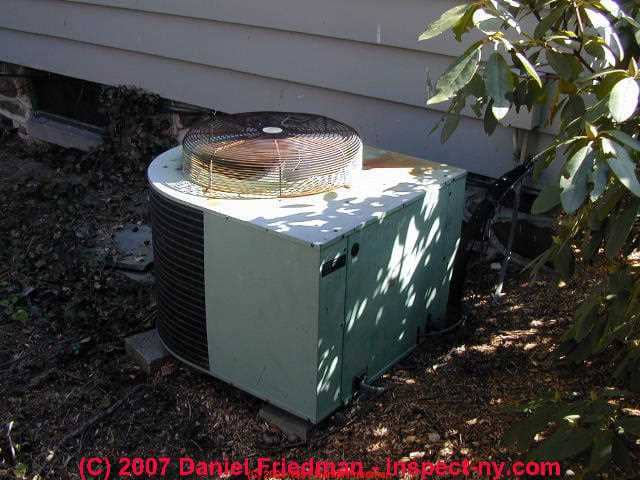
- Diagnose & repair air conditioning system noises: compressor, fans, air handler, ductwork, Recordings of air conditioner or heat pump noises & sounds
- Air conditioner buzzing may be just a loose part
- Air conditioner humming, clanking, buzzing noises can indicate a minor or a serious problem - it depends ...
- AIr conditioner or heat pump noises may diagnose lost cooling capacity
- Air conditioner or heat pump noises may predict equipment damage
- Recordings of A/C or Heat Pump Sounds & Noises: Submit, Listen-to, or Comment on These Sounds
If your air conditioning or heat pump system has lost its cooling capacity or won't start
see REPAIR GUIDE for AIR CONDITIONERS.
See HOW to DETERMINE COOLING CAPACITY of air conditioning equipment if the system seems to be working but is inadequate to cool your building. Contact us to suggest text changes and additions and, if you wish, to receive online listing and credit for that contribution.
First question in diagnosing HVAC system noises is where are the noises coming from?:
- Ductwork noises:
sounds originate in the ductwork, or may be conducted via ductwork from another source, including noise sources not necessarily having anything to do with the air conditioning or heat pump equipment itself.
See DUCT SYSTEM NOISES
and DUCT VIBRATION DAMPENERS
and SOUND CONTROL for AIR DUCTS, HVAC - Indoor Air Handler Noises:
sounds are coming from the air handler/cooling or "blower" unit located indoors.
See AIR HANDLER & DUCTWORK NOISE DIAGNOSIS just below. - Indoor Air Conditioner/Heat Pump Noises from a Wall Mounted Split System Unit
are discussed at How to Diagnose Noises
at SPLIT SYSTEM Air Conditioner / Heat Pump Indoor Wall-Mounted Unit Noises later in this article. - Outdoor A/C or Heat Pump Noises:
are the sounds from the compressor/condenser unit located outdoors,
see NOISES AT THE COMPRESSOR/CONDENSER & CONDENSER FAN UNIT - Other noises:
is the noise somewhere else and perhaps from another source having nothing to do with the HVAC system?
Second question in diagnosing air conditioner or heat pump noises & sounds: what does the noise sound like?
- See our CATALOG OF AIR CONDITIONER & HEAT PUMP NOISES by Description of the Sound in the article below
Air Handler & Ductwork Noise Diagnosis & Cure for HVAC Systems
- Air handler / blower indoor cooling unit noises:
see air leaks, bubbling, clicking, duct noises, fan noises and vibration dampener noises and the articles on these problems listed just below. - Air leaks in ductwork often make a roaring or hissing sound.
See LEAKY DUCT CONNECTIONS and
also
see VIBRATION DAMPENERS for a discussion of devices used to isolate noises produced by HVAC air handlers such as air conditioners and furnaces.
Hissing that continues for a time then stops may be due to a refrigerant leak or due to an emergency overpressure relief valve on the refrigerant system.
See HISSING SOUNDS, HVAC from A/C or heat pump system - Banging, clanking HVAC systems -
see BANGING A/C or HEAT PUMP
and
see COMPRESSOR CONDENSER NOISE
and see BANGING NOISE at AIR HANDLERS or in DUCT SYSTEMS
and see BANGING HEATING SYSTEM NOISES - complete list - Bubbling
or hissing in the refrigerant piping is discussed
at REFRIGERANT LEAK REPAIR
and
at WATER SOUNDS IN HVAC PIPING sounds in HVAC refrigerant piping or coils - Buzzing sounds
(also crackling) at electrical components anywhere, including compressor relay switches, electrical connections at any component, and quite seriously, at circuit breakers can be an indication of arcing and an electrical problem needing prompt attention.
See BUZZING sounds from A/C or heat pump.
Also
see ELECTRICAL SYSTEM NOISES.
Also
see CHATTERING RELAY CONTROL SWITCHES as buzzing and chattering can be confounded - Chattering noises:
in relays or switches; see CHATTERING RELAYS, HVAC EQUIPMENT
Or see CHATTERING RELAY CONTROL SWITCHES
Also see FAN NOISES, HVAC as ticking and chattering may be traced to a fan problem. - Clicking noises from relays & controls can be heard at either the compressor/condenser or at the indoor air handler unit: A failing or defective thermostat or to a defective control itself can cause relays to click on and off repeatedly .
See CLICKING SOUNDS from air conditioner or heat pump system and
also
see CONTACTOR RELAY DIAGNOSIS & REPAIR. Thanks to reader Michael Anderson.
Clicking, rumbling, ticking, rattling, clang and clunk at startup: loose hardware are detailed too
at COMPRESSOR CONDENSER NOISE
Clicking and ticking sounds at HVAC equipment are also traced to a loose or bent fan blade hitting an obstruction.
See FAN NOISES, HVAC - Compressor/Condenser units:
see NOISES, COMPRESSOR CONDENSER [just below] for detailed diagnostic help in finding, evaluating, and fixing noisy compressor units. Humming, rattling, explosion noises, bangs, clanks, hissing, squeaks, humming, squealing noises. Complete diagnostics for the HVAC compressor/condenser/fan unit begin
at COMPRESSOR / CONDENSER REPAIR. - DUCT SYSTEM Noises:
hisses, whistles, even roars, and occasionally click, clunk or clank sounds from expanding or contracting metal ductwork.
We may trace these sounds to supply ducts, return ducts, registers, to a bad vibration dampener, or other components.
Thermal expansion or contraction can cause popping or clicking noises in the duct work or in other large metal components such as an air handler body or its access doors.
A loud pop or boom from ductwork often is traced to movement of a large, un-supported area of sheet metal exposed to sudden changes in air pressure such as in an air handler or ductwork near the blower fan.
Animals in the ductwork
can make a variety of sounds, depending on the critter: fluttering and clanging (a trapped bird), scratching and gnawing (squirrel, mouse, rat, raccoon), buzzing humming (bees or wasps).
See ANIMAL ENTRY POINTS in BUILDINGS.
Blower assembly and fan noises
might be transmitted through the air ducts, such as fan squeaking, squealing, rattling.
See FAN NOISES, HVAC
Return air leaks:
Leaks around the return air register are common and sometimes noisy, perhaps due to a poorly-fit air filter or gasket.
See RETURN DUCT AIR LEAKS. See Take a look at
Also
see LEAKY DUCT CONNECTIONS.
Also see our more general article
on AIR LEAK NOISES
Supply air leaks: Hisses and whistles in supply air ducts and registers might be present too -
see SUPPLY DUCT AIR LEAKS.
Transmitted duct sounds:
Also buzzing, rattling, clanking or other noises originating at the air handler/blower unit may be transmitted into the physical ductwork and thus the building, if the system lacks an adequate vibration dampener -
see VIBRATION DAMPENERS.
Voices in the ductwork? you bet. I still recall the discovery that a girlfriend's parents were monitoring our basement activity when suddenly, out of the air duct by our heads, came her dad's voice: Joanne! Time to come upstairs! HVAC ducts in buildings can transmit sounds between building areas, perhaps more so when air is not moving through the ductwork. So watch out.
Also see SOUND CONTROL for AIR DUCTS, HVAC when the problem is masking normal HVAC noises transmitted through ductwork. - FAN & BLOWER Noises
on heating and air conditioning systems may include ticking or clicking (fan blade hitting an obstruction), humming (motor troubles), rattling (loose fan pulley), squeaking (dry fan or fan motor bearings) and other sounds such as a loud pop or boom when the fan starts (moving nearby sheet metal components).
These fan noises are discussed
at FAN, AIR HANDLER BLOWER UNIT
and
at FAN, COMPRESSOR / CONDENSER UNIT - ticking, clicking, humming, squealing, squeaking.
Also
See CLICKING SOUNDS from air conditioner or heat pump system - a fan blade may be hitting a wire, grille, or obstruction
Also
see ELECTRIC MOTOR NOISE DIAGNOSIS
and
see ELECTRIC MOTOR DIAGNOSTIC GUIDE for help figuring out what may be wrong with the fan motor at either the condenser unit or the air handler unit.
Also see DUCT SYSTEM NOISES above since the air moved by a fan may be hissing at duct leaks or may be producing other HVAC sounds.
Separately at FAN NOISES in BUILDINGS we list sources of noises from various types of fans and fan motors found in buildings and we discuss measures for reducing normal fan noises.
Fan & Blower Unit Articles: - Hissing or Screaming A/C compressor -
See HISSING SOUNDS, HVAC from A/C or heat pump system
then
see COMPRESSOR CONDENSER NOISE - Humming sounds from HVAC systems are outlined
at HUMMING SOUNDS sounds from A/C or Heat Pump system
which usually leads diagnosticians
to COMPRESSOR CONDENSER NOISE and
in that article to our description
of ELECTRIC MOTOR HUMMING.
In the most expensive case we're looking at
a BURNED-OUT COMPRESSOR
Aside: humming on oil fired heating equipment may be a normal sound transmitted to the building via oil piping attachment points. A/C refrigerant piping may also transmit equipment noises if it is not properly routed and mounted.
Electric motors (other than HVAC compressor motors) also make humming noises when running or when trying unsuccessfully to start -
see ELECTRIC MOTOR NOISE DIAGNOSIS . - Rattles at HVAC systems:
look for loose hardware, loose fan blades, pulleys, or motor mounts; also possibly loose ductwork.
See RATTLING & VIBRATION NOISES from A/C or Heat Pump System. - Roaring sounds at the compressor:
See ROARING NOISE from A/C Compressor/Condenser unit - Rumbling or "singing" or siren whining sounds
from a fan motor may be due to a broken internal motor part.
See RUMBLING NOISES A/C compressor/condenser or blower fan motor noise. - Screaming or squeals at the A/C or heat pump compressor -
see COMPRESSOR CONDENSER NOISE or hop over to any of these HVACR noise source descriptions- SCREAMING A/C compressor/condenser unit sounds - warning!
- SILENCE no sound whatever coming from HVAC equipment?
- SINGING, rumbling, whining A/C compressor/condenser or blower fan motor noise
- SQUEALING air conditioner and heat pump equipment, diagnosis
- WaWa, Wow wow sounds from A/C or heat pump system, diagnosis
- Running water sounds,
also described as gurgling sounds at the A/C or heat pump system, often heard at the cooling coil or in refrigerant piping can mean loss of refrigerant, a refrigerant leak, or air/gas contamination in the refrigerant piping system.
See WATER SOUNDS in HVAC refrigerant piping or coils - Silence: if your equipment is not making any sound at all it has no power or is turned off or there is no call for heating or cooling.
See SILENCE no sound whatever coming from HVAC equipment? - Trumpet or trombone sounds -
from the air conditioner or heat pump compressor motor: |
Trumpet or trombone sounds from the compressor motor at shut-down, possibly loud, may be due to leaky internal refrigerant valves;
Meenen [1] asserts this is not a problem as long as a hissing sound is not observed.
See TRUMPETING noises from compressor motors on A/C and heat pump systems for more diagnostic advice.
Also
see COMPRESSOR CONDENSER NOISE - Whistling sounds in HVAC duct work or air handlers are often due to air leaks
Listen for a whistling thermostatic expansion valve - a sign of low refrigerant
Details are
at WHISTLING SOUNDS sounds at HVAC air handler or ductwork - Other building noise sources: In case the noise you think is coming from an air conditioner or heats pump actually originates somewhere else,
see NOISE / SOUND DIAGNOSIS & CURE - For heat pump system noises at the indoor air handler, also
see NOISE CONTROL for HEATING SYSTEMS where we describe other heating system noise sources and cures.
How to Diagnose & Fix Noises at the Compressor/Condenser & Condenser Fan Unit
If you hear unusual noise at the air conditioning system, these compressor sounds could indicate the need for a simple service and adjustment requirement.
But air conditioner compressor noises might also mean that you face an upcoming costly repair involving replacement of the compressor itself. You should have the system checked promptly by an air conditioning service technician.
The following is a list of air conditioning compressor noises and what they may mean about the operation, condition, and remaining life of the cooling system equipment.
- Banging or Clanking air conditioner / heat pump compressor noises,
at least the costly ones, are usually due to a loose connecting rod, piston pin, crankshaft, or other internal part.
Since compressors on most modern commercial and residential air conditioning systems are a sealed unit, the only repair is to replace this (costly) part.
A similar clanking or banging sound can be caused by loose internal mounts. Examples of banging, clanking, rattling noises from A/C and heat pump systems are found
at BANGING A/C or heat pump. - Bubbling, hissing, refrigerant leaks:
a catastrophic refrigerant leak on the air conditioner or heat pump high pressure side will make a loud hissing sound - but that sound won't continue for any longer than to dump the refrigerant into the atmosphere (something prohibited).
But a more subtle refrigerant leak that results in low refrigerant can result in refrigerant gas bubbles traveling around in the liquid refrigerant line. You might hear bubbling sounds at the refrigerant piping or see bubbles in the sight glass if your system has one.
See REFRIGERANT LEAK DETECTION.
Bubbling in the refrigerant liquid line and using
the SIGHT GLASS are discussed
at REFRIGERANT SIGHT GLASS. - Buzzing noises at the outside fan motor:
sounds like a failing motor; check first for loose wiring, arcing connections, arcing or burning at the fan contactor relay switch. The video shown near the top of this page includes
a VIDEO EXAMPLE of BUZZING NOISES at the fan/compressor outdoor unit.
and
See BUZZING SOUNDS from A/C or HEAT PUMP
Also see "Chattering" noises below. - Chattering or rattling noise
in the A/C or heat pump compressor motor at start-up on some models of HVACR equipment whose compressor uses a compressor crankcase heater element if the equipment is started-up before allowing 24-hours of power-on time first.
Details about chattering contactors or relay switches are
at CHATTERING RELAY CONTROL SWITCHES
Example from Carrier: "On 24ANA7 models, starting the compressor without a minimum of 12 hours of crankcase heat prior to initial start--up may result in a compressor chattering noise and possible damage to the compressor." Details about HVACR compressor motor crankcase heaters are found
at CRANKCASE HEATERS
Watch out: a chattering electrical relay switch at any electrical equipment or appliance can be caused by a variety of problems such as burned contacts, low voltage, loose wiring, equipment malfunction, and a hard-starting motor. - If your air conditioner or heat pump compressor motor is having trouble starting that may show up as a buzzing or chattering relay. I'd turn off the equipment and call for an inspection and repair. A hard-start capacitor might get such a motor going but I suspect it's headed for replacement.
Chattering electrical switch relays occur on other mechanical systems as well.
See CHATTERING RELAY CONTROL SWITCHES
Also see FAN NOISES, HVAC as ticking and chattering may be traced to a fan problem.
Also see WATER PUMP PRESSURE SWITCH NOISES and
also see CHATTERING RELAYS, PUMP SWITCH in that article - Clanking or rattling
air conditioner or heat pump compressor: the compressor motor mounts have failed and the motor is thrashing around inside the hermetically-sealed compressor motor can. It may look normal from outside,
but the clanking sound is coming from inside the sealed unit. The compressor should be replaced. - Clicking, rumbling, ticking, rattling, clang and clunk at startup:
loose hardware: Air conditioner compressor noise could be due simply to loose hardware such as a loose shipping bolt, tubing, or a broken spring. Does the noise sound like a metallic rattle?
A visual inspection for loose hardware may help diagnose this condition.
Sometimes a shipping bolt may have been left in the unit and could be the source of a rattle. Loose refrigerant tubing or a bend in tubing that carries it too close to the air conditioner frame or case can lead to rattling that is easily corrected with a careful bend.
Watch out: Beware of both the chance of electrical shock and of injury from moving compressor parts like the cooling fan which can easily chop off a finger. Homeowners should not attempt to open, disassemble, or repair an air conditioner compressor as special training and safety procedures are needed to avoid injury.
Clicking noises from relays & controls can be heard at either the compressor/condenser or at the indoor air handler unit:
A failing or defective thermostat or to a defective control itself can cause relays to click on and off repeatedly or the relay may ultimately buzz -
see CONTACTOR RELAY DIAGNOSIS & REPAIR.
Also see our main catalog of
CLICKING NOISES - Hissing or Screaming A/C compressor,
also described as "very loud screaming" by some sources [1], may be caused by excessive internal pressures - a dangerous condition.
Compressors include a high pressure sensor that should shut the system down if internal pressures are approaching a dangerous level. But if the compressor continues to run and is screaming, turn it off immediately as the system is unsafe.
Watch out: turn off electrical power to the screaming A/C Condenser / Compressor unit immediately.
Other more quiet hissing noises from the air conditioner compressor motor may (if the motor is a reciprocating compressor) be due to leaky internal valves.
The compressor motor makes a hissing sound all during the time the compressor is running; when the motor stops the hissing dies down fairly quickly as the high side and low side pressures equalize.
In this case the condition may not be dangerous, just an inefficient system that is costly to operate.
Examples of field reports of hissing noises from A/C and heat pump systems are found at section below and
at SCREAMING A/C & HEAT PUMP COMPRESSOR / CONDENSER unit sounds - warning! - Humming air conditioning compressor motors, fan motors, other electric motors,
particularly if the motor is slow to start or does not start at all, may indicate that the starting capacitor needs replacement.
If the compressor hums and never starts it could also be that the compressor motor has seized. In that case, leave the system turned off and ask for service from a professional.
Humming electric motors:
Note that while many electric motors make a modest and unchanging humming sound when running - a normal condition - any electric motor that is seized or having trouble starting may produce a humming sound at start-up, not just the A/C or heat pump compressor motor.
For example fan motors at the compressor/condenser or in the air handler blower unit may hum when they cannot start. A failed motor, failed start/run capacitor, or low voltage are common causes of this humming.
See ELECTRIC MOTOR DIAGNOSTIC GUIDE for help with motor diagnosis,
and
see CAPACITORS for HARD STARTING MOTORS.
Examples of more humming noises from A/C and heat pump systems are found at our FAQs section below. - Humming, hard-start compressors, oil leaks:
Another source of cooling system compressor noise is a low oil condition in the compressor unit. Low oil may be diagnosed perhaps by observing evidence of compressor oil leakage on or around the unit.
Modern residential air conditioning compressors are usually a hermetically sealed unit; it would be abnormal to ever see oil loss around this equipment. (But don't mistake spilled oil from lubricating an electric motor or cooling fan bearing for a refrigerant or compressor oil loss.)
Checking air conditioner oil level:
A few residential air conditioning compressors and many commercial systems provide
an OIL SIGHT GLASS to permit a visual check of oil levels. On those units, when the compressor is running the oil level on the sight gauge should read 1/2 to 3/4 full.
If adding oil to a commercial unit, be careful not to add too much.
Both too much or too little oil can cause compressor noises. On a residential compressor which is usually a hermetically-sealed motor, it is not possible to see the oil level nor to add oil. - Squeals, normal A/C compressor:
Normal air conditioner compressor squealing: Some compressors emit a high pitched noise during normal operation or just at startup. This noise should be brief and just at start-up, and will probably have always been present on the system if it's normal.
Also see HVAC NOISE-5 SCREAM SING TRUMPET WHINE WUWU where we describe various high pitched HVAC equipment noises.
Examples of squealing noises from A/C and heat pump systems are found
at NOISES, HVAC SOUND RECORDINGS - Start-up Compressor noises - refrigerant floodback:
Air conditioning compressor noise could also be due to refrigerant liquid "floodback" into the compressor crankcase.
If this is the problem the noise will appear only at the interval of compressor start-up.
That's why it's useful for the inspector or service technician to be right at the compressor unit when the air conditioning system is first turned-on. If this is the problem, a low cost repair might work: a crankcase heater can be installed to address this defect.
Watch out: a burned-out crankcase heater on an air conditioner or heat pump can permit liquid refrigerant to enter the compressor, destroying the motor by liquid slugging.
We explain this further
at REFRIGERANT PRESSURE READINGS & CHARTS where we discuss the effects of improper refrigerant charges.
We discuss crankcase heaters
at CRANKCASE HEATERS. - Ticking or loud clicking noises
at the air conditioner or heat pump compressor unit fan: the fan blade may be contacting a bent fan screen or a stick or piece of debris that has fallen into the compressor unit; a loose or worn fan bearing permitting the fan blade to wobble might also cause this ticking or clicking fan noise.
See also CLICKING NOISES - Trumpet or trombone sounds
from the compressor motor at shut-down, possibly loud, may be due to leaky internal refrigerant valves; Meenen [1] asserts this is not a problem as long as a hissing sound is not observed. - Overheating, Blocked Coils, & Air Conditioner or Heat Pump Noise?
we have had a field report from a reader who explained that a noisy outdoor compressor unit was, according to his HVAC service technician, traced to a blocked, clogged outdoor condensing coil.
We speculate that perhaps the compressor was running hot and that correcting air flow across the condensing coil corrected that condition.
Cooling coils (indoors) or condensing coils (outdoors) can become so blocked that air flow is seriously reduced, possibly also leading to an evaporator or cooling coil icing problem indoors or an overheated, damaged compressor outdoors, or simply loss of cooling capacity of the system.
I have a National comfort Products CPO 2464-B unit which is an air conditioner and gas heating unit combined.
The unit is about 5 years old. The air conditioner had become increasingly noisy. I called the party that installed the unit. After spending $90.00 for a service call I was informed the the external coils were dirty, opening up the unit light was not visible thru the coils.
I was advised to use a garden hose and rinse the coils. I did not have that available so I turned the unit on and using a watering can, poured warm soapy water onto the coils. this was done several times. the unit now seems to work properly. I did not see this particular problem described on your website.
There may be other means of cleaning the coils but this was all I could think of. - C.A.P., Norristown PA
- Also See our CATALOG of AIR CONDITIONER or HEAT PUMP NOISES organized by Description of the Sound
- Also see NOISE, DUCT VIBRATION DAMPENERS
and NOISE CONTROL for HEATING SYSTEMS where we describe duct noises. Fan noises on heating and air conditioning systems are discussed
at FAN, AIR HANDLER BLOWER UNIT and
at FAN, COMPRESSOR / CONDENSER UNIT.
See NOISE / SOUND DIAGNOSIS & CURE for our complete list of building noise diagnosis & repair articles.
How to Diagnose Noises at a Split System Air Conditioner / Heat Pump Indoor Wall-Mounted Unit
Fujitsu has offered some helpful advice in troubleshooting noises that may be heard at the indoor wall-mounted air handler of a split system air conditioner or heat pump. What's particularly helpful is that Fujitsu points out that some noises that people worry about are actually normal and not an indication of trouble. Quoting [3]
- During operation and immediately after stopping the unit, the sound of water flowing in the air conditioner's piping may be heard.
Also, noise may be particularly noticeable for about 2-3 minutes after starting operation (sound of coolant flowing). - During operation, a slight squeaking sound may be heard. This is the result of minute expansion and contraction of the front cover due to temperature changes.
- During Heating operation, a sizzling sound may be heard occasionally. This sound is produced by the Automatic Defrosting operation.
Here are some other noise or sound diagnostic clues for split system air conditioners & heat pumps
- Bubbling in the refrigerant piping is discussed
at REFRIGERANT LEAK REPAIR and may indicate a refrigerant leak, though bubbling sounds on split systems at the indoor wall unit may be normal for some products - see our note below about water noises. - Clicking noises
from relays & controls can be heard at either the compressor/condenser or at the indoor air handler unit:
A failing or defective thermostat or to a defective control itself can cause relays to click on and off repeatedly. - thanks to reader Michael Anderson.
A clicking noise might be traced to a failing electrical control in the air handler or outside at the fan-compressor unit, leading to a control switching on and off too rapidly. - Sizzling noises
from a split system air conditioner / heat pump may be heard at the wall mounted unit when the system is in heating mode.[10] - Squeaking noises
from a split system air conditioner / heat pump might be heard coming from the wall mounted unit.
According to Fujitsu, This is the result of minute expansion and contraction of the front cover due to temperature changes.[10] - Water noises, a sound like running water
may be heard in the refrigerant or condensate piping of a split system air conditioner or heat pump while the equipment is running and/or briefly during unit start-up as well as for a period immediately after the unit shuts off.
While usually we consider the sight or sound of bubbles in the refrigerant piping as an indication of low refrigerant, for some systems this may not be the case and for at least some split system models Fujitsu points out that this sound may be normal. [10]
However if you hear bubbling in the refrigerant piping and the system is not cooling properly, indeed there may be an improper charge or refrigerant may be leaking. [10]
Reader Comments, Questions & Answers About The Article Above
Below you will find questions and answers previously posted on this page at its page bottom reader comment box.
Reader Q&A - also see RECOMMENDED ARTICLES & FAQs
On 2020-07-26 by (mod)
It's not uncommon for a fan or bearing or motor to whine, Rick; to find the exact component that's the noise source the service tech might need to try
- selective shut down of equipment to see what stops the noise
- use of a mechanic's stethoscope
On 2020-07-26 by Rick
I live near a hospital which has a very large HVAC system in the rear parking lot and this system makes a very consistent and very loud noise 24 hours per day, 7 days per week.
The noise very similar to a sine wave although if examined on an oscilloscope it would certainly have distortion.
The pitch is approximately 492 Hz. I have searched all over the internet for an explanation of what causes this noise but have been unable to find an answer. Can anyone help explain what is causing this noise?
On 2020-07-03 - by (mod) -
Tony
Some possible sources of AC compressor/condenser unit noises are at
https://inspectapedia.com/noise_diagnosis/HVAC_Noise_Diagnosis.php#Comp COMPRESSOR NOISES
Please take a look and let me know what you think.
On 2020-07-03 by tony
Very loud noise when compressor is running - reduced cooling. Can shut off system and turn back on couple of minutes later - no noise and unit appears to be cooling ok. after running awhile - compressor becomes very loud again
On 2020-06-01 - by (mod) -
Lorrie
If there is humming and vibration when your particular AC unit is not on then most-likely it's a neighboring unit transmitting sound and vibration. I agree that "live with it" sounds a bit foolish for a number of reasons, including a pending complete failure of somebody's equipment.
If none of the neighbors cares now, I figure they will fix the problem when their unit fails solid.
Or you can see if a local home inspector or similar building diagnostician can help out. Some of these are in the page top EXPERTS DIRECTORY - discuss your needs and ask what the person will do before hiring someone.
At HVAC NOISE-3 HISS HOWL HUFF HUM https://inspectapedia.com/noise_diagnosis/HVAC_Noise_Descriptions_3.php
we list common sources of this humming type noise problem.
On 2020-06-01 by Lorrie
Have lived in my small condo unit (~1000 sq ft) for 20 years. Last summer I started hearing a loud hum, loudest near the wall where the AC units in my stack lives- when my AC is not on.
I also feel and hear a vibration (imagine a sneaker in a dryer or a treadmill) most noticeable when you sit down to watch TV or read a book. It is often intermittent. The TV volume must be turned up to override the sound and vibration.
This morning the sneaker started at 4:15 am. I went to bed at 11:30 pm and the noise was present. So it is obviously coming from another part of the building.
I am on the 2nd of 4 floors with one neighbor to the right and one to the left. I have had 2 electricians check when the panel in my unit is turned off, a plumber to check the hot water heater, the guy upstairs says he hears nothing and the owner's electrician has said he hears nothing up there
. I need a troubleshooter and not someone who is going to tell me to live with it. I am 69 years old and do not have Wonder Woman hearing capacity. Please advise. I am in the Ft Lauderdale/Palm Beach part of South Florida.
On 2020-05-17 - by (mod) -
I want to help but don't have enough information to offer more specifics than to try to narrow down the noise source; Perhaps a mechanic's stethoscope can help.
On 2020-05-17 by Jdags
Not sure exactly as I am having trouble locating it, but it seems that the indoor unit is making a weird compression-like sound when starting then intermittently.
Sometimes it sounds like it's inside, sometimes it sounds like it's outside, sometimes it sounds like it's coming from the electrical panel...I know, weird!
Thought it might be hard start condenser, so I changed it. No luck...
On 2020-03-26 - by (mod) -
Speculating, TJ that could be a hard-starting compressor (motor is failing).
On 2020-03-24 by TJ
My brother had 2 carrier units [5 ton/flr 1 & 3 ton/flr 2] for both Heat & AC installed in Sept 2019. Both are single speed compressors and everything from heater [NG], evap coil, air handler, plenum/etc were all replaced. The unit in questions is the 3-ton that services the upstairs
Over the last 7-10 days, upon turning on the upstairs AC, he has heard a loud rumbling sound for about 15 secs from start-up, then it seems to dissipate and smooth out. His son's room is right under the unit and he was over w his kids Saturday. When he turned on the unit, he said the wall kind of vibrated while the 15 second rumbling took place. My brother has heard it 3 times in 7-10 days, but he has to be in the vicinity of area to hear it.
On 2020-01-26 - by (mod) -
Stan,
Disappointing - "replace the whole system" might make sense if the technicians knew that the failure was a part so costly to replace that the repair approaches the cost of a whole new system - and on an 11 year old system that might be true; maybe a bad compressor in a hard-to-access location. But how do we know that.
When I was in refrigeration school we learned that most of the failures in refrigeration equipment were in the controls and switches.
So every spring when everyone in Dutchess County NY put their old "no-good" refrigerators out on the highway to be carted off as junk, a few enterprising HVACR techs would drive around in pickup trucks picking up the better-looking refrigerators, bring them into the shop, fix the bad defrost timer or door switch or thermostat, and then re-sell the perfectly good refrigerator.
So while neither of us is as smart as Mitsubishi technical support nor as your service tech, before spending $9000. I'd want to know more about what's really wrong.
To me this smells like an OPM problem: spending Other People's Money makes your (the tech's) job both easier and more-profitable, and it doesn't cost you (the person saying "let's just replace it all") a dime.
OTHER PEOPLE's MONEY is at
https://inspectapedia.com/home_inspection/Other_Peoples_Money.php
A squealing noise often means a failed compressor; there are certainly tests such as measuring current draw, that can diagnose that; but something as simple as a stuck reversing valve or defective thermostatic expansion valve can also prevent an A/C or heat pump system from working.
On 2020-01-26 by Stan
I have a Mitsubishi split duct system. Originally the upstairs unit only blew warm air. The downstairs unit workef fine. Repair man couldn't find the problem just added a little refrigerant. Than in the heat mode ,neither unit worked. When I put it in heat mode it would make a squeeling noise.
Repair man was here again, different company. He was on the phone with Mitsubishi and they went through the diagnosis together. Every test checked ok. Finally they said there might be a restriction in the line some where.
They recommended replacement of the whole system. I believe this can be fixed by someone who has experience in these units. This unit is 11 years old , but downstairs ac worked fine until first repair man looked at it and added a little refrigerant. They want $9,000 to replace the whole system. HELP!
On 2020-01-20 - by (mod) -
Samantha: our entire conversation about Magic Pak HVAC unit in my apartment has been making a faint but persistent high-pitched noise. is now found at
https://inspectapedia.com/noise_diagnosis/HVAC-Noise-Diagnosis-FAQs5.php
...
Continue reading at NOISES, HVAC SOUND DESCRIPTIONS or select a topic from the closely-related articles below, or see the complete ARTICLE INDEX.
Or see HVAC SYSTEM NOISE DIAGNOSIS FAQs - questions and answers posted originally on this page.
Or see these
Recommended Articles
- BURNED-OUT COMPRESSOR
- CAPACITORS for HARD STARTING MOTORS
- CONTACTOR RELAY DIAGNOSIS & REPAIR
- CONTROL CIRCUIT BOARD, A/C
- COPELAND ELECTRICAL HANDBOOK [PDF]
- CRANKCASE HEATERS
- FAN, COMPRESSOR / CONDENSER UNIT
- FAN NOISES HVAC
- HARD STARTING COMPRESSOR MOTORS
- HVAC SYSTEM NOISE DIAGNOSIS
- CHATTERING RELAYS, HVAC EQUIPMENT
- DUCT SYSTEM NOISES
- DUCT VIBRATION DAMPENERS
- FAN NOISES, HVAC
- HVAC SOUND DESCRIPTIONS
- HVAC NOISE-1 BANG BUZZ VIBRATE - banging, bearings, buzzing
- HVAC NOISE-2 CHATTER CLANK FAN GROAN - chattering, clanks, clunks, cyclical, fan, groans, growls, honking
- HVAC NOISE-3 HISS HOWL HUFF HUM - hiss, howl, huff, hum, groan, woo wuu wuff
- HVAC NOISE-4 POP, RATTLE, ROAR, RUMBLE - loud start, pop, rattle, rumble, water, silence
- HVAC NOISE-5 SCREAM SING TRUMPET WHINE WUWU - scream, sing, squeal, trumpet, wawa, wowo, water gurgle, whine, whistle, wuwu
- NOISES, HVAC SOUND RECORDINGS
- REFRIGERANT PIPING GURGLING
- POPPING SNAPPING NOISE DIAGNOSIS
Suggested citation for this web page
NOISES, HVAC SYSTEM DIAGNOSIS at InspectApedia.com - online encyclopedia of building & environmental inspection, testing, diagnosis, repair, & problem prevention advice.
Or see this
INDEX to RELATED ARTICLES: ARTICLE INDEX to BUILDING NOISE DIAGNOSIS
Or use the SEARCH BOX found below to Ask a Question or Search InspectApedia
Ask a Question or Search InspectApedia
Try the search box just below, or if you prefer, post a question or comment in the Comments box below and we will respond promptly.
Search the InspectApedia website
Note: appearance of your Comment below may be delayed: if your comment contains an image, photograph, web link, or text that looks to the software as if it might be a web link, your posting will appear after it has been approved by a moderator. Apologies for the delay.
Only one image can be added per comment but you can post as many comments, and therefore images, as you like.
You will not receive a notification when a response to your question has been posted.
Please bookmark this page to make it easy for you to check back for our response.
Our Comment Box is provided by Countable Web Productions countable.ca
Citations & References
In addition to any citations in the article above, a full list is available on request.
- Thanks to Mark Cramer, Tampa Florida, for assistance in technical review of the "Critical Defects" section and for the photograph of the deteriorating gray Owens Corning flex duct in a hot attic. Mr. Cramer is a Florida home inspector and home inspection educator.
- Thanks to Alan Carson and Bob Dunlop, Carson Dunlop, Associates, Toronto, for permission to use illustrations from their publication, The Illustrated Home which illustrates construction details and building components. Carson Dunlop provides home inspection education, publications, report writing materials, and home inspection services. Alan Carson is a past president of ASHI, the American Society of Home Inspectors.
- Thanks to reader Michael Anderson, 8 May 2009, for discussing clicking sounds coming from air conditioning equipment.
- Thanks to Diaz, Domingo I. CIV NAVAIR Bldg.2118, rm. 131: domingo.diaz@navy.mil - Ming Diaz, Great Falls, MD for editing help with the text about discharging air conditioning compressor capacitors - 3/07 DF]
- Thanks to reader Charles A. Plinton, Norristown, PA, for discussing A/C compressor noise, coil cleaning, and system maintenance - August 2010
- [1] Scott Meenen, G&S Mechanical Services, email: ; web search 5/1/11
- [2] Carrier 24ANA Infinity™ Series Air Conditioners with Puron® Refrigerant, 2 to 5 Nominal Tons (Sizes 24-60) Installation Instructions, Carrier Corporation, [copy on file as 24ana-6si.pdf]
- [3] Troubleshooting Split System A/C or Heat Pump Noises, Fujitsu General America, Inc., 353 Route 46 West, Fairfield, NJ 07004, Tel: (888) 888-3424, Tel-Service hotline: (866) 952-8324, Email: hvac@fujitsugeneral.com, Email service: servicehvac@fujitsugeneral.com , retrieved 8/30/12, original source: http://www.fujitsugeneral.com/troubleshooting.htm [copy on file as Troubleshooting Fujitsu Ductless Mini-Splits.pdf]
- Modern Refrigeration and Air Conditioning, A. D. Althouse, C.H. Turnquist, A. Bracciano, Goodheart-Willcox Co., 1982
- Principles of Refrigeration, R. Warren Marsh, C. Thomas Olivo, Delmar Publishers, 1979
- "Air Conditioning & Refrigeration I & II", BOCES Education, Warren Hilliard (instructor), Poughkeepsie, New York, May - July 1982, [classroom notes from air conditioning and refrigeration maintenance and repair course attended by the website author]
- Refrigeration and Air Conditioning Technology, 5th Ed., William C. Whitman, William M. Johnson, John Tomczyk, Cengage Learning, 2005, ISBN 1401837654, 9781401837655 1324 pages
- Air Conditioning SEER - New DOE Air Conditioner and Heat Pump Efficiency Standard
- [10] Fujitsu Room Air Conditioner, Wall Mounted Type, Heat & Cool Model (Reverse Cycle) [Heat pump units] Operating Manual, Models: ASU18RLXS ASU24RLXS ASU30RLX (indoor & outdoor units). Fujitsu General America, Inc., 353 Route 46 West, Fairfield, NJ 07004, Tel: (888) 888-3424, Tel-Service hotline: (866) 952-8324, Email: hvac@fujitsugeneral.com, Email service: servicehvac@fujitsugeneral.com , retrieved 8/30/12, original source: http://www.fujitsugeneral.com/PDF_06/OperationManual/%28OM%29ASU18-24RLX-30RLX.pdf [copy on file as FujitsuASU18-24RLX-30RLX.pdf]
- In addition to citations & references found in this article, see the research citations given at the end of the related articles found at our suggested
CONTINUE READING or RECOMMENDED ARTICLES.
- Carson, Dunlop & Associates Ltd., 120 Carlton Street Suite 407, Toronto ON M5A 4K2. Tel: (416) 964-9415 1-800-268-7070 Email: info@carsondunlop.com. Alan Carson is a past president of ASHI, the American Society of Home Inspectors.
Thanks to Alan Carson and Bob Dunlop, for permission for InspectAPedia to use text excerpts from The HOME REFERENCE BOOK - the Encyclopedia of Homes and to use illustrations from The ILLUSTRATED HOME .
Carson Dunlop Associates provides extensive home inspection education and report writing material. In gratitude we provide links to tsome Carson Dunlop Associates products and services.
 | HOME | ABOUT | ASK a QUESTION | CONTACT | CONTENT USE POLICY | DESCRIPTION | POLICIES | PRIVACY | |
| © 2024 - 1985 Publisher InspectApedia.com - Daniel Friedman | |||||||||