
InspectAPedia® FREE Encyclopedia of Building & Environmental Construction, Diagnosis, Maintenance & Repair |
Question? Just ask us! InspectAPedia
|
Air Conditioner / Heat Pump Diagnostic Procedures
Quick Start to Diagnose an A/C or Heat Pump not working
- POST a QUESTION or COMMENT about air conditioner or heat pump system cooling diagnosis & repair
Air Conditioner or Heat Pump Diagnosis:
This article lists the basic steps followed todiagnose an air conditioner or heat pump that is not cooling.
Typical problems that we need to diagnose and correct include lost or reduced air conditioner cooling capacity (no cool air in cooling mode), weak or no air flow, reduced or no actual lowering of the air temperature (no cooling in air conditioning mode), or an air conditioner that simply won't start at all.
Try the steps on this page before calling your HVAC service company.
If not enough cool air is provided by your air conditioner, or if the air temperature is not cool enough, or if you just can't get your A/C unit running, this article helps diagnose and correct the problem with step by step things to check and links to more detailed explanation when you need it.
InspectAPedia tolerates no conflicts of interest. We have no relationship with advertisers, products, or services discussed at this website.
What to Check First if the Air Conditioner Output is Inadequate or A/C Won't Run
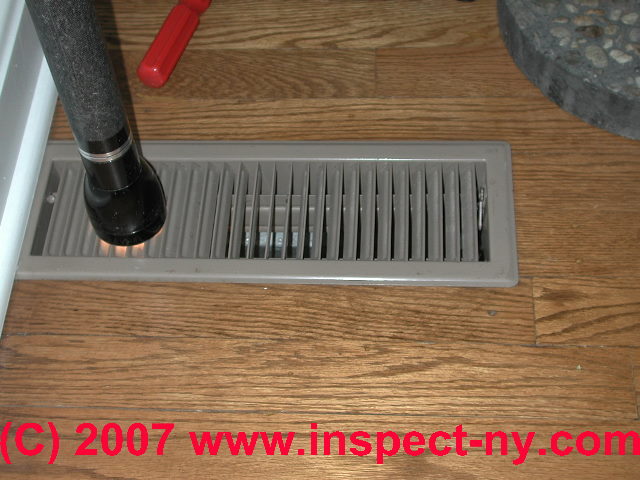
These Simple Checks May Enable Inexpensive Repair of Lost Cooling Output from an Air Conditioner
Here we explain how to diagnose loss of air conditioning cool air flow or cool air temperature.
Before ordering an expensive air conditioner service call to restore lost cooling capacity, here are a few simple steps to perform. Some of these can be done by any homeowner, others may require a bit more expertise.
Below we provide first a very basic Air Conditioning or Heat Pump Diagnostic Checklist, followed by more detailed descriptions of common problem cooling system topics.
Following the checklist we provide more detailed descriptions, photos, and links to in-depth air conditioning inspection, diagnosis, and repair or improvement advice.
The troubleshooting steps on this page are focused on conventional air conditioning or heat pump systems that use an indoor handler that blows air through building ductwork and out of supply registers, with return air through return registers and ductwork.
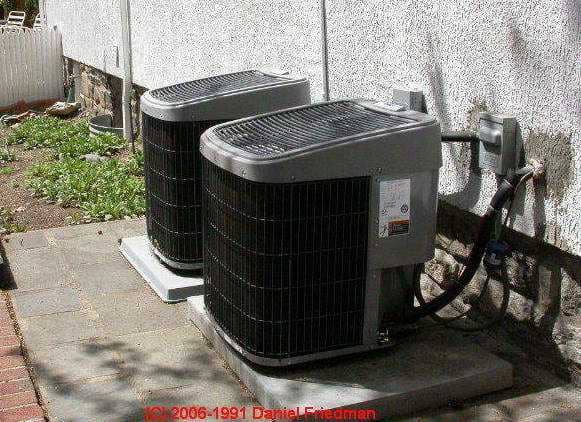
In addition to the indoor air handler or "blower unit" there will be an outdoor compressor/condenser unit where refrigerant is condensed from a gas back to a liquid.
If your air conditioner or heat pump is a split system or mini split system design (using a wall-mounted cooling or heating unit) our separate troubleshooting diagnostics for those are found
at SPLIT SYSTEM AIR CONDITIONERS & HEAT PUMPS.
If you don't see information you want, ask us for it using the COMMENTS BOX at the bottom of this page.
Air Conditioning Checklist for Lost Cooling: What to Do First in Air Conditioner / Heat Pump Tests
First check that the air conditioning equipment is turned on, the thermostat is calling for cooling, and that the blower unit or air handler is actually blowing air through the ductwork.
If the air conditioning system or heat pump is not running at all
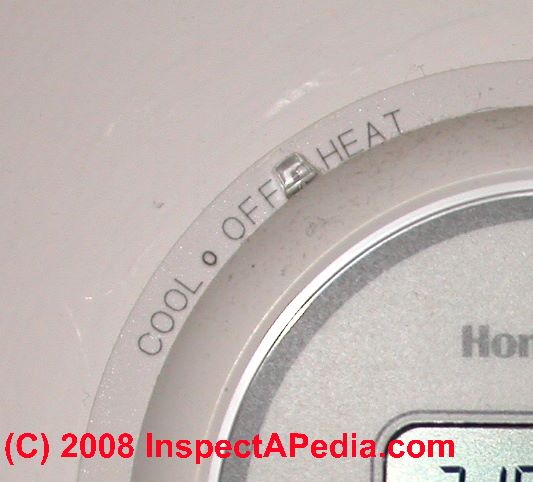
- Check the Room Thermostat Temperature Setting:
Set the thermostat to at least 5 degrees below room temperature.
Our elderly mom has no patience with switches and controls. She regularly calls her air conditioning service company with a service request, sometimes late at night, because she has simply failed to set the temperature on the thermostat lower than the room temperature.
Don't drive your A/C like our mother. - Check that the Room Thermostat is set to "Cool"
not "Off" or "Heat". If the thermostat is not set to "cool" it is simply turning off your A/C. - Check that electricity is on for the equipment.
Check all switches and controls, including service switches, including outside by the compressor, inside at the air handler, and fuses or circuit breakers in the electrical panel.
For example, condensate spilling into an overflow pan that uses a sensor switch can be enough to shut down your air conditioner.
There are several switches and controls, both manual and automatic that can leave an air conditioner or heat pump turned "off" such as a blower compartment door interlock safety switch, an electric motor overload or overheat switches, and a condensate tray spillage detector switch.
Watch out: See A/C - HEAT PUMP CONTROLS & SWITCHES to be sure you have found and checked every manual or automatic electrical switch on the system. A bad or failed starter capacitor could also be leaving your system shut down, failing to start a blower, fan, or compressor motor. Some hard-to-find switches could be keeping your air conditioner from starting, such as
a Float Switch on Condensate Tray or
a blower MOTOR OVERLOAD RESET SWITCH
If after the checks above the air conditioning system is still not working, or if the A/C system is running but cool air is not coming out of the supply registers you probably need to call a service technician, but below are some things to check further yourself.
But first, see
AIR CONDITIONER WON'T START
for more detailed DIY help in diagnosing and repairing the trouble. when your cooling unit or heat pump simply will not turn on at all.
If At Least Some of the Air Conditioner or Heat Pump Equipment is Running but Cool Air is Not Being Delivered
Follow these diagnostic air conditioning / heat pump system checks to get the air conditioner running again.
If you are not sure what A/C or heat pump component is not working or where the trouble lies, follow thee steps just below.
But to make any sense of these checks, you need to know the names of the main parts of your A/C or heat pump and the location of those components.
If you have no idea of the names and locations and purposes of the major parts of your air conditioner or heat pump system, first
read HOW an AIR CONDITIONER WORKS - then come back to this page to step through the diagnostics below.
Step 1: Check the Outside Air Conditioning /Heat Pump Compressor-Condenser unit
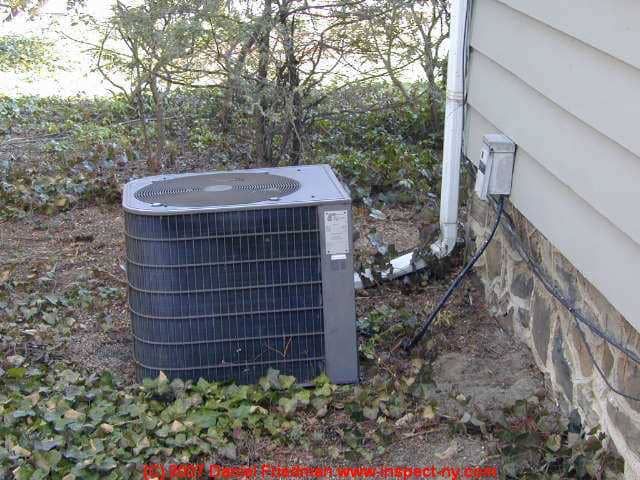 If your air conditioner or heat pump system is not working at all, that is, it won't start,
the problem could be at the thermostat, or lost electrical power, or something as simple as a switch that's turned off.
For cooling, set the thermostat well below the current room temperature, or for heating, set the thermostat well above room temperature or simply "all the way up" to see if the system will start.
Then check the electrical switches at the indoor air handler or blower unit, at the outdoor compressor/condenser unit, and in your electrical panel to be sure that power is turned on to the equipoment.
If the system still wont' start, more details of these checks are found at
AIR CONDITIONER WON'T START
where you'll get more help diagnosing and repairing the trouble.
If the outdoor compressor/condenser unit never starts:
If you don't know what or where this component is,
see COMPRESSOR & CONDENSING COIL
You should hear the outdoor compressor condenser motor start and run (you'll hear an electric motor noise) and should see its fan blades spinning.
If not, be sure that the outdoor compressor/condenser unit SERVICE SWITCH [image] and the air conditioner indoor power switch, fuse, or circuit breaker are all in the "on" position - as we suggested earlier

If the indoor air handler blower starts (described in step 2 below) and there is good air flow but the outdoor compressor/condenser does not run, the supply air at registers will not be cool.
If the outdoor compressor / condenser unit doesn't start
Check the outside compressor condensing coil for damage or blockage.
A blocked condensing coil can cause the compressor to overheat, stop running, or become noisy and work poorly.
See A/C COMPRESSOR PROBLEMS - diagnostic aricles for the compressor/condenser unit.
If you cannot find your air conditioner controls and switches
see A/C - HEAT PUMP CONTROLS & SWITCHES - list of controls and switches found on air conditioners and heat pumps
Also check the compressor/condenser outdoor fan and fan motor
Go to
COMPRESSOR / CONDENSER DIAGNOSTICS
Condensing unit fan diagnostics:
at FAN, COMPRESSOR / CONDENSER UNIT we explain the diagnosis of problems with the compressor/condenser fan and fan motor.
Also see ELECTRIC MOTOR DIAGNOSTIC GUIDE.
at BURNED-OUT COMPRESSOR we explain that if the condensing unit fan is not working the compressor itself may shut down or even be ruined by overpressure or over temperature.
Also see NOISES, COMPRESSOR CONDENSER where some noise problems are traced to the cooling fan .
Step 2: Check the Air Conditioning /Heat Pump Indoor Air Handler Unit
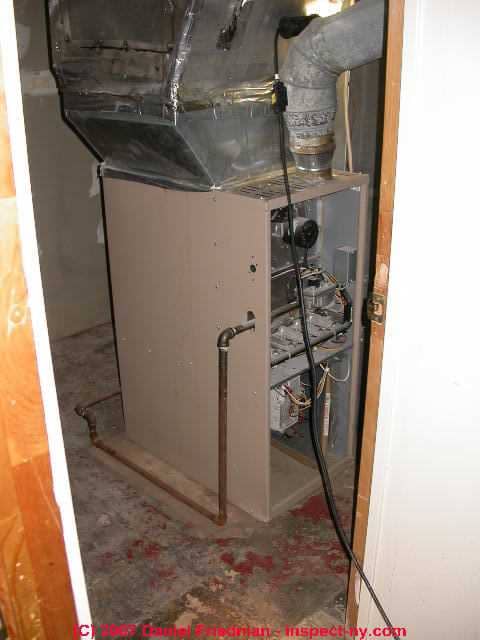
With power on to your equipment and the thermostat calling for heating or cooling the indoor blower or air handler fan should start - you'll hear it if you go to the unit or you'll feel air coming out of the air supply registers in various rooms;
If the A/C or heat pump unit is a wall-mounted "split system" there is no duct work but you should hear the indoor unit fan run and should feel air coming out of the unit's outlet opening (usually at its bottom edge).
If the indoor air handler/blower unit never starts
check the electrical switches as we said above, and be sure to check that the covers or doors on the unit are fully in placed and latched.
Often a blower door safety switch will keep the air handler turned off if the door is not fully seated in place.
Is the indoor blower unit running?
If not be sure that the electrical power switch at your furnace or air conditioner air-handler is in the "on" position.
Typically the air handler or blower unit is indoors inside the basement, crawl area, or attic.
Sometimes there is more than one switch, such as one right at the unit and another at the entry to the room where the equipment is located, or even upstairs on a higher floor if your air handler is in a basement or crawl space.
Make sure that the blower compartment cover or door is properly closed or an interlock switch may be keeping the system "off".
If the indoor air handler blower/fan won't start see
BLOWER FAN OPERATION & TESTING
Step 3: Weak air flow: Check the Air Conditioning /Heat Pump Air Filter(s)
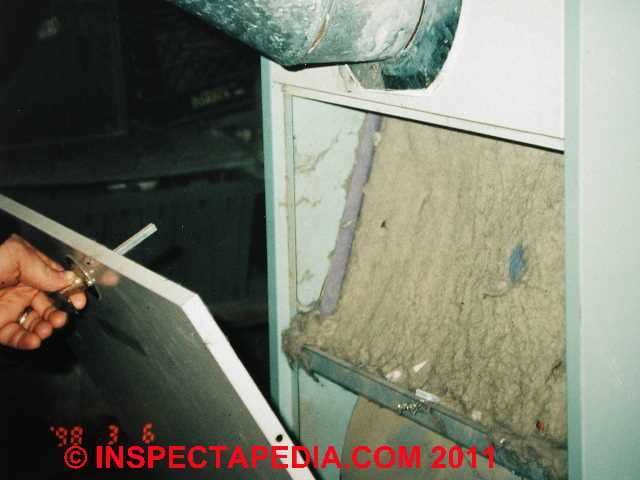
If your air conditioning equipment is running but little or no cool air is coming out of the supply registers, check that your air filter(s) have not become blocked with dirt and debris.
Usually the air filter is right at the air handler or blower unit, or your air filter may be installed behind a grille covering a central warm-air return that sends air back to the air handler.
See A/C FILTER PROBLEMS for details as dirty air filters are a common cause of weak air flow and inadequate cooling.
If the air conditioner or heat pump is running but air flow is still too weak continue at step 4.
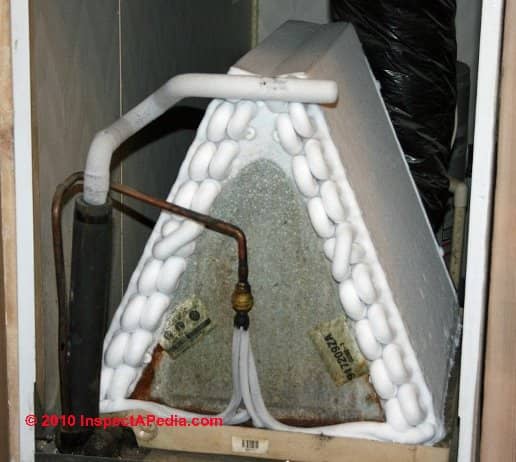
Photo above: a frost-blocked cooling coil in the air handler of an air conditioning system will stop the delivery of cool air to the building.
[Click to enlarge any image]
If the air handler unit blower starts but air flow is weak, the problem could simply be a dirty air filter, or collapsed ductwork, or an ice-blocked cooling coil (illustrated above). Go to
where we describe an ice-blocked or dirt-blocked cooling coil or problems with the return or supply air ducts themselves.
If the blower runs normally but air flow is warm or weak, remember to check for a dirty,
blocked COOLING COIL or EVAPORATOR COIL.
Also see ELECTRIC MOTOR DIAGNOSTIC GUIDE if you suspect a blower motor problem.
Step 4: Weak air flow: Next Check the Air Conditioning /Heat Pump system duct work & air supply registers
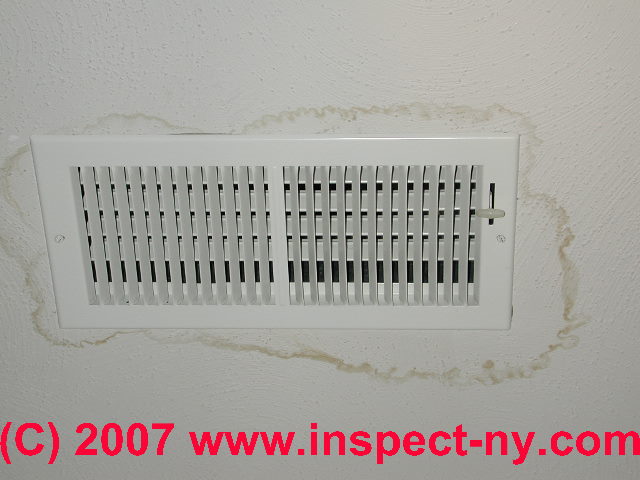
In ceilings, walls, or floors, where cool air is supposed to be delivered to various rooms in the building, be sure that the register is in the "open" position (you will be able to see through it into the ductwork) and be sure you haven't blocked the supply registers with a carpet or furniture.
Look for a duct damper or register that has been closed; look for a flex-duct section that has become disconnected, bent, or crimped or squashed. Remember that a duct may have become disconnected in an attic or crawl space.
Look for an air filter that has come loose and blown into the ductwork, clogging it.
In our photo at above/left you can see a ceiling air supply register that has leak stains around its opening - further investigation for a condensate leak or roof leak is needed.
Also see DUCT & AIR FLOW PROBLEMS for a complete diagnostic guide to inadequate air flow problems
Also see RETURN AIR, HVAC - inadequate return air will reduce the supply of cool air in cooling mode or warm air in heating mode.
Step 5: No air flow at all: Check the Air Conditioning /Heat Pump indoor air handler blower fan assembly
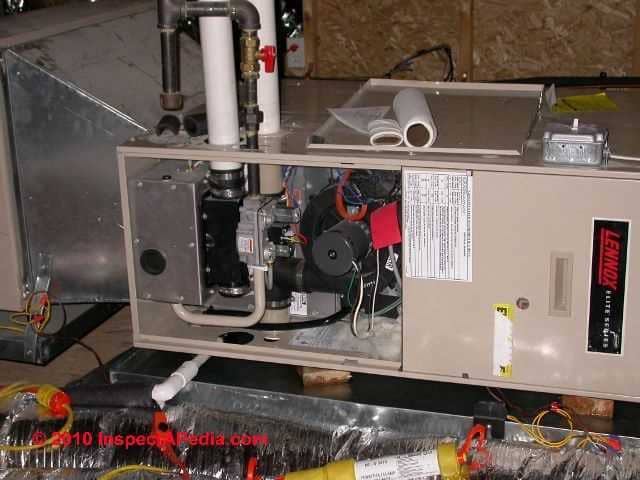
If the indoor air handler blower fan itself won't start,
see BLOWER FAN OPERATION & TESTING.
Check for lost power, a fan motor that wont' start or has tripped a motor reset button or needs a start / run capacitor.
Check for a blower fan that is loose on the motor drive shaft or for a broken or lost blower fan drive belt on pulley-driven blower systems.
Also see ELECTRIC MOTOR DIAGNOSTIC GUIDE for details
Step 6: Air flow is OK but air is not cool: check for lost refrigerant, a stuck refrigerant metering control, a blocked or iced up cooling coil
A coil blocked by ice or dirt will not produce cool air
see details at A/C COOLING COIL ICING.
The coil may need cleaning, or low refrigerant or a bad expansion valve may be causing ice blockage on the coil.
If the air conditioner or heat pump runs but in cooling mode the air supplied is too warm there are several
things that will cause warm air discharge from the supply registers of an air conditioning system or from a heat pump system in cooling mode.
Examples include:
- The compressor/condenser is not running at all
see COMPRESSOR / CONDENSER DIAGNOSTICS - The compressor runs but refrigerant has been lost due to a leak
see REFRIGERANT GASES & PIPING - home
and GAUGE, REFRIGERATION PRESSURE TEST - The compressor runs, refrigerant charge is OK but the refrigerant metering device or TEV is jammed
see step 7 below.
If both indoor air handler and outdoor compressor are running and there is good air flow but the air is not cool, you need help from a service technician.
S/he will check for problems such as lost refrigerant or a stuck refrigerant metering control (thermostatic expansion valve or TEV)
GAUGE, REFRIGERATION PRESSURE TEST - how to check refrigerant levels
THERMOSTATIC EXPANSION VALVE TEV INSTALL, DIAGNOSE, REPAIR - check for a stuck TEV that prevents cooling or heatin
Step 7: Refrigerant Pressure & Temperature Checks to Diagnose Lost Cooling Capacity
Blocked coil, filter, iced coil
Look for dirt, damaged fins, or frost or ice that block the indoor cooling coil (at the air handler) or the outdoor compressor/condenser coil.
Technician's additional tests (not for the homeowner):
A blocked coil is indicated if suction side pressure is abnormally low combined with low superheat and high sub-cooling
Watch out: tests of refrigerant pressure are not something that a typical building owner can or even should attempt. Even if you have HVAC test gauges, if you don't have a supply of the proper refrigerant to purge and connect the pressure gauges you can contaminate and damage your equipment, leading to even more-expensive repairs.
Refrigerant leak (low refrigerant)
Technician's additional tests (not for the homeowner):
- Indicated if suction side pressure is abnormally low combined with high superheat and low sub-cooling.
- These conditions may be found also if outdoor air temprature is at or below the normal operating range of the compressor/condenser
Low temperature drop across the cooling coil
Technician's additional tests (not for the homeowner):
- Normally we see 15-20 °F temperature drop across the cooling coil.
- If the temperature drop across the coil is below 15 °F check for a TEV that's stuck open OR a refrigerant leak (low refrigerant).
- If the temperature drop across the coil is above 20 °F check for a blocked coil, filter, return duct, or other air flow obstruction.
The steps given here will be taken by your trained HVAC repair or service technician who will use gauges and temperature measuring equipment to check the system's operating temperatures and pressures at key diagnostic points.
Stuck Thermostatic Expansion Valve (TEV)
Technician's additional tests (not for the homeowner):
Bad TEV
- If suction side pressure is abnormally low
the expansion valve may be stuck closed. Confirm this by finding the combination of low suction-side pressure with both high-superheat AND high sub-cooling. - Normal Superheat = 8-10 °F.
Find superheat by subtracting the evaporation temperature from the suction line temperature measured at the condenser unit. Normal superheat will be between 8 and 18 °F. - Normal Sub-cooling = 3-12 °F.
(and no bubbles in the sight glass if one is installed). Find sub-cooling by subtracting the liquid liine (high side) temperature from the saturation temperature for the refrigerant. - If suction side pressure is abnormally high
the expansion valve may be stuck open.
Other causes of abnormally high suction side pressure include the wrong TEV model or wrong TEV adjustment, or an internal leak inside the compressor motor, or a defective or mis-adjusetd hot gas bypass regulator.
See details at THERMOSTATIC EXPANSION VALVE TEV INSTALL, DIAGNOSE, REPAIR
Step 8: AIr Conditioner or Heat Pump Runs but Makes Strange Noises
If the air conditioner or heat pump system is running and the air is cool (in cooling mode) or warm (in heating mode) but the system is making strange noises, go to
NOISE AIR CONDITIONER / HEAT PUMP
Step 9: Call your HVAC Service Technician
If after checking the switches, controls or other easy diagnostics in the steps above you the air conditioning system or heat pump is still not working, or if the system is running but cool air is not coming out of the supply registers you need to call a service technician.
Need to Know How an Air Conditioner / Heat Pump Works?
If so, see
AIR CONDITIONER / HEAT PUMP OPERATION how they work
For more photographs of these various air conditioning and heat pump parts, and for an explanation of where these air conditioning components are physically located,
see A/C or HEAT PUMP COMPONENTS which discusses and helps you name and recognize
various INDOOR A/C Components and OUTDOOR A/C Components
...
Reader Comments, Questions & Answers About The Article Above
Below you will find questions and answers previously posted on this page at its page bottom reader comment box.
Reader Q&A - also see RECOMMENDED ARTICLES & FAQs
On 2021-01-06 by thomas
how can you fix an inverter AC compressor with a tight compressor issue ,if by hard starting HOW?
On 2021-01-06 by (mod) - fix an inverter AC compressor with a tight compressor issue
Thomas
a Service tech will typically try adding a hard start capacitor for the compressor motor. But beware that you are probably just squeezing a bit more life out of a failing motor.
On 2020-11-11 by tom
ac side works good air out @ 59-60 deg. when i switch to heat emr,. heat comes on & blows hot air & goes well beyond set point & wont shut off until i shut it off . im mot much good @ computers so help me if you can Thanks
On 2020-11-15 - by (mod) -
Tom
When cooling works and heating mode does not I suspect a control board or reversing valve problem. That's what your service tech will probably check; it's not something a homeowner would try.
...
Continue reading at DIAGNOSTIC DETAILS A/C or HEAT PUMP, or select a topic from the closely-related articles below, or see the complete ARTICLE INDEX.
Or see these
Recommended Articles
- AIR CONDITIONER WON'T START
- AIR CONDITIONING & HEAT PUMP SYSTEMS - home
- AIR CONDITIONER / HEAT PUMP OPERATION - how does an air conditioner or heat pump actually work?
- AIR HANDLER / BLOWER UNITS - home
- COMPRESSOR / CONDENSER REPAIR - home
- COMPRESSOR / CONDENSER DIAGNOSTICS
- CONTROLS & SWITCHES on A/C or HEAT PUMP - what and where are all of the controls?
- DIAGNOSTIC GUIDE A/C or HEAT PUMP -first steps to diagnose an air conditioner or heat pump - you are on this page
- DIAGNOSTIC DETAILS A/C or HEAT PUMP - detailed list of diagnostic procedures
- DUCT SYSTEM DESIGN SIZE & DEFECTS - home
- MANUALS & PARTS GUIDES - HVAC - home
- REFRIGERANT LEAK DETECTION
- SPLIT SYSTEM AC / HEAT PUMP REPAIRS
Suggested citation for this web page
DIAGNOSTIC GUIDE A/C or HEAT PUMP at InspectApedia.com - online encyclopedia of building & environmental inspection, testing, diagnosis, repair, & problem prevention advice.
Or see this
INDEX to RELATED ARTICLES: ARTICLE INDEX to AIR CONDITIONING & HEAT PUMPS
Or use the SEARCH BOX found below to Ask a Question or Search InspectApedia
Ask a Question or Search InspectApedia
Questions & answers or comments about air conditioner system diagnosis & repair
Try the search box just below, or if you prefer, post a question or comment in the Comments box below and we will respond promptly.
Search the InspectApedia website
Note: appearance of your Comment below may be delayed: if your comment contains an image, photograph, web link, or text that looks to the software as if it might be a web link, your posting will appear after it has been approved by a moderator. Apologies for the delay.
Only one image can be added per comment but you can post as many comments, and therefore images, as you like.
You will not receive a notification when a response to your question has been posted.
Please bookmark this page to make it easy for you to check back for our response.
Our Comment Box is provided by Countable Web Productions countable.ca
Citations & References
In addition to any citations in the article above, a full list is available on request.
- ACHR News Magazine, 2401 W. Big Beaver Rd., Suite 700 Troy, MI 48084, Tel: 1-800-837-8337, Email: thenews@pubservice.com, Website: http://www.achrnews.com, Mike Murphy, Publisher, Kyle Gargaro, Editor-in-Chief kylegargaro@achrnews.com, mikemurphy@achrnews.com. This HVACR news magazine offers excellent heating, air condtioning and refrigeration systems education and troubleshooting help.
- Timothy Hemm, Yucala, CA, contributed photographs of electrical wiring and equipment installed in California buildings. Mr. Hemm can be contacted at TimHemm@yahoo.com
- Thanks to reader and research scientist Cyril Roberts, Barbados, for technical discussion and investigation of air conditioning system dehumidification problems (April 2009).
- Thanks to readers Beth & Dennis for asking about how to improve an inadequate air conditioning system supplying cool air through crawl space ducts and floor registers. (May 2010).
- Thanks to reader William Smith for discussing cooling coil leaks and lost cooling capacity diagnosis - June 2010
- Thanks to reader Jacob Behrends, FL for discussing how a clogged condensate drain line can overflow condensate into a condensate pan that in turn may contain a safety switch that shuts down the whole air conditioning system. August 2010.
- Determining Electric Motor Load and Efficiency, U.S. Department of Energy, web search 08/01/2011, original source: http://www.p2pays.org/ref/40/39569.pdf [copy on file at InspectAPedia.com]
- Modern Refrigeration and Air Conditioning, A. D. Althouse, C.H. Turnquist, A. Bracciano, Goodheart-Willcox Co., 1982
- Principles of Refrigeration, R. Warren Marsh, C. Thomas Olivo, Delmar Publishers, 1979
- Refrigeration and Air Conditioning Technology, 5th Ed., William C. Whitman, William M. Johnson, John Tomczyk, Cengage Learning, 2005, ISBN 1401837654, 9781401837655 1324 pages
- In addition to citations & references found in this article, see the research citations given at the end of the related articles found at our suggested
CONTINUE READING or RECOMMENDED ARTICLES.
- Carson, Dunlop & Associates Ltd., 120 Carlton Street Suite 407, Toronto ON M5A 4K2. Tel: (416) 964-9415 1-800-268-7070 Email: info@carsondunlop.com. Alan Carson is a past president of ASHI, the American Society of Home Inspectors.
Thanks to Alan Carson and Bob Dunlop, for permission for InspectAPedia to use text excerpts from The HOME REFERENCE BOOK - the Encyclopedia of Homes and to use illustrations from The ILLUSTRATED HOME .
Carson Dunlop Associates provides extensive home inspection education and report writing material. In gratitude we provide links to tsome Carson Dunlop Associates products and services.
 | HOME | ABOUT | ASK a QUESTION | CONTACT | CONTENT USE POLICY | DESCRIPTION | POLICIES | PRIVACY | |
| © 2024 - 1985 Publisher InspectApedia.com - Daniel Friedman | |||||||||