
InspectAPedia® FREE Encyclopedia of Building & Environmental Construction, Diagnosis, Maintenance & Repair |
Question? Just ask us! InspectAPedia
|
 Electric motor start troubleshoot, select, install, repair
A/C Compressor & Other Electric Motor Start-Boost or Run Capacitors
- POST a QUESTION or COMMENT about installing a hard-start capacitor to get an air conditioner motor, fan motor, or other electric motor running.
Electric motor start-run capacitor instructions:
Tthis electric motor capacitor article series explains the selection, installation, testing, & use of electric motor starter start and run capacitors used on various electric motors found in or at buildings such as air conditioner compressors, fan motors, some well pumps and some heating equipment. These electric motors use a capacitor to start and run the motor efficiently.
We explain the choice & wiring procedures for a hard start capacitor designed to get a hard-starting air conditioner compressor motor, fan motor, refrigerator, or freezer compressor or other electric motor (such as a well pump) going.
We discuss the following: Use of starting capacitors on electric motors for air conditioning, pumps, etc. Start or Run Capacitor Diagnostic Checks: How to Use a VOM or Multimeter to Test a Motor Starting Capacitor. How to fix or replace a hard-starting air conditioner compressor or other hard starting electric motor. How to inspect, test, or install an air conditioner motor starting capacitor. Warnings about remaining life of hard-starting air conditioner or heat pump compressor motors.
Capacitors are electric devices that get an electric motor running at start-up or that help keep a motor running once it has started. If the capacitor has failed the symptom is that the motor won't start. You may hear it humming or observe that it's getting hot. If you observe this we suggest that to avoid damage you turn off the system while waiting for repairs.
InspectAPedia tolerates no conflicts of interest. We have no relationship with advertisers, products, or services discussed at this website.
Air Conditioning Compressor or Other Electric Motor Starting Capacitors
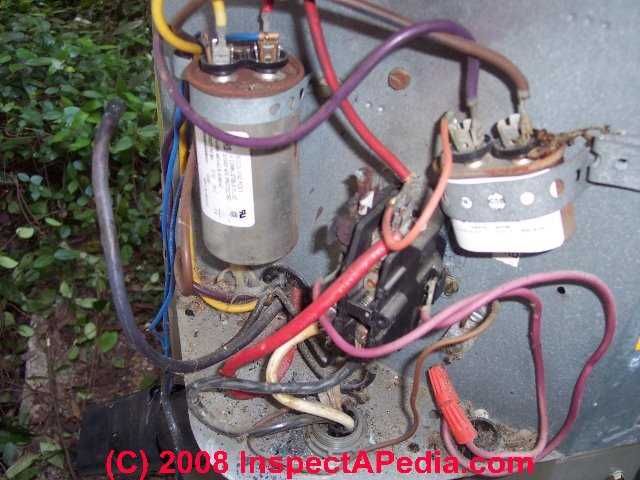
 Capacitors are electric devices that get an electric motor running at start-up by providing a "jolt" of stored electrical energy, or that help keep a motor spinning once it has started.
The starting capacitor helps a motor start spinning by creating a high-torque, rotating, electrical field in the motor. In many electric motors there are actually two capacitors, one boosting the start winding (the start capacitor) and a second that remains in the circuit while the motor continues running (the run capacitor).
If the start capacitor has failed the symptom is that the motor won't start. If either or both start and run capacitors are defective the motor may try to start but will hum and won't keep running.
You may hear a compressor or fan motor humming or observe that it's getting hot.
Watch out: If you observe a humming electric motor that is not starting we suggest that to avoid damage you turn off the system while waiting for repairs.
Question: Could replacing a start capacitor cause the compressor to short to ground?
(Aug 16, 2016) Jen said:
We recently had our "Start capacitor" replaced on a 9 year old Trane HVAC. 3 days later, unit stopped cooling and technican says "compressor is shorted to the ground". When asked if the start capacitor replacment could have created any issue with the compressor shortage, he said "absolutely not".
That seems inconsistent. If the starter capacitor is a "energy booster" to the compressor, how could it be completely unrelated? So my question is, could/is it possible for a new start capacitor install create an "energy event' which would cause the compressor to short out?
The tech said there was no way they could be related technically, Just need an HVAC genius to provide their insight. I would appreciate it. I'm looking at 2400 to replace compressor or 7K for new unit.
This question was posted originally at AIR CONDITIONING & HEAT PUMP SYSTEMS
Reply:
Jen, I can't by e-text rule out a wiring error or mistake that could damage an air conditioner compressor motor during service, but most likely the compressor motor was failing in the first place, before the replacement starting capacitor was installed.
A common quick and inexpensive "repair" that an HVAC tech will try when a compressor motor is having trouble starting is to simply install a hard-start motor capacitor. If I were doing that I'd probably remember to explain to the customer that this repair might give some added life to the compressor but if it's failing - such as by a motor that's binding - then the unit can fail at any time: be prepared.
Question: smoking start capacitor
2 Sept 2016 Rod said:
Trying to replace this smoking black cannister but I don't know what it is nor the brand of the A/C. It's an ICP heat pump and the A/C logo is a molecule. It's pretty old.
Reply:
Rod I looked at the photo link you suggested but couldn't understandwhat I was looking at. If it's connected only by wires it may be a start/run capacitor.
Watch out: If equipment is smoking, TURN IT OFF immediately and leave it off as you're risking a fire.
Normal start & run capacitors on compressors, fan motors, other electric motors
Air conditioner compressor motors (and lots of other electrical motors) that run on two-phase (220V) or single phase (120V) electrical power usually include a capacitor in the start circuit to help get the motor spinning; a capacitor can be put into the "run" circuit of the motor as well to increase motor efficiency.
Starting capacitor: the starter capacitor gives extra torque or boost to get a motor spinning in the right direction by providing about double that nominal system voltage.
Run capacitor: once the motor has started, a run capacitor may be used to help the motor retain full power, providing 1.5 x the nominal system voltage and varying as needed depending on the load on the motor.
In some old-school class views adding a run capacitor is similar to making two-phase out of one-phase electricity and is a common practice on air conditioners. What these folks really are saying is that "With capacitive reactive power of about 75% of the nominal power of the motor, the comparison of power is slightly lower than that of a three-phase motor of equal size." [2]
Technical notes: Single phase electric motors such as those used in air conditioner compressors and fan motors contain two different stator windings: an auxiliary starter winding fed by an electric capacitor and a main run winding fed by the principal electrical circuit.
The auxiliary starter winding is used to provide an extra boost (and proper direction) to get the motor spinning at start-up. (Three phase electric motors do not use start/run capacitors.)
Electric motors that use start/run capacitors may be PSC (permanent split capacitor) and CSR / CSCR (capacitor start, capacitor run) designs. Unlike a PSC motor, a CSR/CSCR motor must also have a starting relay that will cut the start capacitor out of the electrical circuit once the motor has gotten up to run speed. The run capacitor then remains in the circuit to keep the motor spinning properly.
What are Hard-start start/run capacitors or "booster" capacitors?
If your air conditioner has stopped running, a possible problem is the failure of the starting capacitor found on the outside compressor/condenser unit.
If that unit has electrical power but the compressor and/or its cooling fan are not running, one of the components to check (and that is easy to replace) is the starter.
When an electrical motor is having trouble starting, such as an air conditioning compressor motor, blower motor, a refrigerator motor or a freezer motor, or even a fan motor, the repair technician may install a simple and inexpensive hard-start capacitor.
See HARD STARTING COMPRESSOR MOTORS for complete details about choosing & wiring a hard-start capacitor.
The starting capacitor is a simple electrical device which can give an extra voltage jolt or "boost" to get the hard-starting motor spinning.
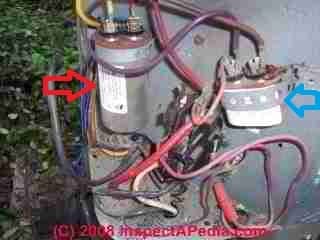
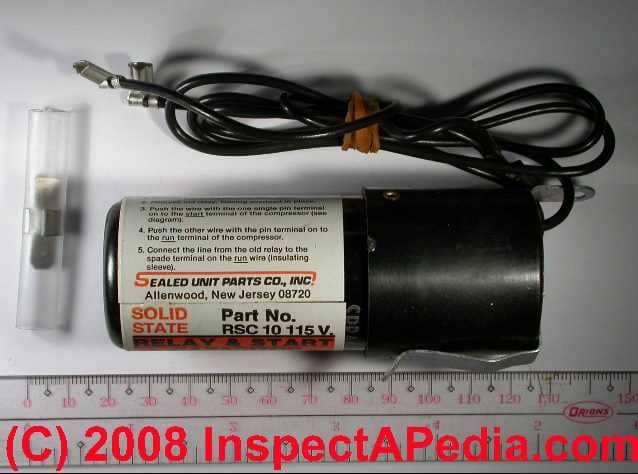
The starting capacitor in our page top photo is oval in cross section, but most replacement and many newer air conditioner motor starting capacitors are simply cylindrical in shape (photo at left).
Field report: describes diagnosing & replacing a bad starter capacitor on a heat pump that had stopped working
Our Heat Pump was new in 2002. It is a 3 ton unit ProSeries brand by Service Masters. We just had a big birthday party at our house for my 1 year old daughter. 95 degrees outside. House full of Aunts, Uncles, friends, Great Grandparents.
 We got through that before the failure.
Next morning it is just real gooey in our house. I can feel the blower fan is on. No cool air at all. I had to go to work so I left the house.
We got through that before the failure.
Next morning it is just real gooey in our house. I can feel the blower fan is on. No cool air at all. I had to go to work so I left the house.
Come back home in the mid afternoon to find house is hotter than before and my wife reports that the air hasn’t been cooling at all. It’s around 86-88 degrees in the house.
I check the little screw in fuse on the side of the blower unit. Hoping to find a $2 fuse blown. Nope. Fuse looks fine. Getting a little sense of panic because I remember how expensive our last service call cost for this heat pump. Plus it takes two days to get a technician to come out.
The key that I found on your web pages was the fact that the fan on the top of the condenser unit wasn’t running and the Compressor wasn’t running either. This pointed [possibly] to the start capacitor. In my system it is actually a pair of them, a dual capacitor unit. Aha!
Finding the start capacitor took about twenty minutes. I work really slowly when I’m trying to not drop a handful of sheet metal screws in the grass [or worse into an electrical component where left in place a dangerous short circuit could occur].
I could see a little bit of bulging on the capacitor and some rust and grunge on the top.
I found a local HVAC Supply house in the phone book and read them the nomenclature from the side of the old Start Capacitor. The order clerk I spoke to was amazingly patient with me. About an hour and a half later I was plugging the new Start Capacitor in and flipping the circuit breaker back on. I put my hand on the coolant line and felt the copper getting cool fast. - James Oiler
Watch out: remember to turn off electrical power to any equipment before opening or working on it. Otherwise you could be electrocuted. Also, remember that an electrical capacitor can retain a large electrical charge even after electrical power has been turned off. You could still be shocked!
Also see HOW TO WIRE up a START CAPACITOR
Air Conditioner Motor Starting Capacitor Safety warnings:
Watch out: When testing a compressor, one must discharge the capacitor first! It'll otherwise have enough power stored on it to be at least very painful. (Author and others have been zapped!)
Some systems will automatically discharge the capacitor, but shorting its leads [to ground] with a screwdriver (after verifying that the power's off) is a safe way to ensure that you won't get shocked. Motor starting capacitors can hold a charge for days!
Watch out: If oil has leaked out of a capacitor: Don't touch any oil that leaked out: old capacitors may contain PCB oils, an extremely carcinogenic (cancer causing) material which require special disposal.
Once the capacitor has been discharged (as described just above), then it can be tested with a multi meter. Either use the meter's built in capacitor test function, or use this trick: Charge the capacitor by using the sense current the meter puts out when set to ohms. You should observe a rapidly rising resistance before the meter indicates over range/infinity. Disconnect the test leads, and switch over to volts. Then, reconnect the test leads. A voltage reading should be observed, approaching zero.
If the capacitor doesn't hold a charge, or the resistance reading never approaches infinity, it probably needs replacement.
Also, the capacitor may be defective if the compressor hums but does not start. Visual inspection may reveal it to be bulged, or have a blown out safety plug.
Examples & Sources of Start / Run Motor Capacitors
- COPELAND ELECTRICAL HANDBOOK [PDF]
- MOTOR START and RUN CAPACITORS [PDF] AFCAP (African Capacitors Limited), Metallized polypropylene film capacitors for motor running applications web search 08/05/2011, original source: http: //www.afcap.co.za /manual/Part2.pdf; 2018/07/11 update: the original source link is no longer valid - Ed.
- Packard 370V 45+5 MFD Round Run Capacitor
- SUPCO AC Hard Starts, HARD START CAPACITOR BOOKLET [PDF], SUPCO, Sealed Unit Parts Co., Inc., PO Box 21, 2230 Landmark Place, Allenwood NJ 08720 USA, Tel: 732-223-6644, Website: www.supco.com, Email: info@supco.com retrieved 2018/07/11, original source: http://www.mcaair.com/docs/supco/hardstartbooklet.pdf
- Supco™ 30+5 MFD 440V 440 Volt 50/60 Hz Round Motor Capacitor (typical application for Amana, Carrier, Rheem, Trane equipment)
- Supco™ 45+5 MFD 440V 440 Vol 50/60 Hz Round Motor Capacitor (typical application for Amana, Carrier, Rheem, Trane equipment)
- Supco HS6 (SPP6) Hard Start Relay Capacitor (230V) gives a starting torque boost of up to 500%. Quoting from product sales literature:
The SUPCO SPP6 Super Boost hard start capacitor increases starting torque up to 500%. Features: Installs in seconds across run capacitor terminals Contains specially designed relay and large start capacitor for severe hard start problems.
Applications: Room A/C units, Residential and commercial PSC A/C units and heat pumps, For all PSC A/C units from 4,000 thru 120,000 BTU's (1/2 thru 10 H.P.) Can be used on 120 thru 288 VAC units, For severe low voltage and hard starting compressors. SPP6 Specifications: Voltage: 115V - 230V. Increased Torque: 390 ounce inches. - retrieved 6/16/14 Amazon.com sales - Supco™ Universal (broad application) Capacitor, 10 MFD at 370V
Reader Comments, Questions & Answers About The Article Above
Below you will find questions and answers previously posted on this page at its page bottom reader comment box.
Reader Q&A - also see RECOMMENDED ARTICLES & FAQs
On 2020-11-06 by (mod) - have to rotate the pump to get it to run
That sounds like a bad start capacitor or possibly a failing motor, perhaps suffering from a bad bearing
On 2020-11-05 by Stephen Dwumfour
When I turn my submersible pump ON I have to rotate the shaft before it moves. What can be the cause?
On 2020-10-04 1 by Moderator Daniel Friedman
Fred
1. the click is often a relay closing - which argues that the relay may be working
2. the fan whirl test can sometimes diagnose a bad start cap; often a service tech will replace the start/run capacitor as a stab at repair because it's quicker and cheaper than running more detailed diagnostic procedures.
When you spin the blower fan if it spins freely and there's no wobble or end play then its bearings may be ok
3. a tech might remove the motor and see if it will run when powered directly on a test bench
On 2020-10-04 by fred
@Anonymous,
Thank you for your response. I agree 100% it's with the heating system and not my Nest thermostat. I've used the same combination of Nest thermostat and this furnace for the past 4 years and have had no issues, so it's unlikely to be a wiring issue.
Today I did some additional tests and noticed that the blower fan either starts and is able to keep running and can go through several cycles (off/on) for a few hours and then it will suddenly stop working. By not working I mean it doesn't start when the heater starts and I am also unable to start it manually with my thermostat either.
I am suspecting it's either:
1. Faulty circuit board. How would I go about diagnosing it? I hear a "click" whenever I manually try to turn on the blower fan, regardless if it actually comes on or not.
2. Bad Start capacitor. When the blower fan wouldn't turn on, I tried to give the fan a quick twirl with a stick and it still wouldn't start. It seems that would point to a faulty capacitor. Could it be the run capacitor instead? How would I go about diagnosing that?
3. Faulty blower fan motor. Completely don't know how to test that.
If I have the original installer come in, what should I expect? Should he be trying to test and diagnose the problem similar to what you teach on your website or would he go straight into replacing parts? I am trying to avoid the latter scenario, but also unsure how to navigate and get him to actually test and try to root cause the problem instead just blindly replacing parts.
I am so stressed because this furnace was brand new just 4 years ago and I have a baby at home and it's starting to get below freezing overnight. I feel so helpless and at the mercy of the technician and if he doesn't know better and starts pushing to replace parts, I don't know what else to do!
On 2020-10-03 by Anonymous
Fred
The root issue here sounds as if it's at the heating system not the thermostat;
When a heating system won't run the thermostat will continue to call for heat indefinitely.
A forced warm air heating system (furnace) will shut off the burner if the heating plenum temperature rises to the HI LIMIT on the fan limit control switch - an important safety feature.
And as you surmise, that will happen if the burner turns on but the blower fan does not.
So the problem is indeed likely to be with the blower circuit, wiring, control board, or motor. Sometimes a starting capacitor can fix a motor that won't start. Usually a tech will test the motor to see that it will start and run if given power directly. If it does then the problem is ahead of the motor - which leaves the wiring and the control board. On some older equipment there's a fan relay that might be replaced but often on newer equipment we're stuck with swapping out the control board.
Review the details found at HVAC BLOWER FAN WON'T START
On 2020-10-03 by fred
I have a Keeprite (ICP I think is the actual brand) high efficiency furnace that was installed brand new just 4 years ago and a couple weeks back, we turned on the heat from our Nest thermostat and our house never warmed up. The Nest thinks it's calling for heat, but the furnace was in lockout due to flame being on for more than 2 minutes.
After a lot of diagnose, I realized that when the call to heat comes, the furnace heats up, but the fan doesn't start (which I think causes overheat and is considered open flame) and enters lock out. I can start the fan manually without the heat being on via my Nest so it doesn't seem to be a capacitor/motor issue. I opened the entire unit and did some light vacuuming and everything worked for 2 weeks until today. Coincidentally, when the temperature drops, this issue occurs. I'm now stumped as I can't figure out what's wrong.
A couple of additional notes:
We also have a central humidifier that's connected and seems to kick in right before the blower fan starts. Would that have to do with anything?
The air filter is clean and is changed regularly, so that shouldn't be the problem.
The original technician who installed the furnace wants to come and charge me and says it's likely a control board that needs to be replaced. Given it's only 4 years old, I am not convinced it's defective and he just seems like he's going to start replacing parts without actually diagnosing the real problem. The last thing I want is to keep replacing part after part and keep paying this guy.
On 2020-02-03 - by (mod) -
Sylvan
Could be a simple loose connection or wire, or a failing motor that's overheating.
On 2020-02-03 by Sylvan Bartlett
The blower motor on my insulation blower will function for a few minutes then stop. Let it sit for a while and it will start again and stop in a few minutes.
On 2019-11-16 - by (mod) -
Do keep us posted, Jeff as what you find will certainly help other readers
On 2019-11-16 by Anonymous
Thanks again Dan. That about lists all the possibilities. Since I already changed the capacitor I'll start looking at the wires themselves. Appreciate your help very much!
Jeff
On 2019-11-14 by (mod) - an electric motor running in reverse direction is caused by ...
ELECTRIC MOTOR RUN DIRECTION describes the usual causes,
Typically an electric motor running in reverse direction is caused by (in order of probabiliy)
A failed electric motor starting capacitor
A single speed single-phase motor leads are reversed on the motor's start widing connections
A single-speed 3-phase electric motor has two of its supply leads reversed
Belt driven air handler motors attached to a blower fan in a multiple-blower HVAC system can be turned backwards with the motor OFF and the squirrel cage fan rotating backwards because of air currents created by other fans that are on in the same system
(For 2-speed electric motors you'll need to contact your motor supplier)
Given that your motor seems to act randomly I would
1. try a new start capacitor
2. if that makes no difference I'd look for a loose wire connection or a winding that's loose or cracked and occasionally opening up in the motor itself.
3. or a bad centrifugal switch that's not switching the start cap in and out when it should. The switch ought to put the start cap IN when the motor is stopped and to take the start cap OUT when the motor gets up to speed. But if the switch is sticking it may not reliably connect the start cap.
Put another way, if the centrifugal switch is sticking you can get random choice of run direction when the motor starts-up again.
Well not in all motors. Some electric motors use a potential relay instead of a centrifugal switch. If the pot. relay is bad the effect of random start direction could still occur.
4. If a motor ALWAYS starts in the wrong direction we think the start winding leads have been reversed - that's not your issue
Question: the capacitor is leaking oil
(June 15, 2015) Larry said:
I noticed my air conditioner's run capacitor is leaking oil - what does this mean?
Reply:
The capacitor is shot and should be replaced.
Reader Question: replaced both start & run capacitors on AC compressor but compressor won't turn on
(June 15, 2015) Larry said:
Trane Xl1600 heat pump cools down to set thermostat setting and then will not turn compressor back on and blow hot air in the home. This seams to happen when Phoenix temperatures reach 100 degrees. Replaced both start and run capacitors a couple months ago as issue started last summer was working fine until 100 degrees. Any assistance with this would be greatly appreciated.
This question was posted originally at DIAGNOSTIC GUIDE A/C or HEAT PUMP
Reply:
Larry if replacing the start/run caps didn't fix the trouble I suspect either a failing control board / relay or a compressor motor that is failing beyond the ability of the starting cap to kick it off. Perhaps your tech will check the current draw of the various motors involved to see if that's going on.
...
Continue reading at MOTOR CAPACITOR TYPES or select a topic from the closely-related articles below, or see the complete ARTICLE INDEX.
Or see CAPACITORS for HARD STARTING MOTORS FAQs - questions & answers about starting capacitors posted originally at the end of this page.
Or see these
Recommended Articles
- BASIC ELECTRICAL TESTS for BURNED OUT COMPRESSOR MOTORS
- CAPACITOR TYPES, for MOTORS
- CAPACITORS for HARD STARTING MOTORS
- CAUSES of HARD STARTING ELECTRIC MOTORS
- HARD STARTING COMPRESSOR MOTORS
- HOW to CHOOSE a START / RUN CAPACITOR
- COPELAND ELECTRICAL HANDBOOK [PDF]
- HOW a STARTING CAPACITOR WORKS
- HOW to WIRE up a START CAPACITOR
- HOW to TEST the MOTOR to ID TERMINALS
- LOCATE the STARTING CAPACITOR
- TEST a MOTOR START or RUN CAPACITOR
- ELECTRIC MOTOR DIAGNOSTIC GUIDE
- HARD STARTING ELECTRIC MOTOR CAUSES
Suggested citation for this web page
CAPACITORS for HARD STARTING MOTORS at InspectApedia.com - online encyclopedia of building & environmental inspection, testing, diagnosis, repair, & problem prevention advice.
Or see this
INDEX to RELATED ARTICLES: ARTICLE INDEX to ELECTRICAL INSPECTION & TESTING
Or use the SEARCH BOX found below to Ask a Question or Search InspectApedia
Ask a Question or Search InspectApedia
Try the search box just below, or if you prefer, post a question or comment in the Comments box below and we will respond promptly.
Search the InspectApedia website
Note: appearance of your Comment below may be delayed: if your comment contains an image, photograph, web link, or text that looks to the software as if it might be a web link, your posting will appear after it has been approved by a moderator. Apologies for the delay.
Only one image can be added per comment but you can post as many comments, and therefore images, as you like.
You will not receive a notification when a response to your question has been posted.
Please bookmark this page to make it easy for you to check back for our response.
Our Comment Box is provided by Countable Web Productions countable.ca
Citations & References
In addition to any citations in the article above, a full list is available on request.
- Supco, Sealed Unit Parts Company, PO Box 21, 2230 Landmark Place, Allenwood, New Jersey, 08720, Tel: 732-223-6644, 201-449-3300, email: info@supco.com, provided the compressor starting capacitor and packaging information (purchased by the author from an air conditioning parts supplier in New York) - our example uses a Sealed Unit Parts Company Solid State part No. RSC 10 115V starting capacitor which was designed for installation on refrigerators and freezers. See www.supco.com/
- [1] "The E Class Advantage", Supco (op cit), describes the company's advanced start/run capacitor products. Web search 08/04/2011, original source: http://www.supco.com/eclassadvantage.htm Quoting from that article:
The SUPCO E-Class Series comprise the most advanced developments in start device technology:
1. Voltage sensing technology that monitors for motor start (current sensing devices require internal fuse protection).
2. A 2-wire connection that simplifies installation
3. A secondary timing circuit that ensures that the capacitor is not permanently left in the start winding circuit
4. A fully electronic device - minimizing the limitations of mechanical devices and secondary fusing associated with triac devices
5. A start device matched with an appropriately sized capacitor to cover the range of compressors for the intended application (one size does not fit all)The use of compressor start devices results from a need to ensure that a compressor (usually air conditioning) will start under voltage conditions that are less than ideal. As discussed, several options exist in the market to address compressor start concerns. Start devices exist in many forms for specific applications. SUPCO provides a full range of products in all relevant technologies to effectively match the proper start device to the application. Care should be taken to utilize a device that meets the requirements of the job. Extra caution should be observed when employing the "one-size-fits-all" and "a bigger capacitor is better" approach to applying a start device. Consult SUPCO, a manufacturer with a complete product range, to ensure the greatest success in the start device application.
- [2] "Motor Start and Run Capacitors", AFCAP (African Capacitors Limited), web search 08/05/2011, original source: http://www.afcap.co.za/manual/Part2.pdf
- COPELAND ELECTRICAL HANDBOOK [PDF] free download from Emerson Climate Controls, at InspectApedia.com
- [3] "Kenmore model 580. 75121 room unit air conditioner wiring diagram", Sears Roebuck window air conditioner wiring diagram for a typical room or window air conditioner
- George Fazio, reader, contributed comments on failed starter capacitor diagnosis by noting the bulged capacitor ends. 09/25/2009
- Troubleshooting Compressor Problems," Henry Puzio, Fuel Oil & Oil Heat with Air Conditioning Magazine, June 1993, p. 39
Tom Morris, Engineer, capacitor discussion and correction to the original data. Email to D Friedman 5/29/2006 - Thanks Tom for critical editing. The text above explaining about capacitors was suggested by Mr. Morris. The original text of the 1993 compressor diagnosis article had the resistance explanation backwards. - Thanks to reader Diane McGivney for asking about air conditioner compressor motor starting capacitor costs and typical air conditioner service call fees - (May 2010)
- Thanks to reader James Oiler for reporting on the replacement of a heat pump starter capacitor, August 2010.
- In addition to citations & references found in this article, see the research citations given at the end of the related articles found at our suggested
CONTINUE READING or RECOMMENDED ARTICLES.
- Carson, Dunlop & Associates Ltd., 120 Carlton Street Suite 407, Toronto ON M5A 4K2. Tel: (416) 964-9415 1-800-268-7070 Email: info@carsondunlop.com. Alan Carson is a past president of ASHI, the American Society of Home Inspectors.
Thanks to Alan Carson and Bob Dunlop, for permission for InspectAPedia to use text excerpts from The HOME REFERENCE BOOK - the Encyclopedia of Homes and to use illustrations from The ILLUSTRATED HOME .
Carson Dunlop Associates provides extensive home inspection education and report writing material. In gratitude we provide links to tsome Carson Dunlop Associates products and services.
 | HOME | ABOUT | ASK a QUESTION | CONTACT | CONTENT USE POLICY | DESCRIPTION | POLICIES | PRIVACY | |
| © 2024 - 1985 Publisher InspectApedia.com - Daniel Friedman | |||||||||