
InspectAPedia® FREE Encyclopedia of Building & Environmental Construction, Diagnosis, Maintenance & Repair |
Question? Just ask us! InspectAPedia
|
 How to Diagnose & Repair Tight or Seized Air Conditioning Compressors
7 Causes of A/C or Heat Pump Compressor Motors
- POST a QUESTION or COMMENT about air conditioning compressor failures: tight, hard-starting, or seized A/C compressor motors
Seized air conditioner or heat pump compressor motor diagnosis:
This air conditioning repair article discusses the Diagnosing Tight or Seized Air Conditioning Compressors and how to re-start a tight air conditioning compressor. Advice for measuring amps or current draw to check for a seized or tight or failing A/C or heat pump compressor motor.
See the basic diagnostic steps suggested BURNED-OUT COMPRESSOR for A/C and heat pump damage indications and causes. Here we continue with details about examining and measuring A/C and heat pump compressors to continue compressor condition diagnosis.
InspectAPedia tolerates no conflicts of interest. We have no relationship with advertisers, products, or services discussed at this website.
Diagnosing Tight or Seized Air Conditioning Compressors
 Sometimes a compressor may be internally damaged or worn in a way that makes the piston(s) run tight in the cylinder(s) rather than
loose and worn - loose or worn air conditioner compressor diagnosis is described separately
Sometimes a compressor may be internally damaged or worn in a way that makes the piston(s) run tight in the cylinder(s) rather than
loose and worn - loose or worn air conditioner compressor diagnosis is described separately
A tight or seized air conditioner compressor might occur, for example, if the compressor ran while low on oil. Or perhaps if the compressor is old and has not been run in some time. The A/C compressor may refuse to start at all, or may be hard-starting depending on when it last ran and what it's temperature is.
A "hard starting" "tight" air conditioner compressor will probably draw excessive current (Amps) during startup, so that measurement may be used as part of the diagnosis of this problem.
Re-Starting a Tight or Seized Air Conditioner Compressor
The service technician may try re-starting a hard-starting or tight air conditioning compressor by trying to move the motor backwards and forwards.
If the compressor can be freed up enough to start at all and the oil level is made correct, the technician may install a "hard start kit" such as we introduced
at HARD STARTING COMPRESSOR MOTORS.
Also see CAPACITORS for HARD STARTING MOTORS for photos, wiring diagram, and installation instructions for air conditioner compressor, fan, blower, refrigerator motor, freezer motor, or other electrical motor starting booster capacitors.
If these steps work the compressor may continue to be used. If these steps do not get the tight or seized compressor running, it needs to be replaced.
But even if these steps do work, the compressor has probably been damaged and you should not count on its long future life before it needs to be replaced.
Amp Draw Testing for A/C or Heat Pump Compressor Motors
Also see Basic Electrical Tests on Air Conditioner or Heat Pump Compressor Motors found
at BURNED-OUT COMPRESSOR. Links there also return here.
How We Measure Amps or Current Draw at the Air Conditioner Compressor
Basic air conditioning compressor operation check: after the air conditioning system compressor/condenser unit has been running long enough to stabilize at its normal operating temperatures and pressures (typically 10 to 20 minutes), the service technician may measure the compressor's current draw in Amps using an ammeter or amp meter or multi-tester and appropriate connections.
Watch out: the nameplate data giving FLA/RLA or LRA for an air conditioning system may include multiple electrical components combined, and even if it pertains to just the compressor motor, according to some industry experts these figures may not be an accurate diagnostic number for checking on hermetically-sealed A/C or heat pump compressor motors. Joe Marchese pointed out back in 2003:
The compressor chart will list the correct amp draw for the compressor under its various operating conditions.
To use the chart, the technician must know the evaporating temperature, condensing temperature, and voltage applied to the compressor. ... It is important to measure the amp draw of the compressor only when you are trying to determine if it is operating properly. [6]
The current draw in AMPS is compared with the unit's specified FLA or "full load amps" found on the data tag or in the service manual for the unit. Remember that the total system FLA number includes the current draw of not only the compressor motor itself but also the condenser fan motor as well as the compressor motor base heater if a heater element is installed and operating. But in our table below we give example RLA/FLA (rated load amps / full load amps) and also LRA (locked rotor amps) data for both air conditioner compressor motors and heat pump compressor motors.
Tables of Typical RLA / FLA and LRA Amp Draw for A/C and Heat Pump Compressor Motors
Typical FLA current draw numbers for air conditioner compressors and heat pump compressor motors (second table below) using Whirlpool data as an example, include these data:
A/C Compressor Motor BTUH [1] |
A/C Compressor Motor RLA/FLA (rated load Amps) |
A/C Compressor Motor LRA (locked rotor Amps) |
|---|---|---|
24,600 |
7.9 |
41 |
28,400 |
9.8 |
55 |
35,600 |
16.7 |
79 |
| 40,500 | 17.9 |
112 |
| 46,500 | 19.9 |
109 |
| 57,500 | 26.4 |
134 |
Notes to the table above
[1] using Whirlpool[4] WPC44H series packaged air conditioning systems as an example. These units operate at 208-240V single phase electrical supply.
Note that these amperage figures are NOT the total amperage draw for the unit, they are specifically compressor motor amp draw data.
These FLA and LRA numbers are for example purposes only. Other compressor motor models and brands will have different, if generally similar by order of magnitude amperage draw numbers.
The apparent inconsistency of Amp draw increase in these tables is most likely due to variations in compressor motor designs among the different BTUH-rated units.
Heat Pump Compressor Motor BTUH [2] |
Heat Pump Compressor Motor RLA/FLA (rated load Amps) |
Heat Pump Compressor Motor LRA (locked rotor Amps) |
|---|---|---|
24,000 |
12.8 |
58 |
29,000 |
14.1 |
73 |
35,400 |
16.7 |
79 |
| 40,000 | 17.9 |
112 |
| 48,000 | 21.2 |
96 |
| 55,600 | 25.6 |
118 |
Notes to the table above
[1] using Whirlpool[4] WGPH45 series packaged heat pump systems as an example. These units operate at 208-240V single phase electrical supply.
Note that these amperage figures are NOT the total amperage draw for the unit, they are specifically compressor motor amp draw data.
These FLA and LRA numbers are for example purposes only. Other compressor motor models and brands will have different, if generally similar by order of magnitude amperage draw numbers.
Locked Rotor Amps - LRA compressor motor data
The current draw in AMPS during compressor motor start-up can also be compared to the unit's specified LRA or "lock rotor amps" found also on the data tag we describe above. However most HVAC repair technicians look at the compressor motor FLA reading since that's the running-condition of the unit. LRA in some references is also referred to as "starting current inrush" - the amount of current drawn, in amps, when full voltage is applied to start up the electric motor, in this case in the air conditioner or heat pump compressor.
Example LRA data is found for both air conditioning compressors and heat pump compressors in the two tables above. Other sources give typical LRA numbers for typical 240V A/C compressors will typically be about 33 Amps per ton or 33 Amps per 12,000 BTUH for up to 3 ton units. So a two ton unit will draw 66-67A, a 3-ton unit 100A during startup only.
Larger compressor motor units do not continue this almost straight line increase in current draw.
So a 4-ton A/C compressor may draw a bit under 120A, and a 5-ton unit 145A. All of these current draws are only during motor start-up and are at 240V AC. [2]
What's the difference between FLA and RLA Amperage Current Draw Ratings?
The reason you see us using "RLA/FLA" in the center table column is that these are about the same thing. The term "Full Load Amps" or "FLA" was officially changed to "Rated Load Amps" or "RLA" back in 1976. Regardless of calling it FLA or RLA, this is the maximum current the motor should draw during any running conditions.
Note that this excludes high amp load during motor start-up. On modern air conditioners and heat pumps you should see RLA marked on the motor data plate. If you are reading an older article referring to "FLA", think RLA.
Some technicians and electricians apply RLA to compressor motors and still use FLA for other motors. RLA is used in circuit wire sizing.
Watch out: don't mix-up RLA (running load amps) with LRA (locked rotor amps). LRA is discussed above as well.
Causes of a seized A/C compressor motor
Question: why did our new air conditioner compressor motor fail
SUSAN said:
We were told our compressor seized. Had a new one installed (old one was about 7 yrs. Old) and then it stopped cooling 1 hour later. Serviceman came back and it stopped cooling after an hour again.
Week later, we were told the coil and air filter were dirty and the handler was improperly installed. Air handler was never checked before the compressor was replaced. Had the company that installed the handler 2 years ago come and they said the coil needed to be cleaned and we needed 4 lbs. Lbs of frion in brand new compressor ).
Compressor was just replaced b/c while it ran, it did not cool.
Should the air handler/coil been checked before the compressor was replaced?
Who do we believe?
Can you tell us what usually causes a compressor to fail or seize up? - June 10, 2014
Reply: 7 Common Causes of A/C or Heat Pump Compressor Motor Failure
I'm sorry to say I'm confused too by this diagnosis: it seems as if multiple explanations for your compressor failure were given: bad motor, dirty air filter, dirty evaporator coil, loss of refrigerant?
Possibly the burned out compressor replacement procedure did not adequately clean the refrigerant system from debris and perhaps a burnout filter drier pair were not installed on the new system.
The result could be clogging of the expansion valve and loss of cooling. Those mistakes can quickly kill a new compressor motor.
Actually cleaning a dirty coil is of course a different and totally external step.
If a compressor motor won't start you may have heard a humming sound described at
COMPRESSOR CONDENSER NOISES - Compressor motors on air conditioners or heat pumps.
In our HVAC noise articles we describe a wide range of sounds: squeaks, hums, clanks, squeals, bubbling, hissing, etc. Humming or chattering noises (rapid clicking) at the air conditioning compressor/condenser unit may mean that a contactor or relay is failing - the unit makes noises but won't actually start.
The most-common reasons that an air conditioning or heat pump compressor motor fails are
- Compressor Liquid refrigerant slugging : liquid refrigerant flows back down the suction line into the compressor motor where only refrigerant gas is expected. The result destroys the compressor's control valves or other moving parts. You may hear horrible loud clacking and clanking sounds when this happens.
- Compressor lubrication failure: loss of lubricating oil in the compressor motor as lubricant is thinned by returning refrigerant - this is a similar failure to liquid slugging but less-dramatic and less noisy.
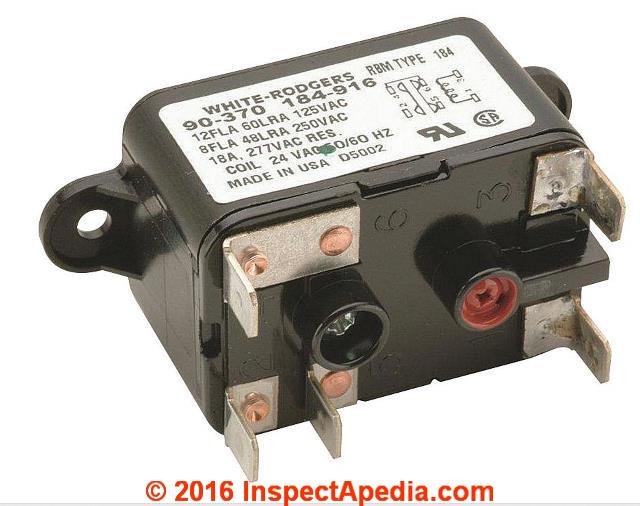
- A/C Compressor or Fan Contactor-Relay Failure: a relay-operated on-off switch or "contactor" fails to close to turn the compressor motor on when it should. You may hear a chattering noise described
at AIR CONDITIONER / HEAT PUMP RELAY SWITCH CONTACTOR CHATTERING - A/C Compressor Motor Start Capacitor Failure: a bad start or run capacitor can cause an electric motor to have trouble starting or to fail to run properly. Repeated hard-starting can in turn cause motor overheating and failure.
Often a service technician will try installing a new start or run capacitor or a hard-start capacitor that might get a hard-starting compressor motor to run again for a time but if the root problem is a lubrication failure or a failing bearing the compressor motor has a short remaining life.
Details are at CAPACITORS for HARD STARTING MOTORS - Failed crankcase heater: if your heat pump or A/C compressor motor is expected to run in cold weather it is likely to include a crankcase heater that keeps the lubrication oil in the compressor motor warm enough that the motor can be safely started in cold weather. If the crankcase heater fails or is left off and the motor tries to start at low ambient temperatures it is likely to be damaged.
Details are at
CRANKCASE HEATERS - Loose hardware: such as loose compressor or fan mounting bolts can permit components to move around until a refrigerant line or electrical wire is cut or other damage occurs in the unit.
This is a less-common cause of compressor unit failure and isn't necessarily a direct failure of the compressor motor itself. But if the compressor comes loose, cuts a refrigerant line, loses refrigerant and lubricant, but continues to run, it's likely to fail completely very quickly. - Low supply voltage: trying to run a compressor or other motor if the voltage being delivered is significantly less th ant the motor's design and operating range can damage the motor, make it hard to start, and can lead to motor failure.
A failed compressor isn't the only part that might need repair or replacement on your air conditioner or heat pump. Other types of air conditioner or heat pump failures such as refrigerant leaks, weak air flow, loss of cooling or for heat pumps loss of heating capacity are described separately in our list of RECOMMENDED ARTICLES at the end of this page.
Reader Comments, Questions & Answers About The Article Above
Below you will find questions and answers previously posted on this page at its page bottom reader comment box.
Reader Q&A - also see RECOMMENDED ARTICLES & FAQs
On 2020-06-24 - by (mod) -
Sure, but from what you have said i suspect the motor is shot.
On 2020-06-09 by Moe
I have a 3 year old American Standard -- still under warranty for parts -- and I believe the compressor is stuck. This theory is based on a lot of research and testing. The wiring diagram shows an optional start kit accessory, including a capacitor switching relay and a starting capacitor. Should I try installing such a device?
On 2018-10-30 - by (mod) -
Please take a look in the article index just above and you'll find a series of articles on HVAC noises including sources of buzzing.
Take a look at that and let me know what you think.
On 2018-10-30 by Len
Have a 12+ year old Trane 3T heat pump. Charged last summer for the first time. It ran well this summer and so far during this fall, but it makes a 1 second buzzing sound, not a rattle, occasionally on startup. Other times its snap and go, with no unusual noises.
Capacitor was low value, so I changed it and the contactor
. It still runs well and I think the noise is less frequent, certainly not on every startup. Electronics is my forte, not refrigeration but I am comfortable making tests. Any suggestions?
(When it was recharged last summer the refrigerant was not weighed.)
On 2018-06-23 - by (mod) -
Perkins
Thank you for the helpful comment. We'll be sure to keep your tip in the HVAC repair suggestions.
On 2018-06-23 by Perkins - what to check if the AC compressor is buzzin g
Don,
There is a fairly rare failure that you can check. If the compressor unit is humming or buzzing, which sometimes can be so loud that it sounds dangerous, pull the service disconnect (or shut of the main breaker) and check to see if an insect is smashed anywhere in the compressor contactor (relay). When spraying the unit it may have caused an insect to look for a new home and sometimes they crawl in and get smashed when the contactor closes.
If it gets smashed by the armature it usually just makes noise but if it gets smashed by the contacts it can cause both noise and failure to apply power to the compressor. It is also possible that a smashed insect can cause arcing which in turn can make a little smoke and a bad smell and cause the contactor to fail.
This problem usually only happens with insect invasions, like spiders and crickets, but I've seen it in very hot summers after someone waters a flower bed next to the compressor unit. Whenever I install units I seal all holes in the electrical area with a dab of RTV silicone so insects can't get in. That also helps keep water out.
On 2018-02-26 - by (mod) -
Don,
I'm only speculating, but it's possible that the water that you sprayed got into the unit and either wet and shorted an electrical component such as a start capacitor or relay, or less likely got into a motor bearing such as a fan shaft bearing causing it to seize. I would leave it turned off
On 2018-02-26 by Don Gates
I have a 220 window unit that hasn’t been running in about 6 months I cleaned the unit with just water and waited until the next day to turn it on it ran great for about 20 min. And shut off and when it came back on the unit started humming and the fan would not come back on what could have happened .?
On 2013-02-14 by BRAT
I have an old 220 window unit. It shorts the plug when turned on, and fused the plug partially. Is this a bad compressor? I got a
continuety reading between the hot and ground on the a.c. 's plug
On 2012-09-03 by Casey
We returned from a 5 day trip to find the outdoor unit was not running. The fan runs. I checked the breaker and the overload red flag is showing. When I switched the breaker off, the flag goes away. Switching the breaker back on instantly brings the red flag. Thoughts?
On 2012-07-27 - by (mod) -
Tim:
If the compressor was not starting before the A/C technician came by and he tested the compressor motor for an internal short or open winding, that's pretty sharp and quick diangosis. I understand the frustration at both surprise and being faced with a big bill, but I'd need something more suspicious before I'd insult the tech with a scam charge.
Certainly you have the option of asking for a second opinion from a different company or technician. Indeed there are plenty of reasons that a compressor motor won't start. And I'm not sure how "cooling less and less" over time maps to a seized compressor. It may have been having trouble starting, but finally starting up?
On 2012-07-25 9 by Tim
We just had an a/c guy come out and one minute the compressor worked, he did something inside by the compressor (when I asked him later, he said he was testing continuity) but when he restarted it, the compressor wouldn't start. He tested the amp draw at that point and said that the compressor finally quit as it wasn't drawing any current. Is this possible? Or is he "scamming" me????
We originally called him because the a/c has been cooling the house less and less over the last week and a half.
On 2012-06-02 - by (mod) -
Jerry, presuming you're talking about the compressor motor itself, if it has jammed, most service techs will assert that the unit is shot and needs replacement
Sometimes a jammed electric motor can be got going by an expert using a surge of current or voltage - not something I'd recommend because it is dangerous (risk is fire or shock) and because once a compressor motor has really frozen, even if you got it spinning again it's damaged internally and is unreliable.
On 2012-06-02 by Jerry
How do you move a air conditioner compressor motor back and forth to try to unstick it?
On 2011-08-13 - by (mod) -
Andy, I'm not sure of the running conditions on the system you measured, but it should help to take a look at the typical FLA and LRA ampacity data for A/C compressors and heat pumps that we've added above. A two-ton unit on 220V single phase (typical residential) hookup would draw about 8 amps while running (FLA) and 40 amps during motor startup (LRA).
On 2011-08-12 by andy
In a single phase compressor there are three leads to the unit. One I measured 23amps another 18 and another 8. Which measurement is my Fla?
...
Continue reading at COMPRESSOR MOTOR REPLACEMENT or select a topic from the closely-related articles below, or see the complete ARTICLE INDEX.
Or see these
Recommended Articles
- COMPRESSOR / CONDENSER REPAIR - home
- BURNED-OUT COMPRESSOR
- CAPACITORS for HARD STARTING MOTORS
- COMPRESSOR / CONDENSER DIAGNOSTICS
- COMPRESSOR / CONDENSER INSPECTION CHECKLIST
- COMPRESSOR / CONDENSER INSTALLATION ERRORS
- COMPRESSOR / CONDENSER LEVELING REQUIREMENTS
- COMPRESSOR CONDENSER NOISES
- COMPRESSOR MOTOR INSULATION
- COMPRESSOR MOTOR REPLACEMENT
- CONTACTOR RELAY DIAGNOSIS & REPAIR
- CONTROL CIRCUIT BOARD, A/C
- CRANKCASE HEATERS
- ELECTRIC MOTOR DIAGNOSTIC GUIDE
- FAN, COMPRESSOR / CONDENSER UNIT
- FAN NOISES HVAC
- HARD STARTING COMPRESSOR MOTORS
- LONG-ON CYCLING AC COMPRESSOR
- MOTOR OVERLOAD RESET SWITCH
- NOISES, HVAC SYSTEM DIAGNOSIS - home
- REFRIGERANT PRESSURE CONTROLS & SWITCHES
- REFRIGERANT PRESSURE READINGS & CHARTS
- SHORT CYCLING AC COMPRESSOR
- TIGHT or SEIZED AC COMPRESSORS
- AIR CONDITIONING & HEAT PUMP SYSTEMS
Suggested citation for this web page
TIGHT or SEIZED AC COMPRESSORS at InspectApedia.com - online encyclopedia of building & environmental inspection, testing, diagnosis, repair, & problem prevention advice.
Or see this
INDEX to RELATED ARTICLES: ARTICLE INDEX to AIR CONDITIONING & HEAT PUMPS
Or use the SEARCH BOX found below to Ask a Question or Search InspectApedia
Ask a Question or Search InspectApedia
Try the search box just below, or if you prefer, post a question or comment in the Comments box below and we will respond promptly.
Search the InspectApedia website
Note: appearance of your Comment below may be delayed: if your comment contains an image, photograph, web link, or text that looks to the software as if it might be a web link, your posting will appear after it has been approved by a moderator. Apologies for the delay.
Only one image can be added per comment but you can post as many comments, and therefore images, as you like.
You will not receive a notification when a response to your question has been posted.
Please bookmark this page to make it easy for you to check back for our response.
Our Comment Box is provided by Countable Web Productions countable.ca
Citations & References
In addition to any citations in the article above, a full list is available on request.
- Thanks to Mark Cramer, Tampa Florida, for assistance in technical review of the "Critical Defects" section and for the photograph of the deteriorating gray Owens Corning flex duct in a hot attic. Mr. Cramer is a Florida home inspector and home inspection educator. Thanks to Jon Bolton, an ASHI, FABI, and otherwise certified Florida home inspector who provided photos of failing Goodman gray flex duct in a hot attic.
- COPELAND ELECTRICAL HANDBOOK [PDF]
- Bychkov, Igor, Common Causes of [A/C or Heat Pump] Compressor Failure, Replacement Components Co, Carrier, Website: https://www.rchvacparts.com/
- [2] "Generator Sizing Guide, How Much Backup Power do I Need", Lazar's Guide to Electric Generators and other Backup Power Systems, Lazar Rozenblat, web search 8/12/11, original source: http://www.generators.smps.us/sizing.html
- [3] Principles of Air Conditioning, RECampus, Dearborn Real Estate Education, REcampus 1905 Palace Street La Crosse, WI 54603, web search 8/12/11, original source: http://www.recampus.com/documents/book02_c01.pdf
- [4] Whirlpool WPC44H Packaged Air Conditioner Product Specifications, Whirlpool Corporation, Tel: 866-305-9974, Email: www.Whirlpool®HVACTechSupport@tradewindsHVAC.net , web search 8/12/11, original source: http://www.whirlpoolcomfort.com/Upload/WPC44H.pdf
- [5] Whirlpool WGPH45 Packaged Heat Pump Product Specifications, Whirlpool Corporation, Tel: 866-305-9974, Email: www.Whirlpool®HVACTechSupport@tradewindsHVAC.net , web search 8/12/11, original source: http://www.whirlpoolcomfort.com/Upload/WPC44H.pdf
- [6] Determining Compressor Amperage Ratings, Joe Marchese, Air Conditioning, Heating, Refrigeration News, 31 July 2003, web search 08/12/11, oe Marchese is owner of Coldtronics of Pittsburgh. He can be reached at 412-734-4433, www.coldtronics.com, or joe@coldtronics.com. Original source: http://www.achrnews.com/Articles/Feature_Article
/c229b8960ac5a010VgnVCM100000f932a8c0____ - quoting:
When you are diagnosing a potential compressor problem, you need to measure its amp draw to get a correct assessment of its vital signs. The best way to determine the correct amperage draw for a particular compressor is by referring to the rating chart for that compressor. Compressor manufacturers publish a rating chart for each compressor they manufacture. The compressor chart will list the correct amp draw for the compressor under its various operating conditions. To use the chart, the technician must know the evaporating temperature, condensing temperature, and voltage applied to the compressor. A technician can determine the correct amp draw for the compressor and use that information to accurately troubleshoot the compressor and the system. With the use of the Internet this information is now easier to obtain. - Our recommended books about building & mechanical systems design, inspection, problem diagnosis, and repair, and about indoor environment and IAQ testing, diagnosis, and cleanup are at the InspectAPedia Bookstore. Also see our Book Reviews - InspectAPedia.
- Complete List of Air Conditioning & Heat Pump Design, Inspection, Repair Books at the InspectAPedia Bookstore.
- Modern Refrigeration and Air Conditioning, A. D. Althouse, C.H. Turnquist, A. Bracciano, Goodheart-Willcox Co., 1982
- Principles of Refrigeration, R. Warren Marsh, C. Thomas Olivo, Delmar Publishers, 1979
- Refrigeration and Air Conditioning Technology, 5th Ed., William C. Whitman, William M. Johnson, John Tomczyk, Cengage Learning, 2005, ISBN 1401837654, 9781401837655 1324 pages
- In addition to citations & references found in this article, see the research citations given at the end of the related articles found at our suggested
CONTINUE READING or RECOMMENDED ARTICLES.
- Carson, Dunlop & Associates Ltd., 120 Carlton Street Suite 407, Toronto ON M5A 4K2. Tel: (416) 964-9415 1-800-268-7070 Email: info@carsondunlop.com. Alan Carson is a past president of ASHI, the American Society of Home Inspectors.
Thanks to Alan Carson and Bob Dunlop, for permission for InspectAPedia to use text excerpts from The HOME REFERENCE BOOK - the Encyclopedia of Homes and to use illustrations from The ILLUSTRATED HOME .
Carson Dunlop Associates provides extensive home inspection education and report writing material. In gratitude we provide links to tsome Carson Dunlop Associates products and services.
 | HOME | ABOUT | ASK a QUESTION | CONTACT | CONTENT USE POLICY | DESCRIPTION | POLICIES | PRIVACY | |
| © 2024 - 1985 Publisher InspectApedia.com - Daniel Friedman | |||||||||