
InspectAPedia® FREE Encyclopedia of Building & Environmental Construction, Diagnosis, Maintenance & Repair |
Question? Just ask us! InspectAPedia
|
 Condensate drains & pumps
Codes & recommendations for HVAC Condensate Drainage
- POST a QUESTION or COMMENT about air conditioner or heat pump condensate drain installation, leaks, clogs, troubleshooting, repairs
A/C condensate drains & pumps: codes, installation, leaks, clogs, connections, troubleshooting & repair:
This article discusses the inspection and repair or un-clogging of condensate disposal systems, including air conditioning, heat pump or condensing boiler/furnace condensate drains & condensate pumps, and their proper installation as part of our review of condensate piping, traps, drains, condensate pumps, and the detection and hazards of air conditioning system condensate leaks in buildings.
We discuss air conditioning, heat pump & condensing boiler or furnace condensate drain leaks, locations, causes, repairs. Air conditioning condensate drain clogging - how to de-clog the A/C condensate line or drain pump. Air Conditioning Condensate Handling defects lead to condensate spillage, leaks, mold.
Where should the air conditioner or heat pump condensate drain be connected - where are we permitted to dump condensate? Examples of Model Building Codes Condensate Disposal Regulations & Recommendations
Condensate leak health and safety concerns are reviewed.
InspectAPedia tolerates no conflicts of interest. We have no relationship with advertisers, products, or services discussed at this website.
What are the Proper Locations for A/C or Heat Pump Condensate Disposal

Carson Dunlop's sketch (left) shows the proper locations for disposal of air conditioner or heat pump condensate.
[Click to enlarge any image]
Notice that one of the most common condensate disposal locations, connection to a plumbing stack vent pipe, is not recommended and is prohibited by building code in some jurisdictions.
Article Series Contents
- CONDENSATE DRAINS, CODES - this article
- LOCATIONS for CONDENSATE DISPOSAL - proper locations
- PLUMBING CODE for CONDENSATE DRAINS - code citations
- CONDENSATE DISPOSAL, IMPROPER
- CONDENSATE DRAIN CLEAN & DE-CLOG
- CONDENSATE DRAIN INSULATION REQUIREMENTS
- CONDENSATE DRAIN PAN CLEANING
- CONDENSATE RETURN PIPES, PUMPS, STEAM
- CONDENSING BOILER/FURNACE CONDENSATE DRAIN
- DIRECT VENTS / SIDE WALL VENTS
Plumbing Code Citation for Installation of Air Conditioning Condensate Drain Piping
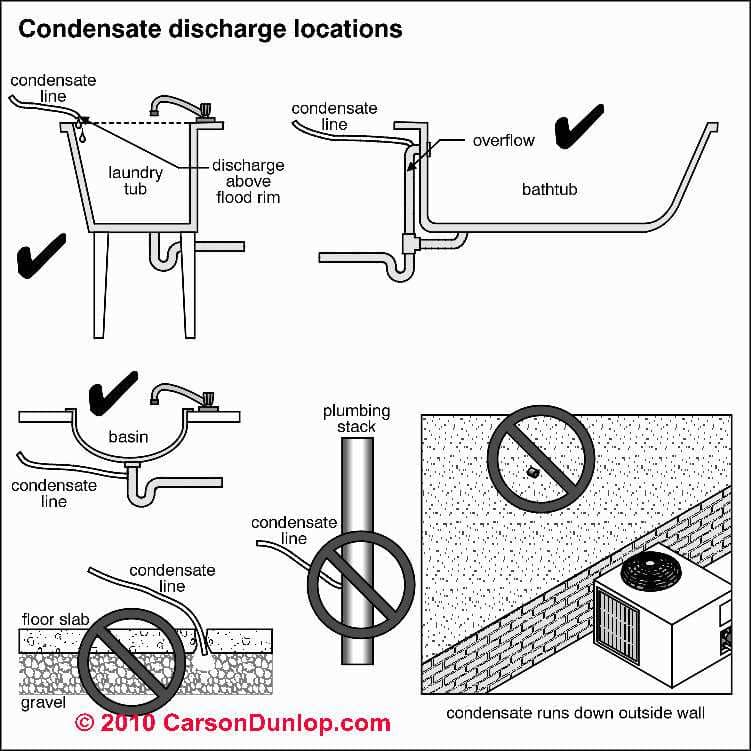 Carson Dunlop Associates sketches (left) illustrate both acceptable and not-recommended locations for the discharge of an air conditioner or heat pump condensate drain line discharge.
Uniform Mechanical Code Section 310.0, 310.1 Condensate Disposal
Here is an excerpt from the Uniform Mechanical Code pertaining to the disposal of air conditioning condensate:
Condensate from air washers, air cooling coils, fuel-burning condensing appliances, the overflow from evaporative coolers and similar water supplied equipment or similar air conditioning equipment shall be collected and discharged to an approved plumbing fixture or disposal area.
If discharged into the drainage system equipment shall drain by means of an indirect waste pipe.
The waste pipe shall have a slope of not less than 1/8 inch per foot (10.5 mm/m) or one percent slope and shall be of approved corrosion-resistant material not smaller than the outlet size as required in either Section 310.3 or 310.4 below for air-cooling coils or condensing fuel-burning appliances, respectively.
Condensate or waste water shall not drain over a public way.
To clarify, an indirect waste pipe is something that is upstream of a trap. That means we cannot dump into anything downstream of a trap. That would include the main plumbing vent stack. -- [Thanks to Al Carson, Carson Dunlop Associates, Toronto]
ICC Model Building Code, Section 307: Condensate Disposal Regulations & Recommendations
Note: new in 2015 is the ICC IMC 307.2.5 & IRC M1411.3.3 Drain Line Maintenance code for 2015
The ICC, under "Drain Line Maintenance" requires that
Condensate drains shall be configured to permit the clearing of blockages and performance of maintenance without having to cut the line. - ICC IMC 307.2.5 & IRC M1411.3.3 Drain Line Maintenance code for 2015, original source: http://www.iccsafe.org/
Devices or methods for providing condensate drain cleaning or de-clogging are discussed in this companion
article: CONDENSATE DRAIN CLEAN & DE-CLOG
The following HVACR condensate disposal recommendations summary cites, paraphrases, & comments on the widely adopted 2006 ICC model building code section on condensate disposal, section 307 [7]
1. Requirement for a drainage system
For the two Types of Condensate: Fuel burning devices vs Evaporators & cooling coils
- 307.1 requires that liquid condensation from fuel burning appliances be collected and discharged "to an approved plumbing fixture or disposal area in accordance with the manufacturer's instructions"
- 307.2 requires a condensate drain system for appliances containing evaporators or cooling coils, conducted from the appliance drain pan to an approved destination
2. Types, sizes, slope of Condensate Drain Piping
- 307.1 Condensate drain piping must be corrosion resistant for condensate from fuel burning appliances. using "corrosion-resistant material" and sized "no smaller than the drain connection on the appliance"
- 307.2.2 Condensate drain piping materials can be "... cast iron, galvanized polybutylene, polyethylene, ABS, CPVC or PVC pipe or tubing"
- Piping shall be at least 3/4" in diameter and ... shall not decrease in size ... [throughout its run from the condensate drain pan to its final disposal destination - no constructions by diameter]
- Horizontal runs of condensate drain piping slope at least 1/8" per foot in the direction of discharge. There is also a requirement for "uniform slope" and "uniform alignment"
4. Acceptable Condensate Drainage Terminations
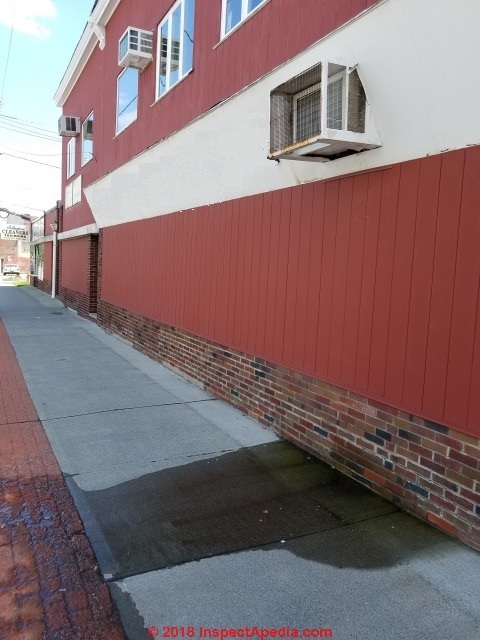
- 307.2: "... Condensate shall not discharge into a street, alley or other areas so as to cause a nuisance." [i.e. do not discharge HVACR condensate over a sidewalk
5. Requirements for a Backup Condensate Drain System & Backup Condensate Drain Options
- 307.2.3 A secondary condensate drain system is required not in every installation instance, but in every installation at which "where damage to any building components will
occur as a result of overflow from the equipment drain pan
or stoppage in the condensate drain piping".
This backup condensate system requirement refers for example to an indoor air handler installed in an attic or in living space where leakage into the attic ceiling or onto a floor system could cause damage to the structure.
Typical damage includes cosmetic leak stains, mold infections of wet drywall or insulation, structural damage from rot or inviting insect attack, and even, as one reader reports, unsafe collapse of a ceiling fan mounted below the leak area. - 307.2.3 recommends any of the following methods for handling a backup condensate overflow protection system:
- 1. An auxiliary drain pan with separate drain:
an auxiliary condensate drain pan at least 1.5" deep and at least 3" larger than the length & width of the appliance beneath which it is placed, using corrosion-resistant material of adequate thickness (0.7mm galvanized metal or 1.6mm non-metallic e.g. plastic) with a separate drain installed under the equipment and discharged to a conspicuous point that will alert building occupants to a blocked primary condensate drain - 2. A separate or secondary condensate overflow drain line
connected to the primary or OEM equipment's drain pan at a higher level than the main drain, and discharged as in 1. above. - 3. An auxiliary drain pan without a separate drain line but instead provided with a water-level detection device
(a switch that senses the presence of water in the drain pan) conforming to UL 508. The water or condensate detection switch in the drainless condensate overflow pan is wired to shut down the equipment. - 4. A water detection device (UL 508)
that will shut off the equipment in event of blockage of the primary condensate drain can be installed in any of several locations that in essence detect that the primary drain is backing up: in the primary condensate drain pan, in the primary condensate drain line, or in the condensate overflow drain line, positioned to detect and shut down the equipment before the primary drain pan would overflow. - An exception to this condensate backup or overflow protection requirement is made for
fuel-fired appliances that already include features that automatically shut down the device should the condensate drain become blocked. This feature is found, for example, on some condensing heating boilers or furnaces.
- 1. An auxiliary drain pan with separate drain:
6. Other requirements for a condensate water-level monitoring device
- Section 307.2.3.1 requires use of a water-level monitoring device to provide condensate overflow protection on equipment where there is no secondary condensate drain and no ability to install an auxiliary condensate drain pan. Quoting
"This device shall shut off the equipment served in the event that the primary drain becomes restricted. Externally installed devices and devices installed in the drain line shall not be permitted."
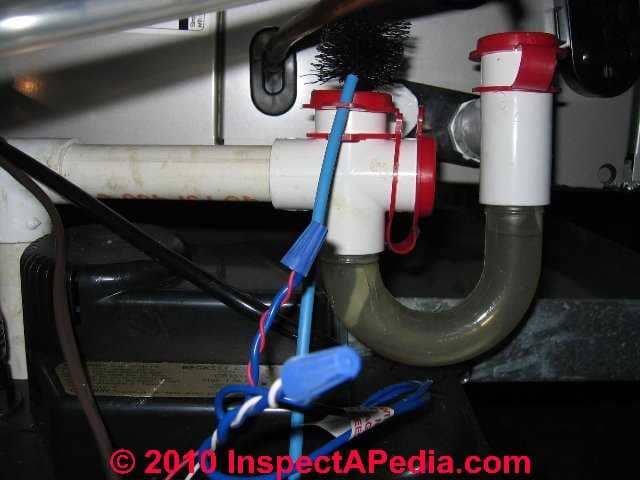
7. Model building code requirements for a P-trap on the HVACR condensate drain system
Bottom line: The model building codes require a P-Trap on all plumbing waste lines that is connected to a sewer.
The model same model building codes contain these very minimal requirements for traps on condensate removal lines for HVAC equipment:
1. a trap shall be installed in accordance with the unit manufacturer's installation and operating instructions
2. the condensate drain line slope towards its final drainage point shall be at 1/8" per foot [or, of course greater, where vertical drains are used - Ed.]
OPINION: your local building code compliance inspector/officer is the final legal authority on HVAC condensate drain trap requirements.
- IMC 407.2.4, Traps, requires that "Condensate drains shall be trapped as required by the equipment or appliance manufacturer." We interpret this provision to defer to the equipment manufacturer's installation instructions.
Watch out: in our OPINION and as we discuss in these articles, while a trap on a condensate drain line, usually provided quite close to the condensate collection pan itself, can reduce the chances of sewer gases backing up from a condensate drain that has been connected to the building DWV vent piping (not a procedure we recommend),
a conventional P-trap in the condensate drain will not protect against all sewer gas backup possibilities.
In particular, when an air conditioner is shut down for long periods of time (say during the heating season) it is common for the water condensate contents of the trap to dry out, thus losing protection against sewer gas leaks backing up through that system. Solutions often proposed are for a trap of sufficient depth that water in the trap will not evaporate sufficiently to lose the trap seal during periods when no condensate is being produced.
Special trap product can also provide a seal against sewer gas back-drafting through a dry trap. See detail
at DRY PLUMBING TRAP CAUSE & PREVENTION
- Canadian CMC 310.3: condensate waste pipes must be made from materials designed to work with that type of condensate drainage.
- U.S. IMC 307.2. 2: an A/C condensate drain inside diameter should not be smaller than 3/4″ and should not be smaller than the drain pan outlet diameter.<
3/4" condensate drain diameter is sufficient for up to 20 tons unless the drain outlet size on the unit itself is larger than 3/4″
Condensate Drain Insulation Code?
Moved to CONDENSATE DRAIN INSULATION REQUIREMENTS
Condensate Pan, Overflow Pan or Base Pan Cleaning Recommendations
We did not find cleaning requirements for condensate drip trays cited in the model building codes surveyed to date. However a read of manufacturer's installation instructions can provide further advice. For example:
"In some installations, dirt or other debris may be blown into the unit from the outside and settle in the base pan (the bottom of the unit).
In some areas of the United States, a “gel-like” or “slime-like” substance may be seen in the base pan.
Check it periodically and clean, if necessary." General Electric Zoneline® instructions [8][9]
Watch out: see the warnings and advice about health hazards in HVAC systems and condensate handling systems
See
- CONDENSATE DRAIN CLEAN & DE-CLOG - cleaning the condensate drain trap and drain line
- DIRTY HVAC COIL CLEANING PROCEDURES
- Legionella BACTERIA & HVAC EQUIPMENT
HVAC Condensate Drain & Condensate Drain Trap Installation Instructions
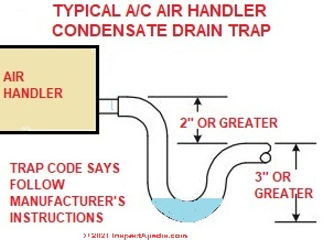
- Also see CONDENSATE DRAIN INSULATION REQUIREMENTS [Web Article] where we provide condensate handling codes & standards
- AIR CONDITIONER SLEEVE OUTDOOR DRAIN KIT INSTALLATION INSTRUCTIONS [PDF] Lowes Building Supply 2021
Note:
These instructions specifically warn to avoid drain hose traps or kinks that may otherwise block successful condensate drainage disposal to the building exterior - Also see: specific condensate drain installations for your specific air conditioner, heat pump, or condensing gas furnace
Examples discussing the code and manufacturer's statements on the requirement for a condensate drain line trap are below: - Amana, ARUF & ASPT AIR HANDLER INSTALLATION & OPERATING INSTRUCTIONS [PDF] (2017)
Excerpts:
NOTE: When units are installed above ceilings, or in other locations where damage from condensate overflow may occur, it is MANDATORY to install a field fabricated auxiliary drain pan under the coil cabinet enclosure. The installation must include a “P” style trap that is located as close as is practical to the evaporator coil.
See [above, as edited for clarity-Ed] for details of a typical condensate line “P” trap. NOTE: Units operating in high static pressure applications may require a deeper field constructed “P” style trap than is shown in Figure 12 to allow proper drainage and prevent condensate overflow.
NOTE: Trapped lines are required by many local codes. In the absence of any prevailing local codes, please refer to the requirements listed in the Uniform Mechanical Building Code.
A drain trap in a draw-through application prevents air from being drawn back through the drain line during fan operation thus preventing condensate from draining, and if connected to a sewer line to prevent sewer gases from being drawn into the airstream during blower operation.
Use of a condensate removal pump is permitted when necessary. This condensate pump should have provisions for shutting off the control voltage should a blocked drain occur. A trap must be installed between the unit and the condensate pump.
IMPORTANT NOTE: The evaporator coil is fabricated with oils that may dissolve styrofoam and certain types of plastics. Therefore, a removal pump or float switch must not contain any of these materials.
- Amana CONDENSING GAS FURNACE SERVICE MANUAL [PDF] Models GUCA, GCCA & Accessories (1998) source: Questar Gas https://www.questargas.com/ForEmployees/qgcOperationsTraining/Furnaces/Amana_GUCA_GCCA.pdf
Excerpts:
[Exhaust flue/vent] Piping must be adequately secured and supported to prohibit sagging, joint separation, and/or detachment from the furnace. Horizontal runs of vent/flue piping must be supported every three feet and must maintain a 1/4 inch per foot downward slope, back towards the furnace, to properly return condensate to the furnace’s drain system.
... Precautions should be taken to prevent condensate from freezing inside the vent/flue pipe and/or at the vent/flue pipe termination. All vent/flue piping exposed outdoors or in unheated areas must be insulated with 1/2” thick closed cell foam such as “Armaflex” or “Insultube.” Inspect piping for leaks prior to installing insulation.
A vent termination shall not terminate over public walkways or over an area where condensate or vapor could create a nuisance or hazard or could be detrimental to the operation of regulators, relief valves, or other equipment...
See in this document excerpted from the manual:
AMANA GUCA GCCA CONDENSATE DRAIN LINES AND DRAIN TRAP INSTRUCTIONS (1998) pp. 29-32 - Intertek CVC96 7 MVC96 TWO STAGE GAS FURNACE INSTALLATION INSTRUCTIONS (2016), Amana, Goodman Manufacturing, 5151 San Felipe Suite 500, Houston, TX 77056 USA Web: www.goodmanmfg.com • www.amana-hac.com
- Rectorseal Co., RECTORSEAL EZ TRAP CONDENSATE DRAIN LINE INSTRUCTIONS [PDF] RectorSeal® 2601 Spenwick Drive, Houston, TX 77055 (800) 231-3345
www.rectorseal.com - Also see CONDENSATE PUMPS for details about when, where, & how to use a condensate drain pump
Improper Disposal of Air Conditioning or Heat Pump Condensate Disposal
This topic has moved to CONDENSATE DISPOSAL, IMPROPER
Reader Comments, Questions & Answers About The Article Above
Below you will find questions and answers previously posted on this page at its page bottom reader comment box.
Reader Q&A - also see RECOMMENDED ARTICLES & FAQs
On 2022-08-25 by InspectApedia-911 (mod) - A/C condensate line should be trapped right at the air conditioner or heat pump
@John W.,
Short answer:
Your HVAC or AC unit condensate should be trapped close to the unit
Typically a condensing tankless water heater doesn’t require a condensate trap (American cited below)
Sharing a drain downstream MIGHT work depending on condensate drain material, size, capacity, routing, etc.
Details: -----
Your A/C condensate line should be trapped right at the air conditioner or heat pump - usually at the condensate drip pan connection to the condensate drain. That's to primarily avoid the risk of sewer gases backflowing up into the unit as can occur in some drain disposal circumstances.
Sharing a condensate drain downstream from the AC unit MIGHT be OK provided its capacity is not exceeded and of course that the condensate drain is installed to drain to an acceptable location (such as outdoors, not onto a sidewalk etc) and terminates where it won't be blocked by snow, shrubbery, etc.
But a trap at the heater is probably required.
Because typically the installation instructions for a condensing tankless water heater include this statement:
Vertical terminations must incorporate a condensate drain and trap as close as possible to the appliance.
Also, about that shared drain idea,
Some condensate products might be too hot for the piping used for an HVAC condensate drain - such as that thinwall flexible plastic tubing found at many installations, (condensate from a condensing tankless water heater is at about 38C or about 100F) but standard PVC pipe, if that's what was used for the drain, should be OK.
I've not found a requirement for insect screens on those outlets and in fact there may be a concern that such screens risk drain clogging and backups.
It would be helpful to know the brand and model of your condensing-type tankless water heater so that together we could consult its installation instructions.
Meanwhile COMPARE these example instructions that discuss proper condensate drainage for a condensing tankless water heater:
RHEEM NON-CONDENSING TANKLESS WATER HEATER INSTALLATION MANUAL [PDF]
Excerpt: DO NOT operate without the condensate trap connected to the vent and routed to the proper drain. (p. 3)
---
AMERICAN COMMERCIAL CONDENSING TANKLESS WATER HEATER INSTALLATION MANUAL [PDF]
Excerpt: The condensate drain does not require a trap. (p. 32)
For other readers: what's the difference between a conventional tankless water heater and a condensing tankless water heater?
The conventional gas-fueled tankless water heater produces hot exhaust that also contains acidic moisture from the combustion process, and has to be vented through a corrosion-resistant chimney.
A condensing gas-fueled tankless water heater recaptures much of the heat that would have gone up the flue, uses it to help heat the domestic hot water, and produces a much-cooler exhaust and condensate that is typically vented through PVC piping to the exterior.
A condensing gas-fueled tankless water heater would be expected to operate at a greater overall fuel efficiency than a comparable non-condensing unit.
On 2022-08-23 by John W.
I recently had a condensing tankless water heater installed I’m trying to determine the proper way to deal with condensate.
I have direct access to an exterior wall, and the condensate from my HVAC (right next to the water heater) in fact already had its own condensate drain running outside.
That HVAC drain runs right beneath where the water heater is hanging, and the water heater condensate line is now hard-piped straight down and into the line so that the condensate runs outside without a trap or vent.
Is this okay? The water heater condensate line is 3/4” and so is the existing HVAC condensate line, so maybe that needs to be replaced with 1” at the very least.
This is in a ground level garage. There’s no floor drain, but the washer standpipe is not far away. From what I can tell, both local code (IPC 2018) and the water heater install guide only say that the condensate line needs an air gap.
And the typical application in the install guide only shows this line running to a floor drain, and of course includes an air gap.
I’m thinking the water heater condensate line may need to just run a short distance and drop into a funnel or something, which then continues straight down and connects to the line out.
Alternatively, should this line have a vent just after it exits the water heater and possibly a small trap before it joins the main line out to keep insects out?
It’s also possible that this install is totally legit, and the air gap requirement is fulfilled by the gap between the ground and the down pipe outside the house.
I’m not sure if this is relevant to the answer, but the water heater has a neutralizer built in so that shouldn’t be an issue either way.
On 2022-06-21 by InspectApedia-911 (mod)
@Tom P.,
Thank you for the discussion. I don't quite understand the last suggestion - perhaps you could make a sketch.
On 2022-06-21 by Tom P.
@InspectApedia , thank you the advice. I was afraid that would be the recommendation. I would explore the route of re-install, but there just isn't enough space in my closet ceiling.
I think the builder cramped as much into that small space to save money. What about using a condensate trap and using the positive pressure to force the water to the condensate outlet?
On 2022-06-21 by InspectApedia (mod) - condensation has been leaking from the drip pan
@Tom P.,
When the AC condensate drain entry point is higher than the condensate drip pan outlet you have to either use a condensate pump - which is what I'd do - or disassemble and re-install the whole AC/Heat system to raise it so that it can drain by gravity.
Sorry but I don't know another reliable solution.
Water doesn't flow uphill, and if you tried raising the sides of a condensate pan to get condensate level high enough to drain by gravity alone, you're building a breeding ground for dangerous bacteria or Legionnaire's disease in the condensate that stays in the lower part of the pan.
On 2022-06-21 by Tom P.
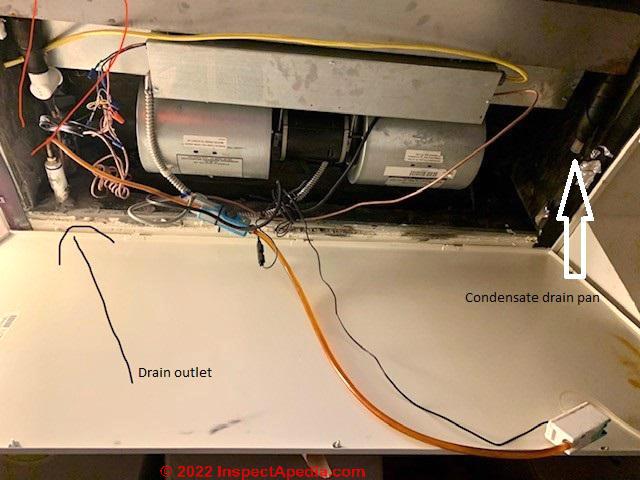
I've been having problem with my fan coil unit for a few years now. The AC/Heat works fine. The problem is the water from condensation has been leaking from the drip pan.
Originally, I think the builder had connected the drain pan on the left direct to the drain outlet, but the pan is lower than the outlet.
So the home builder decided to install a condensation pump, but over time the pump would malfunction due to the corrosive water.
I want to find a permanent solution where I can connect pvc pipe and have the water drain out to the outlet. Any suggestion. Attached is the picture.
On 2022-06-02 by InspectApedia-911 (mod) - ensure proper condensate tubing routing
@Hy,
IMO, Sure that can work, provided the tubing carrying condensate to the drain is routed such that it passes above the flood rim of the sink. Think of it as similar to a dishwasher installation.
The requirement for the air gap on a dishwasher (you could use the same device) is to prevent accidental siphon of the trap as well as to prevent backflow of drain water into the draining appliance (dishwasher or condensate pump).
On 2022-06-02 by Hy
I'm preparing to install a DIY mini split on the back wall of my garage which is an interior wall. Fortunately there's a utility sink directly below it.
I know I can install a condensate drain with air gap above the sink but it doesn't look very elegant to me. I wondered if my alternative idea would be an acceptable solution?
Since the wall is interior I'll build a shallow (about 6" deep) soffit at the top of the wall that will be the same dimensions as the air handler which will mount on the front.
This way my line set can be routed hidden up into the attic above and run to an adjacent wall which is exterior and pass through to the outside. Naturally this type of installation precludes running the condensate drain up with the line-set.
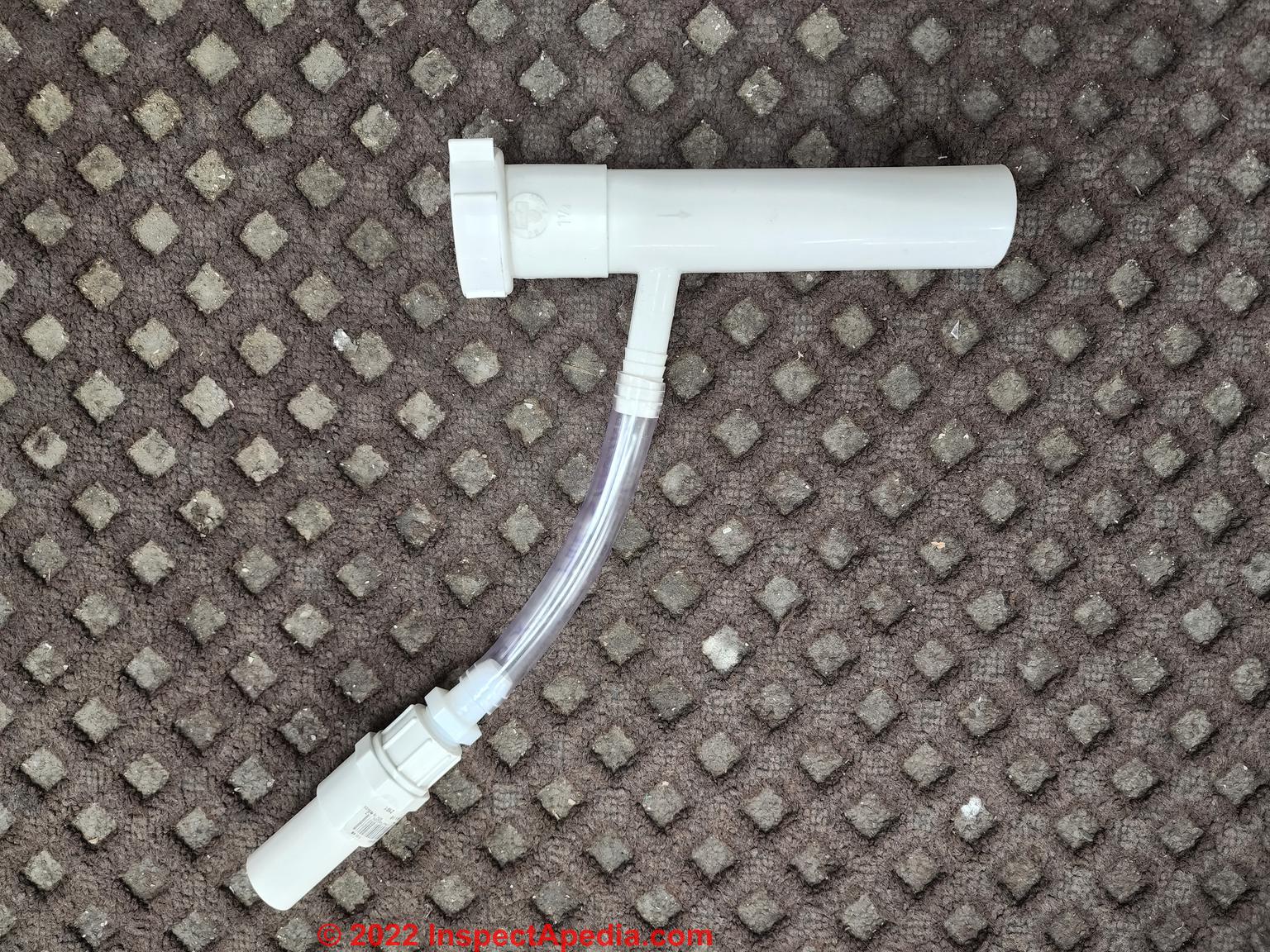
So my idea is to install a 3/4" PVC pipe vertically inside the wall and connect it at the top and bottom with 5/8" adapters. These will allow me to attach clear vinyl tubing that will tie in to the air handler at the top and exit the wall at bottom just below the sink. A short length of clear vinyl tubing will complete the connection to the P-trap.
In order to facilitate the connection to the sink I plan to use a sink drain pipe with an integrated male angled tube connector (same as used in kitchens to connect a garbage disposal). See attached pic for mock-up.
The sink will be used daily so there's little chance for the water to evaporate and allow for sewer gases. I'm still searching for a check valve that only allows the water to run down and put but stops potential gases from migrating up as a backup but so far no luck.
It's this an acceptable install?
Thanks for your help...
On 2022-01-17 by Inspectapedia Com Moderator - follow glue and primer manufacturer instructions
@jacinto raquel,
The closest to building code specifications that you will get for the question you post is the general requirement to install materials following the manufacturer's instructions. In this case, that means read the instructions on the label of the glue being used and on the primer being used. If you're getting PVC pipe joint failures most often that's from improper prepping.
Above on this page, and in the list of Recommended Articles found just at the article end, you will find our series of detailed articles specifying condensate drain piping and routing, requirements for a trap, the materials, and they drain condensate destination. Please take a look.
On 2022-01-17 by jacinto raquel
what is the code for the primer used for gluing pvc schdule 40 pipe for refrigeration evaporators in a 36 degree cooler? what is connection from the evaporator condensate pan to the pvc drain line and what is the material required?
On 2021-10-01 by inspectapedia.com.moderator - how far away can I install condensate p-trap?
@Sean Marlow,
I looked earlier today for an authoritative answer and my research is incomplete.
I have found and will cite the sources of installation instructions prescribing locating the effect condensate drain trap quite distant from the appliance itself.
An example that you will see in some installation instructions used for equipment that is draining through an appropriately sloped drain line with no trap whatsoever down into a condensate pump that in turn pumps condensate to the disposal point.
An example is this VENT-EXHAUST EXTERNAL TRAP INSTRUCTIONS [PDF] posted by Questar Gas
On 2021-09-30 by Sean Marlow
How far away from a florida heat pump can I install the condensate p-trap. Working on a school and they love high ceilings. The unit hung as high as possible, 11'-4" at bottom of unit and finished ceiling height is at 11'-0".
ThIs barely leaves me 3" to work with and that is not enough for proper trap depth and insulation.
I want to know if it is ok to run 6', sloped of course, out from the unit before putting in the trap. This would allow me to run from the hall where the unit and 11' ceiling is to areas where the ceiling is 10' and continue to where drain terminates.
On 2021-06-03 by (mod) - is condensate drain piping insulation required?
@Amy,
Thank you for a helpful question.
Please find your question repeated along with a detailed reply now at
CONDENSATE DRAIN INSULATION REQUIREMENTS
On 2021-06-03 by Amy
My company recently changed out all the hvac equipment at an apartment complex.
The complex is now owned by a new owner and he has contacted us about why we didn't insulate the condensate drain lines that are inside the return air in an air conditioned space.
We live in Texas and I can't find a clear answer on if that is required or not. Does anyone have any information about this topic?
On 2021-04-29 by (mod) - Condensate Removal Pump for a hybrid water heater
@Jack Mc.,
The company Little Giant makes a wide variety of pumps including condensate pumps, pony pumps, and others;
Let's not mix apples and oranges here.
If you are making use of a water heater - to produce domestic hot water used for washing and bathing - water flowing through the heater is pushed by building water pressure, from a municipal supply or from a well water pump or a pressure booster pump.
For those pump purposes, no condensate removal pump would be suitable. IT couldn't handle the volume, nor the flow rate, nor the duty cycle.
DO NOT send a larger-diameter condensate drain outlet into a smaller-sized pipe: there's risk of blockage, overflow, etc.
On 2021-04-29 by Jack Mc.
I have a question regarding the use of a Condensate Removal Pump for a hybrid water heater.
Can I use a little giant type condensate pump with 3/4 into the pump, and 3/8 out of it?
The only code I have found (Oregon) regarding condensate removal is in the mechanical code (which usually applies to HVAC) and this line is making me question whether the pump's output can in fact be less than 3/4":
"307.2.2 Condensate drain piping materials can be "... cast iron, galvanized polybutylene, polyethylene, ABS, CPVC or PVC pipe or tubing"
Piping shall be at least 3/4" in diameter and ... shall not decrease in size ... [throughout its run from the condensate drain pan to its final disposal destination - no constructions by diameter]"
Thank you!
On 2021-03-20 by (mod) - use an Appliance Wye to connect a condensate drain to an existing washing machine standpipe or other drain
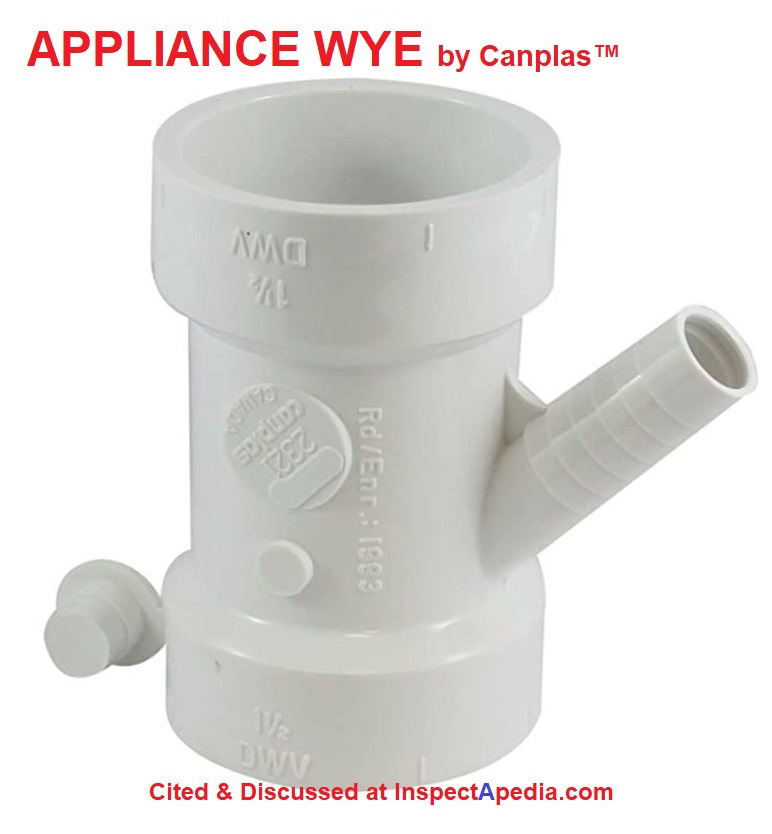 @V.F.G., usually there's no problem sharing that drain between condensate vent and washing machine;
Both require an air gap - which you have, and neither should be overwhelming a properly-sized, un-blocked drain.
The rub may come if the standpipe diameter is too small to admit both the washer drain and the clip holding the condensate drain at the same time.
You'd fix that by either having your plumber install an appliance wye in the standpipe (I show a typical one - the Canplas 212321W Appliance Wye - as widely sold including at Amazon - below) or by pumping your condensate to another drain destination.
On 2021-03-20 by V.F.G.
Hey, so we recently brought a house in MA and have come across this: the HVAC is connected to a standpipe for a washer via a tube.
We dont know what to do but there was no washer and dryer when we moved in to the house. We did not discover this until we brought a washer. Please let us know anything we can do because we need the washer. Thank you
On 2021-02-08 by (mod) - loud eyesore condensate system?
So "loud" perhaps you are talking about a condensate pump that collects condensate from a heat pump or high efficiency heating appliance and pumps it up to a drain
. Those are not usually very noisy; check for malfunction, for mounting on padding, for alternative models, for relocation to a more remote spot that can still pump up to the necessary drain.
On 2021-02-08 by Kelli
It’s a new build. Just curious. It’s loud, an eyesore. We live in Mesa, AZ.
Obviously, I need to ask the builder why he didn’t use the sink in the laundry room.
On 2021-02-08 by (mod) - Can the condensation drain pipe be located behind a washer in the laundry room?
Kelli I need to understand more details of the situation - but in general the answer is sure - properly-connected.
Certainly there is no conceptual constraint on where a condensate drain can be located, but it has to be in a location that works either by gravity or by a condensate drain pump.
It's often permitted but not the best solution to simply drip condensate into the laundry sink.
On 2021-02-08 by Kelli
Can the condensation drain pipe be located behind a washer in the laundry room?
Question: OK to send AC condensate drainage into the (previous) laundry drain
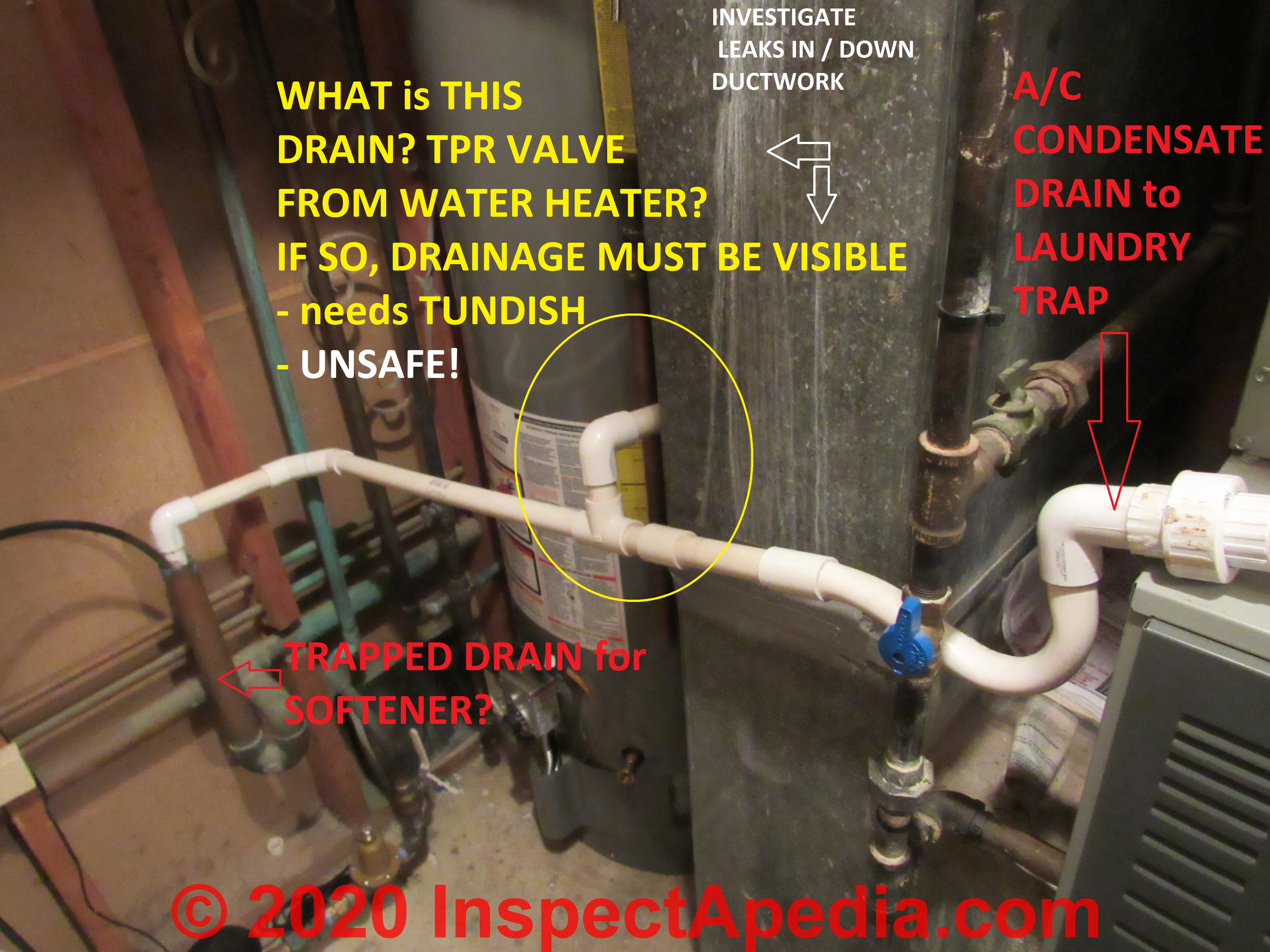
I inspected a home earlier today and they had the AC condensate drainage into the (previous) laundry drainage. It's not directly into the sewage line but I was wondering if there's still an issue of sewage gasses backing into the home. There's a p-trap.
- Dov Ber Kahn, a home inspector in Rockland County, NY has contributed photographs of various building features. Mr. Kahn is a licensed home inspector in New York and New Jersey, and can be reached at Website: Kahnbhomeinspectors, Tel: 845-445-8234, Email: kdovber@googlemail.com
Moderator reply: adequate air gap at condensate drain line into standpipe
It appears that this condensate drain only drops into that vertical standpipe an inch or two and if there is still a decent opening around it to let air into the standing drain line then you got an air gap between the end of the condensate drain and the P-trap below so it should be okay.
Watch out: But as you'll see from the annotations on your photo there are some other questions here, including a water heater TPR valve safety concern and possible leaks into the return air duct system. .
See also TUNDISH used in PLUMBING
On 2020-09-09 by (mod) - primary condensate drain had been capped off with no outlet.
Not illegal but does sound as if there was a problem with the condensate drain system
On 2020-09-09 0 by Rocky
My a/c in my apartment was under performing , so I took a look at the F.A.U. closet. I saw what the problem was, ( under charged or line blockage).
But, what also I noticed was that the primary condensate drain had been capped off with no outlet.
The secondary drain had a wet switch installed in the outlet port.
My question is: Is it in violation of building or installation codes to not have a condensate drain line? My unit was cycling on and off even though it never reached the temperature setting on the thermostat, I suspect this was the wet switch's doing
On 2020-09-09 by (mod) - terminate a condensate line from an interior air handler to a washer stand pipe
Yes with proper air gap
On 2020-09-03 by Dave
Can you terminate a condensate line from an interior air handler to a washer stand pipe
On 2020-08-20 by Pat H.
Are there currently any plumbing codes that prevent A/C condensate from being used for toilet flushing? An English company developed a toilet tank several years ago that uses both condensate and potable water for flushing.
I have to imagine that with A/C being so much more common in the US, the only reason something similar hasn't been developed or adapted for use here is because it isn't allowed.
On 2020-07-24 by Jayson T
I just had a furnace and cooling coil installed in my attic area. For the primary condensate drain the installer piped 3/4" pvc into a condensate pump, which will discharge into a nearby vanity sink prior to the trap via 3/8" vinyl plastic tubing.
For the secondary drain system he installed a wet switch within the pan below the unit which will turn the unit off upon water detection.
Is this an acceptable form of condensate drainage? I worry about relying on the condensate pump and flexible tubing as the primary drain source vs. a hard piped system into the homes plumbing.
On 2020-05-18 by (mod) - overflow drip pan can be capped off provided that there is a water sensor switch
David
The overflow drip pan can be capped off provided that there is a water sensor switch installed that will shut down the AC system if the pan receives condensate water.
On 2020-05-17 by David
Does Texas code require an attic AC drip pan to be be attached to a drain line or is it acceptable for the drain line to be capped off?
On 2020-05-14 by (mod) - warranty company will not cover modification to my condensate drain line
Daria
I want to help but am stymied: the decision to include or not the actual drain line as part of the condensate pump system is going to be in the tiny mind and hands of the insurance company's adjuster department.
My "guess" is that the reason those pumps are excluded is an effort to avoid leak and mold damage liability.
My OPINION is that the pump itself - the container and motor, sold as a unit - is separable from the drain piping or tubing.
My opinion also is that the cost of tubing or plastic drain lines for a condensate pipe is trivial, just a few dollars, and perhaps not worth your time arguing with your warranty company.
On 2020-05-14 by Daria
My warranty company will not cover modification to my condensate drain line because the "items not covered" in my contract list the condensate pump."
Are these considered the same item or are the pump and lines two different items?
Thank you for your help with this matter.
On 2020-01-16 by (mod) - placing an air handler on top of mason bricks sitting inside the drip tray proper installation procedure?
Gerard
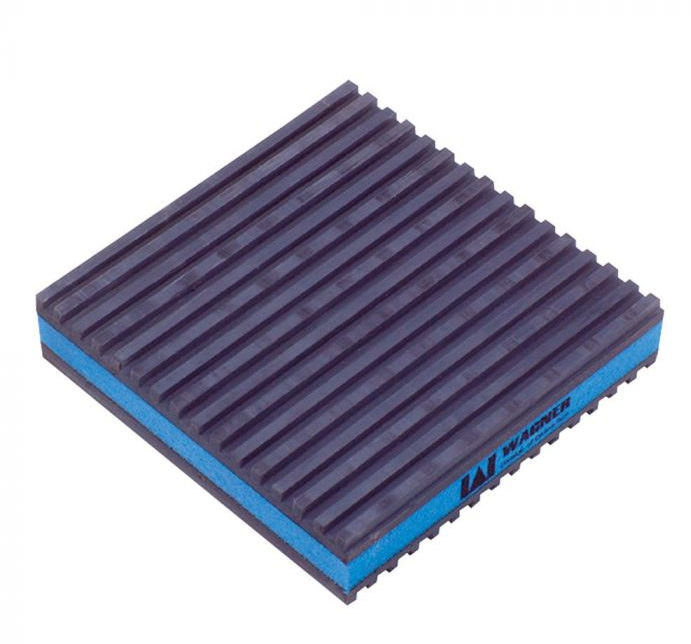
The manufacturer of your air handler is the final authority on this installation detail but in my OPINION while it's common to see an air handler set into a drain pan on wood and sometimes other materials, a rubber anti-vibration pad would be a better practice for two reasons:
1. vibration transmission to the building framing (if the unit is installed on a wood frame floor or ceiling) will make the unit noisier than necessary
2. vibration combined with condensation (and perhaps actual condensate) between the brick surface and the metal housing of the air handler invites corrosion and over a longer term, damage to the unit
A vibration isolating pad such as the Wagner MP-6E EVA Anti-Vibration Pad 6x6 Inch Square by 7/8 Inch Thick pad shown below is a better practice.
On 2020-01-15 by Gerard Russo
Is placing an air handler on top of mason bricks sitting inside the drip tray proper installation procedure? Or should the air handler be seated on rubber be seated on rubber bushings?
On 2019-08-05 by (mod) - problems with flexible condensate drains run through walls
Bob,
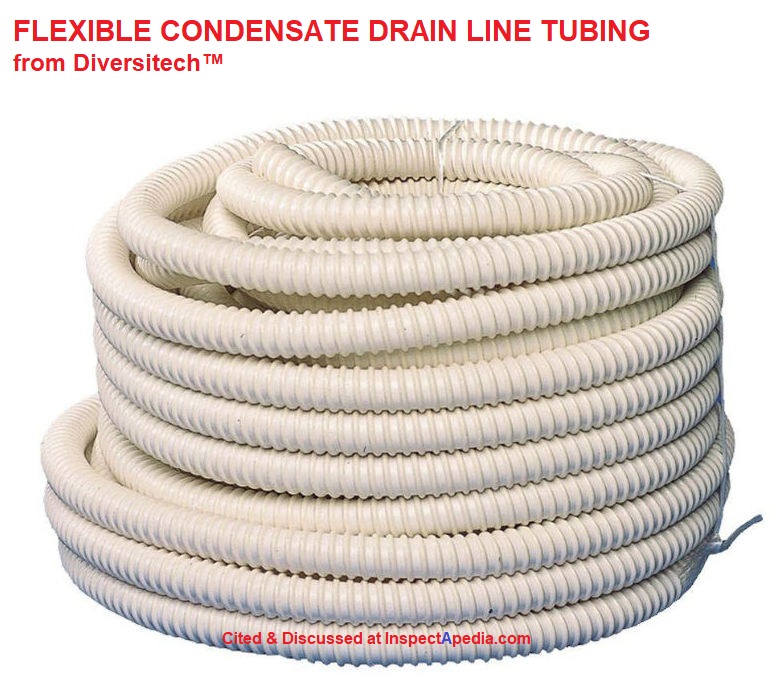
In new HVAC condensate drain installation when the drain is run through framed walls, use of a flexible plastic drain line is common - as shown in the photo I'll attach below and as is described further at inspectapedia.com/aircond/Condensate_Drain_Problems.php
However in my OPINION a better installation uses rigid PVC pipe, properly sloped 1/8" to 1/4" per foot. I often find that the flexible condensate drain tubing is not carefully installed nor supported to maintain drainage slope throughout its run.
The result is the accumulation of dust, debris, algae or mold in a dip in the drain that leads to clogging and potentially to a backup and leak of condensate out at the air handler.
In the photo the white flexible condensate drain tubing is being routed down from above where a split system A/C unit is to be hung on the wall. The drain drops down then runs out through the wall to the building exterior where it drains onto a roof and thence into a gutter and downspout system if not totally evaporated.
The red oval and line mark a critical point where nail plates must be installed to protect the drain line from puncture by future drywall screws or nails.
The black tubing in the photo is actually foam insulated refrigerant piping.

Bob, continuing
Here is Diversitech's 5/8" flexible AC condensate drain tubing - sold at Home Depot and at HVACR suppliers and plumbing suppliers
On 2019-08-05 by Bob
What type of piping or tubing is used for condensation drainage inside a wall on an inside unit of a split unit
...
Continue reading at CONDENSATE DISPOSAL, IMPROPER or select a topic from the closely-related articles below, or see the complete ARTICLE INDEX.
Or see CONDENSATE DRAIN CLEAN & DE-CLOG FAQs questions & answers about how to handle HVAC condensate drainage, posted originally on this page
Or see these
Recommended Articles
- BUILDING CODE DOWNLOADS - free downloadable PDF files of building codes & standards
- CONDENSATE HANDLING, HVAC - home
- CONDENSATE LEAKS
- CONDENSATE PUMPS
- CONDENSATE DISPOSAL, IMPROPER
- CONDENSATE DRAINS, CODES
- CONDENSATE DRAIN CLEAN & DE-CLOG
- CONDENSATE DRAIN INSULATION REQUIREMENTS
- CONDENSATE DRAIN PROBLEMS
- CONDENSATE DRIP TRAY DEFECTS
- CONDENSATE PAN SWITCH LOCKOUT
- Legionella BACTERIA & HVAC EQUIPMENT
- CONDENSING BOILER/FURNACE CONDENSATE DRAIN
- DUCT SYSTEM DESIGN SIZE & DEFECTS - home
- SLAB DUCTWORK
- WATER & ICE IN DUCT WORK
- WET CORRODED DUCT WORK
Suggested citation for this web page
CONDENSATE DRAINS, CODES at InspectApedia.com - online encyclopedia of building & environmental inspection, testing, diagnosis, repair, & problem prevention advice.
Or see this
INDEX to RELATED ARTICLES: ARTICLE INDEX to AIR CONDITIONING & HEAT PUMPS
Or use the SEARCH BOX found below to Ask a Question or Search InspectApedia
Or see this
INDEX to RELATED ARTICLES: ARTICLE INDEX to PLUMBING SYSTEMS
Or use the SEARCH BOX found below to Ask a Question or Search InspectApedia
Ask a Question or Search InspectApedia
Try the search box just below, or if you prefer, post a question or comment in the Comments box below and we will respond promptly.
Search the InspectApedia website
Note: appearance of your Comment below may be delayed: if your comment contains an image, photograph, web link, or text that looks to the software as if it might be a web link, your posting will appear after it has been approved by a moderator. Apologies for the delay.
Only one image can be added per comment but you can post as many comments, and therefore images, as you like.
You will not receive a notification when a response to your question has been posted.
Please bookmark this page to make it easy for you to check back for our response.
Our Comment Box is provided by Countable Web Productions countable.ca
Citations & References
In addition to any citations in the article above, a full list is available on request.
- ICC, International Code Council, 500 New Jersey Avenue, NW 6th Floor, Washington, DC 20001 [P] 888-ICC-SAFE (888-422-7233) [F] (202) 783-2348 International: (202) 370-1800, Website: http://www.iccsafe.org/, Electronic / Digital products including copies of the ICC codes: 888-ICC-SAFE (888-422-7233), ext. 33822 eCodes@iccsafe.org
- [3] Reader Stuart Oakner suggested the Mighty Pump (below) as a method for clearing clogged or blocked air conditioning or heat pump condensate drains.
- [4] Mighty Pump, is a manual pump that is used to clean or clear out a debris-clogged A/C or heat pump condensate drain. The kit from acdrainpump.com includes a reversible, hand operated pump and flexible inlet and outlet hoses designed along with an adapter to connect the pump to a 3/4" condensate drain line. The company can also be contacted by email to Info@ACDrainPump.com.
- [6] Simpson Strong-Tie, "Code Compliant Repair and Protection Guide for the Installation of Utilities in Wood Frame Construction", web search 5/21/12, original source strongtie.com/ftp/fliers/F-REPRPROTECT09.pdf, [copy on file as /Structures/Framing/Simpson_Framing_Protectors.pdf ]. "The information in this guide is a summary of requirements from the 2003, 2006 and 2009 International Residential Code (IRC), International Building Code (IBC), International Plumbing Code (IPC), International Mechanical Code (IMC), 2006 Uniform Plumbing Code (UPC) and the 2005 National Electrical Code." broad. Puerto Rico and the U.S. Virgin Islands enforce one or more of the I-Codes.
- [7] 2006 ICC Model Building Code Chapter 3, General Regulations, New Jersey Mechanical Code, web search 8/2/2012, original source: http://www2.iccsafe.org/states/newjersey/NJ_Mechanical/PDFs/2006_Chapter%203-General%20Regulations.pdf
Quoting about the ICC:
The International Code Council (ICC) was established in 1994 as a non-profit organization dedicated to developing a single set of comprehensive and coordinated national model construction codes.
The International Code Council is a member-focused association dedicated to helping the building safety community and construction industry provide safe, sustainable and affordable construction through the development of codes and standards used in the design, build and compliance process. Most U.S. communities and many global markets choose the International Codes.
The International Codes, or I-Codes, published by ICC, provide minimum safeguards for people at home, at school and in the workplace. The I-Codes are a complete set of comprehensive, coordinated building safety and fire prevention codes. Building codes benefit public safety and support the industry’s need for one set of codes without regional limitations.
Fifty states and the District of Columbia have adopted the I-Codes at the state or jurisdictional level. Federal agencies including the Architect of the Capitol, General Services Administration, National Park Service, Department of State, U.S. Forest Service and the Veterans Administration also enforce the I-Codes. The Department of Defense references the International Building Code for constructing military facilities, including those that house U.S. troops, domestically and a ... - [8] "GE Zoneline® Owners Manual and Installation Instructions, Heat/Cool Model 2900, Heat Pump Model 3900", General Electric Corporation, [copy on file].
- [9] "GE Zoneline® Owners Manual and Installation Instructions, Heat Pump Model 5800", General Electric Corporation, [copy on file].
- [10] "Whirlpool WGPH45 Packaged Heat Pump, Product Specifications", Whirlpool Corporation, [copy on file].
- Our recommended books about building & mechanical systems design, inspection, problem diagnosis, and repair, and about indoor environment and IAQ testing, diagnosis, and cleanup are at the InspectAPedia Bookstore. Also see our Book Reviews - InspectAPedia.
- In addition to citations & references found in this article, see the research citations given at the end of the related articles found at our suggested
CONTINUE READING or RECOMMENDED ARTICLES.
- Carson, Dunlop & Associates Ltd., 120 Carlton Street Suite 407, Toronto ON M5A 4K2. Tel: (416) 964-9415 1-800-268-7070 Email: info@carsondunlop.com. Alan Carson is a past president of ASHI, the American Society of Home Inspectors.
Thanks to Alan Carson and Bob Dunlop, for permission for InspectAPedia to use text excerpts from The HOME REFERENCE BOOK - the Encyclopedia of Homes and to use illustrations from The ILLUSTRATED HOME .
Carson Dunlop Associates provides extensive home inspection education and report writing material. In gratitude we provide links to tsome Carson Dunlop Associates products and services.
 | HOME | ABOUT | ASK a QUESTION | CONTACT | CONTENT USE POLICY | DESCRIPTION | POLICIES | PRIVACY | |
| © 2024 - 1985 Publisher InspectApedia.com - Daniel Friedman | |||||||||