
InspectAPedia® FREE Encyclopedia of Building & Environmental Construction, Diagnosis, Maintenance & Repair |
Question? Just ask us! InspectAPedia
|
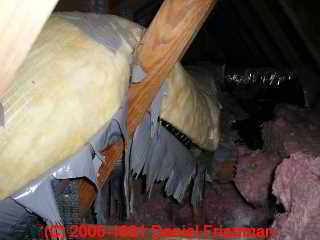 Goodman Gray Flex Duct Deterioration & Failures
- POST a QUESTION or COMMENT about Goodman gray flexduct deterioration in building HVAC duct systems
Goodman gray flex duct HVAC ductwork deterioration:
This article discusses Goodman™ brand gray flex duct disintegration failures with references to product failures by manufacturers of similar flexible duct work products.
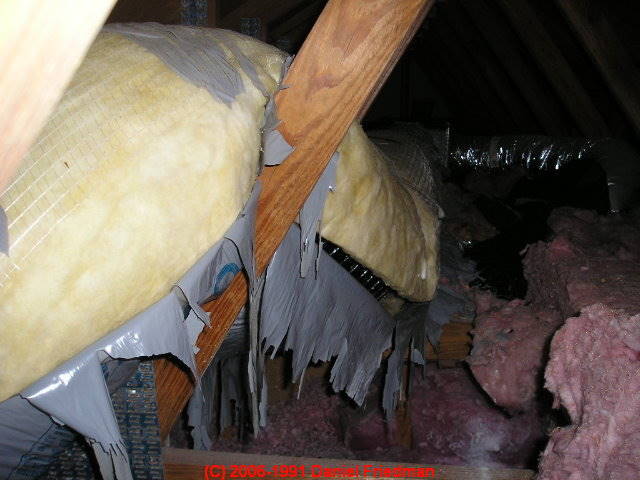
We include photographs illustrating heat-damaged flex-duct covering materials and we explain the implications on home energy costs when this material is installed in buildings.
We include, for comparison, other gray plastic covered flex-duct materials that do not appear to disintegrate in hot attics, using Certainteed's Certaflex-G25 as an example.
InspectAPedia tolerates no conflicts of interest. We have no relationship with advertisers, products, or services discussed at this website.
GOODMAN Gray Flexduct Deterioration in Hot Locations
Air conditioning duct system defects include a remarkably wide range of errors, from failure to supply cool air or failure to even circulate air in the building, to health hazards such as use of asbestos material in or on duct work, to very dangerous conditions such as drawing heating equipment combustion gases into the building cooling (or heating) air.
This article describes Owens Corning Valueflex™ brand gray flex duct failures that appear as loss of the gray plastic duct covering due to brittleness that appears to be caused by exposure to heat (such as in a hot attic), with references to product failures by several manufacturers of flexible duct work, , including ATCO™ Ruber Products, Alloy Systems™, Goodman™ flex duct, Owens Corning™ flex duct, Owl™ flex duct.
We believe that none of these defective flex duct products is currently sold (2010) but both may be found in older homes. Note: not all Owens Corning flex duct products share this defect and disintegration problem.
The loss of the protective plastic covering on flex duct poses several concerns including loss of the duct insulation, increased air conditioning system operating costs, and possibly air leaks out (if supply ducts are damaged) or un-wanted attic debris leaks in (if return ducts are damaged), and in-duct condensation in the HVAC system leading to mold and indoor air quality concerns.
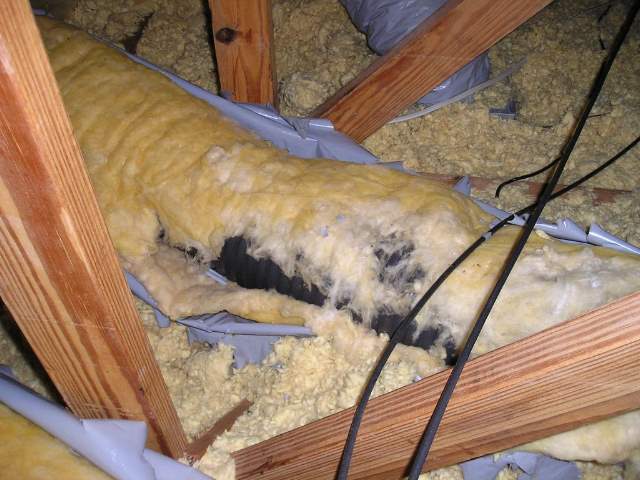
This Goodman gray flex duct or "flex duct" air conditioning duct work material is a defective product.
In hot attic spaces or where exposed to UV light, the plastic of this flexible air conditioning duct material disintegrates leaving its fiberglass insulation exposed to also disintegrate, leak, or possibly blow into the building living space.
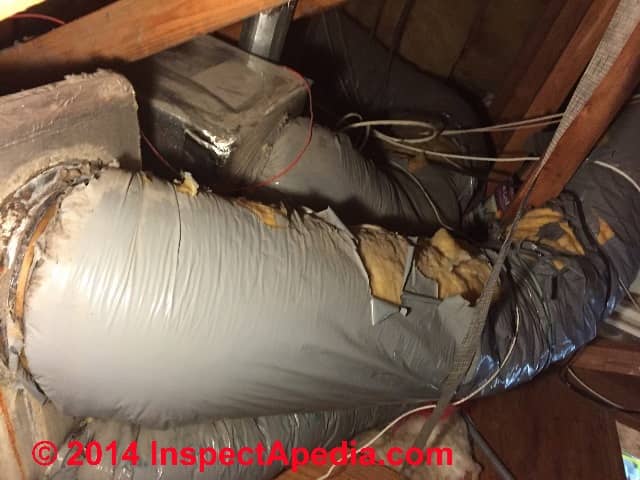
Replacement of the duct work is required - a significant expense. - Thanks to Jon Bolton for these photos. of Goodman gray flex duct disintegrating in an attic.
Where this duct is found in a building it should be replaced. When a heating or air conditioning flex-duct product has lost its exterior plastic covering the effects are these:
- The cost of heating or cooling the building is increased due to lost insulation:
because the ducts are no longer insulated from the ambient temperature in the attic or crawl space where they are located. For example, an air conditioning duct passing through a hot attic and missing its insulation will be heated by the ambient attic air, delivering warmer air to the living space than is desired. - The cost of heating or cooling the building is increased due to leaks:
because damaged ducts are more likely to leak, cooled or warmed air intended for the occupied space may be lost in the attic or crawl space where the damaged HVAC ducts are located.
In addition we might see these two indirect problems developing: - Increased circulation of fiberglass particles
from the duct insulation or from building insulation which may be picked up and blown into the building air supply - Mold growth
in the HVAC ducts due to loss of insulation and increased in-duct condensation in some circumstances. See Flexduct Lawsuit at our references below.
Below at Technical Reviewers & References we include Flexible Air Duct Installation Manuals, standards, guidelines, and contact information for several flexible air duct manufacturers as well as access to Flexible Duct Performance & Installation Standards provided by the Air Diffusion Council.
List of plastic-covered flexible HVAC duct products that appear to deteriorate in hot spaces like attics
Readers concerned with deteriorating plastic and fiberglass-covered flex duct in buildings should see the several HVAC duct failure reports listed just below.
Was there a Goodman Quiet Flex product recall?
Reader Question:
Was in my mother's attic and saw her a/c ductwork shredding. Saw the name Goodman Quiet Flex on the plastic. Researched on the Internet and found information about ductwork failure on your website.
What I haven't been able to determine is if this ductwork is recalled.
Would you have such information? Or is this going to be an expensive replacement?
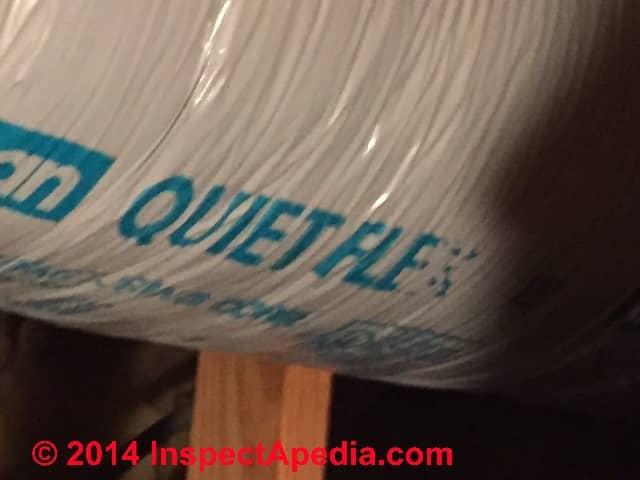
Thanks. - R.G. 10 Jan 2015
Reply:
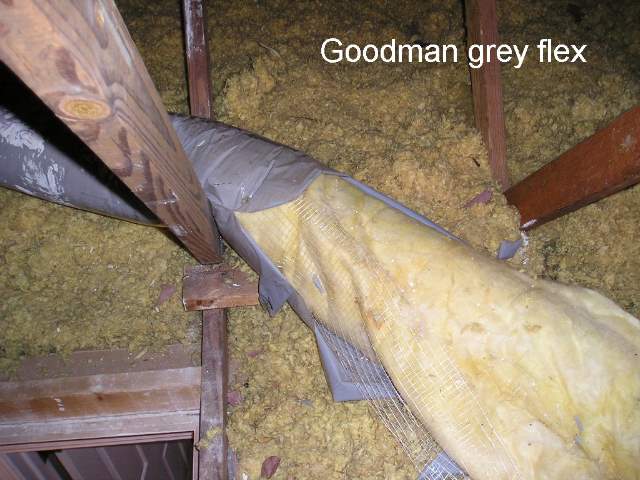
Your images (above and at below-left) give a helpful dose of "real world" to the topic as one can see that in at least some attics crawling or I should perhaps say writhing through trusses and other obstructions are where the real work comes in when replacing deteriorated ductwork. Watch your back and also watch for slicing your head on nails protruding through the roof sheathing.
Your third photo of Goodman QuietFlex ductwork in your mom's attic is shown at below left, while at below right is another brand with its own installation SNAFUs.
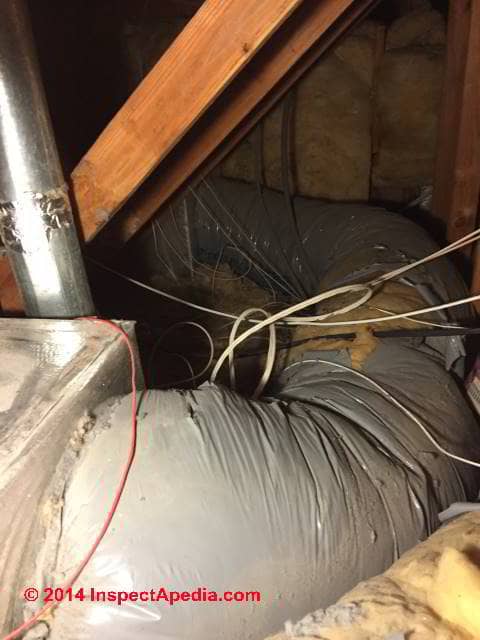
Thank you for the flex-duct question - it helps us realize where we need to work on making our text more clear or more complete.
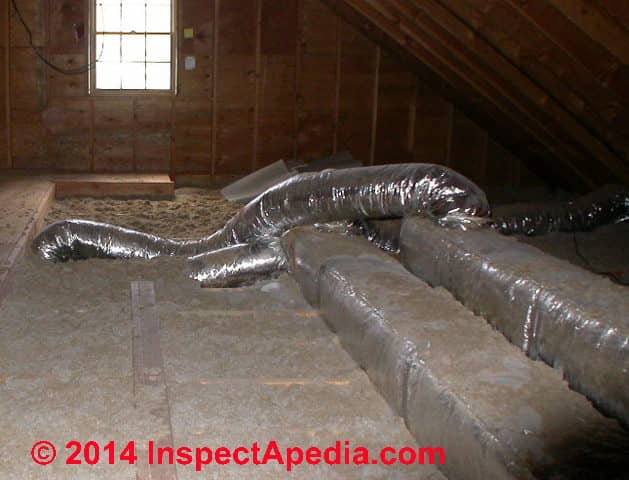
I'm unaware of any recall, class action, or financial relief for this product failure.
However the cost of replacement for flex duct that is routed through accessible areas such as an attic should not be major.
Simply measure the lengths and diameters of flex-duct needed, keeping in mind that you want to avoid unnecessary bends, turns, kinks and that you also want to avoid using greater lengths than necessary between any two points of flex duct connection.
By that I mean that flex duct that is stretched fully open offers less resistance to air-flow and is thus more efficient in heating or cooling than flexible ductwork that has extra length left compressed.
More "do's and don'ts" for flexible HVAC duct installation are
To buy replacement flex duct for your system see
...
Continue reading at GRAY FLEXDUCT FAILURES or select a topic from the closely-related articles below, or see the complete ARTICLE INDEX.
Or see these
Recommended Articles
Suggested citation for this web page
GOODMAN GRAY FLEXDUCT at InspectApedia.com - online encyclopedia of building & environmental inspection, testing, diagnosis, repair, & problem prevention advice.
Or see this
INDEX to RELATED ARTICLES: ARTICLE INDEX to HVAC DUCT SYSTEMS
Or use the SEARCH BOX found below to Ask a Question or Search InspectApedia
Ask a Question or Search InspectApedia
Try the search box just below, or if you prefer, post a question or comment in the Comments box below and we will respond promptly.
Search the InspectApedia website
Note: appearance of your Comment below may be delayed: if your comment contains an image, photograph, web link, or text that looks to the software as if it might be a web link, your posting will appear after it has been approved by a moderator. Apologies for the delay.
Only one image can be added per comment but you can post as many comments, and therefore images, as you like.
You will not receive a notification when a response to your question has been posted.
Please bookmark this page to make it easy for you to check back for our response.
Our Comment Box is provided by Countable Web Productions countable.ca
Citations & References
In addition to any citations in the article above, a full list is available on request.
- Thanks to Mark Cramer, Tampa Florida, for assistance in technical review of the "Critical Defects" section and for the photograph of the deteriorating gray Owens Corning flex duct in a hot attic. Mr. Cramer is a Florida home inspector and home inspection educator.
- Thanks to Jon Bolton, an ASHI, FABI, and otherwise certified Florida home inspector who provided photos of failing Goodman gray flex duct in a hot attic
- Eric Van De Ven, Coconut Creek, Fl 33066 - (954) 340 6615, a South Florida home inspector, former ASHI and NACHI member, current IHINA (Independent Home Inspectors of North America). ev@magnuminspections.com
- Flexduct lawsuit, Richard T.D. Bethea et als, v. Song Hee Hong, et al, filed may 29, 2009, Jackson Tennessee Court of Appeals, dispute involving the contract for sale of a house. A musty odor was associated with mold contaminated flex duct in the building. The ductwork could not be cleaned because of its fragility - an Owl-flex duct product. Sellers (correctly) asserted that the ductwork could not be cleaned. The court finding includes the statement that "OWL FLEX ductwork was uncleanable". The buyers ability to terminate the sales contract was upheld.
- "Design & Installation of Residential Flexible Ductwork Systems", Georgia Department of Community Affairs, 60 Executive Park, NE, Atlanta GA 30329
- (404) 679-4940 - (800) 359-4663 [Also see the installation manuals below at JPL] - original source dca.state.ga.us/development/construction codes/publications/1ONE.pdf
"1. This information is intended to assist contractors, installers and code officials in the proper design and installation of flexible ductwork systems. The information presented in this document comes primarily from sources in the International Mechanical Code including referenced standards and Georgia Amendments.
2. It is recommended as a guide that HVAC system documentation, including owner’s manuals, manufacturer’s installation instructions and a sketch of the duct system design that details duct size and approximate duct lengths be provided to the building owner or posted on the air handling unit or furnace. (See sample Duct System Design Sketch). Documentation should also include Manual J calculations." - "Flexible Duct Performance & Installation Standards", Air Diffusion Council, 1901 N. Roselle Road, Suite 800, Schaumburg, Illinois 60195, Tel: (847) 706-6750, Fax: (847) 706-6751 - Email: info@flexibleduct.org - www.flexibleduct.org/ -
"The ADC has produced the 4th Edition of the Flexible Duct Performance & Installation Standards (a 28-page manual) for use and reference by designers, architects, engineers, contractors, installers and users for evaluating, selecting, specifying and properly installing flexible duct in heating and air conditioning systems.
Features covered in depth include: descriptions of typical styles, characteristics and requirements, testing, listing, reporting, certifying, packaging and product marking.
Guidelines for proper installation are treated and illustrated in depth, featuring connections, splices and proper support methods for flexible duct. A single and uniform method of making end connections and splices is graphically presented for both non-metallic and metallic with plain ends."
The printed manual is available in English only. Downloadable PDF is available in English and Spanish. - Flexduct lawsuit, Richard T.D. Bethea et als, v. Song Hee Hong, et al, filed may 29, 2009, Jackson Tennessee Court of Appeals, dispute involving the contract for sale of a house. A musty odor was associated with mold contaminated flex duct in the building. The ductwork could not be cleaned because of its fragility - an Owl-flex duct product. Sellers (correctly) asserted that the ductwork could not be cleaned. The court finding includes the statement that "OWL FLEX ductwork was uncleanable". The buyers ability to terminate the sales contract was upheld.
- Owens Corning Duct Solutions - www.owenscorning.com/ductsolutions/ - provides current HVAC ductwork and duct insulating product descriptions and a dealer locator. Owens Corning Insulating Systems, LLC, One Owens Corning Parkway, Toledo, OH 43659 1-800-GET-PINK™
- "Flexible Duct Media Fiberglas™ Insulation, Product Data Sheet", Owens Corning - see owenscorning.com/quietzone/pdfs/QZFlexible_DataSheet.pdf
"Owens Corning Flexible Duct Media Insulation is a lightweight, flexible, resilient thermal and acoustical insulation made of inorganic glass fibers bonded with a thermosetting resin." - "Flexible Duct Performance and Installation Standards", (3rd ed.) – Air Diffusion Council, 1901 N. Roselle Road, Suite 800, Schaumburg, Illinois 60195, Tel: (847) 706-6750 - Fax: (847) 706-6751 email: Email: info@flexibleduct.org
- HVAC Duct Construction Standards—Metal and Flexible (1995 ed.) – Sheet Metal and Air Conditioning Contractors’ National Association, Inc. (SMACNA)
- J.P. Lamborn Co., 559-650-2120 / fax 559-650-2112, email: cuserv@jplflex.com - original source for the air duct installation manuals below - http://www.jplflex.com/featured/instructions.asp - note that these FlexDuct installation guides provided by JP Lamborn Co. originate with the Air Diffusion Council - referenced above.
Flexible air duct Installation Instructions for Air Ducts & Connectors without fittings
Flexduct Installation Instructions for Flexible Air Ducts & Connectors with fittings
Flex duct Installation Instructions for Flex Ducts & Connections using mastic
"Originally founded in 1961, JP Lamborn Co. has grown to become one of the largest producers of insulated flexible duct in the country. With 4 state of the art manufacturing plants strategically positioned across the USA in order to serve a growing national distributor base. The company prides itself in delivering quality, service, innovations and competitive pricing to customers it serves." - International Mechanical Code, 2000 Edition, with 2001, 2004 & 2005 Georgia Amendments
- Manual D—Residential Duct Systems – Air Conditioning Contractors of America (ACCA)
- In addition to citations & references found in this article, see the research citations given at the end of the related articles found at our suggested
CONTINUE READING or RECOMMENDED ARTICLES.
- Carson, Dunlop & Associates Ltd., 120 Carlton Street Suite 407, Toronto ON M5A 4K2. Tel: (416) 964-9415 1-800-268-7070 Email: info@carsondunlop.com. Alan Carson is a past president of ASHI, the American Society of Home Inspectors.
Thanks to Alan Carson and Bob Dunlop, for permission for InspectAPedia to use text excerpts from The HOME REFERENCE BOOK - the Encyclopedia of Homes and to use illustrations from The ILLUSTRATED HOME .
Carson Dunlop Associates provides extensive home inspection education and report writing material. In gratitude we provide links to tsome Carson Dunlop Associates products and services.
 | HOME | ABOUT | ASK a QUESTION | CONTACT | CONTENT USE POLICY | DESCRIPTION | POLICIES | PRIVACY | |
| © 2024 - 1985 Publisher InspectApedia.com - Daniel Friedman | |||||||||