
InspectAPedia® FREE Encyclopedia of Building & Environmental Construction, Diagnosis, Maintenance & Repair |
Question? Just ask us! InspectAPedia
|
 HVAC Duct Vibration Dampeners
Asbestos Fabric Duct or Pipe Wrap; Asbestos Vibration Dampeners & Asbestos at the Air Handler
- POST a QUESTION or COMMENT about vibration dampers used in heating & air conditioning air duct systems
HVAC duct vibration dampeners.
This article describes the vibration damper (vibration dampener or vibration isolator) connecting the air handler unit supply plenum to the building supply duct and cites cases of asbestos-containing air conditioning or heating duct work that could send asbestos fibers into building air.
This article also describes asbestos-fabric dampeners on old HVAC ductwork and explains the dampener (or "vibration damper") function, location, inspection, common defects, repairs.
Asbestos fabrics are still sometimes found in buildings at a variety of locations including as HVAC duct vibration dampeners, duct or pipe insulating wrap, electrical wire insulation, and in special applications as fireproof curtains or blankets. Here we give special attention to asbestos cloth fabric HVAC duct vibration dampeners or "vibration dampers":
InspectAPedia tolerates no conflicts of interest. We have no relationship with advertisers, products, or services discussed at this website.
What is the Vibration Dampener Found on Air Handlers for Heating and Air Conditioning Systems?
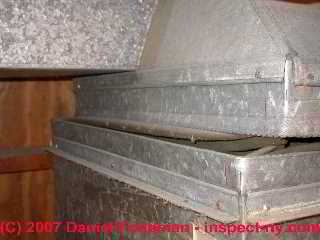
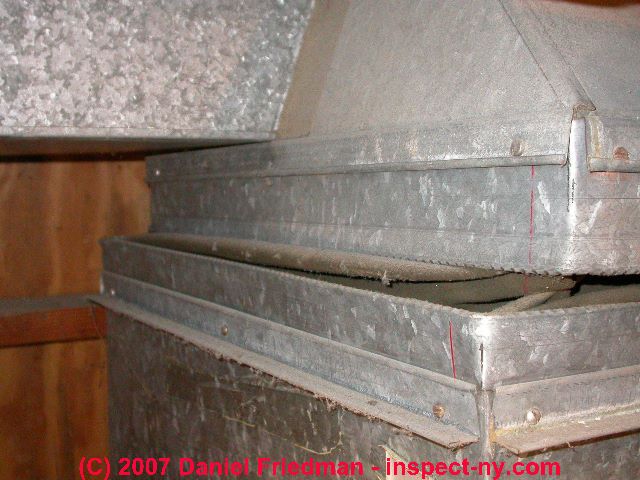
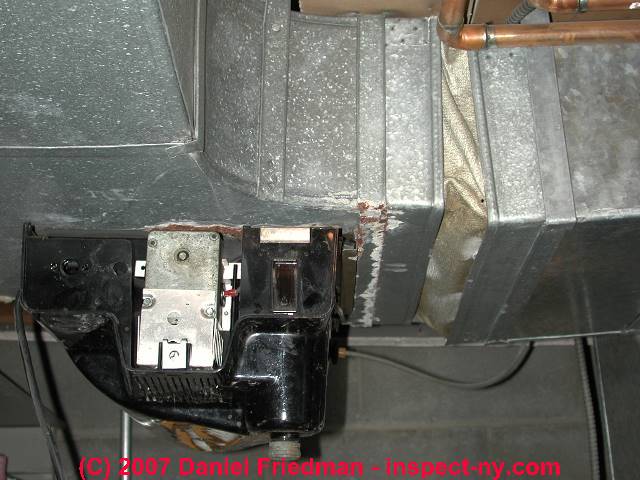
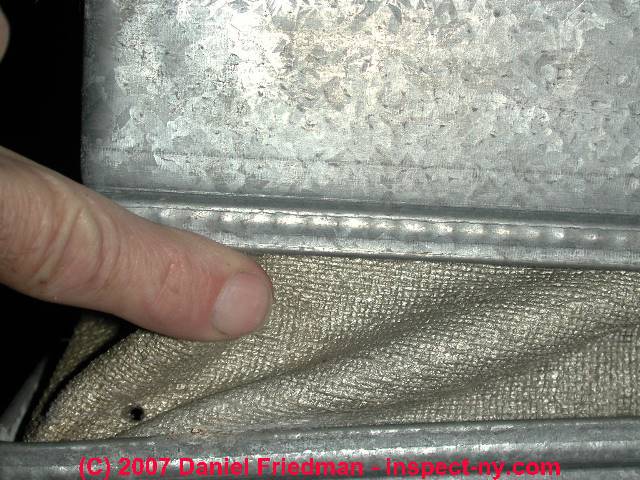
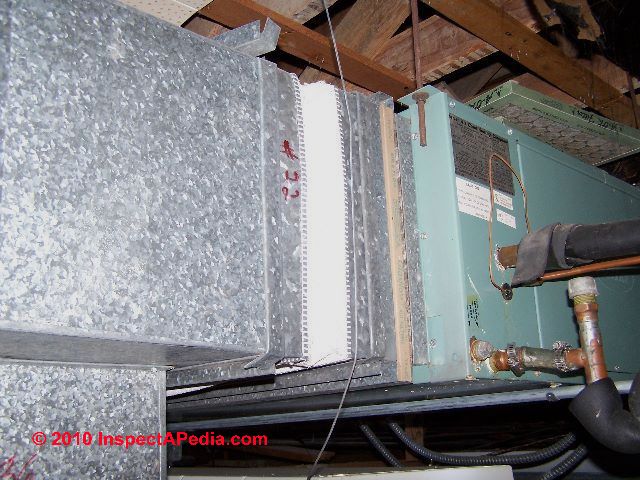
The "vibration damper" [properly called "vibration dampener"] shown in this photograph and at the top of this page is a fabric or rubberized fabric flexible connection used to join the supply air plenum to supply ducts in a building.
On a vertical air handler with conditioned air leaving at the top of the unit, you may see this fabric joint at the supply plenum to which the building supply ducts are connected.
The purpose of the vibration dampener is simple: by providing a flexible link between the air handler itself (a possible source of noisy vibrations) and the building duct work, the installer is reducing the transmission of noise through metal ductwork into the rest of the building when the blower, furnace, or air conditioner are running.
Thanks to reader Kenneth Meichtry, Building Maintenance Superintendent at General Services Agency, San Luis Obispo County, CA,for pointing out that the correct term for the HVAC component we illustrate here is vibration dampener.
Definition of vibration dampener
A vibration dampener is a device designed to absorb rather than transmit vibration. In the case of heating furnaces and air conditioners, mechanical vibrations that occur in the air handler would be transmitted as annoying sounds throughout the building if a vibration dampener were not installed between the air handler unit itself and the metal ductwork to which it is connected.
It would be equally accurate and more descriptive to refer to this device as a vibration isolator since what it's doing is isolating vibration in the vibrating part to avoid transmitting the vibration and thus annoying noise to other parts of the HVAC system or into the building.
 On an air handler system or "blower unit", a fabric, currently often made of rubberized material, is installed as the vibration dampener. Vibrations in the air handler move the fabric without being transmitted into the metal ductwork.
In these articles we may include the less correct term "vibration damper" because it is very widely used among HVAC trades workers and because we want online searches for this noise-reducing component to enable our article to be found using either term: vibration damper or vibration dampener.
An additional HVAC noise source is of course an absent vibration dampener or one that is improperly connected or constructed.
For example we observed an air handler connection to the supply duct trunk that had so little clearance space between the steel components that even though a vibration dampener had been squashed into that space, vibration and noise from the air handler was being transmitted to the duct system and into the building.
Asbestos & Other Defects in Air Handlers & Duct Work: Damaged Vibration Dampeners & More Air Handler Noises
Inspect the vibration dampener to see that it is intact, not torn or damaged. If the blower is running you may feel air leakage around the damper if it is damaged or not properly installed.
- Look for tears or holes in the vibration dampener;
- Look for separation between the vibration dampener and the air handler outlet or plenum
- Look for separation or gaps between the vibration dampener and the air supply duct trunk to which it is joined
Note that air blowing out of leaks in the HVAC supply duct system as well as air blowing into leaks in the return duct system can be a source of noises in the system including hisses, whistles, etc.
Asbestos Textile Fabric Uses in Buildings
Asbestos Fabric in HVAC Ducts as Vibration Dampener Material
 ...
... 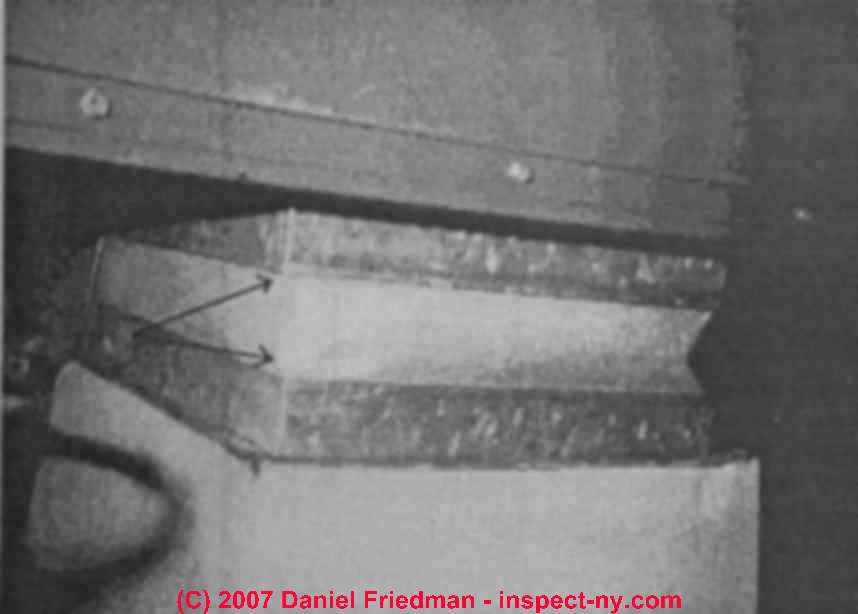
On older furnaces and some air conditioning systems you may see a white woven fabric used for the vibration damper material. It is possible that this material was made of asbestos fabric [better photos wanted].
Colors of asbestos vibration dampener cloth:
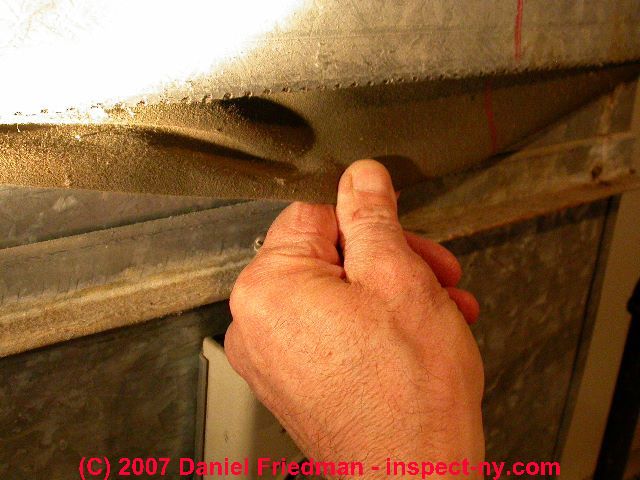
If the vibration damper fabric is white or white-gray (un-coated asbestos fabric) or possibly silver (aluminized coated asbestos fabric) and woven of a coarse-woven fabric it may be an asbestos material, typically containing chrysotile asbestos fibers in a high percentage.
Look at the lower left corner of our close up photo of a silver-colored asbestos vibration damper at a warm air furnace (photo above right). See that little black round spot above the "D" in "Daniel" of our © notice?
 That's where a technician has made a hole in the asbestos damper material in order to insert a thermometer to sense air temperature. The fibers released by such minor damage are probably below the limits of detection.
It is easy to distinguish asbestos fabric in the vibration dampener from other common damper materials which have been used as other fabrics are more finely woven (see photos on this page) and may be rubberized or coated canvas or on newer systems, vinyl-coated synthetic fabric.
Reports of actual asbestos lab tests of asbestos cloth vibration dampers confirms their composition:
The photograph of an asbestos cloth HVAC duct vibration damper shown at left, courtesy Jason Lee, was confirmed by Mr. Lee as containing 65% chrysotile asbestos.
OPINION-DF: Further testing or inspection may be in order, since if indeed asbestos material was used at this location, and especially if it is damaged, it could release asbestos fibers into building air.
Watch out: Do not tear, cut, or damage the asbestos-fabric material during your inspection.
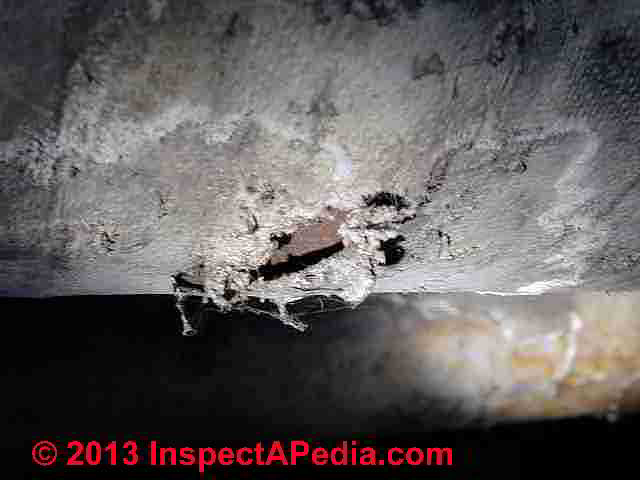 If the vibration damper is missing, torn, leaky, or is made of asbestos, we recommend that it be replaced with modern
materials.
If the vibration damper is missing, torn, leaky, or is made of asbestos, we recommend that it be replaced with modern
materials.
In some cases it may be less costly to simply replace an asbestos-suspect vibration damper than to pay to have it tested.
However if you want to test the vibration damper fabric, look inside the return plenum to the inside of the fabric.
Often we can find an individual thread sticking up above the metal clamp securing the fabric to the metal plenum sides, easily clipped with no damage to the fabric itself.
Asbestos Fabric as Duct or Pipe Insulation
Our photograph above illustrates use of an asbestos textile as a duct wrap or pipe wrap.
Research Confirming use of Asbestos Fabric in HVAC Duct Dampeners
 Illustration: Kazmierski's 1979 patent of a high temperature expansion joint or duct vibration dampener used in HVAC systems.
[Click to enlarge any image]
- Andrews, John S. SILENCER for VENTILATION DUCTS [PDF] U.S. Patent 4,034,826, issued July 12, 1977.
Excerpt: The outer wall may be of rubber or plastic coated fabric such as asbestos cloth or glass fiber cloth. - Cheyney, Charles C. SOUND DEADENER [PDF] U.S. Patent 1,865,677, issued July 5, 1932.
Excerpts:
My device comprises an open frame 10 having top and bottom walls 11 and 12, re spectively, and side walls 13. This frame is made of any suitable material such, for in stance, as asbestos, fiber, plaster, rock wool, or cork board, or any other suitable material which will have a deadening effect upon sound vibrations.
The baffle members 15 may be made of any suitable material such as asbestos, felt, rubber or other suitable soft, non-metallic material which will absorb or deaden sound vibrations. - Edwards, Howard C. "Silencer having contiguous concentric layers of sound absorbent material." U.S. Patent 3,181,646, issued May 4, 1965.
Excerpt:
Shell 212 is surrounded by a relatively tightly compacted layer 216 of sound absorbent material, which may be asbestos or glass wool. - Enlund, Helmer LF, and Enos V. Stanhope. "Sound and vibration isolation support." U.S. Patent 3,606,218, issued September 20, 1971.
- Fraguela-Formoso, José Ángel, José Luís Fernández-Soto, Pablo Fariñas-Alvariño, and Luís Carral-Couce. "Marine safety: Asbestos in the maritime industry." Dyna 83, no. 198 (2016): 205-212.
Excerpt: … asbestos have been used extensively in acoustical applications. However, the health hazard associated with asbestos … of the duct linings were predicted using a bulk reacting duct lining … - Kazmierski Jr, John, Craig E. Thornton, John L. Ambrose, and Frederick S. Dmuchowski. HIGH TEMPERATURE EXPANSION JOINT [PDF] U.S. Patent 4,140,338, issued February 20, 1979.
at
https://inspectapedia.com/hazmat/Kazmierski-Patent-US4140338
This is a use of asbestos fabric coated with aluminum, such as we find in HVAC duct dampers. This is NOT a drywall joint tape.
Abstract:
An expansion joint for duct work is disclosed, which comprises a pair of frames, spacer means extending outwardly from said frames, and a boot. The boot has five layers: an inner asbestos/aluminum/silica material, a fibrous insulation batt, a middle asbestos/aluminum material, a vapor barrier, and an outer asbestos/fluoroelastomer material. - Fraguela-Formoso, José Ángel, José Luís Fernández-Soto, Pablo Fariñas-Alvariño, and Luís Carral-Couce. "Marine safety: Asbestos in the maritime industry." Dyna 83, no. 198 (2016): 205-212.
- French, David W. "Asbestos paper coupling." U.S. Patent 3,227,476, issued January 4, 1966.
This was an asbestos paper used at HVAC heating duct or pipe couplings. - Hamid, Mahmud. "On the application of mastic materials as panel vibration dampers to fan housings and ventilation ducts." (1962).
Abstract:
The Geiger and Complex Modulus standard methods used to obtain the damping properties of viscoelastic materials were compared. The tests, using both methods, are described for a number of available materials.
The results are in good agreement. It was found that a uniform coating of the entire vibrating surface did not correspond to the highest damping efficiency.
An equivalent circuit, based on electro-mechanical analogies, was derived. This circuit proved to be a powerful technique in the study of vibration damping, and some of its parameters were combined in a universal curve.
One viscoelastic material was chosen for most efficient application to a ventilation-duct model. At one anti-node the velocity-amplitude was reduced by 78.9%. - Peck, Robert E. "Conduit construction." U.S. Patent 2,226,523, issued December 24, 1940.
Excerpt: Economy Heat transmission characteristics Tests were conducted on various sizes of onehalf inch thick asbestos ducts ... - Yocom, Alvin M., and D. Olier George. "Cork containing composite sheet material." U.S. Patent 2,584,959, issued February 5, 1952.
Excerpt:
More particularly the present invention relates to composite material composed of at least one thickness or stratum of an asbestos-rubber composition and at least one thickness or stratum of a cork-asbestos-rubber composition.
Reader Comments, Questions & Answers About The Article Above
Below you will find questions and answers previously posted on this page at its page bottom reader comment box.
Reader Q&A - also see RECOMMENDED ARTICLES & FAQs
On 2024-02-06 by Anxious About my Possible-Asbestos Vibration dampener - can't get anyone to replace it
Re-posting from private email:
I am hoping you could please give me some advice/direction. I cannot seem to get any advice or direction that is consistent regarding asbestos. We have a house built in the 60s.
The vibration dampeners in our HVAC system (both return and supply side) t have asbestos in them. I have 3 very young children and I am desperate to find out what the right thing to do is.
I have tried consulting 2 industrial hygienists and 2 remediation companies and one of the Industrial Hygienists said the vibration dampeners should be removed because over time fibers could be potentially released.
The other one said leave them. The one that said leave it said removing it has the potential to contaminate the house and release more fibers and that as long as we leave them alone they are fine.
One of the remediation companies said take it out the other said too risky to take it out. We did TEM testing because I am scared and wanted to see if asbestos fibers where in the air in the house.
There were no fibers seen on the test but apparently the testing only has a sensitivity of 15 s/mm2.
Another environmental specialist recommended annual testing as an alternative to removal but with TEM testing even if nothing showed on the tests wouldn't that miss many dangerous fibers?
Anyway, I have no idea what is safe to do in this situation but want to ensure my toddlers breathe clean air. - Anonymous, 2024/02/06
On 2024-02-06 by InspectApedia Publisher (mod)
@anxious about vibration duct dampener asbestos
I'm sure sorry that you've had all this worry and expense.
Unfortunately the handling of your question, a perfectly reasonable one, has gotten totally out of hand and run amok, with people pouring your money over the problem in part to reduce their risk.
All of what follows is my opinon:
A vibration dampener on some older HVAC equipment used an asbestos cloth. It's not highly friable but might release some asbestos fibers into the air stream, and if damaged, say by chopping or cutting, could release more.
It's not reasonable to have spent money on asking people nor on asbestos testing - the sum of all of that is bound to far exceed the cost of simply removing the whole dampener assembly.
The duct dampener assembly is basically a section of sheet metal or ductwork that includes the dampener fabric between two halves. Its removal is a mechanical operation. During this process the fabric should not be particularly disturbed nor damaged - no cutting, chopping, etc. is needed; it's the sheet metal trunk or duct section that contains the fabric that gets removed, as an entire assembly.
While the actual, practical risk of significant levels of asbestos fiber release from an un damaged dampener is probably extremely small, it's reasonable to simply ask an HVAC duct installer to remove the whole assembly intact and to replace it with a new one that uses a non-asbestos fabric - usually a rubber-coated canvas.
Separately at OTHER PEOPLE's MONEY we explain the risk of asking experts for advice but getting advice that spends your money to reduce their risk. A good deal for them and a bad one for you.
For peace of mind, if you like, after the old vibration dampener(s) has (have) been removed, you can have your duct system cleaned by damp wiping and HEPA vacuuming in the nearby ductwork and in the work area.
On 2024-02-06 by Worried about asbestos fabric vibration dampener in ductwork
@InspectApedia Publisher,
Thank you very much for such a quick response. I really appreciate the information. I am going to make an appointment with an HVAC company to have the whole dampener assembly removed.
On 2024-02-06 by InspectApedia Publisher (mod)
@Worried about asbestos fabric vibration dampener in ductwork,
Smart move. And we're happy to have been of help to you.
Now you could help us out, too:
1. let me know what the HVAC duct company charges. And watch out: don't let them see that you're frightened about this or the cost of the job might be unnecessarily increased.
2. take photos of the vibration dampener as installed,
and take a couple of photos of the dampener being removed, and a final one of the new one installed.
If you give me 3-4 high res photos I can use them to illustrate the procedure - which would certainly help other readers who are faced with the same worry. We'd use them while keeping you anonymous unless you prefer to be identified.
On 2024-03-07 by Worried about asbestos fabric vibration dampener
I did not have any luck getting an hvac company to do the work. The last one I contacted just wrote back "we appreciate the consideration for the project, but we respectfully decline" and another one wanted over $4000 dollars which at the time seemed really high.
I have an appt. with a 3rd hvac company one tomorrow. I also reached out to 3 well known remediation companies b/c at that price I figured mine as well have a licensed abatement company do it.
One actually said they also would pass because I should just leave them in. The two that will do it will cost about 4 thousand dollars but that is including TEM clearance air testing after as well so we are picking one today and just getting it done next week unless the appointment with the hvac company goes well tomorrow.
Most importantly in the meantime, since this was dragging out, I had the IH take another set of 8 asbestos TEM air samples.
Seven of the 8 samples were at the Non Detect level (less then 15 fibers per mm2 or less then .00049 f/cc2 but one room showed asbestos levels in the air so I have to assume it must be from the vibration dampeners because other than tile in the hvac room which is never touched and in good condition we cannot figure out another possible source.
The result in the one room was 14 fibers per mm2 or .0032 s/cc
So now I am scared and willing to pay a whatever high price for the removal, I am also wondering if until they can get these dampeners out my family should leave our house?
And then do we also need to get the whole house remediated once they do remove the dampeners?
The only advice I can get from anyone is the level found in our house is below the clearance level used after remediation and "no amount of asbestos is considered safe" but that our levels are below the clearance level but that's not actually a recommendation.
Thanks for any information. Sorry to go in to so much detail but I just am not well-versed in any of this and just want to do what is safest for my family.
On 2024-03-07 by InspectApedia Publisher (mod) - trouble getting a contractor to replace our asbestos vibration dampener
@Vibration Duct Dampener Replacement Wanted
Please trust that the warning I give here is given with respect and concern for you, though you may not like what I have to say.
I suspect that you have become so scared about this relatively low-risk problem that contractors whom you're contacting get scared too - scared of their liability, which can be a more significant risk when dealing with a customer who they think is very nervous.
You've probably spent more already on asbestos tests than it should have cost to simply have an HVAC company replace the vibration dampener.
I would take another careful look at your asbestos test report, to be sure you've got it right: are you really finding 14 asbestos fibers per cubic millimeter? Could it not be per cubic meter? That's a huge difference.
And if the lab says that your airborne asbestos level is below the "clearance level" - that's the "pass" standard that would be applied following an asbestos remediation job and would be a place to STOP doing further asbestos removal/cleanup.
Remember that when you scare a contractor they're going to be sure to say to you just what they think avoids any liability.
Ask your asbestos test lab to
1. clarify the finding
2. tell you the risk assessment, with reference to acceptable exposure levels (PELs) such as given by this OSHA document
https://www.osha.gov/sites/default/files/publications/OSHA3507.pdf
Permissible Exposure Limit (PEL) for asbestosis 0.1 fiber per cubic centimeter of air as aneight-hour time-weighted average (TWA), withan excursion limit (EL) of 1.0 asbestos fibersper cubic centimeter over a 30-minute period.The employer must ensure that no one isexposed above these limits.
Remember that OSHA guidelines are for the workplace. There may not be the same guides for homes.
Then call some duct installers and in a totally calm, un-concerned voice just ask them to replace your old vibration dampener so that you can be "on the safe side".
If you haven't done so, take a look at OTHER PEOPLE's MONEY - to understand what happened with the contractor you scared away and the one who wants a huge sum.
A typical duct vibration dampener costs about $200. U.S. + installation cost
Keep us posted.
Daniel
On 2022-09-14 by Patrick Butler - will UV light harm the rubberized vibration dampener
I have a rubberized dampener in the plenum of my home. I want to put in a UV light as a disinfectant. Will the UV light destroy the dampening material?
On 2022-09-14 by InspectApedia-911 (mod)
@Patrick Butler,
Good question. The answer is - I don't know.
UV light does ozidize and break down some types of rubber much more quickly than others.
So let's identify the dampener in your HVAC system, its brand and model and start there by asking the manufacturer.
My GUESS is that while UV may break down the rubber over time, it's not likely to be a rapid nor substantial issue.
On 2020-08-31 by TJ - could this 1978's cloth vibration dampener be asbestos fabric?

Hello,
We just moved into our 1978 house, and I noticed these two fabric dampeners on the supply side of the HVAC.
Is this asbestos?
If so, What's the best way to go about safely removing and replacing these? I don't want to release acerated asbestos into my duct or house.
On 2020-09-01 by danjoefriedman (mod) - Yes
Tj
Looks like it could be
Because the dampener is a fabric and is not easily friable, and because it is usually attached to the air plenum or duct work with a metal band, you should be able to remove the screws in the metal band and remove the fabric entirely intact for disposal. If you want to be extra careful you can try using a h e p a vacuum cleaner during and after that removal.
On 2020-02-05 by Mimi does this cloth vibration dampener possibly contain asbestos?
 Hi does this seem like it can possibly contain asbestos?
On 2020-02-05 by (mod) - possible asbestos fabric in vibration duct dampener
Mimi
Yes That vibration duct dampener fabric could be asbestos cloth;
What are the country and city of the building where this is installed and what is the age of the building and of its ductwork?
On 2017-12-19 by (mod) -
Stacy
The vibration dampener cloth shown in our photos is not friable. "Friable" means that you can crumble a material into dust by using simply your fingers to squeeze and smear it.
On 2017-12-18 by Stacy - is asbestos cloth on a vibration dampener friable?
Is asbestos duct clot friable or non friable?
On 2017-12-18 by Mod - Asbestos cloth is not friable
Asbestos cloth is not friable - as the definition of friable means that you can easily reduce a material to fine dust or powder simpy by rubbing it between a thumb and forefinger.
On 2016-11-08 by Eddie - how do I repair the vibration dampener without removing it?
How do you repair the cloth instead of removing it
On 2016-11-08 by (mod) -
On a vibration dampener made of asbestos cloth I would prefer to remove and replace the whole dampener.
In an emergency, as a temporary repair, if I had to leave the dampener in place I'd cut a working size opening in the sheet metal and then bond another heat-resistant cloth over the interior of the dampener joint using cloth and metallic adhesive tape.
Even spraying the interior and exterior surfaces of the fabric with a spray paint sealant would be helpful in reducing any fiber release.
On 2016-08-07 by Marc - if it's not asbestos fabric on our vibration dampener what would it be?
We have green, finely woven cloth as the vibration dampeners on the furnace in our crawlspace---it looks a lot like the cloth in the photos at the top of the page (where you can see a hand pulling the cloth)---is this ACM? If not, what material is being used?
Thanks!
On 2016-08-07 by (mod) - green, finely woven cloth as the vibration dampeners
More likely rubber-coated canvas
On 2016-08-07 by Marc
Thanks! So the green fabric would not be ACM? It says on the page that ACM fabric is easy to identify (white, gray, silver).
On 2016-08-08 by (mod) - rubber-coated canvas duct damper material
Marc,
Truth is, no one can assert for sure what a material is based on a brief e-text. To know for certain if a fabric contains asbestos you'd need to test a sample using a certified ASBESTOS TEST LAB (you can search InspectApedia for that phrase to find certified asbestos testing companies). You wouldn't want to bet your money nor health on speculation.
Question: can a technician fix a bad vibration dampener on a noisy Amana system ?
(20 hours ago) Lynda said:
I have a new Amana 16 seer 2 stage split system. There is a vibration and a variable harmonic sound in the wall where the ground unit connects to the house. It has been insulated in the wall and strapped to a stud. Still noisy.
The tech can not fix it. Any ideas as to cause and repair? Thanks. lyndalnichols@gmail.com
Reply:
Often careful use of a mechanics' stethescope can pinpoint a vibration source such as a bad motor bearing. Figure vibration is most likely coming from an electric motor - of which your outdoor unit has one or more compressors and a fan motor.
...
Continue reading at WHITE NOISE & SOUND CONDITIONERS or select a topic from the closely-related articles below, or see the complete ARTICLE INDEX.
Or see these
Asbestos HVAC Duct Articles
- ASBESTOS HVAC DUCTS - Guide to Identification of Asbestos Materials On or In Heating and Cooling Duct Work: carbon monoxide hazards of transite chimneys and vents
- ASBESTOS TESTING LAB LIST if you need to have asbestos-suspect material tested
- ASBESTOS TEXTILES
- DUCTWORK CONTAMINATION
- IDENTIFICATION of ASBESTOS in buildings - Asbestos Identification in buildings: How to find & identify asbestos-containing materials
- TRANSITE PIPE AIR DUCT ASBESTOS RISKS - Hazards of Asbestos-containing Transite Pipe HVAC Ducts: duct collapse, mold, radon, asbestos fiber release
- TRANSITE PIPE CHIMNEYS & FLUES - Guide to Identifying Asbestos Transite Chimneys & Flues & their Hazards in buildings
Suggested citation for this web page
VIBRATION DAMPENERS at InspectApedia.com - online encyclopedia of building & environmental inspection, testing, diagnosis, repair, & problem prevention advice.
Or see this
INDEX to RELATED ARTICLES: ARTICLE INDEX to ASBESTOS HAZARDS
Or use the SEARCH BOX found below to Ask a Question or Search InspectApedia
Ask a Question or Search InspectApedia
Try the search box just below, or if you prefer, post a question or comment in the Comments box below and we will respond promptly.
Search the InspectApedia website
Note: appearance of your Comment below may be delayed: if your comment contains an image, photograph, web link, or text that looks to the software as if it might be a web link, your posting will appear after it has been approved by a moderator. Apologies for the delay.
Only one image can be added per comment but you can post as many comments, and therefore images, as you like.
You will not receive a notification when a response to your question has been posted.
Please bookmark this page to make it easy for you to check back for our response.
Our Comment Box is provided by Countable Web Productions countable.ca
Citations & References
In addition to any citations in the article above, a full list is available on request.
- Thanks to Areader Jason Lee, Basin Environmental for contributing the photograph and field report of a 65% chrysotile asbestos cloth vibration damper on an older HVAC air handler-to-duct connection. June 2010. Mr. Lee can be reached at Basin Environmental, 325 North Portland Ave., Oklahoma City OK 73107 tel: 405-232-5737 or email to info@BasinEnvironmental.com
- Thanks to reader Kenneth Meichtry, Building Maintenance Superintendent, General Services Agency, San Luis Obispo County, CA, for discussing proper HVAC terminology and the term vibration dampener, February 2011.
- In addition to citations & references found in this article, see the research citations given at the end of the related articles found at our suggested
CONTINUE READING or RECOMMENDED ARTICLES.
- Carson, Dunlop & Associates Ltd., 120 Carlton Street Suite 407, Toronto ON M5A 4K2. Tel: (416) 964-9415 1-800-268-7070 Email: info@carsondunlop.com. Alan Carson is a past president of ASHI, the American Society of Home Inspectors.
Thanks to Alan Carson and Bob Dunlop, for permission for InspectAPedia to use text excerpts from The HOME REFERENCE BOOK - the Encyclopedia of Homes and to use illustrations from The ILLUSTRATED HOME .
Carson Dunlop Associates provides extensive home inspection education and report writing material. In gratitude we provide links to tsome Carson Dunlop Associates products and services.
 | HOME | ABOUT | ASK a QUESTION | CONTACT | CONTENT USE POLICY | DESCRIPTION | POLICIES | PRIVACY | |
| © 2024 - 1985 Publisher InspectApedia.com - Daniel Friedman | |||||||||