
InspectAPedia® FREE Encyclopedia of Building & Environmental Construction, Diagnosis, Maintenance & Repair |
Question? Just ask us! InspectAPedia
|
 Other Products Sold for Repairing Aluminum Wiring
- POST a QUESTION or COMMENT about how to repair aluminum electrical wiring
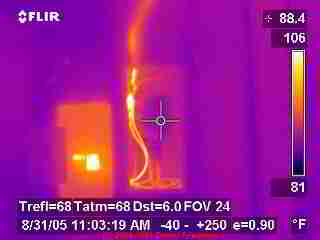
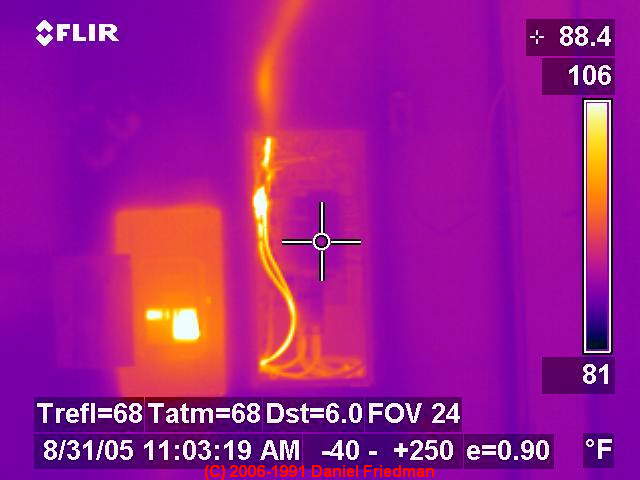
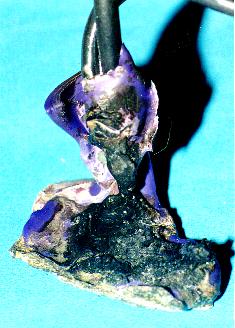
Aluminum wire connections can overheat enough to start a fire without ever drawing enough current to trip a circuit breaker.
Other products sold for repair of aluminum wiring connections: Scotchlok 3M™, Ideal 65™ Purple "Twister", Marrette B-Cap ACS™ #63 AL/CU Twist-On Connector, Electrical Receptacles and switches marked "COALR" or CU/AL, and Harbor Freight's Aluminum to Copper Crimping Tool are not recommended.
Caution - some of these products are not recommended or have been superceded by newer listed products. This website answers nearly all questions about aluminum wiring inspection, hazards, repairs
InspectAPedia tolerates no conflicts of interest. We have no relationship with advertisers, products, or services discussed at this website.
OTHER Not-Recommended ALUMINUM WIRING REPAIR PRODUCTS: for Aluminum Electrical Wiring - Ideal 65 Purple Twister and Other Aluminum Wire Products/Articles
Currently-recommended aluminum wiring repair products & methods such as the AMP/TYCO COPALUM TM crimp connector and the AlumiConn TM connector, as well as other aluminum wire repair methods can be read-about at ALUMINUM WIRING RISK Reduction.
Aluminum Wiring Connectors or "repair methods" which are obsolete or which are not recommended, such as the COALR or CU/AL devivces, the now obsolete Scotchlok TM 3M Special Method, and aluminum wiring connectors and repair methods such as the Ideal-65 TM Purple Twist On Connector, or conventional twist-on wire connectors are described just below.
Further details are also found at Aluminum Wiring Repair Methods - CPSC Meeting.
COALR or CU/AL - Marked Receptacles & Switches for Aluminum Wire "Repair"?
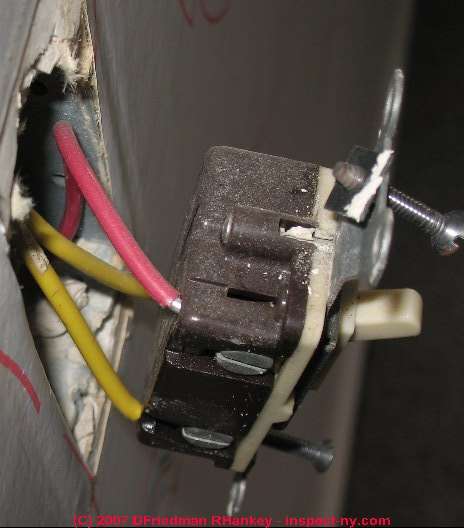 Electrical Receptacles and switches marked "COALR" or CU/AL are also not recommended for aluminum wiring repairs:
The photograph shows a back-wired electrical receptacle with an aluminum-wired branch circuit. In this photograph case the electrical receptacle was marked as "AL-CU" but was further marked as Backwire CU-ONLY by its manufacturer.

[Photograph courtesy of Roger Hankey. Contributions of photos of CU-AL and COALR receptacles are sought by the author.].
See COALR & CU-AL Devices? for the details of these COALR or CU-AL (or AL-CU) products and why they should not be used with aluminum wiring.
Harbor Freight's Aluminum to Copper Crimping Tool
Harbor Freight offers a hydraulic crimping tool advertised as usable for aluminum wiring repairs. The tool is displayed and sold only by Harbor Freight as the Hydraulic Wire Crimping Tool Model 66150. Harbor Freight is a large, long-established tool retailer (since 1978) retailing a wide variety of tools and equipment.
We recommend that you read the instruction manual for this tool (large PDF).
As of 7 Feb 2009 we don't know the approval status of this tool for aluminum wiring repairs.
We took a preliminary look at the Harbor Freight Hydraulic Wire Crimping Tool Model 66150 and also at the instruction manual, and we saw that HF advertises that this tool intended for connecting copper and aluminum wires. The text does not say that the tool is approved for joining copper to aluminum wires as is performed in the standard aluminum wiring repair procedure. But we may be interpreting the manufacturer's text more carefully than did their ad copy writer.
What we don't yet know about this aluminum or copper wire crimping tool:
- Who actually makes this tool - it is distributed exclusively by Harbor Freight http://www.harborfreight.com/ who sell a wide range of tools
- How much force the crimping tool exerts on the crimp connector, whether it is capable of performing the same connection cold weld as provided by the AMP TYCO COPALUM crimping tool
- Which crimp connectors this tool is designed to use - the manual does not specify any specific connectors.
- If TYCO has approved its use with the COPALUM connector or if there is another crimp connector that has been tested and found to perform acceptably with this tool
- If tool has been listed by UL or approved by CPSC for use for aluminum wiring repairs.
- If there are independent certifying tests of this tool and the performance of the connections it produces
What we have learned so far about this copper to aluminum wire crimping tool
The Harbor Freight Hydraulic Wire Crimping Tool Model 66150 instruction manual has some interesting paragraphs like
6. Refer to the wire manufacturer's instructions for specific crimping instructions prior to using this product.
That paragraph alone might exclude the use of this tool for aluminum-copper pigtailing repairs. There are no such instructions. The manual also, quite understandably, includes a general disclaimer:
We shall in no event be liable for death, injuries to persons or property, or for incidental, contingent, special or consequential damages arising from the use of our product.
Is the Harbor Freight hydraulic crimping tool for copper and aluminum wires recommended for repairing aluminum wiring?
No.
But given the difficulty people in some areas have finding qualified aluminum wiring repair electricians, connectors, and tools, here some
IFs
- If this tool is or has been independently tested and demonstrated as capable of producing the same quality of connection as the two currently recommended connectors
- If this tool accepts the AMP TYCO COPALUM crimp connectors or another connector that is tested and recommended by the US CPSC (there are no others as of this writing)
- If this tool and the connections it makes have been or are tested independently and are then recommended by the US CPSC
THEN having another aluminum wire repair method would be a boon for the AL wire repair topic.
This tool is Distributed exclusively by Harbor Freight Tools®. 3491 Mission Oaks Blvd., Camarillo, CA 93011
800-444-3353. We recommend that before using it for aluminum electrical wiring repairs you call the company to ask the questions listed above.
Until those safety conditions are met we do not recommend any aluminum wire repair method other than those described at ALUMINUM WIRING REPAIR METHODS. Using a non-recommended tool for repairing aluminum electrical wiring might be unsafe and might also create fire insurance issues with your carrier.
On 3/6/14 we again asked the company for clarification, including an explanation of this concern:
These questions are critical because the tool is marketed as a repair for aluminum electrical wiring but only two methods of such repair are recommended by the US CPSC. If you or we send readers to a tool that is not recommended AND worse if it does not use a recommended method or connector, you might be actually increasing the risk of your customer having a fire in their home.
Ideal 65 Purple Twist-On Connector for Aluminum Wire "Repair" ?
Ideal-65 Purple Twist On Connector the Ideal 65 Twister (don't call it a "wire nut") - this one doesn't work - purple twist-on connector sold for aluminum wire repair
CPSC reiterates unsuitability of twist-on connectors (Including the Ideal No. 65) for repairing aluminum wiring in residences.
CPSC CONCERNS RE: ALUMINUM WIRING CONNECTORS
Independent Tests indicate Ideal-65 Twist-on retrofit connector fails UL 486C Safety Standard despite UL-listing
Ideal 65 "Twister" History of and Links to CPSC Documents about Purple Twist-on connector failures
Ideal Industries, Inc., 1000 Park Ave, Sycamore IL 60178-994. 800-435-0705 U.S. or 800-527-9105 Canada ideal@wirenut.com
Note: The instructions for this connector require that it always include a copper pigtail when making aluminum wiring connections - a condition impractical for splicing aluminum-to-aluminum wires.
Dr. Jesse Aronstein, "Evaluation of a Twist-on Connector for Aluminum Wire", Forty-Third IEEE Holm Conference on Electrical Contacts, Jan 1997, 0-7803-3968-1/97.
[This article describes the Ideal Industries Ideal#65 purple "Twister" twist-on connector marketed as a repair/retrofit for residential aluminum wiring.--DJF]
Abstract: A new type of twist-on splicing component for use with aluminum
and copper wire combinations is tested to determine initial resistance, performance in a zero-current environment test, performance in a heat-cycle test, and portion of current carried by the connector's steel spring. The splices tested consist of two aluminum wires and one copper wire.
The aluminum wire samples used for the test are of the types actually installed in aluminum-wired homes. Initial resistance is found to be relatively high,
and there is a significant sample-to-sample variation. This reflects failure to consistently establish low-resistance wire-to-wire contact through the insulating oxide film on the wire. Results of the environmental and heat-cycle tests show deterioration of a significant portion of the samples.
The splices made with this connector are also found to be sensitive to mechanical disturbance, such as applied in
normal installation when the completed splice is pushed back in to the junction box. Based on the test results, it is concluded that this connector has not overcome the fundamental deficiency of twist-on connectors for use with aluminum wire applications. Keywords: aluminum wire, connectors, twist-on connectors, environmental test, heat-cycle test.
Marrette B-Cap Twist-On Connector for Aluminum Wire "Repairs"?
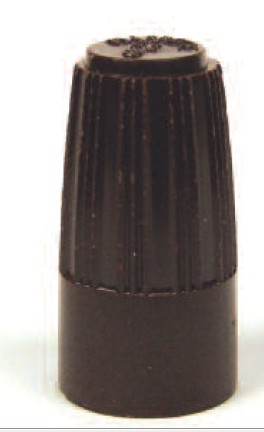
Marrette B-Cap ACS#63 AL/CU Twist-On Connector for aluminum wire repair - is also not recommended for aluminum wire repair by the pigtailing approach. Dr. J. Aronstein provided this answer to the question that we have been asked, "Can I use the Marrette B-Cap ACS 63 AL/Cu twist-on connector along with antioxidant for reliable copper-to-aluminum pigtailing repair of aluminum electrical wiring?"
"The Marrette (Brown) ACS™ Aluminum Wiring Connector (Thomas & Betts) twist-on connector is basically the same as the Marrette "Special Service" twist-on connector, which was tested by Dr. Jess Aronstein shortly after that connector came out in the early 1980's. It performed poorly in tests with aluminum wire within rated conditions."
A paper was published on those tests and is our first citation just below. Aronstein comments that "The addition of an inhibitor compound does not correct the underlying deficiency of the twist-on connector type when used with aluminum wire." See "Reducing the Fire Hazard in Aluminum-Wired Homes" for additional information on twist-on connectors with aluminum wire. -- Jesse Aronstein, Ph.D., P.E.
- "Overheating Failures of Aluminum-Wired Special Service Connectors", J.Aronstein and W.E.Campbell, IEEE Transactions, Vol. CHMT-6, No. 1, March 1983. We include an abstract of this study report below. That complete paper is available from IEEE or through a public or academic library.
- The brown (in colour) the Marrette® (Brown) ACS™ Aluminum Wiring twist-on connector has a Canadian Standards AssociationCSA certification. The product is correctly identified as the Marrette© (Brown) ACS™ Aluminum Wiring connector. The company also certifies that the 63D [and other in the ACS 63 series] is compliant with the European Directive 2002/95/EC (RoHS) or its exemption(s) [referring to the use of hazardous substances such as cadmium, mercury, lead].
- U.S. readers note that the ACS-63 product brochure indicates that the product is not UL-Listed (and thus it is not approved for use in the U.S.).
- According to the Marrette® (Brown) ACS™ Aluminum Wiring product brochure, "The Marrette® ACS™ Aluminum Wiring wire connector is a fixed spring, twist-on connector made of special spring wire materials and coatings, to meet the rigorous standards for aluminum wiring connections." The connector is sold in Canada by Marrette® under catalogue numbers Marrette ACS 63B, ACS 63C, ACS 63P, ACS 63D, and ACS 65C-CDN, ACS 65P, ACS 65D.
- According to the Marrette® (Brown) ACS™ Complete List of Wire Combinations for connector Model No. 63, (pages 28, 29) the connector can be used to connect a limited number of wires that appears to severely restrict its suitability for copper-pigtailing repair of aluminum branch circuit wiring in homes:
- Aluminum to Aluminum: 2 No 12 wires can be joined.
- Copper to Aluminum: 1 or 2 No. 14 wires to 1 No. 12 wire (Unlikely to be found as a useful pigtailing method for general aluminum wiring repair in homes using normal 15-Amp residential electrical wiring where No. 12 aluminum is the smallest solid aluminum wire conductor used for 15-amp circuits. You'd need to pigtail or daisy-chain every individual AL wire to a CU pigtail individually, overcrowding junction boxes and receptacles.)
- Aluminum to copper: in a range of combinations where No. 18 or No. 16 copper wire is used, such as for some lighting fixtures (not suitable for basic copper pigtailing for repairing aluminum wiring).
- Marrette (T&B) Canada branch of Thomas & Betts - has multiple Canadian regions. Contact: Thomas & Betts Limited, Head Office, Technical Support, 700 Thomas Avenue, Saint-Jean-sur-Richelieu, Quebec J2X 2M9 Telephone: (450) 347-5318 Fax: (450) 347-1976.(Text available in English and Français).
Scotchlok 3M Connector for Aluminum Wire "Repair"?
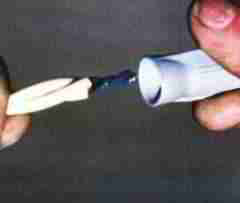 Scotchlok 3M Special Method [- superceded by new alternate repair as of June 2007 -]: this ""Scotchlok 3M Special Method was previously recommended as independent tests showed that it performed acceptably.
While this repair method has been superceded by new alternate repair methods as of June 2007, we have kept this description available to aid home buyers, electricians and home inspectors who may discover or need to be able to recognize this aluminum wire repair method if it was previously used in the building.
- A summary of this method is at Scotchlok 3M connector and the
- Scotchlok 3M connector alternative repair installation details are at SCOTCHLOK 3M REPAIR
...
Continue reading at ALUMINUM WIRING REPAIR METHODS or select a topic from the closely-related articles below, or see the complete ARTICLE INDEX.
Or see these
Recommended Articles
- ALUMINUM WIRING HAZARDS & REPAIRS - home
- ALUMINUM WIRING IDENTIFICATION
- ALUMINUM WIRING REPAIR METHODS
- ALUMINUM WIRING REPAIR ELECTRICIANS
- ALUMINUM WIRING REPAIR METHODS - CPSC Meeting 9/28/95
- COPPER PIGTAILING for ALUMINUM WIRE
- COPPER PIGTAILING FAILURES in ALUMINUM WIRING
- ALUMINUM WIRING FIELD FAILURES
- ALUMINUM WIRE to WIRE CONTACT
- ALUMINUM WIRING EQUIVALENT CIRCUITS
- ALUMINUM WIRING CONNECTOR CURRENT FLOW
- ALUMINUM WIRING CONNECTOR DETERIORATION
- ALUMINUM WIRING CONNECTOR UL TEST INADEQUATE
- ALUMINUM WIRING SPECIAL CONNECTOR FAILURES
- AMP TYCO COPALUM CONECTORS
- SCOTCHLOK 3M REPAIR CONNECTORS
- ALUMINUM WIRING REPAIR SPECIAL CONCERNS
- ALUMINUM WIRING REPAIRS NOT-RECOMMENDED
- REDUCE THE AL WIRE RISK: DETAILS
Suggested citation for this web page
ALUMINUM WIRING REPAIRS NOT-RECOMMENDED at InspectApedia.com - online encyclopedia of building & environmental inspection, testing, diagnosis, repair, & problem prevention advice.
Or see this
INDEX to RELATED ARTICLES: ARTICLE INDEX to ELECTRICAL INSPECTION & TESTING
Or use the SEARCH BOX found below to Ask a Question or Search InspectApedia
Ask a Question or Search InspectApedia
Try the search box just below, or if you prefer, post a question or comment in the Comments box below and we will respond promptly.
Search the InspectApedia website
Note: appearance of your Comment below may be delayed: if your comment contains an image, photograph, web link, or text that looks to the software as if it might be a web link, your posting will appear after it has been approved by a moderator. Apologies for the delay.
Only one image can be added per comment but you can post as many comments, and therefore images, as you like.
You will not receive a notification when a response to your question has been posted.
Please bookmark this page to make it easy for you to check back for our response.
Our Comment Box is provided by Countable Web Productions countable.ca
Citations & References
In addition to any citations in the article above, a full list is available on request.
- Dr. Jess Aronstein, protune@aol.com is a research consultant and an electrical engineer in Schenectady, NY. Dr. Aronstein provides forensic engineering services and independent laboratory testing for various agencies. Dr. Aronstein has published widely on and has designed and conducted tests on aluminum wiring failures, Federal Pacific Stab-Lok electrical equipment, and numerous electrical products and hazards. See ALUMINUM WIRING BIBLIOGRAPHY and see FPE HAZARD ARTICLES, STUDIES for examples.
- Hankey and Brown home inspectors, Eden Prairie, MN, technical review by Roger Hankey, prior chairman, Standards Committee, American Society of Home Inspectors - ASHI. 952 829-0044 - hankeyandbrown.com
- "Reducing the Fire Hazard in Aluminum-Wired Homes", Jesse Aronstein, Ph.D., P.E., provides additional information on twist-on connectors with aluminum wire and discusses effective aluminum wire repair options - updated 2009.
- "Overheating Failures of Aluminum-Wired Special Service Connectors", J.Aronstein and W.E.Campbell,
IEEE Transactions, Vol. CHMT-6, No. 1, March 1983.
This paper appears in: Components, Hybrids, and Manufacturing Technology, IEEE Transactions on Publication Date: Mar 1983 Volume: 6, Issue: 1 On page(s): 8 - 15 ISSN: 0148-6411 Current Version Published: 2003-01-06. This paper is available to IEEE members and subscribers and can be obtained through public or academic libraries.
Abstract: Special service" twist-on connectors are tested with aluminum and copper wire combinations. The special service connectors are qualified by a Canadian standard which applies to connectors for use with aluminum branch circuit conductors. Two brands of special service connectors are presently qualified by this standard and marketed. Both are rated for various combinations of aluminum and copper conductors. Samples of both brands are tested in this investigation. The tests are conducted within rated electrical and environmental conditions, with connections made according to the connector manufacturers' instructions. Overheating failures have occurred among the aluminum-wired special service connector combinations. The failures are accelerated by humid environment to a greater extent than by the application of electrical current. In contrast, connections which are copper-wired, using either standard or special service connectors, are stable and failure-free. The difference between the standard twist-on connectors and the special service connectors is in the material used for the connector spring. Improved compatibility between the spring material and the aluminum conductor, compared to the plated steel springs of the conventional twiston connectors, has not dealt with several important failure mechanisms. The test results indicate that the new standard, as presently defined, cannot be relied on to screen out aluminum-wired connector combinations which will not survive long-term operation within rated conditions. Thus the objective of accelerated qualification testing-- the prediction and assurance of safe and reliable operation in actual service---is not achieved in this case. The reasons are discussed, along with possible improvements. - "Evaluation of a Twist-on Connector for Aluminum Wire", Dr. Jesse Aronstein, Forty-Third IEEE Holm Conference on Electrical Contacts, Jan 1997, 0-7803-3968-1/97.
[This article describes the Ideal Industries Ideal#65 purple "Twister" twist-on connector marketed as a repair/retrofit for residential aluminum wiring.--DJF]
Abstract: A new type of twist-on splicing component for use with aluminum and copper wire combinations is tested to determine initial resistance, performance in a zero-current environment test, performance in a heat-cycle test, and portion of current carried by the connector's steel spring. The splices tested consist of two aluminum wires and one copper wire.
The aluminum wire samples used for the test are of the types actually installed in aluminum-wired homes. Initial resistance is found to be relatively high, and there is a significant sample-to-sample variation. This reflects failure to consistently establish low-resistance wire-to-wire contact through the insulating oxide film on the wire. Results of the environmental and heat-cycle tests show deterioration of a significant portion of the samples.
The splices made with this connector are also found to be sensitive to mechanical disturbance, such as applied in normal installation when the completed splice is pushed back in to the junction box. Based on the test results, it is concluded that this connector has not overcome the fundamental deficiency of twist-on connectors for use with aluminum wire applications. Keywords: aluminum wire, connectors, twist-on connectors, environmental test, heat-cycle test. - Harbor Freight Hydraulic Wire Crimping Tool Model 66150 instruction manual
- Marrette (T&B) Canada branch of Thomas & Betts - has multiple Canadian regions. Contact: Thomas & Betts Limited,
Head Office,
Technical Support, 700 Thomas Avenue,
Saint-Jean-sur-Richelieu, Quebec J2X 2M9 Telephone: (450) 347-5318 Fax: (450) 347-1976. (Text available in English and Français).
According to the Marrette® (Brown) ACS™ Aluminum Wiring product brochure, "The Marrette® ACS™ Aluminum Wiring wire connector is a fixed spring, twist-on connector made of special spring wire materials and coatings, to meet the rigorous standards for aluminum wiring connections." The connector is sold in Canada by Marrette under catalogue Number ACS 63B, ACS 63C, ACS 63P, ACS 63D, and ACS 65C-CDN, ACS 65P, ACS 65D. The product is identified by Marrette as the Marrette© (Brown) ACS™ Aluminum Wiring connector, for which Marrette provides these product specifications:
External Cap: - Made of sturdy, dark brown, phenolic material - rated at 150 degrees C. - Large, finely ribbed, “barrel-shaped” cap - makes it easier to grip even when hands are greasy or damp. - Deep, wide throat ensures full insulation coverage. - Threaded entry helps guide large wire bundles right into the spring. Inner Spring: - Made of a special copper alloy and then plated with a thick coating of tin to satisfy the rigorous standards established for aluminum wire connections. - Round spring design ensures that aluminum conductors and highly stranded copper wires are not scored or severed when joined. - Approved for circuits up to 600V, and lighting fixtures and signs up to 1000V. - Approved for aluminum - to - aluminum, copper - to - copper, aluminum - to - copper (or highly stranded copper) connection.
[Also note: some readers who asked about this product misspelled it as Marratte or Maratte or Marette Twist-On Connectors.] - The Marrette® (Brown) ACS™ Complete List of Wire Combinations is available online at http://www.tnb-canada.com/en/catalogues/online/comresconstruction/pdf/c5/12_marrcat_e.pdf
- Thomas & Betts, 8155 T&B Boulevard Memphis, TN 38125 USA, is a producer of more than 30,000 electrical components. 888-862-3289. Quoting the company:
Thomas & Betts offers more than 30,000 high-quality products marketed under a variety of market-leading brand names. Designed to help passively conduct electricity, Thomas & Betts products are found everywhere electricity is used -- inside commercial and industrial buildings, in homes and schools, inside complex machinery and original equipment, in the power generating plant and distribution network, outside your home and underground. - Using COALR or CU-AL Electrical Outlets and Switches with Aluminum Wire for the details of these COALR or CU-AL (or AL-CU) products and why they should not be used with aluminum wiring.
Canadian Standards Association - what is the CSA?
- The Canadian Standards Association, CSA - see https://www.csagroup.org/ - includes over 700 CSA electrical standards to address safety and application of electrical equipment and installations (as well as standards for many other types of products) and produces/sells the Canadian Electrical Code Handbook, (also see the Canadian Electrical Code and the Quebec Construction Code, and related documents and products. The following quotes from the CSA website:
The Canadian Standards Association is a not-for-profit membership-based association serving business, industry, government and consumers in Canada and the global marketplace.
As a solutions-oriented organization, we work in Canada and around the world to develop standards that address real needs, such as enhancing public safety and health. Advancing the quality of life. Helping to preserve the environment. Facilitating trade.
We help people understand standards through education and information products and services. Each year, thousands of people benefit from the training materials, workshops and seminars offered by the CSA Learning Centre.
What is the The RoHs Directive 2002/95/EC ?
- The RoHs Directive 2002/95/EC restricts the use of certain hazardous substances in electrical and electronic equipment (“RoHS Directive”) such as cadmium, mercury, and lead. Twenty-Nine exemptions (as of 20 February 2009) are permitted, and experts have studied those as well as permitting comment by various stakeholders.
- For a definition and explanation of the RoHS directive, see RoHS Home (UK) at http://www.rohs.gov.uk/ from which we quote:
Working in partnership with the policy lead at the new Department for Business, Innovation and Skills (BIS), NMO is the UK Enforcement Authority for the Restriction of the Use of Certain Hazardous Substances in Electrical and Electronic Equipment Regulations 2008 (the “RoHS Regulations”). These Regulations implement EU Directive 2002/95 which bans the placing on the EU market of new electrical and electronic equipment containing more than agreed levels of lead, cadmium, mercury, hexavalent chromium, polybrominated biphenyl (PBB) and polybrominated diphenyl ether (PBDE) flame retardants. - European Directive 2002/95/EC (RoHS) or its exemption(s) - for more information see http://ec.europa.eu/environment/waste/weee/pdf/era_technology_study_12_2004.pdf (a Do Not Copy document).
- Also see the final European report on this directive at http://ec.europa.eu/environment/waste/weee/pdf/final_reportl_rohs1_en.pdf. The RoHS1 Directive allows electrical equipment manufacturers to use restricted substances for specific applications where there are no alternatives and these are listed in the Annex to the Directive.
- Our recommended books about building & mechanical systems design, inspection, problem diagnosis, and repair, and about indoor environment and IAQ testing, diagnosis, and cleanup are at the InspectAPedia Bookstore. Also see our Book Reviews - InspectAPedia.
- In addition to citations & references found in this article, see the research citations given at the end of the related articles found at our suggested
CONTINUE READING or RECOMMENDED ARTICLES.
- Carson, Dunlop & Associates Ltd., 120 Carlton Street Suite 407, Toronto ON M5A 4K2. Tel: (416) 964-9415 1-800-268-7070 Email: info@carsondunlop.com. Alan Carson is a past president of ASHI, the American Society of Home Inspectors.
Thanks to Alan Carson and Bob Dunlop, for permission for InspectAPedia to use text excerpts from The HOME REFERENCE BOOK - the Encyclopedia of Homes and to use illustrations from The ILLUSTRATED HOME .
Carson Dunlop Associates provides extensive home inspection education and report writing material. In gratitude we provide links to tsome Carson Dunlop Associates products and services.
 | HOME | ABOUT | ASK a QUESTION | CONTACT | CONTENT USE POLICY | DESCRIPTION | POLICIES | PRIVACY | |
| © 2024 - 1985 Publisher InspectApedia.com - Daniel Friedman | |||||||||