
InspectAPedia® FREE Encyclopedia of Building & Environmental Construction, Diagnosis, Maintenance & Repair |
Question? Just ask us! InspectAPedia
|
 Aluminum electrical circuit ground wires
Do we have to Repair the Ground Wire When Making Aluminum Wiring Repairs using Pigtailing?
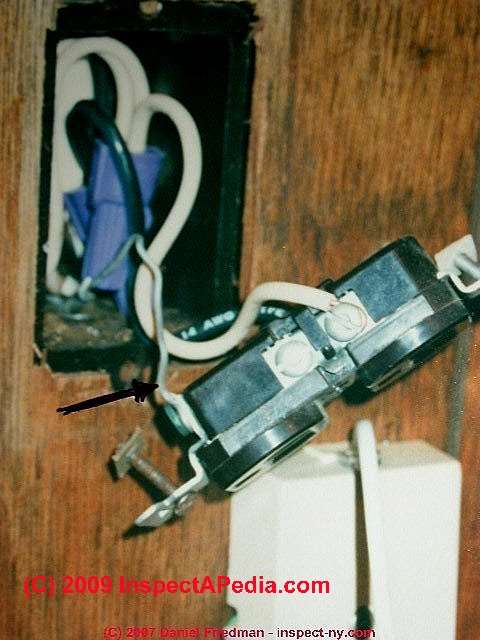
- POST a QUESTION or COMMENT about aluminum electrical wiring in buildings: safety, proper repairs, history, recommendations.
This article describes the importance of including repair of the grounding conductor (ground wire) in buildings where where solid conductor aluminum electrical wiring is being repaired.
This article series describes the acceptable methods to repair aluminum wiring, including which aluminum wire connectors to use for safest results.
InspectAPedia tolerates no conflicts of interest. We have no relationship with advertisers, products, or services discussed at this website.
Do We Need to Pigtail the Ground Wire When Reducing the Hazard of Aluminum Electrical Wiring?
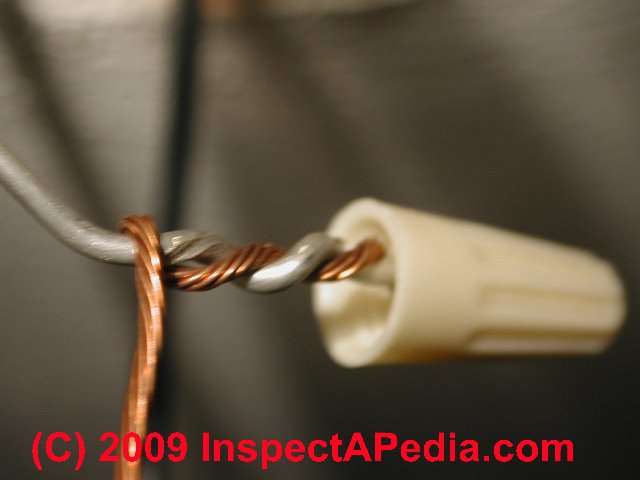
Readers repairing aluminum wiring and faced with limited space in the electrical boxes of an aluminum-wired building ask if it is acceptable to just pigtail the current carrying conductors - the "hot" and "neutral" wires, leaving the aluminum ground wire alone.
Our photo (left) shows an improper aluminum wiring repair - the white twist-on connector is not recommended for this application.
Thanks to Dr. Jess Aronstein for clarifying this question with the comments below.
The electrical ground is part of the electrical safety system and must be capable of carrying current under various fault and malfunction conditions.
The probability of any wire termination or splice of a ground conductor actually carrying substantial current is low relative to the circuit conductors (line and neutral), but not low enough that it can be ignored. That is why modern codes require full-size ground conductors.
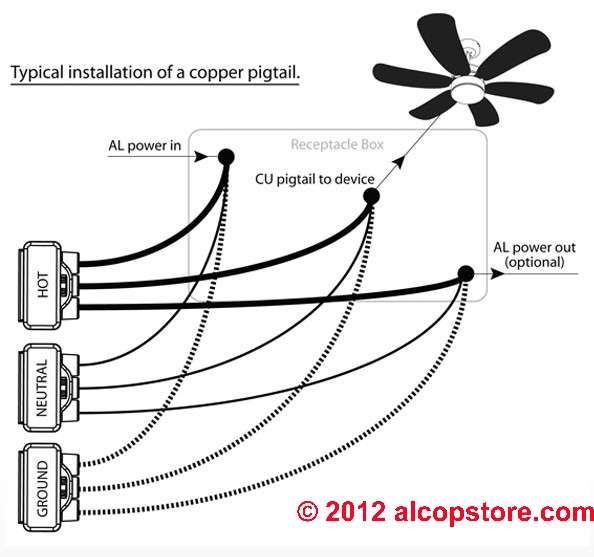
The Installation Instructions for the AlumiConn™ include using copper pigtailing and an AlumiConn connector for the solid conductor aluminum ground wire, handling it just the same as the aluminum hot and neutral wires.
For the specific case shown at left (connection of a ceiling fan), King Innovations points out that ... in the application shown the use of "pigtails" is not required.The aluminum wires and fan can be directly wired to the AlumiConn connector.[7]
However, if the installer is wiring a device such as an electrical switch or receptacle (a more common situation), pigtails would be needed.
Using the AlumiConn for aluminum ground wire repairs
In our version of the AlumiConn™ wiring sketch (left) the incoming solid aluminum ground wire is visible in silver connected to the top terminal in the AlumiConn™ connector - any terminal on the AlumiConn can be used to receive either an aluminum or a copper wire.[7]
Notice that we show two solid aluminum (silver colored) and one solid copper (copper colored ) ground wires leaving the connector.
- An aluminum ground wire entering the receptacle box,
- A copper wire that in the illustration is a ground coming out of the fan assembly, is connected directly to the terminal block.
If instead we were wiring a device, say an electrical receptacle, in our OPINION preferably wire #2 would be a copper pigtail wire connecting from the AlumiConn to the ground connection screw on the receptacle and, if it's a metal junction box, onwards to connect to the box as well, using an approved ground connector such as screws sold for that purpose. - An aluminum ground wire headed for power-out to the next receptacle box in a chain [If this receptacle were the last or only box in the circuit, those "AL power out (optional)" wires would not be present.]
To avoid clutter we didn't color the hot and neutral wires, but the same procedure as described above would apply to those elements of the circuit as well.
The AlumiConn™ connector shown here is used to splice a copper "pigtail" wire together with one or two aluminum wires as a step in reducing the fire hazard associated with aluminum electrical wiring. This connector performs well provided that the wires are properly secured in the connector, and it has been included in the US CPSC recommendations for aluminum wiring repair.
See AlumiConn ALUMINUM WIRE CONNECTORS for a description of how the AlumiConn™ is connected, wired, and torqued.
1950s Fabric-Sheathed Copper Wire, Aluminum Ground Wire
These photographs of fabric and paper-sheathed 14/2 w/g copper wire include what appears to be a solid aluminum grounding conductor, provided courtesy of a NY electrician, via Jess Aronstein.
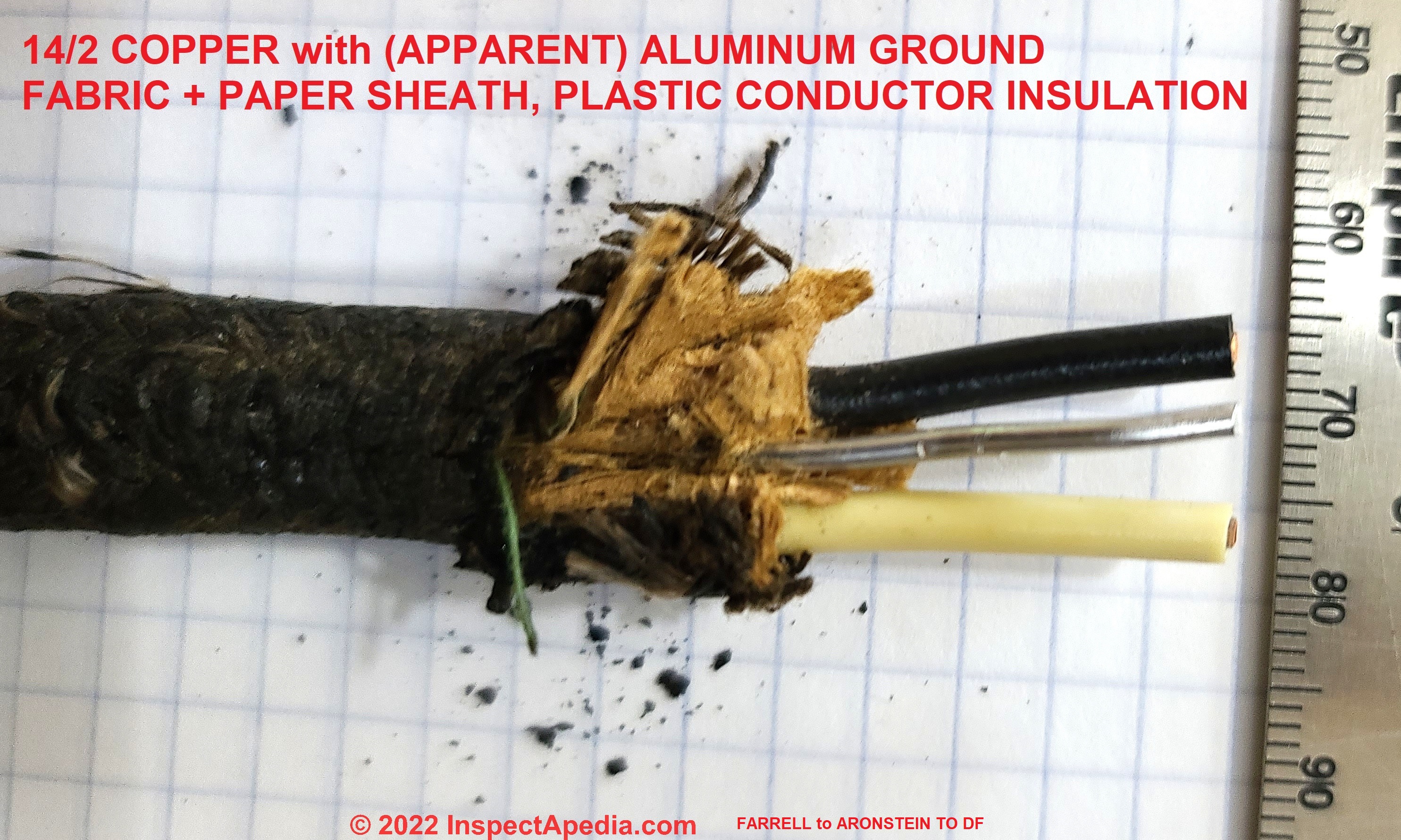
From its physical appearance and choice of materials we think that this wire, made in the U.S. is probably a post-war product from the late 1940s or early 1950s when high-grade or even aircraft-grade aluminum returned to the civilian market.
In the U.S. in the early 1950s, the rising cost of copper compared with more stable aluminum prices led some manufacturers to consider use of aluminum conductors in some applications. (Miles 1951).
It would appear that the wire manufacturer (no brand was found on the cable sheathing) was saving "a few cents per foot" of wire production cost by using the aluminum grounding conductor.
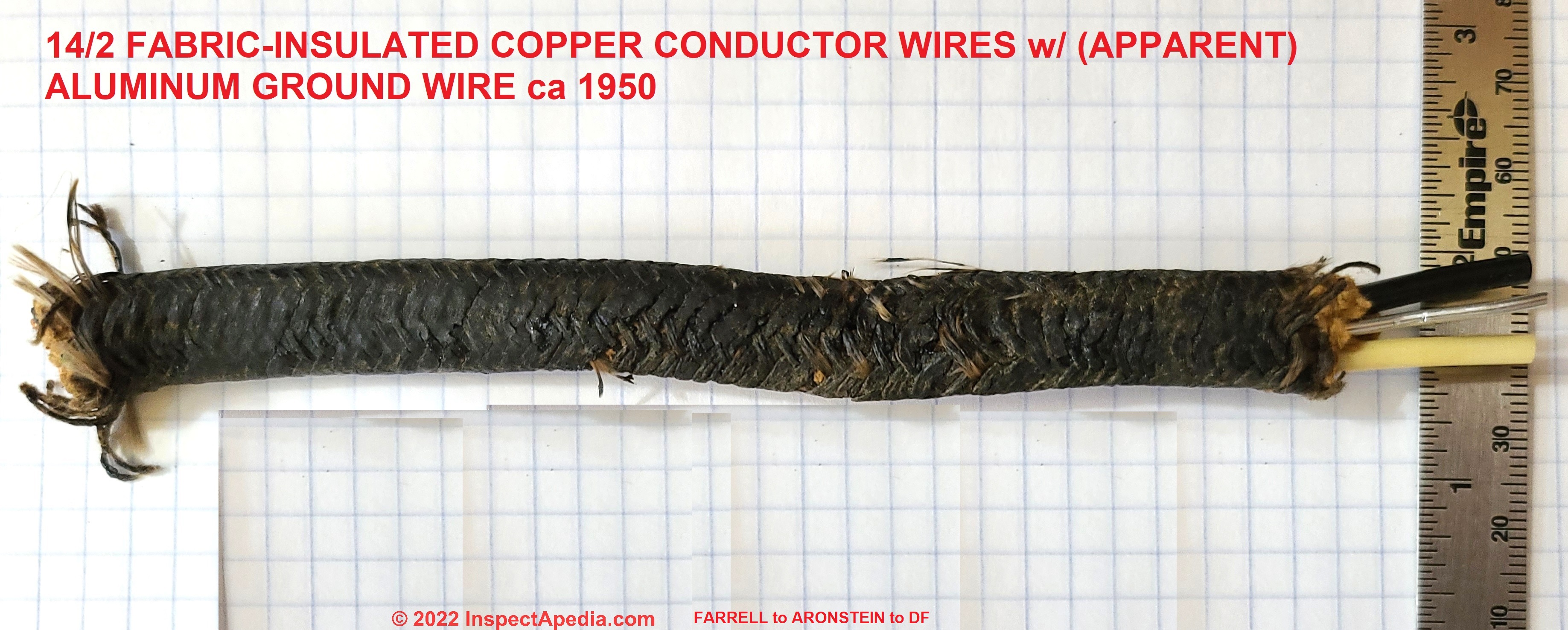
The question of electrical safety or electrical code comment on the use of mixed copper current-carrying electrical wires with an aluminum grounding conductor has not been addressed - we are researching this question. - Ed.
In our subjective analysis performed simply by exposing and bending the silver colored grounding conductor it bends more-easily than steel but was notably more bend-resistant than later aluminum wire products in which all three wires, the conductors and the ground were aluminum.
Also see more about this electrical wire
at FABRIC NMC WIRE INSULATION IDENTIFICATION
Questions regarding electrical code issues are best answered by your local electrical inspection authority, since applicable interpretations vary. In the long run, you should use what is presently listed for the application or what the local electrical inspection authority and your insurer will sign off on.
Because the reader was considering using twist on connectors where the recommended aluminum wiring repair connectors may not fit (not a procedure that we recommend) we strongly advised that he employ the special procedure (wire abrasion under a film of inhibitor, and pre twisting) as described
at REDUCING THE FIRE HAZARDS IN ALUMINUM WIRED HOMES [PDF]
In the financial analysis of the cost of performing a complete and proper repair of aluminum electrical wiring, be sure to include consideration of the possibility that a repair considered to be permanent (CPSC --COPALUM) could have some long-term payback through the value that it adds to the property.
Research on Combined Copper Conductors + Aluminum Ground
- de Araujo, M. M., W. A. Manheimmer, and E. T. Serra. "Corrosion aspects in aluminum electrical conductors." Corrosion Reviews 8, no. 1-2 (1988): 175-198. cf: Housewiring, p. 191. The authors were at CEPEL - Electrical Energy Research Center 21941, Rio de Janerio, Brazil.
- Alshwawreh, Nidal ; Alhamarneh, Baider ; Altwarah, Qutaiba ; Quandour, Shamel ; Barghout, Shadi ; Ayasrah, Osama Electrical Resistivity and Tensile Strength Relationship in Heat-Treated All Aluminum Alloy Wire Conductors
/ Basel: MDPI AG Materials, 2021-10-01, Vol.14 (19), p.5738 - Bergan, Martin D. "Electric connector." U.S. Patent 2,480,280, issued August 30, 1949.
- Durham, Robert A., Stephen J. Szczecinski, and Marcus O. Durham. "Factors impacting selection of grounding and bonding conductors." IEEE Transactions on Industry Applications 56, no. 5 (2020): 4652-4661.
Abstract:
Recent discussions between governmental agencies, engineers, and standards/code making panels have raised the question of the appropriate type of grounding system conductor. What type of conductor should be used in grounding connections? What factors affect the life of grounding conductors? How should grounding conductors be sized?
How do the current standards requirements affect the quality of the ground system? In many cases, the selection of the construction and material conductor to be used is considered a matter of preference. However, the proper selection of the conductor can enhance or degrade system reliability and performance.
This is especially true in critical or high energy applications. The technical factors that go into the selection of a grounding conductor are discussed. Reliable criteria for the selection of the appropriate grounding conductor are developed and presented. - Durham, Robert A., Stephen J. Szczecinski, and Marcus O. Durham. GROUNDING AND BONDING CONDUCTORS: SOLID, STRANDED, BARE OR INSULATED? [PDF] l IEEE, Paper No. PCIC-2018-03." In 2018 IEEE Petroleum and Chemical Industry Technical Conference (PCIC), pp. 19-28. IEEE, 2018.
Abstract: Contents not permitted for public display - Ed. - Efraimsson, Lars, Lars Ingvar Hagman, Ivars Lars Sune Hansson, Hans Christian Andersson, Dietmar Gleich, Anders Jonas Gatu, and Tommy K. Valdemar Asmola. "Grounding conductor, electrical power system and use of grounding conductor." U.S. Patent 10,181,362, issued January 15, 2019.
- Friedrich, Bonwitt Wilhelm. "Aluminum conducting surface treatment." U.S. Patent 2,423,290, issued July 1, 1947.
- Liu, Chang, Ze Xiang, Guo Ma, Haoxia Lei, Fengren Yang, Yang Gou, Xiaojing Huo, Yijun Liu, and Yanchi Li. "Analysis of Replacement for Copper by Common Conductive Materials in Cable Grounding Wire." (2018). [Text of this paper is in Chinese]
Abstract:
In this research, several kinds of common conductive materials were compared with copper on material properties, including conductivity, heat stability, corrosion resistance and mechanical properties.
These results were used to analyze the possibility of replacement for copper by common conductive materials in actual environmental conditions of cable grounding wire.
The results showed that aluminum was the suitable substitute for copper in cable grounding wire. Next to copper, aluminum performed best on most of the material properties and cost performance among the samples.
Due to the lower secondary value of aluminum, it had contributed to decrease the stolen rate of cable grounding wire if the copper was replaced by aluminum.
It also could relieve the pressure of transmission line operation department on protection against burglars and reduce the safe hidden danger indirectly. It had certain research value and social benefits for the application of this result.
Excerpt:
Next to copper, aluminum performed best on most of the … of aluminum, it had contributed to decrease the stolen rate of cable grounding wire if the copper was replaced by aluminum. It … - Mak, Alex. CORROSION OF STEEL, ALUMINUM AND COPPER IN ELECTRICAL APPLICATIONS [PDF] General cable Three Ravinia Drive, Suite 1600, Atlanta, GA 30346 Tel (855) 720-2792 Web: www.stabiloy.com 770 (2002).
- McDonald, F. G. "Discussion on the electrical uses of aluminium." Transactions of the South African Institute of Electrical Engineers 45, no. 6 (1954): 210-211.
- Miles, Lawrence D. MEMORANDUM ON COPPER CONSERVATION Project For Use In Your Wednesday Talk [PDF] Memorandum, Miles to W.A. Sredenschek (23 July 1951). - retrieved 2022/06/25 original source: https://minds.wisconsin.edu/bitstream/handle/1793/3590/84.pdf?sequence=1
Editor's note: W. A. Sredenschek was employed by the General Electric Company where he maintain3d an office at G.E., 1 River Road, Schenectady, N.Y. in the 1950s. Mr. Sredenschek, employed at least by 1940 in GE's Commercial Department, (The New York Times, April 25, 1940) succeeded W.M. Stearns, manager of trade rleations and special contracts, at G.E. in December, 1943. (The New York Times, December 13, 1943, p. 34)
Excerpt:
Because copper in most of our products has at least doubled In cost since design decisions were made while aluminum has increased relatively little and because, in the long rage, aluminum promises to become more plentiful while copper more difficult to obtain, we decided to aggressively examine the practicability of using aluminum instead of copper for our electrical conductors.
We first established that our program would be based upon sound dollar economy, where aluminum will stay because of relative cost even though copper should temporarily become readily available. - PAONE, ANTHONY. "An Alternate to Lead for Telephone Cables." Corrosion 6, no. 2 (1950): 46-50.
- Sullivan, Wellington B. "Electrical connector." U.S. Patent 2,695,990, issued November 30, 1954.
- Wang, Jun ; Xu, Hong ; Su, Tiexiong ; Zhang, Yi ; Guo, Zhen ; Mao, Huping ; Zhang, Yangang Fretting Fatigue Experiment and Analysis of AlSi9Cu2Mg Alloy / Switzerland: MDPI AG Materials, 2016-12-05, Vol.9 (12), p.984-984
Detailed Advice for Aluminum Ground Wire Connections during Aluminum Wire Repair in Buildings
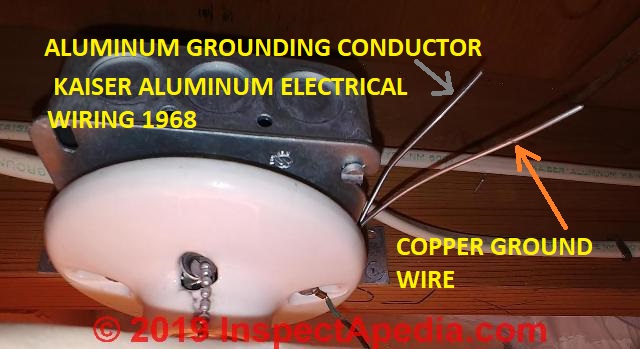 Photo of copper and aluminum ground wires left sticking out of an electrical box contributed by InspectApedia.com reader Christoph 2019/03/28
Question: why were the copper and aluminum wires left sticking out of the electrical boxes?
We moved into a home that was built in 1968 an has aluminum wiring. The boxes in the house are all metal. Every box has a ground wire that is wrapped on a green screw in the back of the box but then the ground wires sticks out of the box about 5".
Every box in the house has this. Where there is drywall the ground wire comes out of the box and runs behind the drywall.
Do you know what the reason for this might be?
Reply:
I don't know why someone would have left ground wires running wild such as in your photo unless it was to warn any observers that solid conductor aluminum electrical wiring is present.
I have on occasion used grounding wire clips that bond an electrical ground wire to the side of a metal electrical box as a listed alternative to connecting the metal box to the grounding conductor, and I could fantisize that a less-trained electrician might be trying to "clamp" the two ground wires against the metal box by pinching them against the box edge by pressure from the ceramic light fixture, but doing so would be improper, unreliable, and unsafe.
Watch out: because what you show is in my opinion a sign of abnormal and perhaps improper electrical wiring in the first place and / or improper or abnormal aluminum wiring repairs, I would have an inspection and further proper repairs done by a licensed electrician who is specifically familiar with the proper repair of aluminum wiring.
Watch out: improperly-"repaired" aluminum wiring, for example using the wrong connector type for splices or connections to devices, can actually increase the risk of a building electrical fire.
Proper ground wire connectors for aluminum wiring systems
Is it necessary to use a rated "pigtail" connector, such as
the AlumiConn
or COPALUM connectors,
on the grounding circuit given that the ground only carries current if and when a fault occurs? It would save considerable money, and space in the fixture box, to use those rated connectors only on the hot and neutral wires which regularly carry current.
The question of how to handle the grounding conductor in aluminum wired homes arises from time to time, especially because in some installations of crowded wiring in junction boxes, people want to leave out the ground pigtail connection. Dr. Jess Aronstein, expert on aluminum wiring failures, testing, and repair procedures, in discussing this topic, has noted that:
The ground is part of the electrical safety system and must be capable of carrying current under various fault and malfunction conditions. The probability of any wire termination or splice of a ground conductor actually carrying substantial current is low relative to the circuit conductors (line and neutral), but not low enough that it can be ignored. That is why modern codes require full-size ground conductors.
The questions regarding code issues are best answered by your local electrical inspection authority, since applicable interpretations vary. In the long run, you should use what is presently listed for the application or what the local electrical inspection authority and your insurer will sign off on.
The US CPSC publication on ALUMINUM ELECTRICAL WIRING specifically says that the main criteria to be met by such a repair method are:
- It must permit the repair of every connection to, or splice between, aluminum wire in the home;
- The repaired connections must be permanent but must result in a system that can be maintained without the need for special switches, wall outlets or other connectors;
- The repair technique must be practical for use in an occupied and furnished home.
In our [DF] non-nexpert-opinion, even though ground wires do not normally carry current, mechanical stresses and potentially loose connections remain, leading to a view that it may indeed be preferable to use a copper pigtail when connecting an aluminum grounding conductor to a device such as an electrical receptacle or light switch, and as well when making a connection between the grounding conductor and a metal junction box, say using a grounding screw sold for that purpose.
Question: Can I Use Twist-on Connectors for Aluminum Ground Wires?
If you do use any twist-on connectors (we and the US CPSC specifically do not recommend this approach, including we do not recommend use of the Ideal-65 "twister" purple twist on connector sold for aluminum wiring repair), we strongly advise that you employ the special procedure (wire abrasion under a film of inhibitor, and pre twisting) as introduced at
https://inspectapedia.com/aluminum/Aluminum_Wiring_Risk_Reduction.php and described in more detail in the
report "Reducing the Fire hazard...." found at https://inspectapedia.com/aluminum/alreduce.pdf
In the financial analysis of the cost of aluminum wiring repair for large buildings, it is important to consider the possibility that a repair considered to be permanent (COPALUM or the Alumiconn) could have some long-term payback through the value that it adds to the property.
Best Practices Guide to Repairing Aluminum Ground Wire Connections
All aluminum wire conductors should be repaired, including the aluminum ground wire.
Since the electrical ground wire is not normally carrying current it may be that aluminum ground wire connections might be in better shape and at lower risk of failure than other wires in an AL wired circuit. BUT
- One of the mechanisms that leads to poor aluminum ground wire connections is mechanical or other disturbances of the electrical device such as an electrical receptacle or switch or fixture. Even though it is not normally conducting current, the ground wire connection at the device is also subject to deterioration from these other forces.
- Since at the very time that a ground wire is going to be called-on to conduct current is an emergency, it seems to me foolish to leave that wire in any doubt whatsoever.
Two Connectors Recommended for Repairing Aluminum Wiring, including Ground Wiring
- The AMP/TYCO COPALUM crimp connector repair consists of attaching a piece of copper wire to the existing aluminum wire branch circuit with a specially designed metal sleeve and powered crimping tool.
The metal sleeve is called a COPALUM parallel splice connector and is manufactured only by AMP Incorporated. This special connector can be properly installed only with the matching AMP tool. This tool makes a permanent connection that is, in effect, a cold weld. An insulating sleeve is placed around the crimp connector to complete the repair. - The CPSC-sponsored research, laboratory tests, and demonstration projects identified only one method of repairing existing aluminum wire circuits which meet these criteria.
That repair is known as the crimp connector repair. But that CPSC publication was written before the AlumiConn was listed - the AlumiConn connector is also an acceptable repair. (just to be clear)
Question: How Can we Address the Problem of Limited Space in the Electrical Junction Box?
Two comments about the space problem inside the junction box:
NEC has made an exception to standard cu. in. space requirements per number of conductors to make it a little easier for an AL wire repair to meet code
When we had a space problem in junction boxes at a rewiring job we purchased box extenders - some suppliers call them "sidecars" that allowed me to extend the size of each metal junction box in the building by removing the exposed side plate of the box and screwing on the extender that gave a few more cu. in. of working space to push wires back into the box.
This might mean cutting and patching drywall wherever this was needed at receptacles and switches.
At an actual 4" square junction box there are also box extenders that increase the total box depth - but that fix means loosening and then re-securing the box so that its face remains flush if it's showing in an interior space. In an attic or basement or other unfinished it should be possible to extend the box sizes without the cosmetic repair issue.
Another approach could be thinner (front to back) receptacles. They do vary a bit from brand to brand and model to model.
Space taken up by aluminum wiring repair connectors
The Alumiconn (recommended) is not much different from the Ideal #65 twist on connector (not recommended) in the volume that it takes up, provided that the wires are bent appropriately.
Solutions to the problem of jamming those additional connectors into an existing electrical box are
at ALUMINUM WIRE REPAIR SPLICE SPACE
Just tighten the existing aluminum ground wire connections?
A general worry is that whenever we do any repair on a building safety topic that is less than the recommended or optimum procedures, the risk picture is foggy - people think that the issue has been "fixed" so they forget about it - which can lead to someone ignoring danger signals and later having a problem.
Question: What About Other Aluminum Wire "repair" Products such as CO/ALR devices?
Please see ALUMINUM WIRING REPAIR NOT-Recommended for details.
Question: Do the grounds on an electrical receptacle also need to have an AlumiConn Connector or Just the Hot and Neutral
When using alumiconn connectors to pigtail plugs and switches, do the grounds on a plug also need to have a AlumiConn as well or just the hot and neutral? Thankyou! J.H.
Reply:
Basically, yes you need to use a connector for EVERY wire that enters as aluminum and connects to something else, including the aluminum ground wire.
So the aluminum ground wire that enters an electrical receptacle box gets pigtailed to a short length of copper wire (the pigtail). That copper pigtail in turn completes the connection of the incoming ground to the electrical receptacle "box") itself as well as to the electrical receptacle - the device you refer to as many do as "the plug".
If your receptacle box is not the last one in a daisy-chain of receptacles, you'll see that there is (or should be) also an aluminum ground "leaving" the receptacle box and heading for the next box in the chain. You should not need an additional copper pigtail for that connection: each AlumiConn terminal block provides three points of connection.
So as you'll see in King's illustration (reproduced with color cues on our web article), the three connections in the AlumiConn used to wire the ground will be used to receive (one-wire each) the following:
- The incoming aluminum ground conductor wire arriving from the electrical panel
- The copper pigtail that connects to the electrical receptacle ground screw and if the receptacle box is metal, also to the metal box using an approved clip or screw
- The outgoing aluminum ground conductor wire heading to the next box in the chain
Reader Comments, Questions & Answers About The Article Above
Below you will find questions and answers previously posted on this page at its page bottom reader comment box.
Reader Q&A - also see RECOMMENDED ARTICLES & FAQs
On 2021-05-31 by inspectapedia.com.moderator (mod)
@Daris,
You wouldn't. One cannot safely try to connect more wires to the AlumiConn connector than the manufacturer permits. Instead you'll need to use multiple connectors; perhaps the simplest is to use two a 3-port AlumiConn (2 aluminum + 1 copper pigtail) along with a two-port AlumiConn (1 aluminum & 1 copper pigtail)
The two copper piggies then connect to the grounding conductor and if present, the metal box.
On 2021-05-31 by Daris
How would i go about splicing a copper "pigtail" wire together with three aluminum ground wires using the Alumiconn 3 port or 2 port connectors?
On 2019-03-28 - by (mod) -
ChristophTo have space for a more-detailed reply I repeat your question (and photo) in the article above and answer it.
Please take a look and let me know what questions remain.
Also I'd like to see more photos of this wiring situation and when you bring an electrician back to inspect and correct this wiring I'd like to see photos of just what was done inside each electrical box to handle or connect aluminum and copper wires together and to the device (such as a light fixture).
Watch out: there are fire hazards at risk with improper aluminum wire repair.
You may need to clear your browser cache and refresh the page to see our updates and your question in the article above.
On 2019-03-28 by Christoph
AUTHOR:Christoph (no email)
COMMENT:We moved into a home that was built in 1968 an has aluminum wiring. The boxes in the house are all metal. Every box has a ground wire that is wrapped on a green screw in the back of the box but then the ground wires sticks out of the box about 5". Every box in the house has this. Where there is drywall the ground wire comes out of the box and runs behind the drywall. Do you know what the reason for this might be?
On 2017-12-29 - by (mod) -
RonaldA 2/0 Aluminum SEC will support a 150A service entry.
A 150A service or service disconnect would use a minimum of #6 copper or #4 aluminum grounding conductor.
Also see NEC 250.122(B). If the ungrounded conductors of the circuit are increased to allow for voltage drop, or because of manufacturer’s instructions, the equipment grounding conductor must be increased in size by the same proportion that the ungrounded conductors have been increased. For example, if the size of the ungrounded conductors is increased by 25%, the size of the equipment grounding conductor must be increased by 25%.
See the table attached
IMAGE LOST by older version of Clark Van Oyen’s Comments Box code - now fixed. Please re-post the image if you can. Sorry. Mod.
On 2017-12-29 by Ronald G Dewald
service supply wiring aluminum 2/0 what is the minimum wire size of aluminum for grounding conductor
On 2016-03-23 - by (mod) -
THANKS Avie.On 2016-03-22 by Avie
The SK73004 seems to have risen in price considerably. I found a HUSKY 1/4" Female Hex Torque Driver Screwdriver online at Home Depot and picked it up at a local store. The cost in the Dallas area was $59.97 plus tax. Their Item # is: 1000-030-971 and the Mfg. SKU: 037103 27650 6. It is made in Taiwan. I suspect if I am gentle with it, their will be no trouble. It has the pounds per inch settings required to install the AlumiConn.
...
Continue reading at ALUMINUM WIRING IDENTIFICATION or select a topic from the closely-related articles below, or see the complete ARTICLE INDEX.
Or see these
Recommended Articles
- ALUMINUM WIRING HAZARDS & REPAIRS - home
- FABRIC NMC WIRE INSULATION IDENTIFICATION
- GROUND SYSTEM INSPECTION - home
Suggested citation for this web page
ALUMINUM WIRE GROUNDS at InspectApedia.com - online encyclopedia of building & environmental inspection, testing, diagnosis, repair, & problem prevention advice.
Or see this
INDEX to RELATED ARTICLES: ARTICLE INDEX to ELECTRICAL INSPECTION & TESTING
Or use the SEARCH BOX found below to Ask a Question or Search InspectApedia
Ask a Question or Search InspectApedia
Try the search box just below, or if you prefer, post a question or comment in the Comments box below and we will respond promptly.
Search the InspectApedia website
Note: appearance of your Comment below may be delayed: if your comment contains an image, photograph, web link, or text that looks to the software as if it might be a web link, your posting will appear after it has been approved by a moderator. Apologies for the delay.
Only one image can be added per comment but you can post as many comments, and therefore images, as you like.
You will not receive a notification when a response to your question has been posted.
Please bookmark this page to make it easy for you to check back for our response.
Our Comment Box is provided by Countable Web Productions countable.ca
Citations & References
In addition to any citations in the article above, a full list is available on request.
- [1]AlumiConn [Website: AlCopStore.com ] ™ AlCopStore.com
223 Salt Lick Road, #279,
St. Peters, MO 63376
Tel: 866-826-2256, Fax: 636-754-0500, Email Sales: pking@AlCopStore.com, Email General Inquiry: info@AlCopStore.com - [2] "Repairing Aluminum Wiring," [As updated 2011] U.S. Consumer Product Safety Commission Publication available online
- [3] "Record of Commission Action, Commissioners Voting by Ballot", CPSC Publication No. 516, Repairing Aluminum Wiring (original version op.cit.), (Briefing package dated March 15, 2011), Quoting:
The Commission voted unanimously (5-0)·to approve republication of CPSC Publication No. 516, Repairing Aluminum Wiring, with the explicit recognition that the COPALUM and AlumiConn connectors currently are the only products that meet the agency's standards to prevent aluminum wire fire hazards
Copy on file as /aluminum/Pub516_Alumi_Conn.pdf - [4] Dr. Jess Aronstein, protune@aol.com is a research consultant and an electrical engineer in Schenectady, NY. Dr. Aronstein provides forensic engineering services and independent laboratory testing for various agencies. Dr. Aronstein has published widely on and has designed and conducted tests on aluminum wiring failures, Federal Pacific Stab-Lok electrical equipment, and numerous electrical products and hazards. See ALUMINUM WIRING BIBLIOGRAPHY and see FPE HAZARD ARTICLES, STUDIES for examples.
- [5] "The Influence of Corrosion Inhibitor and Surface Abrasion on the Failure of Aluminum-Wired Twist-on Connections", Aronstein, J.; Campbell, W., Components, Hybrids, and Manufacturing Technology, IEEE Transactions on Volume 7, Issue 1, Mar 1984 Page(s): 20 - 24
- [6] Thanks to reader Thomas Kremer for suggesting clarification to this topic 08/09
- [7] Personal communication, Email, P. King to D Friedman, 3/10/2012 [copy on file AlumiConn_PK120310.pdf].
- Our recommended books about building & mechanical systems design, inspection, problem diagnosis, and repair, and about indoor environment and IAQ testing, diagnosis, and cleanup are at the InspectAPedia Bookstore. Also see our Book Reviews - InspectAPedia.
 The Aluminum Wiring Information Website Aluminum Wiring Hazards and Repairs: in-depth info, photos, documents. Main Page.
- 05/21/2007 Reducing the Fire Hazards in Aluminum-Wired Homes, [.pdf document], Jess Aronstein, Ph.D., 21 May 2007. This document answers most technical questions about the hazards and remedies of aluminum electrical wiring and includes a report on independent test results of alternative products and methods for repairing aluminum wiring. Some of the sections of this very thorough document are listed below:
- 02/09/2006Reducing the Fire Hazards in Aluminum-Wired Homes, Jess Aronstein, Ph.D., This older version of the above document also answers most technical questions about the hazards and remedies of aluminum electrical wiring
but lacks latest repair product testing such as the AlumiConn connector discussed above. Some of the sections of this very thorough document are listed below:
[UPDATED-DF 03/08/2003, Edits-df 02/09/2006] - In addition to citations & references found in this article, see the research citations given at the end of the related articles found at our suggested
CONTINUE READING or RECOMMENDED ARTICLES.
- Carson, Dunlop & Associates Ltd., 120 Carlton Street Suite 407, Toronto ON M5A 4K2. Tel: (416) 964-9415 1-800-268-7070 Email: info@carsondunlop.com. Alan Carson is a past president of ASHI, the American Society of Home Inspectors.
Thanks to Alan Carson and Bob Dunlop, for permission for InspectAPedia to use text excerpts from The HOME REFERENCE BOOK - the Encyclopedia of Homes and to use illustrations from The ILLUSTRATED HOME .
Carson Dunlop Associates provides extensive home inspection education and report writing material. In gratitude we provide links to tsome Carson Dunlop Associates products and services.
 | HOME | ABOUT | ASK a QUESTION | CONTACT | CONTENT USE POLICY | DESCRIPTION | POLICIES | PRIVACY | |
| © 2024 - 1985 Publisher InspectApedia.com - Daniel Friedman | |||||||||